
By China Made & Tech Team
XPENG Robotics’ announced US$900 million round changes the supplier file. It does not change the deployment verdict. The public transaction record describes conditional Dogotix subscriptions of approximately US$900 million and an implied US$6.3 billion post-transaction valuation under stated assumptions. The same record says completion remains subject to conditions and may or may not proceed. That is a meaningful capital and governance event. It is not a published proof that an IRON humanoid robot has cleared a factory task, a service task, a safety case, a field-support obligation, or a buyer’s return-on-investment threshold.
That distinction is not pedantry. In an embodied-AI supplier file, capital answers a different question from a deployment record. Capital can make it more plausible that a vendor can keep funding engineers, data collection, production tooling, parts, field teams, and commercial operations while a product matures. A deployment record answers whether one defined configuration has performed one defined task, in a specified environment, under an agreed operating and support model. Neither answer can substitute for the other.
XPENG says the funds will support robotics software and hardware R&D, Physical AI model work, data generation, mass-production facilities, and global commercial expansion. It also says IRON is expected to enter mass production by the end of 2026, with initial use at XPENG stores and campuses before intended deliveries in China and overseas in 2027. Those are useful, attributable statements from the company’s financing announcement. A buyer should read them as a roadmap and a continuity signal—not as a completed third-party acceptance file.
This article is for a sourcing, operations, robotics, or product leader asking a narrow question: what does the financing improve in the diligence record, and what evidence must still exist before IRON is treated as a candidate for a real task? The answer is a chain: legal supplier and closing status; exact offered configuration; production and quality controls; task-level evidence; software and data control; service and spares; and a credible exit or replacement path.
The first reading: an announced financing is not one undifferentiated number
The headline figure is easy to repeat and easy to flatten. The more useful reading starts with the transaction structure.
XPENG’s Hong Kong disclosure says that, on August 24, the company, Dogotix, related subsidiaries, investors, and executive subscribers entered into a share-purchase agreement. The disclosed structure comprises US$200 million from XPeng Dogotix, US$600 million from the investors, and US$100 million from executive subscribers. The document also describes potential additional investment and warrants separately; those are not the same thing as the stated approximate US$900 million aggregate. It calculates an implied pre-transaction valuation of US$5 billion and an implied post-transaction valuation of US$6.3 billion under the assumptions set out in the filing, including the specified equity-incentive-plan treatment and excluding the possible additional investment and warrant exercises. Those details are in the listed-company announcement, not an inference from the press coverage.
| Public record | What it establishes | What it does not establish |
|---|---|---|
| Conditional subscriptions of about US$900 million | A disclosed financing structure and a larger capital base if the stated closing conditions are met | Cash received, cash spent, production output, or a delivered robot |
| US$600 million from investors, US$200 million from XPeng Dogotix, and US$100 million from executive subscribers | The disclosed composition of the announced aggregate | A buyer’s conclusion about investor diligence, product quality, or performance |
| Implied US$6.3 billion post-transaction valuation | A valuation calculation under the filing’s assumptions | IRON’s economic value for a particular operation or its future market value |
| XPENG control and continued consolidation under the stated scenario | A governance point to confirm in supplier diligence | The identity of the final contracting, service, data, or warranty counterparty |
| Closing conditions and redemption rights | That the corporate structure has conditions and risk allocation a buyer should track | That the financing is already closed or that those terms protect a customer’s operating continuity |
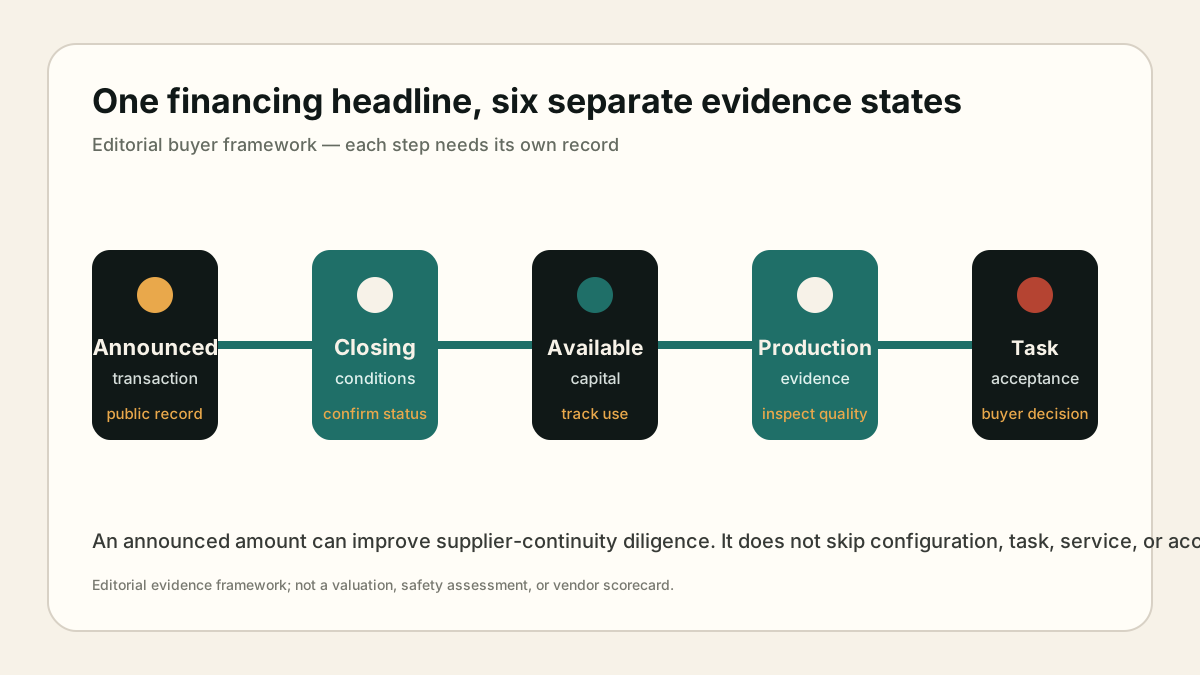 Editorial evidence map based on the public financing record. It separates evidence categories; it does not assess XPENG’s valuation or certify IRON.
For example, the announcement says subscription completion is conditional. That is a live diligence fact. It means the right line in a supplier briefing is not “Dogotix has received US$900 million and is fully funded.” It is closer to: “Dogotix has announced conditional subscriptions totaling approximately US$900 million; closing status, legal entity, ownership, and available capital should be reconfirmed at the point of commercial commitment.” That is still a positive change in disclosure quality. It is also more accurate.
The US$6.3 billion figure is a transaction valuation calculation, not a robot score. It cannot tell an operations team whether a robot can handle exceptions, work around people, recover from a failed grasp, or run through a shift; it cannot tell procurement whether support and replacement will work. Disclosure can improve a supplier file without becoming a task-performance certificate—the distinction also matters in the buyer-governance reading of Unitree’s listing debut.
What capital can improve in a humanoid supplier file
Humanoid robotics is capital intensive in a way that makes a large financing event commercially relevant even before a product has broad field evidence. The work is not limited to assembling a mechanical body. A supplier may need to fund hardware iterations, actuator and hand supply, validation equipment, production fixtures, on-robot compute, training data, model evaluation, integration software, safety engineering, remote operations, spares, service tools, and an organization that can support customers after a pilot ends.
XPENG explicitly says the announced proceeds are intended for software and hardware R&D, model training and iteration, high-quality data generation, end-to-end mass-production facilities, and global commercialization. That stated allocation maps reasonably onto the stages a buyer would worry about: can the product continue to change; can it be made consistently; can it learn from real use; and can the supplier support a commercial route? It is appropriate to record those as areas the company says it intends to fund through the August announcement.
But “intended to fund” is the operative phrase. Funding can resource a gate without proving the gate has opened. A buyer can make this visible with a simple working distinction.
| Delivery gate | How capital could help | Evidence still needed from the supplier and task owner |
|---|---|---|
| Product engineering | More runway for hardware, controls, models, and test cycles | Exact hardware revision, bill of materials boundary, released software/model version, known limitations, and change history |
| Production readiness | Tooling, quality systems, capacity preparation, and supplier development | Actual production state, inspection plan, traceability, yield/rework definitions, spare-parts commitments, and delivery schedule for the offered configuration |
| Data and model development | Data collection, training infrastructure, model iteration, and evaluation work | What data is collected at the buyer site, who controls it, retention and access rules, validation before release, rollback, and the effect of updates on the task |
| Task integration | Application engineering, end effectors, fixtures, systems integration, and training | Task boundary, baseline process, site constraints, exception handling, operator involvement, and test protocol |
| Field support | Service people, diagnostic tools, parts inventory, and operating processes | Named support owner, response path, spare lead times, maintenance plan, escalation, and contractual commitments |
| Commercial continuity | Working capital, governance, and a longer planning horizon | Legal counterparty, closing status, ownership changes, service survival, IP/data rights, termination, and replacement/exit arrangements |
The useful position is: capital matters as one precondition for continuity; deployment evidence is the decision record for the work. Finance can validate entity and closing; technical, operations, and commercial owners still need to own configuration, task, safeguards, support, and exit.
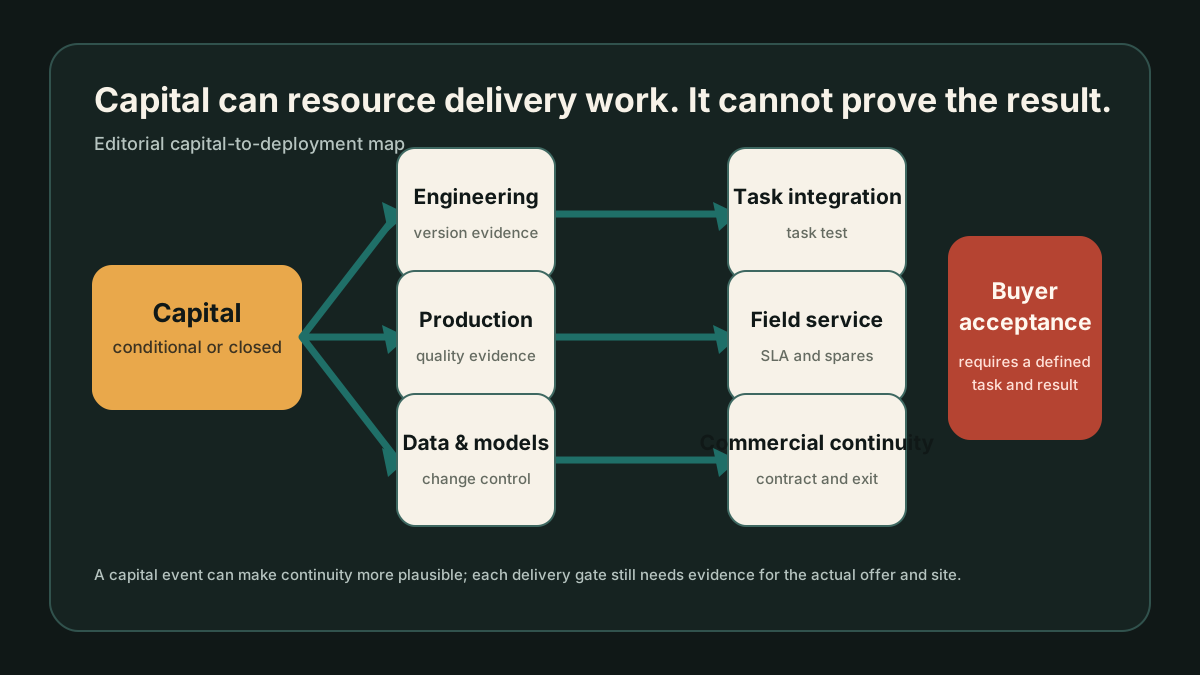 Editorial capital-to-deployment map. Funding can resource work across these gates, but each gate needs its own evidence for the offered configuration and site.
Why the IRON roadmap is useful—and why it is still a roadmap
XPENG’s public sequence is specific enough to be commercially relevant. In the financing release, the company says IRON is expected to enter mass production by the end of 2026; it describes initial commercial deployment at XPENG stores and campuses, then an official launch and deliveries in China and overseas in 2027. This is more useful than a broad promise that a humanoid robot will be “commercial soon.” It names an order: production target, own-site use, then wider delivery. The company’s stated timetable should be preserved in the supplier file with its attribution and future tense intact.
What does that establish?
It establishes that XPENG is describing a staged commercialization route. Own-site use may give the company a controlled early-learning environment, while a 2027 external delivery discussion remains a future commercial milestone rather than present-day availability or acceptance.
What does it not establish?
It does not identify the exact IRON configuration that would be offered to an external buyer. It does not name a third-party customer task, the operating conditions, the test duration, the intervention model, the success metric, the safety functions, the maintenance plan, or a customer acceptance decision. Nor does it document whether a service or campus use case will transfer to a factory, a warehouse, a retail site, or another buyer’s workflow. A guide robot, a visitor-interaction system, and an inspection assistant may share a body but not a task, an end effector, a risk model, a network boundary, or an economic case.
This matters because the language of “initial deployment” can lead readers to skip a category. An own-site planned deployment is not the same as a released third-party deployment. It may be a sensible intermediate stage. It may be an important data-collection and operating step. But it should be called what it is: a company-stated planned stage in the company’s route to a wider market.
The same care applies to older partnership language. At its 2025 AI Day, XPENG said IRON would prioritize commercial scenarios such as guided tours, shopping guidance, and traffic diversion, and it said Baosteel would become an ecosystem partner to explore applications including industrial inspection. That is an informative example of a possible application direction. The operative word is explore. The AI Day release does not provide a public IRON task protocol, a measured industrial result, a support record, or a completed buyer acceptance decision. Calling it an industrial deployment would erase the exact distinction a buyer needs.
The discipline has a useful consequence: no one needs to claim that the Baosteel exploration is insignificant. Exploration is how many serious industrial applications begin. The buyer simply needs a different evidence packet before moving from exploration to a purchase, a production release, or a scale commitment. That packet should state the current configuration, the work cell, task inputs, task outputs, exception path, test design, intervention burden, measurable performance, safeguard ownership, support boundary, and acceptance outcome.
This is the commercialisation ladder developed in the site’s guide to Chinese humanoid robots: a visible product, a stated production objective, a supervised or controlled pilot, and an accepted work system are related stages, not interchangeable labels. The distinction lets a buyer take an early-stage supplier seriously without pretending the later stages are already complete.
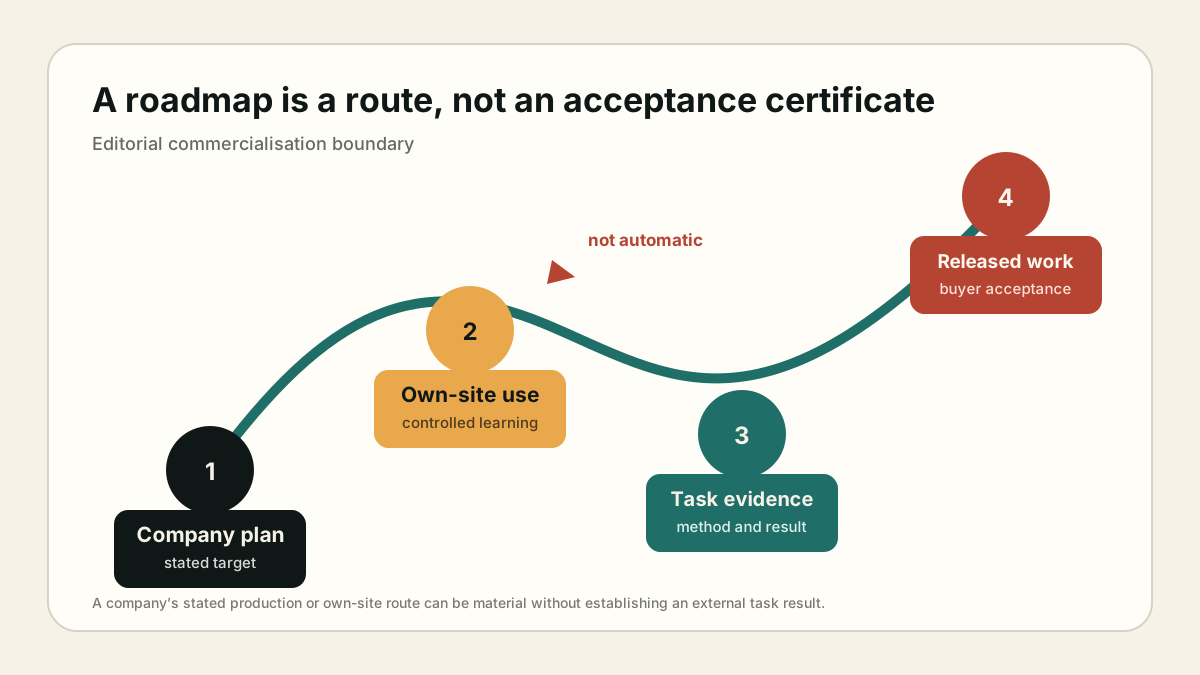 Editorial commercialisation boundary. A stated route or own-site use can be material without establishing an external task result.
A shared Physical AI platform does not transfer a deployment result
XPENG presents its vehicles, Robotaxi, humanoid robots, and flying-car work as parts of a shared Physical AI effort. That is an interesting architectural and organizational claim. It may matter for hiring, software reuse, data practices, chips, simulation, and the company’s ability to spread research investment across product lines. It can also make a supplier’s story more coherent than a standalone hardware demonstration.
It is still not a shortcut around task evidence.
XPENG’s May release says its first mass-produced Robotaxi shares the same VLA 2.0 model foundation as IRON and its flying car. The release also says the Robotaxi would begin pilot operations to validate technical viability, user acceptance, and the complete business model. In other words, even the Robotaxi announcement distinguishes a mass-produced vehicle from the later operating and acceptance questions for that vehicle’s service.
That distinction should become stricter, not looser, when moving from Robotaxi to a humanoid. A road-going vehicle and a bipedal robot differ in physical form, motion, contact, workspace, payload, human proximity, failure modes, duty cycle, sensing, actuation, operational supervision, task specification, and site integration. Shared model lineage can be relevant to an R&D discussion; it cannot establish that one product has passed the other’s safety case or operating test.
The same is true for XPENG’s automotive manufacturing background. Automotive experience may be a reason to ask better questions about production systems, quality disciplines, supplier relationships, controls, and scale. It does not prove that a humanoid assembly process is mature, that a robot can operate autonomously in a new environment, or that a factory will accept it for a specific task. The supplier should show the comparable process, rather than ask the buyer to infer it from a related business.
Platform synergy is a hypothesis about how a company may build or integrate; performance transfer is evidence that a particular configuration performs a particular job. The first can shape questions. The second is what the buyer needs before acceptance.
Independent sector context points in the same direction without making an IRON-specific judgment. Interact Analysis has described sharp production growth while distinguishing it from autonomous, commercially viable deployment. Associated Press reporting likewise discusses momentum alongside commercialization and application constraints. Neither is an IRON test.
That is why the right question is not “Does XPENG have a strong Physical AI story?” The right question is “For our task, what parts of that story are directly evidenced in the offered configuration, and what parts remain a supplier hypothesis?”
The public task record a buyer would need—and the record this article did not find
The reviewed public material gives a useful transaction record, company plans, architecture claims, and sector context. It does not, within this article’s source scope, create a complete IRON task-and-lifecycle record for a buyer.
That sentence has a deliberately narrow meaning. It does not mean that IRON cannot perform a task, that XPENG lacks internal test data, or that a future record will not exist. It means the sources reviewed here did not jointly identify all of the information needed to report a particular deployment as established fact: a current offered configuration; a named task; a task environment; a test protocol; a time period; intervention or supervision conditions; results; safety controls; an economic boundary; support ownership; and an acceptance decision.
Searches did surface future-facing own-site plans and the Baosteel exploration language. They did not supply that combined public bundle. The correct editorial response is not to invent an answer from absence. It is to convert the missing bundle into an evidence request.
China’s 2026 public policy language is useful here because it names the right category of fields without validating any vendor. The joint MIIT/SASAC real-world training notice says user units or third parties should establish scenario-specific test procedures and pass conditions. It calls for evaluation of real task success, efficiency improvement, safety and reliability, and economic feasibility, followed by an application-validation report before regular deployment. The June 2026 notice is a programme record, not a safety standard, contract template, or XPENG certificate. But it captures the basic idea: a deployment claim needs a task, a method, outcomes, and a release decision.
A buyer could ask for the following file before treating an IRON proposal as more than a candidate system.
| Evidence card | Questions that make it usable | Why it cannot be replaced by the financing announcement |
|---|---|---|
| Offered configuration | Which body, hands, sensors, compute, battery, tooling, firmware, model, and optional equipment are included? Which revision is being quoted? | Capital does not identify the exact machine or software a buyer will receive. |
| Task definition | What object, action, start state, end state, cycle, variation, environmental boundary, and exception set are in scope? | A general-purpose claim cannot define a production or service task. |
| Baseline and success measure | What does the current process achieve on output, quality, time, labor, rework, ergonomics, and exceptions? What counts as pass, fail, or no decision? | A valuation does not provide a task baseline or an economic denominator. |
| Test method | How long will the test run? How are changes logged? Who observes? Which cases are excluded? How are failures and retries counted? | A product demonstration can be scripted without answering repeatability. |
| Intervention record | When does a person teleoperate, reset, rescue, select an object, approve a decision, or take over? Is the intervention counted and categorized? | “Autonomous” cannot be inferred from a product category, a model name, or a video. |
| Safeguard and operating boundary | Who owns hazard analysis, physical safeguards, emergency stop behavior, access control, training, incident handling, and the release authority? | Funding does not produce a site-specific safety case. |
| Software and data control | What is the deployed version? What data leaves the site? Who can update the system? What is validated before release? What is the rollback route? | A shared model foundation does not define change control for a buyer site. |
| Service and spares | Who supports the customer? Where are parts held? What is the response process? What is included, excluded, and measured? | A corporate financing can improve continuity but is not an SLA. |
| Commercial and exit file | Who contracts, invoices, owns the data, carries insurance if relevant, accepts risk, terminates, removes equipment, and supports replacement? | Corporate control and customer contract rights are separate questions. |
| Acceptance decision | Who signs off, against which evidence, with what conditions, and what happens if the task later changes? | A roadmap is not a buyer’s release decision. |
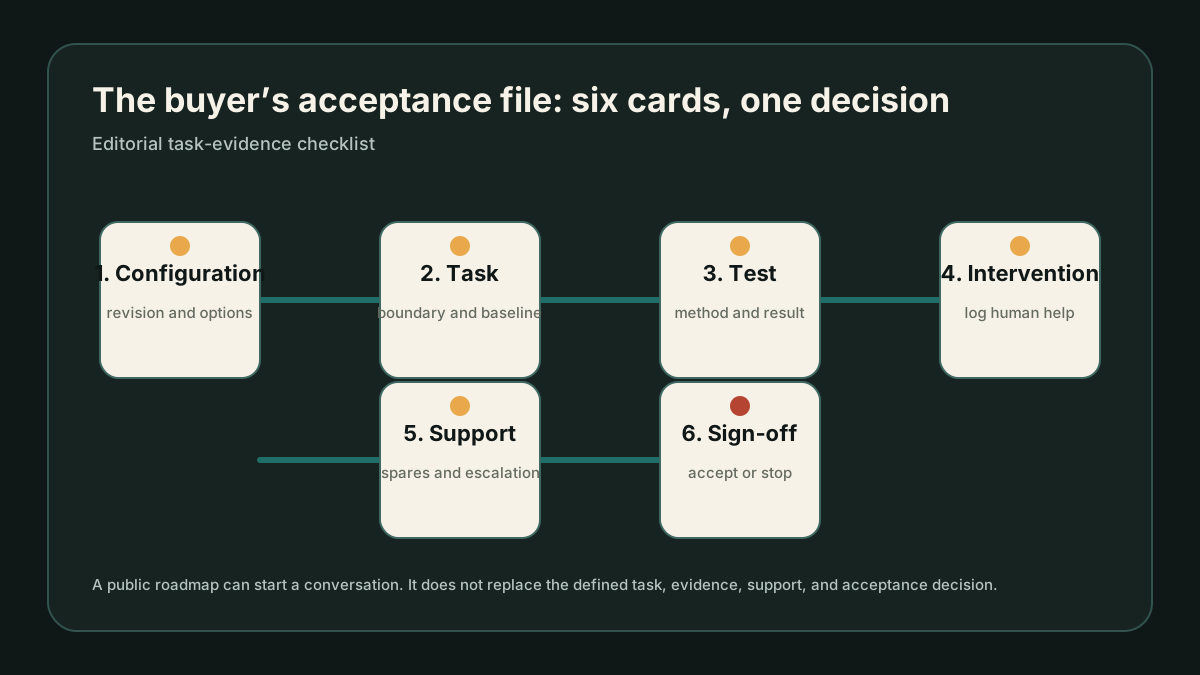 Editorial task-evidence checklist. It is a procurement framework, not an IRON test, a safety assessment, or a vendor scorecard.
The capital-to-deployment chain: six gates that should stay separate
The simplest way to use the financing event is to place it at the beginning of a chain, not at the end.
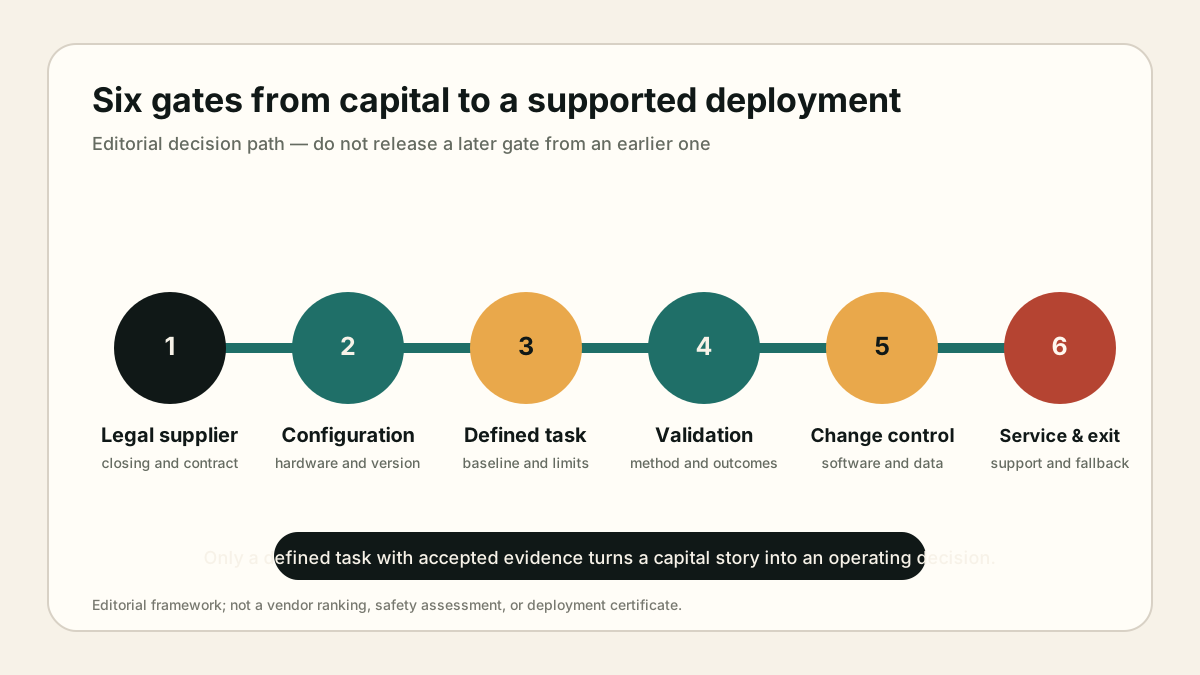 Editorial capital-to-deployment framework. Each gate needs evidence for the actual configuration, task, site, and contract; it does not rate XPENG or certify a deployment.
Gate 1: Capital and legal supplier
Identify Dogotix, XPENG, and the entity that would appear in a commercial offer. Record closing status, ownership assumptions, IP/data roles, service obligations, and the route through which support survives a reorganization. The financing announcement improves the record; it does not replace contract-counterparty review.
Gate 2: Offered configuration and production definition
The next question is not “Can IRON do many things?” It is “What exact configuration will be delivered, and how will its production state be evidenced?” Distinguish concept, prototype, small batch, released, and orderable configurations. If broader manufacturing experience is relevant, show the controls that transfer—traceability, inspection, calibration, build acceptance, rework, configuration control, and repair—rather than asking the buyer to infer them from a corporate identity.
Gate 3: Task and operating model
Define one task in operational language. “Warehouse work” is not a task; moving a defined tote between defined points during a supervised six-hour shift with an exception process is closer. Include variability—misorientation, blocked space, lighting, people, damaged parts, absent targets, delays, and recovery. A commercial task needs a recovery definition, not only normal flow.
Gate 4: Measured validation and release
Record not only what the robot did, but how: period, configuration, version, task sequence, sample, observers, counting rules, interventions, resets, environmental changes, and pass/fail/no-decision criteria. Log teleoperation, remote assistance, human selection, and recovery rather than hiding them. The MIIT/SASAC programme’s focus on task success, efficiency, safety/reliability, and economic feasibility is a useful prompt, not a threshold or an IRON result.
Gate 5: Software, data, and change control
For a system that may improve through data and model iteration, change control is part of the product: record the version that produced the pilot result, permitted updates, revalidation triggers, release owner, retained logs, and rollback route. Separately define collection, access, retention, training use, deletion, and export rights for sensor, task, operator, or site data. This article does not assess XPENG’s specific data or cybersecurity controls; a capital announcement cannot answer them.
Gate 6: Service, commercial terms, and exit
Identify the support owner, maintenance routine, service hours, remote-access policy, parts location, repair turnaround, escalation path, training responsibility, and exit if the pilot fails or the supplier changes. More capital may make field support and stock more plausible, but an investor’s willingness to fund a company is not a customer’s spare-parts agreement.
How to run a pilot without turning it into an expensive demonstration
The right pilot is not a miniature press event. It is a learning instrument with an exit. Its purpose is to reduce a bounded uncertainty that matters to a business decision.
Begin by writing down the decision that will follow the pilot. Examples might be: continue with an expanded controlled test; hold pending a hardware or software revision; replace the use case with fixed automation; use the robot only in a supervised service role; or stop. If the team cannot name the decision, it is likely collecting impressions rather than evidence.
Then set a task baseline. The baseline does not need to prove that a humanoid will be cheaper or better. It needs to describe the existing state honestly: the volume handled, quality rate, cycle time, staffing pattern, ergonomic or safety issue, variability, downtime, training burden, and exceptions. A buyer who lacks this baseline cannot assess “efficiency improvement” or economic feasibility later, even if the robot performs an impressive motion.
Next, define the pilot’s minimum evidence set.
| Pilot stage | Minimum evidence | Decision it can support |
|---|---|---|
| Bench or lab demonstration | Released configuration identification; specified objects and actions; known constraints; operator model | Whether the basic behavior is worth taking to a site-like environment |
| Controlled site trial | Task map; safety and access boundary; supervised operations; intervention log; version log; failure categories | Whether the task is technically plausible under controlled conditions |
| Measured pilot | Defined test period; baseline; success and quality metrics; throughput/cycle measurement; recovery and downtime record; support observations | Whether to extend, revise, or stop the use case |
| Conditional operational release | Acceptance criteria met; service owner and spares; training; change controls; escalation; commercial terms; fallback | Whether to use the system for the agreed limited operating scope |
| Scale decision | Repeatability across shifts or sites; configuration governance; service capacity; economics; exit/replacement plan | Whether scaling increases value rather than multiplying unresolved variance |
Intervention logging deserves special attention. A human may be needed for legitimate reasons: site safety, training, remote support, object selection, recovery, quality review, or a deliberately supervised early-stage pilot. The error is not human involvement. The error is failing to record what type of involvement occurred, how often, how long it took, and whether it is expected to shrink. Without that log, a buyer cannot tell whether the system is becoming more independent, remaining a teleoperated service, or moving the work to a different person.
The same logic applies to failures. A failure is not automatically disqualifying; engineering systems are learned through failures. But the project should classify them: perception error, grasp failure, locomotion issue, planning failure, communications interruption, battery/thermal issue, safety stop, fixture problem, site change, or operator-interface issue. The classification makes the pilot actionable. A vague statement that “the robot struggled sometimes” makes it impossible to decide whether a design change, fixture change, operator change, or task narrowing is appropriate.
Finally, put the alternative in the pilot charter. The alternative might be a fixed arm, a mobile manipulator, a fixture redesign, a conveyor change, software for the existing process, a conventional automation cell, a worker-assist tool, or no change. The most useful humanoid pilot is not the one that proves humanoids are inevitable. It is the one that tells the buyer which solution fits the defined task under the actual constraints.
For a broader conference and demonstration discipline, see the World Robot Conference procurement-day test. The point is the same: a public performance can start the conversation, but it cannot replace task, support, and acceptance evidence.
Commercial controls that belong beside the technical pilot
A technical pilot can fail commercially even if the robot performs the intended motion. The legal, support, data, and replacement questions should therefore enter early rather than appearing after a technical team has become committed to a demonstration.
First, define the commercial object. Is the buyer discussing a robot sale, a rental, a managed service, an integration project, a proof-of-concept, or a conditional framework for later delivery? The answer changes who owns equipment, who maintains it, who controls updates, who carries insurance or operational risk where relevant, and how the buyer can leave. A “robot as a service” label is not enough; the actual obligations, measurement, minimum term, exclusions, and termination rights matter.
Second, write a configuration freeze and a change path. A buyer should not accept a pilot result on one hardware/software combination and receive a materially different combination without a defined revalidation process. This does not mean every change is prohibited. It means the parties agree which changes are routine, which require notice, which require test, and which reopen acceptance. A platform that evolves quickly can still be commercially usable if change control is explicit.
Third, separate customer data and generalized learning. The supplier may need operational data to improve a model, while the buyer may have legitimate restrictions involving site layout, products, employees, customers, process know-how, or commercial information. The parties should define collection, purpose, access, storage, transfer, retention, training use, deletion, and audit rights appropriate to the site. This is a contractual and technical design question, not something that can be resolved by an “AI-powered” label.
Fourth, ask what continuity looks like in a downside case. If a transaction closes later than expected, a product milestone slips, a part is constrained, an update is delayed, a service team changes, or a provider reorganizes, what keeps the pilot safe and recoverable? A sensible answer might include spare-parts ownership, a service escrow or documentation arrangement where feasible, transition support, data export, a removable installation, payment milestones, and a termination/retrieval plan. The right mechanism depends on the deal. The important point is to ask before the work system becomes operationally embedded.
Fifth, keep financial diligence and product diligence connected but not merged. A buyer may care about Dogotix’s closing status, XPENG’s control, investor rights, group support, and the supplier’s ability to sustain a multi-year service model. Those are legitimate questions following the public transaction disclosure. They should be reviewed by the appropriate commercial and financial owners. They should not be misreported as evidence that IRON will perform the buyer’s task.
The same is true in reverse. A good technical pilot may demonstrate a specific task while leaving long-term supplier continuity, data terms, commercial support, and exit unresolved. A project is ready to scale only when both files have progressed.
A short decision memo a buyer can use now
If the current question is whether to start talking to XPENG Robotics, the financing event gives a reasonable basis to deepen the supplier conversation. The disclosed transaction is material enough to request an updated company and commercial briefing. The buyer can ask which entity will be the supplier, what closing status is current, how the announced funds are expected to support the offered route, and what product and support milestones are now realistic.
If the question is whether to buy or release IRON into an operating task, the financing announcement alone is not enough. The buyer should ask for the offered configuration, exact task proposal, test plan, intervention model, site safeguards, version/change control, service and spares, commercial counterparty, and acceptance condition. If those cannot be defined, the right next step may still be a nonbinding technical discussion or a narrowly scoped discovery project—but not a claim that deployment readiness has been demonstrated.
If the question is whether to scale after a pilot, the buyer should inspect the pilot’s evidence, not the enthusiasm around the funding round. Did the system meet the defined task boundaries? How often did people intervene? Were software changes controlled? Were service and recovery workable? Was performance stable across relevant variation? Did the business case remain plausible once support, integration, downtime, and exceptions were counted? A capital story can make a supplier more likely to be present for the next iteration. It cannot answer whether the iteration earned a release.
FAQ: XPENG Robotics funding and IRON deployment
Did XPENG Robotics raise US$900 million?
XPENG’s August 2026 materials and its HKEX announcement describe conditional subscriptions totaling approximately US$900 million for Dogotix. The listed-company filing separates the disclosed components and says completion is subject to conditions, so a buyer should distinguish the announced transaction from a confirmed closing and from cash deployed into operations.
Does the US$6.3 billion valuation prove that IRON is ready for mass production?
No. The US$6.3 billion figure is an implied post-transaction valuation calculated under the disclosure’s assumptions. It can be relevant to capital and governance diligence, but it does not measure IRON’s production quality, task reliability, safety, service, customer acceptance, or economics for a specific operation.
When does XPENG say IRON will enter mass production?
XPENG says it expects IRON to enter mass production by the end of 2026, with initial deployment at its own stores and campuses and intended deliveries in China and overseas in 2027. Those are company-stated future milestones that should be reconfirmed at quotation, pilot, order, and acceptance time.
Has IRON publicly proven an industrial factory task?
This article does not make that conclusion. The reviewed public sources include future own-site plans and an intended Baosteel scenario exploration, but they do not jointly provide a current configuration, named task, public protocol, measured result, support record, and acceptance decision. That scope limit does not prove a negative result; it identifies what a buyer should request.
What evidence should I request before an IRON pilot?
Request an exact configuration, a bounded task and baseline, a written test method, intervention and failure logging, version/change control, site safeguard ownership, data terms, service and spares information, commercial counterparty details, and a defined acceptance or exit decision. Align the level of evidence to the decision the pilot is intended to support.
Method and limitations
This is a desk-research article based on public XPENG material, the August 24 HKEX transaction announcement, a 2026 MIIT/SASAC programme notice, and selected independent sector analysis and reporting. It is not a transaction audit, robot test, factory visit, customer interview, safety assessment, cybersecurity assessment, legal opinion, or investment recommendation.
The article intentionally separates public documents by what they can establish. The HKEX filing is used for transaction structure and conditions. XPENG releases are used for XPENG’s own statements about funding use, roadmap, product relationships, and intended application directions. The MIIT/SASAC notice is used as a public description of validation fields, not as an IRON certification. Independent sector sources are used only as sector context, not as IRON-specific performance evidence.
The reviewed public material did not provide a combined IRON record with a named current configuration, task protocol, measured result, intervention record, service commitment, and customer acceptance decision. That absence narrows the article’s claims; it does not establish that no such data exists or that IRON cannot perform a task. Readers should reconfirm transaction closing, legal supplier, configuration, task evidence, support terms, and commercial conditions before acting.
The bottom line
XPENG Robotics’ announced financing is worth taking seriously because it creates a clearer public record of capital, transaction structure, governance, and the company’s intended investment path. For a buyer, that can improve the supplier-continuity side of diligence. It may justify a more substantive conversation about product roadmap, production preparation, service capacity, and a future pilot.
It does not erase the deployment work. The funding round does not establish a current IRON configuration for a buyer’s job. It does not supply a named third-party task result, a safety or operating case, a service commitment, a data/change-control arrangement, or a release decision. The buyer should therefore keep the funding announcement in the capital file, then build the separate task-and-lifecycle file that a real deployment requires.
That is the practical way to take the event seriously without asking it to prove the wrong thing.