

On January 27, 2025, Nvidia lost $589 billion in market capitalization in a single trading session — the largest one-day destruction of shareholder value in stock market history. The trigger was not an earnings miss or a product failure. It was the release of DeepSeek R1, an open-source reasoning model from a Hangzhou-based AI lab that most people outside China had never heard of.
The market read DeepSeek as evidence that frontier-class reasoning could be approached with far less compute than investors had assumed. But the famous "$5.6 million" number needs care: it refers to the reported official training cost for DeepSeek-V3, not the all-in cost of building R1, the company, the data pipeline, or the earlier failed experiments behind it. The sharper question was still real: if algorithmic efficiency can substitute for part of brute-force compute, how many premium GPUs does the next wave of AI labs actually need?
President Trump called DeepSeek a "wake-up call." The world's 500 wealthiest people lost a combined $108 billion that day. And a 40-year-old former quantitative hedge fund manager named Liang Wenfeng became the most discussed figure in artificial intelligence overnight.
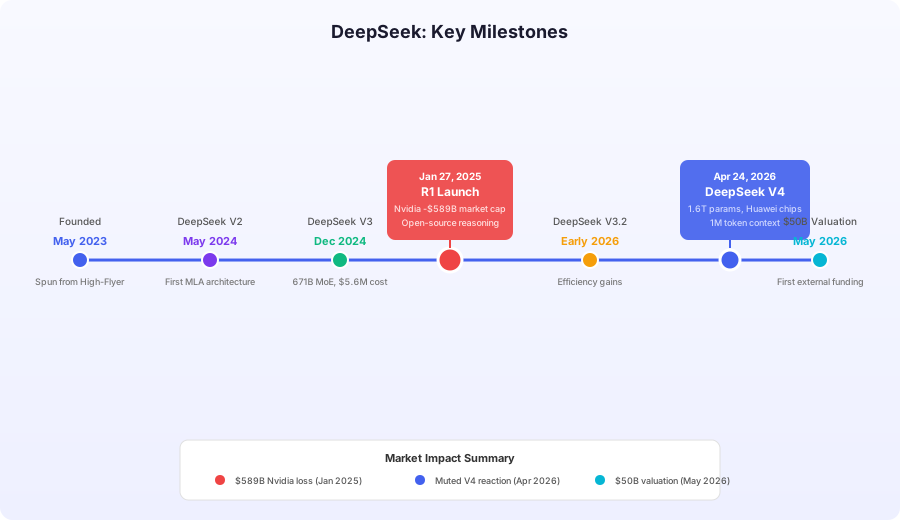
This is the story of how DeepSeek went from a side project of a Chinese quant fund to the company that changed the way investors, engineers, and policy makers talk about AI economics. It covers the founder's background, the technical innovations that made the cost story plausible, the strategic choices that amplified its impact, and the limits of what DeepSeek does and does not prove.
Source File
This article was reviewed on 2026-07-06 against DeepSeek's V3 technical paper, DeepSeek's API pricing page, the official DeepSeek-R1 Hugging Face release, Reuters and Financial Times reporting on DeepSeek's 2026 funding talks and V4 on Huawei chips, TechNode reporting on China's token usage, and SCMP coverage of Qwen and DeepSeek open-source usage. Private-company valuation, revenue, funding, benchmark, and usage figures are treated as reported estimates or provider disclosures, not audited disclosures.
From Quant Trading to Frontier AI
DeepSeek's origin story is unlike any other major AI lab, and understanding it explains much about the company's unusual approach to AI development.
Liang Wenfeng graduated from Zhejiang University — one of China's top engineering institutions — where he studied machine vision. In 2015, he and two university classmates co-founded High-Flyer (幻方量化), a quantitative hedge fund that used machine learning for algorithmic stock trading. High-Flyer grew into one of China's best-known quant funds; reported assets under management and return figures vary across media profiles, so this article treats them as directional context rather than audited performance data.
The fund's competitive edge was computing infrastructure. High-Flyer had built massive GPU clusters for its trading models, giving Liang deep expertise in large-scale training and inference at a time when most of the AI world was still running experiments on modest hardware. The firm was one of the first Chinese quant funds to invest heavily in GPU computing, building data centers that rivaled those of major tech companies. This infrastructure bet gave High-Flyer a speed advantage in executing trades — and gave Liang an intuitive understanding of how to squeeze maximum performance from limited computing resources.
According to Bloomberg reporting, Liang's insight was that the same infrastructure and talent could be redirected from predicting stock prices to building frontier AI models. The transition from quant trading to AI research was not as jarring as it sounds. Both disciplines involve training large neural networks on massive datasets, optimizing for performance under hardware constraints, and iterating rapidly based on measurable outcomes. The quantitative mindset — rigorously empirical, data-driven, skeptical of narratives — translates directly to AI research.
DeepSeek was formally founded in May 2023 as an independent entity, spun out of High-Flyer's AI research division. The company's stated mission — "making AGI a reality" — echoes every other AI lab, but its funding structure was different. Rather than raising venture capital to burn on compute, DeepSeek was initially bankrolled by High-Flyer's trading profits. This gave Liang something most AI founders lack: patient capital with no quarterly board meetings demanding revenue.
That structure appeared to be changing in 2026. Reuters and the Financial Times reported that DeepSeek was in talks for outside funding at a valuation that could reach roughly $45 billion to $50 billion, with state-linked capital and Tencent discussed as possible participants. That should be read as reported financing context, not as an audited cap table or a confirmed completed round.
The Technical Breakthrough: Doing More With Less
DeepSeek's core technical contribution is not a better model. It is a better way to build models. Two architectural innovations define the DeepSeek approach, and both are responses to a specific constraint: limited access to the most advanced AI chips.
Mixture-of-Experts (MoE)
DeepSeek V3, released in December 2024, uses a Mixture-of-Experts architecture with 671 billion total parameters but only 37 billion active per token. In plain terms: the model contains 671 billion "knowledge units," but for any given question, it only uses about 5.5% of them. A routing mechanism dynamically selects which experts are relevant to each input.
The cost savings are dramatic, but they are often overstated. Traditional dense models activate every parameter for every query, which means compute scales linearly with model size. DeepSeek's V3 paper reports 2.788 million H800 GPU hours and a final official training cost of $5.576 million. That number is meaningful because it describes the compute bill for one disclosed model-training run. It does not include prior research, ablation experiments, data work, salaries, infrastructure, failed runs, or the additional reasoning-stage work behind R1.
Multi-Head Latent Attention (MLA)
The second innovation addresses memory bandwidth — the bottleneck that constrains inference speed and cost. Traditional transformer models use Multi-Head Attention, which requires storing large key-value caches for every token in a sequence. This becomes expensive at scale, especially for long-context tasks.
DeepSeek's Multi-Head Latent Attention compresses the key-value cache into a low-rank latent representation, dramatically reducing memory requirements without significant performance loss. Combined with FP8 mixed-precision training (using 8-bit floating point instead of the standard 16-bit or 32-bit), this allowed DeepSeek to train larger models on less capable hardware.
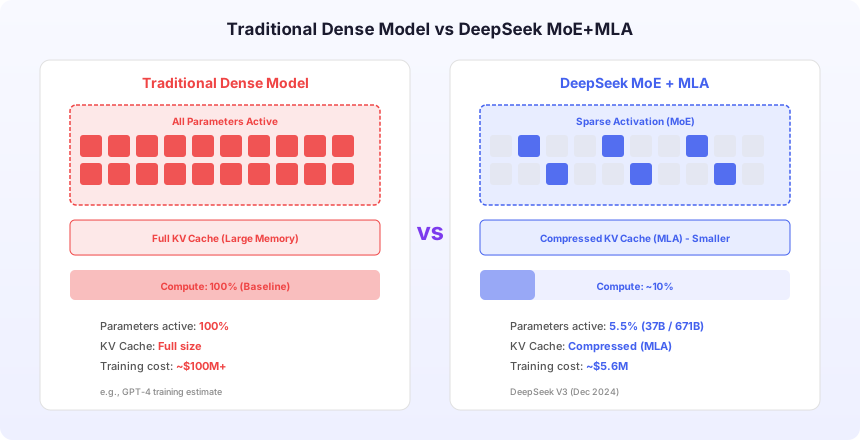
The constraint produced the innovation. US export controls had restricted DeepSeek's access to Nvidia's H100 GPUs, limiting the company to the H800 — a version with reduced interconnect bandwidth. Rather than treating this as a fatal disadvantage, DeepSeek designed architectures that compensated for hardware limitations through algorithmic efficiency. As one analysis noted, the software was shaped around the hardware's constraints.
The result was a model that did not just match GPT-4 on benchmarks — it matched it using a fundamentally different approach to compute. Where Western labs threw more GPUs at the problem, DeepSeek found ways to use fewer GPUs more intelligently. The V3 technical paper, published on arXiv, became one of the most-cited AI papers of 2025 precisely because it demonstrated that the brute-force scaling paradigm was not the only path to frontier performance.
The Model Lineup
DeepSeek has released models at a pace that matches or exceeds any Western lab. Here is the complete timeline of major releases:
| Model | Release | Parameters | Key Innovation | Training Cost |
|---|---|---|---|---|
| DeepSeek V2 | May 2024 | 236B MoE | First MLA architecture | Not disclosed |
| DeepSeek V3 | Dec 2024 | 671B MoE (37B active) | MoE + MLA + FP8 | ~$5.6M |
| DeepSeek R1 | Jan 2025 | 671B MoE | Open-source reasoning, RL-trained | Not disclosed as all-in cost |
| DeepSeek V3.2 | Early 2026 | Improved V3 | Efficiency gains | Not disclosed |
| DeepSeek V4 Flash | Apr 2026 | 284B MoE | Lightweight, fast inference | Not disclosed |
| DeepSeek V4 Pro | Apr 2026 | 1.6T MoE (49B active) | Huawei Ascend support, 1M context | Not disclosed |
Interestingly, the market reaction to V4 was notably muted compared to the V3/R1 "black swan." As Omdia's chief analyst observed: "This announcement followed a rather predictable path." The AI market had normalized Chinese innovation — the expectation that capable models would emerge from China was now "baked into valuations."
Performance: Where DeepSeek Stands
Benchmarks are imperfect but useful. Here is how DeepSeek's models compare against the leading Western alternatives on widely-cited tests:
| Benchmark | DeepSeek R1 | OpenAI o1 | GPT-4 | Notes |
|---|---|---|---|---|
| MATH-500 | 97.3% | 96.4% | — | Mathematical reasoning |
| HumanEval (Code) | 82.6% | — | 80.5% | Code generation |
| GPQA Diamond | Comparable | Comparable | — | Graduate-level science |
| SWE-bench Verified | 81.0% (V4 Pro) | — | — | Real-world coding tasks |
DeepSeek V4 Pro's BenchLM composite reasoning score of 87 exceeds Gemini 3.1 Pro's 77.1 and leads all Chinese models. It ranks #4 out of 115 models in coding and programming benchmarks with an average score of 90.5.
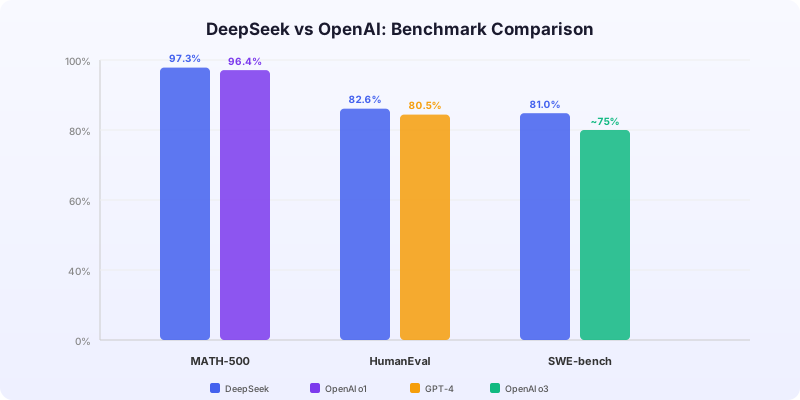
The picture that emerges is near-parity on mathematical reasoning and coding tasks, with Western models maintaining advantages in creative writing, multimodal capabilities, and complex multi-turn dialogue. For the high-volume, high-value applications that dominate enterprise AI — code generation, data analysis, mathematical computation — DeepSeek is genuinely competitive.
The Open Source Strategy
DeepSeek's most consequential decision was not technical. It was strategic: releasing every major model as open weights.
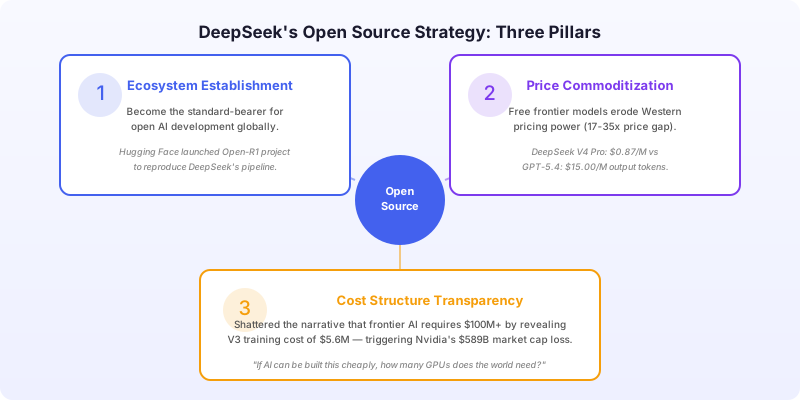
R1's open-source release on Hugging Face and GitHub in January 2025 was not charity. It accomplished three things simultaneously:
First, it established DeepSeek as the standard-bearer for open AI development. While OpenAI (despite its name), Anthropic, and Google have progressively closed their models, DeepSeek went the opposite direction. The developer community responded immediately. Hugging Face even launched an "Open-R1" project to fully reproduce DeepSeek's training pipeline in the open — a remarkable vote of confidence from the Western open-source community.
Second, it commoditized the reasoning model category. By releasing a model competitive with OpenAI's o1 for free, DeepSeek undermined the pricing power of closed-source providers. If comparable reasoning capability is available at zero marginal cost, the justification for paying premium API rates weakens considerably. This aligns with what our analysis of the China AI Token Price War: Official Prices And Buyer Risk documented: Chinese models charge 10-35x less than American equivalents, and open-source releases accelerate this price compression.
Third, it exposed the cost structure of frontier AI. DeepSeek's transparency about V3's official training compute cost undercut the narrative that every frontier-class model must require hundreds of millions of dollars in a single training run. The immediate market consequence was the $589 billion Nvidia selloff: if models this capable can be built with smarter architectures and constrained hardware, how many of Nvidia's highest-end GPUs do you actually need?
Hugging Face published a dedicated analysis titled "One Year Since the DeepSeek Moment," examining how the release reshaped the global open-source AI ecosystem. The impact was measurable: China's open-source models — primarily Qwen and DeepSeek — now account for roughly 30% of global AI usage and about 15% of the global AI market, up from roughly 1% just a year ago.
The Economics: Cost Comparison
The pricing gap between DeepSeek and Western providers is not incremental. It is structural.
| Provider | Model | Input ($/M tokens) | Output ($/M tokens) | Cached ($/M tokens) |
|---|---|---|---|---|
| DeepSeek | V4 Flash | $0.14 | $0.28 | $0.028 |
| DeepSeek | V4 Pro | $0.435 | $0.87 | $0.028 |
| Leading closed U.S. providers | Frontier models | often several dollars to low double digits | often low double digits | varies |
| Anthropic | Claude-class | often several dollars | often low double digits | varies |
The output token gap is the most striking. DeepSeek has often priced output tokens far below comparable closed Western frontier-model APIs. For a company processing 100 million output tokens per month, a difference of even a few dollars per million tokens changes the adoption case. For Chinese enterprises operating on thin margins in competitive industries - manufacturers running quality inspection models, logistics companies optimizing delivery routes, small businesses deploying customer service chatbots - low inference pricing can make AI adoption economically viable where premium Western APIs would not.
There is a legitimate critique of the headline $5.6 million training cost. The V3 paper itself says the figure excludes prior research and ablation experiments, and outside analysts have noted that it also leaves out infrastructure, staff, data, and failed attempts. The true all-in cost of creating DeepSeek's capability was almost certainly much higher. The important point is narrower: the disclosed official training run was far cheaper than the market expected for a model in that performance class.
DeepSeek has also used temporary discounts, including a 75% discount period that ran through May 31, 2026. Buyers should check the live price sheet before building a cost model. The broader pattern remains consistent with the Chinese AI price war documented in China AI Token Price War: Official Prices And Buyer Risk: use low inference prices to pull developers and enterprises onto domestic cloud and model ecosystems.
The Geopolitical Dimension
DeepSeek's story cannot be separated from the US-China technology competition. The company's trajectory directly challenges the theory behind American export controls.
Since October 2022, the United States has progressively tightened restrictions on advanced AI chip exports to China. The stated goal: deny China access to the compute infrastructure required for frontier model training, slowing AI development. The theory is straightforward — if capability scales with compute, and you restrict compute, you restrict capability.
DeepSeek has exposed a flaw in this theory. R1 and V3-era work depended on Nvidia H800s, the export-restricted version with reduced interconnect bandwidth. DeepSeek compensated with algorithmic innovations, particularly MLA and FP8 mixed-precision training, that extracted more capability from constrained hardware. V4 then became important because it was reported as adapted to run on Huawei Ascend chips, not because public evidence proves an end-to-end Nvidia-free training stack.
As Ankura China Advisors noted in Reuters: "The 'wow factor' was last year — that's already priced in. What matters now is whether China can continue advancing on AI development, and potentially do so with its own chips — the geopolitical implications would be significant."
The irony is sharp. The export controls that were supposed to slow Chinese AI development may also have pushed Chinese labs to innovate around hardware constraints. DeepSeek's efficiency gains - MoE, MLA, FP8 training - were born from the necessity of doing more with less. That does not mean export controls "failed" in a simple sense. It means the policy created both constraint and adaptation.
The White House memo released on April 23, 2026, accusing China of "industrial-scale theft" of AI intellectual property, underscores the shifting US posture. If Chinese AI labs were simply copying Western techniques on smuggled Nvidia chips, export controls would be effective. The fact that the policy debate has shifted to accusations of IP theft suggests that computational containment is not working as intended.
The same China-origin asset question also appears on the M&A side. The Meta-Manus acquisition block shows why buyers cannot treat offshore headquarters, cap tables, or Singapore/Cayman structures as enough proof that an AI asset is outside Chinese review. For global acquirers, the DeepSeek lesson is about compute constraints; the Manus lesson is about where the code, people, IP, and regulatory hooks actually sit.
The deeper question is whether DeepSeek's efficiency innovations are replicable or represent a unique advantage. Our analysis of DeepSeek V4 open-weight signal suggests the answer is both: the MoE and MLA techniques are published and reproducible (Hugging Face's Open-R1 project proves this), but DeepSeek's particular expertise in squeezing performance from constrained hardware reflects a deep institutional competence built through years of quant trading on similar constraints.
DeepSeek in the Chinese AI Ecosystem
DeepSeek operates within an AI ecosystem that has reached industrial scale. China's daily AI token consumption hit 140 trillion in March 2026 — a 1,000-fold increase from early 2024. ByteDance's Doubao AI assistant alone processes 120 trillion tokens daily.
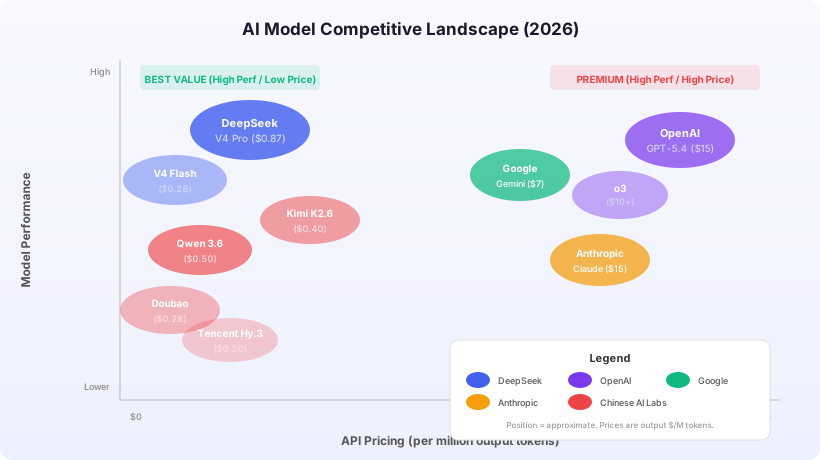
But DeepSeek's position within this ecosystem is changing. The muted reaction to V4 reflected not just market normalization but also intensified domestic competition. Moonshot AI's Kimi 2.6 and Alibaba's Qwen have narrowed the gap with DeepSeek. As our DeepSeek V4 analysis analysis documents, the Chinese AI landscape is now defined by multiple capable providers rather than a single leader.
The competitive dynamics are fierce. OpenRouter data cited in Chinese AI coverage shows Chinese models accounting for over 60% of tracked token volume. Five of the top 10 models by traffic were Chinese in that snapshot, with Tencent's Hy.3 and Kimi K2.6 among the leading models.
DeepSeek's differentiation lies in its open-source commitment and its demonstrated ability to achieve frontier performance on domestic chips. These are not easily replicated advantages. Alibaba, by contrast, released three proprietary models in April 2026 accessible only through its cloud platform — the opposite strategic bet.
What DeepSeek Reveals About the AI Race
Three structural implications emerge from DeepSeek's story:
Efficiency can substitute for scale. The dominant assumption in Western AI development has been that capability scales with compute budget. OpenAI, Google, and Anthropic have each pursued larger models trained on larger clusters, with training runs costing hundreds of millions. DeepSeek demonstrated that algorithmic innovation — MoE, MLA, FP8 training — can deliver comparable results at 1/50th to 1/100th the cost. This does not mean scale is irrelevant. It means scale is not the only path to frontier performance.
Open source is a competitive weapon, not an act of charity. DeepSeek's open-source strategy mirrors the "commoditize your complement" playbook that Microsoft used against Netscape and Google used against Apple with Android. By releasing frontier models for free, DeepSeek erodes Western pricing power, builds a global developer community, and creates switching costs that no marketing budget can buy. Every product built on DeepSeek is a product not built on OpenAI.
Export controls can accelerate domestic adaptation. The US chip restrictions were designed to slow Chinese AI development. They also forced Chinese labs to develop more efficient architectures and to accelerate domestic chip deployment. DeepSeek V4 running on Huawei Ascend chips is a technical and procurement signal; it is not final proof that computational containment is impossible.
None of this means China has achieved AI superiority. The United States still leads in the strongest closed frontier models, semiconductor manufacturing equipment, enterprise AI revenue, and the cloud infrastructure that supports large-scale AI deployment. DeepSeek narrowed one important gap; it did not erase the whole stack of U.S. advantages.
But the gap is narrowing faster than most analysts predicted. And DeepSeek is the primary reason why.
The Path Ahead
DeepSeek's next challenges are different from the ones it has already solved.
Scaling without Nvidia. V4 suggested that serious Chinese models can be adapted to domestic AI accelerators. The harder question is training and scaling future models when the most advanced Nvidia hardware remains restricted. Closing that gap - or continuing to compensate architecturally - will determine whether DeepSeek can maintain its trajectory as models grow larger.
Commercializing without compromising. If the reported outside-funding talks turn into a large round, they will come with expectations. DeepSeek's API pricing is aggressive but not the most aggressive in the market. Finding a path to profitability without closing its open-weight models - the strategy that Alibaba has chosen for some releases - will test Liang's commitment to openness.
Competing with domestic rivals. DeepSeek's brief position as China's clear AI leader is over. Kimi, Qwen, Doubao, and others have caught up. As Omdia noted, the AI market has normalized Chinese innovation. Being first is no longer DeepSeek's primary advantage — being the most efficient and the most open is.
Hallucination and reliability gaps. The quality gap between Chinese and American models remains real. According to Semi Fundamental analysis, Chinese frontier models hallucinate at rates 3 to 5 times higher than US frontier models — 3-5% versus under 1% on factual tasks. For consumer chatbots and content generation, this is tolerable. For enterprise applications in healthcare, legal, or financial services, it is a dealbreaker. DeepSeek has not publicly addressed this gap, and closing it may require fundamentally different approaches to training data curation and output verification.
The distillation clock. Several analyses have noted that Chinese AI labs benefited from training on outputs from Western frontier models — a technique called distillation. This shortcut has a limited shelf life. As Western providers implement countermeasures — rate limiting, output watermarking, API restrictions on bulk querying — the distillation advantage erodes. Semi Fundamental estimates this approach has roughly a 6-month shelf life before countermeasures make it ineffective. DeepSeek's continued competitiveness will depend on whether its native research capabilities can sustain progress without this crutch.
The question that matters most is not whether DeepSeek can beat OpenAI. It is whether the competitive dynamics of the AI industry — where winner-take-all economics and massive compute requirements favored a handful of well-funded Western companies — still hold when your competitor can build a frontier model for $6 million and run it on chips you cannot block.
Methodology
This profile separates technical claims from market claims. Technical sections rely primarily on DeepSeek's papers, official model releases, public API pricing, and independent technical explainers. Market-share, valuation, funding, and usage figures come from media reporting and platform snapshots, so they are presented as estimates with date-specific context. Benchmark comparisons are volatile and can change when model providers update weights, prompts, pricing, or evaluation harnesses.
Claim Confidence File
| Claim | Confidence | Evidence boundary |
|---|---|---|
| DeepSeek-V3 uses a 671B-parameter MoE architecture with 37B active parameters per token | High | Stated in DeepSeek's V3 technical paper |
| The $5.576M figure is the full all-in cost of DeepSeek R1 | Low | The figure is tied to V3 official training and excludes prior research, infrastructure, staff, ablations, failed runs, and R1-specific work |
| R1 was competitive with OpenAI o1 on math and coding benchmarks at release | Medium-high | Supported by release benchmarks and third-party benchmark snapshots, but benchmark harnesses and model versions change |
| DeepSeek completed a $3B-$4B external round at a $45B-$50B valuation | Medium-low | Reported as funding talks, not audited cap table disclosure |
| V4 proves DeepSeek no longer needs Nvidia hardware | Medium-low | Public evidence supports Ascend adaptation for running/deployment, not a complete end-to-end Nvidia-free training stack |
| DeepSeek proves China has overtaken the United States in AI | Low | It narrows cost and open-weight gaps but does not erase U.S. advantages in top closed models, chips, cloud, and enterprise revenue |
Frequently Asked Questions
What is DeepSeek?
DeepSeek is a Chinese AI research lab founded in 2023 by Liang Wenfeng, a former quantitative hedge fund manager. Based in Hangzhou, the company has released a series of open-weight large language models, including V3, R1, and reported V4 releases. Media reports in 2026 described outside-funding talks at a possible $45 billion to $50 billion valuation, but those reports should not be treated as audited ownership disclosure.
How does DeepSeek compare to OpenAI?
DeepSeek R1 was competitive with OpenAI o1 on several math and coding benchmarks at release, and DeepSeek models have often been much cheaper to run through API pricing. OpenAI and other U.S. frontier labs still retain advantages in multimodal capability, tool ecosystems, enterprise distribution, and the strongest closed-model tiers. Benchmark comparisons should be read as snapshots, not permanent rankings.
How did DeepSeek train models so cheaply?
Two key innovations matter: a Mixture-of-Experts architecture that activates only 37 billion of 671 billion total parameters per token, and Multi-Head Latent Attention that reduces memory requirements. Combined with FP8 mixed-precision training, those techniques helped bring DeepSeek-V3's reported official training cost to $5.576 million. That is not the all-in cost of DeepSeek, R1, or the full research program.
Is DeepSeek open source?
Yes. All of DeepSeek's major models — V3, R1, V3.2, V4, and V4 Pro — have been released as open weights on Hugging Face and GitHub. Developers can download, fine-tune, and deploy these models locally without paying API fees. The open-source strategy has made DeepSeek the standard-bearer for open AI development, with Hugging Face launching a dedicated project to reproduce DeepSeek's training pipeline.
Who owns DeepSeek?
DeepSeek was founded by Liang Wenfeng, who previously co-founded High-Flyer, one of China's best-known quantitative hedge funds. The company was initially funded through High-Flyer-linked resources. Reuters and the Financial Times reported 2026 outside-funding talks involving a possible $45 billion to $50 billion valuation, but public sources do not provide a complete audited ownership file. Liang remains the central public figure.
Why did DeepSeek cause Nvidia to lose $589 billion?
On January 27, 2025, investors reacted to R1 as evidence that frontier-class reasoning might be built with less compute than expected. Nvidia shares fell about 17%, erasing $589 billion in market cap. The selloff reflected concern that efficient open-weight models could reduce the assumed demand curve for the most expensive Nvidia GPUs, even though DeepSeek's public cost figures do not equal the full cost of creating R1.
Related Entries
- China's AI infrastructure scale — China's AI and Robotics Industry: From Labs to Factory Floors
- DeepSeek V4 analysis — Chinese AI Models Compared: DeepSeek vs Qwen vs Yi vs Baichuan
- DeepSeek V4 Preview: China AI Efficiency Signal — DeepSeek V4 Changes Everything
- China's 140T AI Tokens: Infrastructure Signal, Not Hype — China's 140 Trillion Daily AI Tokens
- China AI Token Price War: Official Prices And Buyer Risk — China Sells AI at $0.10 While OpenAI Charges $3
- Meta-Manus Deal Blocked by China: Risk File — Meta-Manus Deal Blocked by China: Risk File
- DeepSeek V4 open-weight signal — Open Source Chinese AI: What Developers Need to Know
- China lithography bottleneck — China's AI Chip Design: Huawei Ascend, Biren, and Moore Threads