

China's April 27, 2026 decision on the Meta-Manus deal is not just an AI news item. It is a warning file for any acquirer, venture fund, cloud platform, or strategic buyer looking at a China-origin AI asset that has moved its legal home offshore.
The hard fact is narrow and important: China's foreign-investment security review office, housed at the National Development and Reform Commission, said it had made a prohibition decision on the foreign acquisition of the Manus project and required the parties to revoke the transaction. Al Jazeera reported the blocked buyer as Meta and described Manus as an AI startup linked to a proposed acquisition by the US tech company.
For investors, the buyer lesson is sharper than the headline. A Singapore, Cayman, Delaware, or other offshore holding structure does not by itself answer the regulatory question. If the founders, codebase, training data, research team, patents, model weights, or operating history are materially China-linked, the deal may still need a China risk file.
Quick Answer
| Question | Buyer answer |
|---|---|
| What did China do? | NDRC's foreign-investment security review office prohibited the foreign acquisition of the Manus project and required the parties to revoke the transaction. |
| Why does this matter? | It shows that China-origin AI assets can remain reviewable even after a company has moved legal domicile or global operations offshore. |
| Is this the same as US outbound investment screening? | No. China's action is an inbound foreign-acquisition review. The US OISP screens certain outbound US investment into China-linked sensitive technology. |
| What changed on the US side? | Treasury's OISP took effect on January 2, 2025; the COINS Act was later signed into law but still requires implementing regulations for some changes. |
| What should an acquirer verify? | Founder nationality is not enough. Verify legal entities, operating subsidiaries, IP ownership, code development history, data location, employee location, export-control approvals, and prior Chinese filings. |
Source File
| Source | What it supports | Why it matters |
|---|---|---|
| NDRC April 27 notice | China prohibited the foreign acquisition of the Manus project and required revocation of the transaction | Primary source for the China decision |
| Al Jazeera report | Identifies Meta as the buyer and frames the deal as an AI acquisition blocked by China | Secondary source linking the official notice to the Meta-Manus transaction |
| Foreign Investment Security Review Measures | China's review system for foreign investments that may affect national security | Legal background for why a security-review office can intervene |
| US Treasury OISP page | OISP covers semiconductors, quantum information technologies, and AI, and took effect January 2, 2025 | Baseline US outbound-investment screen |
| 31 CFR Part 850 | Operative US outbound investment regulations | Primary regulatory text for US persons and covered transactions |
| COINS Act analysis | COINS Act codifies and expands outbound-investment screening | Explains the statutory layer added after OISP |
| Implementation status note | COINS changes require Treasury rulemaking; current OISP remains in effect in the interim | Prevents overstating immediate legal effect |
Who Is Manus AI
Manus is an AI agent product associated with Butterfly Effect. It is not primarily a foundation model story like DeepSeek, Qwen, or Kimi. The business value sits closer to agent orchestration: planning tasks, calling tools, using models, and turning user instructions into multi-step workflows.
That distinction matters because the buyer is not just buying a chatbot. The acquirer is buying product architecture, agent-planning logic, workflow data, developer knowledge, and a team that may have built meaningful parts of the system while operating in China. Those are exactly the facts a national-security review can care about.
The public record around Manus also illustrates why offshore relocation is not a complete diligence answer. Reports have described Manus as China-founded and later Singapore-based. That kind of structure may help with global hiring, banking, customers, and capital access. It does not automatically separate the asset from Chinese regulatory concerns if the technology, team, or historical operating base remains China-linked.
What China Actually Signaled
The NDRC notice was short. That brevity is part of the risk.
It did not publish a long legal analysis. It did not list every asset, entity, data set, or employee covered by the decision. It said the foreign-investment security review office had made a prohibition decision and required the parties to revoke the acquisition transaction.
For a buyer, the important phrase is not only "prohibit." It is "revoke the transaction." That creates a deal-certainty problem. If a transaction has already moved forward commercially, the buyer must consider whether China can still require unwinding, asset disposal, or other corrective action under a national-security review theory.
This does not mean every offshore China-founded AI company is unbuyable. It means the deal file must be built differently. Legal domicile is one row in the table. It is not the whole table.
The US Side Is A Different File
The US side should not be collapsed into the same bucket. China's Manus decision was about foreign acquisition of a China-linked AI project. The US Outbound Investment Security Program is about certain US persons making investments into covered foreign persons connected to countries of concern in sensitive technology areas.
Treasury's OISP page says the program covers three categories: semiconductors and microelectronics, quantum information technologies, and artificial intelligence. The current regulations sit in 31 CFR Part 850 and have been effective since January 2, 2025.
The COINS Act adds another layer. It was signed as part of the FY 2026 National Defense Authorization Act and codifies outbound-investment controls. But the diligence point is that some COINS changes still need Treasury implementation. A buyer should not write "COINS immediately replaces OISP" in a memo. The safer line is: current OISP rules govern now; COINS signals a more durable and possibly broader statutory regime once implementing rules are issued.
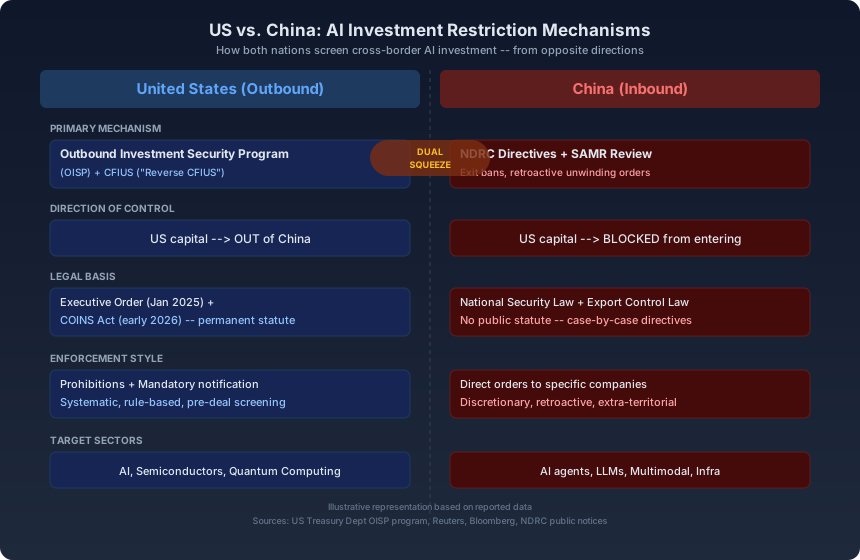 Data sources: NDRC foreign-investment security review notice, US Treasury OISP materials, 31 CFR Part 850, COINS Act legal analysis
Why The Offshore Structure Did Not Settle The Issue
A cross-border AI deal usually begins with an entity chart. In the Manus case, that chart is not enough.
For diligence, separate five layers:
| Layer | What to verify | Why it matters |
|---|---|---|
| Holding company | Jurisdiction, shareholders, board control, investor rights | Determines corporate law and acquisition mechanics |
| Operating entities | China, Singapore, Cayman, US, or other subsidiaries | Shows where people, contracts, and assets actually sit |
| IP ownership | Code, model weights, trademarks, patents, data rights | Determines whether the buyer can actually receive the asset |
| Development history | Where core code and product know-how were created | Can trigger export-control or national-security review concerns |
| People and data | Founder location, key engineers, customer data, training/workflow data | Often creates the practical enforcement lever |
What Acquirers Should Ask Before Signing
For a China-origin AI target, the diligence memo should answer these questions before exclusivity:
- Which legal entity owns the model, agent framework, product code, trademarks, patents, and user data?
- Was any core technology developed while employees or contractors were in mainland China?
- Did any Chinese entity receive government funding, subsidies, industrial-park support, university support, or state-linked customer contracts?
- Are any founders, key engineers, or data sets still located in China?
- Has the company made any prior filing, consultation, or communication with NDRC, MOFCOM, cyberspace regulators, or export-control authorities?
- Does the target use Chinese foundation models, Chinese cloud infrastructure, or China-hosted data in a way that affects transferability?
- Could the transaction require China foreign-investment security review, export-control review, data-export review, or cybersecurity review?
- Does the US buyer face OISP notification or prohibition analysis because of its own investor status, fund structure, or controlled foreign entities?
The answer cannot be "the company is Singapore-based." That is a starting point, not a conclusion.
Investor Risk Map
The Manus decision creates four practical risk buckets.
First, closing risk. The buyer may need China clearance or at least a reasoned China review position before signing. A condition precedent is better than trying to solve a national-security issue after integration begins.
Second, unwind risk. The NDRC notice's language about revoking the transaction should make buyers think about reverse break fees, integration covenants, IP-transfer timing, and employee movement before closing.
Third, information-rights risk. Even minority investors should ask whether board seats, observer rights, technical information access, or model-development visibility could create a regulatory issue under US or Chinese rules.
Fourth, founder and personnel risk. AI assets are often people-heavy. If key staff cannot move, sign assignments, provide transition support, or continue working for the combined company, the buyer may not receive what it thought it bought.
What The Public Record Still Does Not Prove
The public record does not show the full transaction agreement, the complete Manus entity chart, the IP assignment chain, the exact assets China considered sensitive, or the internal analysis used by China's security-review office. That matters because buyers should not turn one prohibition notice into a universal rule that every China-founded AI asset will be blocked.
The stronger lesson is narrower and more useful. The official notice proves that China was willing to prohibit and require revocation of a foreign acquisition of the Manus project. It does not prove the same outcome for a passive minority investment, a non-controlling commercial partnership, a cloud resale arrangement, or a purely offshore asset with clean non-China development records.
This distinction is important for diligence. A buyer memo should separate confirmed facts from risk inferences. Confirmed facts include the NDRC-linked prohibition notice, the existence of China's foreign-investment security review regime, the US OISP rules, and the COINS implementation caveat. Risk inferences include whether a specific future AI target has enough China-linked personnel, code, data, or IP history to trigger a similar review. Mixing those two layers can create either false comfort or unnecessary deal panic.
In practice, the right answer is a two-column file: what the sources directly prove, and what the deal team must still verify through documents, interviews, counsel memos, and regulator outreach.
What This Means For China-Origin AI Startups
For founders, the deal lesson is uncomfortable but clear. Moving headquarters offshore can solve some market-access problems, but it does not erase the origin story of the technology. If the company wants global M&A optionality, it needs a cleaner paper trail much earlier:
- IP assignment records from day one
- entity-by-entity employee and contractor records
- clear data-location logs
- documented model and tool dependencies
- export-control analysis for technology transfer
- written advice on whether China security review could apply
- clean separation between China domestic operations and global product rights, if that is the intended structure
This is especially important for agentic AI companies. The valuable asset may not be a single model weight file. It may be an orchestration layer, workflow memory, action logs, user task data, browser automation stack, and a team that knows how to make the system reliable. That bundle is harder to diligence than a normal SaaS acquisition.
Reader Judgment
The Meta-Manus block should not be read as "all Chinese AI acquisitions are impossible." That is too broad.
The better judgment is narrower: China-origin AI assets now need a dual review file. One side asks whether China can object to foreign control, transfer, or unwinding of a strategic technology asset. The other asks whether US investors, acquirers, or funds face outbound-investment restrictions when money, control, or technical assistance flows into China-linked sensitive technology.
For buyers, the practical rule is simple: do not let the entity chart outrun the source file. If the legal domicile, development history, IP ownership, data location, and personnel map do not tell the same story, the deal is not ready.
Methodology And Source Notes
This article was reviewed on 2026-07-07 after an E-E-A-T source-file pass. It uses the NDRC April 27 notice as the primary source for China's decision, Al Jazeera and legal-client alerts as secondary sources identifying the transaction as Meta-Manus, NDRC/MOFCOM foreign-investment review materials for China legal background, Treasury and 31 CFR Part 850 for the current US OISP regime, and legal analysis from Latham & Watkins and O'Melveny for COINS Act status. It treats reports about individual executives, valuation details, and transaction mechanics as reported facts unless a primary source is available. It is a diligence framework, not legal advice.
Claim Confidence File
| Claim | Confidence | Evidence boundary |
|---|---|---|
| China's NDRC-linked security-review office prohibited the foreign acquisition of the Manus project and required revocation | High | Directly supported by the official NDRC notice |
| Meta was the buyer in the blocked Manus transaction | Medium-high | Supported by multiple secondary reports and legal-client alerts; the NDRC notice itself does not name Meta in the cited text |
| Offshore headquarters alone cannot settle China-origin AI asset review risk | Medium-high | Reasoned inference from the Manus decision and China's FISR framework, but each target needs counsel-led review |
| Every China-founded AI company is unbuyable by a foreign acquirer | Low | The public record supports a specific prohibition decision, not a universal rule |
| Current U.S. OISP rules are already in force for covered outbound AI-related transactions | High | Supported by Treasury's OISP materials and 31 CFR Part 850 |
| COINS immediately replaces all OISP analysis without further implementation work | Low | Legal analyses note that some COINS changes still depend on Treasury rulemaking |
Frequently Asked Questions
Did China block Meta's acquisition of Manus?
Yes. China's NDRC-linked foreign-investment security review office said it prohibited the foreign acquisition of the Manus project and required revocation of the transaction. Al Jazeera and other outlets identified the foreign buyer as Meta.
Does a Singapore headquarters protect a China-founded AI startup from Chinese review?
Not by itself. Offshore headquarters can matter for corporate law, banking, and global operations, but regulators can still look at where the technology was developed, where key people sit, who owns the IP, and whether the asset has a China national-security nexus.
Is COINS already the active US outbound-investment rule?
The current active rule is Treasury's OISP in 31 CFR Part 850, effective since January 2, 2025. COINS was signed into law and codifies or expands the framework, but several changes still depend on Treasury rulemaking.
What should a buyer verify before acquiring a China-origin AI asset?
Verify the full entity chart, IP chain, code-development history, data location, founder and engineer location, prior Chinese filings, export-control exposure, and US outbound-investment status. A simple offshore incorporation certificate is not enough.
Related Entries
- DeepSeek V4 Preview: China AI Efficiency Signal -- DeepSeek's latest model launch
- China's 140T AI Tokens: Infrastructure Signal, Not Hype -- China's AI infrastructure scale
- DeepSeek Profile: China's AI Lab Explained (2026) -- DeepSeek company profile and source file
- China AI Token Price War: Official Prices And Buyer Risk -- China AI pricing and infrastructure pressure
- China Autonomous Driving 2026: Reality Check -- China-origin AI systems in export-sensitive markets