
The AI token price gap is no longer only a rumor from developer forums. Xiaomi's own MiMo pricing page lists MiMo-V2.5 at $0.14 per million cache-miss input tokens and $0.28 per million output tokens, and MiMo-V2.5-Pro at $0.435 input / $0.87 output. DeepSeek's official API page lists DeepSeek-V4-Flash at the same $0.14 input / $0.28 output level and DeepSeek-V4-Pro at $0.435 input / $0.87 output. OpenAI's GPT-5.5 release note lists gpt-5.5 at $5 input / $30 output and gpt-5.5-pro at $30 input / $180 output.
That spread is large enough to change application economics. It is not, by itself, proof that every Chinese model is equivalent to every Western frontier model. For a manufacturer, developer, exporter, or operations team, the useful question is narrower: when does low-cost Chinese inference become usable capacity, and when is it only a risky quote? The buyer problem is that a token price does not reveal model reliability, data governance, uptime, jurisdiction, version stability, or whether the provider can keep pricing stable.
Source File
This article was reviewed on 2026-07-03 against official API pricing pages from OpenAI, OpenAI's GPT-5.5 pricing note, DeepSeek, and Xiaomi MiMo, plus Reuters and Bloomberg reporting on Chinese AI pricing pressure where available. Platform token-share figures are treated as snapshots, not permanent market-share numbers. This article is framed as a buyer/operator file: the price war matters only where the workload, controls, and total cost of ownership make the cheaper token usable.
Quick Judgment
| Buyer question | Practical answer |
|---|---|
| Are Chinese AI tokens meaningfully cheaper? | Yes, especially for high-volume input-heavy workflows and budget model tiers. |
| Does cheaper mean equivalent? | No. Quality, hallucination rate, long-context reliability, latency, and data controls vary by provider and workload. |
| Is the low price structurally supported? | Partly. Electricity, architecture, and platform economics help, but below-cost pricing and recent price hikes show stress. |
| Who benefits first? | Teams running translation, support, summarization, internal search, catalog cleanup, coding assistance, and non-critical agents. |
| Who should be cautious? | Regulated, safety-critical, customer-facing, IP-sensitive, and audit-heavy enterprise workflows. |
The Official Price Table That Matters
Current inference pricing tells a clear story at the list-price level. These are not normalized benchmark-adjusted prices; they are public API prices that should be rechecked before procurement.
| Provider / model | Source status | Input ($/M tokens) | Output ($/M tokens) | Buyer note |
|---|---|---|---|---|
| Xiaomi MiMo-V2.5 | official Xiaomi MiMo pricing page | $0.14 cache miss | $0.28 | low-cost multimodal tier; cache-hit price is lower |
| Xiaomi MiMo-V2.5-Pro | official Xiaomi MiMo pricing page | $0.435 cache miss | $0.87 | closer to DeepSeek Pro pricing |
| DeepSeek V4 Flash | official DeepSeek API docs | $0.14 cache miss | $0.28 | budget tier with 1M context |
| DeepSeek V4 Pro | official DeepSeek API docs | $0.435 cache miss | $0.87 | higher-capability tier |
| OpenAI GPT-5.4 | official OpenAI model page | $2.50 | $15.00 | stronger general model, materially higher list price |
| OpenAI GPT-5.5 | official OpenAI model page | $5.00 | $30.00 | flagship frontier tier |
| OpenAI GPT-5.5 Pro | official OpenAI model page | $30.00 | $180.00 | premium accuracy tier; not a budget comparison |
The usage signal is widening fast. China's daily AI token consumption hit 140 trillion in March 2026, up more than 40% from the end of 2025 according to the official disclosure reported by TechNode. As our analysis of China's 140 trillion daily tokens documented, this growth should be read as an infrastructure adoption signal, not as audited proof of model superiority.
Three Structural Enablers of China's Cost Advantage
The price gap is not arbitrary. Three distinct structural factors make it possible, and understanding them is essential for predicting where pricing goes next.
Power and infrastructure policy. Reuters and other market reporting point to local power-price support and data-center incentives for Chinese AI infrastructure, especially where operators use domestic chips. Treat the exact subsidy level as location- and contract-specific, not a universal national tariff. The durable point is that inference cost in China is being shaped by energy policy, cloud competition, and domestic-chip industrial policy together.
Architectural efficiency. Chinese model developers have leaned heavily into sparse and mixture-of-experts designs that reduce active compute per token. DeepSeek and Xiaomi both present efficiency as part of the product story. Buyers should not assume efficiency equals quality, but it helps explain why the low price floor is technically plausible rather than only subsidized.
Platform pricing. Some Chinese providers may use model access to pull developers into broader cloud, storage, agent, and enterprise-service ecosystems. That does not mean every low price is below cost. It means buyers should evaluate the whole platform bill, not only the model line item.
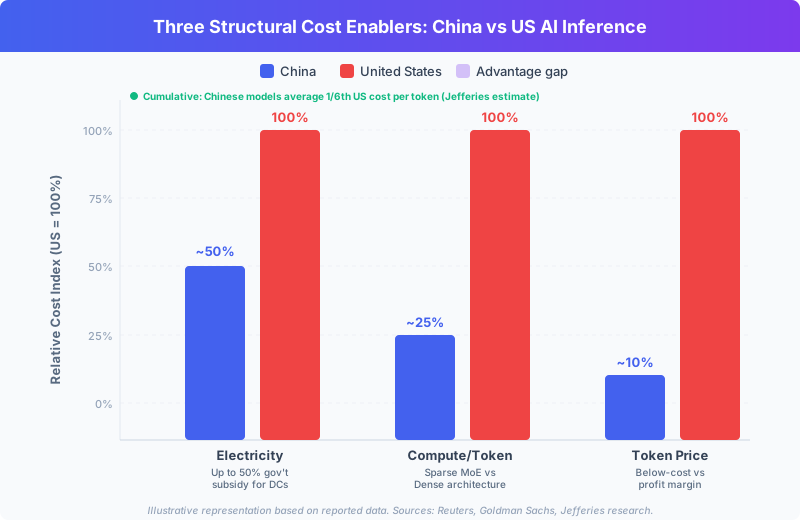 Data sources: official OpenAI, DeepSeek, and Xiaomi pricing pages; Reuters and market reporting for infrastructure context.
The manufacturing analogy is useful. A low factory quote can be real and still be incomplete. The quote may exclude certification, warranty support, logistics, tooling amortization, quality inspection, or after-sales service. Token pricing works the same way. The API price is one line in the cost file, not the whole landed cost.
| Cost layer | What the token price hides |
|---|---|
| Model quality | reruns, human review, hallucination cleanup |
| Data governance | security review, redaction, private deployment, audit logs |
| Reliability | retries, latency buffers, multi-provider fallback |
| Integration | prompt migration, eval harnesses, monitoring, version pinning |
| Compliance | customer policy, jurisdiction, export-control or data-transfer limits |
| Exit cost | switching providers when prices rise or model behavior changes |
The Contradictions: Cracks in the Foundation
The race-to-the-bottom narrative has significant contradictions that complicate the story and suggest the current pricing regime is not stable.
Alibaba raised prices 34%. On March 18, 2026, Alibaba increased AI computing prices by up to 34%, citing surging demand that outstripped infrastructure capacity. This is the opposite of what you expect in a price war — it suggests that even China's largest cloud providers are finding the current pricing unsustainable at scale. When the company with the most data center capacity in China decides to charge more, not less, the market is sending a signal about cost structure.
Zhipu raised prices 83%. Zhipu AI, backed by Alibaba and Tencent, raised its API prices by 83% in early 2026. In a surprising twist, call volumes rose after the price increase, suggesting that at least some developers value reliability and quality over rock-bottom pricing. This mirrors patterns seen in cloud infrastructure markets where the cheapest provider rarely captures the most enterprise revenue. Zhipu has also stated that the price war will spread internationally — a signal that below-cost pricing is viewed as a competitive weapon, not just a domestic dynamic.
A Tencent executive called tokens "non-sticky." Li Qiang, a vice president at Tencent, described token sales as a "non-sticky business" — meaning customers switch providers freely based on price, making it difficult to build durable competitive advantages. This is an unusually candid assessment from a major platform player, and it undercuts the narrative that below-cost pricing builds lasting market position.
Three providers raised prices in February 2026 alone. That is a sustainability signal, not a sign of confidence.
The Counter-Narrative: Tokens Are Not Fungible
Reuters Breakingviews argued in April 2026 that the "token obsession may be misguided" — and the data supports this view more than the headline pricing suggests.
Quality still commands a premium. A bank's risk model, a legal document workflow, a medical triage system, and a factory safety workflow are not interchangeable with a consumer chatbot. For these workloads, price per token matters less than accuracy, repeatability, auditability, and liability.
Benchmarks are not your workload. Public benchmark results and third-party hallucination tests can help screen providers, but they should not be treated as production evidence. The high-standard buyer test is a private evaluation set built from the buyer's own documents, code, images, tickets, defects, or supplier files.
Hardware constraints still shape the ceiling. Huawei Ascend, Cambricon, and other domestic accelerators are improving, but the export-control environment still shapes what Chinese providers can train and serve economically. Low-cost inference is partly a response to that constraint: if hardware access is constrained, efficiency and utilization become strategy.
The distinction matters: Chinese models can be cheaper for tasks where "good enough" is sufficient and the output can be reviewed. Premium Western models may still be the safer default where correctness, auditability, and liability dominate the decision. These are different markets with different economics, and the buyer should test the workload rather than infer quality from price.
Workload Fit: Where Cheap Chinese Inference Is Most Useful
The price war matters most when the task has high token volume, clear quality checks, and low downside from a wrong answer.
| Workload | Fit | Why |
|---|---|---|
| Product-catalog translation and cleanup | Strong | high volume, easy human spot-checking, measurable terminology errors |
| Supplier-email summarization | Strong | low cost changes daily operating behavior, but sensitive files still need controls |
| Customer support draft replies | Medium | useful with human approval and escalation rules |
| Internal document search | Medium | depends on retrieval quality and data policy |
| Code assistant for non-critical tooling | Medium | needs security review and repository-access limits |
| Contract, medical, finance, or safety decisions | Weak without heavy validation | accuracy, auditability, and liability outweigh token savings |
| Robot control or factory automation decisions | Weak unless edge validated | latency, fail-safe design, and certification dominate API price |
Who Survives: Financial Reality Check
The financial data from China's AI startups reveals how much blood is on the floor, and it paints a stark picture of an industry burning cash to buy market share.
Reported losses matter, but provider-level evidence is uneven. Some Chinese AI startups have been reported to carry heavy losses relative to revenue. Treat those numbers as company-specific financial signals, not as proof that every low-cost API is unsustainable.
Cloud-backed providers have a different risk profile. A model provider attached to a large cloud platform can price tokens differently from an independent lab because storage, deployment, enterprise software, and compute services may carry the margin.
DeepSeek's official pricing shows discipline as well as aggression. V4 Flash is extremely cheap, but V4 Pro is priced higher. That tiering matters. It suggests Chinese providers are not only racing to zero; they are segmenting workloads by capability and willingness to pay.
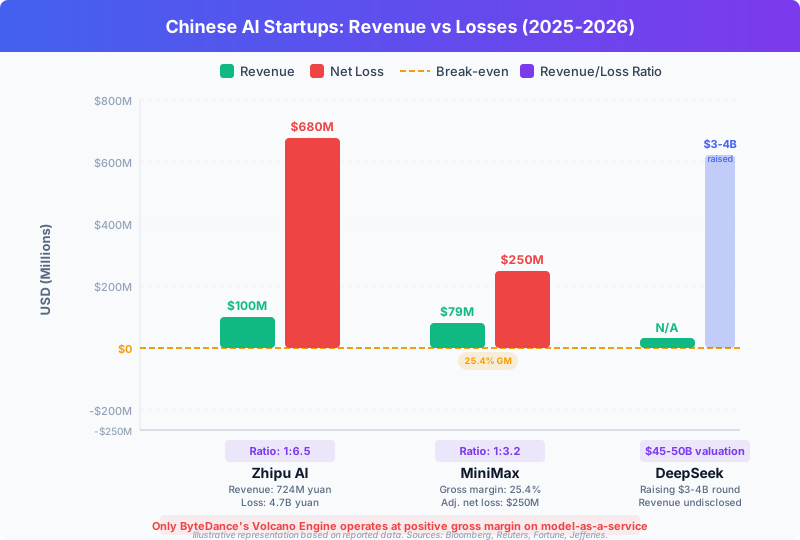 Data sources: official pricing pages and market reporting. Company financial figures should be checked against the latest filings or financing disclosures before investment use.
The consolidation signals are already visible. Smaller providers without cloud platform backing (and thus without the "model as bait" subsidy model) are being squeezed out. The survivors will likely be those attached to major cloud platforms: ByteDance's Volcano Engine, Alibaba Cloud, Tencent Cloud, and possibly Huawei Cloud. Independent model providers without platform revenue will struggle to compete on price while funding continued R&D. Fortune's reporting on the Chinese token economy notes that the startup bloodletting is accelerating consolidation toward the big four platforms.
This supplier-risk lens matters for enterprise users. If a provider prices aggressively to win workload but later raises prices, changes model behavior, or exits a tier, the buyer inherits migration cost. The right diligence question is therefore not "which API is cheapest today?" It is "which provider can support this workflow for the next 24 months without breaking quality, price, or data controls?"
Verification Checklist Before Moving Workloads
| Check | Evidence to request or test |
|---|---|
| Effective price | input/output price, cache policy, volume tiers, regional routing, minimum spend |
| Quality on real workload | evaluation set using your own documents, tickets, catalogs, images, or code |
| Model-change policy | version pinning, deprecation notice, regression testing window |
| Data controls | retention period, training opt-out, private deployment option, audit logs |
| Latency and uptime | region-specific SLA, rate limits, throttling behavior under load |
| Human review loop | escalation threshold for high-impact outputs |
| Exit path | prompt portability, fallback provider, export format for logs and embeddings |
What This Means for Global AI Economics
The strategic framework behind Chinese pricing is not new. It resembles the "commoditize your complement" playbook: if inference becomes cheap enough, the value shifts to adjacent layers such as cloud infrastructure, application development, data pipelines, domain-specific fine-tuning, workflow software, and enterprise support.
If inference costs fall another order of magnitude, the distinction between cheap and very cheap becomes less important than reliability, governance, fine-tuning quality, and compliance guarantees. The closer token prices move toward zero, the more buyers should inspect the surrounding platform.
The real question is sustainability. American providers are trying to support frontier-model economics at higher prices. Chinese providers are trying to expand adoption at lower prices, often with platform, cloud, or ecosystem revenue around the model.
Both bets could prove correct. Or both could prove wrong. What is clear is that the current divergence cannot persist indefinitely. Either Chinese companies find a path to profitability at these prices, or prices rise to sustainable levels — in which case the cost advantage narrows significantly. The first scenario requires massive volume growth. The second scenario undermines the entire strategic rationale for below-cost pricing.
The reader judgment is therefore conditional. Cheap Chinese inference is already changing the cost floor for measurable, reviewable, high-volume tasks. It is not yet a universal replacement for frontier US models in high-stakes enterprise work. The winners will be teams that split workloads intelligently: low-cost models for volume, premium models for correctness-sensitive tasks, and a governance layer that makes the difference visible.
Claim Confidence File
| Claim | Confidence | Evidence boundary |
|---|---|---|
| Chinese model providers are quoting materially lower token prices than frontier US references in the article | High for the cited snapshots | Anchored to official pricing pages cited in the Source File; prices can change without notice. |
| Low token cost can change application economics for manufacturers and operators | Medium-high | A buyer inference from pricing spreads; workload quality, uptime, governance, and integration costs still determine usable savings. |
| Lower listed token price proves model equivalence | Low | The article rejects this; benchmarks, latency, reliability, context behavior, and data controls require buyer testing. |
| The price war will remain stable at current levels | Low | The article treats pricing as a volatile market signal, not a durable contract term. |
Methodology Note
Pricing data was rechecked on 2026-07-03 against official OpenAI, DeepSeek, and Xiaomi MiMo pricing/model pages. Prices are public list prices per 1 million tokens and can change by model version, cache status, context length, region, enterprise contract, batch mode, and data-residency setting. Financial and market-structure comments are based on public reporting and should not be treated as investment analysis.
Frequently Asked Questions
Why are Chinese AI models so much cheaper than OpenAI?
Three factors appear to drive the gap: power and data-center policy, efficient model architectures that reduce active compute per token, and platform pricing where model access helps sell broader cloud or workflow services. The exact economics differ by provider, chip stack, cache rate, and enterprise contract.
Is Chinese AI quality comparable to OpenAI and Anthropic?
For general-purpose tasks such as summarization, translation, draft generation, and basic code assistance, leading Chinese models can be cost-effective. That does not prove equivalence for regulated, safety-critical, or high-liability work. Buyers should run their own evals on private documents, code, images, tickets, or defect data before moving production workflows.
Will the AI price war continue through 2026?
Signals are mixed. Some providers have cut prices, while others have introduced higher premium tiers or changed price schedules after demand increased. The most likely outcome is bifurcation: budget models stay cheap for high-volume workloads, while premium tiers charge more for reliability, reasoning quality, context length, data controls, and enterprise support.
What does AI commoditization mean for developers?
Lower inference costs benefit developers directly — applications that were too expensive to run at $15/M output tokens become viable at $0.28/M. The risk is vendor lock-in through platform integration. When the model is cheap but the surrounding cloud services are proprietary, the real cost shifts to data egress, storage, and compute for fine-tuning. Developers should evaluate total cost of ownership, not just token price.
Can Chinese AI companies survive at these price points?
Some independent model companies face a harder path than cloud-backed providers because they must fund model development while selling inference into a falling-price market. Survival depends less on the headline token price and more on whether the provider can sell durable platform, enterprise, deployment, or workflow revenue around the model.
Should developers switch to Chinese AI models?
For non-critical workloads such as content drafting, summarization, prototyping, translation, catalog cleanup, and internal support, Chinese models such as DeepSeek, Qwen, MiMo, and Doubao may offer material cost savings. For enterprise deployments requiring high accuracy in finance, legal, healthcare, safety, or customer-facing decisions, run workload-specific evaluations and assess total cost of ownership rather than token price alone.
By China Made & Tech Team. Independent English field guide to China's niche hardware brands, hidden champions, founders, factory towns, and supplier clusters.
Related Entries
- China's AI infrastructure scale — how official token-volume disclosures should be read
- DeepSeek Profile: China's AI Lab Explained (2026) — DeepSeek: the Chinese AI lab that shook Silicon Valley