
By China Made & Tech Team
As of August 18, 2026, the most important fact for a U.S. drone buyer is also the easiest one to miss: China’s August 5 measure is not a blanket ban on every Chinese drone entering the United States.
The Ministry of Commerce announcement says that drones, key components, and related technologies already included in China’s dual-use item control list, when exported to the United States, will face strict case-by-case review and will not receive license-facilitation treatment. The announcement took effect immediately.
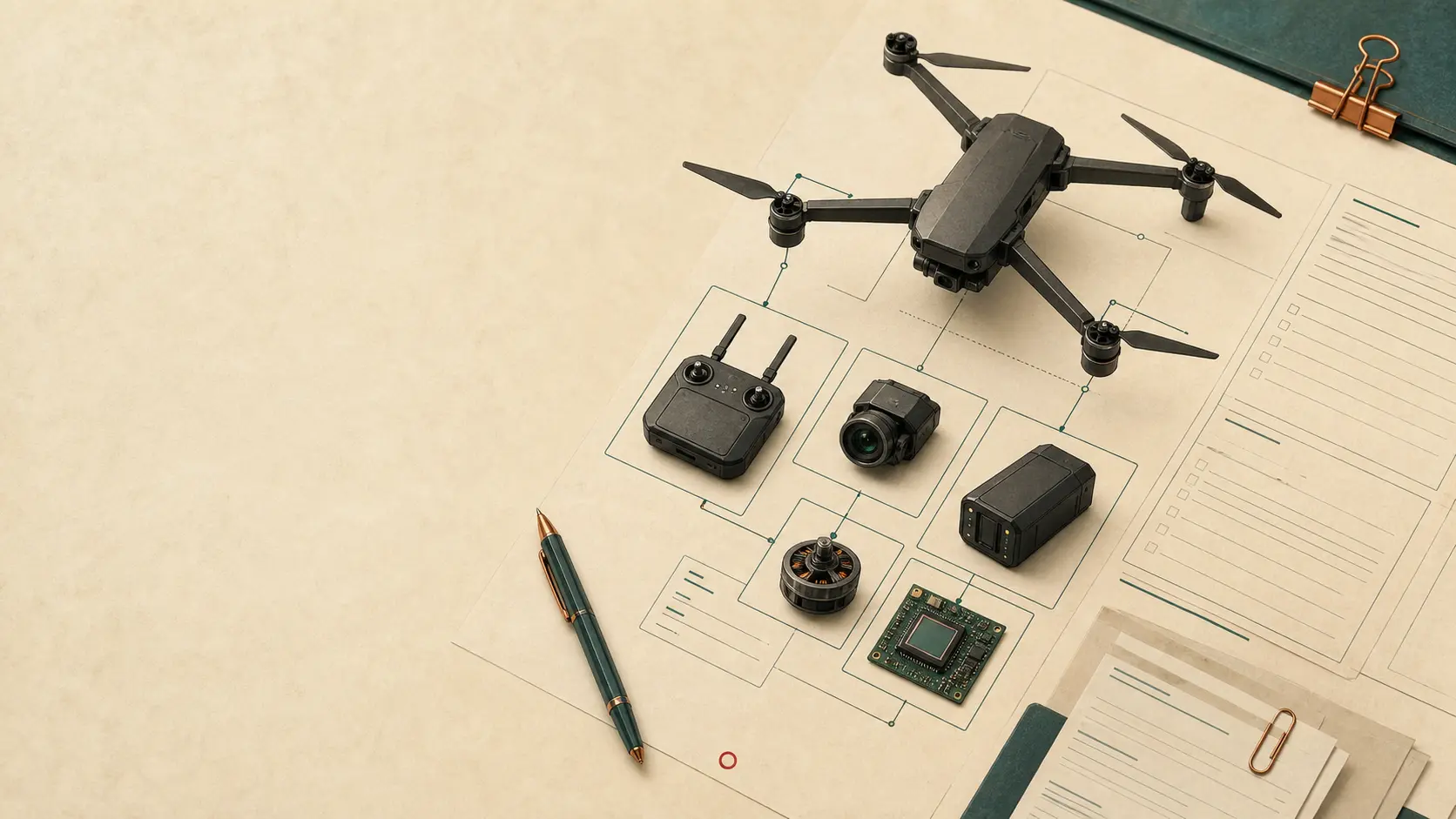
That wording creates a transaction problem, not just a headline. A buyer cannot answer the question with “the drone is Chinese” or “the product is civilian.” The relevant file may include the airframe, flight controller, communications link, ground station, navigation module, camera or sensor, battery-management system, motor, software, technical data, spare parts, and post-sale support. It also includes the importer, end user, end use, destination, route, contract, and any change after the original application.
There is a second source of confusion. The Chinese export-license question and the U.S. Federal Communications Commission question are separate. The FCC’s Covered List notice addresses whether certain foreign-produced unmanned aircraft systems and critical components can receive new FCC equipment authorization. It does not decide whether China will issue an export license. China’s notice does not decide whether a new U.S. model can receive FCC authorization.
The useful response is an order-to-license file: one set of linked records with separate owners for item classification, China-side licensing, U.S. authorization, import review, service, and change control. If the file is incomplete, the buyer does not need to predict the regulator’s answer. The buyer needs to narrow the order, escalate it, or hold it before payment and shipment.
What changed on August 5
The August 5 announcement changes the review posture for a defined class of exports. It does three things that matter immediately to procurement:
- It points to drones, key components, and related technologies that are already in the dual-use item control list.
- It applies when those listed items are exported to the United States.
- It says the applications will be reviewed strictly and case by case, without license-facilitation treatment.
It does not publish a model-by-model list of every drone that can no longer ship. It does not say that every China-origin drone, battery, camera, motor, or software update is automatically prohibited. It does not turn a commercial product description into a legal classification.
Independent reporting from the Associated Press places the measure in a wider U.S.-China technology and trade escalation and describes the same case-by-case review language. That context explains why the announcement arrived. It does not replace the primary source when a buyer needs to classify an item.
The first procurement question should therefore be narrow:
> Is this exact item, in this exact configuration, with this technical description, destination, importer, end user, and end use, on or connected to a controlled dual-use entry—and what evidence supports the answer?
That is a different question from “Is this a Chinese drone?” The country label may start the review. It does not finish it.
Three gates that must stay separate
Treat the order as three parallel gates rather than one geopolitical risk score.
| Gate | What it asks | Primary owner | What it does not prove |
|---|---|---|---|
| China item and transaction gate | Is the item in scope, and is the application file consistent enough for the Chinese export-control process? | Supplier/export-control team, with buyer review | It does not prove U.S. FCC authorization or customs clearance. |
| U.S. FCC gate | Can a new foreign-produced UAS or critical component receive the equipment authorization needed for the intended U.S. market path? | U.S. manufacturer, applicant, importer, or regulatory counsel | It does not grant China export permission. |
| Buyer release gate | Are the importer, end user, end use, route, contract, support, change-control, and destination requirements owned and documented? | Buyer procurement/compliance and its qualified advisers | It does not substitute for a regulator’s decision. |
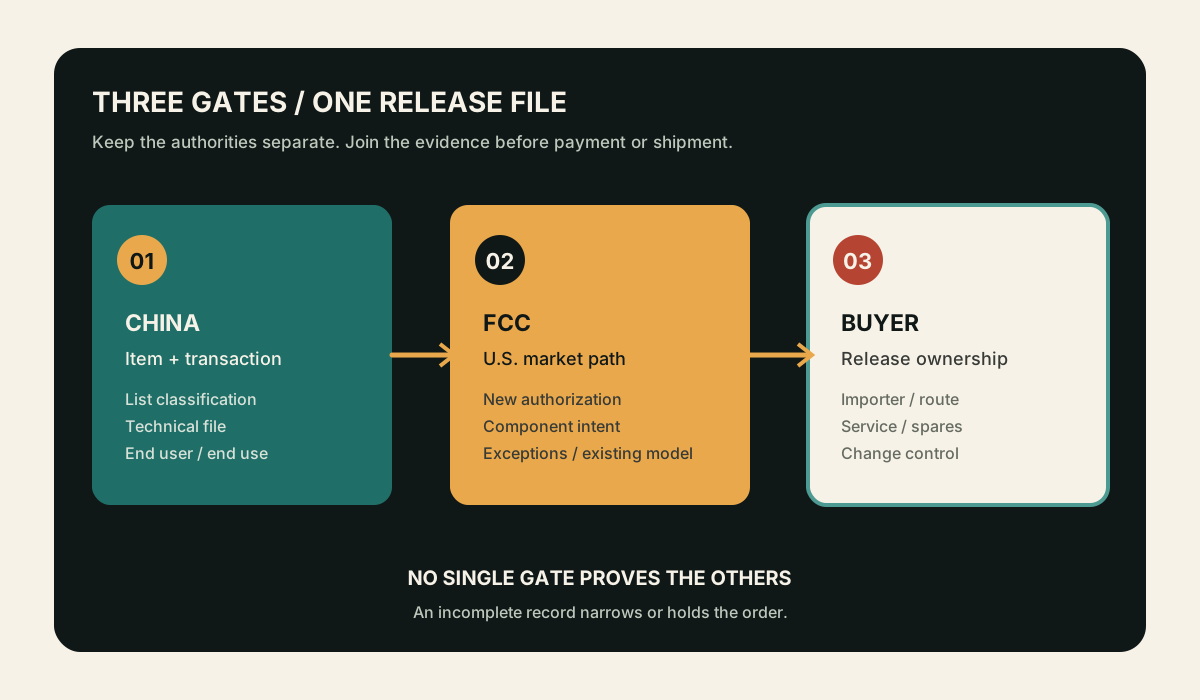 Editorial diagram: the three gates are separate decisions joined by the buyer’s evidence file.
The item-classification gate: a civilian label is not enough
The August notice points back to China’s existing dual-use control structure. The 2026 dual-use item and technology license directory is an administrative reference, and the official database warns that the official list controls if the database and the list differ.
China’s official license-application guidance makes the practical implication clear: classification depends on the item and its technical facts. The guidance gives drone-related examples of performance information such as maximum endurance, wind resistance, maximum range, and aerosol-dispenser capacity. Those details are not decoration. They are the kind of facts that allow an exporter and reviewer to compare the product with the relevant control entries.
That means a buyer should be suspicious of four shortcuts:
- “It is sold for agriculture, mapping, inspection, or photography, so it is automatically civilian.”
- “The model name is enough; the supplier can classify it without a technical file.”
- “Only the aircraft body matters; the controller, battery, camera, or firmware is just an accessory.”
- “A freight forwarder can decide whether the shipment needs a license.”
The fourth shortcut is particularly risky. A logistics provider can help execute an approved shipment, but that does not make the forwarder the owner of technical classification or end-user/end-use diligence. The buyer should know who owns the classification memo, who signs the end-use representation, who applies for the license, and who must stop the shipment if the facts change.
What to request before the quote becomes an order
Ask the supplier for a product file that is specific enough to be reviewed. At minimum, request:
- Exact manufacturer, exporter, model, revision, and configuration identifiers.
- Airframe dimensions, maximum takeoff weight, payload, endurance, range, wind-resistance rating, and any other performance parameters used in the supplier’s specification.
- Flight-controller type, navigation system, communications/data link, ground station, remote controller, cameras, thermal or multispectral payloads, and battery-management system.
- Technical data sheets, test reports, user manuals, firmware or software descriptions, and a list of included and optional modules.
- Whether a component is made for general industrial use or primarily designed or intended for a UAS system.
- Production location for the aircraft and each critical component, rather than only the seller’s headquarters or brand country.
- Whether the quote includes technical assistance, calibration, training, remote diagnostics, software updates, or repair documentation.
Do not turn this request into a declaration that any one component is controlled. The point is to make a fact-specific review possible. If the supplier cannot describe the system at this level, the file is incomplete before a lawyer or export-control specialist can give a useful view.
Why the aircraft is not one SKU
The FCC’s UAS guidance uses a component concept that reaches beyond the airframe. The FCC FAQ discusses data-transmission devices, communications systems, flight controllers, ground stations and controllers, navigation equipment, sensors and cameras, batteries and battery-management systems, motors, and associated software. It also explains that the design and primary intended use of a component matter; a generic battery or motor is not automatically covered merely because a drone company could use it.
This is an FCC framework, not a substitute for China’s dual-use list. But it is a useful way to build a buyer’s system map.
| System layer | What can be hidden in the quote | Evidence to request | Buyer risk if omitted |
|---|---|---|---|
| Airframe and flight system | Exact revision, payload interface, flight controller, navigation, and autonomy functions | Configuration sheet, revision history, technical parameters, manuals | The delivered configuration may differ from the one initially reviewed. |
| Communications | Data link, radio, video link, telemetry, encryption or network module | Module list, radio information, software/firmware description, intended-use statement | A “controller” may carry a separate communications and authorization question. |
| Ground control | Remote controller, ground station, tablet, antenna, docking station, charging cabinet | Full system BOM, controller model, station architecture, software dependencies | The aircraft may be unusable or unreviewed without the ground system. |
| Navigation | GNSS, inertial unit, terrain or obstacle sensing, precision positioning | Navigation and sensor specifications, interface map, use case | A high-performance navigation module may matter more than the brand label. |
| Imaging and payload | RGB camera, thermal camera, multispectral sensor, mapping payload, agricultural dispenser | Payload model, resolution and performance parameters, export classification support | A payload can change the technical description and end-use story. |
| Power | Battery cells, smart battery, BMS, charger, power-distribution board, motors | Battery/BMS and motor identifiers, production origin, service instructions | Replacement packs or motors can become an unplanned support dependency. |
| Software and data | Firmware, control software, cloud account, SDK, mapping data, remote diagnostics | Software bill of materials, update method, access roles, data path, technical-support terms | A shipment may pass as hardware while the support path remains unresolved. |
| Spares and repair | Replacement camera, motor, controller, battery, board, calibration tool, technical manual | Spare-parts list, repair process, return route, technical-data boundary, change notice | The initial order may be acceptable while later repairs create a new review event. |
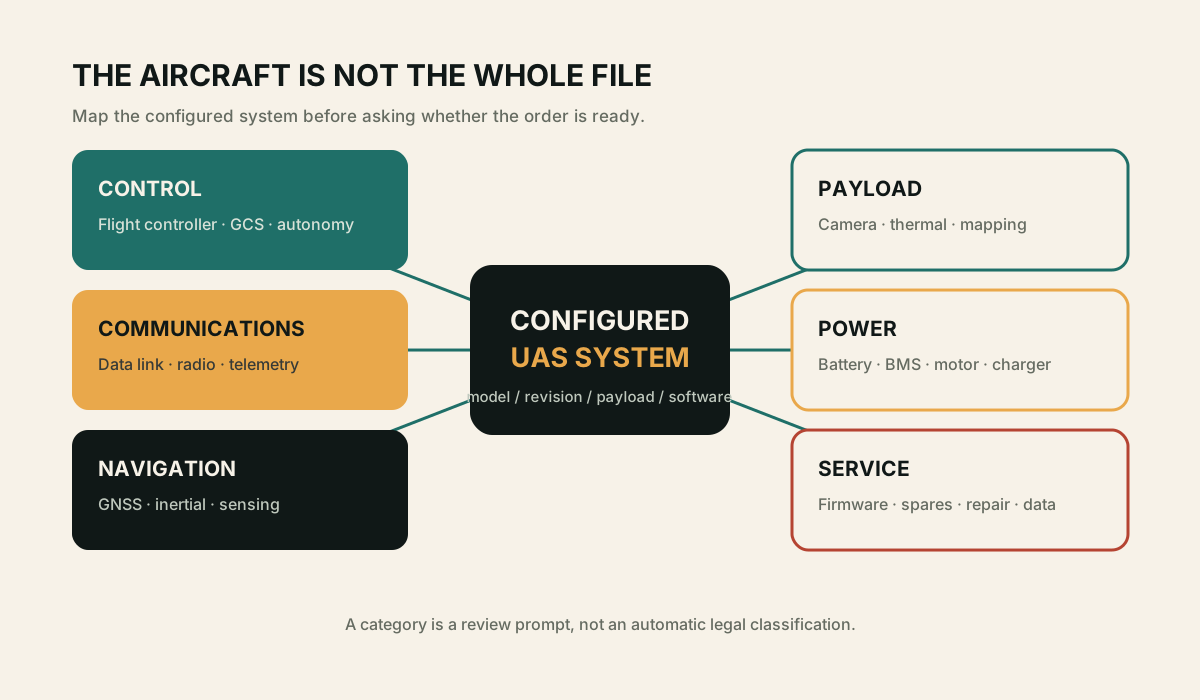 Editorial diagram: component categories are review prompts, not automatic legal classifications.
The China license file: technical facts plus transaction facts
The Chinese guidance describes a paperless application process and asks for more than a product brochure. Depending on the application, the file can include the application form, contract or agreement, technical description or test report, end-user/end-use proof, importer and end-user profiles, identification materials, and concrete performance parameters.
The buyer should read that as a consistency test. The same model, quantity, route, importer, end user, and end use should appear consistently across the quote, contract, technical description, end-user document, application, invoice, packing list, and shipping record. A buyer should not assume that a one-line “civilian use” statement can cure contradictions elsewhere.
The six-part China-side file
Build the supplier discussion around six folders.
#### 1. Item identity
Record the manufacturer, exporter, model, revision, serial-number logic, configuration, included modules, optional modules, and spare parts. If the supplier changes a camera, battery, controller, or software version, the change should be visible in the file.
#### 2. Technical description
Capture the performance facts used for classification: endurance, range, wind resistance, payload, sensors, navigation, communications, control architecture, and relevant environmental or operating limits. Keep the technical description consistent with the production configuration, not just the marketing page.
#### 3. Transaction evidence
Keep the quote, purchase contract, invoice logic, quantities, Incoterms if used, payment terms, shipping route, destination, and any distributor or reseller involved. A supplier’s willingness to sign a contract is not proof of license eligibility, but an incomplete transaction file makes review harder.
#### 4. Importer and end user
Identify the U.S. importer, consignee, ultimate end user, parent entity where relevant, operating site, and any intermediary. Ask who will possess, operate, maintain, resell, or integrate the system. If the buyer is purchasing for a customer, the customer should not disappear behind a generic distributor description.
#### 5. End use
Describe the application in concrete terms: inspection of what asset, mapping of what area, agricultural use on what crop, research at what site, or training for what operator group. The purpose is not to produce an attractive narrative. It is to give the exporter and reviewer an accurate, stable description of what the system will do.
#### 6. License and record trail
Ask who is responsible for the application, what license or approval reference will be provided if one is issued, how the shipment is matched to that reference, and how records are retained. Do not accept a verbal “approved” status as the whole file.
The Chinese dual-use export-control regulation also makes the end user and end use part of the transaction’s continuing control logic. If the user, use, route, or material facts change, the exporter and buyer should stop and recheck rather than treating the change as a harmless post-sale update.
End-user and end-use questions for the buyer
Before payment, ask the supplier and your own compliance owner to answer these questions in writing:
- Who is the ultimate end user, and does the shipping entity differ from the operating entity?
- Where will the aircraft, controllers, batteries, payloads, and spares be stored and operated?
- What is the specific application and what is outside the stated use?
- Will any distributor, integrator, contractor, university, public body, or reseller receive access?
- Will the system be exported, re-exported, leased, transferred, or demonstrated to another party after arrival?
- Does the contract restrict changes in end user, end use, route, configuration, or destination without prior review?
- Who is allowed to request firmware, SDK, cloud, mapping, calibration, or repair support?
- What happens if the buyer changes the payload, controller, battery, operating site, or customer?
These questions do not decide whether a license is required. They expose the places where the transaction file can become inconsistent.
The U.S. FCC gate is separate
On December 22, 2025, the FCC added foreign-produced UAS and UAS critical components to its Covered List. The FCC notice says covered equipment cannot receive new equipment authorization. The FAQ explains the practical market-access consequence: a new model that needs FCC authorization can face a serious U.S. entry-to-market problem if it falls within the Covered List.
This is not the same as saying that every foreign-made drone already in the United States must be removed, or that China’s August 5 measure grants or denies an FCC approval. The FCC FAQ preserves several distinctions:
- Existing models that already received FCC authorization are treated separately from new authorization applications.
- Lawfully purchased and already authorized equipment is not automatically erased by the Covered List update.
- The FAQ describes temporary exceptions through January 1, 2027 for items on the Blue UAS Cleared List and qualifying domestic end products.
- The FCC describes a conditional-approval path and says entity nationality alone is not the decisive production test.
- A generic battery, motor, or other component may not need FCC authorization in the first place; the component’s design and primary intended UAS use matter.
The FCC fact sheet and FAQ is therefore essential for avoiding two opposite mistakes: assuming a new Chinese model is market-ready because it has a China export path, or assuming every existing drone and generic part is automatically unusable.
What to ask the U.S. authorization owner
For a new model or a major configuration, request:
- The exact equipment-authorization status for the aircraft, controller, radio, ground station, and any component that needs its own authorization.
- The applicant, grantee, model number, revision, and configuration covered by the authorization.
- Whether the intended U.S. product is the same configuration as the authorized product.
- Whether the proposed path depends on Blue UAS, a qualifying domestic end product, conditional approval, or another exception.
- Which component or production facts support the claim that the product is outside or inside the Covered List.
- What is grandfathered, and what happens when the product changes its controller, radio, firmware, payload, or manufacturing site.
Do not let a supplier answer a U.S. FCC question with a China export-license document. Do not let a U.S. distributor answer a China classification question with a domestic sales page. Each gate needs the record owned by the party responsible for it.
The order-to-license buyer file
The following matrix turns the policy into a procurement sequence. It is an editorial decision framework, not a regulator’s universal checklist.
| Stage | Buyer question | Minimum record | Owner | Hold condition |
|---|---|---|---|---|
| Quote | What exact system and configuration is being offered? | Model/revision, BOM, technical sheet, modules, spares, software scope | Supplier sales plus technical owner | Quote uses a marketing family name with no configuration. |
| Classification | Which listed entries or technical thresholds were reviewed? | Classification memo, list reference, parameters, supplier sign-off | Supplier export-control team; buyer reviews | Supplier says “civilian” but cannot show technical facts or list reasoning. |
| End user | Who will ultimately possess and operate it? | Importer, consignee, ultimate user, operating site, intermediary map | Buyer compliance and customer owner | Distributor or integrator obscures the ultimate user. |
| End use | What will the system do, where, and for whom? | End-use statement, site/application description, contract language | Buyer business owner and compliance | Intended use is vague, changes frequently, or conflicts with the application. |
| China license | What is the export path for this exact item and transaction? | Application package, supporting documents, license or approval reference if issued | Exporter and Chinese compliance owner | No responsible applicant, no status record, or inconsistent documents. |
| U.S. FCC | Can the intended U.S. model receive the required authorization? | Authorization reference, applicant, exact configuration, exception basis if any | U.S. applicant/importer/regulatory owner | New model status is assumed from an older model or an unrelated component. |
| Shipment | Does the shipping file match the approved item and route? | Invoice, packing list, serial/configuration record, route, license match | Logistics plus compliance | Part numbers, quantities, route, or consignee differ without review. |
| Support | What happens after arrival? | Repair, spare, firmware, SDK, cloud, calibration, data, and access terms | Service and technical owners | Support is remote or undocumented and no one owns future review. |
| Change | What changes require a stop and recheck? | Change-notice clause, approved change log, new classification/FCC review where needed | Contract owner and compliance | Payload, controller, battery, user, destination, site, route, or use changes informally. |
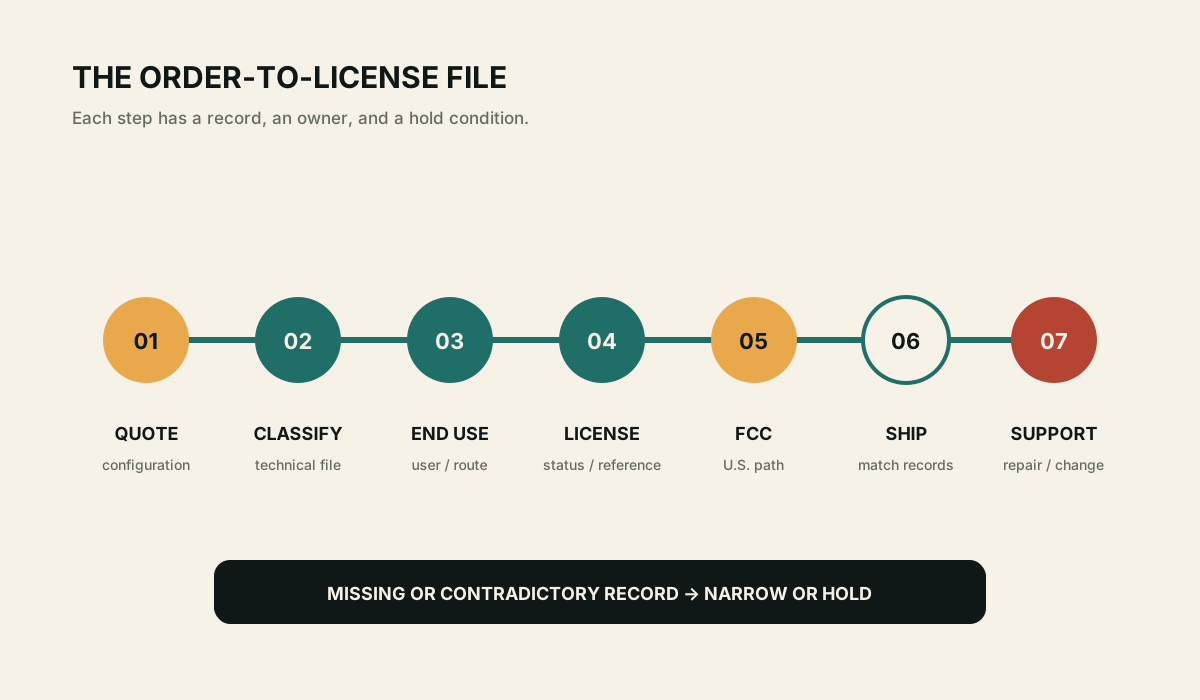 Editorial diagram: each step needs a record owner and a hold condition.
Four common procurement scenarios
Scenario 1: A low-cost consumer drone for internal photography
The seller says it is a civilian product and ships globally. That is not enough to close the file. The buyer should still record the exact model, production origin, controller, communications path, battery, and intended use. If the item does not match a controlled list entry and the U.S. authorization path is already clear, the transaction may be lower risk. But “lower risk” is a conclusion from a completed review, not a substitute for one.
Scenario 2: An enterprise mapping drone with thermal payloads
The payload, navigation performance, communications system, and end use deserve a more detailed technical file. The buyer should not classify the airframe in isolation. The supplier should describe the aircraft and payload as delivered, identify the technical parameters used in classification, and explain whether any optional module changes the reviewed configuration.
The buyer also needs to align the business description with reality. “Commercial inspection” is more useful when it identifies the asset, operating site, customer, operator, and data workflow. A vague end-use statement can become a weak point if the actual deployment expands later.
Scenario 3: A U.S.-assembled system using China-origin components
Assembly location does not answer every question. China export control may focus on the item leaving China and the transaction facts. The FCC may focus on whether the UAS or critical component is foreign-produced, whether it needs new authorization, and whether a component is primarily designed or intended for UAS use. U.S. procurement rules may add another origin or supply-chain layer.
Treat these as separate columns in the file. Do not use U.S. assembly as an automatic answer to China export scope, and do not use Chinese component origin as an automatic answer to the FCC question without checking the exact product and authorization path.
Scenario 4: A replacement battery, motor, controller, or software package
After-sales support is where many “finished-product” files break. A replacement part may have a different manufacturer, production location, model, technical performance, or intended use from the original part. A firmware or SDK delivery may involve technical data, remote access, or a new service route. A repair return may change the shipment’s description and destination.
The right response is not to declare every spare controlled. It is to list the spares and service channels at the time of purchase, identify the owner of future review, and include a change-notice process in the contract.
What not to do
The August measure creates pressure to make a shipment look simpler than it is. That is exactly when a buyer should make the file more precise.
Do not split a system into separate packages to avoid discussing the complete configuration. Do not route an item through a third country and assume the original item, end user, destination, or license issue disappears. Do not relabel a technical component as an ordinary accessory. Do not submit a generic civilian-use statement that conflicts with the actual customer or operating site. Do not pay the balance while the supplier is still “checking” the license path. Do not let a forwarder, distributor, or sales representative become the unassigned owner of classification.
Those actions are not procurement shortcuts. They create contradictions between the technical description, contract, end-user document, invoice, packing list, route, and support record. A clean hold is easier to manage than a shipment that has to be explained after the facts have diverged.
A practical pre-payment checklist
Before releasing payment for a China-origin drone or related component headed to the United States, confirm that the file contains:
- Exact model, revision, configuration, components, payloads, spares, and software scope.
- Technical parameters that support the supplier’s classification reasoning.
- A written statement of what was checked against the current Chinese dual-use list and license directory.
- Contract, quantity, destination, route, importer, consignee, and end-user records that agree with one another.
- A concrete end-use description and a named owner for changes.
- The Chinese exporter’s license-applicant identity and documented status for the actual transaction.
- The U.S. FCC authorization status for the exact new model or critical component, including the basis for any exception or grandfathering position.
- A service file covering repairs, spare parts, firmware, SDKs, cloud access, calibration, data, and technical support.
- A change-control clause covering user, use, destination, route, payload, controller, battery, software, manufacturing site, and support changes.
- A hold rule: if a required record is missing, contradictory, or stale, who stops the order and who resolves it?
The file does not need to predict the regulator. It needs to show that the buyer has identified the relevant question, supplied the facts, assigned the owner, and avoided an unsupported release decision.
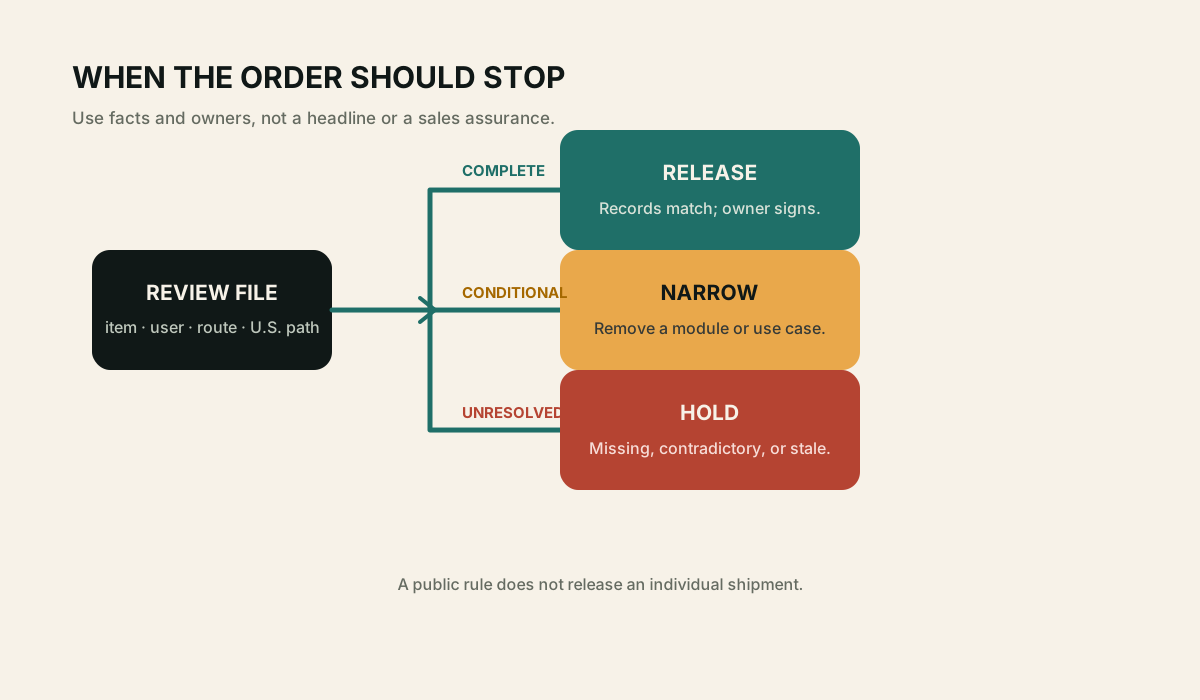 Editorial diagram: a missing or contradictory record should produce a controlled hold or narrowed scope, not an informal workaround.
Why this matters beyond one August headline
The U.S. policy environment is also emphasizing domestic drone production, secure critical components, and Blue UAS procurement priorities. The White House drone policy order is useful context for why government-facing buyers may ask more questions about origin, components, support, and supply-chain security. It is not a universal commercial prohibition.
That context matters because a drone purchase is increasingly a system purchase. The aircraft is only one visible part of the value chain. The controller, data link, navigation stack, camera, battery, software, repair route, and cloud or local-control model can determine whether the system remains useful after the initial shipment.
For a broader market-structure view, see our evergreen analysis of DJI Drone Dominance: How It Built a 70% Share. That article explains why DJI is not merely a brand in a catalog but a deeply integrated aircraft, component, software, and channel ecosystem. The procurement implication is not that DJI or any other named brand is automatically approved or rejected. It is that a buyer should understand the system dependency before asking whether a single aircraft SKU is replaceable.
After shipment: the file must stay alive
An order-to-license file is not finished when the crate reaches the warehouse. The buyer should decide in advance which post-arrival events reopen the review. This is especially important for enterprise fleets, where a drone can remain in service for years and acquire new payloads, software, controllers, batteries, and customers.
Start with a configuration baseline. Record the aircraft revision, controller, firmware version, battery type, payload, ground station, cloud or local-control mode, and the approved operating site. Give that baseline a date and owner. When a technician replaces a motor or camera, the service team should be able to say whether the replacement is the same part, an approved equivalent, or a materially different component requiring review.
Next, separate ordinary maintenance from a change in the transaction story. Cleaning, inspection, and a like-for-like replacement may be operationally routine. A new thermal payload, a different communications module, an SDK that exposes new control functions, a remote support connection from a new country, or a transfer to a new end user may change the technical, end-use, or route facts. The buyer should not write a universal legal conclusion into the maintenance manual. It should write a trigger: “stop, record the change, and route it to the named compliance owner.”
The service contract should answer five questions:
- Who can authorize firmware, software, SDK, cloud, or remote-diagnostics access?
- Where will technical data and flight data be stored, and who can access them?
- Which spare parts are included in the approved support scope?
- What happens when a failed component is returned to China, repaired, replaced, or shipped to a different site?
- How quickly must the supplier notify the buyer about a manufacturing-site, component, software, end-user, route, or regulatory change?
This is not administrative overkill. A fleet can be compliant at the first shipment and still become difficult to support if the only documented review covered the aircraft body. Conversely, a support change is not automatically a new violation. The point is to preserve a fact pattern that can be reviewed rather than relying on memory, email fragments, or a sales representative’s assurance.
For a reseller, add one more layer: do not pass the customer a generic statement that the product is “approved” unless the statement identifies which gate, which configuration, which jurisdiction, and which date it refers to. A China license reference, an FCC authorization, a customs entry, and a buyer’s internal acceptance record are not interchangeable. Keep the evidence labels precise so the next customer does not inherit a conclusion that was never made.
Method and limitations
This article is desk research reviewed on August 18, 2026. It uses the August 5 MOFCOM announcement, China’s dual-use license directory and application guidance, China’s dual-use export-control regulation, FCC records and FAQ, the White House policy order, AP reporting, and official Chinese compliance guidance. The sources establish public rules, process descriptions, dates, and policy context. They do not decide whether an unknown model needs a license, whether a particular application will be approved, whether a shipment will clear customs, or whether a buyer is compliant.
The buyer matrix, component map, and hold conditions are editorial synthesis. They are intended to help a procurement team ask better questions and assign owners. They are not legal, customs, FCC, FAA, engineering, or procurement advice. Recheck the live Chinese list, the exporter’s classification, the end-user/end-use file, the route, the FCC status, and the contract before award, payment, shipment, import, repair, software transfer, resale, or a material configuration change.
FAQ
Did China ban all Chinese drones from being exported to the United States in August 2026?
No. The August 5 notice concerns drones, key components, and related technologies already in the dual-use item control list when exported to the United States. It subjects them to strict case-by-case review without license-facilitation treatment. It does not itself classify every China-origin drone or declare every civilian model prohibited.
Is a civilian or commercial label enough to avoid China’s export controls?
No. The current list, technical parameters, configuration, intended use, destination, end user, and transaction records matter. A civilian label can describe the market, but it cannot replace item classification or end-use documentation.
Does FCC Covered List status mean China will refuse the export license?
No. The FCC and Chinese export-control systems are separate. FCC status concerns the U.S. equipment-authorization and market-access path. China’s process concerns the item and transaction leaving China. A buyer should run both reviews.
Do batteries, motors, cameras, and software automatically become controlled drone items?
No automatic conclusion should be made from the category name alone. The FCC FAQ discusses critical components and says design and primary intended UAS use matter. China’s classification still depends on the applicable list and technical facts. Map the parts, request the evidence, and escalate the exact configuration.
What is the single most important document to request from a supplier?
There is no single document that cures an incomplete file. Start with an exact configuration and technical description, then require the contract, importer/end-user/end-use proof, route, classification reasoning, license status, U.S. authorization status, and service/change-control records to remain consistent with it. If the supplier cannot explain who owns those records, the order is not ready for release.