

By China Made & Tech Team.
China’s semiconductor industry is often described in a single sentence: China is building chips at scale, trying to replace foreign technology, and constrained at the leading edge. Each part of that sentence points toward something real. As an explanation, it is too compressed to be useful.
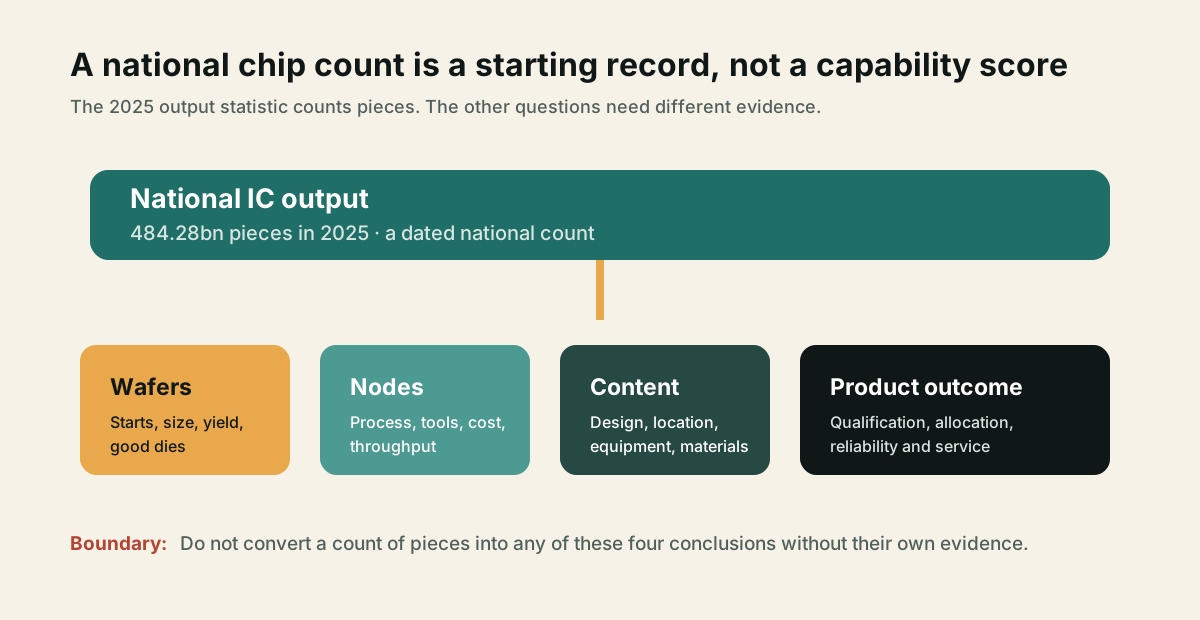
China’s National Bureau of Statistics recorded 484.28 billion integrated circuits produced in 2025, up 10.9% from the preceding year. That is a major national production record. It does not tell us which process nodes those devices use, how much value was created domestically, whether a chip design is competitive, whether a factory can make a particular product at a particular yield, whether a piece of equipment is qualified, or whether a shipment is permitted under a current export-control rule.
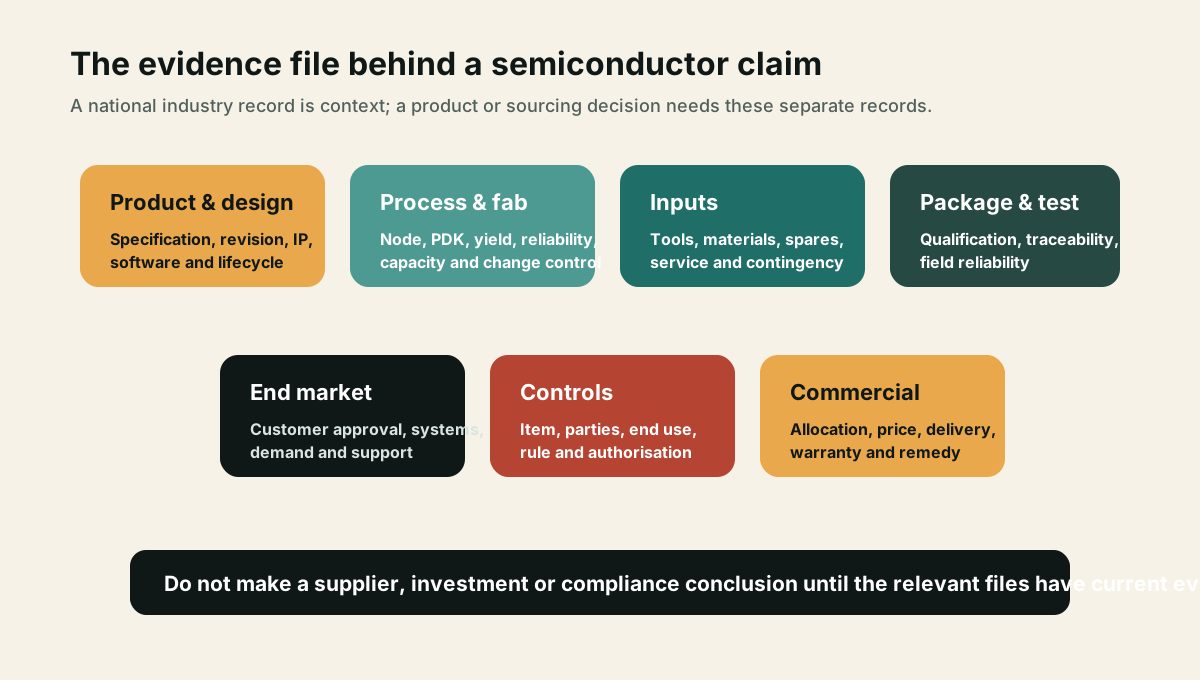
The reason is simple: semiconductors are not one industry. They are a linked stack of different industries and decisions. Chip architecture and design are one file. Wafer fabrication is another. Equipment and materials are another. Packaging and test are another. End-market integration is another. Trade and technology controls add a transaction-specific layer across the whole stack. A national output figure can be important without being an answer to all of them.
This guide is a way to read the Chinese chip industry without turning a production headline, a company milestone or a regulation announcement into a national scorecard. It starts with what the 2025 output record actually counts. It then lays out the industry files a serious claim must pass through, explains why capacity needs a segment and date, places advanced-node headlines in a foundry-specific file, and treats export controls as a separate compliance question rather than a geopolitical slogan.
The 2025 output record is large—and narrowly defined
The National Bureau of Statistics’ 2025 national communiqué lists integrated-circuit output at 4,842.8 hundred-million pieces: 484.28 billion pieces. The table also gives a 10.9% year-on-year increase. Those facts establish industrial scale. A country producing hundreds of billions of devices has a meaningful manufacturing base, an enormous domestic electronics market, and substantial networks of designers, fabs, assemblers, equipment users and downstream product makers.
The unit is the boundary. The statistic counts pieces. It does not count wafers started, functional dies, transistor density, technology nodes, chip revenue, local value added, domestic content, equipment origin, design ownership, utilisation, yield, profit or customer acceptance. A tiny power-management IC, a discrete device, a sensor component, a mature-node microcontroller and a leading-edge processor can all count as integrated-circuit output while representing very different engineering, capital, supply-chain and commercial realities.
That is not a flaw in the statistic. National industrial data is designed to show a defined production aggregate. It becomes misleading only when a reader asks it to answer a different question. “China produced 484.28 billion ICs” is a supportable statement. “China therefore has complete leading-edge chip independence” is not a conclusion the table supplies. The path between the two would require many other measures.
The NBS has also described a five-year rise from 2,614 hundred-million IC pieces in 2020 to 4,843 hundred-million pieces in 2025 in a later sector account. That longer comparison is useful as context for production growth. It is still a count-of-pieces trail, not a technology trajectory. It cannot show whether the increase came from the same product categories, the same process mix, the same sources of design IP, the same equipment, or the same end markets.
| A headline says | What it can establish | What it cannot establish |
|---|---|---|
| 484.28bn IC pieces in 2025 | A national count of integrated circuits produced in a stated year | Node mix, die size, wafer capacity, value or quality |
| 10.9% year-on-year growth | Change in that national piece count from 2024 | The composition, margin, yield or strategic importance of the change |
| A “full chain” is forming | An official category-level description of industrial breadth | Availability, cost, qualification or parity at every product and process |
| A fab or company announces capacity | A stated project or expansion direction | Current output, customer allocation, yield or commercial success |
Why chip pieces are a particularly slippery measure
Piece counts are attractive because they feel concrete and comparable. Yet chips vary enormously. Some are extremely small and produced in very high volume. Others are physically large, expensive, complex and made in comparatively small quantities. A count of packaged devices cannot reveal how much silicon area was processed, how many useful dies emerged from a wafer, how much the devices sold for, which functions they perform or what process equipment was required.
This is why different audiences need different measurements. A fab manager may care about wafer starts, equipment uptime, process windows, yield and output by product. A chip designer may care about a process design kit, IP, EDA flow, libraries, packaging options and production access. A buyer may care about a named part, qualification evidence, allocation, lead time, field returns and service. A policy analyst may care about investment, trade exposure, control scope, capacity by segment and critical dependencies. None should accept a national piece count as a substitute for the measure their decision requires.
The same warning applies to statements about “domestic substitution.” A device assembled in China, a design owned by a Chinese company, a wafer fabricated in China and a product made using domestic tools and materials are not identical descriptions. They can overlap, but they answer different ownership and dependency questions. A serious claim should state which definition it uses and which inputs it has actually verified.
A chip industry is six different industries
China’s NBS describes the integrated-circuit chain in categories spanning design, manufacturing, packaging and test, equipment and materials. That is a helpful starting map. It shows why an answer about “China semiconductors” cannot be obtained by naming one leading foundry or one device maker. Even so, the categories are not proof that every layer has the same depth, availability, quality, cost structure or customer qualification. They are the folders a reader should open.
1. Design: the product definition file
Design determines what the chip is supposed to do. The file includes architecture, IP blocks, physical design, verification, software/tool flow, power and performance targets, package interaction, security requirements, manufacturing rules and the final test plan. A design company can be highly capable in one product class and not in another. A chip may be fabricated locally while crucial parts of its design flow, libraries, IP or software ecosystem come from elsewhere. Conversely, a domestic design can be manufactured through an international chain.
The question is therefore not simply whether a company is “Chinese” or whether a chip is “made in China.” It is: what is the part, which design assets and tools were used, what process was targeted, and who owns or supports the design? Those questions become especially important for safety-critical, security-sensitive or long-lifecycle products. A press release about a new processor is not a substitute for a product specification, software support policy, errata record, security documentation or customer qualification.
2. Fabrication: the process-and-yield file
Fabrication converts a design into wafers through a long sequence of process steps. The relevant evidence includes process technology, wafer size, product mix, capacity allocation, equipment configuration, process-control data, yield, defect management, reliability, cycle time, packaging interface and customer qualification. A fab can be strategically important without making every kind of chip. A process can be technically feasible without being the lowest-cost, highest-volume or most commercially competitive option.
This distinction is central to advanced-node headlines. It is reasonable to ask whether a fab can demonstrate a certain class of process. It is a different question whether that process has repeatable yield, sufficient throughput, competitive cost, stable tool support, a broad product portfolio and a durable customer business. For an example of how narrow that evidence needs to be, see the published SMIC Explained: China's Chipmaking Limits (2026) guide. It examines a foundry-specific question; it should not be used as a national verdict on every Chinese chip category.
3. Equipment and materials: the process-window file
Fabs do not operate on a generic notion of “equipment.” They depend on particular lithography, deposition, etch, cleaning, metrology, inspection, implant, anneal, wafer-handling and software systems, as well as materials such as wafers, gases, chemicals, photoresists, targets, masks and packaging inputs. The availability of a category is not the same as the availability of a configuration that meets a defined process window.
The important question is not whether China has companies in an equipment or materials category. It is whether a named product is available for the target process, is qualified by the fab, meets throughput and reliability needs, has a support and spare-parts path, and can be supplied under the relevant commercial and regulatory conditions. A domestic alternative may be valuable for resilience, but resilience is not an attribute that can be inferred from a category label alone.
4. Packaging and test: the productisation file
Wafer fabrication is not the end of the chip story. Packaging attaches the die to the electrical and thermal interfaces that make it usable; test verifies the product against the relevant specification. The file can include assembly approach, test coverage, thermal and mechanical design, substrate and interconnect requirements, reliability qualification, traceability, failure analysis, capacity, logistics, product change notification and lifecycle support.
This layer can be especially important when a product’s value depends on heterogeneous integration, memory proximity, power delivery, radio-frequency behaviour, thermal constraints or a long field life. A country can have substantial packaging and test activity while the requirements of a particular advanced package, device class or qualified end market remain a separate question. A customer should ask for product-level evidence, not assume that a national production record settles it.
5. End markets: the demand-and-integration file
Chips are made for systems. Automotive electronics, industrial control, consumer devices, communications equipment, data centres, power electronics and IoT products have different volumes, cost pressures, qualification cycles, software dependencies and service expectations. A part that fits one market can be unsuitable for another even when the physical device looks similar on a catalog page.
End-market fit determines whether a component is designed in, qualified, supplied and supported over time. It influences the package, the required documentation, the reliability standard, the inventory model, the field-failure process and the economics of production. This is why it is not enough to know that a fab or supplier has capacity. A buyer needs to know whether the capacity is relevant to the product family, process, package, quality system and commercial schedule in question.
6. Controls and transactions: the legal-and-compliance file
The last layer is not a factory operation; it is a transaction boundary. Products, software, technology, destinations, end users, end uses, ownership links, licence conditions and changes in regulation can affect whether an otherwise viable technical path can be used. These questions apply across design, equipment, materials, fabrication and product shipment. They must be handled with current sources and, where needed, qualified legal and compliance advice.
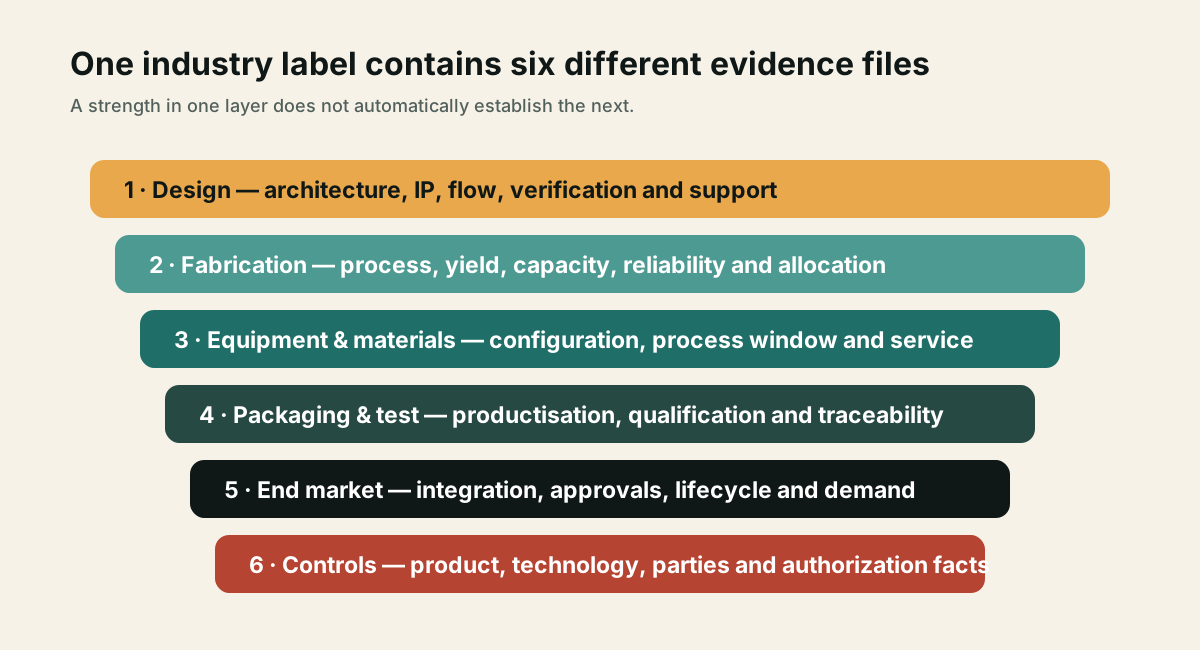
The six files overlap, but they should not be merged. A strong design does not guarantee wafer capacity. A fab expansion does not guarantee a qualified tool chain. A large equipment category does not guarantee a process window. A package does not guarantee an end-market approval. A regulatory headline does not decide an individual transaction. The Chinese industry is large and increasingly interconnected; the quality of analysis comes from preserving the connection and the boundary.
Capacity is not a single number
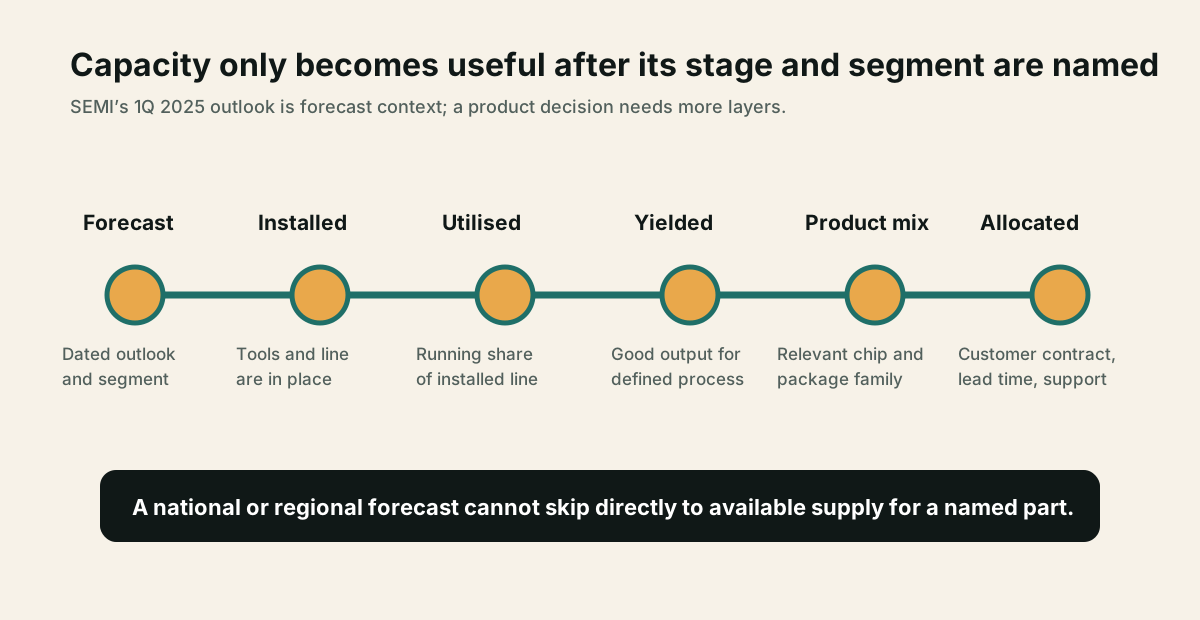
Capacity claims are another common source of confusion. Capacity may refer to a fab building, installed tool sets, cleanroom space, wafer starts, available slots, wafer output, packaged-device output or customer-allocable supply. Each definition has a different unit and a different time boundary. A forecast capacity number is not the same as installed capacity, and installed capacity is not the same as utilised capacity or good output.
SEMI’s 2025 market outlook, which uses World Fab Forecast data from the first quarter of 2025, is useful precisely because it does not present capacity as a monolith. Its China section labels the picture “Uneven Development Across Key Semiconductor Segments” and presents China/global projections across broad categories. The source is a dated industry outlook, not a real-time fab inventory or a company-by-company technology ranking. But it provides an important analytical correction: where capacity sits is as important as how much capacity is counted.
Segment mix matters because different segments need different equipment, materials, process integration, customer qualification and market conditions. Analog, discrete, logic, microcontroller and memory categories are not interchangeable. Nor are mature-node and leading-edge logic, or different kinds of memory. A capacity expansion in one segment does not automatically solve a constraint in another.
The outlook should therefore be used as context, not as a scoreboard. It can support the statement that China-related fab capacity development is uneven by segment in a dated forecast. It cannot establish the live availability of a named product, the technology level of a particular line, the yield of a process, the source of a component or the outcome of a customer qualification. Those need their own current records.
| Capacity phrase | The next question to ask |
|---|---|
| “New fab capacity” | Is this planned, under construction, installed, qualified or in commercial output? |
| “Wafer capacity” | What wafer size, product segment, process family, utilisation and yield boundary apply? |
| “Leading-edge capacity” | Which node definition, tool chain, process steps, volume, cost and customer qualification are evidenced? |
| “Domestic capacity” | Does domestic mean ownership, location, design, equipment, materials, value added or a different definition? |
| “Available supply” | Is there a named part, customer allocation, lead-time commitment, quality approval and service path? |
Dependency is a graph, not a chain with one weakest link
The word “supply chain” is useful, but it can make semiconductor dependencies look more linear than they are. A chip programme is closer to a graph. One design may depend on multiple IP blocks, software tools, masks, process recipes, tool modules, chemicals, wafers, package substrates, test programmes, logistics paths and customers. One of those inputs can have alternatives; another may be tied to a single qualified configuration. A change in any node can require engineering work elsewhere in the graph.
This is one reason broad claims about a “complete chain” need to be unpacked. A category may have several suppliers, while a particular process or customer has only one currently qualified option. A material may be widely available, while the grade, purity, delivery form or documentation needed for a sensitive process is limited. A piece of equipment may exist in a product family, while the chamber configuration, software version, service response or process integration relevant to a fab is not yet proven. A part may be fabricated, but lack a qualified package or test route for its intended market.
The correct analytic move is not to search for one dramatic bottleneck and declare the rest of the industry irrelevant. It is to identify the critical path for the product and decision at hand. For a mobile processor, that path could look very different from the critical path for a power device, display driver, industrial controller, image sensor, memory component or networking chip. The relevant process node, volume, package, thermal requirement, design ecosystem, reliability target and control exposure can all change.
That is also why substitution has to be tested rather than announced. A substitute can be technically compatible but commercially impractical, qualified for a different customer but not this one, available for one process version but not another, or costlier and slower than the legacy input. The practical evidence is configuration-specific: specification, sample, test plan, acceptance criteria, qualification result, supply commitment, change notification, field support and contingency plan. A sector-level article cannot provide that proof. It can tell a reader why they should ask for it.
For procurement and engineering teams, the graph view suggests a useful discipline. List the highest-consequence inputs and interfaces; identify the source and version for each; record whether an alternative has been tested; separate a technically possible alternative from a qualified and contractible alternative; then attach control and logistics conditions. This does not guarantee resilience. It makes hidden dependency visible early enough to manage.
“Domestic” is a question, not a conclusion
The same graph explains why the word domestic needs a definition. It can refer to a company's headquarters, the location of design work, the ownership of IP, the location of wafer fabrication, the origin of equipment and materials, the location of packaging, the controlling ownership of a supplier, or the legal jurisdiction of a transaction. A single product can have a different answer for each definition.
This is not merely a semantic issue. A government policy discussion may care about local production or industrial capability. A buyer may care about continuity of supply and technical support. A compliance team may care about origin, technology, parties and destination. An investor may care about revenue and ownership. A security reviewer may care about software, firmware, lifecycle governance and access to updates. Treating all of these questions as a generic domestic-content score creates more confidence than the underlying evidence deserves.
A stronger formulation says exactly what has been established: “the wafer was fabricated at this location,” “the design is controlled by this company,” “this material is supplied from this source,” or “this package has passed this customer's qualification.” Those statements can then be tested. A vague assertion of domestic substitution cannot.
Time is part of the capability question
Semiconductor claims often fail because they collapse time. An announcement can be reported in the present tense even when it describes an intention. A new fab may be “capacity” in a forecast before construction begins, in a different sense when tools are installed, and in yet another sense when a qualified product reaches a customer. A policy objective can set direction without becoming an operating result. An advanced-node demonstration can be historically important without proving broad, repeated commercial output.
This is why every strong chip claim needs a status verb. Proposed means a plan has been disclosed. Under construction means a physical project is advancing. Installed means tools or lines are in place. Running means some operation occurs. Qualified means a defined product or process has met stated gates. Allocated means a customer has a documented supply path. Service-ready means the lifecycle support system is functioning. The stages may overlap, but they should not be silently skipped.
The status verb also makes public information more valuable. A corporate filing, government notice, equipment announcement or capacity outlook can be a real signal at the stage it actually describes. The error is not using public material; the error is recasting it as evidence of a later stage. A board approval does not become a qualified product. An equipment shipment does not become high-volume wafer output. A test chip does not become a stable, customer-supported platform.
For a reader following China, this time discipline helps cut through competing headlines. One article may focus on a new industrial project, another on a domestic equipment vendor, another on a chip launch, and another on trade controls. They can all be relevant to the same ecosystem while sitting at different evidence stages. The task is to put each fact in the right folder and date it, not to force every signal into an immediate verdict about national technological progress.
Capability, competitiveness and independence are separate tests
Three words are often used as if they mean the same thing: capability, competitiveness and independence. They should be separated.
Capability asks whether a defined product or process can be performed. Evidence might include a device, a process record, test result, qualification scope or validated manufacturing result. It is the narrowest and most technical of the three questions.
Competitiveness adds a market test. Can the capability be supplied at a useful cost, volume, quality, delivery and support level compared with alternatives? This requires commercial and customer evidence, not only a technical demonstration. A technically possible process can be expensive or slow; a reliable mature product can be commercially very strong even if it is not at the smallest node.
Independence adds a dependency test. How much of the relevant design, equipment, materials, software, manufacturing, packaging, logistics, finance, support and control path can operate under a defined disruption scenario? The question cannot be answered with a flag on a package or a location of final assembly. It requires a detailed graph of inputs and conditions—and even then the result can be product-specific rather than national.
Keeping those tests apart makes China's industry easier to understand. China can expand output, deepen specific layers and develop important capabilities while gaps, cost differences, foreign dependencies, product-specific constraints and trade-control exposure remain material elsewhere in the graph. That is not a contradiction. It is what an industry at this scale looks like when examined at the level of actual products and processes.
Advanced-node headlines belong in a foundry file
Advanced-node claims attract attention because they appear to answer the widest strategic question: can China make chips at the frontier? Yet they are among the claims that most need a narrow evidence file. A process-node label is not a single physical measurement, and it does not by itself disclose the product, performance, power, density, yield, cost, volume, tool chain or customer outcome behind it.
The right starting point is to identify the actual claim. Is it a claim of technical demonstration, limited production, volume production, a design win, a teardown observation, a vendor statement, a qualified product, or a comparable commercial process? The answer determines what evidence would be meaningful. A teardown can identify characteristics of a particular device. A company filing can describe investment or financial context. A customer qualification can show something else. No one item necessarily establishes the full commercial picture.
This is why the national production record and advanced-node discussion should not be forced into the same paragraph. The former is an aggregate output statistic. The latter is a process-specific engineering and commercial question. The published SMIC Explained: China's Chipmaking Limits (2026) article provides a focused foundry context. It distinguishes technical feasibility from yield, cost, throughput and product outcome. That distinction should remain in any broader industry analysis.
Mature-node and speciality production deserve the same analytical respect. “Mature” does not mean trivial. Many industrial, automotive, power, connectivity, sensor and consumer applications depend on processes, packages and qualifications that have their own technical and commercial demands. A broad industry guide should not create a hierarchy in which only the smallest node counts as a semiconductor capability. It should ask which product and market are being discussed, and what evidence matters for that product.
Controls are a separate transaction file
Trade and technology controls make the semiconductor conversation more complicated, not less. They do not erase the need to analyse design, fabs, tools, materials, packages and end markets. They add an additional file that can change the feasibility of a particular path.
The current U.S. Export Administration Regulations, Part 744 includes §744.23, whose heading covers supercomputers, advanced-node integrated circuits and semiconductor-manufacturing-equipment end-use controls. The regulation states conditional licence requirements for listed categories when the exporter, reexporter or transferor has the specified knowledge about destination, end use or type of end user, subject to the section’s detailed text and exclusions.
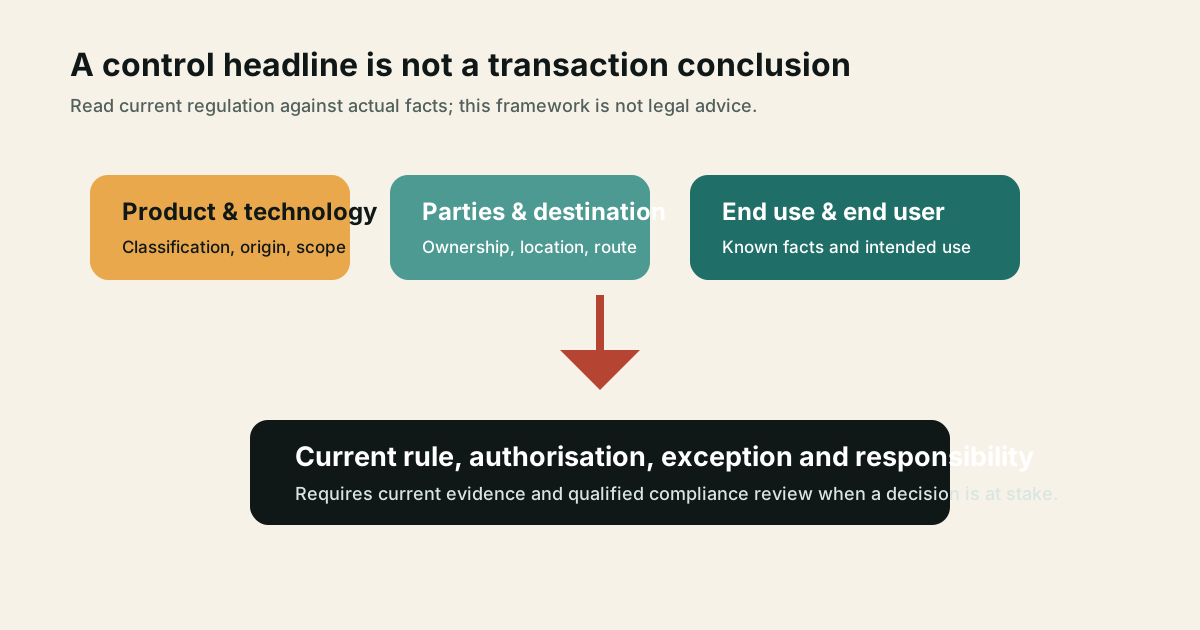
That sentence is intentionally narrow. It identifies a regulatory category and why a control layer belongs in the industry map. It does not determine whether a particular chip, machine, material, software tool, service, person or transaction is permitted. That conclusion can depend on classification, product origin and technology, destination, end user, end use, ownership and control, knowledge, licensing policy, exceptions, later amendments and other facts. Regulations change; transaction facts matter; this article is not legal advice.
The analytical value of the control file is that it prevents two errors. The first is treating controls as an abstract political backdrop while ignoring that they can affect concrete equipment, software, technology and customer paths. The second is treating a rule headline as an automatic verdict on all semiconductor trade with China. A responsible reader does neither. They identify the actual item and transaction, consult current official sources, and use qualified compliance and legal review where a decision requires it.
For a business, this means that compliance should be integrated early into product and sourcing work. It is expensive to learn after design selection, tool procurement, or supplier nomination that a critical input requires a different path. It is equally dangerous to reject an option from a headline without checking the relevant rule, classification and facts. The control file is neither an afterthought nor a replacement for technical diligence; it is one of the conditions under which the technical plan has to operate.
The diligence file: turning an industry headline into a decision
The practical question is rarely “Does China have a semiconductor industry?” It clearly does. The practical question is usually narrower: can a particular part be sourced, can a product roadmap be supported, can a foundry make a target design, can a tool be qualified, can an input be delivered, or can a transaction proceed under current rules?
Those questions need a diligence file that matches the decision.
Product and design record
Start with the exact component or design: function, revision, architecture, datasheet, software dependencies, IP status, security requirements, lifecycle expectation and substitutability. A buyer needs to know what the system actually requires before asking whether a national industry can supply it. A strategy team needs to know whether a published company claim relates to the desired product class rather than a different chip category.
Process and manufacturing record
Identify the intended fab, process family, wafer size, product mix, process design kit status, manufacturing readiness, capacity stage, yield boundary, reliability requirements and change-control policy. This is the point at which a broad capacity statement becomes either relevant or irrelevant. It is also where a foundry-specific public record can be useful—but only within the limits of that record.
Equipment, materials and package record
For each critical process input, document the configuration, source, qualification, lead time, spares, service, material specification and contingency. For the finished device, document package, test coverage, reliability, traceability, logistics, quality-system evidence and field-support terms. A supply chain is only as robust as the inputs and interfaces that have actually been qualified for the product.
End-market and commercial record
Confirm the customer’s performance requirements, industry certifications, approval cycle, forecast, allocation, commercial terms, warranty, delivery commitment and product-change notification. A technically capable part without an approved commercial and support path may not solve the problem the buyer has. The field should distinguish a brochure capability, an engineering sample, a qualified part, a contracted allocation and a service-ready source.
Control record
Finally, create a current compliance record for the relevant transaction. It should identify the item, technology, parties, destination, end use, end user, known facts, applicable rules, authorisations or exceptions, responsibilities and change triggers. This is a request for a disciplined process, not a legal conclusion in a blog post.
The result is more useful than a national slogan. It allows the reader to acknowledge China’s production scale, growing industrial breadth and strategic importance while still asking whether the chip, process, tool, material, package and transaction in front of them are supported by the evidence they need.
A compact reading rule for news and vendor claims
When a new China semiconductor headline appears, start by underlining the noun and the verb. Is the noun an IC output count, a fab, a tool family, a material, a chip design, a packaging method, a customer programme or a regulatory rule? Does the verb say announced, planned, installed, demonstrated, qualified, shipped, allocated or operating? Then ask what the source actually is: a public statistic, a company statement, a filing, a technical test, an industry forecast, a regulator notice or independent reporting.
That small exercise often resolves the confusion. It does not make the headline unimportant; it gives it the correct weight. A company announcement can be a valuable source of intent. A public statistic can show national scale. A forecast can show a scenario. A regulation can identify a compliance category. None needs to become a stronger claim than its own evidence supports.
Method and limitations
This is a desk-research guide. It uses China’s National Bureau of Statistics for the 2025 national IC output record and official sector-category framing; SEMI’s 1Q 2025 World Fab Forecast outlook for dated capacity-composition context; and the U.S. Bureau of Industry and Security’s current EAR Part 744 text for a regulatory-category boundary. It does not use first-hand fab, product, supplier, package, yield, qualification or transaction evidence.
Accordingly, the article does not rank Chinese chip companies, estimate domestic content, set a national process-node ceiling, assess product performance, endorse a supplier, or decide whether a shipment is permitted. A reader considering a concrete product, supplier, investment or transaction should assemble the relevant product, process, commercial and control records, validate their current date and scope, and obtain specialised engineering, sourcing, compliance or legal advice where needed.
Sources
- National Bureau of Statistics — 2025 Statistical Communiqué of National Economic and Social Development
- National Bureau of Statistics — Five-Year Development Achievements: Innovation Momentum
- SEMI — Market Outlook: Capex Market Outlook (1Q 2025 World Fab Forecast context)
- U.S. Bureau of Industry and Security — Export Administration Regulations, Part 744