

By China Made & Tech Team
China's solar price-war crackdown does not give a buyer a universal safe price floor. It makes cost basis, layer economics, and supplier continuity more important.
The sequence is now clear enough to change a quote review. On July 20, China's Ministry of Industry and Information Technology described implementation work for mandatory energy-consumption and efficiency standards covering polysilicon, monocrystalline silicon, modules, and inverters. The ministry said the standards would raise entry thresholds and help high-energy, low-efficiency capacity exit the market. The official briefing is a standards and policy record, not a promise that a particular factory will close.
Then came the market signal. Reuters reported that China's market regulator would meet solar-industry representatives on July 31 over pricing compliance and cost-accounting standards, against a background of excess capacity and large expected losses. Specialist reporting on the meeting said the cost-accounting framework covered polysilicon, wafers, cells, and modules, but did not establish a numerical minimum selling price.
That distinction is the buyer's starting point. A low quote may become less credible when the industry is being pushed away from below-cost selling. But a higher futures price or an industry pledge does not certify the seller's cash runway, warranty reserve, approved bill of materials, or replacement capacity. The right response is not to predict which Chinese manufacturer survives. It is to turn the quote into a continuity file before committing volume.
What changed — and what did not
The policy story has three layers.
First, the standards layer is real. The MIIT briefing links new energy and efficiency requirements to market access and the orderly exit of high-energy, low-efficiency capacity. That can matter differently to a polysilicon plant, a wafer line, a cell factory, a module assembler, and an inverter maker. A plant may remain legally open while its process, energy profile, utilization, or financing becomes less competitive.
Second, the pricing-compliance layer is more limited than the headline. The July 31 meeting and the reported cost-accounting framework seek a clearer basis for identifying destructive competition. Reporting described possible compliance reminders, regulatory interviews, administrative guidance, and further enforcement for conduct that seriously disrupts market order. It did not produce a public “minimum price per watt” that makes every quote below that number invalid.
Third, the producer layer is a market reaction. pv magazine reported that eight large polysilicon producers signed an initiative not to sell photovoltaic products below full cost and to reduce capacity that fails efficiency or technology requirements. That is useful evidence of industry pressure, but it is still a reported initiative. Without the signed document, an implementation audit, and the exact supplier's participation, a buyer should not write “the industry has established a binding floor” into a purchase memo.
The first practical rule follows:
> A policy signal can change the meaning of a quote without proving the quote is impossible, illegal, or fraudulent.
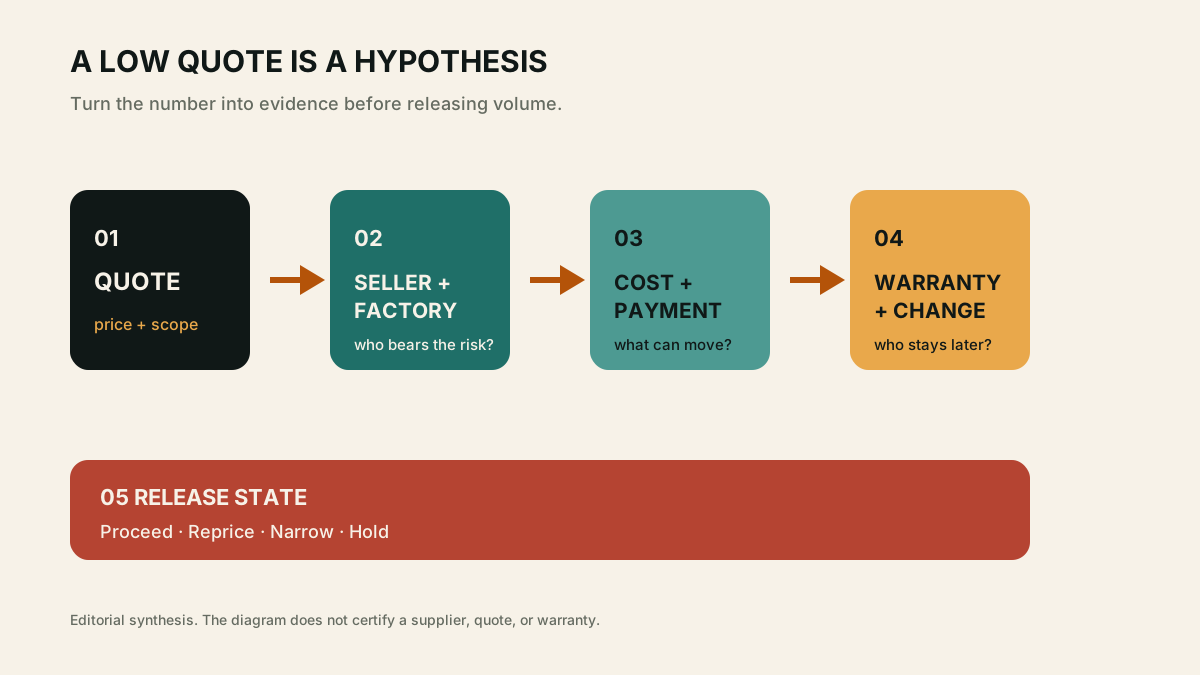 Editorial diagram: a quote becomes a continuity file before the buyer releases volume.
Why the cheap quote is no longer neutral
Price pressure is not confined to one part of the chain. In a stressed market, polysilicon, wafers, cells, modules, and inverters can carry different inventory, utilization, and financing conditions. The product on the buyer's quote may be profitable while an upstream affiliate is not, or it may be cheap because the seller is trying to preserve factory utilization and channel position.
The public numbers show why a single price comparison is inadequate.
China's National Energy Administration reported 71.77 million kW of new photovoltaic grid connections in the first half of 2026 and cumulative PV capacity of 1.272 billion kW at the end of June. The NEA release establishes installed-capacity and grid-connection figures; it does not say that module demand, manufacturer margins, or supplier health moved in the same direction. Industry reporting described the H1 addition figure as 66.04% below the prior-year period, which makes timing and inventory discipline more important to a quote review.
Upstream prices also moved sharply around the policy narrative. A MOFCOM commodity-price analysis recorded the main polysilicon futures contract at RMB 37,710 per ton on June 11 after an 8.99% daily rise. Later reporting recorded RMB 37,040 per ton on August 7 and a roughly 13.8% increase from the level immediately before the July 31 meeting. Those are futures observations, not delivered module prices. They do not reveal the seller's realized cost, hedging position, credit terms, or warranty funding.
The loss signals are equally important but easy to overread. A July industry roundup summarized preliminary H1 2026 loss forecasts including RMB 3.4–3.8 billion for LONGi and RMB 180–360 million for Trina Solar. The same reporting described JA Solar's expected loss range and continued pressure from oversupply, weak demand, low utilization, and weak margins.
This does not mean that every low quote is a distress sale. It means that the buyer should ask which layer is absorbing the discount and how the seller funds the obligations after the invoice: production, inspection, shipment, commissioning support, replacement modules, and warranty administration.
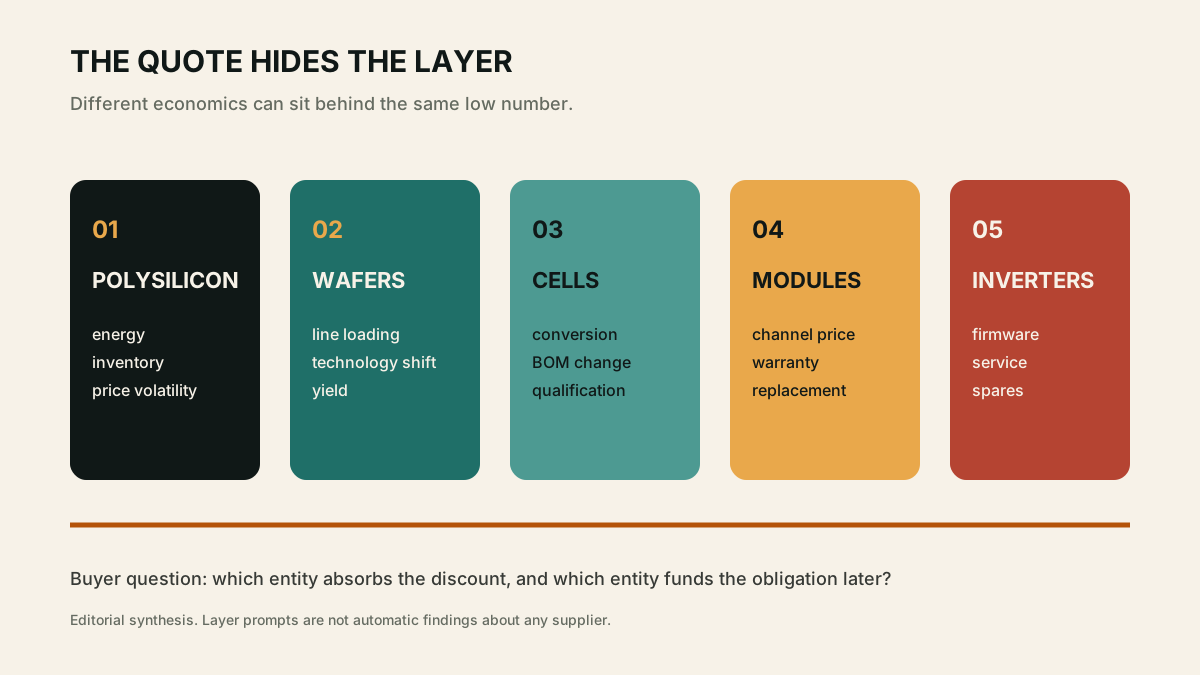 Editorial diagram: manufacturing-layer prompts, not automatic findings about any supplier.
What a public financial file can — and cannot — show
Public filings are useful because they make the buyer ask better questions. They are not a substitute for a counterparty file.
JinkoSolar's official Q1 2026 release reported a net loss attributable to ordinary shareholders of RMB 463.5 million. It also disclosed RMB 22.81 billion in cash, cash equivalents, and restricted cash, RMB 13.77 billion in net receivables, and RMB 17.71 billion in inventories at March 31. The company's release shows the combination a buyer should learn to read: loss, liquidity, receivables, inventory, shipment volume, and debt costs belong in the same conversation.
LONGi's Q1 report gives a different but related signal. It recorded negative RMB 1.92 billion in net profit attributable to shareholders and negative RMB 2.45 billion in operating cash flow. The report said the increased operating cash outflow was mainly related to lower collections of receivables and lower tax rebates. LONGi's filed report is a primary company disclosure, but it still describes LONGi, not the private trading company or regional distributor named on a buyer's quote.
The layer question matters because the same discount can mean different things at different points in the chain. A polysilicon producer may be managing energy costs and inventory. A wafer maker may be protecting line utilization. A cell maker may be clearing a technology transition. A module assembler may be defending a customer relationship or using a group transfer price. An inverter seller may be pricing hardware aggressively to preserve a software, service, or channel position. The invoice alone cannot tell the buyer which story is true.
That is why the file should follow the physical and contractual chain rather than stop at the brand name. Map the material or component into the finished product, identify who owns the specification, and ask which entity bears the loss if the price becomes uneconomic. The answer may sit with a parent company, a factory affiliate, a distributor, or the buyer through a change order that was never priced.
The lesson is not “loss equals failure.” A large producer can have substantial cash and inventory while reporting losses. It can also ship at scale while reducing capacity, changing its product mix, raising financing, or relying on group support. The lesson is that “bankable,” “Tier 1,” and “factory direct” are not documents. They are claims that must be tied to the legal seller, the manufacturing entity, and the obligation the buyer actually needs fulfilled.
The quote-comparison matrix
Two quotes should not be compared until their evidence fields are normalized. The following matrix is an editorial buyer framework, not a regulator's required form.
| Field | Quote A | Quote B | What to verify |
|---|---|---|---|
| Legal seller | Named entity and jurisdiction | Named entity and jurisdiction | Contracting party, payment account, parent or guarantee path |
| Manufacturing layer | Polysilicon, wafer, cell, module, or inverter scope | Same layer or different | Factory name, production location, and whether the quote is resale or own production |
| Product identity | Exact model, wattage, efficiency, and revision | Exact model and revision | Datasheet, serial format, approved BOM, certification scope, and change notice |
| Price basis | Currency, Incoterm, tax, freight, escalation | Same basis | Whether the low number excludes inspection, inland freight, duties, insurance, or commissioning |
| Cost story | Current quote and validity period | Current quote and validity period | What changed from the prior quote and whether the seller explains the basis without promising a market floor |
| Payment exposure | Deposit, milestones, retention, security | Deposit, milestones, retention, security | Who holds title, what triggers payment, and what protection exists if production stops |
| Warranty counterparty | Manufacturer, seller, insurer, or service company | Named responsible party | Where a claim is filed, who stocks replacements, and whether the warranty survives a seller change |
| Replacement path | Approved alternative and spare inventory | Approved alternative and spare inventory | Whether substitution requires requalification, and who pays for the delay or re-test |
The supplier-continuity file
Before award, a buyer should request a compact file with six sections.
1. Seller and factory identity
Request the full legal name, registration jurisdiction, invoicing entity, manufacturing entity, bank-account name, and any parent or performance-guarantee relationship. “Direct from factory” is not enough. The factory that makes a module may not be the entity that signs the warranty, receives the deposit, or controls replacement stock.
2. Product and bill-of-materials control
Request the exact model revision, cell or wafer technology, BOM boundary, factory location, serial-number logic, and certificate scope. Ask what happens if the supplier changes a cell, wafer, glass, encapsulant, junction box, inverter board, or firmware. A price concession that depends on an unapproved substitution is not a saving; it is an unpriced qualification event.
3. Cost and payment basis
Ask the seller to explain the quote's validity period, production slot, currency, Incoterm, freight, tax, inspection, and escalation terms. Do not ask for a confidential cost sheet as a ritual. Ask for enough evidence to understand whether the quote is a normal commercial price, a temporary inventory clearance, a channel subsidy, or a number that becomes invalid when one input moves.
4. Cash-conversion and execution evidence
For a listed group, review the latest results, operating cash flow, receivables, inventory, debt maturity, and relevant segment notes. For a private seller, request trade references, recent shipment evidence, a production schedule tied to the order, and payment protections appropriate to the exposure. None of these proves solvency. Together they show whether the seller can explain how the order becomes finished product and how claims will be funded later.
5. Warranty and service continuity
Name the warranty counterparty and the service route. Confirm the claim window, evidence requirements, response time, replacement stock, labor responsibility, transport responsibility, and what happens if the distributor or factory changes. For modules, ask about replacement equivalence and requalification. For inverters, ask about firmware, spare boards, remote diagnostics, and whether the service company is contractually bound to the project.
6. Change and exit control
Set a written change-notification trigger for factory, BOM, component, certification, legal seller, warranty entity, and payment-account changes. Define the buyer's options: accept, requalify, reduce volume, delay payment, or terminate the affected lot. Also define the replacement route before the first failure. “We can source another model” is not a continuity plan unless the alternative is technically, commercially, and contractually qualified.
Proceed, reprice, narrow, or hold
The file should end in a release state rather than a vague confidence score.
- Proceed when the seller, factory layer, model revision, price basis, payment path, warranty counterparty, and change controls are documented and internally consistent.
- Reprice when the quote depends on a moving input, a short validity window, unusual payment exposure, or a cost claim that the seller cannot explain clearly.
- Narrow when one model, factory, region, or delivery batch is evidenced but the rest of the proposed volume is not. Release the qualified scope and keep the unqualified scope conditional.
- Hold when the legal seller is unclear, the BOM or factory changes without notice, the warranty counterparty cannot be identified, payment protection is absent for the exposure, or the replacement path is only verbal.
These states are buyer controls, not regulatory findings. A hold does not prove that a supplier will fail. It says the buyer does not yet have enough evidence to price the failure modes.
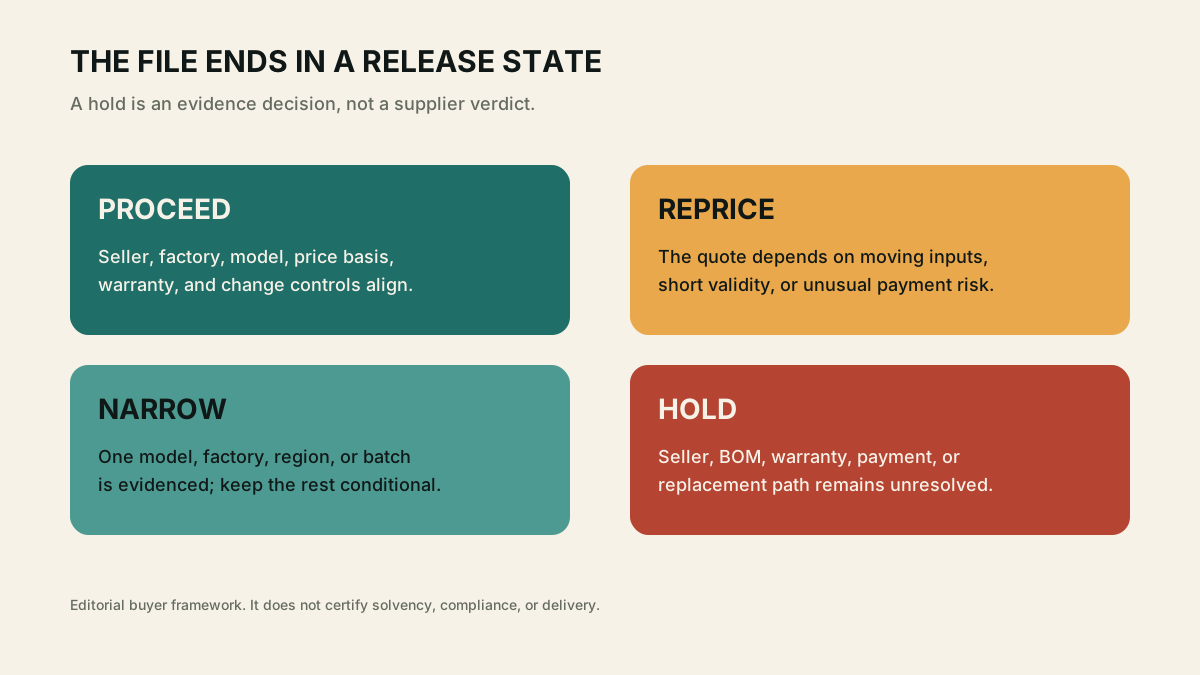 Editorial buyer framework: release states reflect evidence completeness, not a credit or compliance ruling.
The deeper story is larger than one week of polysilicon futures. China's solar manufacturing system still has enormous scale, dense upstream supply, and global reach, but its price advantage is being tested by excess capacity, weak margins, standards, financing, and the cost of keeping a product supported for 20 or more years. For that structural context, continue to China Solar Dominance: Supply Chain Power, Profit Crisis.
Method and limitations
This is desk research as of August 19, 2026, not credit, investment, legal, engineering, procurement, or warranty advice. Official sources establish standards, public capacity, and company disclosures; independent reporting supplies context for meetings and industry initiatives. No factory audit, supplier interview, credit report, project-finance review, physical product test, or buyer-specific contract review was conducted. A public loss, price move, or producer initiative does not classify a private supplier's solvency or guarantee delivery. Recheck the seller, manufacturing layer, payment security, BOM, warranty counterparty, and replacement path before award, payment, shipment, or long-term reliance.