

By China Made & Tech Team.
China is large enough in world trade that almost any supply-chain conversation can begin with a striking number. The World Trade Organization’s April 2025 table lists China as the largest merchandise exporter in 2024, at US$3.577 trillion and 17.8% in that table’s comparison of exporters excluding intra-EU trade. That is an important fact. It tells a reader that China is a major node in global goods trade.
It does not tell the reader whether a specific product is exposed.
It does not identify the material, component, tooling step, process chemistry, software dependency, test house, port pair, freight booking, bank, distributor or contract clause that could stop an order. It does not prove that a buyer has one source, that an alternative exists, that a second country can make the same part, that a qualified substitute can be approved on time, or that a shipment is legally and operationally ready to move. A national trade number is orientation. A real supply-chain decision needs a much smaller file.
That distinction is the point of this guide. “China supply chain” often becomes a shorthand for several different questions:
- How important is China to global goods trade?
- Is a particular input concentrated among a small group of origins or suppliers?
- Is the country printed on a customs document the same as the whole production chain?
- Is final assembly the bottleneck, or is the bottleneck upstream in materials, processing, tooling, testing, electronics, software or qualification?
- Is the risk in making the item, moving it, financing it, clearing it, servicing it, or proving the paperwork?
- Does “China Plus One” solve the constrained node, or merely add another country name to a presentation?
These are related questions, but they are not interchangeable. The useful way to read China’s global supply-chain role is therefore not as a single dominance score. It is as a set of linked but separate files: the trade context, the concentration context, the value-added chain, the logistics route, and the transaction record. Only then can a buyer decide whether to accept, protect, qualify around or diversify a real dependency.
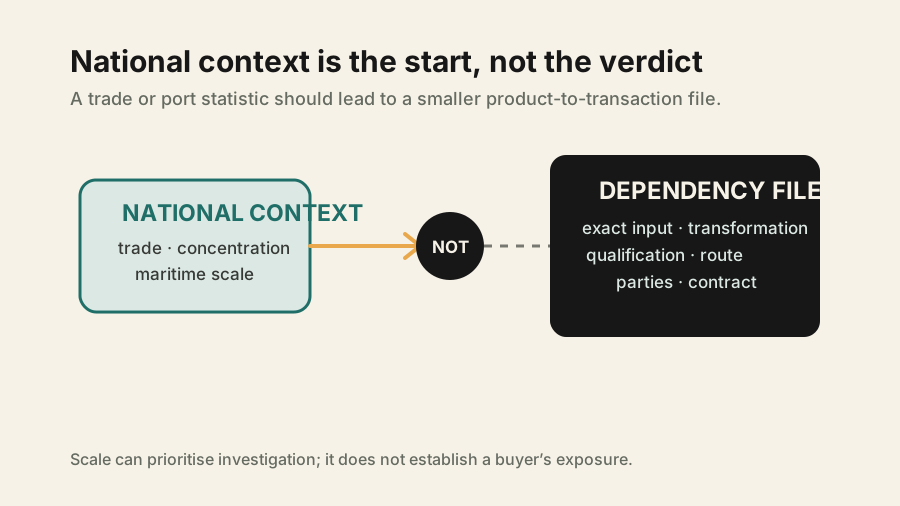
China’s scale is real. Your exposure still has to be proved.
The WTO figure is worth keeping because vague statements such as “China makes everything” are less useful than a dated, scoped record. The WTO’s 2024 table puts China first among merchandise exporters in its stated presentation. It is evidence of scale in gross goods trade, and scale changes the practical environment in which buyers operate. More global products encounter Chinese suppliers, components, finished goods, ports, distributors and service ecosystems because China participates at that scale.
But the statistic has a definition. It is gross merchandise exports in a particular year and table structure. It is not a census of all value created in China. It is not an origin trace for every part inside an exported product. It is not a bill of materials. It is not an inventory report. It is not a count of available alternative suppliers. And it is not a measure of how difficult a buyer would find it to replace a particular input.
That may sound obvious until a decision meeting turns a country statistic into an operating conclusion. Consider the shortcuts that follow a headline number:
- “China exports so much that our product must be China-dependent.”
- “Our final assembly is outside China, so China is no longer part of the chain.”
- “We identified another country, so our exposure is diversified.”
- “Our supplier says the finished good is made elsewhere, so the upstream risk is resolved.”
None of those propositions follows from a national export total. A finished good can be exported from China with imported inputs. A final-assembly site in another country can use Chinese tooling, materials, subassemblies, manufacturing equipment, firmware, components or logistics services. A supplier can have multiple factories but one qualified source of a critical process. Two suppliers can buy the same upstream input. A product can have no country-level concentration in customs data yet still depend on one approved formulation, one test sequence, one proprietary fixture, one transport lane, or one approved contractual party.
The right first question is not “How dependent are we on China?” It is: What is the exact thing that would fail if a China-linked link failed? Name the object before naming the country. It might be a specific grade of material, a precision component, a printed-circuit-board assembly, a mould, a coating step, a battery cell, a power module, a test service, a spare part, a firmware release, a shipment document, or an approved repair channel. Then identify the transformation that makes it usable in your product.
This does not minimise China’s role. It makes the role legible. A buyer who begins with a product and transformation can discover a meaningful China dependency where a broad trade table cannot see it. The same buyer can also avoid spending money on a symbolic diversification project that does not protect the actual constrained node.
Gross trade describes a flow, not a failure mode
Trade data is valuable for market orientation. It can show that a country has a large export role, that a product category is traded at scale, or that a particular trade relationship has changed over time. It can help a company decide where to investigate, which product families deserve a dependency scan, and which country claims should be treated cautiously.
It should not be asked to answer a failure-mode question by itself. Failure modes are narrower. They include a supplier losing capacity; an approved material becoming unavailable; an import rule changing; a container missing a sailing; a port disruption; a quality issue that prevents substitution; a product test that must be repeated; a distributor that is not authorised; a buyer unable to document origin; or a contract that assigns the cost of a delay to the wrong party.
Each of these needs a record with a different owner and a different proof standard. Procurement may own the supplier and contract records. Engineering may own the drawing, material specification and validation plan. Quality may own the approved-vendor and change-control files. Logistics may own the route, broker, booking and contingency records. Compliance may own classification, origin, end-use, counterparty and documentation questions. Finance may own payment and working-capital exposure. A country statistic belongs in the background layer. It cannot substitute for any of those records.
A national statistic can still change the questions you ask
There is a productive use for the scale signal. When a trade system is this large, do not treat a simple country label as a sufficient description of a purchase. Ask more precise questions at the outset:
- Is the supplier’s legal seller the same entity that manufactures or sources the critical input?
- Is the claimed origin about final assembly, a material, a substantial transformation, or a customs declaration with a specific legal purpose?
- What comes from the factory’s local network, and what comes from a different country or region?
- Which inputs are approved only from one source, even if several final assemblers exist?
- Which dates, documents, licences, certifications, test results or warranty terms must travel with the product?
The answers may show that China is not the most important dependency. They may show that it is. The discipline is to let the product evidence decide.
Concentration is more revealing than scale—but only after you name the input
Supply-chain exposure becomes more meaningful when it includes concentration. A product is more exposed when it relies on a narrow group of sources and when switching sources is difficult, slow or uncertain. But concentration also has to be read at the correct level. A country’s share of world trade is not the same as a market’s supplier concentration. A supplier count is not the same as a qualified supplier count. A list of factories is not the same as available capacity that can meet a required specification.
The OECD Supply Chain Resilience Review is useful because it resists two opposite simplifications. It says that only about 30% of global exports are overly concentrated in a few trading partners, so most trade flows remain relatively diversified. At the same time, it reports a 50% rise in significant import concentration in the early 2020s compared with the late 1990s. Its key figures also say China’s role in other countries’ significant import concentration rose by 25 percentage points over the past two decades.
Those findings support a careful conclusion: China’s relevance to concentrated import relationships has increased, but neither every trade flow nor every China-linked input is concentrated. A buyer should not infer “no issue” from the fact that most trade remains diversified. Nor should the buyer infer “single-source crisis” from China’s role in an aggregate concentration measure. The next question remains: which exact input, for which use, with what approval and substitute path?
This is where many “China dependency” analyses stop too early. They identify a country or a customs code, count trading partners, and declare a vulnerability. That can be a useful screening step. It is not a finished diligence result.
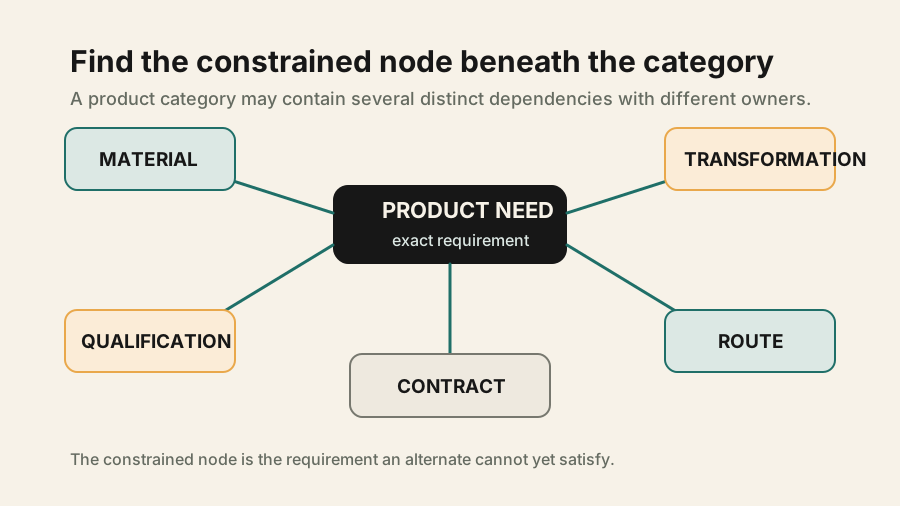
The constrained node is usually smaller than the category
Take a category called “electronics,” “solar equipment,” “industrial machinery,” “consumer appliances,” “batteries,” or “medical devices.” Each category contains many different chains. Some inputs may be widely available. Some may be technically substitutable but commercially impractical. Some may be easy to buy but hard to validate. Some may be made in several countries but depend on the same upstream chemistry, equipment, intellectual property, testing method or supplier group.
The constrained node is the point where a realistic substitution fails one of the requirements that matter to the buyer. Requirements can include:
- The item meets a drawing, material grade, performance specification or regulatory requirement.
- The replacement can be qualified within the necessary time window.
- The supplier has verified capacity, quality control, tooling, test capability and change-management discipline.
- The substitute works with existing software, firmware, equipment, packaging or service procedures.
- The route can move the item with workable lead time, documentation, insurance and total landed cost.
- The contracting parties can legally and commercially transact under the required terms.
- The buyer can support the product after sale with spare parts, updates, warranty or repair.
If an alternate source fails one of those gates, it may be a potential source, not a qualified substitute. This is why a map with two or three country flags can create false comfort. Geographic diversity is a means, not the proof of resilience.
Count approved capacity, not supplier names
A supplier list can overstate resilience in three ways. First, several companies may buy the same upstream material or use the same specialist subcontractor. Second, a supplier may be able to quote but not yet be approved for the buyer’s specification. Third, the claimed production site may be unable to take the required volume without a tooling, staffing, process or quality change.
For a practical exposure check, separate at least four states:
| State | What it means | What it does not prove |
|---|---|---|
| Identified source | A company appears able to supply the category | It can meet your exact specification or capacity need |
| Sample source | A company can provide a sample or prototype | It can repeat production at the required quality and scale |
| Qualified source | The item has passed an agreed technical or quality process | It has capacity, commercial terms or route readiness for a disruption |
| Activated source | A source is contracted, operational and supplying the required volume | It is immune to its own upstream, logistics or regulatory constraints |
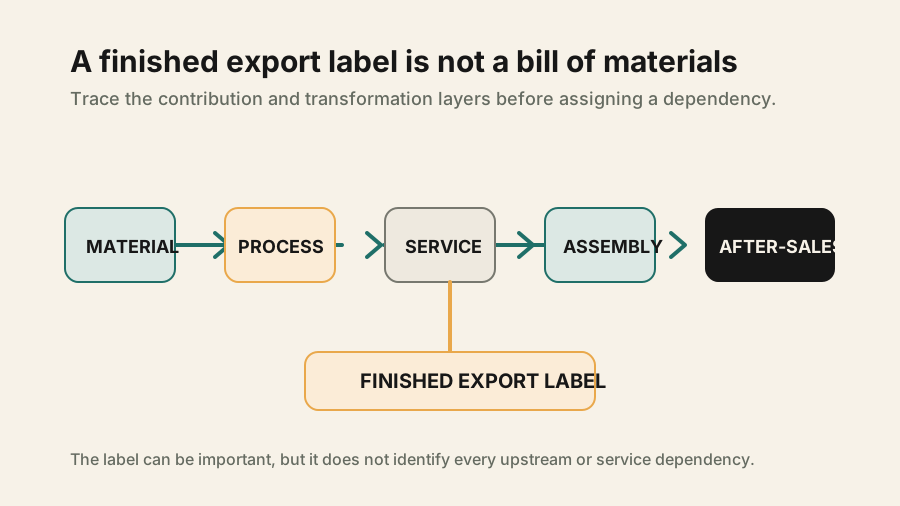
A country of export is not a bill of materials
The second common error is to treat the country attached to a finished export as the whole origin story. Modern production is made of value added from different places: raw materials, intermediate goods, design services, equipment, software, finance, logistics, assembly, testing, packaging, distribution and after-sales support. One country may perform a visible final step while another provides an upstream component or process that cannot be easily replaced. Another may provide a service layer that does not appear as a physical part inside the product.
The OECD’s China Trade in Value Added country note explains the measurement boundary well. Its TiVA framework looks beyond conventional gross trade statistics at the domestic and foreign value added embodied in exports, imports and final demand. It also describes how imports support export performance and how services contribute to manufactured goods. The 2025 edition covers 81 economies and 50 activities from 1995 to 2022.
This does not make TiVA a live traceability system. Its historical, aggregate scope is exactly why it should not be used to certify the origin of a specific part or product. But it provides a critical conceptual correction: an export label is not a complete production map. If a reader sees a product labelled “made in” one country, that label may be important for a particular commercial, customs or consumer purpose. It still cannot identify every material, component, process, service, intellectual-property, equipment or logistics dependency behind the product.
Final assembly and upstream transformation are different questions
For a buyer, “where is it made?” should be unpacked. The question can mean several different things:
- Where was the final good assembled?
- Where did the critical material originate?
- Where was the material refined, coated, formed, machined, tested or packaged?
- Where was the most difficult transformation performed?
- Where are the tooling, fixtures, process know-how and quality controls located?
- Where are replacement parts and repair capability held?
- Which legal entity sells, ships, invoices, warrants and accepts returns?
These questions may point to the same place. They often do not. Treating them as one question makes a supply chain look simpler than it is.
Suppose a buyer shifts final assembly. That may change one exposure, and it may be exactly the right decision. But it does not establish that the bill of materials, qualified upstream capacity, process equipment, software stack, packaging supplier, testing service, shipping route, service parts or seller responsibility also moved. The change should be described precisely: final assembly moved from A to B, or a second approved assembly site became active. That statement is valuable. A broader claim that the entire chain “left China” needs separate proof for every material node it implies.
Do not confuse a customs purpose with an operational dependency map
Country-of-origin information can be essential. It can affect customs treatment, customer requirements, procurement rules, origin marking, preference claims or contractual representations. This article does not provide customs or legal advice. The operational point is simpler: the documentation needed for a legal origin claim and the evidence needed to understand business continuity are related but not identical.
A business-continuity file may need to know where an input is transformed, how quickly an alternative can be qualified, who controls tooling, whether the quality system can reproduce a result, which route transports the input, and who bears the cost of a failure. A customs file may need defined legal facts and supporting documents. Neither should be replaced by a presentation slide about final assembly.
This distinction is especially important when a buyer hears a reassuring phrase such as “local content,” “non-China source,” “global supply base,” “dual source,” or “made outside China.” Each phrase may be accurate in one narrow sense. Ask the speaker to name the product, the transformation, the document, the source, the period and the exception. The aim is not to catch someone out. It is to decide whether the statement resolves the actual requirement.
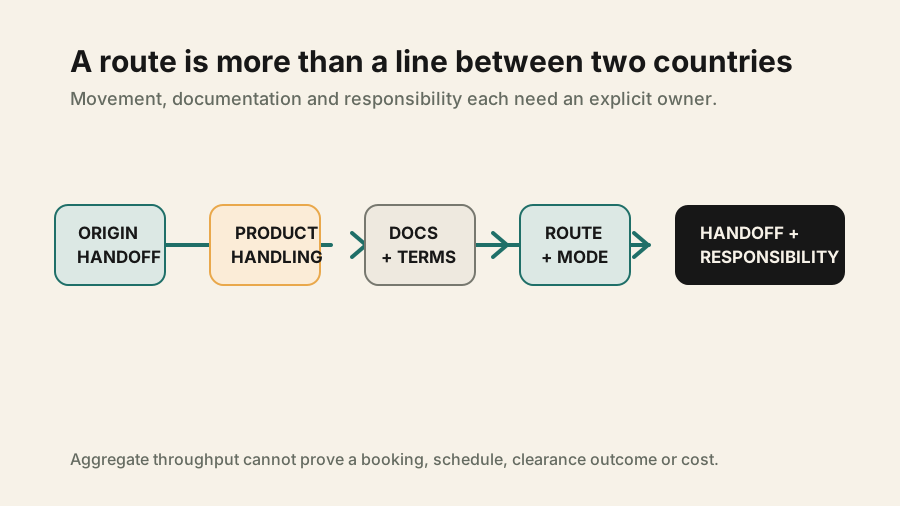
Logistics is a separate dependency layer
Manufacturing capacity is not the same as delivery capacity. A supplier can make an acceptable part and still fail to deliver it on the required route, with the required paperwork, in the required window. A route can look diversified on a map while relying on one port pair, one carrier arrangement, one consolidation point, one broker, one document sequence, or one cross-border handoff. The logistics file deserves the same attention as the factory file.
UNCTAD’s maritime profile for China reports 279,793,800 TEU of container port throughput in 2024. That is useful context for the scale of China’s maritime infrastructure. It tells us that ports are a material part of the country’s trade system. It does not tell us whether a named port is appropriate for a buyer’s cargo, whether a particular sailing has space, whether a shipment will clear, what insurance will cost, whether a route is compliant, or when an order will arrive.
The separation matters because manufacturing and transport disruptions behave differently. A factory disruption can affect an approved process, tooling, labour, quality or component availability. A route disruption can affect schedules, transit time, container positioning, port congestion, transshipment, documentation, insurance, demurrage, detention, customs clearance or communication. A resilient factory plan can fail at the logistics stage; a resilient route plan can fail because the alternative factory is not qualified.
Build a route file, not a port reputation score
When a shipment matters, the route record should be concrete. At a minimum, it should identify:
- The origin facility and handoff point, not just the country.
- The port, airport, border crossing or consolidation point used in the normal path.
- The carrier, forwarder, broker and document owners where relevant.
- The product’s packaging, hazardous-goods, temperature, security, insurance or handling constraints.
- The expected transit and clearance stages, with a dated assumption rather than a permanent promise.
- The alternate route or transport mode, including what it changes in cost, capacity, documentation and product condition.
- The party authorised to make a routing change and the commercial consequences of delay.
This is an operational record, not a national judgment. China’s port scale can be significant background, but the decision lives in the exact route. The same discipline applies outside China. A company that merely replaces one country label with another without mapping the new route may exchange a visible dependency for an unmeasured one.
Documentation may be the bottleneck even when the product is available
Physical availability is not enough to complete a transaction. A product can exist in a warehouse while a shipment remains blocked by missing specifications, inconsistent invoices, packaging records, export documents, import entries, origin declarations, end-use statements, bank requirements, insurance terms or contract instructions. These are not administrative afterthoughts. They determine whether goods can move and who bears the loss when they do not.
The published graphite export-compliance buyer file shows how a material-specific rule and documentation requirement can change the buyer question from “Is there supply?” to “Can this exact shipment be supported by the necessary technical and transaction evidence?” That article is a specific critical-materials example, not a template for every category or jurisdiction. Its broader lesson is still useful: a supply chain is a chain of proof as well as a chain of physical goods.
China Plus One works only when it clears the constrained-node gates
“China Plus One” can be a sensible strategy. It can spread geographic exposure, create a second source, improve negotiating leverage, shorten a route for a particular market, add regional capacity, meet a customer requirement, or give a buyer a tested contingency. It can also become a label for a supplier search that never resolves the actual bottleneck.
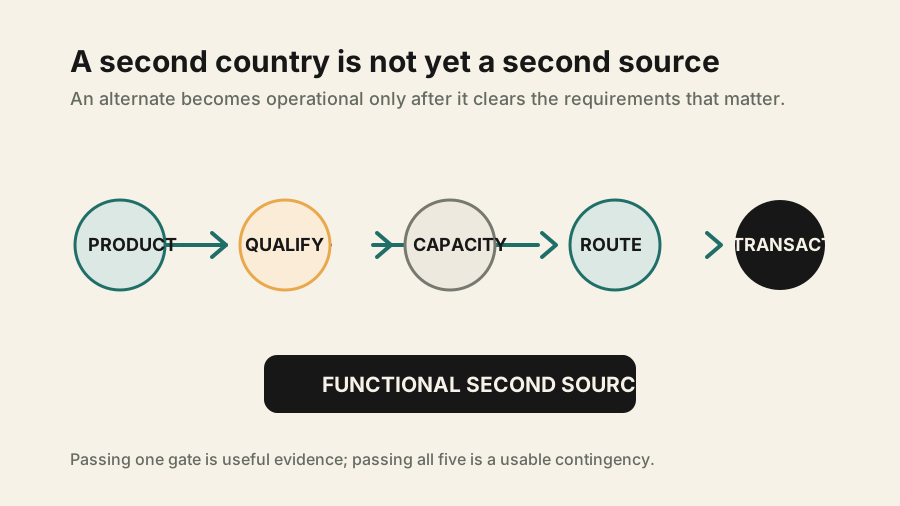
The key is to distinguish geographic presence from functional substitution. A supplier in a second country is not automatically a second source for your product. It becomes one only after it can meet the relevant technical, commercial, route and service conditions. In some cases, the new source may still depend on Chinese materials, equipment, subcomponents, tooling, management or logistics. That is not necessarily a failure. It simply means the mitigation should be described accurately.
An IMF working paper on supply-chain diversification offers a useful framework. Its model examines the resilience-efficiency trade-off in diversifying import sources. It finds that diversifying targeted imports—those more exposed to shocks, positioned upstream in the chain and subject to greater rigidities—can enhance expected welfare when the probability of a large trade shock is sufficiently high. That is not a forecast for a particular firm. It is a reason to make the target, the upstream position, the rigidity and the trade-off explicit.
The word targeted is doing most of the work. It means a buyer does not have to rebuild every global relationship to improve resilience. It also means the buyer should not assume that a broad country switch is valuable if the real constrained node has not moved.
Test an alternate source against five gates
Before describing a second-country supplier as a mitigation, test it against five gates.
| Gate | Question | Evidence to request |
|---|---|---|
| Product | Can it make the exact required input or product? | Drawing, specification, sample result, bill of materials where appropriate |
| Qualification | Can it reproduce the required quality and be approved in time? | Validation plan, quality record, change-control process, responsible owner |
| Capacity | Can it deliver the required volume under realistic conditions? | Capacity assumption, tooling status, lead-time basis, allocation terms |
| Route | Can it move the product with acceptable handling, documents and contingency? | Route file, broker/forwarder plan, packaging and document requirements |
| Transaction | Can the parties contract, pay, insure, warrant and manage failure? | Legal entity, terms, responsibilities, compliance and dispute path |
Diversification has costs that should be visible
The OECD review models a broader point: efforts to relocalise supply chains can impose large trade and GDP costs and do not consistently improve resilience. The model is not a recommendation about a particular company. It is a warning against treating localisation as a free insurance policy.
At the firm level, costs can include duplicated tooling, additional testing, qualification delays, smaller order quantities, inventory, supplier development, quality engineering, route setup, working capital, local service, spare-parts stock, systems integration, different failure modes and management attention. These costs may be justified. The decision becomes better when they are compared with the loss the mitigation is intended to avoid.
Ask: What disruption are we insuring against? A long geographic disruption, a short logistics delay, a supplier quality failure, a policy change, a document failure and a port shutdown require different responses. More inventory may help one. A qualified second source may help another. A different port may help a third. A contract, document or compliance review may help a fourth. “China Plus One” is not a response category by itself; it is a possible design choice within a specific response.
Build the product-to-transaction dependency file
This is the practical core of the guide. Before calling a product China-dependent, or declaring it diversified, build a file that someone else can audit and update. The file does not need to be a giant database. It needs to answer the decision that is actually being made.
Step 1: define the failure object
Name the item or capability that would matter if it were unavailable. Avoid category labels such as “Chinese electronics” or “China logistics.” Use the smallest operational object you can: a specified component, material grade, process step, test, tool, service, document or repair part.
Write the consequence of failure in operational terms. Does production stop? Does a regulated product lose approval? Does a customer delivery slip? Does warranty service fail? Does the product become unusable? Does a contract trigger a penalty? Does cash become tied up? The consequence determines how much evidence is needed.
Step 2: map the transformation, not only the supplier
Identify what turns the object into something the buyer can use. A material may require refining, coating, cutting, forming, machining, assembly, programming, calibration, test, packaging or documentation. A supplier may be replaceable at one stage and irreplaceable at another.
Do not assume that the most visible supplier controls the most important transformation. Ask who owns the tooling; who sets or knows the process parameters; who conducts the test; who supplies the critical intermediate; and who can approve a change. If the answer is uncertain, record the uncertainty rather than filling it with a country assumption.
Step 3: classify the dependency honestly
Use a plain-language classification. For example:
- No identified China linkage: the reviewed object has no documented China-linked input, process, route or transaction in the current file. This is not proof that none exists.
- China-linked but substitutable: a link is identified, and the file includes an approved alternative with defined capacity and route conditions.
- China-linked and partially mitigated: an alternative exists but has an open qualification, capacity, route, commercial or service gap.
- China-linked constrained node: the required source, transformation or transaction path cannot yet be credibly replaced within the decision window.
- Unknown: evidence is insufficient to place the object in another category.
“Unknown” is an honest and often valuable result. It tells the team where to spend research time. It is safer than a confident “low risk” label built from a final-assembly claim or a country map.
Step 4: test the substitute, not the story
For each potential alternate, request the evidence that matters to the failure object. A prospect might need a sample and validation record. A new site might need capacity evidence and a change-control plan. A new route might need a packaging check, broker confirmation and document flow. A critical material might need a specification and process-comparison review. A service dependency might need replacement-part and support responsibility evidence.
The proof need not be identical for every product. A low-value, noncritical commodity can require a lighter file than a safety-critical, regulated, high-volume or customer-visible item. But the logic remains: a claimed substitute is not a substitute until it meets the requirements that make the original object usable.
Step 5: map the movement and transaction separately
Attach a route file and a transaction file. The route file identifies the physical path and handling constraints. The transaction file identifies the seller, buyer, payer, insurer, consignee, warranty party, document owner and escalation route. If the mitigation depends on a new country, say which parts of these files change and which stay the same.
This often produces a more nuanced result than “leave” or “stay.” A company may keep an upstream Chinese input, add a non-China assembly site, retain a China-linked toolmaker, qualify a second route, and change the contracting entity for a particular market. That may be a very strong response. It should be described as a multi-layer design, not as total decoupling.
Step 6: assign owners, dates and triggers
Every dependency file should have an owner, an evidence date and a refresh trigger. Trade figures can be refreshed on an annual or periodic schedule. Capacity, qualification, supplier, policy, route, freight, financial and contract facts may need a different cadence. A useful trigger can be a design change, a supplier change, a new market, an order-volume change, a policy event, a quality incident, a route disruption or a customer requirement.
Without an owner and trigger, a dependency assessment becomes a snapshot that slowly turns into a slogan. With them, it becomes a decision record that can survive a handoff, an audit, a negotiation or a disruption.
What China supply-chain coverage should stop claiming
Several familiar lines make a reader feel informed while hiding the work still required:
- “China dominates, therefore we are exposed.” China’s gross trade and concentration role can justify investigation; they do not identify your constrained node.
- “Final assembly moved, therefore the chain moved.” Final assembly is one transformation. Map materials, components, tooling, tests, software, routes and service separately.
- “We have three suppliers, therefore we have resilience.” Count qualified, activated capacity and shared upstream dependencies, not company names.
- “A second country equals China Plus One.” A country is not a functional substitute until it clears product, qualification, capacity, route and transaction gates.
- “Port scale proves delivery reliability.” Aggregate throughput is context; a shipment needs a dated route and document file.
- “Trade data proves origin.” Gross trade and value-added datasets cannot certify a specific product’s legal origin or bill of materials.
- “Relocalisation is automatically safer.” OECD modelling and firm experience alike require the resilience benefit and the cost to be tested against the actual disruption.
The published China manufacturing guide provides useful background on the systems that can make Chinese manufacturing networks fast and deep. It is not proof of a particular supplier relationship, production location, capacity commitment or product origin. Treat it as context, then return to the file for the exact object in front of you.
FAQ: China supply-chain dependency and diversification
Does China’s export share mean my business depends on China?
No. It means China has a large role in a stated gross-merchandise-trade measure. Your business may have no relevant China-linked constrained node, or it may have one that a national statistic cannot identify. Start with the exact input, transformation, route and transaction that would affect your product.
Is a product made outside China automatically less exposed to China?
Not automatically. Final assembly can move while upstream materials, components, tooling, software, equipment, testing, logistics or service remain China-linked. The product may be less exposed in one layer and still constrained in another. Record what changed rather than using a single country label for the whole chain.
What is the difference between a supplier and a qualified second source?
A supplier may be capable of quoting or sampling. A qualified second source has passed the relevant product and quality process. An activated source also has workable capacity, route and commercial arrangements. For a disruption plan, those later stages matter more than a name on a vendor list.
Does China Plus One always improve resilience?
No. It can improve resilience when it targets an exposure that is upstream, hard to reconfigure and important under a plausible shock. It can also add cost, delay, complexity and a new unmeasured bottleneck. The practical question is whether the alternate clears the product, qualification, capacity, route and transaction gates for your requirement.
Can trade data tell me where every component in a product comes from?
No. Aggregate trade and value-added data can describe broad patterns and measurement boundaries. They do not replace a bill of materials, supplier declaration, audit, origin document, qualification record or transaction file for a named product.
What should I do first if I suspect a China-linked dependency?
Name the smallest failure object, identify its transformation and current source, then ask whether an alternative is identified, qualified, activated and contractually usable. Add the route and transaction files. If the evidence is incomplete, classify the object as unknown or partially mitigated rather than assuming the risk is low.
Method and limitations
This is a desk-research guide. It uses the WTO for a 2024 gross-merchandise-trade record, the OECD for aggregate concentration and value-added frameworks, UNCTAD for a 2024 China maritime-profile figure, and an IMF working paper for a conditional model of targeted diversification. The article team did not audit a supplier, factory, bill of materials, shipment, route, contract, qualification process or business-continuity plan.
The guide does not provide customs, legal, sanctions, investment, engineering, freight, insurance or procurement advice. It does not establish any company’s actual sourcing, origin, capacity, qualification time, route, price, compliance status or supplier relationship. Those are evidence questions for the exact product and transaction. The durable conclusion is narrower: use China’s national scale to know where to look, then build the smaller file that can support a real decision.
Related reading
- How China Manufactures: Inside the World's Factory (2026) — background on China’s manufacturing-system context; not evidence of a product’s exact origin or supplier relationship.
- China Graphite Export Controls: Buyer Compliance File — a specific material-compliance file; not a rule for every product or jurisdiction.