

AI-generated editorial illustration by China Made & Tech. It depicts no real phone, carrier, coverage area, store, network result, or device certification.
By China Made & Tech Team. Independent English field guide to China’s niche hardware brands, hidden champions, founders, factory towns, and supplier clusters.
“Will this Chinese phone work in the United States or Europe?” sounds like a question about a brand. It is not. It is a question about an exact device identity, an exact carrier process, an exact activation route, an exact market record, and an ownership path that may change with software, time, or the seller’s version of the product.
That distinction is easy to miss when a listing looks familiar. A phone may carry a well-known Chinese brand, use a familiar charging port, show a long band table, run an Android-based interface, and still leave essential questions unanswered. Is this the exact hardware SKU the buyer thinks it is? Is it unlocked? Does the destination carrier currently accept its IMEI? If the buyer needs eSIM, does the device’s EID pass the carrier’s separate eSIM check? Does the market record describe the device actually being sold? Can the buyer obtain updates, warranty service, security support, repair parts, and a return remedy after import?
The answer is rarely a simple yes or no. A phone can be usable in one narrow sense and unsuitable in another. It can register on a network but lack a feature the buyer needs. It can accept a physical SIM but not complete an eSIM flow. It can have a regulatory identifier but no carrier admission for the buyer’s plan. It can have USB-C and still leave every radio, service, and support question open. The useful goal is not to turn uncertainty into a universal verdict. It is to shrink the uncertainty before money, shipping, and return rights make the decision expensive.
Is a Chinese phone brand compatible with U.S. or European carriers?
No brand-level answer is reliable enough to use as a buying decision. Compatibility belongs to a particular model, hardware version, software state, destination carrier, plan, activation method, and date. Use current carrier and market records for the exact device rather than a brand name or another buyer’s anecdote.
Are network bands enough to tell whether an imported phone will work?
No. Bands matter, but they are not the whole admission decision. AT&T says devices can fail on its network because of incompatible cellular technology or frequency bands and directs buyers to its current tested-and-approved device list. A copied band table therefore cannot substitute for the carrier’s own exact-device check. AT&T’s support guidance is a useful example of the boundary.
Does an FCC ID prove that a phone will work on a U.S. carrier?
No. An FCC authorization record can be useful for a bounded certification-status question. The FCC says an FCC ID signals that a device has received equipment certification and can be checked through its Equipment Authorization System. That does not determine a carrier’s activation, plan eligibility, coverage, feature support, or service outcome. The FCC document describes the authorization boundary, not a carrier result.
Does USB-C mean the phone is compatible in Europe?
No. USB-C answers a charging-port question. The European Commission says common-charging requirements have applied to handheld mobile phones since 28 December 2024 and identifies USB-C as the common port in scope. It does not decide cellular service, eSIM, local features, warranty, or the status of a particular imported device. The Commission’s common-charger page is evidence for the charger file, not the carrier file.
Compatibility starts with an identity, not a brand
The phrase “Chinese phone” is a useful search term. It is not a technical identity. It can describe a brand founded in China, a phone designed for the domestic market, a global-market model, a device sold by a marketplace importer, an older regional variant, a refurbished device, or a handset whose listing combines photographs and specifications from several versions. Those are not interchangeable products.
Even a product name is often too broad. A manufacturer can use a family name across storage variants, radio variants, carrier variants, regional software builds, and revised production runs. A marketplace title may shorten the name, omit the suffix that identifies a regional edition, or say “global version” without explaining who built the software image, where the unit was intended to be sold, or which support programme applies. The buyer’s first task is to move from a marketing name to a device identity that can be checked.
That identity is a package, not a single field. Start with the exact model code shown on the device, its box, and the seller’s invoice. Add the hardware and software version visible in the settings page; the declared region or market; the SIM arrangement; the IMEI for the actual unit when the seller can provide it lawfully and safely; and the EID if eSIM matters. Retain the listing URL, dated screenshots, stated return terms, seller identity, and the stock-keeping reference. These records do not prove compatibility. They make compatibility checkable.
Why model identity is stronger than a specification table
A specification table can help a buyer generate questions. It can show that a product allegedly has a certain port, a certain SIM arrangement, or radio capabilities that need more investigation. It cannot show that the seller will deliver that exact version. It cannot show that a carrier will accept the device today. It cannot show that a regional software image includes the provisioning, settings, emergency features, or update channel that the buyer expects. And it cannot tell the buyer whether the listed device is new, refurbished, modified, locked, or covered by a meaningful return remedy.
Treat the table as a discovery document. Turn each important entry into a record request. If the listing says “dual SIM,” ask whether the second path is physical SIM, eSIM, or a configuration that changes when eSIM is enabled. If it says “5G,” ask which model code and software build the claim describes, then run the destination carrier’s current device process. If it says “global ROM,” ask what “global” means for this exact unit, who supplies updates, and how the seller will handle a device that cannot be activated as intended. If the answers remain generic, the buyer has learned something important before purchase.
The opposite error is treating a number as magic. An IMEI is not a public promise that the phone will work everywhere, and buyers should avoid disclosing it casually. Its value is that a carrier can use it in a specific current decision process. An EID is similarly not a badge of universal eSIM success. It is a device identifier a carrier may need when assessing the eSIM path. The buyer should use identifiers through the intended carrier’s official workflow or a verified support channel, not publish them in a comment thread or send them to an unrelated reseller.
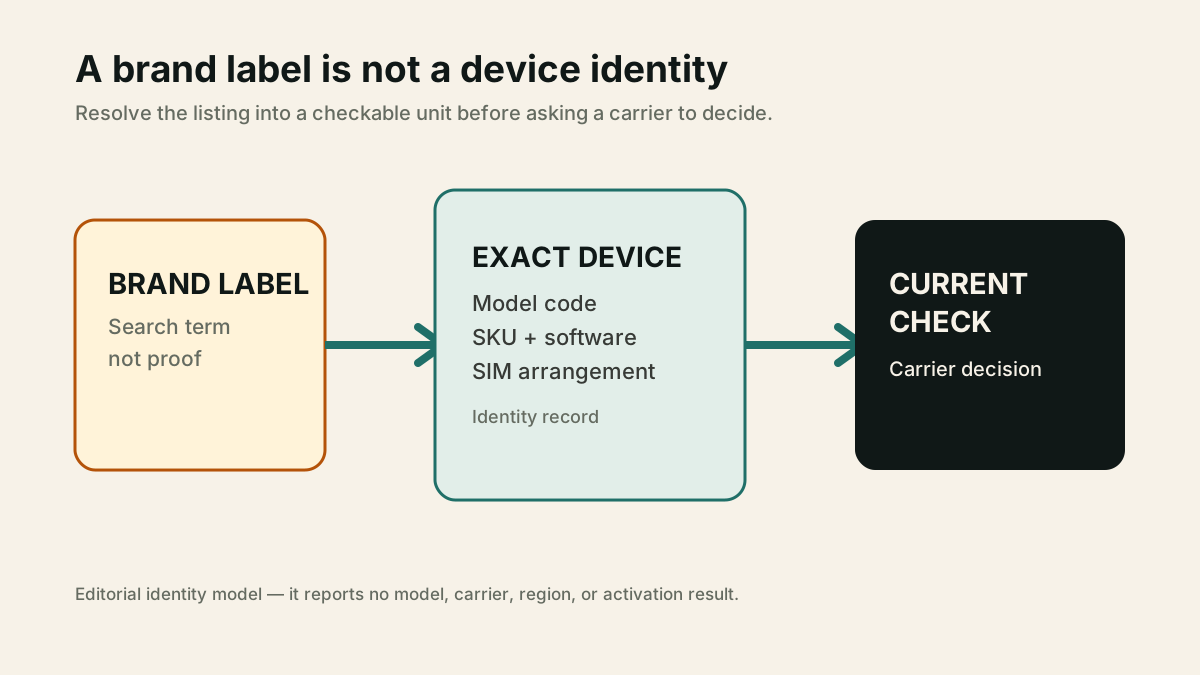
Editorial identity model. It names no phone, carrier, regional version, coverage result, or activation outcome.
Carrier compatibility is a live device decision
The carrier file is the most important file because it connects an imported handset to the service the buyer actually intends to use. It should be built before purchase whenever the carrier offers a pre-purchase process. The file answers a narrow question: on the date checked, did the destination carrier’s own process say that this exact device identity could be brought to that network under the stated path? It does not answer whether another carrier will say the same thing, whether every feature will work, or whether the result will remain unchanged after a software or policy change.
T-Mobile’s public BYOD workflow illustrates why model identity matters. The carrier asks a user to enter an IMEI to see whether the phone is compatible with its network. When eSIM compatibility is uncertain, it asks for the device’s EID as a separate check. The page also says that non-T-Mobile devices may have varying experiences and that the carrier cannot guarantee functionality or performance for devices it did not sell or whose software version it did not sell or update. Those are T-Mobile’s published conditions, not a finding about any individual Chinese phone. But they are enough to show why “the phone has the bands” is not the end of the decision.
AT&T frames the same lesson differently. Its support page says that devices may not work because the cellular technology or frequency bands are not compatible and sends buyers to a current list of tested and approved devices. That does not mean a buyer must use AT&T’s list for another network, or that every carrier operates an identical list. It means that a carrier can apply its own current device boundary beyond the general language of a retail listing. A buyer should use the process of the carrier they actually plan to use, in the country and plan context they actually have.
What a carrier-file result can say
If an official checker, store, or written support path gives a positive result for the exact identifier, record the date, input identifier, carrier, plan context if relevant, result wording, and any stated conditions. A careful buyer can then say: “This exact device passed this carrier’s current compatibility process on this date under these stated conditions.” That is a useful statement. It is also intentionally limited.
The record should not be broadened into “this brand works in the country,” “this model works on all plans,” “all features will work,” or “the phone will keep working after every update.” These claims add uncertainty that the check did not remove. They can be disproved by a carrier change, a software revision, a different retail SKU, an account restriction, a separate feature prerequisite, or a condition buried in the activation flow.
If the result is negative, partial, unclear, or unavailable, treat that as a decision signal rather than a problem to solve with optimism. A buyer can ask the carrier what exact prerequisite is missing, check a different official activation path, consider a physical SIM if appropriate, select a locally supported device, or abandon the import. What the buyer should not do is treat an anecdote or a superficial similarity as a replacement for an unresolved carrier result.
Features need their own proof boundary
Basic registration, calls, data, messages, hotspot use, emergency functions, visual voicemail, Wi-Fi calling, 5G access, eSIM transfer, carrier application features, and device-management policies do not necessarily share one answer. A carrier’s compatible result may be sufficient for a basic service decision and insufficient for an essential feature the buyer expects. If a feature changes the purchase decision, give it its own question and preserve the carrier’s response.
This is particularly important for buyers who need the phone for work, travel, emergency contact, accessibility, mobile-device management, or a number they cannot easily replace. Their standard should be higher than “someone online says it connects.” They should define the service they must preserve, use the carrier’s current channel to ask about that service for the exact device, and keep a written record of what the carrier did and did not confirm. The phone may still be a reasonable purchase. The point is to make the risk visible before the buyer is committed.
Activation is not a footnote
Activation is the process that turns a theoretically acceptable device into a working line. It has its own identifiers, account checks, plan rules, and failure modes. A buyer who plans for physical SIM can still care about the correct SIM format, the availability of a physical slot in the actual SKU, the device’s unlocked status, and how the carrier will provision it. A buyer who plans for eSIM has a different problem: the device must have the required eSIM capability, the carrier must accept the relevant EID, and the account and activation flow must support the desired transfer or new-line process.
T-Mobile’s BYOD page makes that separation visible. It directs users to an IMEI check for network compatibility, then offers an EID check when eSIM eligibility needs confirmation. It also describes a physical-SIM option when eSIM is not compatible. The useful conclusion is not that every imported phone will work with one of those paths. It is that eSIM is a second compatibility question. A buyer should not buy a device on the assumption that “eSIM-capable” in a retailer description settles the destination carrier’s current eSIM decision.
Write down the activation path before buying. Is this a new number, a port-in, a replacement device, a travel line, a secondary line, or an enterprise-managed line? Is the buyer changing from physical SIM to eSIM, transferring an existing eSIM, or adding a new eSIM? Does the buyer have account access and any security information the carrier requires? Does the purchase need to preserve a time-sensitive number? The answers can determine how much uncertainty is acceptable.
A physical SIM is not automatically a universal escape hatch. It may avoid one eSIM question while leaving carrier admission, device lock, network feature, and service-support questions unresolved. Likewise, an eSIM-capable device is not automatically eligible for a particular carrier’s eSIM service. The practical choice is to use the carrier’s exact process for the desired activation route before the return window starts counting.
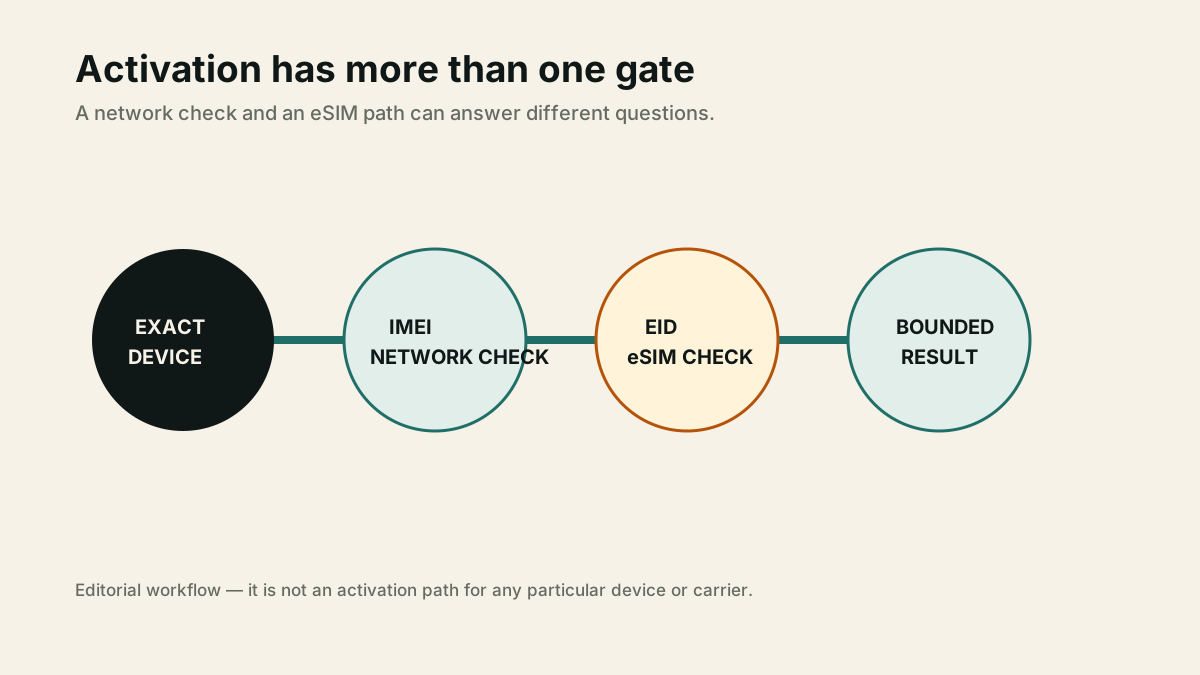
Editorial activation workflow. It does not claim that a named device, carrier, account, or eSIM profile will pass any gate.
Market records are separate evidence files
An imported phone can raise market-access questions that do not belong in the carrier file. Treat them separately. A carrier’s positive IMEI result does not replace a buyer’s responsibility to understand the status of the device being acquired and used in the destination market. Conversely, a regulatory or market record is not a promise that a carrier will activate the device or enable every service feature.
In the United States, an FCC identifier is an example of a bounded record. The FCC’s July 2026 document says an FCC ID signals that a device has received equipment certification and that the public can use the Equipment Authorization System to verify certified equipment. This can help a buyer ask whether an exact identifier appears in an authorization record. It cannot tell the buyer whether the phone is accepted by a named carrier, whether an imported unit is the same configuration as the record, whether a carrier will enable a feature, or whether the buyer has complied with every applicable requirement. Treat the FCC authorization explanation as a certification-status check, not a shortcut to service compatibility.
The European Union common-charging framework illustrates another separate file. According to the European Commission, common-charging requirements have applied to handheld mobile phones since 28 December 2024, and USB-C is the common port. That is useful for a buyer deciding whether a phone and charger ecosystem align on the specified charging question. It is not proof of mobile-network registration, eSIM eligibility, national carrier feature support, language availability, return handling, or a manufacturer’s long-term update practice. A port is a port; it is not a complete operating system for ownership.
Do not turn a market marker into a service claim
A regulatory mark, an authorization identifier, a manufacturer declaration, or a charger specification can be meaningful evidence inside its intended scope. The mistake is to make it carry more than it can. “This unit has an FCC ID” may support a question about an authorization record. “This phone uses USB-C” may support a question about a charger. Neither sentence settles whether the buyer can make a call, provision a particular eSIM, receive a specific carrier feature, obtain a repair, or return the device to a seller in another jurisdiction.
The same caution applies to the word “global.” It is a marketing description until a buyer ties it to a defined device identity and the evidence that matters for their own destination. A global-market version may be the right one for a buyer. A domestic-market version may be workable for a sophisticated buyer. Neither label is a substitute for a carrier result, a support policy, or a current market record. The buyer should record the exact term used by the seller and then ask what factual file supports each part of it.
The five files behind a sensible imported-phone decision
The following five-file framework is an editorial tool. It does not replace carrier support, regulatory review, manufacturer documentation, or qualified advice where needed. It gives a buyer a way to keep different questions from being accidentally answered by one attractive claim.
File 1: device identity
Record the exact model code, retail SKU, unit condition, declared market, software build, seller, invoice, listing URL, SIM arrangement, and identifiers required for legitimate carrier or manufacturer checks. Preserve images of the box and settings screen once the device is in hand. The file should distinguish what the seller stated from what the buyer has observed after delivery. If the seller cannot identify the actual variant clearly before purchase, the buyer should treat that as a material uncertainty rather than fill the gap with a product-family name.
File 2: carrier admission
Record the destination carrier, date, exact official checker or support channel, result wording, identifier used, plan context if relevant, and any carrier caveat. The carrier file should answer only its defined question. If the buyer cares about a particular service feature, add it as a separate question rather than assuming it came with basic admission. Keep screenshots or messages that preserve the carrier’s wording; a vague memory of a positive result is difficult to review later.
File 3: activation route
Record whether the line will use physical SIM or eSIM, whether the device is unlocked, the EID if a carrier needs it, the account and transfer context, the expected activation sequence, and a fallback decision if the preferred route fails. Do not put a device through an irreversible account or number transfer until the buyer understands the recovery path. The file should make a simple distinction: planned, checked, activated, and still unresolved are different states.
File 4: market and charger record
Record the exact market-access or certification question the buyer is asking, the authoritative source used, the identifier or product scope searched, the date, and what the record cannot establish. If charging matters, record the port, charger, cable, plug, power delivery expectation, and seller disclosure as separate ownership facts. Do not use this file to make an activation claim, and do not use a carrier result to declare a legal conclusion.
File 5: ownership and support
Record the seller’s return commitment, payment protection, warranty issuer, repair path, update source, security-support information if available, accessory and part availability, local service contact, and a plan for data transfer or exit if the device does not meet the buyer’s need. This file matters because a technically usable phone can still be a poor imported purchase if the buyer has no realistic remedy. It also matters because support information can be more volatile and less transparent than a hardware specification.
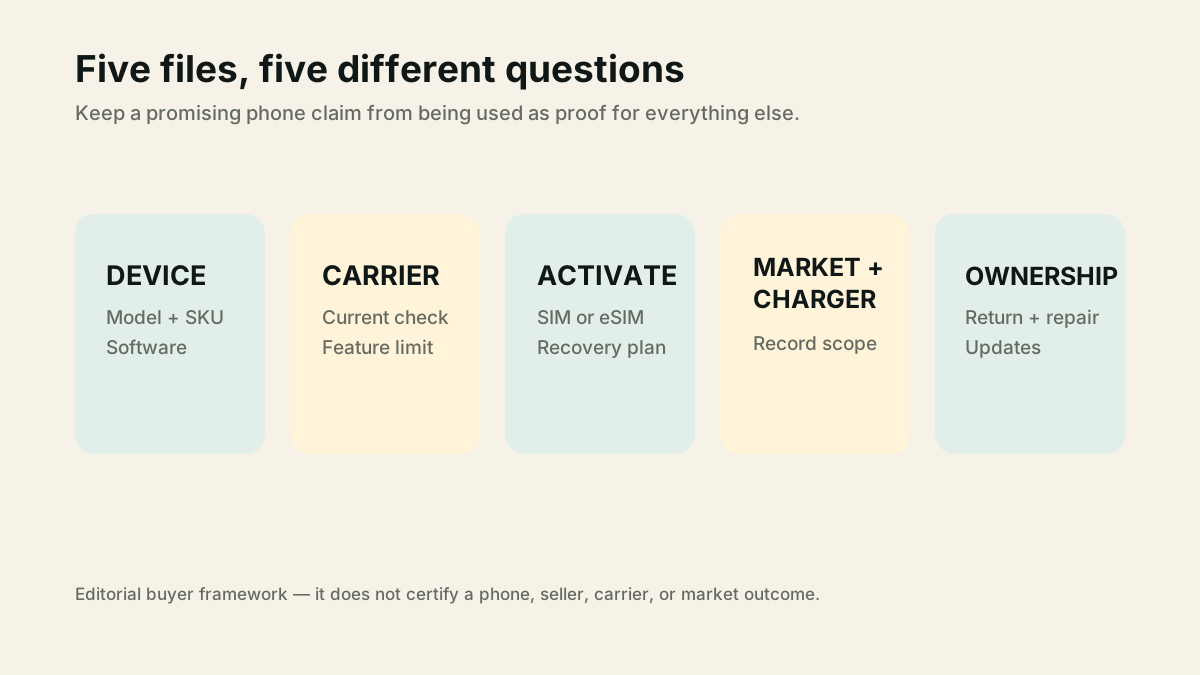
Editorial buyer framework. These files organise questions; they do not certify a phone, seller, carrier, or market outcome.
Use the files in a pre-purchase sequence
The files are most useful before the buyer owns the phone. After delivery, a buyer may have less leverage, less time to return it, and more pressure to make the device work because a number, data transfer, travel plan, or work requirement is already attached to it. A small amount of structured checking before payment is usually cheaper than trying to reverse an import decision later.
Start with the consequence of a failed purchase. If the phone is a hobby device, a secondary travel handset, or a non-critical experiment, the buyer may accept more uncertainty. If it must replace a work phone, carry a primary number, support an accessibility need, connect to an enterprise system, or be used where service failure has a high cost, the buyer should require stronger evidence. The question is not whether imported phones are good or bad. It is how much unverified dependency the buyer can afford to carry.
Step 1: name the non-negotiable use case
Write one sentence before comparing devices: “This phone must do X in country Y with carrier Z, using activation path A, by date B.” X might be a physical-SIM line, an eSIM travel line, a number port, voice service, data access, a specific carrier feature, or a support arrangement. The sentence is deliberately plain. It stops the buyer from treating a large feature list as a substitute for the single condition that will decide whether the phone is useful.
Then identify what would make the purchase fail. It may be a negative carrier checker result, no local return route, no physical SIM in the actual SKU, an inability to move an existing number safely, a missing ownership-support path, or an unclear seller identity. Put those conditions at the top of the decision. Do not postpone them until after comparing cameras, storage, charging speed, or price.
Step 2: collect the seller’s exact version record
Ask the seller for the exact model code and the information needed to distinguish the unit from a family name. Ask whether the phone is new, refurbished, opened, modified, carrier-locked, or supplied with non-standard software. Ask what market the unit was intended for and who provides warranty or return service. Keep the reply with the listing. The buyer is not looking for a persuasive answer; they are looking for a record that can be compared with the device received.
If the seller cannot give a stable model identity, stop there unless the buyer consciously accepts a high degree of uncertainty. A response such as “all versions work,” “international unlocked,” or “same as global” may be marketing shorthand rather than a description of the unit in the parcel. An exact identifier, an invoice, and a return commitment are more useful than a long catalogue of generic specifications.
Step 3: use the destination carrier’s current process
For the primary carrier, use the carrier’s official compatibility path when one is available. If the buyer needs eSIM, run or request the separate EID check as the carrier instructs. Do not enter an identifier into a third-party checker simply because it offers a quicker answer. A buyer may need to use a carrier’s store or verified support channel when an online tool cannot decide the case. Record the date and the result wording.
The buyer should also read the words around the result. T-Mobile’s public flow is useful here because it does more than ask for an IMEI. It warns that functionality and performance of non-T-Mobile devices are not guaranteed and that experiences may vary. A buyer should treat those caveats as part of the result, not as small print to ignore. T-Mobile’s BYOD page shows why a pass can still be narrower than “everything will work.”
If the buyer wants to use a different carrier later, repeat the check for that carrier. Porting a phone between networks is not a reason to carry a prior result forward automatically. A successful result is evidence for the process that produced it. It is not a property that attaches permanently to a brand, a product family, or even a device after all relevant conditions change.
Step 4: decide the activation and recovery plan
Before paying, plan how the first activation will happen and what happens if it fails. For a new line, the recovery may be simple: use an alternative device or order a physical SIM. For a number port or a work line, recovery may be more consequential. The buyer should know whether to keep the old phone active, how to receive account verification messages, how to restore an eSIM or physical SIM, and how to avoid losing access to accounts during the change.
This is not a technical recipe because the correct process depends on the carrier, account, jurisdiction, and device. It is an ownership discipline. Make the first activation when the buyer has time, account access, a fallback device, and a support channel—not during a flight, at the beginning of a work trip, or after the return period has almost expired. Preserve the original box, invoice, and device identifiers until the decision is genuinely complete.
Step 5: keep the conclusion narrowly written
At the end of the sequence, write a result that matches the evidence. For example: “The seller identified model code X; carrier Y’s current IMEI process returned a compatible result on date Z; the eSIM path remains unconfirmed; the purchase is acceptable only if physical SIM is sufficient and the stated return terms remain available.” That statement is much more valuable than “this phone works here.” It tells the buyer and any later reviewer what is known, what is not known, and which condition would change the decision.
The same format handles a no-go outcome without drama. “The exact model identity was not confirmed,” “the carrier’s checker did not accept the device,” “the needed eSIM path could not be verified,” or “the seller did not provide a workable return remedy” are all valid reasons to choose a different device. A disciplined no is often a better result than an imported device that becomes an expensive troubleshooting project.
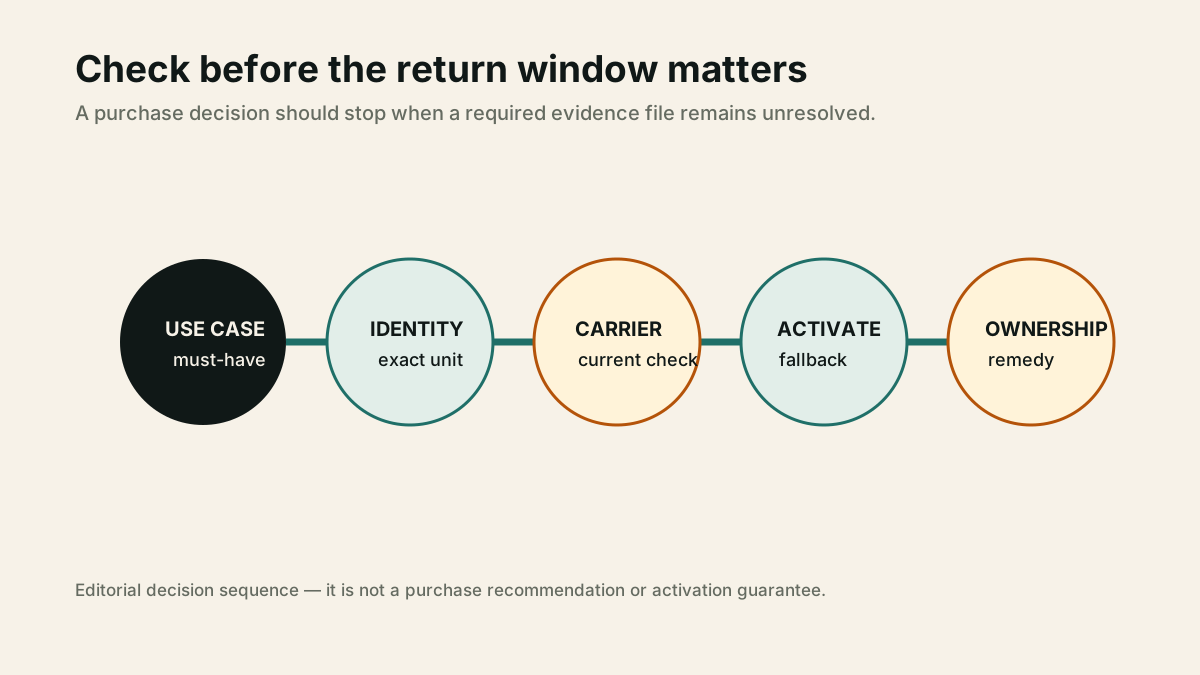
Editorial decision sequence. It is a planning aid, not a carrier workflow, purchase recommendation, or guarantee of a successful activation.
Common shortcuts that do not answer the real question
Most bad compatibility decisions begin with a shortcut that sounds reasonable. The shortcut is usually not useless; it is simply too small to carry the conclusion placed on it.
“The bands match, so it will work.”
Band information is a legitimate input. It can help a buyer decide whether an exact device deserves a carrier check. It cannot replace that check. AT&T’s guidance is direct that devices may fail because of incompatible cellular technology or frequency bands and points buyers to a current tested-and-approved device list. That combination matters: hardware characteristics are relevant, but the carrier keeps a current device boundary. A buyer should use the information as a question generator, then use the relevant carrier process for the decision.
The band shortcut also hides time. A copied table may describe a different hardware version, a different software state, a different country variant, or an earlier production run. A carrier’s process may also change while a third-party product page remains online. The practical response is not to memorise more band numbers. It is to preserve the exact device identity and check the current service path that matters to the buyer.
“The listing says global version.”
“Global version” can be a useful seller description, but it is not a standardised answer to every compatibility question. The buyer should ask what exact variant it refers to, which software image is installed, how updates arrive, who will support a failed activation, and what return remedy applies if the product differs from the description. A seller that gives clear, consistent, checkable answers may reduce uncertainty. A seller that relies on labels but cannot identify the actual unit increases it.
Do not make the opposite shortcut either. A device described as a domestic-market version is not automatically unusable; it may be a deliberate choice for a buyer who understands and accepts the support and carrier boundaries. The issue is suitability, not national identity. The files force the buyer to compare the required use case with evidence about the unit actually on offer.
“It has eSIM, so activation will be easy.”
eSIM capability on a device is only the start of an activation path. A carrier may use a device EID to check eSIM compatibility and may offer physical SIM when the eSIM path is not available. That is why the activation file should remain independent from basic carrier admission. If the buyer must have eSIM, the exact eSIM result is a purchase condition. If physical SIM is acceptable, it can be a fallback only after the buyer checks that the actual SKU has the right slot and that the carrier path supports the rest of the use case.
Avoid converting a carrier’s sample web flow into an expectation of instant activation. Account security, number transfer, plan rules, device state, and support availability can all affect the process. The safe claim is not “this phone will activate by eSIM.” It is “this exact device’s EID should be checked in the destination carrier’s current eSIM process before the purchase becomes irreversible.”
“It has an FCC ID or CE mark, so the rest is fine.”
An official record is valuable when the buyer asks the question it can answer. The FCC says its FCC ID supports a certification-status record that can be checked through EAS. The European Commission’s USB-C rule supports a charging-port question within its product scope. Neither record turns into an all-purpose promise about carrier acceptance, service quality, local feature support, a seller’s warranty, or long-term ownership.
This distinction protects both buyers and sellers. A seller can accurately disclose a record without exaggerating it. A buyer can verify the record without assuming it eliminates other work. The result is a cleaner transaction: each party can discuss the exact model, the exact record, and the remaining unresolved question instead of arguing about a broad compatibility label.
“Someone online used the same phone.”
An anecdote can reveal a question worth checking. It is rarely enough to settle the buyer’s answer. The person may be using a different carrier, market version, software build, account type, activation method, date, or feature set. They may also report an initial success without identifying a limitation that appears later. Forums are useful for discovering terminology and failure modes. They are weak evidence for a purchase promise.
When an anecdote conflicts with an official carrier result, resolve the conflict in favour of the current process that applies to the buyer’s exact situation. If the carrier cannot resolve it, the uncertainty remains. That may be tolerable for a low-stakes experiment and unacceptable for a primary phone. The files do not make that value judgment for the reader; they make the trade-off visible.
How to communicate a compatibility result honestly
Buyers, sellers, workplace administrators, and reviewers all benefit from language that matches the record. Good communication separates statement, source, condition, and limit.
Instead of saying “This phone is compatible with Europe,” say: “The unit uses USB-C, which addresses a charger question; service and activation still require the destination carrier’s current exact-device check.” Instead of saying “This brand works on the carrier,” say: “The carrier’s current IMEI process accepted the specified device on the stated date; the carrier’s published limitations for non-carrier devices still apply.” Instead of saying “the FCC approved it,” say: “An FCC certification-status record can be checked for the listed identifier; that is not a carrier-service result.”
This style may sound less exciting than an all-clear claim. It is more durable. It survives a product revision, a changed carrier policy, a new software build, a different seller, or a later reviewer who needs to know what was actually tested. It also allows a buyer to compare options rationally: one phone may have a complete identity and carrier file but weaker ownership support; another may have a strong local service path but an unresolved eSIM question. The right choice depends on the buyer’s use case and tolerance for those different gaps.
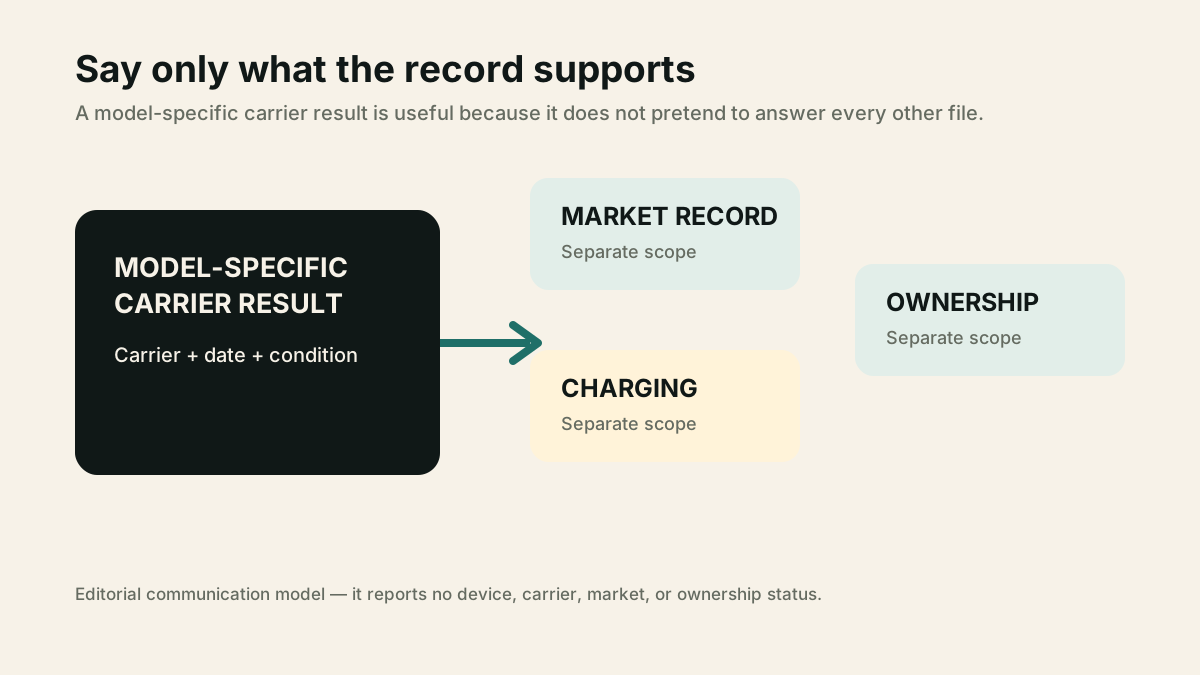
Editorial communication model. It does not report the status of any phone, brand, carrier, or regulatory file.
A practical stop-or-proceed rule
Proceed only when the files answer the non-negotiable use case. For a buyer who needs a local physical-SIM line and a clear return route, a documented exact model, current carrier result, physical-SIM confirmation, and support remedy may be enough. For a buyer who needs eSIM transfer, a primary work number, an enterprise feature, or fast local service, the evidence standard should be higher. An unresolved required condition is not a small footnote; it is a reason to delay the transaction or select another product.
Do not confuse caution with hostility toward Chinese brands or imported devices. The same framework works for any phone bought outside its intended channel. It is especially useful for Chinese phone searches because public discussion often skips from a brand name to a universal conclusion. The buyer should bring the decision back to the unit, the carrier, the activation route, the record, and the remedy.
For brand context, see Chinese Smartphone Brands: The Buyer Context. A brand guide can explain the market and product families. It should never replace the current evidence needed to activate one particular phone on one particular carrier.
Method and limitations
This is desk research based on current public BYOD material from T-Mobile and AT&T, an FCC equipment-authorization document, and the European Commission’s common-charger page. These sources are used only for their stated processes and record boundaries. The article does not claim that the editorial team tested a handset, ran a live IMEI or EID query, activated a SIM or eSIM, inspected firmware, used a carrier account, reviewed a seller’s stock, or verified a device’s legal status in a particular transaction.
Carrier eligibility, model identity, software, plan terms, activation paths, market requirements, support commitments, and seller practices can change. A buyer should check current official channels for the exact device and destination before purchase, retain transaction records, and obtain appropriate qualified advice for legal, regulatory, business, safety, accessibility, or other high-consequence decisions.
Frequently asked questions
Which Chinese phone brands work in the U.S.?
There is no reliable brand-wide answer. Start with the exact device model, intended carrier, and current carrier process. A product-family name, an FCC ID, an online band chart, or another person’s activation anecdote is not a substitute for an exact-device result.
Can I use a China-market phone with a physical SIM abroad?
Possibly, but physical SIM only answers one part of the activation path. Confirm the exact hardware version, unlocked state, destination-carrier admission, required service features, and return or support route. Do not treat a physical SIM slot as proof of full compatibility.
Does a phone that passes an IMEI checker have every feature?
Not necessarily. T-Mobile says it cannot guarantee functionality or performance of non-T-Mobile devices and that experience can vary. If a particular feature matters, ask about that feature through the carrier’s current channel and keep the answer with the device record.
Is this legal or customs advice?
No. The article distinguishes market and carrier records but does not make a legal, customs, certification, or transaction conclusion for any device. Seek current qualified guidance for the actual product, destination, seller, and use case.