

By China Made & Tech Team.
Chinese smartphone brands are easy to recognise and hard to compare. A search may begin with Xiaomi, Huawei, OPPO, vivo, Honor, OnePlus, realme, TECNO, Infinix, nubia, RedMagic, or another familiar name. It may lead to a global shipment table, a spectacular China-only handset, a retailer listing, a short-form camera review, or a low-priced importer offer. Those results create the feeling that the task is to choose the best brand.
It usually is not.
The useful object is an exact phone variant in an exact market. That includes its hardware configuration, radio bands, regional software image, preloaded services, payment and notification behavior, official sales channel, warranty jurisdiction, repair route, update policy and return rights. A strong brand can make that search easier; it cannot make those questions disappear. A phone marketed in China can be close to a global counterpart, different in important ways, or have no formal global counterpart at all.
The market context is real. Counterpoint’s preliminary 2025 global sell-in estimate put Xiaomi third with 13% share, said vivo ranked fourth, and said a combined OPPO/realme entity would have 11%. But the same report labels its figures as global sell-in and states its vendor grouping. It is a snapshot of branded shipments in a defined period, not an active-user count, a camera score, a carrier-compatibility result, or a verdict on the best phone for a reader.
China tells a different story. Omdia’s 2025 mainland-China estimate puts the country’s full-year market at 282.3 million units. It estimates Huawei at 46.8 million shipments and 17%, vivo at 46.0 million and 16%, Xiaomi at 43.7 million, and OPPO at 42.8 million. Those figures are meaningful domestic-market context. They do not establish that a particular China-market handset will work, be sold, be repaired, or be warrantied where you live.
This guide is therefore not a shopping ranking. It is a way to read Chinese smartphone brands without confusing a company with a device, a domestic product with a global model, a shipment estimate with an ownership experience, or an importer price with a support package. It starts with what market tables can tell you. It then explains why China is a separate market file, why the current handset environment can change after an annual ranking is published, how a China version differs from a global version as a decision object, and what to verify before you buy, specify, import, or recommend a phone.
A Chinese smartphone brand is not a single product
The first mistake is to treat nationality as a device specification. “Chinese phone” can refer to a company’s worldwide portfolio, a handset designed for mainland China, a regional version sold in Europe or Southeast Asia, a model brought in by a distributor, a rebranded sibling, a carrier-specific configuration, or a grey-market import. The phrase is useful for finding a category of companies. It is too broad to decide which device is in your hand.
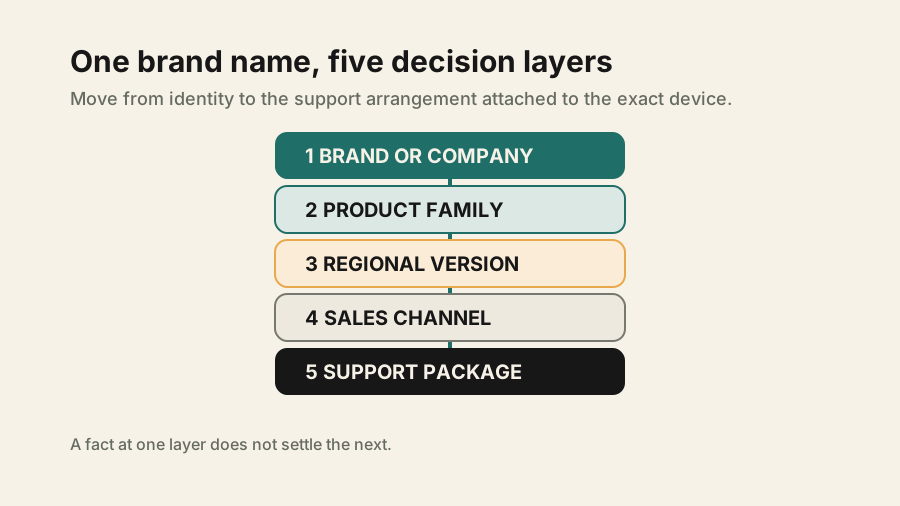
Think of the phone search as a stack of five different objects:
- The company or brand — the name on the site, box, retailer listing, service page, or market-research table.
- The product family — a series or model line that can contain several storage, camera, radio, software and market variants.
- The regional version — the actual software image, regulatory configuration, carrier bands, services and retail package intended for a named market.
- The channel — an official store, authorised retailer, carrier, marketplace seller, specialist importer, or private reseller.
- The support package — warranty, repair, spare parts, software updates, returns, local service and account or app support.
A positive fact at one layer does not automatically settle the next. A company can be globally large while a specific model has no local repair path. A high-end China variant can have excellent hardware while its software and services are not configured for your accounts or region. A global model can have formal support while an importer listing offers a different storage configuration or a different contractual seller. A trusted retailer can sell a product whose warranty is limited to the jurisdiction in which it was first sold. The stack is not bureaucracy. It is the ownership experience.
This is why a brand list often produces bad advice even when every name on it is legitimate. Lists typically answer a discovery question: Which companies are important? A buyer has a different question: Which exact device and support arrangement will meet my needs where I am? The first can be informed by market research. The second needs model-specific documents and local evidence.
There is also a naming issue. Some corporate groups operate multiple brands, product lines or regional identities; a research publisher may count a parent company, a combined entity, or a standalone brand depending on its methodology. Counterpoint’s note that the 2025 OPPO/realme combined entity would have 11% is a good reminder that the column label in a shipment table is not necessarily the same thing as a retail decision. A buyer does not purchase an “entity.” They purchase an exact model from an exact seller under a set of terms.
The practical response is not to ignore brand identity. Brand identity can help you locate product families, official service sites, software documentation and regional launch pages. It may tell you which ecosystem of accessories, devices or support channels to investigate. The rule is simply: use the brand name as the beginning of the file, not the end of the decision.
Global shipment scale is context, not a quality ranking
The global market is useful because it shows that Chinese brands are not a niche import category. They compete at worldwide scale and across price bands, regional channels and product classes. That scale helps explain why global readers encounter so many Chinese-brand phones in stores, operator channels, online marketplaces and travel markets.
Counterpoint’s preliminary 2025 estimate is a concise example. It reports that Xiaomi retained third place at 13% of global smartphone sell-in. It describes vivo as fourth and says that, if realme is integrated with OPPO for the group presentation, the combined entity would have 11% and take fourth position. The report also says its table is based on sell-in and notes the OPPO/OnePlus grouping used in the analysis. The figures are helpful because they establish a dated competitive presence rather than a vague claim that Chinese brands are “rising.”
| Market statement | What the 2025 global estimate can tell you | What it cannot tell you |
|---|---|---|
| Xiaomi held 13% in the preliminary global sell-in estimate | Xiaomi had global shipment scale in a defined 2025 research series | Whether a specific Xiaomi model is available, compatible, or supported in your country |
| vivo ranked fourth | vivo had a large worldwide position in that source’s period and grouping | Whether a particular vivo China variant has your required software or radio bands |
| OPPO/realme would have 11% when combined | Grouping choice changes how a brand landscape is read | That every OPPO or realme product shares hardware, software, service or warranty terms |
| Chinese brands compete in several price bands | The category has breadth and market weight | That a shipment table is a camera, battery, security or durability ranking |
The time boundary matters too. A 2025 full-year estimate describes a completed period. It does not tell you which series will be launched next, which storage configuration a retailer will stock, how a brand will respond to component costs, whether a regional operation will expand, or how an importer will price a device next week. Global scale remains relevant after the date passes, but it should be used as background rather than a frozen product catalogue.
This distinction is especially important when a comparison begins with a brand narrative: “This company is number three worldwide, so its phone is a safe choice,” or “This brand is not in the top five, so it is risky.” Both statements skip the intervening evidence. Safety for a phone buyer might mean firmware support, carrier compatibility, repair parts, returns, account access, official distribution, battery availability or the ability to use a banking app. None of those properties follows from a worldwide shipment share.
What global scale can legitimately signal
Scale can still be a useful lead. A widely distributed company may have more regional launch pages to investigate, a larger accessory ecosystem, a bigger channel footprint, and a broader history of product generations. It may make it easier to find local retailers, official firmware support or community documentation. That is a reason to look further, not a substitute for looking.
For an analyst or retailer, global figures can also identify which names are worth mapping by region. A business deciding which device families to evaluate may start with vendors that appear across several markets. But the next step should be country and channel research. The brand may be strong in Latin America, Southeast Asia, India, China, the Middle East and Africa, while being absent or operating through different arrangements in another region. A “global” brand does not imply uniform global distribution.
For a consumer, the most useful conclusion is modest: a market table can tell you that a brand is a serious participant. It cannot tell you whether the phone on a particular page is the version you want. Move from the brand tab to the product tab before moving toward checkout.
China is a separate market file
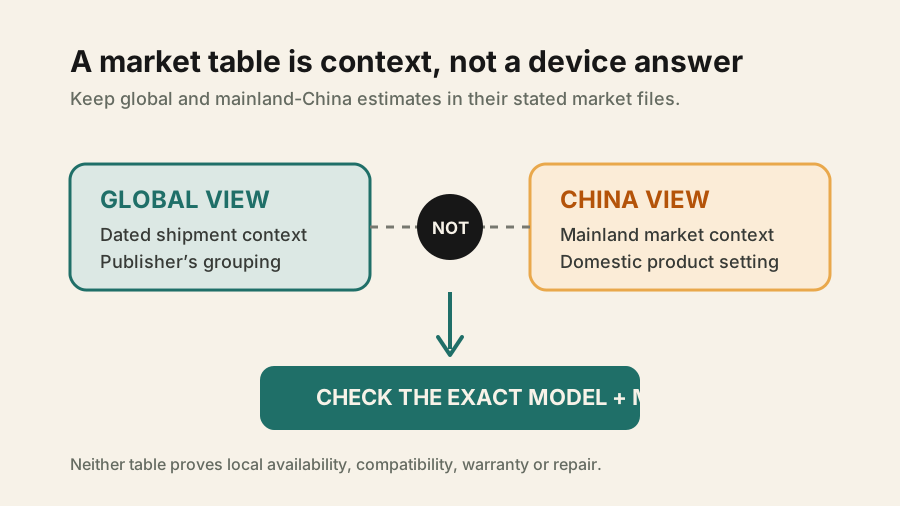
Mainland China is one of the world’s largest smartphone markets, but it is not a miniature global market. Product portfolios, launch timing, software services, sales channels, subsidy effects, carrier relationships, local apps, payment habits, regional network configurations and competitive positions can differ. A phone that is significant in China can be unavailable elsewhere. A global bestseller can have a different role in China. A company’s China position can be a valuable strategic signal without becoming global proof.
Omdia’s 2025 data makes the separation concrete. Its report estimates 282.3 million smartphone shipments in mainland China, down 1% year on year. It places Huawei first at 46.8 million shipments and 17%, with vivo second at 46.0 million and 16%; it then gives Apple, Xiaomi and OPPO separate figures. Those statistics establish the source’s view of the domestic competitive landscape. They do not contradict a global table. They measure a different geography and market.
| Omdia’s mainland-China 2025 estimate | Reported units or share | Boundary to retain |
|---|---|---|
| Total smartphone market | 282.3 million units | Mainland China, full year 2025 |
| Huawei | 46.8 million; 17% | Domestic shipment estimate, not worldwide share |
| vivo | 46.0 million; 16% | Domestic shipment estimate, not a model rating |
| Xiaomi | 43.7 million | China-only volume estimate |
| OPPO | 42.8 million | China-only volume estimate |
The difference affects how you interpret press coverage. A domestic launch can be important because it reveals a new product direction, a new system feature or a competitive response in China. It does not automatically mean the phone will be certified or released in Europe, North America, India, Southeast Asia, Africa, Latin America or the Middle East. Conversely, a phone that looks less prominent in domestic reporting may have a meaningful global channel presence. The reader needs to check the launch page and support page for the actual market.
This is also a reason to be careful with the phrase “Chinese version.” It does not mean simply “a cheaper version.” It can refer to a product configuration intended for a particular market environment. The hardware may be similar to a global model, but the software image, preloaded applications, services, network features, language defaults, warranty program, radio configuration and carrier treatment can differ. The differences can be small for one device and material for another. The only responsible shortcut is no shortcut: identify the exact model number and market.
The published Huawei comeback story gives brand-specific context for one of the most visible China-market narratives. It is not a device recommendation, a statement about global app support, or a warranty file. That separation is intentional. A company story can explain why a brand matters without answering whether a particular model belongs in a reader’s pocket.
Why an annual brand list is not a current product answer
Even a correctly scoped 2025 market table can become stale before a buyer sees it. Smartphones combine fast product cycles with component availability, storage pricing, channel inventory, operating-system releases and local launch decisions. The fact that a brand held a certain market position in a prior year does not tell you the current configuration, price, stock or service state of a phone.
IDC’s Q1 2026 Worldwide Quarterly Mobile Phone Tracker reports a useful current context. It says worldwide smartphone shipments were 293.8 million in the quarter, down 2.9% year on year, and attributes pressure in part to limited memory availability and higher bill-of-materials costs. Its table reports 33.8 million shipments and 11.5% share for Xiaomi, 30.7 million and 10.5% for OPPO, and 21.2 million and 7.2% for vivo. IDC also specifies that the table covers branded device shipments, excludes refurbished units, and uses current parent-company grouping.
That is not an invitation to compare the quarterly percentages mechanically with every annual number from another publisher. The source periods, grouping rules and methods are not identical. It is a reminder that time changes the product environment. IDC’s cited memory constraints and cost pressure are market-level conditions. They can influence portfolio choices, marketing, channel support, storage variants and prices, but they cannot tell a reader the price or availability of one exact model at one retailer.
The safer reading sequence is:
- Use a dated market report to understand the strategic landscape.
- Use a current regional launch or official product page to identify an exact model.
- Use current retailer, operator or authorised-channel documentation to understand availability and terms.
- Use the model’s support, warranty and update documents to understand ownership.
- If importing, treat the import seller and regional version as an additional risk layer rather than an invisible discount.
The current market environment also changes the meaning of “value.” A low advertised price can be attractive, but the total ownership cost may include an importer margin, shipping, taxes, return friction, missing service, an incompatible accessory, a replacement battery sourced later, or an unusable regional feature. A more expensive official regional model may bundle a support path that a private import does not. Neither choice is universally superior. The important thing is to compare like with like: same model number, same storage configuration, same software region, same seller responsibility, same warranty and same return jurisdiction.
Do not mistake a parent company table for a retail catalogue
IDC’s methodology note is not a footnote to ignore. It says the “Company” represents the current parent company or holding company for brands owned and operated as subsidiaries. That is useful for market analysis because it keeps a vendor landscape coherent. It can be confusing for a buyer because a parent-level row may contain several distinct retail identities. The row does not tell you which product line is in a local store, which software it runs, whether it has official accessories, or what repair arrangement follows it.
The same caution applies to words such as “premiumisation,” “offline execution,” “emerging markets,” or “channel management” in analyst commentary. These phrases can explain market movement. They are not product specifications. A brand may improve its mix in one geography while an individual listing in another geography remains an import-only version with no local service. Translate the analyst language into a question: Which exact model and channel are you asking me to evaluate?
China version versus global version: the real comparison
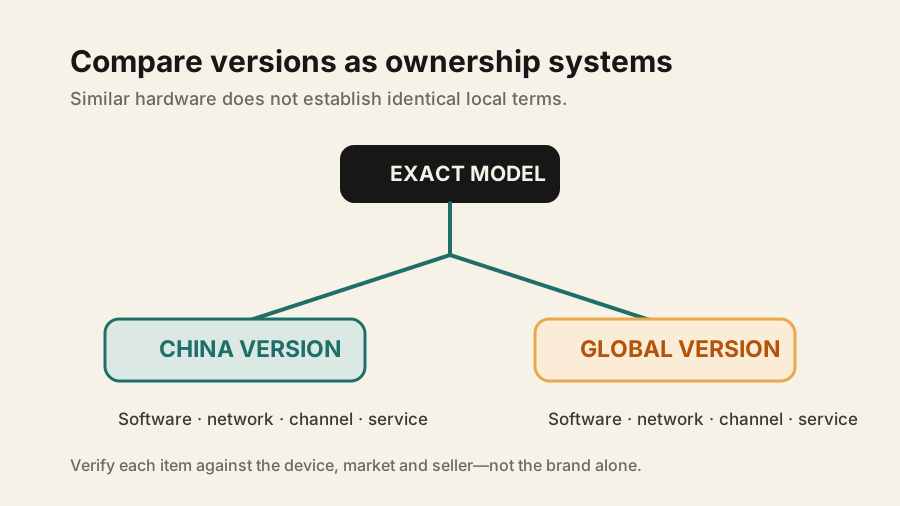
If a reader is comparing a China version with a global version, they are not just comparing hardware. They are comparing two possible ownership systems. The difference may cover software, preloaded services, account setup, language availability, notifications, payment behavior, satellite or regional services, carrier bands, eSIM behavior, regulatory functions, call features, warranty, repair and resale. The fact that the physical shape and camera hardware look similar does not settle those layers.
An April 2026 Android Central importer report is useful precisely because it does not claim to be a universal test. The author says they used China variants of vivo, OPPO, Xiaomi, Huawei and Honor during the prior 12 months. They describe China-market devices as lacking Google Mobile Services out of the box and discuss their own experience with installing services, background-notification behavior, preinstalled software and after-sales limitations. The piece also carries affiliate-disclosure context. It is one informed reviewer’s experience with named variants, not a carrier certification, a security audit, a repair dataset or a rule for every Chinese phone.
That boundary makes the report more useful. It suggests questions a reader should ask, rather than giving them a conclusion to borrow.
Software and service: ask about the installed image, not the brand
“Android phone” is insufficient software information. A regional software image can change which services are preloaded, which app stores are present, which account flows are expected, which language and voice features are offered, how notifications are managed, what local services are enabled, and which updates are distributed. Some differences may be easy to work around for an experienced user. Others may be deal-breakers in a work, payment, accessibility, security or family-support context.
For example, an app might install successfully but behave differently in background operation. A phone may support the language you need but not have the service integration you expect. A local feature highlighted in a China launch can require a China-market account, SIM or service partner. An online guide may describe a workaround that changes after the next update. None of these possibilities should be assumed from the logo on the box.
Before purchasing, verify the exact regional software name and version, update channel, initial setup language, official documentation for app and account services, and the local availability of the functions you rely on. If a task-critical app, authentication tool, payment service, accessibility feature or enterprise management system matters, test or obtain a written confirmation for that model and version. Do not treat a general review as a substitute for your own required-use test.
Network and radio: a specification check, not a brand question
Network support needs the same discipline. Radio bands, carrier features, emergency services, VoLTE or VoWiFi behavior, eSIM availability and local certification can vary by market, model and carrier. Some questions may have a clear answer on an official regional specification page. Others may require a carrier’s compatibility record or a retailer that will accept a return if the phone does not meet the stated need.
Avoid claims like “Chinese phones work in Europe” or “China phones do not work in the United States.” Both are too broad to help. A model can support one set of bands and not another; a carrier can approve one configuration and not another; a future software release can change a service behavior. The appropriate comparison is the model number against the required network features in the market where it will be used.
For a business buyer, this can matter even when the phone is not the primary work device. Enrollment, device management, emergency calling, two-factor authentication, roaming, local repair and replacement speed may be more important than a marginal hardware advantage. Put these into the acceptance criteria before the purchase rather than treating them as post-purchase troubleshooting.
The importer changes the contract
An imported handset can be a legitimate choice for a reader who understands the trade-offs. It may offer a configuration or timing unavailable through official local channels. It may also shift responsibility from the brand’s local operation to an intermediary seller. The question becomes not merely “Is the phone genuine?” but “Who is responsible if the device is defective, misdescribed, blocked by a service change, needs a battery, or cannot be repaired locally?”
Read the seller’s return policy, destination, warranty language, repair process, shipping responsibility, tax treatment, charger and plug inclusion, data-protection terms and dispute route. Check whether the seller identifies the exact model and regional software image rather than using generic marketing photographs. Ask whether they will confirm the relevant hardware configuration in writing. If the answer is ambiguous, price the ambiguity as part of the deal.
The importer route can also complicate updates. A global model bought through an official channel may receive a local support path; a China version resold across borders may have a different schedule or support boundary. That does not make all imports bad. It means a grey-market saving is not a free product feature. It is a different support arrangement.
Warranty, repair and channel are part of the phone
Warranty is often treated as a small-print detail after camera, screen, chip and battery. For a phone used every day, it is part of the product. A repair path determines what happens when a screen breaks, a battery degrades, a port fails, a camera develops a fault, an account problem appears after an update, or a device needs replacement during travel. The answer is usually market-specific.
Xiaomi’s International Warranty Service page provides a concrete example of why general claims fail. Xiaomi says some features and materials can differ due to national or regional systems, regulations, listing versions and standards. Its international warranty FAQ says the service applies to designated models; eligibility is tied to stated conditions including purchase through official channels in listed markets and local activation. Xiaomi also says availability and timing are subject to local conditions. These are Xiaomi’s own terms for its programme. They do not describe Huawei, vivo, OPPO, Honor, realme, TECNO, Infinix, or every Xiaomi device and reseller.
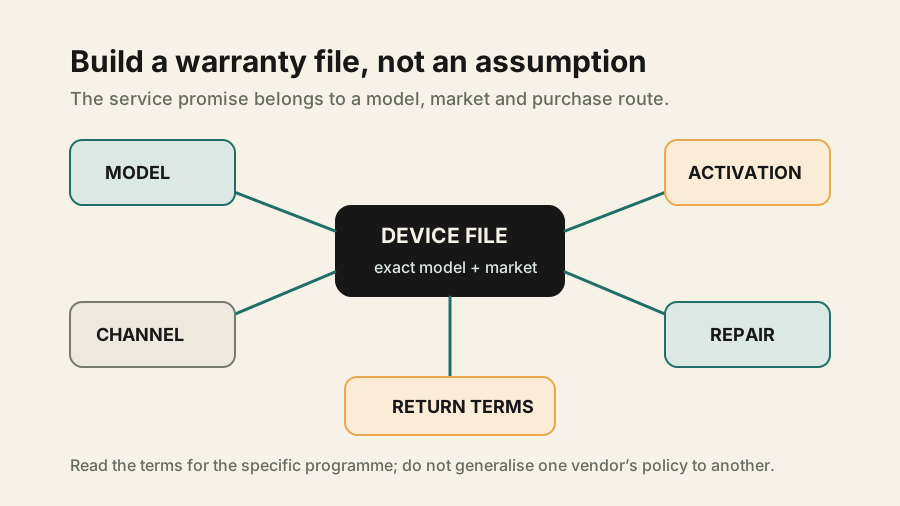
The lesson is broader than Xiaomi: read the warranty as a model-and-market document. A manufacturer may offer a global-looking site while the relevant service program covers only selected markets, selected devices or selected purchase routes. A retailer may offer its own warranty, which is not the same as a manufacturer warranty. A third-party marketplace promise may be a seller obligation rather than a local authorised repair entitlement. An international warranty may cover basic service but not the accessory, accidental damage program, replacement unit, loaner, or repair time you expect.
Before buying, obtain answers to these questions:
- Is this exact model sold officially in the country where it will be used?
- Is the seller an official channel for this market and model?
- Which entity provides the warranty: manufacturer, distributor, retailer or marketplace seller?
- Where is the authorised repair location, and can it obtain the relevant parts?
- What evidence of purchase and activation is needed for a claim?
- Are software support, accessories and replacement parts available locally?
- What return route applies if compatibility or regional services differ from the listing?
These questions may seem less exciting than a launch event, but they are where a phone changes from a specification to a dependable tool. A brand with a smaller shipment share but a clear local service path can be a better operational choice than a more glamorous import. A highly capable China version can still be the right choice for a technically experienced user who accepts the support trade-off. The framework does not choose for you; it makes the trade-off visible.
A brand-to-variant decision map
The following sequence turns a broad “Chinese smartphone brands” search into a practical investigation. It applies whether you are buying one phone, selecting a family device, recommending a handset to a colleague, sourcing test devices, or evaluating a brand’s international strategy.
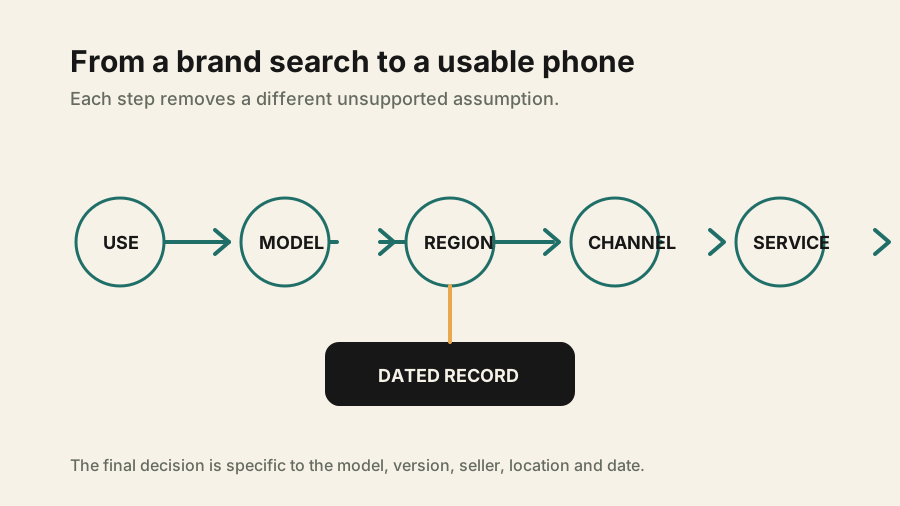
Step 1: define the job before naming brands
Write the conditions the phone must meet. For a personal device, that might include local network use, banking, messages, camera workflow, transit, payments, language, accessibility, travel, repair and budget. For a work device, add mobile-device management, authentication, update policy, support ownership, replacement timing and data-handling requirements. For a retailer or analyst, add catalogue freshness, channel rights, warranty liability, localisation and returns.
The point is not to create a maximal checklist for every buyer. It is to identify the conditions that would make a device unusable or expensive to own. A camera specification does not compensate for a missing business app. A large battery does not compensate for a missing repair path. A low import price does not compensate for an unacceptable return process. Define the fail conditions first.
Step 2: identify the exact product code and regional version
Get the model number, regional designation, storage configuration, colour only if it affects SKU, operating-system version, charger package and stated radio specification. Save the official product page for that market. If the seller cannot provide this information, do not assume the marketing name is enough. A series name may cover materially different products.
Compare product pages in the markets you are considering. Look for differences in system features, network notes, included accessories, supported services, warranty language and official downloads. A difference does not mean one version is inferior. It means the decision needs a stated use case. The version optimised for China may be attractive for someone who uses it there; the version optimised for another market may be better aligned with that market’s accounts, networks and support systems.
Step 3: separate official evidence from reseller assertions
An official manufacturer page, local authorised service page, operator compatibility page and written warranty terms have different authority from a reseller title, marketplace bullet point, social-media post or unverified specification database. Resellers can be useful and knowledgeable, but their commercial description is not automatically a product guarantee. Preserve the source and ask for clarification in writing when a detail changes your decision.
This is especially important for phrases such as “global ROM,” “international version,” “unlocked,” “works worldwide,” “Google installed,” “official warranty,” and “same as global model.” Each phrase can be used precisely or loosely. Ask what it means for the exact SKU, who supplied the software, what services are preinstalled, which warranty applies, and where a problem would be repaired. If a seller cannot make those facts concrete, choose a channel that can.
Step 4: treat software and carrier fit as acceptance tests
Do not leave critical services to a forum workaround. If you depend on an app, account, network feature or device-management system, establish whether it works on the exact version. An official compatibility statement is ideal. A direct test within a return window may be appropriate for a consumer. A business should use its normal device-acceptance procedure. Keep the outcome attached to the device, software build, carrier and date.
This step is also a defence against overconfident negative claims. A reviewer’s issue may have been real for a particular version and time but resolved for another. A person’s smooth experience may have depended on their country, carrier, account, tolerance for configuration work or use of a global rather than China model. The relevant question is not “Do Chinese phones have this problem?” It is “Does this exact version meet my stated requirement now?”
Step 5: price the service path
Take the listed purchase price and add the cost of delivery, tax, accessories, insurance where appropriate, expected repair friction, possible return shipping, spare parts, warranty exceptions and replacement downtime. This is not a universal total-cost formula. It is a way to prevent an obvious cost from masking a costly failure mode.
If the phone is a personal discretionary purchase, you may accept a higher support risk for a unique configuration or value proposition. If it is for a parent, employee, field team or customer-facing use, the cost of a failed support path can be much higher. The same device can be a sensible enthusiast purchase and a poor managed-fleet choice. That is why the article does not rank brands as universally “safe” or “risky.”
Step 6: keep a dated decision record
Save links, screenshots or written confirmations for the model page, seller listing, warranty terms, price, support contact, software version and carrier information used in the decision. Conditions change. A dated file makes it easier to explain a choice, use a return right, seek service, update a procurement specification or re-evaluate a replacement later.
This record is also useful for readers following brand strategy. It connects the headline layer to the operational layer. A company’s shipment scale, launch momentum or ecosystem story becomes meaningful only when you can see which regional device and service promise carries it into the real world.
What Chinese smartphone brand coverage should stop claiming
Several common shortcuts make readers less informed:
- “The top Chinese brands” as a universal recommendation. Top by which market, period, shipment definition, parent-company grouping, price band or product category?
- “China version equals global version.” Similar hardware does not establish identical software, support, radio, service or warranty conditions.
- “Global share proves quality.” Market scale is a context signal, not a durability, repair, privacy, accessibility or compatibility result.
- “Cheaper import equals better value.” The price comparison must include seller responsibility and the support path.
- “One user report proves a universal experience.” A good reviewer case points to questions; it does not replace model-and-market verification.
- “Warranty is global because the brand is global.” Warranty programs often contain model, channel, activation and territory conditions.
Removing these shortcuts does not make the Chinese smartphone landscape less interesting. It makes it more legible. Chinese vendors matter because they operate at scale, compete across markets, and create a wide range of product choices. That variety is precisely why the regional version and support package deserve attention.
The broader manufacturing story is useful context here. China’s manufacturing system helps explain why hardware ecosystems can move quickly from components to finished products. It does not prove the provenance, network support, operating-system behavior or repairability of a particular smartphone. The link is context, not a substitute for the device file.
FAQ: Chinese smartphone brands and regional versions
Which Chinese smartphone brands are the biggest globally?
It depends on the source, period and grouping. Counterpoint’s preliminary 2025 global sell-in estimate put Xiaomi third at 13%, with vivo fourth and a combined OPPO/realme entity at 11%. Those figures describe a defined market estimate, not a ranking of individual phones or local support arrangements.
Are Chinese phones sold in China the same as global models?
Sometimes they are similar, but similarity is not enough. Software image, preloaded services, radio configuration, account support, warranty, service and included accessories can differ. Confirm the exact model number and regional documentation before treating a China version as the same product.
Can I use a China-version phone outside China?
That depends on the exact model, software version, carrier, local services and your required apps. A 2026 reviewer report illustrates possible workarounds and limitations, but it is not universal compatibility evidence. Verify the precise version and use case through official documentation, your carrier, the seller’s written terms and a suitable return path.
Do Chinese smartphone brands offer international warranties?
Some brands may offer defined cross-market programs, but coverage is not automatic. Xiaomi’s published example limits its international-warranty service to designated models and stated conditions including official channels and local activation. Check the relevant brand’s exact current terms for the model and market you are considering.
Method and limitations
This is a desk-research guide. It uses Counterpoint for a preliminary 2025 worldwide sell-in estimate, Omdia for a 2025 mainland-China shipment estimate, IDC for Q1 2026 worldwide market context, Xiaomi for its own international-warranty terms, and Android Central for a clearly limited 2026 importer experience. The article team did not test, import, activate, repair, certify, compare or warrant any smartphone.
The guide does not rank phones, verify a current price, establish a device’s network compatibility, guarantee software behavior, assess security, determine customs treatment, or advise on a purchase. Those are exact-model, market and use-case questions. The durable conclusion is simpler: use a Chinese smartphone brand to find the right file, then verify the variant, channel and support package that will carry the device through real ownership.
Related reading
- Huawei Comeback Story: How Sanctions Remade It — published context for Huawei’s strategic recovery; not a device or compatibility recommendation.
- How China Manufactures: Inside the World's Factory (2026) — published manufacturing-system background; not evidence of a phone’s exact configuration, warranty or service path.