

“Huawei 5G equipment” sounds like a product question. “Huawei 5G ban countries” sounds like a list question. In practice, neither phrase describes one stable, global fact.
One reader may be trying to understand a company’s telecom infrastructure business. Another may need the rule that applies to a mobile operator in one jurisdiction. A third may be deciding whether a particular radio, core function, management platform, software release, support arrangement, or integration plan can enter a live network. Those are connected questions, but they have different evidence.
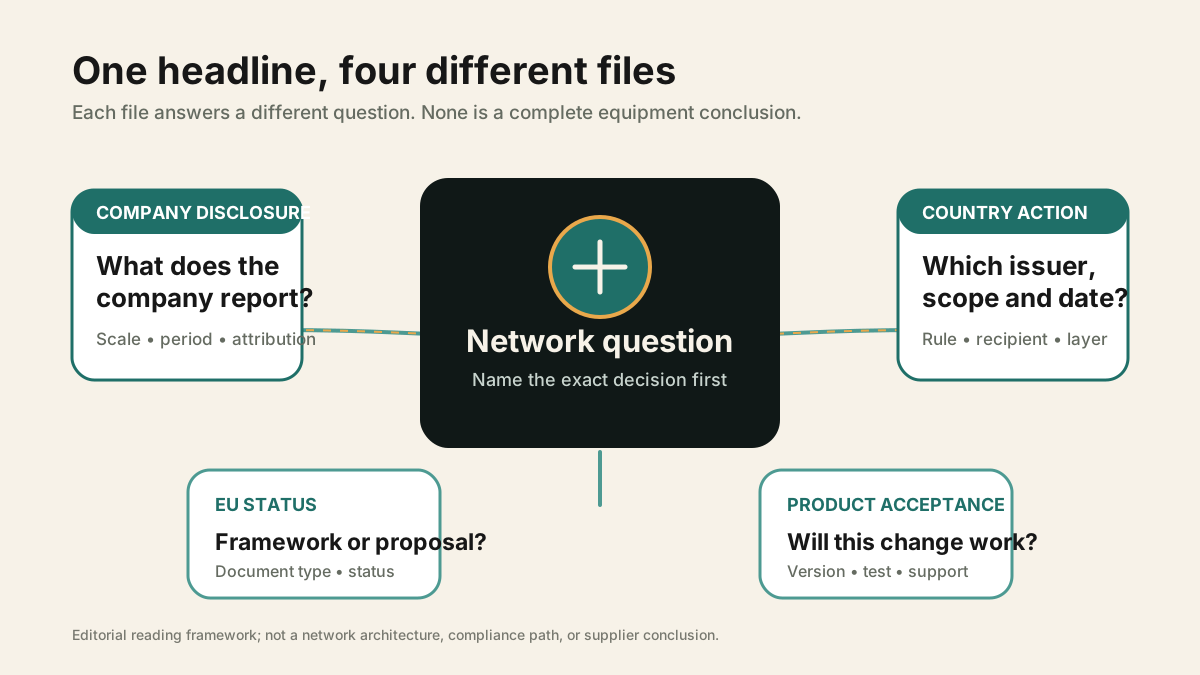
That distinction matters because Huawei’s scale is real while restrictions on its equipment are also real—and the public records do not say the same thing. In its 2025 annual report, Huawei reports CNY375.014 billion in ICT Infrastructure revenue, up 2.6% from CNY365.424 billion in 2024. The UK has a legal direction with a named operator audience and a 2027 5G deadline. Germany’s public record names critical components and particular network functions on two different dates. The European Commission has both a 2023 communication and a January 2026 proposal, which are not the same legal object.
The useful conclusion is deliberately narrower than a vendor verdict: a Huawei 5G headline should send you to a country and network file, not to a global ban map. A company disclosure, a policy record, an operator architecture, and a product acceptance file answer different questions. This guide shows how to read each one, what it can establish, and what still has to be verified before anyone reaches an equipment conclusion.
The short answer: what public records can—and cannot—tell you
The table below is not a product scorecard. It is a map of record types. Its purpose is to stop one category of evidence from being used as a substitute for another.
| Record | What it can establish | What it cannot establish |
|---|---|---|
| Huawei annual report | What Huawei reports about segment revenue and stated 5G-A activity | Independent equipment performance, cybersecurity, interoperability, certification, or buyer suitability |
| National policy or legal action | The stated jurisdiction, recipient, scope, conditions and dates | Another country’s law or a global security finding |
| EU communication or proposal | The Commission’s stated framework or proposed policy direction | A completed country-level legal check or an already enacted obligation where the text says “proposal” |
| Operator and product file | The actual equipment, layer, software state, integration and acceptance evidence | A general conclusion about every Huawei deployment or every network |
The right first question is therefore not “Is Huawei allowed or banned?” It is: which issuer, which jurisdiction, which operator, which network layer, which product state, and which date does this question actually require?
Why the global-ban framing fails
The global-ban framing fails because it turns four separate nouns into one implied verdict.
The first noun is the company. Huawei can report revenue, product development, partnerships, and activity in its own annual report. Those disclosures are useful for understanding how the company describes its business. They are not independent tests of the products referenced in that report.
The second noun is the state. A government can publish a direction, a contract, a designation, a regulator requirement, or a policy proposal. Each has an issuer and a legal or administrative status. The same words—restriction, exclusion, removal, high risk—can operate differently in different records.
The third noun is the network. A 5G network is not one box at the edge of a city. Public records may distinguish the core, access network, transport network, network-management functions, physical equipment, software, support, or a location with special significance. Dropping that qualifier changes the meaning of the claim.
The fourth noun is the decision. A reader evaluating a system has to know the exact operator, layer, architecture, product and support state. Even a valid national policy record does not disclose every element of a specific operator’s implementation. Even a strong company result does not prove that a proposed equipment change will interoperate with the reader’s existing hardware, software, monitoring, escalation and acceptance requirements.
This is not semantic caution for its own sake. The source of an error is often a missing qualifier:
- “The UK” becomes “every country.”
- “Critical network-management functions” becomes “all equipment.”
- “A Commission proposal” becomes “current law.”
- “Huawei reports” becomes “independently proven.”
- “A 5G deployment” becomes “a successful decision for my network.”
The remedy is not to replace one sweeping conclusion with an opposing one. It is to retain the qualifier that gives each record its actual boundary.
The Huawei company file: scale is not a product verdict
Huawei’s telecom infrastructure business is large enough that it naturally appears in infrastructure discussions. The company’s 2025 annual-report segment table reports ICT Infrastructure revenue of CNY375.014 billion for 2025, compared with CNY365.424 billion for 2024. The table reports a 2.6% year-on-year increase.
Those numbers are useful, especially because they have a named business segment, currency, comparative year and reporting period. They tell a reader that the company reports a very large infrastructure business. They do not say how that revenue is allocated among countries, network layers, hardware generations, software, services, customers or products. Nor do they tell the reader what happened in a particular operator network.
| Huawei-reported item | Reported value | Proper reading |
|---|---|---|
| ICT Infrastructure revenue, 2025 | CNY375.014bn | A company-reported business-segment amount |
| ICT Infrastructure revenue, 2024 | CNY365.424bn | The comparative base used in the report |
| Year-on-year change | 2.6% | A reported revenue comparison, not a network-quality result |
| Worldwide 5G-A users | More than 60m at end-2025 | A company-reported activity statement, not an independent common-configuration benchmark |
That is not a criticism of the annual-report format. Company reporting has a legitimate job: it tells investors, partners and readers how the company describes its business. The error comes when a reader asks it to do another job—such as prove that a named product is more secure, more interoperable, more suitable, or more compliant in a different country.
What a company number is good for
Use the company file when you need to answer questions like these:
- Does the company report material infrastructure activity?
- Which business segment is the company discussing?
- What period, currency and comparative base does the disclosure use?
- Does the company itself describe a particular technology or deployment theme?
- What claims should be carried forward as company statements, with attribution?
For example, it is fair to write that Huawei reports CNY375.014 billion of 2025 ICT Infrastructure revenue. It is not fair to infer from that number that a particular baseband, radio unit, core function, security control, software image or field-support plan will meet a reader’s requirements. Revenue is a business measure. It is not a system-acceptance test.
What a company number cannot settle
Before a company disclosure becomes a decision input, the reader has to ask which evidence is still absent. The missing evidence is usually specific:
- Exact object. Which hardware model, software build, licence, feature set, interface and release is being considered?
- Exact environment. Which spectrum, sites, transport path, core arrangement, orchestration system, monitoring stack and traffic profile are in scope?
- Exact jurisdiction. Which current law, direction, licence condition, contractual obligation, security requirement, certification rule or procurement restriction applies to the operator and project?
- Exact operating plan. Who owns updates, vulnerability response, spares, escalation, interoperability regression testing and end-of-support obligations?
- Exact acceptance evidence. What test cases, performance thresholds, security controls, rollback procedures and sign-off criteria are required before the equipment enters service?
Those questions can feel less satisfying than a headline because they do not produce a binary answer. But they are what turns “Huawei telecom infrastructure” from a search phrase into an implementable inquiry.
Where “technically competitive” belongs in the file
The original search intent often contains a second question: what makes Huawei equipment technically competitive? That question is legitimate, but it cannot be answered responsibly with a generic adjective or a country-policy headline. “Technically competitive” needs a comparison boundary before it has a usable meaning.
At minimum, the reader would need to name the product class and feature being compared, the relevant release and configuration, the operating spectrum and traffic condition, the interface and interoperability requirements, the reliability and recovery expectations, the security and operations controls, the support horizon, and the evaluation method. A claim about power use, capacity, latency, automation, maintainability or cost is only as meaningful as the system boundary and test or operating record behind it.
That is why this guide does not rank Huawei against another vendor. The public records reviewed here do not provide a reproducible common test, a shared deployment configuration or a complete product-by-product acceptance record. The absence of that evidence is not evidence of either superiority or inferiority. It is a reason to move the question into the product and operator file, where a reader can request the relevant proof.
A revenue category is not a network topology
It is worth being precise about why the annual-report boundary matters. A financial segment is a reporting category. It can aggregate revenue from a large set of commercial relationships and products while remaining useful to investors and readers. A network topology is an operating description. It has to identify the systems that exchange data and control signals, the interfaces between them, the versions that are deployed, the dependencies that can interrupt service, and the teams that can change or restore them.
Those are different documents because they answer different audiences. A business-segment number may help an analyst understand whether a supplier has material infrastructure activity. It does not identify what the supplier has delivered to a named operator. It does not reveal whether a particular product is in an access layer or a core function, whether it is part of an existing integration, whether the operator uses a multi-vendor design, or whether the relevant hardware is near end of support. It also does not identify an operator’s change-control process, its outage tolerance, or its contractual rights when an update creates an unintended effect.
That separation protects readers from two opposite mistakes. One mistake is to dismiss a company disclosure because it is not a full technical test. The disclosure can still be useful and material within its stated boundary. The other mistake is to let the company disclosure perform every role at once: market-share estimate, product benchmark, security proof, country-policy proxy and procurement recommendation. A figure can be accurately reported and still be inadequate for all of those additional roles.
The same discipline applies to a deployment claim. A company can say it has worked with carriers and partners; a carrier can say it serves a certain customer population; a government can say it has issued a direction; and an integrator can say an installation has been completed. Each statement has evidentiary value. None automatically tells a reader whether the reader’s intended change will operate as designed in a different system. The difference is not an inconvenience in the research. It is the core of the decision.
For this reason, procurement and policy discussions work best when they carry an explicit “evidence owner” beside each assertion. The company owns its revenue and stated activity. The government owns the description of its action. The operator owns the current architecture and transition plan. The technical team owns the test record. The accountable decision-maker owns the acceptance decision. When those owners are clear, the team can see what has been confirmed, what has merely been claimed, and what has not yet been demonstrated.
The distinction also matters for how Huawei’s broader corporate narrative is read. The site’s published Huawei Comeback Story: How Sanctions Remade It explains a related sanctions-and-company context in smartphones. That history can help a reader understand why supply-chain and product-stack questions matter. It does not settle the separate question of whether a specific 5G deployment is permissible, secure, supportable or fit for purpose.
The UK file: legal direction, recipient and date
The United Kingdom offers a concrete example of why a policy headline needs its full file.
The UK government’s 13 October 2022 legal-notices statement says a designated-vendor direction had been sent to 35 UK telecoms network operators. The statement says Huawei equipment must be removed from UK 5G public networks by the end of 2027. It also lists other controls, including an immediate ban on new Huawei installation in 5G networks and earlier requirements for the network core.
Those are meaningful details because they make the UK record much more specific than “Britain banned Huawei.” The document has:
- a named issuer: the UK government;
- a stated instrument: a designated-vendor direction;
- a recipient group: 35 telecoms network operators;
- a defined country: the United Kingdom;
- a stated subject: Huawei equipment in the described public 5G networks;
- a stated terminal date: the end of 2027;
- and additional controls with their own scope and deadlines.
Each part of that sentence matters. If a reader works outside the UK, the direction does not become their law. If a reader works inside the UK but on a different question, such as a consumer device, a legacy system, a non-public network, an inherited component, a support arrangement, or a mixed architecture, the reader still needs the current specific rule and the operator’s implementation record. The 2022 statement provides the public boundary; it does not expose a complete live network inventory.
The NCSC explanation is also country- and condition-specific
The UK government statement points to technical security analysis from the National Cyber Security Centre (NCSC). The NCSC’s own Huawei advice page explains that its assessment changed after a May 2020 US sanctions change. It says the NCSC no longer considered the UK able to manage the security risks of affected Huawei technology in future UK 5G networks.
That wording is important for two reasons.
First, it connects the UK analysis to a described supply-chain change. The public explanation is not simply an abstract assertion that every product, in every period, in every jurisdiction has the same status. It identifies why the UK agency said its previous risk-management approach had changed.
Second, it marks the scope as UK telecom networks. The NCSC page explicitly distinguishes that subject from consumer devices in the home. A reader should not erase that boundary merely because “Huawei” appears in both a mobile-network headline and a consumer-electronics conversation.
This does not minimise the UK’s policy decision. It makes the decision readable. A serious interpretation should preserve the fact that it is a UK national risk-management judgement, made by a named agency, under conditions it describes, for a stated class of future network technology. That is more useful than treating it as either a trivial event or an all-purpose global proof.
A policy action does not end the network-resilience question
The UK’s later policy material adds an important complication. In its 2025 response on telecoms supply-chain diversification, the government discusses concentration in the radio access network (RAN), mobile core and subcomponent supply chains. The response says efforts to improve security by removing high-risk vendors had exacerbated concentration risk in the short term.
That statement is not a reason to ignore the direction. It is a reason to avoid the shallow inference that a removal requirement makes all architectural questions disappear. A network still needs resilience, compatibility, supply continuity, skills, maintenance, testing, monitoring and a workable replacement path. Supplier concentration is a network-system issue, not merely a brand-label issue.
The UK example therefore contains two public facts that should be held together:
- A defined legal direction controlled Huawei’s role in described UK 5G public networks.
- A later UK diversification response acknowledged short-term concentration risk across multiple network layers.
Holding both facts does not settle what another government should do. It simply demonstrates that a supplier-policy file can contain a security action, an implementation timetable and a resilience trade-off at the same time.
A deadline is not a migration plan
Policy deadlines are often treated as if they reveal the whole implementation plan. They do not. A deadline says that a transition must reach a stated condition by a stated time. It does not disclose how each operator will sequence the work, which dependencies must move first, how services will be protected during changes, what the replacement solution is, or what evidence will count as completion.
This is particularly important when a record touches more than one layer. A core change may interact with subscriber management, service continuity, roaming arrangements, monitoring and interconnection. An access or transport change may interact with site design, backhaul, radio planning, physical works, spectrum operations, field maintenance and local acceptance. A management-function change may interact with configuration systems, automation, logs, access controls, backup procedures and the people who respond when a change does not behave as expected.
None of these observations alters the UK direction. They explain why the direction’s schedule should be read alongside an operator-level implementation file. That file may include asset discovery, controlled categorisation, transition waves, supplier and skills dependencies, maintenance windows, testing gates, rollback points, residual risks and formal acceptance. A headline saying “removed by 2027” cannot tell a reader whether all those elements are complete, whether an exception applies, or whether a particular product is in scope.
The concentration point in the UK’s 2025 response makes the same practical lesson visible. A change that reduces one category of risk can expose or intensify another dependency if replacement options, expertise or components are concentrated. That is why the reader should not use “diversification” as a synonym for “problem solved.” It is a continuing design, supply-chain and operating question. The relevant evidence has to show not only what leaves the network, but what takes its place, who supports it, and how the live system remains resilient while the transition occurs.
For a reader outside the UK, this is a method rather than a rule export. Do not import the UK’s date or policy judgement into another market. Import the habit of reading the deadline as the start of an implementation file. Ask which authority is binding, which assets are within scope, which dependencies move with them, and which evidence confirms that the new state is working as intended.
The German file: critical components are not every component
Germany’s 2026 parliamentary record shows why copying the UK sentence into another country would lose important information.
On 1 April 2026, the Bundestag’s parliamentary news service reported the federal government’s answer about public-law contracts with Telekom, Vodafone and Telefónica. According to that record, the companies must no longer use critical Huawei and ZTE components in their 5G core networks by the end of 2026.
The same record states a second deadline: by the end of 2029, critical functions of Huawei and ZTE 5G network-management systems in access and transport networks must be replaced by technical solutions from other manufacturers.
| German record element | Publicly stated scope | Deadline |
|---|---|---|
| Critical Huawei and ZTE components | The three operators’ 5G core networks | End-2026 |
| Critical Huawei and ZTE network-management functions | 5G access and transport networks | End-2029 |
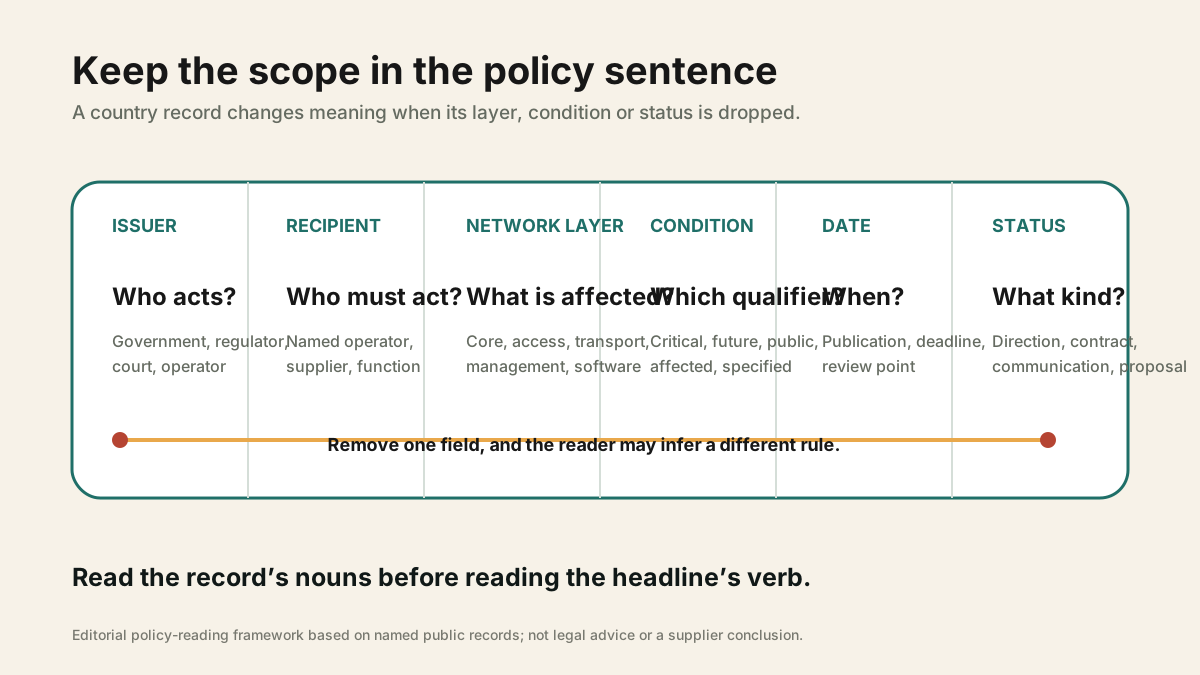
This is one of the most useful habits in telecom policy reading: repeat the noun that limits the action. If the record says critical components, retain “critical components.” If it says management functions, retain “management functions.” If it says access and transport, do not restate the sentence as “all network equipment.” If it names three operators, do not silently widen it to every possible network owner.
Why network layers change the inquiry
The distinctions in the German record also explain why a technology decision cannot be made from a single vendor label.
The core broadly concerns functions that coordinate services and sessions. The access network concerns the radio-facing portion that connects devices to the wider network. Transport carries traffic between network elements. Network-management functions help configure, observe and operate those systems. A policy record may identify one or more of these areas as critical, but that does not provide the reader with a complete engineering diagram, a product list, a migration plan or an acceptance test.
For an actual project, the reader would still need to identify:
- whether the proposed change touches a core, access, transport or management function;
- whether the component or function is within a controlled category in the relevant record;
- whether any hardware, software, integration or support dependency remains;
- how the operator will test and migrate the change;
- and which current authority can verify that the interpretation is still up to date.
The lesson is not that every country must have the same taxonomy. It is that a country’s own taxonomy is part of the decision. Germany’s 2026 and 2029 dates, and the layers associated with them, are part of the fact—not details to remove after the first sentence.
The EU file: framework, communication and proposal
The European Union adds another kind of complexity. It is tempting to see the words “EU,” “high-risk suppliers” and “5G” and assume that they name one uniform, final rule. The public material reviewed here does not support that shortcut.
The European Commission’s 15 June 2023 Communication on implementation of the 5G Cybersecurity Toolbox discusses Member State implementation and says that Member State decisions to restrict or exclude Huawei and ZTE are justified and compliant with the Toolbox. The page also notes Member State competences regarding national security.
That is a strong policy statement by the Commission. It is still not the same thing as a reader’s completed legal-status check in a specific Member State. A common framework, a Commission assessment, a national security competence, a regulator’s measure and an operator’s compliance action can relate to one another without being interchangeable.
The status distinction becomes even clearer in 2026. On 20 January 2026, the Commission announced a new cybersecurity package and described a proposed revised Cybersecurity Act. The Commission says the proposed act would enable mandatory derisking of European mobile telecommunications networks from high-risk third-country suppliers.
“Proposed” is not a weak word. It is the key status word. It tells the reader that the page is announcing a legislative initiative rather than reporting an already complete, universally applied final obligation. The right response is not to dismiss the proposal; a proposal can materially change planning, investment, policy discussion and risk assessment. The right response is to keep the proposal’s status visible and continue checking the relevant national and operator records.
A practical way to read EU-level material
When a reader finds an EU-level headline, use this sequence:
- Identify the document type. Is it a Commission communication, a proposal, an adopted regulation, a directive, an implementing measure, a national law, a regulator decision or an operator commitment?
- Identify the issuer. Is the claim made by the Commission, a Member State, a national regulator, a court, an operator or an industry body?
- Identify the scope. Does it concern a supplier category, a product category, a critical asset, an operator type, a network function, a funding condition or a certification scheme?
- Identify the status date. Was it proposed, adopted, in force, under consultation, subject to a transition period, or reported as an implementation intention?
- Identify the reader’s actual decision. Does the reader need a policy overview, an operator-compliance confirmation, a product certification result, a procurement assessment or a technical acceptance plan?
This sequence is useful beyond Huawei. It is a defence against a common infrastructure error: treating a high-level policy signal as if it already supplied the full record for a component that must work in a named network on a named date.
The missing file: operator, product and acceptance evidence
The company, UK, German and EU materials are useful precisely because they reveal what they do not contain. None of them gives a reader the full file necessary to decide whether a particular item of Huawei 5G equipment should be selected, retained, removed, configured, certified or accepted in a specific network.
That missing file is usually held across several parties. A policy or legal team may establish the current jurisdictional boundary. An operator or system integrator may establish the architecture and affected functions. A supplier may provide the hardware and software identifiers, support lifecycle, patch information and interface documentation. A technical team may execute compatibility and acceptance tests. A security and operations function may define monitoring, response and change-control requirements.
The point is not to prescribe an organisation chart. It is to make the evidence hand-off explicit. If the question is “What did the UK require?”, the UK direction and NCSC explanation are appropriate starting sources. If the question is “Which critical functions are described in the German record?”, the Bundestag record is a relevant starting source. If the question is “What does Huawei report about its infrastructure business?”, the annual report is appropriate. If the question is “Will this exact product change work in our network and remain supportable?”, those sources are insufficient on their own.
The country-and-network file
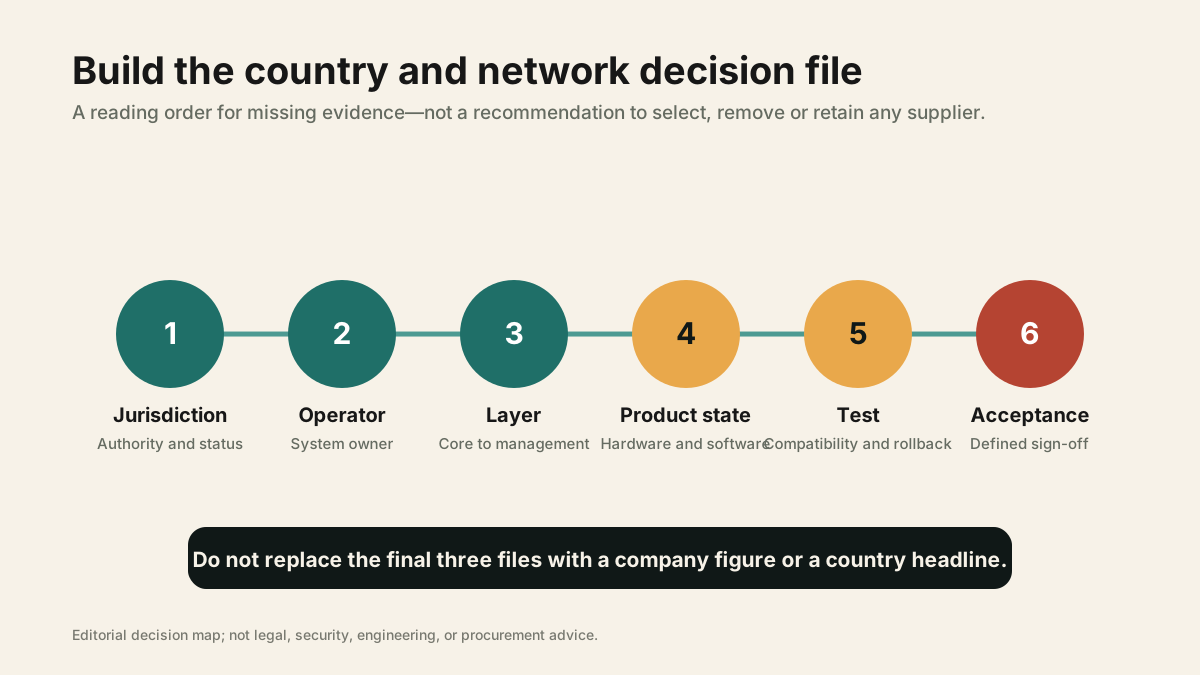
Before treating a Huawei 5G equipment headline as an operational answer, build a file with the following headings.
| File heading | Question to answer | Evidence to request |
|---|---|---|
| Jurisdiction and status | What authority governs this project now? | Current law, regulator direction, licence condition, official guidance, binding contract or written interpretation from the competent party |
| Operator and network role | Whose system is changing and which layer is affected? | Architecture scope, ownership map, affected core/access/transport/management functions, project boundary |
| Product identity | What exactly is under review? | Hardware revision, software release, features, licences, interfaces, dependencies and change record |
| Compliance and control | Which requirement applies to that object? | Applicable rule mapping, certification or approval status where relevant, audit trail and review date |
| Compatibility and resilience | Can it coexist with the existing system and fail safely? | Test plan, interoperability results, rollback plan, spare strategy, monitoring and incident-response ownership |
| Support and lifecycle | Who will maintain it and for how long? | Patch cadence, vulnerability process, support agreement, escalation route, end-of-support and replacement plan |
| Acceptance | What counts as ready for service? | Defined acceptance criteria, test evidence, residual-risk sign-off and accountable approver |
Ask questions that preserve the boundary
The quality of a procurement or analysis request often improves immediately when the question is rewritten. Compare these examples:
| Broad question | Better file question |
|---|---|
| “Is Huawei banned here?” | “Which current authority, instrument, recipient, network function and deadline govern the proposed component in this jurisdiction?” |
| “Is Huawei equipment secure?” | “Which threat model, product revision, operating conditions, assurance evidence and accountable security authority are in scope?” |
| “Can this 5G equipment work with our network?” | “Which exact hardware and software versions will interoperate with our core, access, transport, management and monitoring environment under the defined acceptance tests?” |
| “Should we remove the vendor?” | “Which legal, operational, lifecycle, concentration, migration and acceptance records are required to evaluate this controlled change?” |
What to watch next
This article should be refreshed when one of its record types changes:
- Huawei publishes a later annual report or a materially different infrastructure disclosure.
- The UK updates, enforces, amends or reports implementation of its direction.
- Germany publishes a newer authoritative record about the stated contracts, scope or deadlines.
- The European Commission’s 2026 proposal moves through a formal legislative stage, is amended, adopted, withdrawn or superseded.
- A reader’s operator, regulator or product situation changes the specific network layer and evidence request.
The last trigger is the most practical. There is no substitute for current, project-specific information where a live network, a controlled supplier action or a product acceptance decision is involved. A country headline may identify a risk or a starting point. It cannot complete the project file.
Frequently asked questions
Is Huawei 5G equipment banned worldwide?
No single source reviewed here supports a worldwide binary ban. The UK direction is a UK action with named recipients and dates; Germany’s public record has a different critical-component and network-function scope; EU material includes a 2023 Commission Communication and a 2026 proposal. Check the exact jurisdiction, document status and affected network layer.
What does Huawei’s 2025 infrastructure revenue prove?
Huawei’s annual report reports CNY375.014 billion in 2025 ICT Infrastructure revenue and a 2.6% increase from 2024. That establishes the company’s own reported segment scale. It does not independently prove a particular product’s security, performance, interoperability, lawful status or suitability in a specific network.
What is the UK deadline for removing Huawei from 5G networks?
The UK’s 2022 legal-notices statement says Huawei equipment must be removed from UK 5G public networks by the end of 2027. The same public record includes other controls and interim requirements, so the relevant project should be checked against the applicable current direction and operator context rather than only the terminal date.
Does Germany’s 2026 record mean every Huawei component is prohibited?
The Bundestag record describes critical Huawei and ZTE components in 5G core networks by end-2026 and critical network-management functions in access and transport networks by end-2029. Its wording is layer- and function-specific. The record should not be restated as a complete inventory or a conclusion about every component.
Is the European Commission’s 2026 5G derisking measure already law?
The Commission’s 20 January 2026 announcement describes a proposed revised Cybersecurity Act. A proposal may be strategically important, but it is not the same thing as a completed country-level legal-status check. Confirm the current applicable rule before acting.
Method and limitations
This is a desk-research guide. It uses Huawei’s public annual report and primary UK, German and European Commission records to distinguish company disclosures, country actions, a Commission communication and a Commission proposal. It does not test, operate, audit, procure, secure, certify, accept or manage Huawei equipment or any carrier network.
The article therefore does not determine whether a product is secure, compliant, interoperable, performant, supportable or suitable for a reader’s network. Those are project-specific conclusions that need the current jurisdictional record, exact operator and network-layer scope, product and software identity, compatibility evidence, lifecycle plan and defined acceptance criteria.
By China Made & Tech Team. Independent English field guide to China’s niche hardware brands, hidden champions, founders, factory towns, and supplier clusters.
Related entries
- Huawei Comeback Story: How Sanctions Remade It — company and sanctions context for Huawei’s consumer-business rebuild; it is not a 5G equipment verdict.