
“The US Huawei ban” is a useful search phrase and a poor decision category.
It is useful because it points to a real sequence of US actions. The original 2019 BIS temporary-general-license record alone shows why a one-line account is inadequate: it identifies the Entity List action but also documents a time-bounded authorization for specified activity. The phrase is poor because it makes several different records sound like one rule with one answer. A reader may mean an export or reexport question under the Export Administration Regulations (EAR). They may mean the FCC’s Covered List. They may mean equipment authorization. They may mean whether an old phone will have a particular software experience. Or they may simply be asking what happened to Huawei as a company.
Those questions overlap, but they do not use the same evidence. The 2019 Entity List action is not identical to a later foreign-produced-item rule. A temporary general license is not a permanent authorization. The FCC’s equipment record is not the same thing as an EAR transaction analysis. And Huawei’s revenue movement is not a causal measurement of sanctions, US-company effects or supply-chain effects.
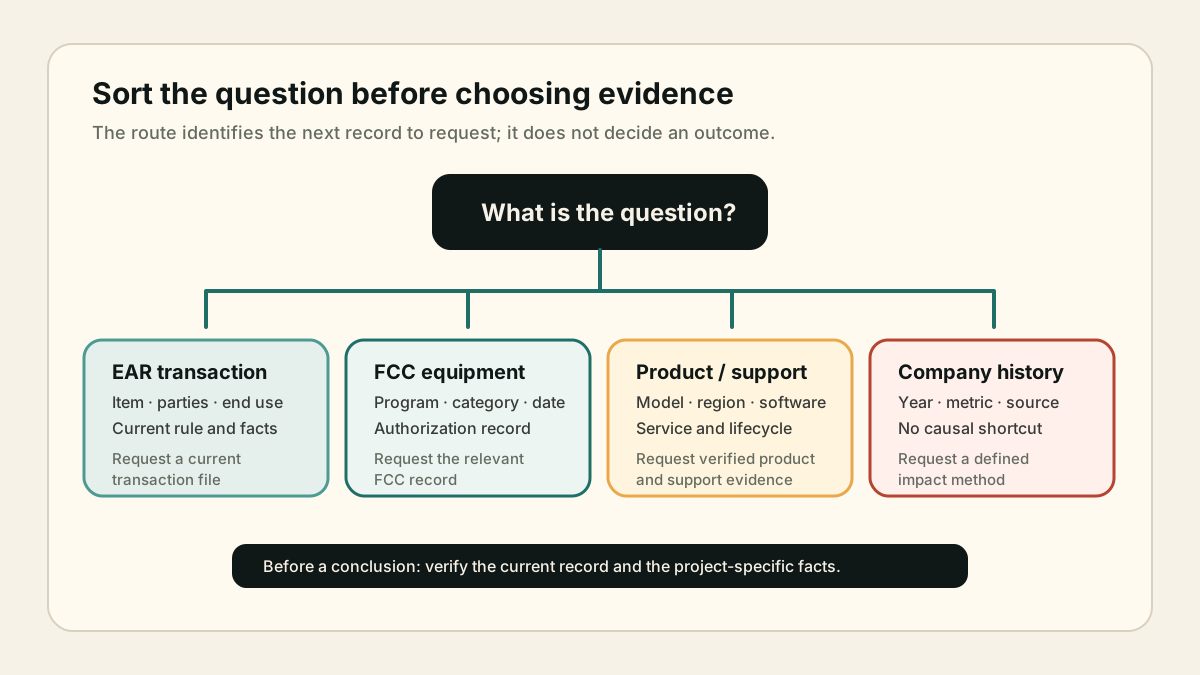
The most useful short answer is therefore deliberately narrow: the phrase “US Huawei ban” describes a timeline of separate US measures. Before acting on it, identify whether your question is about an EAR transaction, an FCC equipment record, a product or support fact, or company history—then obtain the current evidence for that file.
This article is a reading guide, not legal advice, an export classification, a license opinion, a product test, a support guarantee or a procurement recommendation. It uses original BIS and FCC records plus Huawei’s own annual-report disclosures. That boundary matters: public records can show what an agency action says; they do not decide a reader’s transaction, product configuration, Google-service availability, network acceptance or legal position.
The four files hiding inside the phrase “US Huawei ban”
The confusion starts when a headline does too much work. A headline is normally designed to say that something material happened. It is not designed to preserve the issuer, date, conditional language, product category, transaction facts, subsequent changes and unanswered questions that a real decision needs.
Use this table as a map of the files, not as a compliance checklist. Each column tells you which public record is relevant and, just as importantly, which conclusion that record cannot carry on its own.
| If the reader is really asking… | Start with | What that record can establish | What it cannot establish by itself |
|---|---|---|---|
| “Can this item be exported, reexported or transferred?” | Current EAR text, item facts, parties, end use and an appropriate compliance/legal review | The regulatory framework and the factual questions that must be answered | Whether the reader’s specific item, party, destination and transaction are permitted |
| “Is this equipment on an FCC list or subject to FCC authorization rules?” | The current FCC Covered List and applicable authorization record | The FCC category, list date and stated authorization mechanism | An EAR answer, overseas status, support entitlement or the condition of existing equipment |
| “Will this phone, radio or platform have a particular service or support outcome?” | Exact hardware, region, software build, entitlement, vendor documentation and service record | Facts about a named product or support arrangement, if verified | A conclusion from a sanctions headline alone |
| “What happened to Huawei after the restrictions?” | Dated regulatory records plus clearly attributed company disclosures | A timeline of measures and what Huawei reports about its own results | A proven causal scorecard for sanctions, US companies or global supply chains |
For example, an FCC list may matter greatly to a reader evaluating an FCC equipment-authorization issue. It does not tell that reader whether an EAR license is required for an item in a particular transaction. A BIS rule may describe conditions around certain foreign-produced items. It does not tell a reader whether a phone has a particular app, subscription, operating-system build or regional service. A revenue figure may show that Huawei reports more or less revenue in a given year. It cannot reveal the counterfactual—what revenue would have been without the measures—or allocate a result among product mix, China demand, currency, new businesses, other policies, competitors, customer decisions and management choices.
The first useful move is therefore a classification move: do not ask “What is the ban?” until you have asked “Which file is my question actually in?”
2019: the Entity List action and a limited temporary authorization
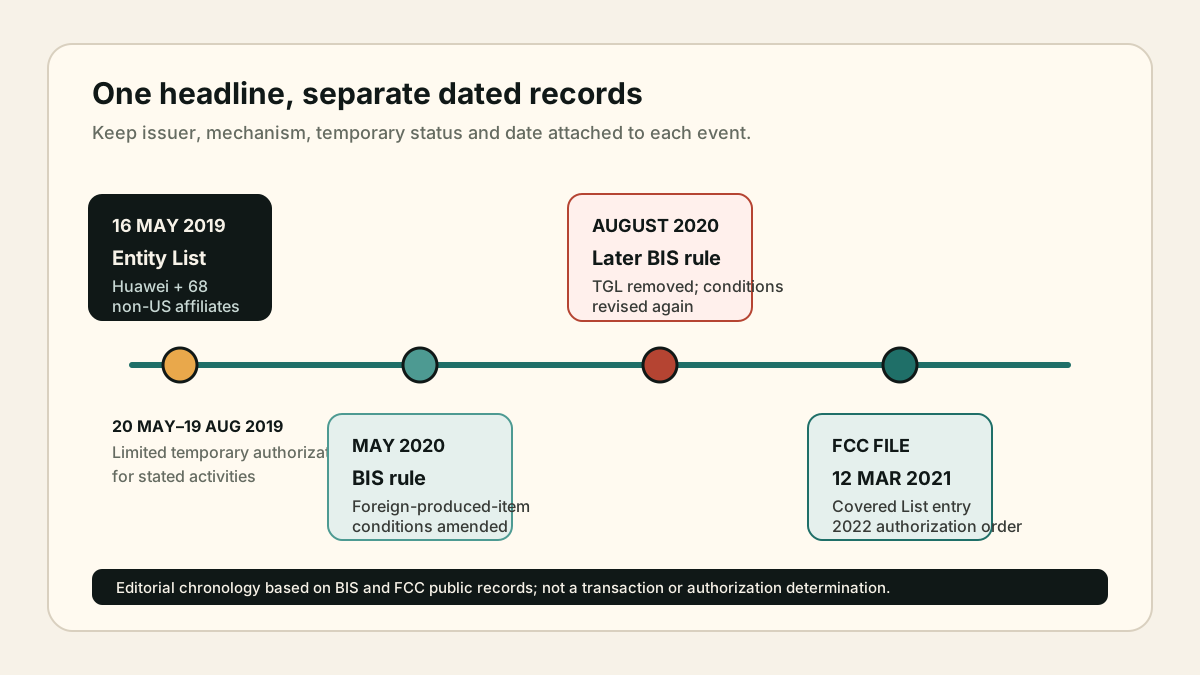
The 2019 record is where many timelines begin, but it is often retold too loosely. The BIS temporary-general-license rule says Huawei Technologies Co., Ltd. and 68 non-US affiliates were added to the Entity List on 16 May 2019. The same record created a 90-day Temporary General License (TGL), effective from 20 May through 19 August 2019, that partially restored prior licensing requirements and policies for specified activity.
Two parts of that sentence need to stay together: temporary and specified. The record did not say that the Entity List addition disappeared. It did not create a free-standing conclusion that a reader could reuse indefinitely. It created a time-bounded authorization with stated conditions and categories, while retaining other EAR obligations.
The original rule lists categories including continued operation of existing, fully operational networks and equipment; service and support for existing Huawei handsets that had been available to the public before 16 May 2019; cybersecurity research and vulnerability disclosure; and activity necessary for 5G standards development in a duly recognized international standards body. Those categories are meaningful because they show that even the transitional record was not a simple yes-or-no ban narrative. It had dates, defined activities, conditions and explicit limits.
That historical detail is still useful in 2026. It explains why public discussion often contains apparently conflicting statements such as “Huawei was listed,” “some support continued,” or “standards work was addressed.” Those statements can all describe parts of the historical record, but none should be stripped of its time and scope.
What the 2019 record does not let you say
It does not let a reader declare that any current shipment, download, update, repair, service arrangement or transaction is authorized. The cited TGL was historical and conditional; it also said it did not relieve persons of other EAR obligations. A current question requires current regulations and facts—not a recollection of a 2019 transition measure.
It also does not settle the popular phrase “Huawei without Google.” The source record is an export-control measure, not a product-by-product account of Google Mobile Services availability. A particular device question needs the exact model, region, release, software image, commercial entitlement and current documentation. Readers should avoid converting a regulatory headline into a universal device-service claim.
Finally, listing scope is not a company-wide technical verdict. An Entity List entry is a regulatory mechanism with named parties and stated licensing consequences. It is not an independent assessment that every product, deployment, customer or country shares the same condition.
Why the temporary-license detail is more than historical trivia
The TGL matters because it teaches a broader record-reading habit. In technology policy, the question is often not only “Was a restriction announced?” It is also:
- Who issued the action and under which authority?
- Which named entities, items, activities or recipients are described?
- Did the action take effect immediately, have a transition period, or include a specified authorization?
- What conditions and exclusions appear in the actual record?
- Was the rule later amended, removed, superseded or otherwise changed?
Those questions do not create an answer where the evidence is missing. They stop an old headline from being treated as a live compliance conclusion. That is especially important when a temporary authorization appears in a search result: its title tells you a transition existed; it does not tell you that the transition exists now.
2020: two foreign-produced-item rules, not one undifferentiated escalation
The next major part of the timeline is often summarized as the “foreign direct product rule.” That shorthand points to real regulatory changes, but it can hide the fact that BIS issued distinct rules in May and August 2020. The distinction matters because a reader should not use an early summary to describe later conditions, or assume the first temporary arrangement remained in place.
The May 2020 BIS rule amended General Prohibition Three, commonly referred to as the Foreign-Produced Direct Product Rule. In its stated terms, it added controls on certain foreign-produced items where a person has knowledge that an item is destined to a footnote 1 Entity List entity. The exact definitions and conditions in the rule are the point. It is not accurate to replace that conditional language with “all foreign-made products were banned.”
The August 2020 BIS rule is a separate record. Its title and summary address the addition of Huawei non-US affiliates to the Entity List, the removal of the Temporary General License, and further amendments to General Prohibition Three. The rule revises stated conditions around items that will be incorporated into, used in, or are part of a transaction involving items produced, purchased or ordered by a footnote 1 Entity List entity.
The practical point for a reader is not to memorize legal vocabulary from a long rule. It is to recognize that several questions sit underneath any loose phrase about a foreign-produced item:
- What is the item and why is it potentially subject to the EAR?
- Is it a foreign-produced item within the rule’s stated framework?
- Which technology or software, production relationship and knowledge conditions are actually present?
- Which party is involved, and what is its current status?
- What is the transaction—export, reexport, transfer, incorporation, support, development, manufacture or something else?
- What is the current version of the rule and any relevant authorization, guidance or license record?
That list is not a self-service compliance test. It is the reason a generic online answer cannot responsibly decide a specific deal. A buyer, distributor or component supplier looking at a real project should retain the technical documentation, party information, dates and contractual facts needed for an appropriate current review.
Why “global supply-chain impact” needs a higher evidence standard
It is reasonable to say that the 2020 measures were consequential. A rule that changes stated controls on certain foreign-produced items and Huawei-related parties is plainly material. But “material” is different from a verified causal story about every affected supplier, country or supply chain.
To make a causal claim about impact, a writer would need more than an announcement and a company revenue chart. They would need a defined affected population, a time window, a counterfactual or credible comparison, sources that distinguish announced policy from actual transaction outcomes, and a way to separate the policy effect from other changes. Without that evidence, claims such as “the restrictions caused a particular US company’s loss” or “the rules reshaped the global semiconductor supply chain by a stated amount” are assertions waiting for a study, not conclusions supported by these public records.
That does not make the reader powerless. It tells the reader what to request. For a supplier or buyer, the useful questions are concrete: which component, which production route, which party, which date, which end use, which written determination, which contingency supplier, and which current contract term? Those questions are more valuable than an unsupported global scorecard because they can connect to the actual object under review.
The FCC file: a different agency, a different mechanism
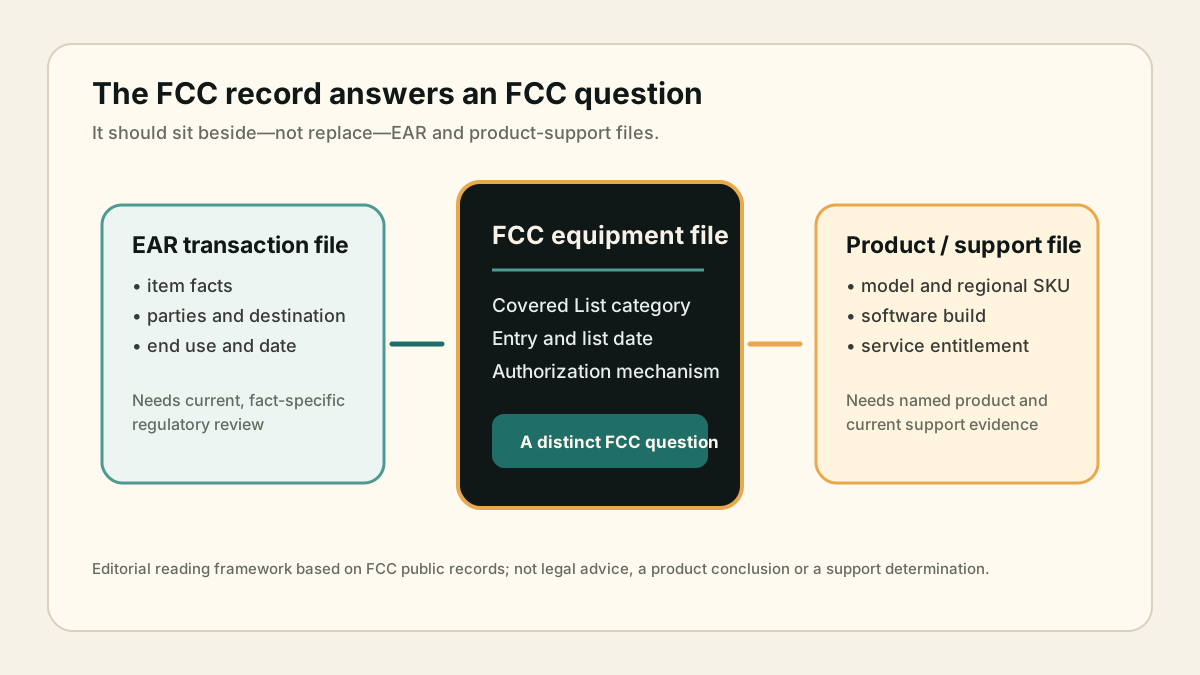
The FCC material belongs beside the BIS timeline, not inside it. That distinction can be hard to see in headline language because both are US government actions involving Huawei. But their mechanisms and records are different.
The FCC’s Covered List dated 12 June 2026 includes Huawei telecommunications equipment and services and gives 12 March 2021 as the Huawei entry’s inclusion date. That is a current FCC list record with a named category and date. It should be cited as such.
The FCC also adopted an equipment-authorization order in 2022. The order says it prohibits authorization of telecommunications and video-surveillance equipment produced by Huawei and ZTE and their subsidiaries or affiliates as Covered List producers. Again, the important word is authorization. It names an FCC program and a stated equipment category; it does not become a universal answer to every question involving Huawei equipment.
What the FCC record can answer
The FCC documents can help a reader establish whether a relevant category appears on the FCC’s current Covered List, when an entry was included, and what the cited 2022 order says about equipment authorization for the named producers. This can be material for a reader whose question actually concerns an FCC equipment-authorization pathway.
The records also demonstrate a discipline that is useful outside the United States: always state the issuing authority and program. Saying “Huawei equipment is restricted” is weaker than saying which agency’s document, which mechanism, which date and which equipment category you mean. The latter description preserves the useful facts and makes it easier to spot when a different record is needed.
What the FCC record cannot answer
The Covered List is not an EAR classification or an answer to an export, reexport or transfer question. The equipment-authorization order is not a product support contract, app availability statement, cybersecurity test report, operator acceptance report or worldwide rule. It also cannot tell you, by itself, whether an existing deployment has a particular operational state or whether a product in another jurisdiction is permitted, supported or suitable.
This is where readers often need to slow down. A product question may begin with an FCC headline, but it ends only after the reader confirms the product identity, relevant jurisdiction, software and hardware state, intended use, support terms and any current applicable records. The name “Huawei” is not enough to complete those facts.
Huawei’s company timeline: useful context, not a sanctions scorecard
The corporate history is real and worth reading. Huawei reports total revenue of CNY858.833 billion in 2019, CNY891.368 billion in 2020, and CNY636.807 billion in 2021 in its 2022 annual-report financial summary. Its 2025 annual report reports total revenue of CNY880.941 billion for 2025, compared with CNY862.072 billion for 2024.
These figures give the public story a needed time axis. They show that a familiar restrictions narrative should not be reduced to a single before-and-after number. The series rises from 2019 to 2020, falls in 2021, and has a later reported 2025 total near the earlier level. Anyone who wants to discuss Huawei’s evolution should be able to place those company-reported numbers in time.
| Huawei-reported year | Total revenue | Proper use in this article |
|---|---|---|
| 2019 | CNY858.833bn | Starting point in Huawei’s reported historical series |
| 2020 | CNY891.368bn | A company-reported next-year comparison, not a policy verdict |
| 2021 | CNY636.807bn | A later reported point that should retain its company-disclosure boundary |
| 2025 | CNY880.941bn | Current company-reported context, not proof of a complete recovery in every business or market |
Why a revenue line cannot prove impact
For a revenue line to prove a policy impact, the analysis would have to answer questions the annual reports do not answer by themselves. What would Huawei’s revenue have been absent the measures? Which businesses, countries, product lines and customers drove each change? What happened to prices, inventory, product availability, component substitution, domestic demand, foreign demand, currency, acquisitions, accounting choices and competition? Which revenue was shifted in time rather than lost? Which US suppliers or other companies experienced which verified effect?
Those questions need different evidence: company segment data, counterparty disclosures, shipment or order records, investment data, contemporaneous reporting, careful academic or economic analysis, and a method that can distinguish coincidence from cause. This article does not have that record, so it does not claim it.
The appropriate phrasing is simpler and more credible: Huawei reports the figures above. The public regulatory record establishes the stated measures above. A reader can put those timelines next to one another without pretending the two series automatically explain each other.
For more company and consumer-business context, read Huawei Comeback Story: How Sanctions Remade It. That article explores Huawei’s changed smartphone strategy; it is useful background, but it likewise should not be used as a transaction or FCC equipment determination.
“Impact” works at four different levels
The word impact is the part of the search query most likely to outrun the evidence. It can mean a rule changed a legal framework. It can mean a company reported a changed financial result. It can mean a named buyer or supplier documented a specific operational consequence. Or it can mean an analyst has measured a broader economic effect with a stated method. Those are four different levels of claim.
At the first level, the evidence in this article is strong and direct. The 2019 temporary-general-license record, the May 2020 amendment, the August 2020 amendment, the current FCC Covered List and the FCC authorization order all establish public measures made by the issuing agency. It is reasonable to say the measures changed the public regulatory framework they describe.
At the second level, Huawei’s reports establish what Huawei says about its own revenue in the stated periods. The series is useful precisely because it is concrete: CNY858.833 billion in 2019, CNY891.368 billion in 2020, CNY636.807 billion in 2021, and CNY880.941 billion in 2025. But a concrete number is not automatically a causal explanation. The number tells the reader what the company reports. It does not isolate why the number changed.
The third level is a named operational impact. Here, a credible claim would need a named actor and an inspectable record: for example, a supplier’s filing, an operator’s published migration documentation, a contract notice, a specific order change, a disclosed inventory adjustment, a court record, a product-support notice or an independently documented transaction. It would also need a bounded statement. “Company X reported that a defined program changed in a stated period” is potentially auditable. “The restrictions hurt American companies” is a broad conclusion that cannot be verified from one unnamed anecdote.
The fourth level is system-wide impact. Claims about a global semiconductor supply chain, national innovation outcomes, price effects, market shares or a policy’s ultimate success need a method. A serious analysis must specify the population, dates, mechanism, metric, comparison and uncertainty. It has to distinguish a policy announcement from the implementation date, identify other factors moving at the same time, and explain why the chosen comparison supports a causal inference. Without that work, a vivid story may be interesting but it is not an evidence-backed answer to a global question.
The impact ladder
| Level of statement | Example of a bounded statement | Evidence needed | What to avoid |
|---|---|---|---|
| Regulatory record | “BIS’s August 2020 rule removed the TGL and revised stated conditions.” | The original rule and its date | “The rule answers every transaction today.” |
| Company disclosure | “Huawei reports CNY880.941bn of 2025 revenue.” | The dated company report | “The figure proves the policy failed.” |
| Named operational consequence | “A named party reported a specific action in a defined time window.” | Primary record from that party plus relevant independent context | “One case represents all suppliers or all countries.” |
| System-level effect | “A study estimates an effect for a defined population and method.” | Transparent data, comparison method and limitations | “A headline demonstrates global causality.” |
This is especially relevant to Huawei because its business is not one product, one geography or one customer relationship. A revenue total aggregates many activities. It may include different businesses, time periods, contract structures, currencies, geographic patterns and competitive conditions. A buyer looking at a component issue, a phone user looking at support, and an analyst looking at company history can all learn from the same total; none should assume it answers the others’ question.
What an honest impact answer sounds like
An honest answer has a visible subject, verb and boundary. It says “BIS amended General Prohibition Three in May 2020,” not “Washington cut off all technology.” It says “Huawei reports revenue of X for year Y,” not “sanctions caused Huawei to recover.” It says “the FCC’s 2026 list includes a stated Huawei category,” not “Huawei is illegal everywhere.”
That style can sound more cautious, but it is more useful for a reader who must pass information to another team. A procurement lead can ask counsel to review a defined transaction. A product manager can ask an owner to verify a named regional SKU. An analyst can compare a company’s disclosed series with a properly sourced market dataset. No one can act responsibly on a sentence that blends all three questions into an unqualified verdict.
Preserve the sequence before interpreting the story
Regulatory chronology is not a decorative timeline. It is part of the interpretation. The 2019 listing, the limited historical temporary authorization, the May 2020 amendment, the August 2020 amendment, the 2021 FCC list-entry date and the 2022 FCC authorization order are not interchangeable milestones. Each changes what a sentence about “the ban” could reasonably mean.
Start with the 2019 record. The Entity List addition and temporary authorization appear in the same historical period, but the relationship is not “listing cancelled.” The BIS rule makes the relationship clearer: the TGL partially restored prior requirements and policies for specified activity and stated an effective period ending 19 August 2019. The restriction and the limited transition measure must both stay in view.
Then read 2020 as two documents rather than one headline. The May rule contains the initial amendment to General Prohibition Three described above. The August rule records a later set of amendments and the removal of the TGL. An article that calls all of this “the 2020 ban” loses the fact that the rule text itself changed.
The FCC sequence has its own clock. The June 2026 Covered List reports 12 March 2021 for Huawei’s entry, while the 2022 order describes a later authorization action. A reader should not infer that the FCC list date is the BIS listing date, or that an authorization order answers an export-control question. Keeping two agency timelines separate is not paperwork; it is how the reader avoids an incorrect source substitution.
A chronology check before reuse
Before reusing any headline, summary or internal note, ask these six questions:
- Which record is being quoted? Give its official title or at least its issuing agency and program.
- What is the record date? Separate announcement, effective, inclusion, transition and publication dates when the source distinguishes them.
- Was the action limited, conditional, temporary, proposed, superseded or current? Do not replace that status word with a more dramatic one.
- Which rule family is it in? EAR transaction controls and FCC equipment actions may both matter, but they are not interchangeable.
- What facts are needed to apply it? An item, party, end use, product, region or authorization category may be required before the record becomes decision-relevant.
- What changed after the record? A later rule, updated list, later annual report or product release can make an otherwise accurate summary incomplete.
Chronology also helps readers distinguish a historical explanation from a current answer. A 2019 or 2020 rule is essential background for understanding why Huawei’s technology stack and business narrative changed. It is not a substitute for opening the current text and verifying a live project’s facts. Historical reporting explains how a situation developed; current documentation determines what a reader can responsibly say about now.
A better way to ask the question
The phrase “What is the impact of the US Huawei ban?” is too broad to produce one defensible answer. Rewrite it into a question with an object, issuer, date and decision. The following table is a practical way to start.
| Broad question | Better question | File to open next |
|---|---|---|
| “Can we ship this to Huawei?” | “What is the exact item, relevant EAR status, party, destination, end use and transaction date, and which current record governs those facts?” | Current regulatory text, item file, party screening and competent compliance/legal review |
| “Is this Huawei equipment prohibited?” | “Which authority, program, jurisdiction, equipment category and date does the question refer to?” | The relevant FCC, regulatory, national or contract record—not a general headline |
| “Will this phone have Google?” | “Which model, regional SKU, software version and verified service entitlement are being discussed?” | Product documentation and current support/service evidence |
| “Did sanctions hurt Huawei?” | “Which business, period and metric are we measuring, and what comparison would establish cause?” | Company disclosures plus a method capable of testing causality |
| “Did US firms lose from the rules?” | “Which company, component, transaction window and independently documented result are in scope?” | The named company’s filings and transaction-specific evidence |
The record request for a live project
If a real procurement, distribution, repair, migration or support project is involved, a robust file usually needs more than any public article can provide. The exact contents depend on the situation, but the following categories show the kind of records that are often absent from generic coverage:
- Identity. Exact legal parties, corporate relationships, product identifiers, hardware revisions, software builds, country of origin and intended destination.
- Transaction facts. The proposed export, reexport, transfer, incorporation, development, service or support activity; the dates; the end user; and the end use.
- Current authority. The applicable and current regulatory text, agency guidance, license or written determination where relevant—not an old news summary.
- FCC-specific facts, where relevant. The actual authorization category, product documentation, equipment status and the program at issue.
- Product and service facts. Region, model, operating-system build, feature set, service entitlement, patch state, support agreement and lifecycle status.
- Technical evidence. Compatibility, interoperability, rollback, security and acceptance material suitable for the reader’s specific environment.
- Decision ownership. The person or team accountable for the legal, technical, operational and commercial decision, with a date for rechecking the evidence.
The list does not say that every project must use every document. It makes a narrower point: those facts cannot be inferred from the words “US Huawei ban.” When they matter, they have to be obtained from the appropriate current source.
What to watch next
This page needs review when the FCC updates the Covered List, when BIS changes a relevant rule or issues new guidance, when Huawei publishes a later annual report, or when the reader’s project introduces a new item, party, destination, product version or support condition. The date is part of the evidence—not a footnote to it.
The most important thing to watch is scope drift. It happens when a current FCC list becomes “all Huawei business,” an old temporary authorization becomes “still allowed,” a company revenue chart becomes “proof the restrictions failed,” or a regulation becomes “this phone has or lacks a service.” Each rewrite is more confident than the source permits.
The stronger habit is to keep the original nouns visible: BIS rule, FCC list, authorization program, product record, company disclosure. When the nouns stay visible, the next document is usually easier to find and an unsupported conclusion is easier to avoid.
Frequently asked questions
What was the US Huawei ban?
The phrase usually refers to a sequence of US actions, including the 2019 Huawei Entity List addition, a limited historical temporary authorization, later 2020 foreign-produced-item rule changes, and separate FCC Covered List and equipment-authorization records. Those are different mechanisms with different dates and scopes; the phrase is not itself a complete legal or product conclusion.
Is Huawei still on the US Entity List?
This article explains the historical 2019 listing and later rules but does not make a current party-screening or transaction determination. For a live decision, check the current official record and the exact party, item, activity and date with an appropriate qualified reviewer.
Does the US Huawei ban mean Huawei phones cannot use Google?
No public BIS or FCC record cited here can answer that product-service question by itself. “Huawei without Google” requires the precise phone model, regional version, software build and verified current service-entitlement documentation; do not infer it solely from a regulatory headline.
What did the 2020 foreign-produced-item rules change?
The May and August 2020 BIS rules each amended General Prohibition Three around stated conditions for certain foreign-produced items involving footnote 1 Entity List entities. The August rule also removed the Temporary General License. Their definitions and conditions matter, so a real transaction requires current, fact-specific review rather than a generic summary.
Did US restrictions cause Huawei’s revenue decline?
Huawei’s annual reports provide a reported financial series, including CNY858.833 billion in 2019, CNY891.368 billion in 2020, CNY636.807 billion in 2021 and CNY880.941 billion in 2025. Those figures do not by themselves establish causation, counterfactual outcomes, effects on US companies or a global supply-chain impact.
Method and limitations
This is a desk-research article using primary BIS and FCC records and Huawei annual-report disclosures. The article separates what an agency record says from what Huawei reports about its own revenue, and it treats the difference between those two types of evidence as part of the reader’s answer.
It does not classify an item, determine whether a license is required or available, screen a party, inspect a contract, confirm a device’s service availability, test equipment, verify cybersecurity, assess interoperability, review acceptance criteria, or make a procurement recommendation. A reader facing a live decision needs current, project-specific regulatory, product, service and technical evidence from the appropriate sources and accountable experts.
By China Made & Tech Team. Independent English field guide to China's niche hardware brands, hidden champions, founders, factory towns, and supplier clusters.
Related entries
- Huawei Comeback Story: How Sanctions Remade It — Huawei's altered consumer-business strategy after the sanctions shock; background, not a regulatory or product-service determination.