

By China Made & Tech Team.
At the end of 2025, China’s Ministry of Transport recorded 50,000 kilometres of operating high-speed railway. It also recorded 2,862 km of new HSR put into service during that year. Those are extraordinary national-system numbers. They make China the unavoidable reference case for anyone trying to understand fast rail construction, train manufacturing capacity, metropolitan connectivity, or the politics of major infrastructure.
They do not, by themselves, answer the question most people quietly mean when they cite them. They do not tell a reader whether a particular route carries enough passengers, whether a station is well connected to the city it serves, whether a project company can meet its obligations, whether public benefits exceed public costs, or whether an overseas railway should be built on Chinese terms. A route kilometre is a measure of network extent. It is not a measure of passenger experience, financial viability, engineering quality, safety performance, economic return, or export suitability.
That distinction is not a pedantic footnote. It is the difference between learning from China’s high-speed rail system and using China as a slogan. The system matters because it combined a national programme, a supply-and-construction ecosystem, service design, planning institutions and local participation at exceptional scale. The constraint matters because every corridor still has its own geography, competing modes, passenger market, station access, cost base, funding structure and public-value case.
This guide treats China’s HSR network as a systems file. First, it identifies what the current official record counts. Then it separates that record from an all-rail passenger statistic that is often misread as an HSR result. Next, it uses the World Bank’s historical analysis to explain the delivery system and to show why demand and finance cannot be inferred from network length. The final section turns the lesson into a corridor-evidence file: the questions a reader should ask before deciding that a railway is a triumph, a burden, or a transferable model.
The 50,000-km record is real—and tightly scoped
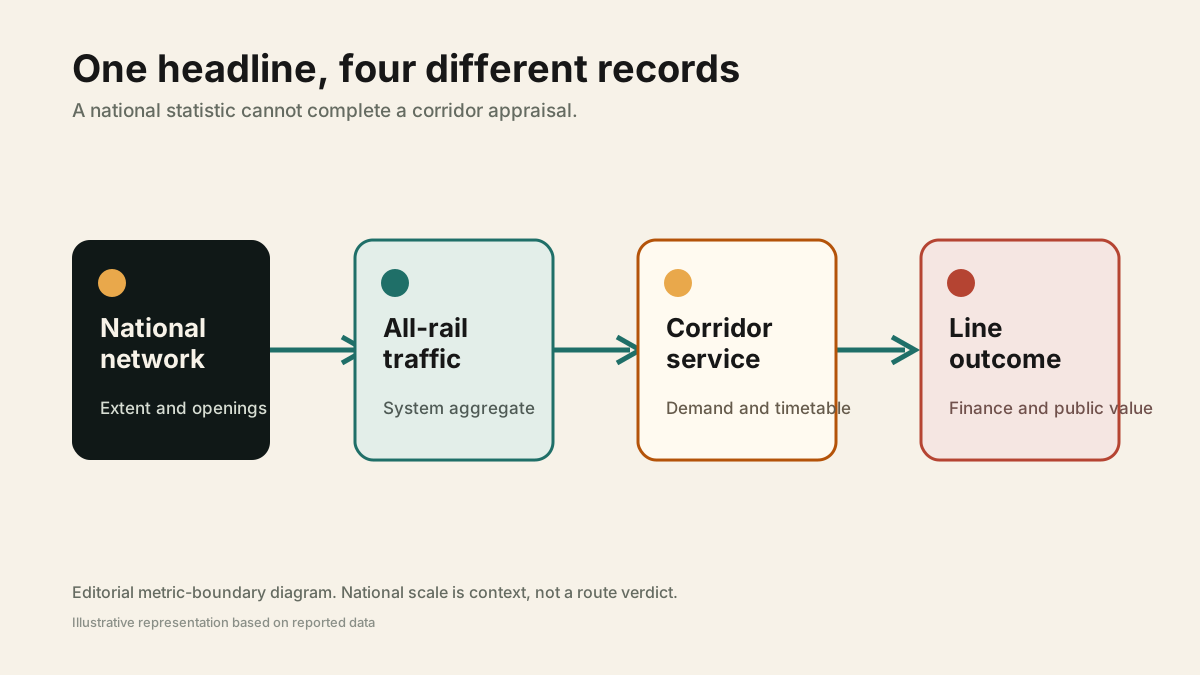
China’s current rail scale should not be minimized. The Ministry of Transport’s 2025 transport-industry statistical bulletin says that, at year-end, the national railway network totalled 165,000 km and the operating HSR network totalled 50,000 km. The same bulletin records 3,109 km of new railway put into operation during 2025, including 2,862 km of new HSR. These figures are a useful starting point because they say exactly what they are: national infrastructure totals for a calendar year.
The wording matters. “Operating HSR length” tells us that a defined amount of high-speed railway was in service in a national network at the end of a stated year. “New HSR put into operation” tells us that a defined amount opened during the year. Neither number tells us how many trains run over each kilometre, how many seats are filled, how long passengers take door to door, how much a segment cost, which entity bears revenue risk, whether a rural station is reachable, or what benefits and trade-offs occur off the railway itself.
That may sound obvious until a large network number starts doing argumentative work it cannot do. It can be used to imply that every route is busy, that every investment is justified, that every high-speed train supplier is proven, or that an overseas line is de-risked by association. None of those inferences appears in the Ministry’s national statistical record. The record is evidence of a national programme’s physical reach. It is not an inspection report, route model or audit.
The rail regulator separately says that total national railway fixed-asset investment reached RMB 901.5 billion in 2025. Its 2025 major-indicators release is useful because it puts the investment figure beside the national railway label. That label prevents another common mistake: this is not presented as HSR-only investment, and it is not a capital-cost figure for a named line. It describes the all-rail programme, which includes a wider set of infrastructure and activities than the HSR operating-length count.
The first practical lesson is therefore simple: preserve the unit, period, issuer and denominator. A good explanation of China HSR does not merely say “50,000 km.” It says “50,000 km of operating HSR at the end of 2025, according to the Ministry of Transport.” A good explanation of the investment programme does not say “China spent RMB 901.5 billion on high-speed rail.” It says “the National Railway Administration recorded RMB 901.5 billion of national railway fixed-asset investment in 2025.” Precision is what keeps a systems story from becoming a talking point.
| Record | 2025 figure | What the figure measures | What it does not establish |
|---|---|---|---|
| Operating HSR length | 50,000 km | National HSR in operation at year-end | A line’s demand, cost, safety or return |
| New HSR opened | 2,862 km | National new HSR put into service during the year | Station access, service frequency or passenger use |
| National rail investment | RMB 901.5bn | All-national-railway fixed-asset investment | HSR-only spending or a corridor’s capital cost |
| National railway passengers | 4.601bn trips | All-rail passenger trips | HSR-only ridership or a route’s traffic density |
A railway passenger total is not an HSR ridership result
China’s overall railway traffic is also huge. The National Railway Administration says national railways carried 4.601 billion passenger trips in 2025 and produced 1.639556 trillion passenger-kilometres. Those figures are evidence of a railway system with immense aggregate traffic. They are not, however, an HSR-only passenger count.
This is an important correction because transport statistics are easy to borrow across categories. A passenger trip is not automatically a high-speed trip. A national passenger-kilometre total is not a passenger-density measure for a particular HSR corridor. Neither measure reveals whether trips were made on high-speed, conventional, intercity, regional, overnight, or other rail services. It also does not reveal the length distribution of journeys, the frequency passengers were offered, the direction of travel, the fare paid, the mode a passenger would otherwise have used, or the purpose of the trip.
The distinction becomes even more consequential once a reader tries to move from national context to a specific line. A line’s passenger case depends on the relevant city pair and intermediate markets. It depends on where people live and work, how far stations are from the actual origins and destinations of trips, whether airports and expressways are strong alternatives, how frequently trains run, how transfers work, and whether timetables align with the trips people need to make. A national total can coexist with high demand on some corridors and very different conditions on others.
China’s HSR story has often been told through an intuitive visual: trains moving through enormous stations, new lines appearing on maps, and high annual passenger volumes across the rail system. Those images and figures establish that something structurally significant exists. They should prompt the next questions, not end them. Which services make up the count? Which routes carry the traffic? What is the service pattern? How does travel compare with road and air for the relevant market? What does the passenger have to do before and after the train trip?
The World Bank’s 2019 study, China’s High-Speed Rail Development, helps explain why those questions are not hostile to the network story. Its historical analysis describes high-speed rail as a service design problem as well as an infrastructure programme. Frequency, travel time, comfort, price and urban connection all influence whether passengers use a service. The report’s relevance here is not that it gives a current scorecard. It does not. Its relevance is that it forces the reader to see the chain between track, timetable, passenger choice and a line’s economics.
For any current China claim, then, a reader should ask two classification questions before accepting a number. First: is this an all-rail, HSR-only, route-level or station-level statistic? Second: is it a count of people, journeys, passenger-kilometres, seats, train pairs, fare revenue, or something else? Those categories cannot be swapped. They answer different questions.
This is also where travel experience belongs in the right place. A passenger’s report about a clean station, a packed train or an easy booking flow may be useful as an individual experience. It cannot validate the national financial case. A national passenger total can describe demand at a broad level. It cannot stand in for the passenger experience of one journey. Both may be true, but each needs its own evidence and its own scope.
The delivery system was more than track and trainsets
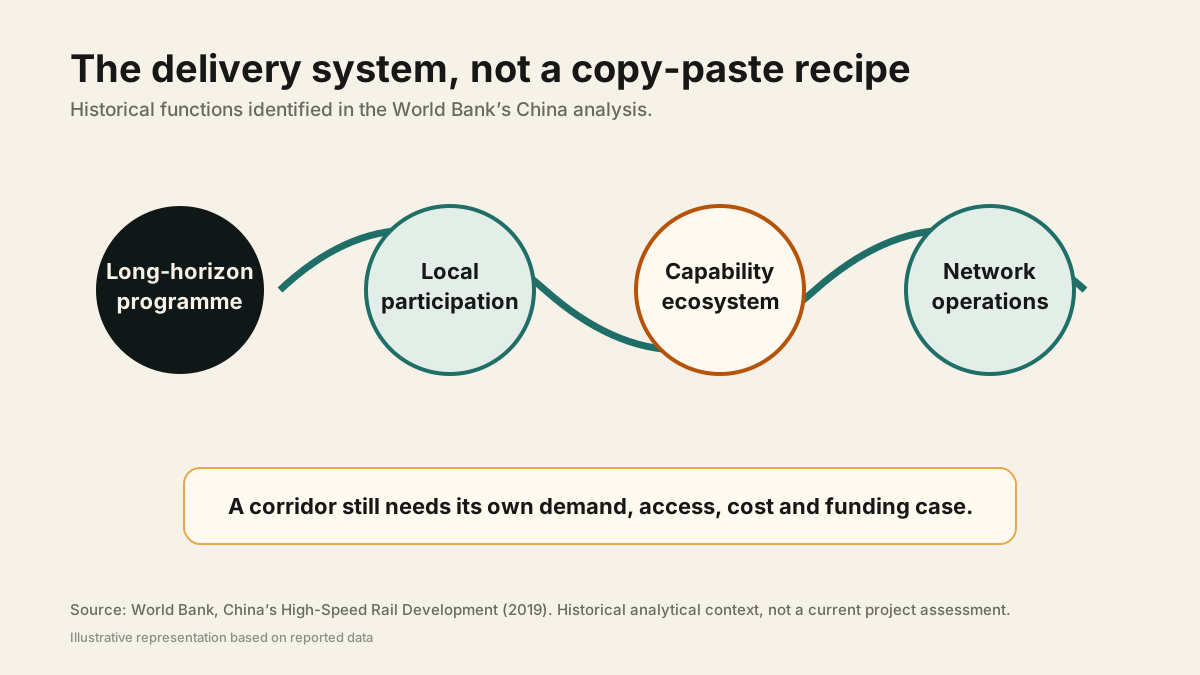
China did not reach this scale by laying track as a collection of unrelated projects. The World Bank’s 2019 analysis of China’s HSR development identifies a system of long-term planning, government support, implementation plans, relatively stable project frameworks, local-government participation through joint ventures, and coordination among rail manufacturers, universities, research institutions, laboratories and engineering centres. Its focus is the earlier buildout, so it should be read as a historical explanation rather than a claim about every current project. But that distinction makes the explanation more useful, not less.
The first element was programme continuity. A national network plan can provide an ordering logic for lines, technical standards, construction capacity and supplier investment. If suppliers, design institutes, contractors and local governments have a credible view of a multi-year programme, they can build organizational and physical capacity around it. That does not remove risk. It changes the environment in which risk is managed. A factory making a specialized component, a contractor deploying dedicated equipment, or an engineering team building experience across similar projects is operating within a programme rather than starting from zero for every corridor.
The second element was institutional coordination. The World Bank describes a structure in which local and provincial governments participated in planning and financing through joint ventures. This matters because railways are not only linear assets. Stations, land use, local transport connections, regional development goals, approvals and capital all touch institutions beyond the national railway operator. A system with mechanisms for aligning those actors can move faster than a system in which each project must renegotiate roles, land, funding and standards from the beginning.
Coordination is not the same as proof of good outcomes. It is a capacity to act. A project can still have weak demand assumptions, poor station integration, difficult geography or financial pressure. Yet it explains why the Chinese case cannot be reduced to an assertion that the country simply “built faster.” Speed is a result. Behind it are planning cycles, project governance, supply chains, technical standards, construction management and a workforce that accumulates learning across a programme.
The third element was a capability ecosystem. The World Bank points to cooperation among manufacturers, research institutions, laboratories and engineering centres as part of rapid technology advancement and localization. This is the manufacturing-system dimension of HSR. A high-speed railway is not only a train. It is civil works, track, power supply, signalling, communications, control systems, maintenance equipment, rolling stock, station systems, inspection routines, standards, design capacity and trained organizations. The story is therefore related to the wider logic of How China Manufactures: Inside the World's Factory (2026) and China Industrial Clusters: A Buyer's Sourcing Map: repeated demand and coordinated specialization can create dense capability. But rail remains a special case because public planning, network integration and safety-critical operation shape its system much more directly than they do an ordinary export product.
The fourth element was standardization with iteration. A large programme can support repeatable specifications, shared equipment, procurement routines and accumulated operating knowledge. Standardization can reduce the amount of reinvention needed for each project. At the same time, it carries a trade-off. A unified system may favour network integrity and consistency over the freedom of each asset owner or local project company to redesign services, pricing or operations on its own. The World Bank’s discussion of historical financing and operations reflects this tension: a network can benefit from unified dispatching and control while the individual asset’s commercial options remain constrained.
That is why the appropriate lesson is not “copy China’s model.” The appropriate lesson is to identify the system functions China solved: long-term programme design, project sequencing, local participation, technical capability, standardized delivery, network control and operational integration. A country considering HSR must ask whether it has equivalents for those functions, whether they fit its own institutions, and whether its corridors have the demand to justify the resulting service. The design cannot be copied separately from the market.
A high-frequency service needs a passenger market
Track does not create a useful high-speed rail service on its own. The service needs trains, seats, crews, maintenance, dispatching, schedules and passengers who choose to use it. This is where a grand national story encounters the discipline of the corridor.
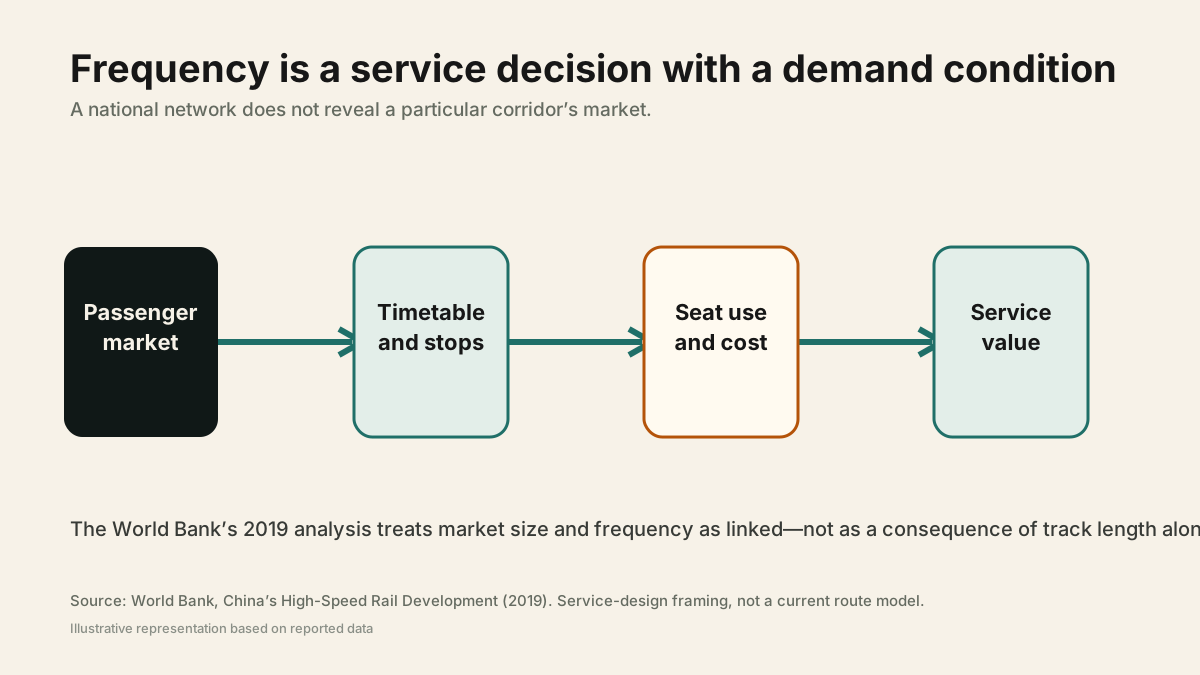
In its historical China analysis, the World Bank says that intensive hourly HSR service requires an average route load of roughly 4–6 million passengers a year to operate efficiently. The figure should not be treated as a universal construction threshold. It appears in a particular analytical discussion about service frequency, capacity and market size. Different corridors will have different trip lengths, stopping patterns, costs, speeds, fares, settlement patterns, competing modes and public objectives. The point is not to carry the 4–6 million number into every feasibility study. The point is to recognize that frequency has a demand requirement.
That requirement is intuitive if stated plainly. Frequent service makes a railway more attractive because passengers have more departure choices and less need to plan a journey around a sparse timetable. But frequent service also creates more seats to fill and more operating work to pay for. If the underlying market is too thin, a high-frequency schedule can lower occupancy and raise unit operating costs. If a corridor has dense, time-sensitive demand, frequent service can become part of the value proposition that attracts more passengers. The relationship is dynamic, but it is not magic.
China’s core high-demand corridors are one reason the historical case is difficult to transfer mechanically. The World Bank report describes China’s mix of large cities, travel distances and population density as relevant to the early HSR programme. It also points to the role of service characteristics such as frequency and affordability in making HSR competitive. Those are market conditions, not just construction achievements. A country or corridor without comparable travel demand cannot make the gap disappear by importing a trainset or copying a map.
Station access is part of the same argument. A timetable can be excellent on the railway and still be awkward in door-to-door terms if the station is distant from residences, jobs, airports or local transport. Conversely, a well-integrated station can make a service more useful than its line speed alone suggests. The World Bank’s framework considers user costs and benefits beyond the train itself, including the time and ease of travel. That is a useful reminder for readers who frame HSR only as an engineering specification.
Competing modes also matter. A corridor’s relevant comparison may be intercity bus, private car, a legacy rail service, domestic aviation, or a combination of them. The answer can change by distance, urban form, road congestion, airport location and the value passengers place on reliability. A route that has a strong rail case in one geography may have a weak case in another. A country can have strong nationwide rail demand while a specific intercity link has too few passengers at the times and fares needed to support its operating plan.
This is the first reason not to turn China’s national success into a universal export conclusion. The thing being transferred is not merely rail hardware. It is a service system that has to fit a local passenger market. The evidence file therefore starts with observed and forecast demand, but it cannot end there. Demand must be translated into time-of-day patterns, trip purpose, desired frequency, stopping pattern, fare sensitivity, station access and competition. A single annual ridership forecast is an opening question, not a decision.
Financial performance and public value are different files
Public debate often compresses HSR economics into a false binary. One side points to construction costs or debt and declares the network a burden. Another points to passenger volumes, development effects or national integration and declares every line justified. Both moves confuse different questions.
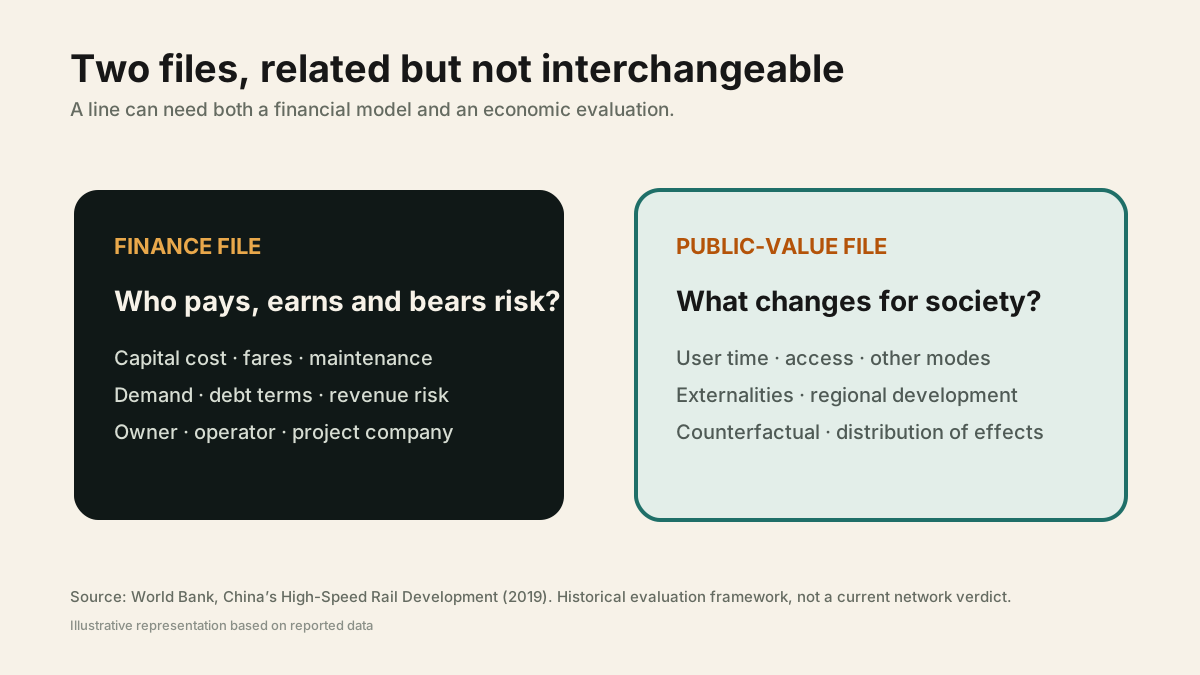
The World Bank separates the financial performance of project companies and operators from the broader economic evaluation of a railway. In its historical treatment, financial results depend on variables such as capital costs, operating and maintenance costs, service speed, fares, traffic density and financing structure. The report’s modelling also shows that breakeven conditions can differ substantially across speed classes and underlying assumptions. That is a valuable warning against treating a national network size as a finance result.
The report is explicit about its own limits. Its examples and modelling use an earlier network state, historical cost and revenue inputs, and stated assumptions. It is not a 2026 audit of China’s current HSR balance sheet. It does not license a writer to claim that every Chinese line is profitable, that every project has paid its debt, or that a foreign line will do the same. What it does provide is a disciplined way to ask which variables belong in a finance file.
An economic evaluation is broader still. The World Bank describes categories that include capital costs, operator effects, user costs and benefits, externalities such as congestion and emissions, and regional-development effects. It also notes that economic returns vary across lines and characterizes its then-current programme estimate as preliminary. This framework matters because a line can create benefits that do not appear as an asset company’s ticket revenue, while a line with a plausible public purpose can still require honest treatment of the capital and operating resources it consumes.
For a reader, the useful distinction is between at least three questions:
- Can the operating and asset structure cover its financial obligations under stated fares, costs and traffic?
- Do travellers and other users receive time, reliability, access or other benefits relative to available alternatives?
- Do wider regional-development, environmental, congestion or resilience effects justify the public resources and risks involved?
These questions overlap, but they are not interchangeable. A positive answer to one does not automatically settle the other two. Nor can a national HSR route-kilometre figure answer any of them at the corridor level. They require a consistent counterfactual: what transport services, costs and development patterns would exist without the project? They require an agreed time horizon, current cost and funding assumptions, and transparent treatment of who bears risk.
The finance file also needs governance. Who owns the infrastructure? Who operates trains? Who sets or receives fares? Who performs maintenance? Who carries revenue risk? Who services debt? Are those functions unified or separated? The World Bank’s historical discussion of China’s joint-venture and access-charge structures illustrates why these questions matter. A system can organize network control and asset management in a way that differs from how a stand-alone private railway concession would work. Readers should not assume that a project-company balance sheet captures every relevant part of the system.
The public-value file needs geography. Which cities and intermediate communities are connected? What do passengers actually save in time or transfers? What happens to conventional rail capacity, roads, airports, land use or local transit? Do benefits accrue to the places the project claims to serve, and how are they measured? Those are empirical questions. They cannot be answered with a network map alone, even when the network map is impressive.
The corridor file: what a China headline cannot decide
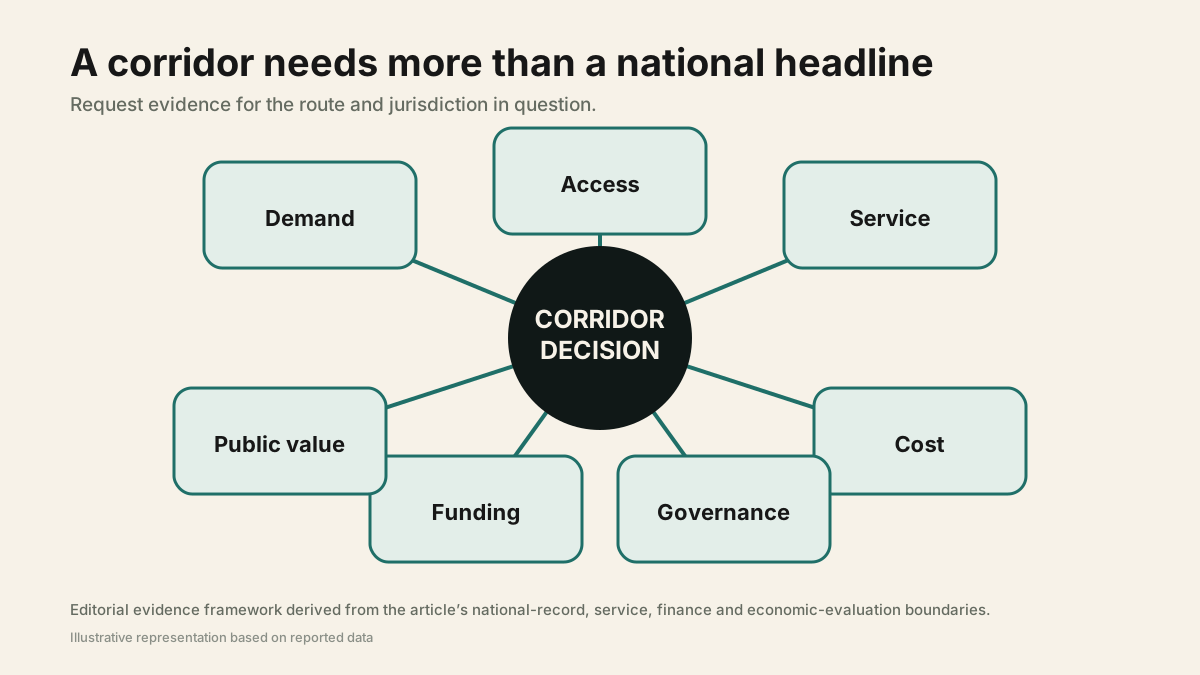
The most productive way to use China as a reference case is to turn admiration or scepticism into a request for documents and metrics. Before accepting a claim about a specific HSR corridor—inside China or elsewhere—a reader should build a file that is detailed enough to distinguish national context from project evidence.
1. Demand and competing modes
Start with the market the corridor actually serves. What are the origin and destination cities, intermediate markets and likely trip purposes? How many trips occur today by road, conventional rail and air? What are the observed travel times and fares? How does demand vary by season, day and time of day? Which share of trips is expected to shift from another mode, and which share is newly generated? What assumptions produce those estimates?
The goal is not a single optimistic ridership number. It is a transparent demand story. It should show how passengers reach the station, what timetable they can use, why they would choose the train, and what happens if the forecast is lower than expected. China’s national rail passenger total cannot answer those questions for another corridor. Nor can an image of a full train during a holiday peak.
2. Service plan and station access
Ask what service is actually proposed. What is the planned speed, stopping pattern, rolling-stock capacity, train frequency, operating day and connection pattern? Are express and stopping services both required? What maintenance windows are assumed? What happens during disruption? The service plan should be checked against the passenger market rather than designed independently of it.
Then examine access. How far are stations from actual trip origins and destinations? What local rail, bus, road, walking, cycling or taxi links exist? How do transfer times compare with existing alternatives? A station can be a regional development project, a transport interchange, or a remote structure that creates a long first-and-last-mile penalty. The classification must be evidence-based. Network coverage is not the same thing as useful access.
3. Capital, construction and maintenance
The capital file should identify the route length, terrain, bridges, tunnels, land, stations, power, signalling, communications, rolling stock, depots, enabling works, taxes, contingencies and escalation assumptions. It should distinguish an early estimate from a contracted price and a contracted price from an eventual outturn. It should specify who takes geotechnical, land-acquisition, currency, supply-chain and delay risks.
Maintenance belongs in the same long-lived asset discussion. A high-speed railway’s value is not created at opening alone. Track, structures, power systems, signalling, rolling stock, inspection equipment, depots, parts, skilled staff and renewal cycles all require a long-term operating plan. A national construction record cannot substitute for a maintenance-resourcing file. The relevant question is not merely whether a railway can be opened; it is whether it can be operated and renewed at the required standard over its intended life.
4. Governance, operations and risk allocation
China’s historical experience suggests that programme coordination and unified network functions can matter. For a new corridor, readers should make those functions explicit. Which institutions approve the project? Which entity owns assets? Who is responsible for construction oversight? Who dispatches services? Who certifies safety? Who runs stations? Who owns customer data and ticket revenue? Who pays for operating losses if they arise? Which obligations sit with national government, local government, an operator, a project company, lenders, contractors and suppliers?
These questions are not bureaucratic extras. They shape incentives and the reliability of the operating system. A project may have a technically capable contractor and still face a weak ownership or maintenance model. It may have a strong train supplier and still lack an accountable local operator. It may have a credible passenger forecast and still lack a funding arrangement that can absorb construction overruns or demand volatility. The governance file connects these moving parts.
5. Finance and affordability
The financial model should say whose cash flows are being measured. Is it the infrastructure owner, the train operator, a joint venture, a government budget, or a consolidated system? What are the fare assumptions? Are subsidies included? What are the debt terms, interest-rate risks, currency exposures and repayment profile? What happens if capital costs rise or ridership lags? How sensitive is the result to service frequency and maintenance spending?
Affordability is a separate question from commercial return. A fare can be attractive to passengers and insufficient to cover certain costs. A fare can cover more costs and exclude potential users. A service can be supported for public-policy reasons, but that support should be transparent. The useful discipline is to state the policy objective, identify who funds it, and avoid pretending that a single fare or ridership statistic resolves the trade-off.
6. Public value and distribution
Finally, test the wider case. What time savings are credible compared with realistic alternatives? Does the corridor relieve a binding capacity constraint on another transport mode? Does it reduce road congestion or improve resilience? What environmental effects are included, under what electricity and modal-shift assumptions? Which communities gain access, and which may be bypassed? Does station-area development create real additional activity or redistribute activity from elsewhere?
These questions are harder than counting track, which is why they are often pushed to the end of a presentation. They should not be. The public-value case is where a government, lender or citizen decides whether the railway is doing more than moving trains. It is also where claims about national development need the most careful counterfactuals.
What China’s system does—and does not—teach
China’s HSR network is a powerful demonstration that a country can build a large, technically demanding rail system quickly when several conditions align: long-range programme design, political and institutional continuity, local participation, engineering and manufacturing capacity, standardized delivery, network control and strong intercity demand in core markets. That is a consequential achievement. It changed the scale at which HSR is discussed globally.
The same evidence also argues for restraint. It does not show that rail capacity can be ordered from a supplier and dropped into any market. It does not show that a national network figure proves the operating performance or finances of every constituent line. It does not show that a historical analysis of China’s conditions can serve as an appraisal for an overseas project. The more impressive the number, the more important it is to preserve the boundary of what the number measures.
For readers interested in manufacturing, the key lesson is that the train is only one part of a system. Railways accumulate capability through standards, repeated delivery, research institutions, suppliers, construction methods, maintenance practices and operating organizations. That is why China’s HSR story belongs beside a broader explanation of How China Manufactures: Inside the World's Factory (2026) and the role of China Industrial Clusters: A Buyer's Sourcing Map. Yet an HSR corridor also has features that ordinary manufactured goods do not: fixed geography, public financing, network externalities, long-lived civil works and public responsibilities that cannot be reduced to a purchase order.
For readers interested in infrastructure, the key lesson is different. China’s experience provides hypotheses to test: does a proposed programme have enough continuity to build capability? Are local roles, funding and land issues aligned? Does the market justify the service pattern? Is the network operational model coherent? Can the owner fund maintenance and renewal? Does the public-value case survive conservative assumptions? Those questions travel better than a headline kilometre count.
The right conclusion is therefore neither celebration nor dismissal. China’s 50,000-km network is evidence of a national system that deserves close attention. A railway project deserves a separate answer.
A quick way to read the next China HSR headline
When a new China HSR announcement appears, begin by identifying the object before interpreting the adjective. Is it an announcement, a construction start, a tunnel breakthrough, a test, a line opening, a timetable change, an annual network statistic, a manufacturer claim, or a project-company financial result? These are all railway facts, but they sit at different points in the system. A construction milestone shows progress on a specified work package. It does not show that passenger service has begun. A line opening shows that an asset entered service. It does not show its eventual demand or economic return. A test result may describe a bounded condition; it does not certify every train, route or operating day.
Then keep the geography visible. A national statistic can be useful context for policy capacity and programme scale. A corridor statistic can be useful context for service demand. A station-area statistic can be useful context for access or local development. But the move from one geography to another needs evidence. A national network does not automatically represent a peripheral route; a major-city corridor does not automatically represent an entire province; and a successful station-area project does not automatically establish a transport effect for all stations.
Next, ask whose outcome is being described. A passenger may care about a reliable, convenient trip. A railway operator may care about service revenue and operating cost. An infrastructure owner may care about maintenance and debt service. A local government may care about access, development or land use. A national transport system may care about capacity, resilience and connections between regions. These objectives can point in the same direction, but they can also conflict. A good story should name the actor rather than use “success” as if it were self-defining.
Finally, date every conclusion. The current Ministry of Transport network record is about 2025. The World Bank delivery and financial analysis is historical and assumption-bound. A reader can use both, as long as they are not blended into a fictional real-time scorecard. That habit—object, geography, actor and date—takes less than a minute, and it prevents most overclaims in discussions of China’s high-speed rail.
Frequently asked questions
How large is China’s high-speed rail network?
China’s Ministry of Transport records 50,000 km of operating high-speed railway at the end of 2025, with 2,862 km of new HSR put into service during that year. That is a national operating-network figure; it does not measure passenger use, route profitability or the performance of a specific train line.
How many people use China’s high-speed rail?
The National Railway Administration reported 4.601 billion passenger trips across the national railway system in 2025, but the cited release does not make that an HSR-only ridership figure. A claim about China HSR passengers needs a source that explicitly isolates the high-speed service category and specifies its period and scope.
Why was China able to build high-speed rail so quickly?
The World Bank’s 2019 analysis points to a historical combination of long-term planning, implementation discipline, local-government participation through joint ventures, and coordination across manufacturers, research bodies and engineering institutions. Those factors explain a delivery system; they do not guarantee that the same approach fits another country or a particular new route.
Is China’s high-speed rail financially profitable?
There is no responsible one-word answer for the whole network. The World Bank’s historical modelling shows that financial conditions vary with speed, traffic density, capital cost, fare and financing assumptions, while a broader economic evaluation includes user, operator, externality and regional-development effects. A current verdict requires line- and entity-specific data.
Can another country copy China’s HSR model?
Another country can study China’s programme functions—planning, sequencing, technical capability, institutional coordination and service integration. It still needs its own corridor evidence on demand, access, competing modes, cost, maintenance, governance, financing and public value. A national China statistic is context, not a feasibility study.
Method and limitations
This is a desk-research guide, not a train review, engineering audit, safety assessment, route feasibility study or investment recommendation. Current network and all-rail traffic figures come from the Ministry of Transport and National Railway Administration records cited above. The delivery, service-design, finance and economic-evaluation discussion is attributed to the World Bank’s 2019 report and remains bounded by that report’s historical data and stated assumptions.
We did not inspect a train, ride a route, visit a station or construction site, test rolling stock, audit signalling, review a project contract, model a corridor, examine a debt schedule, or interview passengers, operators, engineers, lenders or public officials. The article therefore does not assess the safety, quality, profitability, economic return, accessibility, supplier suitability or public value of a specific Chinese or overseas railway. Those questions require their own current, route-specific evidence file.
Related entries
- How China Manufactures: Inside the World's Factory (2026) — the broader manufacturing system that helps explain how repeated programmes can build capability.
- China Industrial Clusters: A Buyer's Sourcing Map — a sourcing and specialization lens for China’s manufacturing ecosystems.