

“Chinese e-commerce goes global” is a useful headline and an unreliable description of a specific purchase, seller or supply chain.
It is useful because cross-border online commerce from China is large, and familiar names such as Temu, SHEIN, AliExpress and Alibaba.com give many global buyers their first direct encounter with it. China’s official 2024 trade record reports CNY2.63 trillion in annual cross-border e-commerce imports and exports. That is real scale. It is unreliable as a complete description because the figure is a national trade aggregate, not the sales of one app, the output of a named factory, or proof of where an individual item was made and how it will arrive.
The platform names create a second confusion. A platform can connect merchants to buyers, provide listings, marketing, payment, data tools, fulfillment support or cross-border logistics relationships. That does not mean the platform manufactured the item, owns the seller, controls every shipping hand-off, tested the product, set every price or can answer the local consumer-law question for a particular order. A listing can be connected to a China-based merchant without being a verified factory-direct offer. It can look inexpensive without revealing the exact terms, route, origin, return process or lifecycle support behind the price.
The useful conclusion is narrower: Chinese e-commerce going global is a family of platform and channel arrangements. Before interpreting a platform headline—or relying on a listing—separate the trade aggregate, platform model, merchant, product, shipment and jurisdiction files.
This is a desk-research reading guide, not a shopping review, sourcing report, safety test, legal opinion or buying recommendation. It uses an official China trade record, company filings from PDD Holdings and Alibaba, European Commission marketplace records, and one UK product-safety action. Those sources establish different things. None identifies a reader’s particular seller, factory, item origin, price, customs treatment, delivery outcome, return right or product quality.
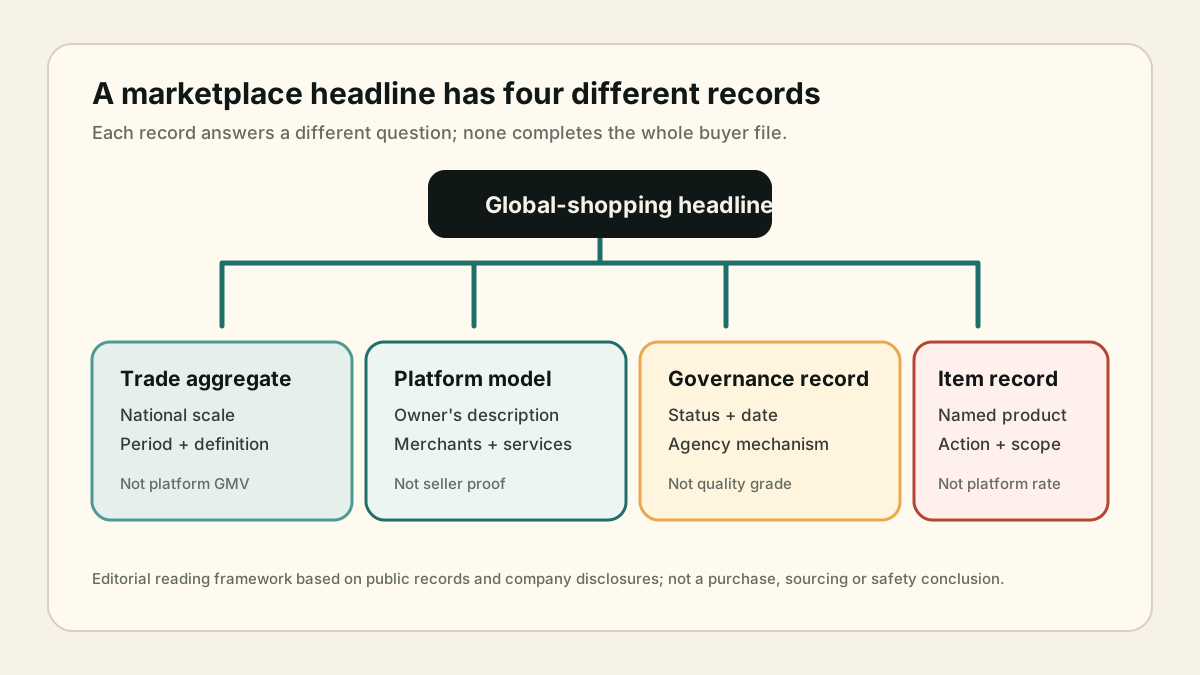
The four files inside a global-shopping headline
The global-shopping story often moves too quickly. A product appears in an app. A buyer sees an unusually low price, a broad catalogue, a parcel route or a social-media claim about “direct from the factory.” Then a platform name is used as shorthand for every commercial relationship behind the listing.
That shortcut hides the actual objects that need verification. A national trade figure describes aggregate imports and exports. A company filing describes how a platform owner says it serves merchants or buyers. A marketplace-regulation record describes a regulator’s status, procedure or stated concern. A product-safety alert describes a named item and corrective action. These are related, but they are not substitutes.
| Reader question | First record to open | What it can establish | What it cannot establish alone |
|---|---|---|---|
| “How large is China’s cross-border e-commerce activity?” | A dated official trade aggregate | National scale for the stated period and definition | A platform’s GMV, market share, supplier base or a product’s origin |
| “How does a named platform say it operates?” | The owner’s current filing or formal terms | The company’s description of its platforms, merchants and services | The facts behind every seller, product, delivery or price |
| “What is the platform’s regulatory status in the EU?” | A regulator’s designation, request or proceeding | The stated status, date and mechanism | A final compliance, liability, quality or safety conclusion |
| “Is this listing safe, genuine, factory-direct or suitable?” | The exact seller, item, price, shipment and applicable local record | Facts about that object, if independently verified | A platform-wide answer inferred from the app name |
Why “direct from China” is not enough information
The phrase can mean several things. It may describe a merchant’s location, a product’s claimed origin, the first fulfillment point, the export route, a marketplace’s seller base, or simply the buyer’s perception that a traditional local retailer is absent. Those are not the same fact.
A manufacturer can sell directly, through a distributor, through a trading company, through a marketplace seller or through a local warehouse. A platform can host merchants from more than one geography. A product can be made in one place, warehoused in another, sold by a different legal entity and delivered by a third party. A listing may be honest about a product while still leaving vital commercial details unknown: the entity taking payment, the specification that will be shipped, the warranty provider, the return location, the applicable consumer protections and the party responsible if the item is defective.
That is why “direct” is an invitation to verify a chain, not a conclusion. The reader needs to identify the merchant of record, seller identity, product identifier, claimed origin, warehouse or fulfillment arrangement, destination, terms, return route and applicable consumer or product rules. The exact priority will change with the product and country, but the category of missing evidence does not disappear because the checkout page looks simple.
Scale context: a national aggregate is not a platform metric
China’s cross-border e-commerce activity is large enough to deserve attention outside individual apps. The China government report says the 2024 annual value of cross-border e-commerce imports and exports reached CNY2.63 trillion, CNY1 trillion more than in 2020. The number belongs in a global-commerce discussion because it shows that the channel is not a niche consumer trend.
It also needs its full label. The report presents it inside a wider foreign-trade account. It is a national total for cross-border e-commerce imports and exports. It is not a Temu number, a SHEIN number, an AliExpress number, an Alibaba.com number, a count of parcels, a count of Chinese factories, or a measurement of how much traditional retail has been displaced.
| The CNY2.63tn figure is useful for… | It is not evidence for… |
|---|---|
| Understanding the reported national scale of the channel in 2024 | A ranking of global marketplaces |
| Seeing that the official record reports a CNY1tn increase from 2020 | A platform’s user growth, GMV or profitability |
| Asking which commercial and logistics ecosystems support cross-border trade | The origin, safety, price or delivery of an item in a cart |
| Framing why platform and merchant verification matter at volume | A causal claim that online commerce bypassed a particular importer, distributor or retailer |
The same rule applies to the phrase “China’s manufacturing ecosystem.” China’s industrial depth may help explain why merchants can access broad category supply, but the official aggregate does not identify which workshop made a particular listing or which supplier relationship the platform uses. Those statements need separate records. For broader published context on how Chinese production systems are organized, see How China Manufactures: Inside the World's Factory (2026). It is useful background, not a provenance check for an item in a marketplace cart.
Platform files: similar storefronts can carry different routes
Platform interfaces make channel differences easy to miss. An app or website can present a single search bar, recommendation feed and checkout path even when its merchants, logistics services, product categories, destination markets and commercial relationships vary. The cleanest public starting point is therefore the platform owner’s own formal description, read with attribution.
Temu: PDD’s description is a platform file, not a seller certificate
PDD Holdings’ 2025 Form 20-F says Temu was founded in Boston and initially launched in North America in September 2022, followed by expansion to other regions. The filing says Temu works with a global network of logistics vendors and fulfillment partners to help merchants reach broader markets. It also says that Temu and Pinduoduo primarily serve merchants in China.
Those are important company-reported facts because they place Temu in a specific type of cross-border platform story: a platform owner describes China-focused merchant access, international consumer reach and logistics/fulfillment partners. That is more useful than saying merely that it is “a Chinese shopping app,” and more accurate than treating every listing as a direct shipment from an identified Chinese manufacturer.
The disclosure does not tell a reader who made a particular item. It does not identify the legal seller behind every listing, the origin of every component, whether an item is sent cross-border or from a local warehouse, the carrier handling a given parcel, the actual shipping cost, the return address, or the product’s conformity with the reader’s local requirements. It also does not prove that a low price is permanent, that the platform has no intermediaries, or that a particular merchant is a factory rather than a distributor, brand owner, trading company or another seller type.
This distinction is useful for a seller as well as a buyer. A merchant evaluating a channel should ask what the platform actually provides, which party controls the listing, how fulfillment is configured, who bears product and return obligations, which data and marketing services apply, and where the commercial terms are documented. A buyer should ask who is selling the exact item, where the order will be fulfilled, what specification is being offered, and who will handle a problem after delivery.
Alibaba: international retail and wholesale are not one route
Alibaba’s Form 20-F describes an International Digital Commerce Group with both retail and wholesale businesses. In its international retail description, Alibaba says AliExpress enables global consumers to buy directly from manufacturers and distributors in China and around the world. In its international wholesale description, Alibaba says buyers who sourced business opportunities or completed transactions on Alibaba.com were located across more than 190 countries in fiscal year 2026.
The phrasing matters. “Manufacturers and distributors in China and around the world” is not the same claim as “every listing comes directly from a Chinese factory.” It is a company description of a retail channel with multiple seller and geography possibilities. “Buyers across more than 190 countries” is not a parcel count, a buyer count, a market-share calculation or proof that every transaction closed successfully. It is a company-reported reach statement for the wholesale marketplace.
Alibaba’s filing is valuable because it makes channel variety explicit. The global e-commerce landscape includes consumer retail, wholesale sourcing, regional marketplaces, brands, distributors, small merchants, third-party services and multiple logistical arrangements. A reader looking for a factory is asking a different question from a consumer looking for a product, and both are asking a different question from a wholesale buyer assessing supplier capability. They may use the same company family or marketplace, but they need different evidence.
Read a platform description with the right verbs
The safest verbs in this section are “says,” “describes,” “reports,” “enables” and “serves.” They preserve the difference between a platform owner’s formal account and an externally verified outcome. It is fair to say PDD says Temu works with logistics vendors and fulfillment partners. It is not fair to turn that into a delivery guarantee for a reader’s order. It is fair to say Alibaba describes AliExpress as enabling purchases from manufacturers and distributors in China and elsewhere. It is not fair to assume every specific seller is a manufacturer.
This is not simply a linguistic preference. It is a way to stop a broad platform claim from swallowing the details that determine commercial reality. The closer a decision gets to a particular product, the more specific the evidence must become.
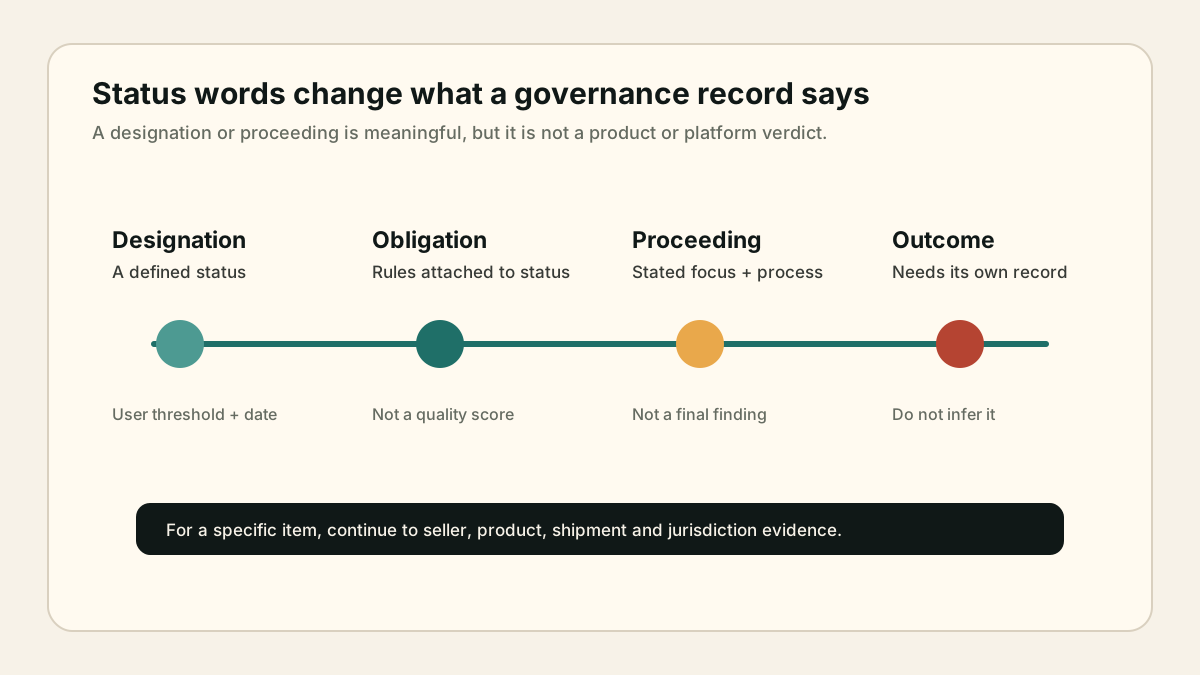
Marketplace governance: designation is a status, not a quality grade
When platforms reach many consumers, marketplace governance becomes another file. The European Commission’s records provide a concrete example of why user scale, statutory status and enforcement procedure must not be turned into a simple trust label.
On 31 May 2024, the Commission designated Temu as a Very Large Online Platform under the Digital Services Act (DSA). The page says Temu communicated an average of more than 45 million monthly users in the European Union, above the threshold for the designation. That number is useful within its exact context: it is a platform-communicated EU monthly-user figure used in the Commission’s designation record. It is not a current global-user count, a GMV figure, a customer-satisfaction score, or a product-quality measure.
The Commission designated SHEIN as a Very Large Online Platform on 26 April 2024. The Commission says SHEIN communicated average monthly EU users above 45 million. The result is a regulatory status with related obligations; it is not a certificate saying that every seller, product, interface or outcome has been independently verified.
The distinction is essential. A designation can matter operationally because it attaches a legal framework and stated obligations to a service. But a reader should not convert “VLOP” into “safe,” “unsafe,” “approved,” “noncompliant,” “better governed” or “worse governed.” Those are different claims requiring different evidence.
A proceeding is not a final finding
The same discipline applies when an agency opens an investigation. On 17 February 2026, the European Commission announced formal DSA proceedings against SHEIN. The Commission’s page lists the areas it says the investigation will focus on, including systems to limit illegal products, risks associated with addictive design, and transparency of recommender systems.
That is material current information about procedural status. It is not a final finding on every allegation, a judgment about every product or seller, a final liability result, or a platform-wide safety outcome. The correct wording is “the Commission opened proceedings and stated these areas of focus,” not “the platform has been found to have done X.”
This is more than legal caution. It matters to a buyer or seller trying to decide what to do. An open proceeding may be a reason to watch official updates, review a platform’s current policies, or understand why traceability and user-interface questions are part of marketplace governance. It does not replace the immediate files a specific order needs: product identity, seller details, price terms, shipping arrangement, return policy, safety documentation and applicable local requirements.
A listing is an item and seller file, not a platform verdict
The difference between marketplace status and product evidence becomes clearer when the record concerns a specific item. The UK Office for Product Safety and Standards published a product-safety recall for named water-absorbent beads sold via SHEIN. The record identifies the product, gives 12 December 2025 as the recall/alert date, describes a serious asphyxiation risk if the hydrated beads are swallowed, and says the product was recalled from end users and the listing was removed by the marketplace.
This is a useful record because it is specific. It names an item, a hazard and a corrective action. A reader can see what an actual item-level safety action looks like: the subject is neither “Chinese e-commerce” nor “all marketplace products.” It is a defined product record with a date and an action.
It is not a representative sample of every SHEIN listing, every product on another marketplace, every China-linked item or every seller. It cannot support a platform-wide safety rate, overall compliance judgment, delivery claim or conclusion about a product the reader is considering. A single recall is an alert to inspect the item file, not a mathematical summary of a marketplace.
What this case changes for a careful reader
The case suggests a practical distinction. When a reader sees a product claim, the questions should move closer to the object:
- What exactly is the product—model, size, material, package count, intended use and safety-relevant variant?
- Who is the seller or economic operator, and what contact or traceability information is available?
- Which product document, warning, certification, test report or recall database applies to this precise item and destination?
- What are the current delivery, return, refund and support terms for the buyer’s location?
- Which regulator or consumer-protection authority is competent if a problem arises?
The article does not answer those questions for a reader’s cart. It makes clear why they are needed. A platform page can be the beginning of product research; it should not be the end of it.
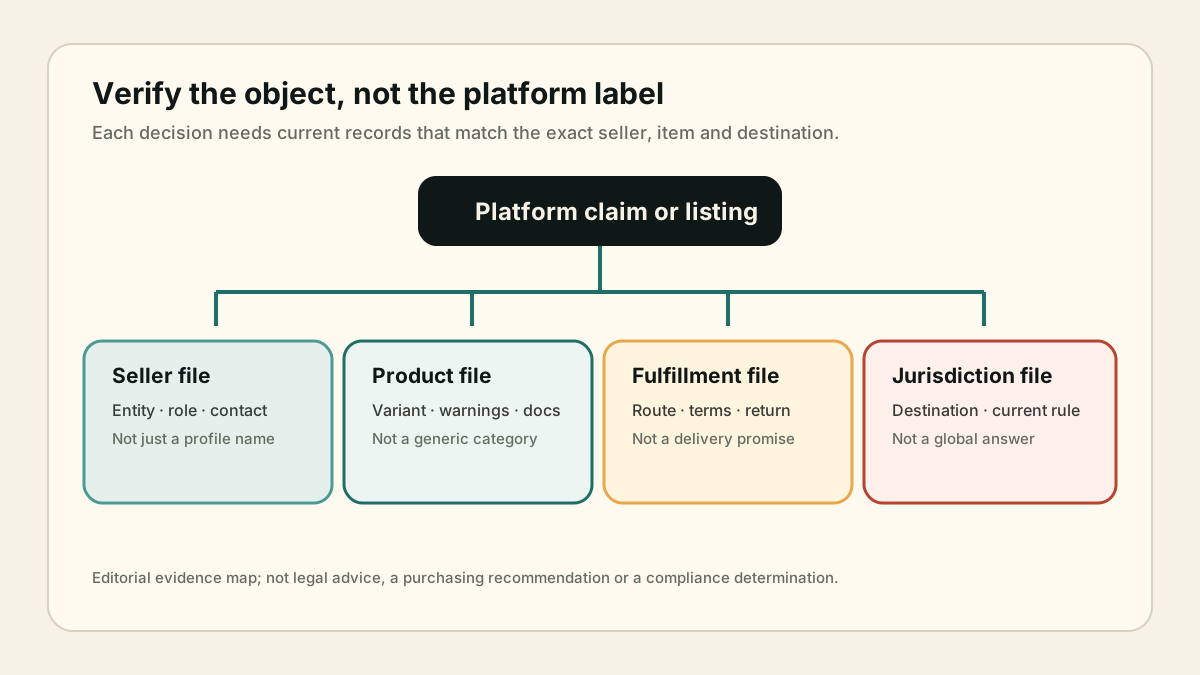
The practical file: verify the object, not the headline
Different readers have different decisions, but the same pattern holds. A consumer wants to know whether a listing is what it claims to be and what recourse exists. A small seller wants to know what obligations, terms and fulfillment responsibilities apply. A wholesale buyer wants to know who makes a product and whether that supplier can meet a defined specification. An analyst wants to understand a platform’s business model without turning a national trade aggregate into market share.
The table below maps those decisions to the next evidence to request. It is not a universal checklist or an instruction to transact. Its purpose is to prevent a generic label from substituting for the relevant object.
| Question | Object to identify | Evidence to request or verify | What a platform headline cannot replace |
|---|---|---|---|
| Is this exact consumer item suitable? | Model, variant, material, seller and destination | Listing terms, product identifiers, warnings, applicable records, delivery and return terms | An app’s popularity, a low price or a national trade number |
| Is this seller actually the producer? | Legal entity, manufacturing relationship and product scope | Seller identity, factory/brand documentation, product and quality records, transaction terms | “Direct from China” or a marketplace search result |
| How will the item be fulfilled? | Warehouse, carrier, route, delivery service and return location | Current shipping and return terms for the destination, order-specific information | A platform’s general logistics description |
| What does a marketplace regulation record mean? | Agency, instrument, date and procedural status | The current official designation, decision, request or proceeding record | A final quality, safety or liability verdict |
| How large is the wider channel? | Geography, period and measurement definition | Official aggregate or a platform-specific disclosure with its own methodology | The outcome for a named merchant, item or country |
The seller-to-shipment chain
A useful way to visualize a cross-border order is as a chain of records rather than a single storefront:
- Platform file. What does the platform say it is offering, and which terms govern the buyer or merchant relationship?
- Seller file. Which entity is presenting the item, receiving payment or making the commercial promise?
- Product file. What exact item, version, warning, specification and documentation are in scope?
- Origin and production file. What can actually be verified about producer, origin and supply relationship—not what a platform name suggests?
- Fulfillment file. Where is the item expected to ship from, who handles it, and what do current shipping and return terms state?
- Jurisdiction file. Which local consumer, product, tax, customs, privacy or marketplace rules are relevant to the actual transaction?
- Exception file. What happens if the item is delayed, damaged, unsafe, misdescribed or not returnable, and which party is accountable?
The order of the chain will vary. A consumer may begin with the product file; a sourcing professional may begin with the seller and production files; an analyst may spend most time on platform and aggregate files. What should not vary is the principle that no single public claim completes every link.
What Chinese platforms can change—and what they cannot prove
The evidence in this article supports a sensible but limited statement: platforms can make it easier for merchants to reach buyers across borders, and the China official aggregate shows that cross-border e-commerce is large in reported trade terms. PDD and Alibaba describe services that connect merchants and buyers through different retail, wholesale, logistics and fulfillment configurations. These are real commercial mechanisms worth studying.
The evidence does not support an automatic conclusion that platforms have removed all intermediaries. A distributor may still exist. A merchant may not be a factory. A local warehouse may be used. A payment, advertising, logistics, product-compliance or return function may sit with another party. The relevant chain is a factual question for each category, platform, seller and destination.
Nor does the evidence support a universal price explanation. A low displayed price can reflect product specification, merchant strategy, inventory, promotion, fulfillment design, tax treatment, customer-acquisition spending, currency, competition or something else. Without a defined product and comparable transaction terms, a price comparison is not a reliable statement about manufacturing cost or supply-chain efficiency.
The claim ladder for Chinese online shopping platforms
One way to keep a marketplace analysis useful is to match the breadth of the claim to the breadth of the record. The source set in this article supports some statements directly, supports others only with attribution, and leaves many tempting claims unanswered.
| Level of claim | A defensible formulation | Evidence needed | A claim this evidence cannot support |
|---|---|---|---|
| Trade context | “China’s official record reports CNY2.63tn in 2024 cross-border e-commerce imports and exports.” | A dated national aggregate | “Platform X owns this share of China’s trade.” |
| Platform description | “PDD says Temu primarily serves merchants in China and works with logistics partners.” | The platform owner’s filing | “Every Temu listing is factory-direct and cross-border shipped.” |
| Channel description | “Alibaba describes retail and wholesale international channels.” | The company’s filing and named channel | “Every AliExpress or Alibaba.com supplier has the same role or origin.” |
| Marketplace procedure | “The Commission designated a service as a VLOP” or “opened proceedings.” | The official record and status date | “The platform has been cleared, found liable, or has a defined product-quality rate.” |
| Item-specific fact | “This named product was recalled and its listing removed.” | The named product alert and corrective-action record | “The whole platform is safe or unsafe.” |
The mistake is to jump three levels without showing the missing evidence. If a buyer says “this is factory-direct,” ask for the seller and product file. If an analyst says “this platform has taken over market X,” ask for a comparable market metric, period and method. If someone says “the platform is unsafe,” ask whether they are describing an individual alert, a regulator decision, an independently measured rate or an opinion. The request does not weaken the analysis; it turns a slogan into a testable claim.
A practical due-diligence conversation
For a low-stakes purchase, the record request may be short: identify the item, seller, delivered price, return condition and basic product information. For a business purchase, it may grow to include entity documentation, technical specification, production capacity, samples, test evidence, contract terms, packaging, logistics, customs and after-sales responsibility. For a regulated or safety-sensitive product, the required documentation will be more demanding and location-specific.
The principle is the same across the range. A platform can help the reader discover an offer, but the platform’s identity cannot serve as a substitute for the seller’s identity or the item’s evidence. Buyers should be cautious when a decision depends on a property that the listing does not document: origin, material, safety, certification, compatibility, warranty, return route, delivery time or economic operator. The absence of a record is an absence of a record—not evidence that the claim is false, but not a reason to silently fill it with confidence either.
For business readers, this is also a way to avoid a false choice between platforms and traditional channels. The relevant comparison is not “online versus offline.” It is the evidence and accountability chain attached to a defined product and transaction. A distributor can provide technical support and a local return process; a marketplace seller may offer a different route; a direct manufacturer relationship may give a buyer another set of records. None is automatically best. The choice depends on the product, terms, destination, risk and evidence available.
Three shortcuts that make a platform analysis weaker
The first shortcut is using price as a source of origin. A low price may be commercially interesting, but it is not a document. It cannot tell the reader which entity manufactured the item, what material or specification is included, whether the merchant owns the brand, how the item was warehoused, or what costs will arise if it is returned. A meaningful comparison needs a defined product, delivered-price terms, destination, warranty and return conditions. Without those, “cheaper” can describe a promotional screen rather than a comparable transaction.
The second shortcut is using a platform description as an item-level warranty. PDD and Alibaba disclosures help a reader understand the companies’ stated platform configurations. Their value lies in being explicit about a merchant-facing and cross-border channel. But the more a question narrows to a single listing, the less a general platform description can answer. A product image, seller profile and delivery estimate are leads for verification; they are not the same as a signed specification, origin document, test record or accountable support promise.
The third shortcut is using a regulator’s label as a consumer-quality score. A VLOP designation says something particular about a service within the DSA framework and a communicated user threshold. A formal proceeding says something particular about process and stated focus. A product recall says something particular about an item and corrective action. These records may be important. Their importance comes from their specificity, not from a license to generalize them into “the platform is good” or “the platform is bad.”
The reader gains more by preserving those boundaries than by forcing a verdict. A credible platform analysis can say where a claim begins, which evidence supports it, and what still has to be checked. That is the difference between understanding a cross-border marketplace ecosystem and merely repeating its marketing—or its backlash.
What to watch next
This guide should be refreshed when the China customs or commerce authorities publish a later cross-border-e-commerce aggregate, when PDD or Alibaba publish a later annual filing with a material platform-model change, when the European Commission updates a designation or proceeding, or when a named product action changes status.
It should also be refreshed whenever the reader’s object changes. A new seller, regional storefront, product revision, delivery location, fulfillment choice, return policy or destination rule can change the relevant evidence. The fact that a marketplace is global does not make the operational details global and uniform.
The practical trigger is an important claim that cannot be tied to an appropriate current record. If a seller says it is a manufacturer, seek the relationship and product evidence. If a listing says it is compliant, seek the precise documentation and jurisdiction. If a platform says a delivery route is available, read the current terms for the destination and order. If a regulation changes, read the current official record rather than relying on a social-media summary or a prior version of this article.
Frequently asked questions
What are the main Chinese e-commerce platforms used globally?
The answer depends on whether the reader means consumer retail, wholesale sourcing, a particular region or a specific product category. Temu, SHEIN, AliExpress and Alibaba.com are prominent names, but they do not share one identical business model. Start by identifying the relevant platform, seller type, product and destination rather than treating “Chinese online shopping platforms” as one channel.
Does Chinese e-commerce mean buying directly from a factory?
Not necessarily. A platform can connect buyers with manufacturers, distributors, brands, trading companies or other merchants, and a product can be fulfilled through different routes. A “direct” claim needs the actual seller, producer relationship, product documentation and transaction terms; it cannot be verified from platform identity alone.
How big is China’s cross-border e-commerce market?
China’s official 2024 foreign-trade record reports CNY2.63 trillion in cross-border e-commerce imports and exports, CNY1 trillion more than in 2020. It is a national import-and-export aggregate, not a market-share or sales figure for Temu, SHEIN, Alibaba or any other individual platform.
What does the EU’s VLOP designation mean for Temu or SHEIN?
The European Commission designated Temu and SHEIN as Very Large Online Platforms under the DSA after the services communicated EU monthly-user figures above the relevant threshold. The designation creates a stated regulatory status and obligations. It is not a product-quality grade, a final enforcement finding or a guarantee about a particular seller or order.
Does an investigation or product recall prove that a marketplace is unsafe?
No. The Commission’s SHEIN proceedings have a procedural status, and the UK water-beads record concerns one named product and corrective action. Both can be relevant information, but neither is a platform-wide safety sample or a final statement about every seller, product or marketplace outcome.
Method and limitations
This is a desk-research guide using a China official trade record, attributed PDD and Alibaba SEC disclosures, European Commission DSA records and one UK product-safety record. It separates national trade context, company platform descriptions, regulatory status and item-level evidence because the sources themselves have different scope.
The article does not purchase, ship, receive, return, inspect, test, source, audit or sell any platform product. It does not identify a merchant or factory behind a reader’s listing, verify a product’s origin, price, quality, safety, compliance, delivery, return right or warranty, or determine an applicable legal requirement. Those are decision-specific questions requiring current seller, product, shipment and jurisdiction records from the appropriate accountable parties and authorities.
By China Made & Tech Team. Independent English field guide to China's niche hardware brands, hidden champions, founders, factory towns, and supplier clusters.
Related entries
- How Temu Works: Business Model and Tariff Risk — published business-model context for Temu; not a seller, item, safety or shipment verification.
- How China Manufactures: Inside the World's Factory (2026) — published context on Chinese production systems; not a provenance check for a marketplace listing.
The same restraint applies to product quality. A broad catalogue can expand choice while making product-specific verification more necessary, not less. A regulatory designation or an individual safety record can make governance or product evidence relevant, but neither turns into a product test for every listing.