

By China Made & Tech Team.
The phrase “Huawei’s chip strategy” often arrives already packed with conclusions. It can mean that Huawei has its own chip-design capability. It can mean that a Kirin-branded processor has appeared in a phone. It can mean that a particular device was found to use a particular manufacturing process. It can mean that U.S. controls forced the company to change suppliers or engineering choices. And, in its most expansive form, it can mean that Huawei has rebuilt an entire semiconductor supply chain.
Those are not the same claim. They do not even belong to the same evidence file.
Huawei’s 2025 annual report says the company spent CNY 192.3 billion on R&D in 2025, employed 114,000 R&D staff—53.7% of its workforce—and held 165,000 active granted patents at year end. The report also lists HiSilicon Technologies Co., Limited among relevant Huawei subsidiaries. Those are substantial company disclosures. They tell a reader that Huawei reports a very large research base and a named design-related entity within its group. They do not identify the budget, team, process, foundry route, yield, package, cost or market result of any particular chip.
At the product level, TechInsights reported after inspecting a Huawei Mate 60 Pro in 2023 that it found a Kirin 9000s die, concluded from identifying die features that the processor was manufactured by SMIC, and observed 7nm features. The same report said the die’s critical dimensions were larger than what the firm had observed for 5nm. That is an important independent, dated device finding. It is not a production-volume estimate, a yield report, a cost calculation, a component-provenance list, or a result for every later Huawei handset. TechInsights’ own account makes the named device and its laboratory finding the subject of the analysis.
Then there is the control layer. A Bureau of Industry and Security public order describes an August 17, 2020 licensing requirement for certain foreign-produced direct products of specified U.S.-origin software and technology when a listed Huawei entity is party to the transaction. That record explains why a chip-access question may be about much more than the country where a wafer is processed. It can turn on the product, the technology, the plant, the entity’s role, the destination, the end use, the end user and authorization. It is regulatory context, not a legal answer for an individual shipment.
Taken together, these sources support a more useful picture than either triumphalism or dismissal: Huawei has a company-reported research base; it operates in a hard manufacturing-access and trade-control environment; and at least one high-profile device produced an independently reported technical finding. The public record reviewed here does not prove a complete domestic supply chain, mass-production capacity, economics, repeatable yield, a particular packaging strategy, or an approved transaction path.
This guide explains how to hold those facts together without forcing them into one slogan. The aim is not to decide whether Huawei has “won” or “lost” a semiconductor contest. It is to show what a reader needs to verify before converting a Huawei chip headline into a sourcing, investment, policy, product, or compliance conclusion.
Start by splitting the headline into three evidence files
The most common error in Huawei chip analysis is not a wrong number. It is a category error: taking evidence designed to answer one question and using it to answer another. A company R&D disclosure, an inspected phone, and a control record are all meaningful. They have very different jobs.
The company file asks what Huawei says about its organisational resources, research investment, products, entities, financial capacity and priorities. It can establish that a company has reported spending or staff. It can identify a corporate entity as listed in a report. It cannot, without more evidence, establish that a particular program reached tape-out, that a chip performed at a stated level, that a foundry accepted a design, or that a product achieved a particular volume or margin.
The device file asks what can be observed in a named product. A teardown, reverse engineering report, certification database, bill of materials, benchmark, software image, or lab test can be powerful in this file. Its value comes from being concrete: this device, obtained at this time, examined with this method. Its limitation is equally concrete. A device result does not automatically reveal the quantity of devices produced, the commercial cost of the chip, the continuity of a supply route, the outcome of a later model, or the conditions under which another buyer can obtain a component.
The control file asks whether an item or transaction falls within particular rules. That requires an accurate description of the item, applicable technology, parties, roles, destination, end use, end user, time, and any authorization. A broad sanctions headline may be useful context for why a company faces constraints. It is not enough to decide a shipment. The fact that an item is made outside the United States, or that a company has a domestic design team, does not eliminate the need for transaction-specific analysis.
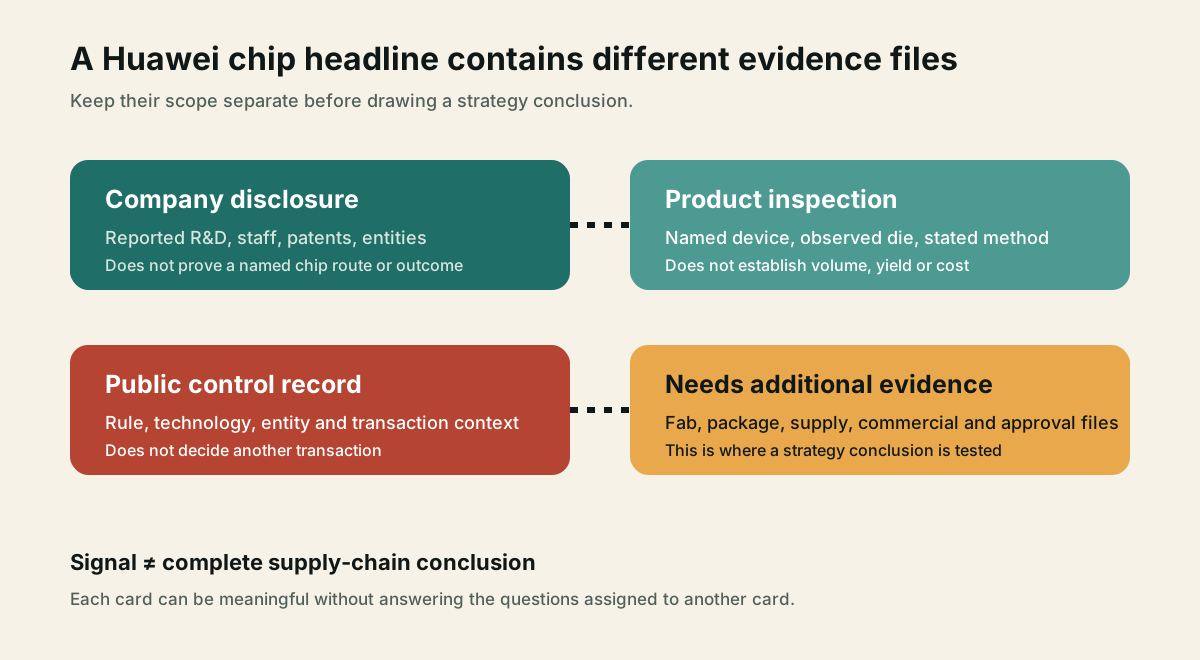
This separation can sound cautious to the point of being obvious. In practice, it changes the conclusion. Consider these four sentences:
- Huawei reports a large R&D organisation.
- A third party inspected one phone and reported a specific processor finding.
- A regulator has described a control mechanism involving foreign-produced items and listed Huawei entities.
- Huawei therefore has a complete, scalable, low-cost, legally unconstrained domestic chip stack.
The first three can each be sourced with a stated boundary. The fourth does not follow from them. It adds several missing premises: that the relevant design can be produced repeatedly; that the chosen process has suitable yield and throughput; that tools, materials and packaging are available at the required quality and cost; that the part is commercially viable in the intended product; that a transaction is allowed; and that the whole system can persist over time. Those are not pedantic details. They are the strategy.
For global readers, this distinction also keeps different decisions from contaminating one another. An investor might care about revenue, capital intensity, margins, product roadmap and competitive positioning. A smartphone buyer might care about device availability, operating-system support, carrier compatibility, security updates, repair, warranty and app ecosystem. A component buyer might care about a named part, qualification, lifecycle, allocation, traceability and service. A compliance team might care about classification, ownership, end use, end user and license status. They may all read the same Huawei headline, but they should not request the same file.
The article’s shorthand is therefore simple: company signal, device signal, control signal. A strategy reading begins where those signals meet. It goes wrong when one of them is allowed to impersonate the other two.
The company file: large R&D inputs are real, but they are inputs
The company file is where the Huawei story should begin, not end. Corporate research spending and research headcount matter because advanced hardware and software development requires long-lived technical organisations. A company that reports sustained research investment has more capacity to fund product programs, develop systems, support software, maintain component roadmaps, and absorb engineering iteration than a company without that base. But that is an inference about organisational input, not proof of a particular product outcome.
Huawei’s 2025 report makes the scale visible. It reports CNY 192.3 billion in R&D expense for the year. It reports 114,000 R&D employees, or 53.7% of its workforce, at the end of 2025. It also reports 165,000 active granted patents. These are useful figures precisely because their year and issuer are clear. They are Huawei’s own company-level disclosures, not an independent audit of a named Huawei chip.
Why preserve that wording? Because “R&D” is not a synonym for “semiconductor design.” Huawei operates across connectivity, computing, consumer products, cloud, digital power and other business domains. A consolidated research figure may support many kinds of work: system engineering, software, optical technologies, radio products, power electronics, quality systems, enterprise products, consumer hardware, research infrastructure and product support. The report does not turn the total into a budget for one Kirin program or establish how those resources were allocated among chip architecture, verification, physical design, firmware, tools, manufacturing support, packaging or test.
The same discipline applies to patent counts. A patent total can be a useful indication of formal intellectual-property activity across a diversified technology company. It is not a benchmark score. It does not identify which patents are essential to a specific product, commercially valuable, valid in every jurisdiction, implemented in a chip, licensed, or relevant to a foundry process. Patent portfolios, like R&D budgets, belong in the company file. They should not be used as a shortcut to device performance or semiconductor self-sufficiency.
Huawei’s report also lists HiSilicon Technologies Co., Limited among relevant subsidiaries. The name matters because a reader looking for “Huawei chips” may encounter Huawei as the consumer-facing corporate name, HiSilicon in chip-design discussion, a device brand in retail channels, and additional entities in regulatory or corporate documents. An entity list helps a reader avoid pretending that every name in a news story refers to the same legal or operating object.
It does not resolve the operational questions. A listed subsidiary name does not tell us what a given team designed in a given year, which IP or software it used, which process design kit it targeted, which manufacturing route was available, which chip entered a commercial device, or which entity was a party to a specific transaction. Those are all separate records. The useful conclusion is modest: the annual report supplies a corporate context and a naming anchor. It is not a parts list.
What a real company-to-chip chain would require
If the question is “Can Huawei design chips?”, a reader needs more than a company R&D total. At minimum, the design file would need to identify the product family, architecture or function; the responsible entity; a dated announcement, specification or official document; the design-tool and IP assumptions where relevant; the manufacturing target; the software and firmware relationship; and a way to distinguish announcement from shipped, supported product.
If the question is “Can Huawei obtain a chip for a particular product?”, the file changes. It needs a named device, the chip identifier, product configuration, production date, evidence of actual shipping or availability, the relevant supply relationship, qualification and lifecycle evidence, and any control or authorization review appropriate to the transaction. A corporate research metric is background. It cannot replace any of those facts.
If the question is “Has Huawei created an alternative to a named foreign component?”, the proof bar becomes still more specific. An alternative is not defined merely by physical presence in a device. It has to be compared on function, interface, performance under stated conditions, software support, power, thermal behavior, security, reliability, quality, availability, cost, service and the customer’s intended use. In a regulated or safety-sensitive product, qualification and traceability may be more important than a headline feature. The right comparison is a controlled product evaluation, not an inference from a corporate annual report.
This is not a demand for perfect information before discussing Huawei. Public analysis necessarily works with incomplete files. The point is to label the information by what it can establish. The R&D disclosure says: there is a large company-reported research base. It does not say: every necessary design, process, tool, material, packaging and commercial layer has been independently verified.
That distinction makes the company file more valuable, not less. It tells the reader where sustained technical capacity might come from while keeping them from assuming that all the other files have been solved.
The control field: access can be a transaction problem, not just a technology problem
Huawei’s chip story cannot be read only through engineering language because access to technology and manufactured items can be shaped by controls. The central lesson is not that every Huawei transaction has one outcome. It is that the answer can depend on a structured set of transaction facts.
The BIS public order cited above describes a Huawei-related change effective August 17, 2020. In the order’s account, BIS imposed a license requirement on certain foreign-produced direct products of specified U.S.-origin software and technology when a listed Huawei entity was a party to the transaction. The record is especially useful as an explanation of why “made outside the United States” is not, by itself, a complete answer to a control question. The conditions involve the item’s production relationship to specified technology or software and the role of a listed entity in the transaction.
That matters well beyond semiconductors. A component supply route can include design software, process equipment, manufacturing machinery, testing, firmware, logistics, financing, distributors, intermediaries and end users. A headline that says a part is “domestic” or “foreign-made” may hide the very facts that determine a control analysis. The relevant question is not usually “Which flag is on the factory?” It is “What exactly is the item, what rules apply at the relevant time, who are the parties, what is the end use and destination, and what authorization exists?”
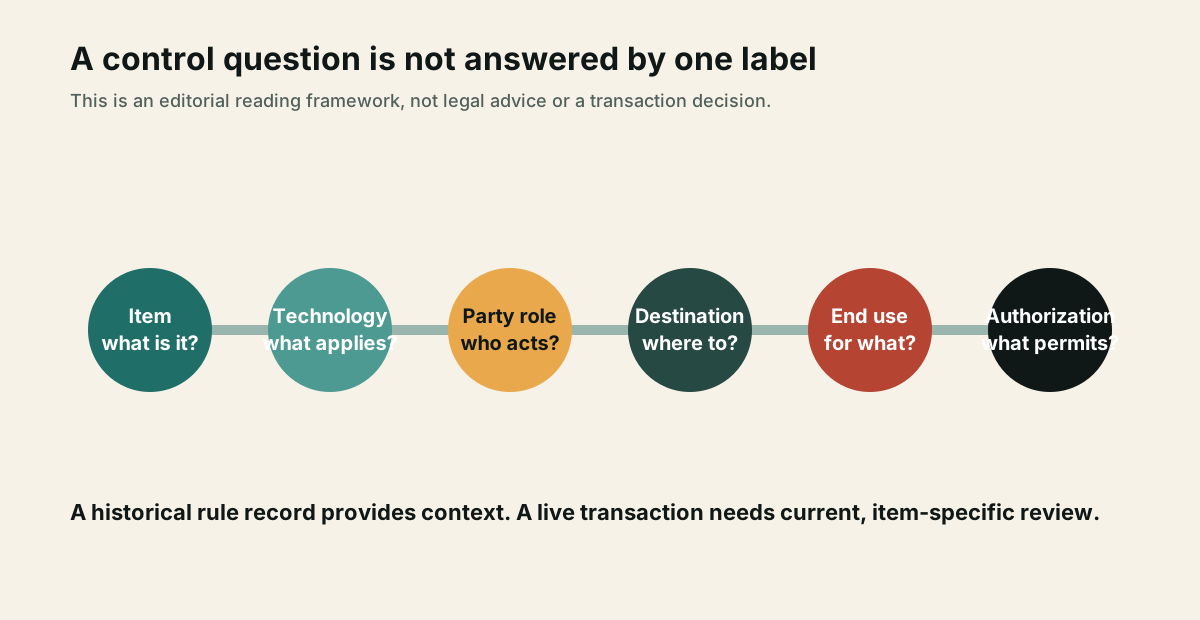
The order should nevertheless be used carefully. It is a public regulatory and enforcement record describing a particular historical rule context and transaction. It is not a current classification ruling. It is not a license. It is not a list of every Huawei entity or every controlled item today. It does not tell a reader whether a new product can be shipped, whether a supplier’s internal process fits the rule, whether an exception applies, or how an authority would decide a new case.
For an actual transaction, teams need current primary materials, the exact item classification, technical documentation, party screening, ownership information, end-use and end-user statements, destination data, contractual facts and qualified advice. The required depth will depend on the item and jurisdiction. A public article cannot substitute for that work. What it can do is stop a reader from treating the word “sanctions” as a sufficient description of the constraint.
Why controls alter the meaning of “strategy”
In an unconstrained supply environment, a chip strategy may be framed mainly as an architecture, product and cost problem. Under control pressure, engineering choices may also need to be read alongside access risk. That does not mean public observers can infer the company’s private supplier negotiations, tool choices or legal strategy. They cannot. It means the reader should expect the strategy to involve a wider decision space than a single chip spec.
For example, a product program can be affected by whether a design can be implemented on an available process; whether the process flow uses accessible tools and materials; whether packaging and test capacity fits the part; whether the operating system and application stack support the hardware; whether product qualification is complete; whether an item can move through a relevant transaction; and whether the final device works for the intended market. These conditions interact, but none can be assumed from another.
The correct mental model is a constraint field, not a binary switch. Controls may narrow paths, create delay, introduce licensing uncertainty, require alternative engineering, or make provenance and documentation more important. The severity is product-specific. A power-management chip, an RF component, a server accelerator, a smartphone application processor and a piece of manufacturing equipment can each raise different technical and regulatory questions. A broad Huawei label does not erase those distinctions.
This is also why the phrase “without TSMC” is too strong for an evidence-led title. It suggests a fully known before-and-after manufacturing relationship and a fully observed replacement path. The sources reviewed for this article do not establish such a narrative. They establish that Huawei reports a large R&D base, that a BIS record describes a significant control mechanism, and that TechInsights reported a specific finding in a specific 2023 device. The rest belongs in properly sourced, narrower files.
The device case: what the Mate 60 Pro teardown actually establishes
The Mate 60 Pro became an unusually important object in the public Huawei chip story because it offered something headlines usually lack: a physical product available for inspection. A device teardown cannot answer every strategic question, but it can move the discussion from conjecture to a specific, inspectable object.
TechInsights says it analyzed the Mate 60 Pro after receiving the phone at its Ottawa lab. Its report identifies a HiSilicon Kirin 9000s system-on-chip and says the die measured 107 mm², compared with 105 mm² for the Kirin 9000 cited in the report. It says that, from identifying features on the die, the firm concluded that the processor was manufactured by SMIC. It also reports that its initial laboratory results placed the die beyond SMIC’s 14nm process node but with critical dimensions larger than observations it had made for 5nm; additional measurements led it to describe the die as having 7nm features. These are the report’s findings and should be read as such, with the device boundary intact. The original TechInsights report is the appropriate source for the detail.
This result is meaningful for several reasons. First, it is independent of Huawei’s marketing copy. Second, it is specific about the product inspected. Third, it describes the basis for the analyst’s conclusion in terms of die features and critical-dimension observations rather than merely repeating a model name. Fourth, its technical comparison contains a limit: a “7nm” label does not mean the same thing as a blanket declaration of equivalence to every 7nm process or every current high-end product.
That last point is worth staying with. Process-node labels are convenient categories, but they are not universal performance scores. A product outcome depends on architecture, library choices, design implementation, IP, frequency, power, thermals, memory, package, software, modem or connectivity integration, manufacturing variation, test, binning and many other factors. A process label can be part of a technical description. It cannot tell a consumer which phone is better, tell a purchaser the reliable production cost, or tell an analyst the performance of a chip not measured in the report.
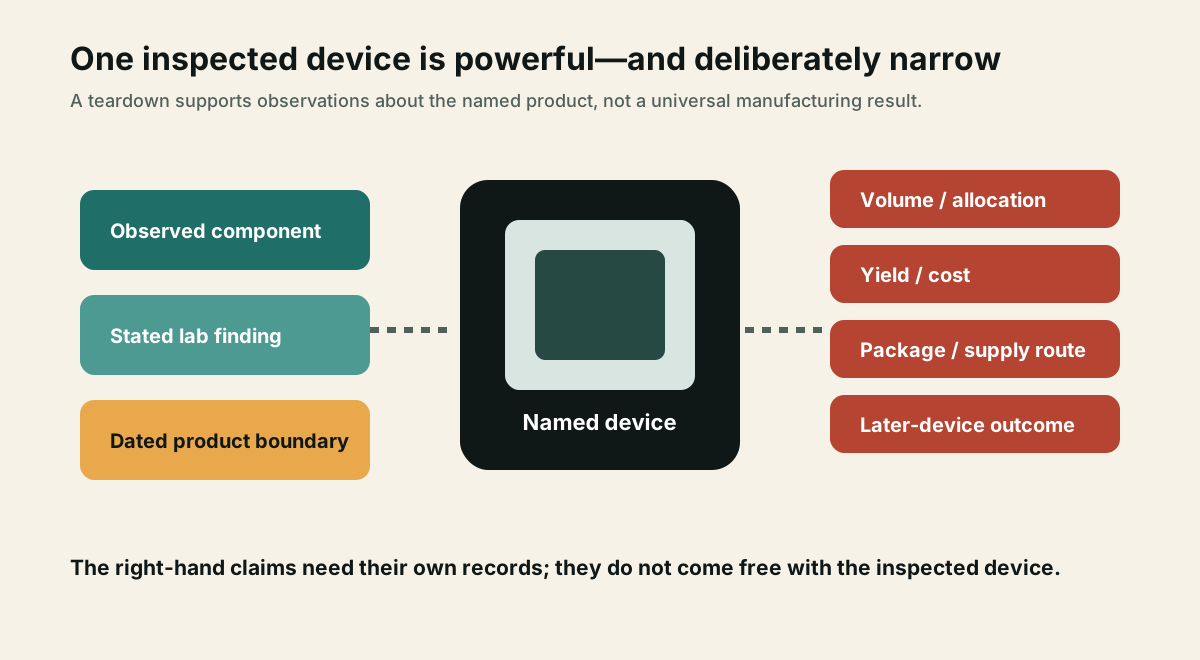
A teardown is a strong signal with a deliberately small denominator
The denominator for the TechInsights result is one inspected device. That is not a criticism; it is what makes the claim auditable. It tells us exactly what was inspected. But the narrow denominator means the report cannot settle several questions readers often attach to it.
It cannot establish volume. One phone shows that an inspected unit existed. It does not reveal wafer starts, die output, usable yield, shipped units, allocation, inventory, channel availability or the duration of a production run. A volume conclusion would need manufacturing records, shipment data, financial disclosures, channel evidence or another appropriate source.
It cannot establish yield. Yield is a relationship between input and usable output under a stated process and product context. It depends on defect density, process maturity, design characteristics, wafer economics, test, binning and many other details. A die can be technically impressive and still have a cost or yield profile unknown to outside observers. Conversely, a company can choose to ship a product under commercial conditions that are not visible from the die alone.
It cannot establish cost. Semiconductor cost is not simply a node label multiplied by a die area. It can involve mask count, cycle time, equipment utilization, materials, yield, packaging, test, logistics, volumes, contractual terms, overhead and the product’s required margins. Public discussion often treats technical feasibility and commercial feasibility as a single yes-or-no question. They are related but distinct.
It cannot establish a complete supplier list. A system-on-chip sits in a device alongside memory, power management, RF components, displays, cameras, sensors, storage, batteries, mechanical components, software, cloud services and manufacturing processes. Even a detailed teardown must be read for exactly which component it identifies and which it does not. A conclusion about every part of a phone or every layer of a national supply system would need additional inspection and provenance evidence.
It cannot establish later products. A later device may use a different chip, configuration, process variant, package, memory, modem, software stack or supplier set. A good reader resists both directions of extrapolation: one Mate 60 Pro does not prove that every later Huawei phone repeats the same path, and it does not prove that no later product can change it. The correct response is to obtain a later-device record.
This is how the Mate 60 Pro case becomes more than a news event. It is a model for how to handle concrete technical evidence. State the device. State the analyst. State the method at the level disclosed. State the conclusion. Then state the questions the test was not designed to answer.
The missing middle: manufacturing, packaging, supply and commercial proof
Public narratives frequently leap from a design name to a finished phone. The leap hides the middle: the long chain of choices and conditions that turns a design into a supported commercial product. That middle is where claims about a “rebuilt supply chain” become hardest to prove.
Consider the fab file. To understand whether a design can be manufactured repeatedly, a reader would ideally need process documentation, a dated manufacturing target, product-specific design rules, wafer-start or output context, yield information, test and binning evidence, throughput, lead time, capacity allocation and a definition of what counts as production. Most of that information is commercially sensitive and not public. The absence of public data does not prove failure. It does mean that outside analysts should not convert a product teardown into a production-scale claim.
Consider tools and materials. A process flow is not a single machine. It involves a sequence of lithography, deposition, etch, metrology, cleaning, inspection, process-control and other steps, together with chemicals, gases, wafers, photoresists, masks and specialist services. The relevant question is not whether one category exists in China. It is whether the required item is qualified for the specified process, at the required quality, cost, reliability, quantity and delivery schedule. A national or company-level category statement is not a product-specific qualification record.
Consider packaging and test. A chip can be designed and fabricated but still face constraints at assembly, package substrate, interconnect, thermal management, test, reliability screening, binning, module integration and final-device manufacturing. The package may affect performance, power, durability and system design. A claim about “packaging innovation” requires a named package, technical documentation or inspection evidence, and a clear explanation of what feature is being claimed. The sources reviewed here do not provide that evidence for Huawei’s strategy, so this article does not make that claim.
Consider software and system integration. A smartphone application processor is not valuable in isolation. It interacts with operating system, drivers, security, modem or radio subsystems, memory, storage, cameras, display, battery management, application compatibility, developer tools, updates and service. Huawei may have relevant system capabilities, but a buyer or operator looking at a particular device still needs product-specific information. A chip finding does not settle app availability, regional network behavior, security-maintenance policy, repair support or device lifecycle.
Consider commercial evidence. A product can exist without being broadly available, profitable, repeatable or suitable for a particular customer. Commercial proof may include announced configurations, price, channel availability, returns, warranty terms, service network, repair parts, production dates, lead times, customer qualifications, revenue disclosure and field performance. Each has a different source and limitation. None is supplied by an R&D figure, a node discussion or a control headline alone.
The distinction between these files is familiar to hardware people because the real work is always interdependent. A product can be blocked by a small component, a package choice, a test bottleneck, a software issue, a supply allocation, a certification problem, a distributor record or a regulatory fact. The challenge for public writing is to preserve that complexity without inventing a hidden map. The useful sentence is often not “Huawei has solved the stack” or “Huawei has not solved the stack.” It is: which layer has public evidence, and which layer remains an evidence request?
For foundry-specific context, the published SMIC guide is helpful because it keeps technical feasibility, yield, throughput, cost and product outcome apart. It should not be read as proof of a Huawei contract, a current production route, a device-specific bill of materials or an authorized transaction. It shows why the foundry file must stay a foundry file.
A practical diligence file for Huawei chip claims
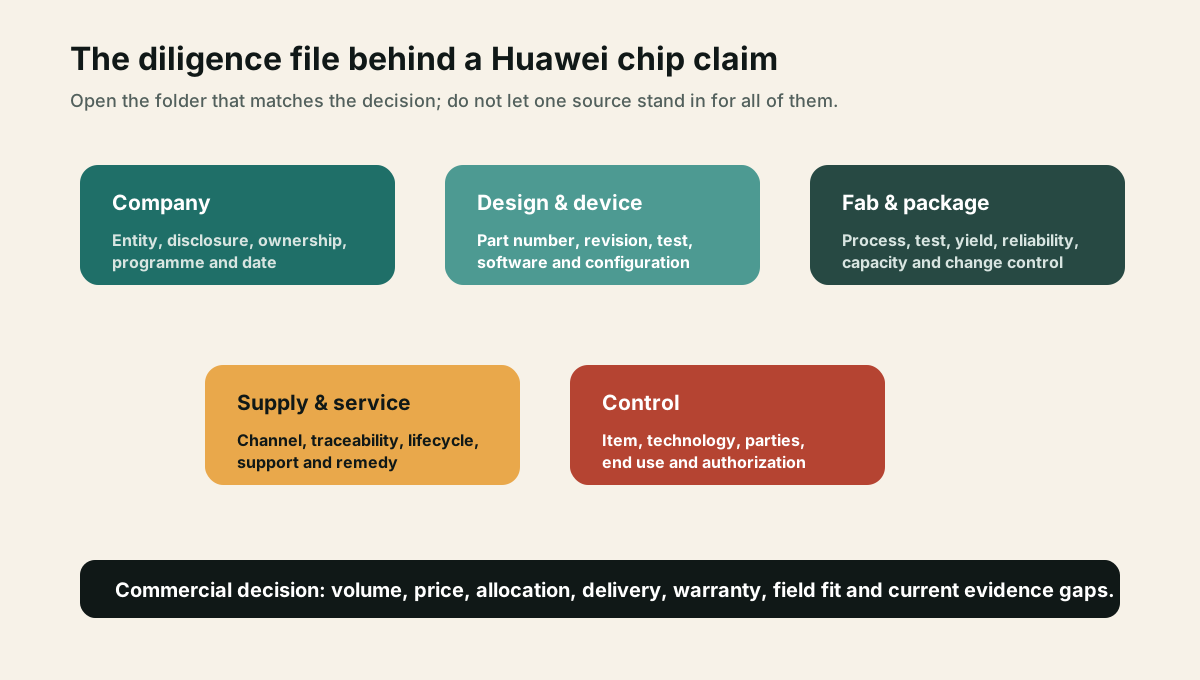
The best way to use this story is not to memorize a verdict. It is to build a request list matched to the decision. The following questions are deliberately more useful than “Is Huawei self-sufficient?” because each one can be paired with a record.
1. Identify the object precisely
Start with the exact object: company entity, device model, variant, chip identifier, package, production date, software version, destination and intended use. “A Huawei chip” is too broad. A Kirin name may describe a family, a device may have market-specific configurations, and an article may refer to a company, a subsidiary, a retail brand or a listed entity with different roles. Precision at this stage reduces every later error.
For a consumer device, ask for the model number, regional version, memory and storage configuration, radio bands, operating-system version, warranty jurisdiction and service channel. For a component, ask for the part number, revision, package, data sheet, lifecycle status, qualification evidence, firmware requirement, approved distributor and traceability information. For an enterprise product, add security documentation, support terms, maintenance windows, integration requirements and data-handling implications.
2. Separate design evidence from manufacturing evidence
Design evidence can include an official product specification, an architecture description, a verified chip identifier, software support, SDK documentation, a dated engineering announcement or a reliable physical inspection. Manufacturing evidence needs different documents: process documentation where available, a foundry or supplier statement, a date, a production record, a qualification report, capacity or lead-time information, and enough detail to understand what is being claimed.
The absence of public manufacturing data is common in semiconductors. Do not replace it with a confident story. Mark it as unavailable. If a decision needs it, obtain it through the appropriate commercial, contractual or diligence route. If it cannot be obtained, narrow the decision rather than raising the confidence of the narrative.
3. Test the product, not the adjective
Words such as “advanced,” “domestic,” “secure,” “independent,” “next generation” and “sanctions-proof” are not specifications. Replace them with tests. What function does the device or component perform? Under which workload, software release, network, temperature, power and configuration? What third-party test or customer acceptance record is available? How does the device behave over the intended lifecycle? Which claims are verified externally, and which are supplier statements?
The Mate 60 Pro example shows why this helps. TechInsights reported a defined observation about an inspected processor. That is much stronger than an adjective. At the same time, it is not an all-purpose product score. The more tightly the question is defined, the more useful the evidence becomes.
4. Build the supply and service file separately
For procurement, a working sample is the beginning, not the end. Ask who supplies the part or device, through which authorized channel, with what traceability, lead time, warranty, repair path, spare parts, firmware support and change-notice process. Identify single points of failure: a unique component, a specialist test house, a package substrate, a software service, a distributor, a repair location or a regulator.
For a Huawei-branded finished device, this may mean asking about regional availability, carrier or network compatibility, app ecosystem, update policy, warranty jurisdiction, repair logistics and data-policy implications. For an embedded Huawei-related component, it may mean asking about quality qualification, lifecycle management, support ownership, documentation access and alternative sourcing. None of these questions can be answered from a corporate R&D spend or a device-node headline.
5. Treat control review as a gated workstream
If a decision involves cross-border movement, controlled technology, a listed entity, sensitive end use or a restricted destination, keep control review separate from the commercial enthusiasm for the product. Capture the item and technical data, parties and beneficial ownership, origin and production facts, destination, end use, end user, relevant rules at the transaction date, contractual commitments and any authorization. Escalate to qualified compliance or legal professionals where needed.
This does not mean every reader must become an export-control specialist. It means no reader should use a general article as a license determination. The 2020 BIS record demonstrates why transaction elements can matter. A current decision requires current, item-specific review.
6. Record what you do not know
The final tab in a good diligence file is a gap register. List missing volume data, yield data, cost data, supplier data, test data, support data, end-use facts or legal determinations. Give each gap an owner, a date and a decision consequence. If the missing fact would change the decision, it is not a footnote. It is a stop condition or a risk to be priced.
This discipline is especially valuable in geopolitical technology stories because the public conversation rewards certainty. A company may reasonably keep technical and commercial details confidential. An outside reader may have to proceed with uncertainty. The responsible move is to distinguish “unknown” from “solved” and from “impossible.”
Huawei is a system story, but systems still need component-level proof
Huawei’s relevance is not limited to one processor or one phone. The company participates in products and systems that join hardware, software, networks, cloud services, power, devices and channel support. That makes a purely chip-centric reading incomplete. A component may be technically capable but unsupported by the needed software. A device may have a compelling system design but lack service in a particular market. A supply route may work for one product category and fail for another. A control question may turn on an entity role invisible in consumer marketing.
For that reason, the phrase “design-to-device stack” is more useful than “chip stack.” It asks the reader to look at the connected path: corporate capability and design; manufacturing access; package and test; device integration; software; channel; customer use; service; and control exposure. But it does not assume the chain is complete. It is a checklist of where evidence has to live.
The broader Chinese manufacturing context can help explain why product ecosystems matter, which is the subject of the published China manufacturing guide. It is background, not semiconductor provenance. Manufacturing depth in a region does not establish that a particular chip, tool, material, package or transaction meets a particular technical or regulatory requirement.
This is also the difference between a strategic signal and a strategic conclusion. The Huawei annual report is a signal about reported company resources. The BIS record is a signal about the kind of constraint field that can surround a transaction. The TechInsights report is a signal about one independently inspected device. A strategic conclusion requires the next layer: current product and market facts, manufacturing evidence, commercial evidence and a decision-specific control analysis.
Readers sometimes hear such caveats as an attempt to deny the significance of the Mate 60 Pro finding. The opposite is true. A bounded claim is more durable. Saying that an independent analyst reported a specific technical observation in a named 2023 device is clear, meaningful and checkable. Saying that the same event proves every hidden part of a national or corporate supply system is rhetorically bigger but analytically weaker.
The questions that should survive the next headline
New Huawei devices, chip names, policy actions and teardown reports will continue to generate confident claims. The questions below help a reader preserve the useful part of each update.
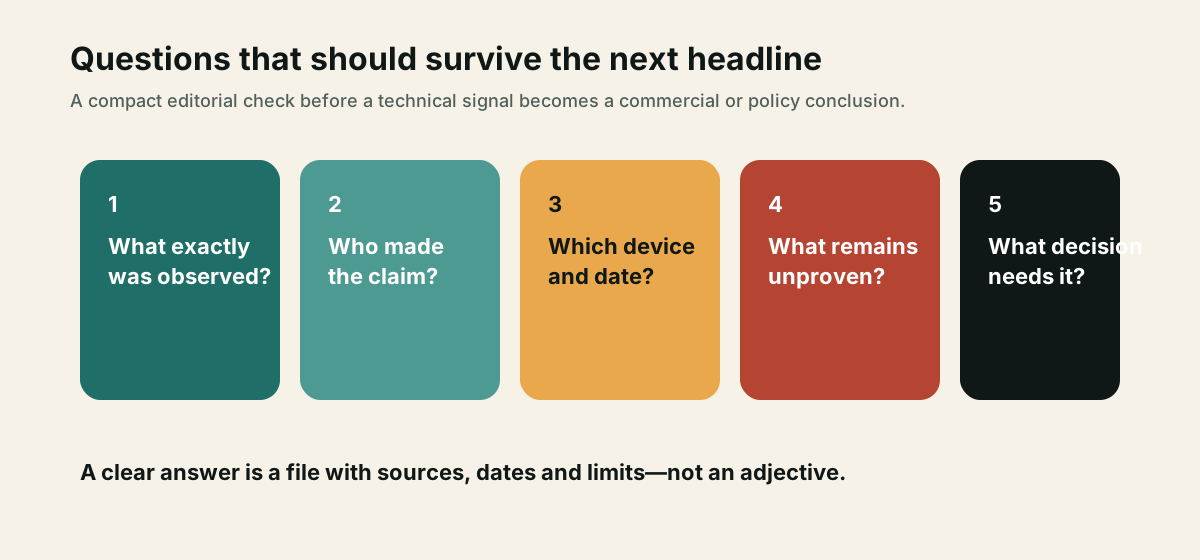
When a company reports a figure, ask: Is it a company input, a product result, or a commercial outcome? What exactly is the denominator? Which business domains does it cover? Does a third party verify the specific feature being discussed?
When a product appears, ask: Which exact model and configuration was observed? Who inspected it? What component was identified? What method was disclosed? Which conclusion belongs to that component, and which claims—volume, yield, cost, supplier continuity, performance, service—remain outside the observation?
When a control action is mentioned, ask: Which rule version, item, technology, party role, end use, end user, destination and authorization are relevant? Is the speaker describing a historical rule, a current guidance document, an enforcement record, or a transaction-specific decision? Has anyone actually performed the review required for the proposed action?
When someone says “domestic supply chain,” ask: Domestic in what sense? Design ownership? Wafer fabrication location? Tool origin? Material origin? Packaging and test? Device assembly? Corporate control? Service? No one label carries all of those meanings. A useful answer names the relevant layer and the evidence behind it.
When someone says “mass production,” ask: What record establishes volume, yield, lead time, allocation, price and sustained availability? A physical device is evidence that a device exists. It is not, by itself, a manufacturing scale study.
When someone says “equivalent,” ask: Equivalent for which job? Architecture, performance, power, software, security, reliability, qualification, lifecycle, cost, interface, repair or regulatory exposure can each matter. The answer may be different for a consumer phone, a telecom system, a vehicle controller, an industrial device or a server.
These questions are deliberately reusable. They work whether the next claim is optimistic, skeptical, domestic, foreign, technical, commercial or political. Their purpose is to move the discussion from identity labels to evidence categories.
Method and limitations
This is a desk-research article. It draws on Huawei’s 2025 annual report for company-reported R&D indicators and entity information; a BIS public order for a description of the Huawei-related foreign-produced direct product rule context; and TechInsights’ 2023 report for a device-specific Mate 60 Pro finding. The article team did not perform a device teardown, visit a fab, audit a supplier, inspect a design database, review a bill of materials, obtain a foundry contract, measure yield, analyze a transaction or provide legal advice.
The article therefore does not claim to establish Huawei’s current wafer volume, yield, package route, unit cost, supplier list, domestic-content rate, later-device characteristics, future roadmap, product performance ranking or the eligibility of a particular transaction. Those are not minor omissions. They are separate questions that need source-appropriate evidence.
The practical conclusion is simple. Huawei’s chip strategy is neither a mystery to be filled with speculation nor a single fact to be treated as complete. Read the company disclosure as a company disclosure. Read the control record as control context. Read the teardown as a test of one device. Then request the fab, supply, commercial and transaction files that the decision actually needs.
Related reading
- SMIC Explained: China's Chipmaking Limits (2026) — published foundry-specific context; it does not prove a Huawei sourcing relationship or an authorized transaction.
- How China Manufactures: Inside the World's Factory (2026) — published manufacturing-system background; it does not establish a chip’s provenance, process capability or supply-chain completeness.