
By China Made & Tech Team — a desk-research explanation of a Chinese hardware-manufacturing system.
An online hardware order can look deceptively simple: upload files, receive a quote, choose services, and wait for a shipment. The physical work behind it is not simple. A board design still needs engineering review; components must be available and compatible; fabrication and assembly have process limits; test and logistics still create distinct gates.
That is why JLCPCB is better understood as a coordination interface than as a magical single factory. The company connects several manufacturing services through one digital path. That changes the friction of quoting, data handoff, pooled orders, production routing and repeat ordering. It does not eliminate the physical conditions that determine whether a particular product can be built as intended.
JLC’s own platform description says it pools small orders and moves quotation, review, production and logistics online; its delivery-time definition makes clear that the production interval has stated conditions and excludes courier transit.
A public-company record for a multi-service system
Shenzhen JLC Technology Group listed on the Shenzhen Stock Exchange Main Board on 4 August 2026 under stock code 001232, according to its listing announcement. Its 2026 interim report describes an electronics and mechanical industrial-internet business rather than a PCB-only company.
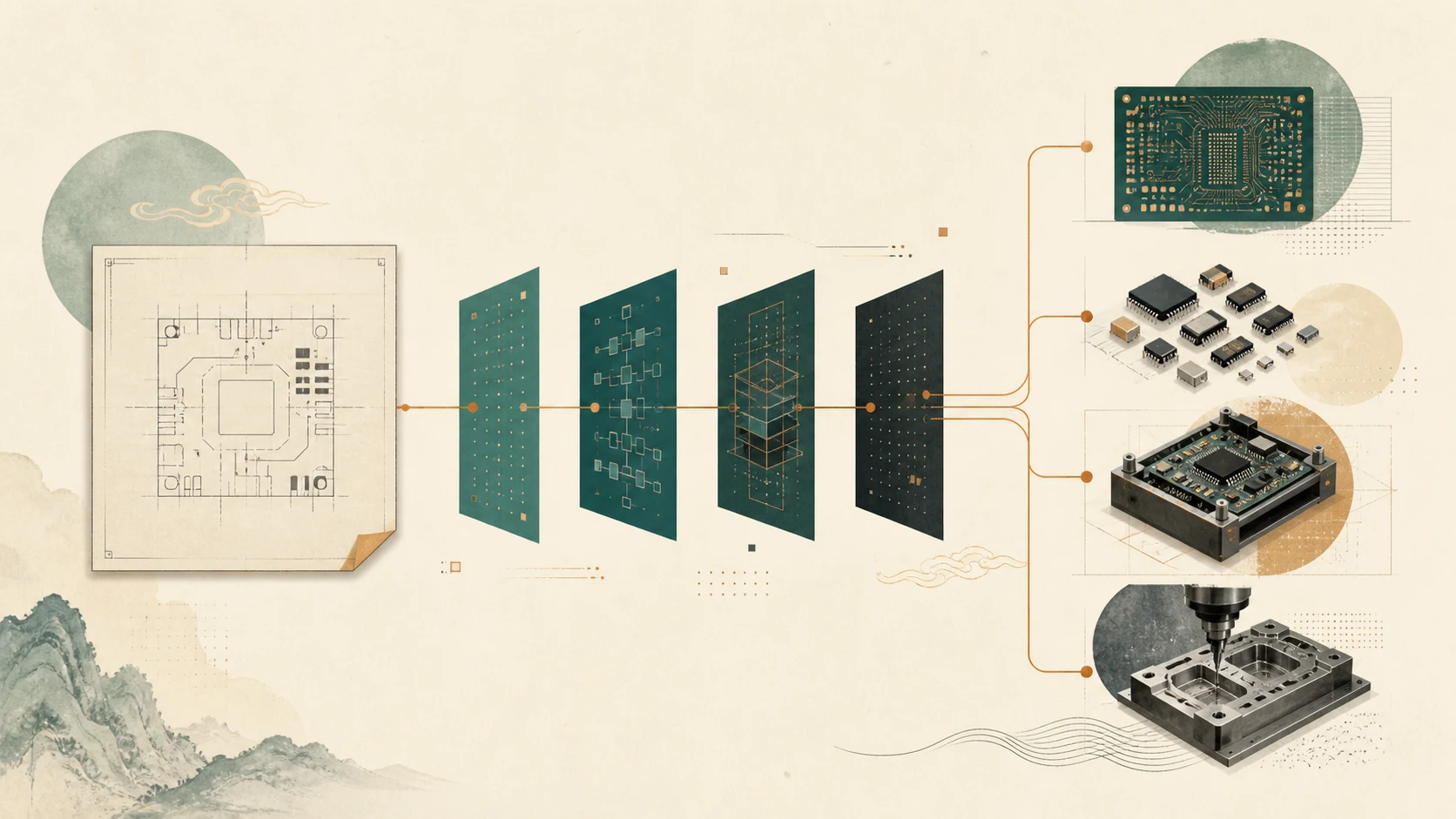
The service list is the important part. The report names PCB fabrication, electronic components, PCBA, EDA/CAM, stencils, 3D printing, CNC and FA parts. That mix reflects a common hardware-development reality: a useful manufacturing interface spans more than one physical process, even when the starting point is a PCB file.
For the larger ecosystem behind those services, see China’s manufacturing guide. JLC’s Shenzhen origin also sits inside the Shenzhen manufacturing guide.
What the online layer coordinates
JLC says its platform pools small orders and moves quotation, review, production and logistics online across connected services. The interface can standardize repeated handoffs: a design file can carry configuration information into a quote; an order can be grouped with similar work; and a team can traverse related fabrication, component, assembly and mechanical services without restarting the administrative process each time.
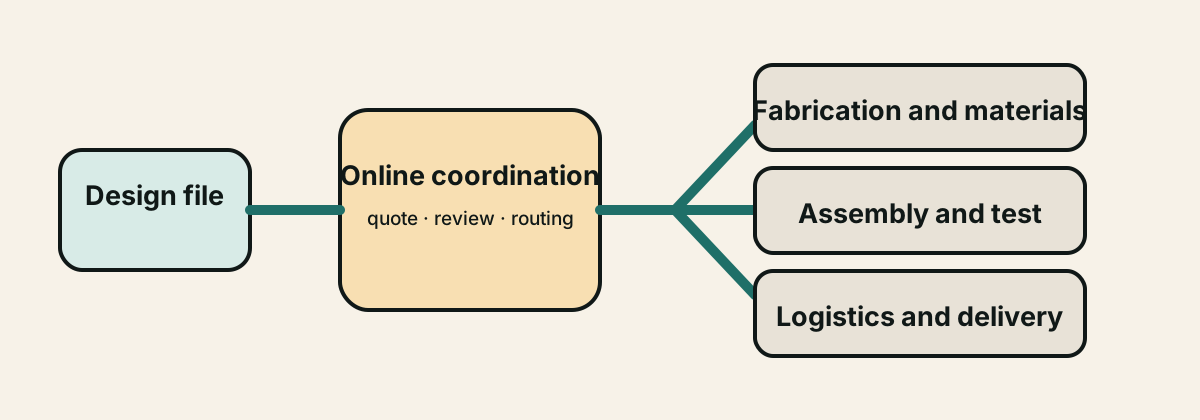
The online layer can reduce handoff friction. Each physical gate still has its own acceptance conditions.
The interim report adds a useful constraint. It describes fixed setup costs, frequent production changeovers and material utilization as problems that its production system addresses with an AI panelization approach. Digital coordination sits on top of manufacturing economics and process physics; it does not make them disappear.
That point explains why the interface is valuable without making it mystical. Small hardware orders can have disproportionate administrative and engineering overhead. A conventional factory may need the same basic questions answered whether an order is one board or many: what is the specification, are the files usable, which materials and processes apply, which operations are required, and when can the work enter a schedule? An online system can make recurring answers machine-readable and easier to route. It can also make the status of an order easier to expose to the customer.
But standardizing the handoff is not the same as standardizing the product. A PCB is still an electrical and mechanical object with a specified stack-up, dimensions, copper features, surface finish and fabrication rules. An assembly is still a combination of a bill of materials, footprint data, placement, soldering, inspection and test. The next service in the path inherits the conditions of the previous one. The interface can reduce ambiguity; it cannot make an ambiguous or unvalidated design unambiguous.
The connected-service model, step by step
The service list in the interim report is best read as a set of adjacent handoffs. PCB fabrication creates a substrate for electronics. Components and PCBA connect the fabricated board to sourcing and assembly. EDA/CAM is closer to the design-data and manufacturing-data transition. Stencils sit inside an assembly workflow. 3D printing, CNC and FA parts extend the interface toward enclosures, fixtures, prototypes and mechanical supporting parts.
This does not mean every project should use every service, or that every service is operated under identical conditions. It means the company’s public description presents a common entry point for several tasks that often appear together in a hardware iteration. A prototype team can move from design files to a board, from a board to populated electronics, and from electronics to a mechanical context without treating each stage as an unrelated administrative search.
The benefit is coordination across repeated transitions. Design data can be associated with a manufacturing configuration. A quote can become an order without manually recreating every field. An order history can make a revision easier to identify. A connected catalog can make component selection visible in the same general workflow. These are operating conveniences, not evidence that a particular component is suitable, that an assembly will pass a test, or that the final product will be ready for scale production.
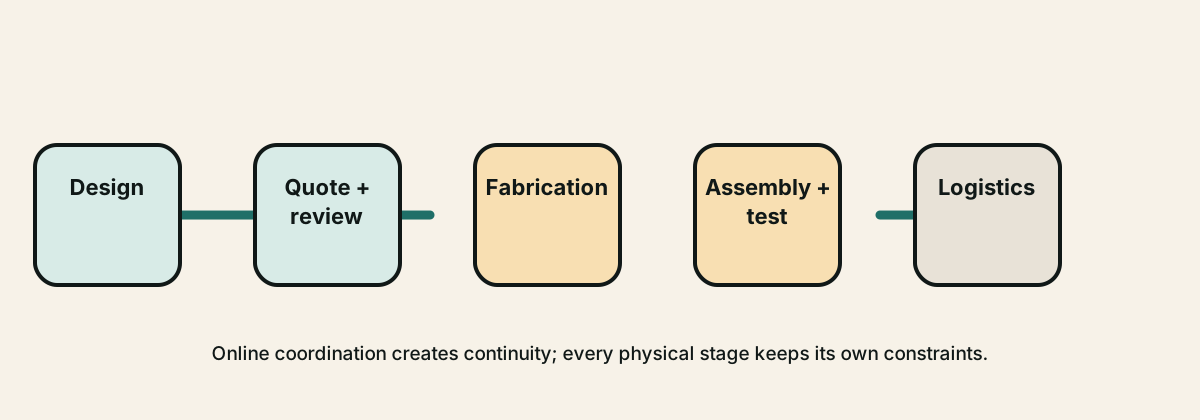
An online interface connects the handoffs; it does not collapse the technical checks inside them.
Where the physical gates reappear
The first gate is design-for-manufacture. A fabricator needs a file that matches its process parameters; an assembler needs placements, component data and production information that can be interpreted consistently. The second gate is supply and configuration: a bill of materials must be available, compatible with the intended assembly, and handled according to the order’s stated rules. Neither gate disappears because a team can upload a file quickly.
The third gate is production execution. Panelization, changeovers, material utilization, inspection and process control are all physical operations. The interim report’s discussion of cost and production constraints is useful here because it prevents a false picture in which the website is the manufacturing system. The website is an interface into a manufacturing system; the physical process remains responsible for the physical result.
The fourth gate is verification and delivery. A design may need electrical test, functional test, cosmetic inspection, packaging or documentation suited to its intended use. After production comes a delivery path with its own customs, courier and destination conditions. A company can state how it defines a production lead-time category, as JLC does, while the final arrival time and suitability of the item remain separate questions.
What a platform changes in a hardware workflow
For a hardware team, the most concrete change is the sequence of handoffs. Rather than separately negotiating routine steps with several providers, an online interface can expose common configuration choices and connect data, quote, review, order and fulfillment states. That can matter for repeatable, small or changing work where transaction overhead is a large share of the effort.
But the interface is not the thing being manufactured. A design still has tolerances and stack-up requirements; components still have lifecycle, substitution and placement implications; an assembly still needs its own process and test plan; a mechanical part still depends on a material and machine process. These are not failures of the online model. They are the enduring facts of physical production.
The company reported RMB7.173 billion in revenue and RMB1.030 billion in net profit for the first half of 2026 in its interim report. Those figures provide a dated sense of reported company scale. They do not predict the lead time, cost, quality or engineering suitability of another team’s order.
Why turnaround and capability pages need conditions
The company’s PCB delivery-time page is explicit about its definition: its stated production categories run from paid scheduling through factory completion and packaging, and courier transit is outside that interval. It presents conditional 12-, 24-, 48- and 72-hour categories rather than one universal promise.
Likewise, the technology-capability page presents PCB options as process parameters. A capabilities table is a starting condition for a review, not an engineering approval for an unexamined design. The exact board configuration, materials, file quality, volume, component status, test needs and destination all still matter.
Reading these pages as conditions rather than promises is not a cynical interpretation. It is the most practical one. The published categories tell a reader which order attributes need attention. They also identify which questions a project still has to answer before it can interpret a quote or schedule: what exact process is needed, when is the file complete, how will the order be reviewed, which components are constrained, and what delivery definition is relevant?
An online manufacturing interface can make those questions easier to submit and track. It cannot answer them correctly without project-specific information. That is why the final evidence for a hardware decision should be the scoped quote, engineering review, order confirmation, test plan and delivery terms for that decision—not a generic platform page or a reported company financial number.
Why pooling matters for hardware work
The phrase “pooling small orders” can sound like a marketing slogan until it is placed next to manufacturing’s fixed work. Production lines and engineering teams incur setup, scheduling, materials-handling and changeover work before a particular board or part reaches volume. A platform that can group compatible work and make its input data more consistent has a reason to exist even when it never promises that every project is simple.
For a hardware team, this can change the economics of iteration. A smaller order can become less burdensome to place when the administrative path is standardized and a service has familiar input formats. That may shorten the cycle between a revised design and the information needed to decide on the next revision. It does not remove the cost of a bad revision, an unavailable part, an unsuitable stack-up or a missing test requirement. The iteration is still a physical learning loop.
Pooling also creates a reason to be precise about which claims are company-level and which are order-level. The company can describe a system designed to receive many orders. A reader can observe reported group revenue. But a team with one particular product still needs to establish whether its file, quantity, components, assembly instructions, test requirements and destination fit the conditions of the relevant service. The platform’s scale may make the interface more consequential; it does not make that project-specific work optional.
The difference between a quote and a manufacturing decision
A quote is a useful checkpoint, not the end of the engineering process. It expresses a set of assumptions: which process, options, materials, quantity and schedule are being considered. If any of those assumptions change, the quote may no longer describe the same manufactured object. This is why a link between design data and quoting is valuable, but also why teams should keep track of the revision that was actually reviewed.
An engineering review adds another layer. It can find a file-format issue, a feature outside a stated capability, a component mismatch, a missing placement detail or a question about how the product will be tested. Such a review is not an inconvenience added after the interface; it is evidence that the interface is carrying a real manufacturing question from digital data toward physical execution.
The final decision also involves commercial and operational conditions outside fabrication. A project may care about alternate components, traceability, programming, inspection records, packaging, customs paperwork or delivery sequence. Some of these may be relevant only for a particular sector or product. The right conclusion from an integrated online system is therefore not that every decision has been centralized. It is that some recurring handoffs are connected well enough to make their remaining exceptions easier to identify.
How to read the company’s reported scale
The 2026 first-half figures provide a useful denominator for the article’s claims. JLC reported a large and growing business across the period covered by the interim report. That helps explain why the company’s interface and service mix are worth examining as a manufacturing system rather than only as a website. It does not establish the current status of every capacity, product line or service condition after the report date, and it says nothing by itself about another company’s bill of materials or delivery performance.
Reported scale and a specific order should remain in different mental boxes. Scale can suggest that the company has built a repeatable channel for a wide class of work. A specific order needs its own evidence trail from file to quote, review, production, test and delivery. Keeping both boxes in view is the most accurate way to understand why an online interface can be genuinely useful while still requiring ordinary manufacturing discipline.
This frame also explains why the company can be relevant to global hardware teams without the article making a supplier recommendation. A shared online interface can lower the coordination cost of reaching Chinese manufacturing services and can make the path across adjacent operations more legible. Whether it is the right path for a particular product remains a separate decision, with its own engineering, commercial, compliance and delivery evidence.
The durable value of JLC’s model is not that it makes hardware easy. It makes some of the recurring boundaries in hardware work easier to traverse. The physical boundaries remain, and they are exactly where a responsible team should concentrate its project-specific validation.
The practical reading frame
Use JLC’s public record to understand a Chinese manufacturing system that brings multiple hardware services behind an online interface. Use its company pages to understand the conditions it currently advertises. Then keep the final decision at the level where evidence belongs: the actual design, bill of materials, process, review, test, schedule and logistics route.
That framing identifies the real value of the interface—less friction across recurring handoffs—without converting the interface into a universal guarantee.
It is a useful distinction for any platform whose digital surface is easier to see than the physical chain behind it. The screen can simplify coordination, but the product is still made, checked and delivered in the real world.
The same frame makes later changes easy to assess: new services, terms or capacities may change the interface, while each order still requires its own check at the relevant physical gate.
That is manufacturing’s unavoidable and useful reality.
Method and limitations
This is desk research by China Made & Tech Team using Shenzhen Stock Exchange disclosures and current JLC pages accessed on 2 September 2026. We did not place an order, audit a factory, test a board or assembly, or verify a customer delivery result. Financial figures are issuer-reported and period-specific. JLC’s service, delivery and capability statements are attributed company descriptions, not independent proof that any particular design or order will meet a stated outcome.