
By China Made & Tech Team.
SHEIN is often explained with one compact story: software notices a trend, a tightly connected supply base makes a small run, demand data triggers replenishment, and a global logistics system gets the product to a shopper. It is a memorable story. It is also too small to answer most of the questions that a buyer, seller, supplier, policymaker or analyst actually has.
The first issue is evidence. The public record contains several different kinds of documents. In a current environmental-policy document, SHEIN says it begins with small initial batches and aligns subsequent production with customer demand to reduce excess inventory. In a 2026 supplier announcement, it reports spending and factory-program figures. In a 2025 Wroclaw announcement, it describes a European logistics hub and seller support. European authorities, meanwhile, publish status and procedure records that concern the platform rather than its marketing narrative. A UK authority has also published a product-safety action on one named item sold through the platform.
None of those documents is interchangeable. A company policy can describe the method a company says it uses. It cannot, by itself, establish the inventory level, waste outcome, factory conditions, product quality or delivery outcome for every item. A supplier-program announcement can show the company’s stated investment and reach. It is not a factory-by-factory audit. A logistics-hub announcement can identify a stated facility role. It is not a parcel’s carrier scan or a delivery guarantee. A regulator’s designation or procedure can establish a particular legal status; it is not an overall grade for all sellers and goods.
The useful conclusion is narrower and more practical: SHEIN’s public materials can help a reader map the company’s stated platform model. They cannot replace the separate factory, seller, product, order, shipment, return and jurisdiction records needed for a real transaction or compliance question.
This is a desk-research guide, not a shopping review, factory audit, garment test, delivery trial, sourcing report or legal opinion. It reads company-owned documents as company disclosures, European Commission materials as procedural records, and a UK product action as a named-item record. It does not determine whether a particular item is suitable to buy, whether a factory meets a reader’s requirements, whether a seller will perform, or what rule applies in a specific destination.
The four files hidden inside the platform story
The most common mistake in reading a global marketplace is to make the platform name do every job. Someone says “SHEIN is on-demand,” then assumes the actual garment has a known production history. Someone sees a supplier-program number, then assumes a particular factory has been checked. Someone hears about a European warehouse, then assumes the order will arrive from there. Someone sees a regulatory headline, then turns a procedural action into a final conclusion about every product.
Those jumps are understandable. A digital storefront makes many relationships appear as one surface: the recommendation feed, product photo, price, checkout, delivery promise and returns page sit in a single interface. The work behind that screen is not necessarily singular. It can involve a platform operator, a seller, a manufacturer, a fabric or trim supplier, a fulfillment entity, a carrier, a payment provider, an importer or economic operator, and a consumer-law regime. Each party can have a different location, contract and document trail.
| Reader question | First file to open | What the file can establish | What it cannot establish alone |
|---|---|---|---|
| “What model does SHEIN say it uses?” | Current company policy or formal disclosure | The company’s description of production, platform or demand practices | A verified result for every inventory unit, factory or item |
| “What does the supplier program cover?” | The company’s dated program announcement | The reported investment, initiative and stated reach | Conditions, product quality or compliance at a particular facility |
| “What does the European hub mean?” | The company’s facility announcement and order records | The role the company says the hub plays | Carrier, route, delivery time, return outcome or applicable stock for one order |
| “What is the platform’s current EU status?” | The authority’s designation, notice or procedure page | A stated legal or procedural status at a date | A final finding, product-quality rate or platform-wide safety conclusion |
| “Can I rely on this garment or seller?” | The exact seller, product, order, shipping and jurisdiction records | Facts about the object if the documents are available | A universal answer from the platform’s brand or app interface |
That discipline matters especially in fashion. “The product” may not be one static thing. Size, color, fabric composition, trim, labelling, seller entity, warehouse location, order date and destination can all alter what a buyer is actually receiving and which document is relevant. Even two listings with nearly identical photos can carry different sellers, stock locations, measurements or terms. The title of a platform article cannot resolve those differences.
A platform is a coordination layer, not an item certificate
It can be tempting to describe a marketplace as though it either owns every commercial step or has no role at all. Both frames miss the operational middle. A platform can set rules, operate recommendation tools, coordinate seller access, provide merchant software, handle marketing, shape listing requirements, offer payments or logistics services, and build warehouses. Yet that does not make the platform the manufacturer of every item or the party that can certify every fact about an item.
The same point applies in reverse. A seller or factory appearing on a platform does not mean the operator is irrelevant. Interface design, enforcement systems, data flows, merchant terms and logistics arrangements may materially shape how a listing reaches a customer. But a company-level platform role does not automatically identify the exact legal seller, factory or responsible economic operator for a given transaction.
For readers who are comparing marketplace models, How Temu Works: Business Model and Tariff Risk provides a published file on another global shopping platform. The value of comparing models is not to decide which app is categorically better. It is to recognize that different commercial configurations call for different checks. For broader context on industrial systems in China, How China Manufactures: Inside the World's Factory (2026) is useful background; it does not identify the producer behind an individual garment or marketplace listing.
The model file: a stated production method is not an outcome
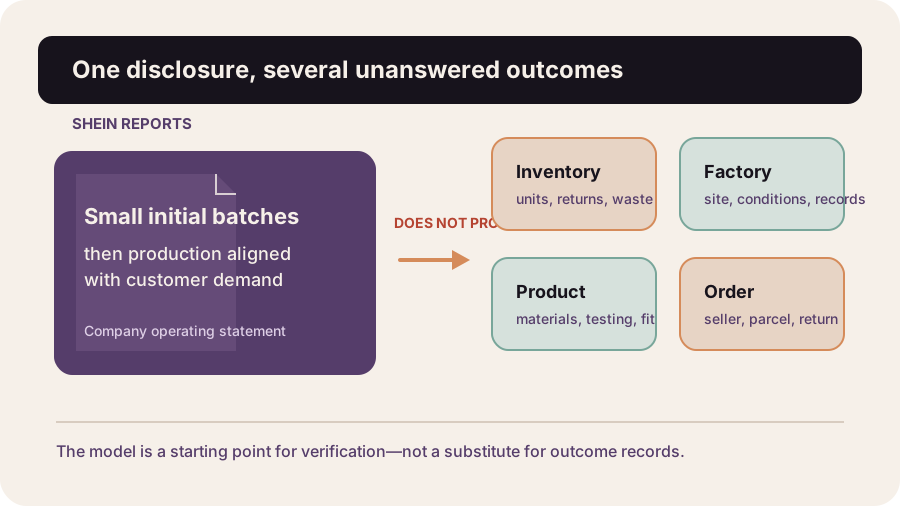
SHEIN’s operating-model story rests heavily on the claim that production responds to demand information instead of relying entirely on large forecasts made long before a product is shown to customers. In its current policy document, SHEIN says it starts with small initial batches, then aligns subsequent production with customer demand in an effort to reduce excess inventory.
That is a meaningful description of the company’s stated method. It gives a reader a mechanism to investigate: initial production, customer response, later production decisions, supplier capacity and the relationship between a digital platform and garment manufacturing. It is more specific than saying simply that the company uses “technology” or is “data-driven.”
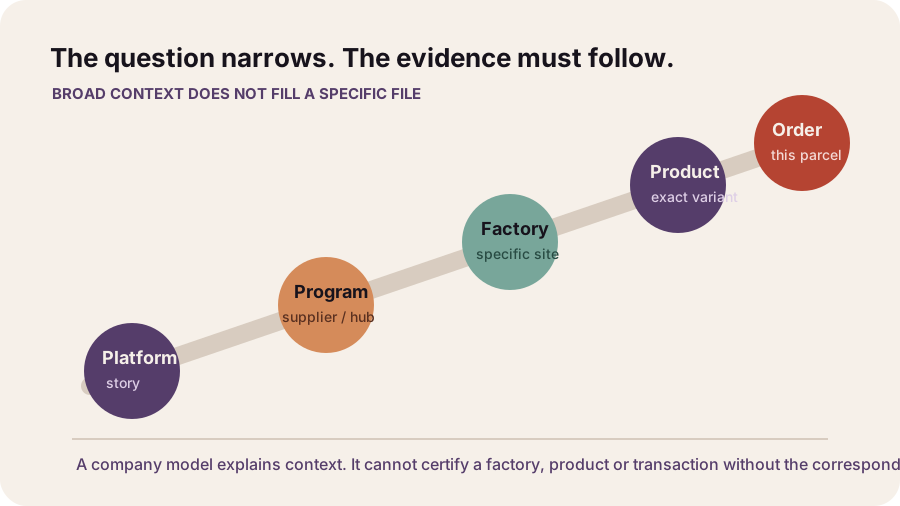
It is not, however, a measurement of an outcome. The document does not, by itself, establish how many units were produced for every style, how quickly every signal was observed, whether the signal was predictive, how much inventory remained, which facilities made a given item, how materials were sourced, how products performed after wear, or how any process compared with a named alternative. The word “small” is not a universal production-order record. The phrase “aligned with customer demand” is not a published ledger of orders and unsold stock.
That boundary can feel overly technical only when the claim remains abstract. It becomes concrete as soon as someone makes a decision. A buyer asking whether a particular dress is likely to fit needs measurements, material composition, care information, the exact seller and return conditions. A brand or supplier considering a commercial relationship needs contractual terms, production specifications, payment structure, capacity planning and appropriate compliance materials. An analyst evaluating inventory efficiency needs a defined period, a consistent metric, a comparison group and records that show how the metric was constructed. A policy reader concerned with a supply-chain impact needs evidence suited to that effect, not only a description of how the platform operates.
What “on demand” can mean—and why the object matters
The phrase “on demand” is used widely in commerce. It can mean a product is made only after an order. It can mean a catalogue is tested in a limited quantity before reordering. It can mean a retailer uses sales data to revise a forecast. It can mean a marketplace has a more responsive supplier network. Those are different operational claims, with different evidence requirements.
SHEIN’s policy is best read at the level it actually gives: a company statement about small initial batches and later production aligned with customer demand. It does not say that every purchase is made after the customer places an order, nor does it identify a production rule for every category. It also does not establish a whole-system environmental, economic or labor result. A method may be important while the degree of implementation and outcome remains unverified in the public evidence reviewed here.
The right next question is therefore not “is the model real?” as if there could be a single yes-or-no answer. It is “what exact claim is being made, for what product category, during what period, by which entity, and with what record?” If a reader needs proof for a particular order, the most relevant evidence will usually be closer to that order than a group-level policy document.
The missing records are not a footnote
The operating-model claim invites several downstream inferences. A reader might infer lower inventory, less waste, a more responsive factory, a better product, a faster delivery route or a more ethical production outcome. None follows automatically from the statement that initial batches are small and later production is aligned with demand.
Each inference has its own missing record:
- An inventory claim needs a defined inventory measure, period, scope, treatment of returns and comparable baseline.
- A waste claim needs material, production and disposal data with a clear boundary rather than a general operating narrative.
- A factory-practice claim needs facility-specific documentation, independent inspection or other evidence suited to the condition being discussed.
- A product-quality claim needs the exact product, material, construction, test or use evidence—along with a defined standard of comparison.
- A delivery claim needs the order’s stock location, carrier, destination, service level, dispatch time, customs path and actual delivery record.
Listing missing evidence does not prove the opposite result. It does not prove that the company has excess inventory, that a supplier performs poorly, that an item is unsafe or that a delivery will fail. It simply stops an appealing platform description from becoming an answer to a different question.
This distinction is particularly useful for business readers. A company considering a marketplace or supplier relationship can acknowledge that a flexible ordering system may be commercially relevant while still asking for the terms that govern the specific relationship. What is the order minimum? Who owns a design or product data? What are the quality controls? How are changes approved? What happens when material availability changes? Which party bears the cost of a return, chargeback, late dispatch or nonconforming product? These questions are not a rejection of the model. They are how a model becomes an operational relationship.
The model is a starting point for due diligence
A careful reader can use the policy disclosure productively. It signals where to look for stronger evidence. If the claim concerns rapid product iteration, ask for version-controlled specifications and sample-approval records. If it concerns reduced excess stock, ask what measure is used, how it treats returns and how it compares over time. If it concerns supplier responsiveness, ask about scheduling, subcontracting, capacity constraints and quality inspection. If it concerns global availability, ask which stock location, entity and carrier apply to the order in question.
The needed record should match the consequence. A low-stakes purchase may only require clear sizing, material, price and return information. A wholesale relationship, safety-sensitive category or branded production arrangement will require more. The fact that the purchase interface is easy does not make the evidentiary chain simple. It makes it easier to forget that the chain exists.
The supplier file: a program announcement is not a factory audit
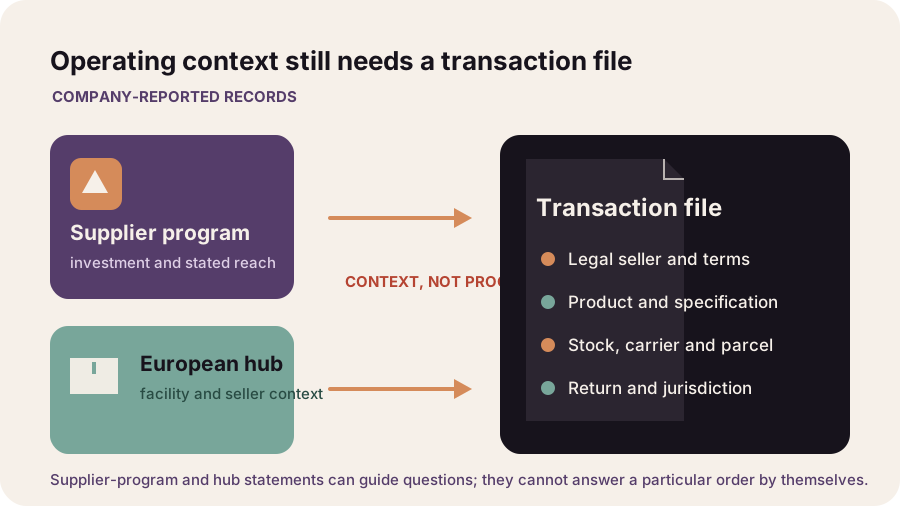
The supplier story is often where the abstract platform becomes a manufacturing story. The company’s February 2026 supplier-capability announcement says its Supplier Community Empowerment Program (SCEP) launched in 2023. SHEIN reports that it had invested more than US$42 million through the end of 2025, and that more than 200 supplier factories had been renovated and modernised. The same company announcement gives further figures about floor area, workers and training activity.
Those are useful company-reported indicators of a program’s stated scale. They say the platform operator is presenting supplier capability as part of its operating system, not as an invisible background condition. They also give a reader a dated basis on which to ask more specific questions: what does a renovation mean, which capabilities are included, how are suppliers selected, which standards apply, and how is progress measured?
They do not identify the facility behind an individual listing. They do not name a particular factory, show the physical or managerial changes made at every participating site, establish working-hour, wage, safety, quality or environmental conditions, or confirm that a given garment came from a participating supplier. They also do not establish whether every supplier in a network is included, whether a particular subcontractor is involved, or how the company validates the results it reports.
The difference between a program and an audit is worth preserving. A program can be real, funded and important without being a complete answer to a factory-specific question. An audit can also be limited in time and scope. A reader should not substitute either word for a defined record of the condition that matters.
Read the US$42 million figure with its label attached
The reported investment figure is easily turned into a summary judgment: a large number can sound like evidence that supplier challenges have been solved, while a smaller number can sound like evidence that they have not. Neither conclusion is justified by the amount alone.
The figure is most useful when it keeps four labels:
- Issuer: SHEIN reports the figure in its own announcement.
- Program: It is tied to the Supplier Community Empowerment Program rather than an independently defined industry total.
- Timeframe: The reported total runs through the end of 2025.
- Boundary: The figure does not disclose every supplier, every factory outcome or a common performance measure for each site.
With those labels intact, the number helps a reader understand the company’s stated priority and program scope. Without them, it becomes a floating score. The same is true for the statement that more than 200 supplier factories were renovated and modernised. It may indicate a significant program reach, but “renovated” and “modernised” need their own definition before they can become evidence of a labor, safety, product or environmental result.
A useful supplier conversation begins with the actual facility
For a buyer, brand or operator, supplier verification should return to the actual manufacturing relationship. The right file may include the legal entity, site address, product category, relevant licenses, quality system, traceability information, approved materials, production capacity, sample records, inspection procedure, subcontracting policy and corrective-action history. The right requests depend on the product and destination. They should be specific enough that the answer can be checked.
For example, a party buying a basic garment may prioritize the confirmed seller, size specification, composition, country-of-origin declaration if relevant, pricing and returns. A party commissioning a large order may need samples, technical packs, factory and subcontractor information, inspection terms, packaging requirements, lead-time definitions and remedies. A party dealing with a regulated or safety-sensitive item will need records tailored to the regulation, not just a statement that a factory participates in a broad supplier program.
The platform’s supplier announcement can be a starting lead. It should not be a substitute for these transaction-level records. The same logic applies to a factory tour, marketing brochure or one-off certificate. Each can be a useful input. None should silently become proof of every property a business needs to rely on.
Supplier capability is not the same as supplier identity
The global fashion story sometimes treats “the supply chain” as a single asset, as if an operator’s relationship with a region tells a reader who made a specific product. It does not. Supply networks can include multiple tiers and changing relationships. A supplier may manufacture, cut and sew, source materials, subcontract a process, operate a warehouse or perform another role. A seller may be an entity distinct from the facility. A garment can change in materials, fit or labelling over time.
This is why a facility’s participation in a program and a product’s provenance are not the same fact. A supplier program may be a meaningful system-level fact. Product provenance is an item-level fact. The former can tell a reader where to investigate. The latter requires identifiers and records that connect the actual product to the actual production and commercial path.
The logistics file: a hub announcement is not a delivery record
Global expansion is often described as a product of digital demand plus nearby stock. That is why warehouse announcements receive so much attention. On 22 December 2025, SHEIN announced the opening of a Wroclaw, Poland facility that it calls its primary European logistics hub. The company says the hub supports Polish and European sellers. It also says its activities have created at least 5,000 jobs in total across Poland and that it works with 170 small and medium-sized enterprises.
This is a concrete statement about the company’s stated infrastructure and ecosystem. It helps explain why the platform’s global story is not only a webpage, a production model or a cross-border parcel. A regional hub can matter for how a company organizes inventory, seller support and the relationship between platform operations and local service providers.
It does not reveal the route of an individual order. The announcement does not tell a reader whether a particular item is stocked in Wroclaw, which legal entity takes the order, which carrier will handle it, whether it will cross a border, how long delivery will take, whether customs is involved, which return address applies, or what happens after a failed delivery. It is also SHEIN’s own reporting of jobs and SME relationships, not an independent employment study or a delivery-performance dataset.
Separate the facility map from the parcel map
The most useful way to read a warehouse announcement is as a facility map. It tells a reader that a company says it has built or opened a particular location for a stated role. That can be valuable context for understanding a platform’s regional strategy. But a buyer’s decision needs a parcel map: the exact stock location for the ordered SKU, dispatch date, carrier, service level, tracking, destination, duties or taxes if applicable, return path and responsible contact.
Those maps may intersect; they are not identical. A primary regional hub can influence the broader network without holding every product. An order can be promised in a local interface while being fulfilled through a different route. A product can be available in one location and not another. A return route can differ from the outbound route. The real record is order-specific and time-specific.
| A hub announcement can support | An order record still needs |
|---|---|
| “The company says this facility is its primary European logistics hub.” | The stock location of the actual item |
| “The company says the facility supports Polish and European sellers.” | The legal seller and the party responsible for the transaction |
| “The company reports work with SMEs and jobs created in Poland.” | The carrier, delivery estimate, dispatch scan and receipt for a parcel |
| “The facility adds context to the company’s European strategy.” | Return terms, address, costs and post-sale responsibility |
Logistics is a chain of accountable handoffs
The reader’s most important question is often not “does the platform have a warehouse?” but “who owns the next handoff?” A shipment can involve the merchant preparing the item, a fulfillment party receiving it, a carrier accepting it, a customs or import step, a local delivery company and a returns processor. Each handoff may generate a record. Each may also assign responsibility differently.
For a consumer purchase, basic clarity may be enough: what is the promised dispatch window, where does the seller say the item will ship from, what delivery service applies, what happens if it does not arrive, and how can the product be returned? For a business purchase, the requests may extend to Incoterms or equivalent commercial terms, documentation, insurance, title, inspection, lead-time definition, packaging, damage claims and after-sales support. The platform’s hub announcement does not answer those questions, but it helps show why the answers matter.
The governance file: status and procedure are not a verdict
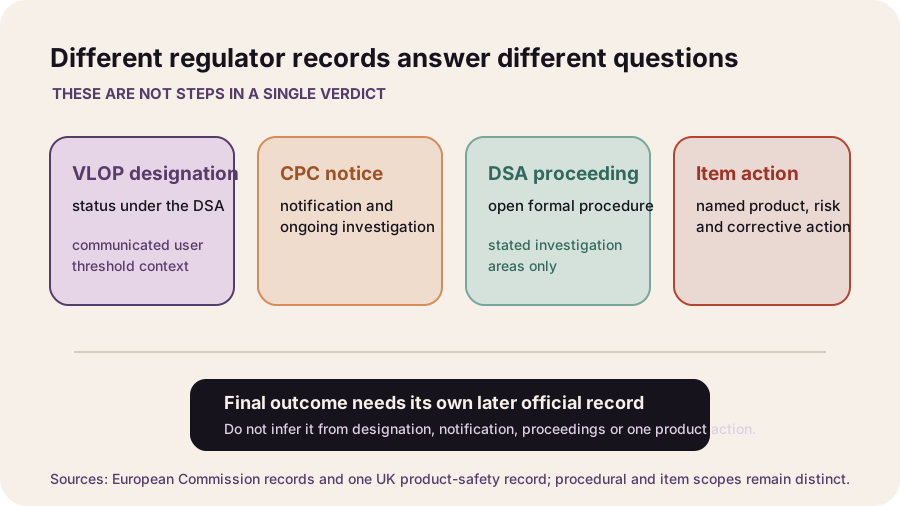
Platform governance adds another layer to the story. Unlike a company policy or newsroom announcement, a regulator record is issued by an authority. It can establish a status, notification or procedure in the authority’s own framework. It must still be read at the level of that framework.
The European Commission designated SHEIN a Very Large Online Platform under the Digital Services Act on 26 April 2024. The Commission says SHEIN communicated average monthly European Union users above 45 million, the threshold relevant to the designation. This is an official status record. It is not a current global-user estimate, a measure of every seller’s conduct, an assurance of product safety or a grade of company quality.
The distinction may sound formal, but it guards against two opposite misreadings. One reader could see the designation as proof that a large platform has been comprehensively approved. Another could see the fact that a platform is subject to heightened obligations as proof that it has been found to have failed. The record says neither. It says that the authority designated the service under the DSA after a stated user-threshold condition. The obligations and later procedures must be read separately.
The 2025 consumer-protection record has its own status
On 26 May 2025, the Commission said that the Consumer Protection Cooperation Network and the Commission had notified SHEIN of a number of practices they say infringe EU consumer law. The notice says SHEIN remained under investigation and that further information was requested.
This is material because it is a dated public action by an authority network. But its wording matters. A notification and ongoing investigation are not a final infringement decision, a settled remedy, a legal conclusion for every jurisdiction, or proof that every shopper has a particular right or outcome. The article should retain the subject, date and process described in the record instead of turning a press notice into a platform-wide verdict.
For a reader deciding how to interpret the notice, the practical questions are limited but useful. What did the authority say was under examination? What is the current status? Has a subsequent official action changed the position? Which terms, seller and consumer rules apply to the reader’s actual country and transaction? The questions do not presume a conclusion. They locate the correct record.
The 2026 DSA proceeding has not become a final result
On 17 February 2026, the European Commission announced formal proceedings against SHEIN under the DSA. In its notice, the Commission identifies systems addressing illegal products, possible addictive design and recommender-system transparency among the areas it will investigate.
The operative words are “announced formal proceedings” and “will investigate.” The notice establishes procedural status and the stated focus. It does not establish a final finding of wrongdoing, a liability result, a consumer remedy, a conclusion on all products or sellers, or an overall safety assessment. Those would require a later record that actually makes such a determination.
That is not merely cautious wording for lawyers. It is a practical distinction for ordinary readers. A shopper should not use the open proceeding as a substitute for checking a product’s details and current consumer terms. A supplier should not use it as proof of its own status or a competitor’s. An analyst should not treat the opening date as a completed enforcement outcome. In each case, the reader needs the official status and the documents that address the question at hand.
A named product action is not a platform sample
The limit becomes even clearer with an item-level public record. The UK Office for Product Safety and Standards published a recall for named multi-colour water-absorbent beads sold via SHEIN. The record identifies a serious asphyxiation risk if hydrated beads are swallowed and says the item was recalled from end users and the listing was removed by the marketplace.
This is a meaningful item-specific record. It identifies a product, a stated risk and corrective action. It shows what product-safety evidence looks like when the question has been narrowed to an object. It is not a sample of every product on the platform, a measurement of platform-wide safety, a conclusion about all sellers or a statement about an unrelated garment. A product action gains force from its specificity; it loses meaning if it is stretched into a universal conclusion.
The correct lesson is therefore not “one recall proves the platform is safe” or “one recall proves it is unsafe.” The useful lesson is that real product questions require real product records. Where the stakes are high, a reader needs to identify the product variant, seller or responsible entity, destination, warnings, relevant standards, test documentation where appropriate, and current authority records. A brand headline and a general platform narrative cannot do that work.
The decision file: verify the transaction, not the storyline
The model, supplier, logistics and governance files can all be useful. They can help a reader understand why SHEIN is an important global platform and what kinds of systems the company says it is building. They do not answer the final question in most live decisions: what is true of this exact transaction?
That question is deliberately less dramatic than the platform story, but it is more actionable. It converts vague impressions—on-demand, global, direct, local warehouse, marketplace, regulated—into requestable records. The following map is not a universal legal or procurement checklist. It is a way to match the reader’s question to the evidence that could actually answer it.
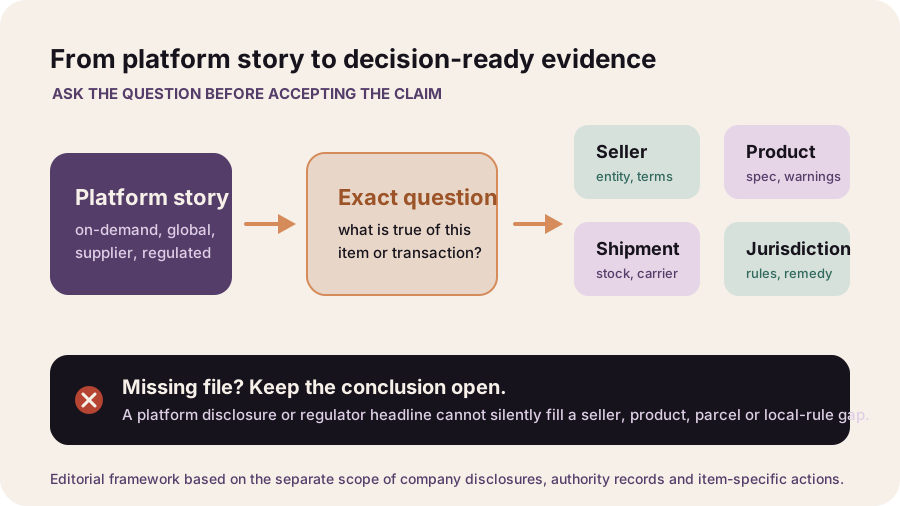
| If your question is… | Ask for or verify… | Do not substitute… |
|---|---|---|
| Who is selling this? | Legal seller name, contact information, applicable entity and the current terms for the transaction | The platform logo or an app profile alone |
| What exactly is the item? | Product identifier, variant, composition, measurements, warnings, images and specification | A broad “on-demand fashion” description |
| Where and by whom was it made? | Origin or producer information where available, traceability documents and factory-specific evidence appropriate to the claim | A regional supplier-program announcement |
| Is it suitable or compliant for the destination? | Product-category documentation, current authority sources and destination-specific requirements | A VLOP designation, a proceeding headline or a generic product label |
| How will it arrive and be returned? | Stock location, dispatch terms, carrier, tracking, delivery and return terms for the order | A company announcement about a regional hub |
| Can the supplier meet a business requirement? | Entity, sample, technical specification, capacity, quality, subcontracting, contract and support records | A program investment figure without a facility link |
The absence of a record is still information
An unavailable record does not prove that a claim is false. A seller may have documentation that is not public, a facility may operate well without publishing a marketing page, and an order may perform successfully without a warehouse announcement. But the absence does change what the reader can responsibly conclude.
If a buyer cannot identify the seller, then seller identity remains unresolved. If a business cannot connect an item to a factory or product specification, provenance or capability remains unresolved. If an order page does not state a clear return route, then the return arrangement is uncertain until the terms or seller clarify it. If a regulator has opened a proceeding but no final decision has been published, then the outcome remains open. Honest analysis should leave those gaps visible instead of filling them with a favorable or unfavorable story.
This is the central discipline behind a useful platform file. It allows the reader to be interested in operational innovation without accepting every marketing inference; attentive to regulatory scrutiny without misrepresenting procedural status; and pragmatic about product choice without claiming personal testing or factory knowledge that the article does not possess.
Three shortcuts that weaken the analysis
The first shortcut is using speed as evidence of a supply-chain result. A platform may make rapid iteration central to its story. That does not show how fast a particular factory made a product, how long a particular parcel will take, or whether a return will work. Time-sensitive claims need time-stamped operational records.
The second is using program scale as evidence of a factory outcome. The SCEP figures tell a reader what SHEIN reports about the program’s investment and reach. They do not turn every facility into a verified condition, every garment into a verified product, or every supplier relationship into a completed audit. Site-specific claims need site-specific evidence.
The third is using regulatory attention as a quality score. The European designation, consumer-protection notification and formal DSA proceedings are public records with different procedural meanings. The UK recall is a specific item action. None licenses a shortcut from “the authority said something” to “every product, seller or platform outcome has been decided.”
The stronger approach is less theatrical: name the record, state who issued it, say what it covers, retain its date and scope, and ask what evidence is still absent. That is how a global-platform analysis becomes something a reader can use.
What to watch next
This page should be reviewed when SHEIN publishes material changes to its operating, supplier or logistics documentation; when the European Commission updates the status of the CPC or DSA matters; when a later official product record alters the status of the named UK case; or when a reader’s actual object changes.
The last condition is easy to overlook. A new seller, garment variant, size, fabric composition, inventory location, destination, checkout entity, shipping method, return term or consumer rule can change the relevant evidence even if the platform’s brand story remains the same. A global marketplace is not a single transaction. It is a system in which many transactions require their own files.
Method and limitations
China Made & Tech prepared this as a desk-research guide using SHEIN’s own policy and newsroom documents, European Commission records, and one UK product-safety record. The article does not claim that the team bought, wore, inspected, tested, returned, shipped, sourced from, audited, visited or interviewed SHEIN, a seller, a factory, a supplier, a carrier, a customer or a regulator.
The company documents are cited as company disclosures. The EU records are cited as designation, notification or proceeding records at their published status. The UK page is cited as a named item-level action. No source reviewed here establishes a particular seller’s identity, a particular factory’s conditions, an individual product’s quality or safety, an order’s delivery outcome, a platform-wide product rate, or a final outcome of an open procedure. Readers should match their next check to their particular product, transaction and jurisdiction.