
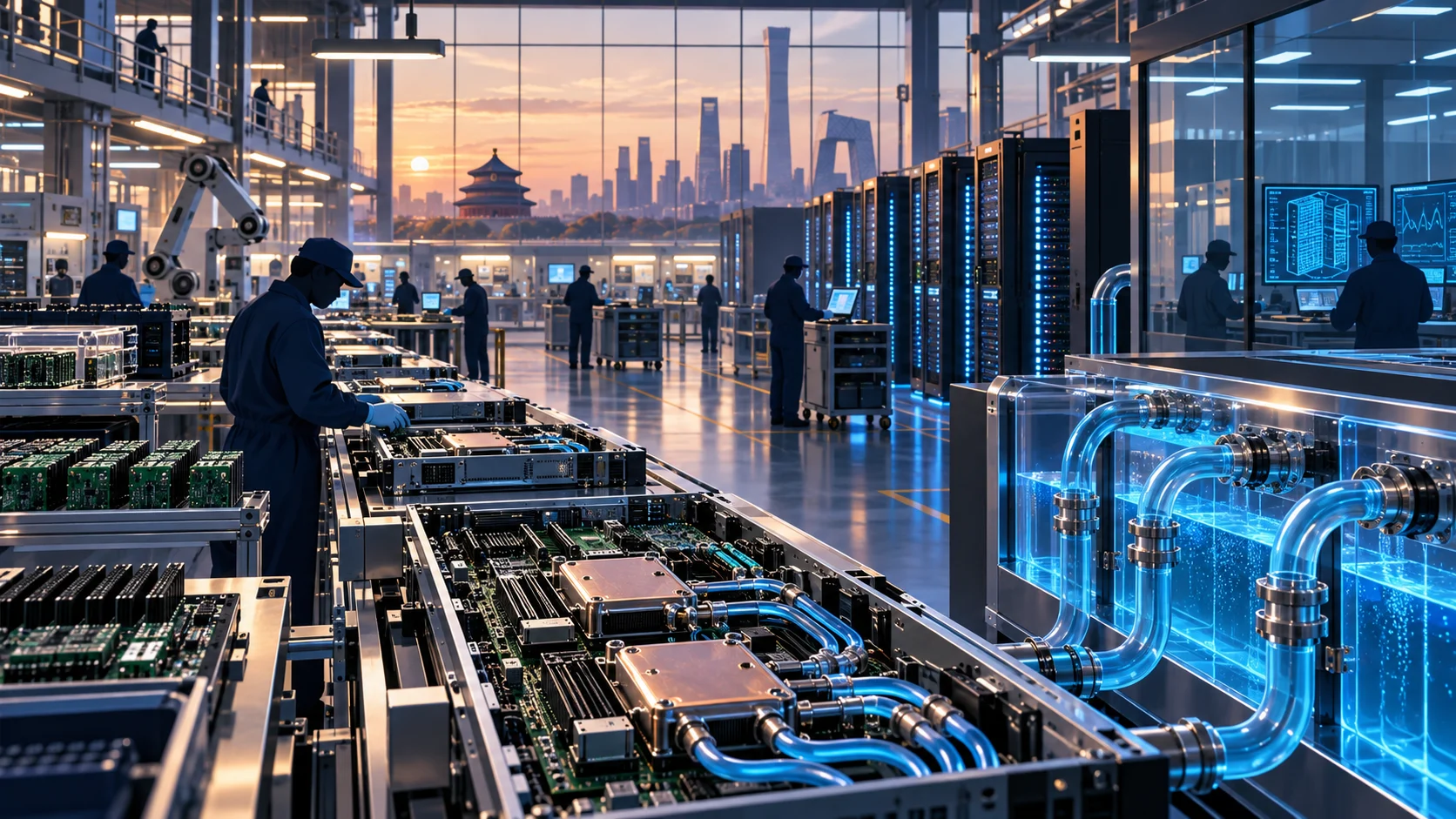
SoftStone Huafang's intelligent shared factory in Beijing's Tongzhou district has moved from construction plan to operating site. On August 30, 2026, the factory completed final testing of its first liquid-cooled server and brought the product off the line. The Beijing municipal government report describes the site as Beijing's first AI-compute shared smart-manufacturing factory with end-to-end liquid-cooled rack delivery capability.
That sentence contains three different developments. There is a physical factory, a manufacturing process capable of handling liquid-cooled systems, and a business model that offers production capacity to other companies. They should be assessed separately. A building can be finished before a line is stable. A line can be technically capable before it has a qualified customer product. A shared factory can be open to outside orders before it has a large, repeatable order book.
The launch therefore matters less as proof that Beijing suddenly has a new source of AI chips or finished compute demand. It matters as a concrete attempt to shorten the path between an AI hardware design and a deliverable server system. The 2026 Beijing launch report describes a 33,000-square-meter building, SMT (surface-mount technology) and server assembly, flexible switching between air-cooled and liquid-cooled products, automated warehousing, AI visual inspection and digital-twin scheduling. Separately, the municipal industry-bureau report sets a first-phase target of 100,000 servers a year, annual output value up to RMB 10 billion and a second-phase target of 300,000 servers after expansion, and says the factory will pursue validation and production around the Ascend 950 supernode series.
Those are meaningful capabilities and ambitious targets. They are still reported project claims and operating plans. They do not, on their own, show current run rate, yield, customer orders, system certification, component origin, field availability or realized revenue. The Beijing launch report describes the commissioning boundary; the practical question for an equipment buyer, AI company, investor or regional policymaker is more specific: what does SoftStone Huafang's Tongzhou launch add to the AI hardware chain, and what evidence is still needed before the factory can be treated as a dependable production platform?
The launch has three layers
The first layer is execution. A factory that completes its first liquid-cooled server has crossed a threshold that a rendering, construction announcement or equipment purchase cannot cross. Material has moved through a sequence of production and test steps. People, equipment, software, quality checks and logistics have had to work together well enough to produce a physical system. The event is evidence of commissioning and initial production activity.
The second layer is process scope. The site is presented as more than an assembly room. The pre-launch description from the Tongzhou district government lists PCBA (printed-circuit-board assembly), whole-machine assembly, liquid-loop testing, high- and low-temperature liquid-cooled aging, automatic packaging and automatic warehousing. The 2026 launch reports add AI visual inspection and digital-twin scheduling. If those functions are operating as described, the factory can connect board-level manufacturing, server integration, cooling-system verification, aging and shipment in one local flow. The later Beijing launch report and industry-bureau report provide the launch-side sources.
The third layer is commercial access. SoftStone Huafang presents the site as a shared OEM/ODM platform. A small AI company, research organization or hardware start-up could use the facility for prototype making, small-batch production, validation and larger-scale manufacturing without owning a complete heavy factory. This is the part that distinguishes the project from a conventional captive server plant. The asset is supposed to be useful to an ecosystem, not only to the company that financed it.
The difference is important because the transition between design and repeatable manufacturing can expose problems that are invisible in a laboratory. An accelerator board can work in a prototype and still encounter problems when it is installed in a rack, connected to a liquid loop, exposed to a thermal cycle, updated through a management system and shipped to a data centre. A shared factory could reduce that transition cost if it has the equipment, documentation, engineering staff, supplier discipline and customer-change process to support it.
It can also increase coordination risk. Outside customers bring different board layouts, firmware, mechanical envelopes, liquid-cooling interfaces, compliance requirements and acceptance tests. A platform that can handle one reference design is not automatically a platform that can handle many designs. The factory's real value will be visible in repeatable changeovers, first-pass yield, engineering-change control and customer acceptance rather than in the launch ceremony alone.
A shared site also has to make the transition from one-off engineering to a production commitment explicit. A prototype may use hand-selected parts and engineering attention that cannot be scaled to every unit. A pilot build tests whether work instructions, fixtures, material kits and test records are repeatable; volume production adds scheduling, yield and service obligations. Customers need to know when that status changes, whether they receive capacity priority, and which configuration is frozen for the order. These are not disclosed outcomes at Tongzhou yet, but they are the operational questions that distinguish a shared factory from rentable floor space.
What the 33,000-square-meter site says—and does not say
The reported building area is 33,000 square meters, according to the Beijing launch report and the Tongzhou pre-launch report. That is large enough to suggest a serious production and support operation, but area is not capacity. The number includes some combination of production floor, warehouses, offices, laboratories, test spaces, utilities, circulation and training facilities. It does not tell us how much space is available for active server lines or how much capacity is constrained by power, cooling, testing or material flow.
The pre-launch government report provides a useful description of the intended flow. It says the site would support both air-cooled and liquid-cooled servers on a digitally managed line, with process coverage from PCBA through final packaging and automated storage. That matters because liquid cooling adds production and test steps that an ordinary air-cooled server assembly line may not need. A rack can be mechanically complete and still fail when a manifold leaks, a cold plate has poor contact, a pump behaves outside its expected range, or the software does not report a thermal fault correctly.
The phrase “end-to-end” should therefore be read as a process claim that needs definition. Does it include the manufacture of every liquid-cooling component? Does it include water-quality preparation, pressure testing, leak detection, thermal cycling and final rack-level acceptance? Does it include the power-distribution unit, network cabling, firmware configuration and data-centre integration? The published reports establish the factory's stated capability direction, but they do not disclose a detailed boundary map.
This distinction is familiar to readers following How China Manufactures: Inside the World's Factory (2026). A factory's identity depends on what it makes, integrates, tests and supports after shipment. “AI server factory” can mean board assembly, final integration, system validation, rack integration or a much wider operation; responsibility for a defect usually follows that boundary.
The site description also points to a regional strategy. A shared factory can be useful when a city has software, research and application teams but wants a nearer route into specialized hardware production. It could allow a team to take an idea from prototype to pilot and product validation without sending every iteration to a distant supplier.
That can shorten the feedback loop. Engineers can observe a line, change a fixture, adjust a test sequence, retrieve a suspect unit and discuss a failure in the same regional network. It can also reduce the friction of small orders that are too large for a laboratory and too small to justify a dedicated plant. But geography helps only if the factory has the technical authority to resolve problems. A nearby line that must wait for every design decision, imported component or external test slot may still have a long cycle time.
Why liquid cooling changes the manufacturing problem
Liquid cooling is often described as a data-centre efficiency solution. In manufacturing terms, it is also a system-integration problem. The server's heat-producing components, cold plates, hoses, manifolds, quick connectors, pumps, sensors, control logic, rack structure and facility loop have to work together. The risk is not limited to the compute board.
That creates an important boundary between factory acceptance and site acceptance. A factory can test the server-side loop under a controlled setup, but a deployed system also meets the customer's coolant distribution unit, piping, water-quality controls, inlet conditions and monitoring practices. The report's mention of liquid-loop testing does not say whether the Tongzhou test covers only the server or includes a rack and facility interface. The buyer should ask for the tested configuration, coolant specification, operating range, pressure and leak criteria, then define a separate commissioning test for the site connection. Otherwise, a passing factory test could be mistaken for evidence about plumbing or control conditions that the factory never examined.
The Open Compute Project's ACF Reference Design Guidance and Liquid Cooling Integration and Logistics guidance distinguish equipment integration from facility installation and commissioning, including the technology-cooling and facility-water loops. These documents support the general engineering boundary described here; they do not establish SoftStone's actual test configuration or results.
The boundary also affects failure investigation. If a system reports elevated temperature or a flow alarm, the cause could sit in the server, the rack manifold, a site pump, a control setting or an operating procedure. A useful handoff record identifies which measurements were captured at factory test and which must be recorded during installation. That lets the operator distinguish a product defect from an integration or facility condition without assuming that either party is at fault before the data is reviewed.
For an air-cooled server, the production team still has to manage thermal interfaces, fans, ducts and airflow. A liquid-cooled design adds fluid paths and a stronger requirement for leak prevention and verification. The assembly process must control torque, seals, cleanliness, routing and mechanical stress. The test process must identify a slow leak or marginal connection before the rack reaches a customer site. The software must know when flow, pressure or temperature is outside the allowed window.
That is why the Tongzhou reports' references to liquid-loop testing and liquid-cooled aging are more informative than a generic statement that the factory can “make AI servers.” They indicate that the project team understands the product as a thermal and reliability system. The reports do not reveal test pressures, cycle durations, pass criteria or sample rates, so a buyer cannot infer a reliability result. They do show the types of operations that need to exist if the factory is to support liquid-cooled deployments responsibly.
The air/liquid mixed-line claim carries another implication. If a flexible line can switch between both product families without long reconfiguration, it may help a shared factory serve customers with different cooling architectures. That flexibility is valuable when demand is uncertain. It can also create scheduling and quality risks. Fixtures, software recipes, material kits and test profiles have to change correctly. An operator or automated system must not apply an air-cooled process to a liquid-cooled unit or carry a configuration error into final acceptance.
A serious production file would therefore include the line's changeover method. It would show how bills of material are locked, how serial numbers follow a unit, how the correct cooling test is selected, how rework is recorded and how final configuration is tied to the customer order. None of that is visible in the launch release. It is the next evidence request for any party considering the factory as a manufacturing partner.
The factory's stated use of AI visual inspection is similarly promising but incomplete as public evidence. Vision systems can detect missing parts, connector positions, label errors, surface defects and assembly conditions that are difficult to check consistently by eye. Their performance depends on image quality, lighting, training data, threshold settings, false-negative handling and human escalation. A report that says AI inspection is embedded in the process establishes an investment and a design choice. It does not establish the measured false-reject rate or escape rate, meaning defects that pass the factory's controls and reach a customer.
Digital-twin scheduling can help coordinate material, labour, equipment and orders. It may make a shared line more responsive than a simple first-in, first-out queue. The value depends on the accuracy of the model and the discipline with which real deviations are fed back into it. A digital twin that sees a clean virtual schedule while a supplier is late, a test station is down or a customer has changed firmware is not a substitute for operational control.
The 100,000-server target is a planning number
The most attention-grabbing figure is the first-phase target of 100,000 servers a year. The industry-bureau report also says the second phase would expand to 300,000 servers and attributes annual output value of up to RMB 10 billion to phase one. The industry-bureau report provides these figures. They belong to the phase-one and phase-two project plan reported in September 2026. These numbers make the project legible to policymakers and investors, but they should be treated as targets and attributed plans rather than as current performance.
A capacity target can mean theoretical line capacity, installed equipment capacity, a full-development plan or a capacity available after customer qualification. The report does not specify the product mix behind the 100,000 figure. One compact air-cooled server, one high-density liquid-cooled rack and one customized system do not consume the same labour, test time, floor area, material or logistics capacity. “Servers per year” is therefore a useful headline unit and a weak standalone operating metric.
The output-value claim has the same limitation. Dividing the stated RMB 10 billion by 100,000 units would imply an average of RMB 100,000 per server if the entire first-phase value were associated with that unit count. That arithmetic is only an illustration, not a company financial forecast. The bureau report does not define the product mix behind the output-value figure; it may include different products or services. It cannot be converted into a realized margin or revenue expectation without a product definition and an order book.
The more useful questions are operational. How many units can the current line complete per shift? What is the bottleneck: SMT, assembly, liquid testing, aging, burn-in, power test, packaging or customer acceptance? What share of units passes on the first attempt? How much rework is typical? What is the average time from material release to shipment? How many designs can be active without disturbing the line? Which supplier components have long lead times?
Capacity should also be measured against the quality system. A line that can assemble 100,000 units but cannot maintain test coverage or traceability at that volume is not a 100,000-unit commercial platform. A line that can ship quickly but requires heavy field rework may transfer cost from the factory to the customer. A line that achieves a high output number by limiting customization may be less useful as an open OEM/ODM service.
Project descriptions can also use different product boundaries at different stages. A factory may support several product families, or a later announcement may narrow the public scope to the product closest to launch. That is why the capacity denominator needs a product boundary. A buyer should ask which products share the line, whether their targets are additive and what happens when demand for one family rises.
The shared-factory model can solve a real bottleneck
Many AI hardware companies face a mismatch between their market ambition and their manufacturing volume. They may have a board design, an accelerator partnership or a customer prototype, but not enough predictable demand to build a plant. Contract manufacturers can provide assembly, yet a complex AI rack may need more than generic electronics manufacturing. It may require server firmware, thermal integration, system validation, test automation, customer-specific configuration and a support process.
A shared AI-compute factory sits between a prototype lab and a dedicated mass-production plant. It can pool expensive equipment and engineering capabilities across several customers. It can offer a path from a few pilot units to a small batch and then to a larger run. It can help a university or start-up learn what its design does in production before it commits to a long-term supply chain.
The model is especially relevant to liquid cooling because the investment is not only a pick-and-place line. A customer may need fixtures, test stands, fluid preparation, rack handling, burn-in capacity and staff who understand both electronics and thermal systems. If the shared site owns those capabilities, it can lower the entry cost for a company that cannot build them alone.
The model also creates a neutral-platform question. An OEM customer will want the factory to protect design files, firmware, bills of material and failure data. A shared factory will need to manage conflicts among customers that use overlapping suppliers or similar mechanical designs. It will need rules for intellectual property, data access, component substitution, quality escapes and warranty attribution. Public launch material does not describe those rules.
The operating challenge is to share equipment without sharing uncontrolled variation. Each customer design needs a configuration baseline: approved components, firmware version, cooling connections, test limits and permitted substitutions. Change control then determines whether a late board revision requires a new qualification run, whether an alternate pump can be used, and how the change is reflected in the build record. Without a stable baseline, the same line may produce units that look alike but have different thermal behavior or software support status. With one, a common facility can still accommodate variation while keeping each customer's acceptance file distinct.
Scheduling is part of the same problem. Prototype work arrives irregularly and often needs engineering time at short notice; production orders need predictable slots, complete material kits and stable test capacity. A platform that treats every job as an isolated rush can disrupt repeat builds, while one that reserves all capacity for longer runs undermines its promise to small customers. The useful service design separates engineering access from production reservation, defines when a design is ready to enter the line, and makes the cost of a late change visible. These are operational principles for a shared manufacturing service, not documented features of Tongzhou's current contracts.
There is a commercial question as well. The platform is valuable only if customers can obtain enough attention and capacity when they need it. A factory optimized for a single anchor product may prioritize internal schedules over outside innovation projects. A factory optimized for maximum flexibility may charge more or take longer than a dedicated line. The shared-factory proposition must therefore be tested with actual service-level commitments: lead time, minimum order quantity, engineering-change time, test coverage, escalation path and reserved capacity.
That trade-off explains why a public capacity number cannot settle the question. A plant can have ample nameplate capacity but little uncommitted room for short runs if fixtures, thermal stands or engineering staff are already reserved. Conversely, a technically flexible line may have a lower unit rate only after enough compatible orders are grouped together. Customers need to compare the full route—engineering preparation, qualification, production slot, acceptance and service—rather than a quoted assembly price alone. The launch establishes an invitation to use the platform; the terms of access and the way competing jobs are prioritized will determine whether it fills a genuine gap.
SoftStone Huafang's reported OEM/ODM language suggests a broad service ambition. The Beijing report says outside science and technology companies can use local capacity for prototype production, small batches, validation and larger-scale manufacturing. That is the right sequence for a shared platform because it links product development to volume instead of forcing a company to jump from a laboratory board to a full factory commitment.
The phrase “ODM” adds a further expectation. OEM manufacturing usually means the customer owns more of the design while the factory builds to specification. ODM can mean the factory contributes design and manufacturing expertise. If the site intends to provide ODM services, customers will need to know which reference architectures, thermal designs, firmware stacks and validated components are available, and which parts remain the customer's responsibility. The public release establishes the business model's direction, not the contract terms.
The Ascend 950 plan is a future workload for the factory
The launch reports say SoftStone Huafang will validate and produce around the Ascend 950 supernode series as part of a “Beijing-made” AI-compute strategy. The industry-bureau report and the Beijing government report are the public basis for that direction. This places the factory in the policy and supply-chain context of domestic AI infrastructure. It also makes the distinction between assembly and origin more important.
Producing a server around a named accelerator does not mean every component is made in Beijing or even in China. A finished system can combine an accelerator module, high-speed interconnects, memory, storage, power supplies, cooling components, chassis parts and software from many suppliers. “Beijing-made” can refer to final assembly, system integration, local value added, brand ownership or a broader industrial objective. The launch report does not define the term at component level.
For a public buyer, the important document would be a bill of material with origin and responsibility fields. It would identify the accelerator or module supplier, memory and storage source, network devices, power conversion, cooling hardware, chassis, firmware and test ownership. It would separate country of design, country of manufacture, final assembly location and support location. Without that file, the phrase is useful as a regional strategy signal but insufficient as a supply-chain claim.
The Ascend 950 direction also requires a system-level validation plan. A supernode is not simply a group of chips placed into a rack. It depends on topology, interconnect bandwidth, memory behaviour, power delivery, thermal control, software compatibility and workload performance. The factory would need to validate both the physical assembly and the software-defined operating envelope. A customer will want to know which tests are performed at the factory, which are left to the data-centre integrator and how failures are divided among the parties.
The plan could nevertheless be strategically useful. A local factory that can validate a domestic accelerator platform gives Beijing AI companies a nearer manufacturing and integration route. It may allow hardware teams to iterate faster on rack design and deployment. It may also create a common production base where component vendors, system firms and application companies can learn from the same test data. That benefit depends on actual access, compatible software support and a sufficient stream of qualified designs.
The relevant evidence will arrive in stages. First would be a named reference configuration and a completed validation record. Next would be an announced customer or deployment with a clear acceptance boundary. Later evidence would include stable production, field availability, power and thermal performance, service records and repeat orders. The launch announcement is the beginning of that sequence.
What the first product proves
The first liquid-cooled server is not a ceremonial object with no industrial value. According to the Beijing government launch report, one system reached final testing and came off the line. That reported event indicates that a project team brought together at least some combination of materials, tools, work instructions, assembly staff, test equipment, software and logistics; it does not independently establish the maturity of the normal production process.
It does not prove that the first system represents the line's mature process. Early units often receive more engineering attention than volume units. Engineers may hand-correct problems, inspect more thoroughly, change a fixture between builds or complete tests outside the normal takt sequence, the planned rhythm for completing successive units. A first product can therefore demonstrate feasibility without demonstrating cost, repeatability or production yield.
The same logic applies to the reported launch date. Entering operation on August 30 is a dated commissioning record. It tells the reader when the site publicly crossed into operation. It does not tell the reader how many hours the line has run since, how many servers have shipped, or how quickly the factory can respond to an order in September or October.
The reviewed government reports should therefore be described precisely: the factory entered operation and completed a first liquid-cooled server. That is enough to make the event meaningful. Treating it as proof of full-capacity operation would go beyond those reports.
The same evidence discipline applies to the word “intelligent.” The site uses automation, AI visual inspection and digital-twin scheduling according to the launch reports. Those are attributes of the process design. They do not automatically establish lower defect rates, better labour productivity or higher customer satisfaction. Those outcomes require operating data over time.
The useful next record would connect the first product's configuration and test results to its disposition—internal demonstration, customer unit or qualification build—and show whether subsequent units passed the same acceptance standard. That would turn the launch milestone into a production record.
Testing the shared-factory proposition
The factory's disclosed gaps point to three focused checks for a potential customer. First is access: can a company bring a design into Tongzhou for prototype work, and what technical staff, equipment time and engineering-change support are actually available to outside customers? A shared-factory claim matters only if customers can use the platform on terms that fit their product and schedule.
Second is system validation. The customer should identify the exact server, board, cooling loop and software configuration, then review how electrical, firmware, thermal, leak and aging tests map to the intended deployment. For liquid cooling, the test boundary should specify the loop connection, pressure and temperature conditions, duration, pass criteria and record retention; the OCP's integration guidance describes these as staged equipment and site checks. A first server test shows that a unit passed the factory's stated final gate; it does not establish performance under every customer workload or data-centre environment.
Third is responsibility. An OEM/ODM customer needs to know who controls the design, approves component substitutions, holds test data, accepts the finished system and handles warranty or field failures. These boundaries become especially important when the customer supplies a board or accelerator while the factory integrates the chassis, cooling and firmware. A serial-number record should connect the shipped configuration to its component lots, test results, rework and service history. OCP's guidance describes commissioning, site acceptance and handover records as general integration practice; it does not show which records SoftStone provides.
Together these checks test whether Tongzhou can move an outside customer's design from prototype into a repeatable accepted build while keeping configuration and responsibility clear.
Beijing's industrial policy bet
The launch materials frame Tongzhou as part of a local AI-hardware and manufacturing programme. That policy bet is best assessed through the shared platform's outcomes: whether local teams can move designs into qualified production, whether outside customers use the factory, and whether the site builds durable technical and service roles. Training activity and proximity may support that ecosystem, but neither is a substitute for production evidence. The public materials do not yet show how much the project has shortened prototype cycles or changed regional supplier participation.
The metrics that would change the assessment
The most useful public update would pair a dated output series—units assembled, accepted and shipped by product type—with one customer example that follows a named configuration from prototype through pilot to accepted production. For an Ascend 950 programme, it should identify what SoftStone Huafang validates, what the platform owner validates and what the customer accepts. Together, those records would connect headline capacity to repeatable output and actual platform use.
What this changes for AI hardware companies
For hardware start-ups and research teams, the immediate change is a more plausible local route from design to prototype and pilot, potentially reducing the need to coordinate separate PCB, server, thermal and test suppliers. Larger system companies may value overflow capacity or a regional second source, while component vendors gain a potential place to qualify pumps, cold plates and monitoring equipment in a complete system. Access, qualification, service terms and test records will determine whether these uses materialize.
For data-centre operators, the plant could shorten the engineering distance to a system change, but only if spare parts, software support and post-shipment responsibilities are defined. For Beijing, the project tests whether shared manufacturing can give local AI teams a hardware route without each firm building a factory. Investors can read the launch as strategic direction, while utilization, customer concentration, capital intensity and warranty exposure remain unknown.
A disciplined conclusion
SoftStone Huafang's Tongzhou factory has crossed a real commissioning milestone. A first liquid-cooled server completed final testing at a building reported to cover 33,000 square meters by Beijing's launch report and Tongzhou's pre-launch report. The reports describe a scope linking SMT, assembly, cooling tests, aging, packaging and storage. The industry-bureau report gives the first- and second-phase capacity targets and output-value estimate; the government reports describe a shared OEM/ODM route.
The launch adds a plausible local bridge between AI hardware design and production. Its value will depend on whether outside customers can use the platform, whether complete systems pass tests tied to their deployment, and whether configuration, warranty and service responsibilities remain clear as products move into volume. Those are also the measures that will show whether the shared model has become useful to companies beyond its operator.
The 100,000- and 300,000-server targets, annual output-value estimate and planned Ascend 950 validation describe the ambition. Accepted output and customer progression will determine whether Tongzhou becomes a dependable regional manufacturing platform.
Methodology and evidence boundary
This article uses public government and industry-bureau reports checked on September 23, 2026. The launch facts, site area, production scope, capacity targets and Ascend 950 direction are attributed to those reports. The Tongzhou pre-launch report is used to compare the planned process with the later launch description.
No factory audit, customer order or independent system test was available for this article. The OCP material supplies general liquid-cooling guidance, not SoftStone-specific results; future reporting can assess the factory through customer qualification, accepted production and service evidence.