
The most useful China robotics signal here is not another humanoid demo, benchmark, or stage performance.
It is a tablet production line.
AGIBOT said on April 14, 2026 that multiple `G2` robots had been integrated into Longcheer's live tablet production lines in Nanchang. The company framed it as a large-scale embodied-AI deployment inside core consumer-electronics precision manufacturing. The buyer value is not the superlative. The buyer value is that the claim comes with factory metrics: up to 310 units per hour, 19-20 seconds per operation, over 99% success in continuous operation, line integration within 36 hours, about 3,000 units per shift, over 140 hours of continuous operation, and downtime loss below 4%, according to AGIBOT and Longcheer's PRNewswire deployment release.
That is the right object for analysis because it drags embodied AI into one of China's hardest factory contexts: consumer-electronics ODM manufacturing, where product cycles are short, fixtures shift, line balance matters, and a robot that cannot survive exception handling becomes a demo machine rather than production equipment.
Source File
| Source | What it supports | Why it matters |
|---|---|---|
| AGIBOT and Longcheer PRNewswire deployment release | 310 UPH, 19-20 second cycle time, over 99% success, 36-hour integration, and downtime claims | Stable source for the article's main production-line evidence |
| Longcheer official co-creation note | Longcheer's view of MMIT station work, product sorting, information exchange, and process context | Customer-side context beyond AGIBOT's own release |
| AGIBOT G2 launch release | G2 positioning as an industrial-grade embodied operation robot | Background for why the robot platform fits factory tasks |
| The Robot Report on AGIBOT WORLD 2026 | G2 multi-modal data capture, including RGB(D), tactile, LiDAR, IMU, and full-body joint-state signals | Stable third-party source for the platform/data-pipeline background |
| AGIBOT Defined Support Period PDF | Published support-period dates for G2 and related software | Procurement-risk source for service and update diligence |
Claim Confidence File
| Claim | Confidence | Evidence boundary |
|---|---|---|
| Agibot, Longcheer, and precision ODM signals matter because humanoid commercialization depends on manufacturing partners, not demos alone | Medium-high | Supported by cited company/ODM context; it remains a buyer-risk interpretation rather than proof of scaled deployments. |
| ODM involvement proves the robot is production-ready for all factory tasks | Low | The article separates supply-chain seriousness from safety case, uptime, task fit, and after-sales support. |
| Buyers should ask for reference deployments, task envelope, service owner, spare parts, and integration evidence | High | This is the article's procurement-file recommendation. |
| The article ranks Agibot as the safest humanoid supplier | Low | It evaluates evidence quality and buyer controls, not a full vendor ranking. |
Quick Answer
| Buyer question | Practical answer |
|---|---|
| What is genuinely new? | AGIBOT is positioning G2 robots inside a real tablet ODM workflow, not only in a demo hall or research benchmark. |
| Why does Longcheer matter? | Longcheer brings a serious precision-manufacturing environment with line standards, cycle-time pressure, and product-changeover constraints. |
| What numbers matter? | 310 UPH, 19-20s cycle time, over 99% success, 36h integration, 3,000 units per shift, 140+ / 200+ operating-hour claims with different source wording, and 4% downtime-loss claims. |
| What is the buyer risk? | The use case is still narrow, support periods are short, and the economics depend on service, changeovers, fixtures, and exception handling. |
| Evergreen bridge | Read this with How China Manufactures: Inside the World's Factory (2026), China Humanoid Robot Filings: Commercialization Reality Check, AgiBot WorldArena deployment proof, and China factory robot deployment. |
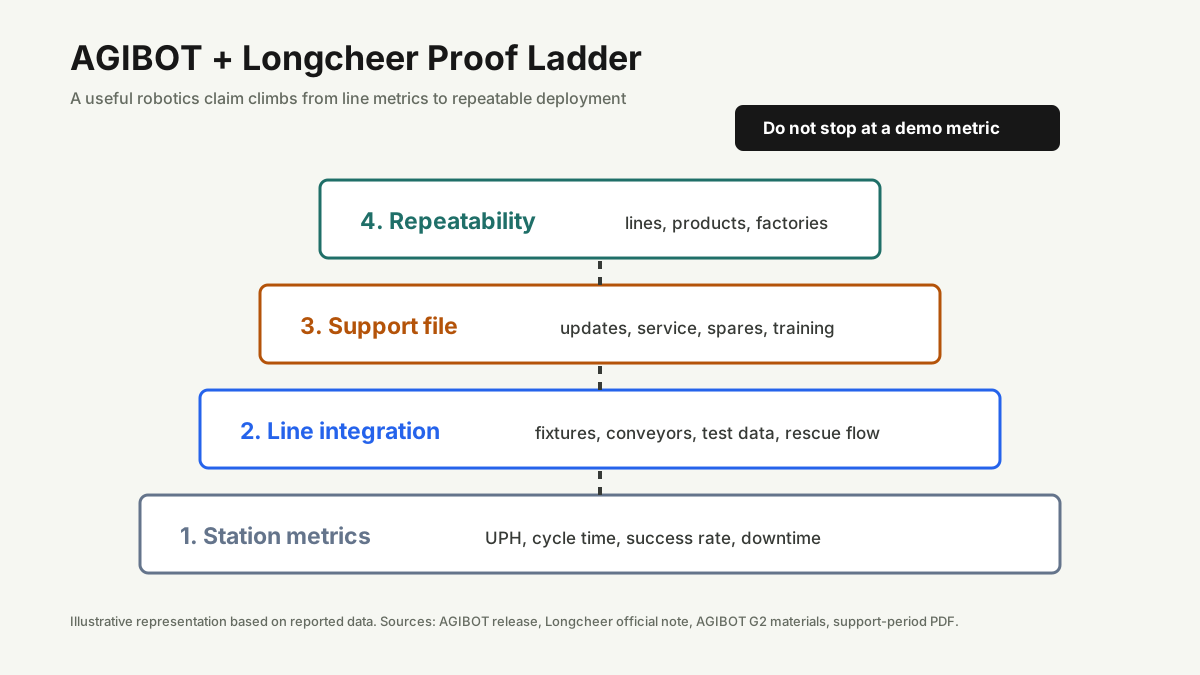 Source: China Made & Tech analysis based on AGIBOT deployment release, Longcheer official note, AGIBOT G2 launch materials, and AGIBOT support-period PDF.
The Protagonist Is A Factory Buyer Testing Flexible Automation
The protagonist is not the robot. It is the factory buyer.
That buyer is a consumer-electronics ODM operator facing short product cycles, high mix, tight cycle time, pressure to reduce labor dependence, and the limits of fixed automation. Longcheer's role matters because the company is not a robotics lab. It is a smart-device ODM with years of production engineering discipline. If embodied AI cannot survive an ODM line, it is not ready for the factory use cases most buyers care about.
The desire is clear: move from rigid automation and manual handling toward more flexible work cells that can adapt to line variation without months of custom tooling. The obstacle is also clear: a production line does not forgive vague AI claims. It measures output, cycle time, downtime, quality, changeover burden, safety, maintenance, and support.
That is why this story belongs in How China Manufactures: Inside the World's Factory (2026). The Chinese manufacturing advantage is not only that factories are large. It is that new hardware can be tested against real line pressure quickly. The AGIBOT-Longcheer file shows that pressure in a narrow but meaningful setting.
Why Consumer-Electronics ODM Is A Better Test Than A Demo Hall
A tablet line is a better embodied-AI test than a conference video because the robot must operate inside constraints that are boring and brutal.
AGIBOT says the G2 robots were deployed at MMIT stations, where they load and unload tablets, navigate the factory environment, place devices into testing fixtures with millimeter-level accuracy, and sort finished or defective units. Longcheer's own official note says the robot receives information from test equipment, sorts finished and non-conforming products, and returns them to the conveyor through information exchange.
That makes the task more interesting than "robot picks object." It is a mini production system:
| Production requirement | Why it matters | Buyer implication |
|---|---|---|
| Fixture accuracy | Tablets must be placed correctly into test positions | Vision and force control must tolerate small deviations |
| Information exchange | Robot needs test-result status, not just motion | IT/OT integration matters as much as manipulation |
| Cycle-time discipline | The line cannot wait for robot hesitation | Robot speed must match takt-time expectations |
| Exception handling | Non-conforming units and offsets occur | Buyer must test edge cases, not only normal cycles |
| Changeover pressure | ODM lines shift products and fixtures | Flexibility is the real economic claim |
The Best Numbers Are The Most Boring Ones
The headline "world's first" is less useful than the dull production numbers.
AGIBOT's release says the G2 reached up to 310 UPH, a 19-20 second cycle time, over 99% success in continuous operation, line integration within 36 hours, roughly 3,000 units per shift, 24/7 autonomous operation support, over 140 hours of cumulative continuous operation, and downtime loss below 4%. Longcheer's official note adds a complementary view: from March 16, the robot had been integrated into the main line, operating over 10 hours per day on average and accumulating more than 200 hours of operation, with only 4% downtime loss. Treat the 140+ and 200+ hour figures as related but not identical source wordings.
Those numbers are valuable because they let buyers build a first-pass diligence file:
- Throughput: does the robot match or improve the station's required UPH?
- Cycle time: does 19-20 seconds include the full pick, travel, fixture placement, result handling, and return cycle?
- Success rate: what counts as success, and who audits failed actions?
- Integration time: what was already prepared before the reported 36-hour integration?
- Downtime: does the 4% loss include robot faults, line stops, fixture issues, software issues, or only robot-caused downtime?
- Continuous operation: are the reported hours enough for production acceptance or only a pilot milestone?
The right buyer reaction is not disbelief. It is specificity. Ask what each number includes.
Longcheer's Note Adds The Missing Manufacturing Context
Longcheer's official writeup is important because it explains why a robot was selected for this process. The company described its precision-manufacturing experience feeding back into the project, from production-line layout and process standards to cycle-time requirements and exception handling. It also said the robot's role relates to information gaps, system interconnection, real-time monitoring, prediction, analysis, and future smart-manufacturing decision-making.
That context changes the interpretation. This is not only a labor-replacement story. It is a line-integration story.
The robot becomes a minimal working unit with testing equipment and conveyor tracks. It moves the production cell from fixed programming toward flexible adaptation. That is the important claim for buyers. A general-purpose robot is economically interesting only if it can reduce the cost of future changeovers or handle variation that fixed automation struggles with.
This is also where AGIBOT's G2 background matters. The October 2025 G2 launch release described the robot as an industrial-grade embodied operation robot with high-performance motion joints, high-precision torque sensors, spatial perception, rapid learning and deployment capabilities, and multimodal interaction. Later coverage of AGIBOT WORLD 2026 by The Robot Report described G2 as part of a multi-modal data pipeline capturing RGB(D), tactile signals, LiDAR point clouds, IMU data, and full-body joint states.
Those details do not prove production reliability. They explain why AGIBOT thinks G2 is the right platform for narrow factory tasks.
The Support Clock Is Short, And Buyers Should Notice
The most uncomfortable fact in the file is not the robot's performance. It is the support period.
AGIBOT's Defined Support Period PDF says it will maintain security updates for at least one year from the launch day of certain device models. The product list includes `G2/AgiBot G2` with a January 1, 2026 launch date and January 1, 2027 end date for security update support. The software list includes Aimmaster, App, and PAD with support through January 2, 2027.
That does not mean AGIBOT will abandon the product after a year. The PDF says support periods may be extended and reviewed. But a factory buyer should treat the published support clock as a serious diligence item. Industrial equipment is not a phone accessory. A production robot can remain in service for years. If software, security, app, or tablet support is unclear beyond one year, the buyer must negotiate the service and update terms before deployment.
The support question is especially important because embodied robots are software-defined production equipment. Their value depends on perception models, motion planning, remote diagnostics, software tools, integration scripts, and safety updates. A short public support window can create procurement friction even if the robot performs well in a pilot.
Why "Deployment Year One" Still Needs Narrow Scenario Discipline
AGIBOT has been framing 2026 as a deployment year for embodied intelligence. That is directionally important. It does not mean buyers should expect general-purpose robots to roam across a factory and solve open-ended labor shortages.
The Longcheer case is narrow. That is a strength, not a weakness. The task is bounded by fixtures, conveyors, testing stations, information exchange, and defined sorting logic. The robot can be evaluated against known metrics. That is the path embodied AI needs if it is going to become factory equipment.
The buyer should therefore look for repeatability:
| Question | Why it matters |
|---|---|
| Can the same G2 deployment pattern move to another line? | Determines whether this is a one-off pilot or reusable solution. |
| How much customization was required? | Affects integration cost and delivery time. |
| Who maintains fixtures, software, and robot skills? | Defines long-term ownership. |
| How often do models, products, or fixtures change? | Tests whether flexibility is real. |
| What happens when the line stops? | Reveals whether the robot handles exceptions or needs human rescue. |
What English Coverage Still Misses
Most English coverage of this story repeats the performance numbers and the "world's first" framing. That is useful as a headline, but it misses the procurement file.
The missing analysis is the relationship between four layers:
- Line evidence: throughput, cycle time, success rate, downtime, continuous operation.
- Manufacturing environment: ODM process standards, fixture variation, line balancing, exception handling.
- Robot platform: perception, force control, multimodal data, rapid deployment tools, hardware roadmap.
- Support boundary: update period, software tools, service terms, integration responsibility.
A buyer needs all four. A strong metric without a support file is risky. A strong robot platform without line evidence is speculative. A strong factory story without repeatability is a one-off case study.
Price The Pilot As A Repeatability Test
The strongest commercial question is not whether AGIBOT can make one station work. It is whether the next station costs less to deploy than the first one. That is where embodied-AI procurement becomes different from buying a single robot body.
A serious buyer should ask the supplier to separate the price of the robot, end effector, fixtures, site mapping, software integration, line-system connection, operator training, acceptance testing, support response, and future changeovers. If all of that is bundled into one pilot price, the buyer cannot tell whether the economics improve with scale. A pilot that only works because a vendor team stays on site indefinitely is not yet a scalable automation model.
The Longcheer case is promising because it gives buyers a real production object: MMIT stations, tablet handling, test-equipment signals, conveyor return, non-conforming-product sorting, and continuous operation. The next evidence layer is repeatability. Can the same deployment logic move to a neighboring line, a different tablet model, a phone assembly step, or a supplier-owned factory with less vendor engineering? Can line technicians recover common faults without calling the core robotics team? Can the skill library, perception setup, and interface work be reused?
That is the procurement lens that turns a robotics headline into a manufacturing decision.
A Better Buyer Checklist For Embodied AI In ODM Factories
For manufacturing executives, start by identifying stations with measurable, bounded work. Avoid vague goals such as "replace workers." Look for tasks with stable input/output, clear fixture geometry, measurable cycle time, and a known pain point around flexibility or staffing.
For process engineers, require a before-and-after line study. It should compare manual work, fixed automation, and embodied robot deployment on UPH, cycle time, rework, downtime, changeover time, floor-space impact, maintenance burden, and operator rescue frequency.
For IT and OT teams, map integration points. The robot must exchange information with test equipment, conveyors, MES or line systems, and human supervisors. The buyer should know which interfaces are standard, which are custom, and who maintains them.
For procurement teams, negotiate support beyond the pilot. Ask for spare parts, software update terms, vulnerability disclosure, response time, remote diagnostics, on-site support, training, and what happens after the published security update period.
For investors and analysts, watch whether AGIBOT can turn this deployment into repeatable customer references across similar consumer-electronics lines. The transition from "interesting deployment" to "commercial category" requires repeatability, not just one public success.
What Buyers Should Not Assume
Do not assume this proves humanoids can handle broad factory work. It proves AGIBOT is making progress in a bounded precision-ODM task.
Do not assume the 36-hour integration means a buyer can deploy from scratch in 36 hours. The site, task, fixtures, software interfaces, and team preparation matter.
Do not assume "over 99% success" is enough without knowing failure definitions, audit method, and recovery process.
Do not assume a one-year published security support window is compatible with a multi-year production asset without a separate service agreement.
Do not assume fixed automation is obsolete. For stable, high-volume, low-variation processes, traditional automation may still be cheaper and more robust.
Buyer Takeaway
The AGIBOT-Longcheer deployment is important because it gives embodied AI a more serious factory object. It moves the conversation from "can a robot move?" to "can a robot hold cycle time, handle fixtures, exchange data, reduce downtime, and survive ODM line discipline?"
That is the right test. It is also only the beginning.
For buyers, the practical move is to treat this as a proof ladder. First verify the station metrics. Then verify the line-integration cost. Then verify support and update terms. Then test whether the deployment template can repeat across lines, products, and factories. Only after that should anyone call it a scalable manufacturing platform.
Methodology
This article uses AGIBOT and Longcheer's April 2026 PRNewswire deployment release, Longcheer's official co-creation note, AGIBOT's October 2025 G2 launch release, The Robot Report's AGIBOT WORLD 2026 coverage, and AGIBOT's Defined Support Period PDF. Vendor and partner claims are treated as claims unless separately verified by customer audits, line data, service contracts, or third-party factory assessments.
Frequently Asked Questions
Did AGIBOT prove humanoid robots are ready for every factory job?
No. The Longcheer deployment is meaningful because it is narrow, measurable, and tied to tablet-line work. It is evidence for bounded embodied-AI production tasks, not proof that general-purpose robots can replace broad factory labor.
Why does the Longcheer customer reference matter?
Longcheer is a consumer-electronics ODM, so the robot had to fit cycle time, fixtures, test-equipment signals, sorting logic, and line discipline. That makes the reference more useful than a showroom demo.
Which metric should buyers verify first?
Start with the 19-20 second cycle time and 310 UPH claim, then ask what the metric includes: travel, fixture placement, test-result handling, exception recovery, and line stoppages.
What is the biggest procurement risk?
Support and repeatability. A buyer should verify service terms, security-update commitments, spare parts, on-site response, and whether the same deployment pattern can move to another line without heavy custom work.
By China Made & Tech Team. Independent English field guide to China's niche hardware brands, hidden champions, founders, factory towns, and supplier clusters.