
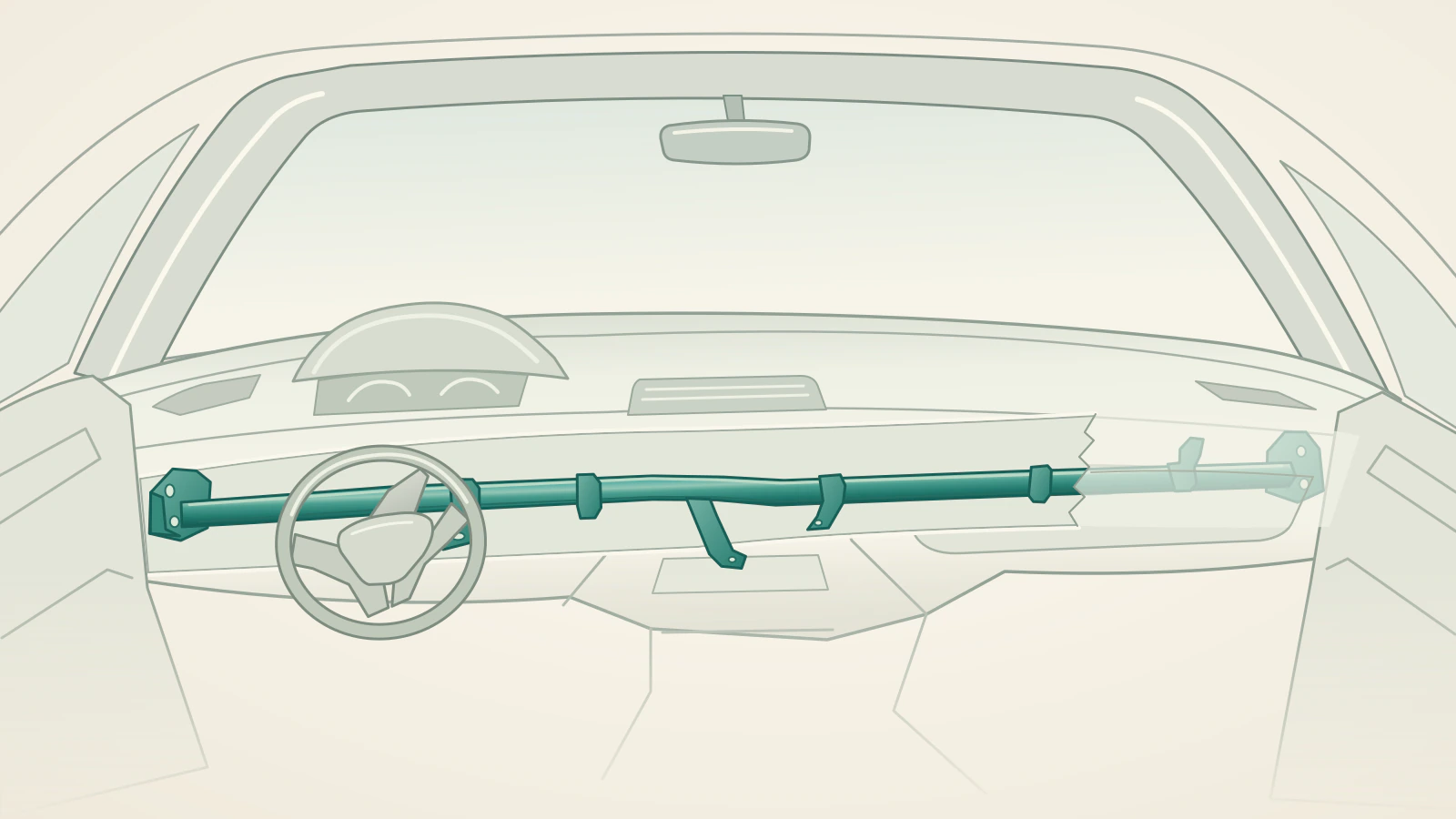
At BYD’s factory in Camaçari, Brazil, the beam behind the dashboard used to arrive ready to install. Then the shape of the shipment changed. Its pieces began arriving separately, and workers in Bahia took on the welding, assembly and calibration. On June 4, 2026, the plant’s quality team inspected the first batch. Bahia’s account of the beam line
Five months later, a family collected an Atto 2 at a dealership near São Paulo. BYD counted it as its 200,000th car sold in Brazil that year. For a parts maker in Bahia, a market that size raises a more specific question. How much of the work will BYD bring into its own factory, and which parts might it order from a plant nearby? BYD’s November sales announcement
What changed behind the dashboard
The beam runs across the cabin and provides mounting points for the steering column, the brake pedal and the airbag. Their position helps explain why the new work in Bahia included more than joining pieces of metal. The line had fixtures to hold the pieces in place, robots to weld them and equipment to align and calibrate the assembly. Under the previous arrangement, someone else had already done those jobs by the time the beam reached Brazil. Bahia’s description of the component and equipment
The new line had a customer waiting in the same factory. Final assembly could start taking the beams once the quality team validated the process. Buying some of the pieces from Brazilian companies was a further goal. A worker in Camaçari could therefore gain responsibility for how accurately the beam fitted together while the plant still depended on shipments of its constituent parts. Bahia’s June 4 report
That October the same factory was testing welding on a different scale. To make a car body, presses first stamp sheet metal into panels. The body shop welds those panels together, and the shell goes on to the paint shop. On October 26, BYD said it was running final tests in welding and paint while construction continued on the stamping shop. The factory could already turn out finished cars as it learned to make more of each one. BYD’s October 26 factory update · Toyota UK’s guide to pressing, welding and painting
On October 29, reporter Natália Scarabotto saw workers in the paint shop handling body shells for the Atto 2. A few Mako pickup bodies also passed through during her visit, though the pickup had yet to enter regular production there. The plant added a third production shift on November 9. In announcing the extra shift, BYD said the welding and paint shops were still in their final tests. Scarabotto’s report for Automotive Business · BYD’s November factory update
Some of the suppliers were there first
For one component in Camaçari, BYD could look next door. When it invited Brazilian parts makers to apply to supply the plant in August 2025, it named its first approved supplier, the neighboring Continental tire factory. Continental had opened that factory in 2006. By January 2023 it had made 100 million passenger-car tires there. BYD was a prospective new customer for a tire maker that had been producing in Bahia for nearly two decades. BYD’s supplier announcement · Continental’s Camaçari production history
In Rayong, Thailand, a supplier relationship made the journey with BYD. Its passenger-car factory opened on July 4, 2024, with stamping, welding, painting and final assembly. Two weeks later, BYD and the auto supplier FORVIA opened a separate seat plant in Rayong. The two companies had formed a joint venture in 2017. Together they had already opened seven factories in China. FORVIA expected the Thai plant to start assembling complete seats a month after the opening, including sets for the Atto 3. The tire factory in Bahia predated BYD’s arrival. In Rayong, the seat factory was new, and it was the working relationship that BYD could bring from China. BYD’s Rayong factory announcement · FORVIA’s account of the seat plant and joint venture
For the car plant in Szeged, Hungary, BYD followed the supply chain one step further back, to the sheet metal itself. In June 2025 it named Austria’s voestalpine as a supplier. The steelmaker said it would fill the order for flat steel for car bodies and outer panels from Linz. BYD cited proximity as one reason for the choice. On a map of Europe that is regional sourcing. Draw the line at Hungary’s border and the same order calls for imported steel. BYD and voestalpine’s announcement
What stops coming through the port?
At the September 2026 opening of the Subang plant in Indonesia, BYD executive Luther Panjaitan told reporters that the company had stopped importing whole cars. Dealers would still sell through imported stock, he said, with fresh supply coming from domestic production. For someone choosing between a car on the lot and one still on order, the two could come from different countries. ANTARA’s interview at the Subang opening
In November, ANTARA reported that BYD had partnered with Indonesian suppliers for tires, glass and brake components. The September announcement told dealers where BYD would get their next cars. The November report identified some of the parts that Indonesian suppliers could sell to the plant. ANTARA’s November 13 report
Back in Bahia, the beam gives that distinction a physical shape. What used to cross the border was an assembly someone could fit behind the dashboard. By June it was a set of pieces that a team in Camaçari had to turn into that assembly. The next change to look for is a Brazilian supplier making one of those pieces. The beam could look identical in the finished car, and a different factory would have earned the order. Bahia’s account of BYD’s local sourcing plans