

AI-generated editorial illustration by China Made & Tech. It depicts no real operator, vendor, site, customer, coverage result, or security conclusion.
By China Made & Tech Team. Independent English field guide to China’s niche hardware brands, hidden champions, founders, factory towns, and supplier clusters.
China 5G is easy to make sound self-explanatory. A very large base-station count becomes a claim about Huawei. A subscriber figure becomes a claim about network quality. A factory list becomes a claim about productivity. A foreign restriction becomes a global security verdict. Each jump is understandable; none is licensed by the number alone.
The national record is substantial. China’s Ministry of Industry and Information Technology (MIIT) says there were 4.838 million 5G base stations at the end of 2025, including 2.064 million RedCap-capable stations. The same bulletin records 1.204 billion 5G mobile-phone users, or 65.9% of mobile-phone users. MIIT labels the 2025 data preliminary and states that its statistics exclude Hong Kong, Macao, and Taiwan. Those are useful facts about a named national statistical record. They do not identify which supplier sits in a particular radio network, measure a household’s experience, prove a factory’s return, or determine another country’s law.
That distinction is the point of this guide. The Chinese telecom industry is large enough that its figures often arrive in discussions that are actually about different objects: a carrier’s operations, an industrial deployment, a supplier’s position, or a policy response. Rather than turn a China-versus-Huawei debate into a single conclusion, this page uses four separate files:
- The national record: what a public count measures, when, and within which boundary.
- The operator-system record: what a named carrier says about its own network, customers, coordination, and operating context.
- The enterprise-workload record: what a named industrial project lists, and what must still be proved about the workload and outcome.
- The supplier-policy record: what a named jurisdiction required, for whom, in which network scope, and on what timetable.
The framework does not make a telecom decision for the reader. It gives a buyer, policymaker, analyst, or technically curious reader a safer next question. If the claim is national scale, open the national record. If it is about a carrier, ask for the carrier file. If it is about a factory, ask for the workload and acceptance evidence. If it is about Huawei 5G infrastructure or another supplier, open the jurisdictional policy and architecture file. The most important discipline is refusing to use one file as a substitute for another.
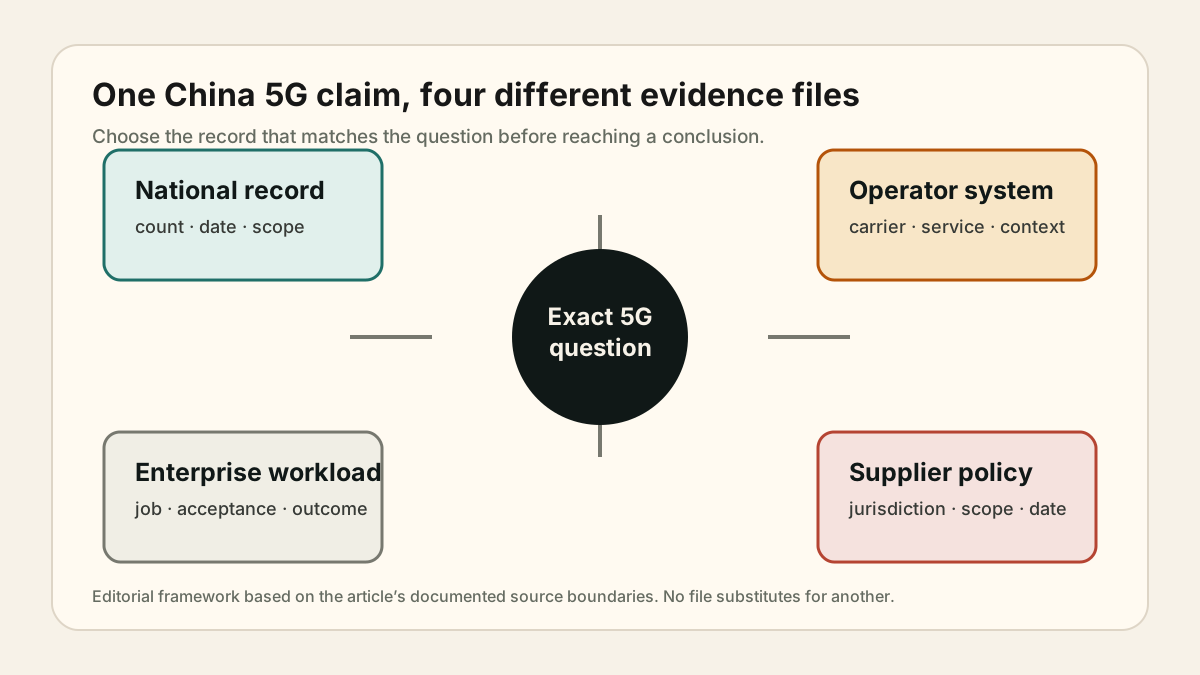
Editorial evidence map. The four files are distinct reading lenses, not a network architecture, compliance path, or vendor ranking.
China’s 5G scale is real. It is not a universal answer.
The first useful move is to read the unit before reading the headline. “China has X 5G” can mean a base station, a mobile-phone user, a connection, a technical capability, a city with a commercial service, a private-network project, or a company disclosure. These are related descriptions of a telecom ecosystem, but they answer different questions.
MIIT’s end-2025 count of 4.838 million is a count of 5G base stations. A base station is not a subscriber, a handset, a SIM, a connection, an equipment unit, or a supplier share. The figure is impressive precisely because it describes physical network rollout at national scale. It can support a statement such as: China had a very large recorded 5G base-station footprint at the stated date. It cannot, by itself, support: Huawei supplied all, most, or a stated share of that footprint; users receive a particular speed; a network is secure; a particular customer deployment will work; or every location has equivalent service.
The 1.204-billion figure has a different object. MIIT calls it 5G mobile-phone users and gives the proportion—65.9%—of mobile-phone users. It is an adoption-style measure within the ministry’s published statistical boundary. It should not be silently converted into the number of individual people, into active data sessions, into a test of phone quality, or into a global connection statistic. A country can have many mobile subscriptions, varying patterns of device replacement and use, different tariff definitions, and urban-rural differences that one total does not show.
RedCap makes the same point in miniature. MIIT records 2.064 million RedCap-capable 5G base stations, equal to 42.7% of its 5G base-station total. That is a technical capability count. It is not an assertion that every such site has a particular enterprise device connected, that a specific industrial application has been commissioned, or that a given buyer can reproduce the outcome. The number is useful when the question is capability rollout. It needs other records when the question is workload adoption.
The following table keeps the measures in their own lanes.
| Record and date | What is counted | What the count can establish | What it cannot establish on its own |
|---|---|---|---|
| MIIT, end-2025 | 4.838 million 5G base stations | National physical rollout scale within the stated statistical boundary | Supplier allocation, local experience, security, or equipment quality |
| MIIT, end-2025 | 1.204 billion 5G mobile-phone users; 65.9% of mobile-phone users | A named national mobile-user measure | People, active usage, global connections, or carrier performance |
| MIIT, end-2025 | 2.064 million RedCap-capable 5G base stations; 42.7% of 5G stations | A recorded technical sub-scope of the base-station universe | RedCap workload, device uptake, or industrial results |
| GSMA, 2026 report | More than 40% of global 5G connections; a projection of more than 1.7 billion connections by 2030 | GSMA’s attributed market context and forecast | An MIIT user count, a vendor result, or a network test |
This may sound like excessive caution, yet it is the shortest route to a clear conclusion. The right interpretation is not “the data say nothing.” The right interpretation is: China has a large national rollout record, and the evidence needed for the next question depends on what that next question is. A research note about national policy can use the national count. A network procurement cannot stop there.
The boundary is part of the statistic, not fine print
A counted object has a scope. MIIT says its 2025 communications statistics are preliminary and exclude Hong Kong, Macao, and Taiwan. That scope note is not a weakness in the data. It is part of the definition that lets another reader understand what is—and is not—being compared. The same principle applies to period. “At end-2025” is not a claim about today’s live network configuration, the next operator report, or a future technology cycle.
Readers should therefore record four fields whenever they cite a China 5G number: publisher, object, date, and boundary. Add a fifth field—decision use—before allowing the number into a conclusion. A national planner may use it to describe rollout trajectory. An investor may use it as context for an operator question. A manufacturer may use it as a reason to investigate connectivity availability. None should use it as a shortcut to a vendor-specific or site-specific answer.
This habit resembles good sourcing practice in physical industry. A dense manufacturing ecosystem can be a meaningful explanation for rapid iteration and supplier discovery, as China’s industrial-cluster map explains. But a cluster is not proof that a particular factory can meet a particular specification. In the same way, China’s national 5G footprint is context for a carrier or enterprise inquiry, not proof that the individual inquiry has been answered.
China 5G is also not a proxy for a single supplier
The phrase “Huawei 5G infrastructure” commonly appears beside China’s national deployment figures. It can be a useful search phrase, but it combines at least two evidence tasks. One task is a national 5G count. The other is a supplier, network-layer, contract, configuration, or policy question. They need different proof.
If the reader wants to understand a supplier’s position in a named network, the needed material is more concrete: the operator, geography, RAN or core scope, equipment revision, integration partners, support terms, procurement date, maintenance arrangement, and any stated policy or contractual restriction. If the reader wants to make a security assessment, the needed material is different again: architecture, access model, update and vulnerability processes, audit scope, governance, applicable rules, and an assessment appropriate to the jurisdiction. None of those details can be read out of a national base-station total.
This is not a claim that suppliers are irrelevant. It is the opposite. Supplier questions are important enough to deserve their own record rather than a borrowed statistic. A four-file reading method keeps the supplier question visible while preventing it from consuming every other part of the Chinese telecom industry.
Move from national scale to the place where the decision happens
Most practical mistakes occur between a national statistic and a real location. A company may see China’s size and ask whether it can run a connected product at a warehouse, a mine, a plant, a port, a university campus, or a customer site. The useful answer does not start with the country total. It starts with a location and an intended service.
Write down the street address or geographic boundary, whether the service must work indoors or outdoors, the expected number and type of devices, the hours of use, and the consequence of a loss of service. Then identify whether the product needs public mobile access, a private-network arrangement, a managed enterprise offer, fixed wireless access, a local edge system, or something else. These choices affect the relevant carrier team, design, contract, installation, and test method. A base-station total can explain why a China inquiry is worth opening; it cannot select among those options.
The next question is measurement. “Coverage” can mean a signal indication, a completed data task, a throughput result, a latency observation, an application success rate, or an agreed service level. A useful site record says which one matters. If a vision system has to send video at a given time, a generic signal reading is insufficient. If a device sends a small periodic record, a maximum-speed test may be irrelevant. If a workflow controls a process, the failure behaviour, local fallback, and recovery procedure can matter more than the headline radio generation.
This is where a reader should ask the carrier, integrator, or product supplier for evidence in the same form as the decision. Request the date, device configuration, test location, test method, observed conditions, exceptions, and the person responsible for the result. Ask what changed between the test configuration and the proposed operating configuration. Ask whether the evidence covers a single trial, a network slice, a commercial plan, a public network, or a dedicated system. The goal is not to demand a theatrical amount of documentation. It is to stop a national fact from being misrepresented as a local commitment.
The distinction also protects the positive case for China’s network scale. A reader who asks for the correct local evidence is not dismissing the national record. They are using it in its proper role: a reason to investigate a defined operator and location, rather than a reason to assume the investigation is complete. That is a stronger and more durable way to discuss China 5G than either an unqualified superlative or a blanket sceptical response.
An operator network is an operating system, not a country total
Once the question moves from “How large is the national rollout?” to “What does a carrier operate?”, the evidence object changes. A carrier has customers, assets, shared arrangements, planning processes, operations and maintenance, spectrum context, commercial priorities, and internal reporting boundaries. A national number can frame that inquiry. It cannot describe all of those relationships.
China Mobile’s 2025 annual report provides a useful, clearly attributed example. The company says it had more than 2.77 million 5G base stations in operation, 640 million 5G network customers, and more than 57,000 5G industry commercial cases at the end of 2025. These disclosures are more detailed than a national total because they name the reporting company and the measures it chose to disclose. They remain China Mobile’s own disclosures. They do not independently audit service quality, identify every vendor and network layer, reveal a complete topology, or establish the outcomes of each reported commercial case.
That boundary matters for both critics and enthusiasts. An admirer should not turn a company’s customer count or industry-case count into proof that every listed use case produced a measurable return. A critic should not turn a limited public disclosure into proof that a network lacks a capability. The annual report supports a narrower but still valuable conclusion: a named operator reported a named set of network, customer, and commercial-case figures for its stated period.
The China Telecom–China Unicom co-build and co-share arrangement makes the operator layer even more visible. China Telecom’s 2025 annual report says its mechanism covers joint network planning and investment decisions, project acceptance, base-station location and equipment-type determinations, and operations-and-maintenance coordination. The company’s description of that co-build/co-share mechanism is useful because it shows why “China’s network” is not a single, unstructured object. An operating network involves choices and coordination that a national deployment figure does not disclose.
The same MIIT bulletin separately records 938,000 public-service data-centre racks supplied by the three basic telecom enterprises. That separate compute record is another warning against collapsing the system into a base-station headline. It does not tell us how any one network is configured. It does show that national telecom reporting contains distinct infrastructure objects that should not be substituted for one another.
What belongs in a named operator-system file
A real operator inquiry should begin with the question that prompted it. Is the reader evaluating coverage for a site? A wholesale or roaming relationship? An enterprise private-network offer? A managed-service contract? A security or lawful-access concern? A replacement or interoperability risk? The answer determines which fields belong in the record.
For a coverage or availability question, ask for the exact area, indoor or outdoor conditions, frequency band and device assumptions, measurement method, and date. A national base-station number cannot answer these. For an enterprise service question, ask for the service scope, SLA, responsibility boundaries, integration model, core-network location, management interfaces, support escalation route, and commercial terms. For a supplier question, ask for the relevant network layer and named components rather than treating “the carrier” as a single component.
For a shared-network question, ask who makes which decisions, how changes are accepted, what happens during an incident, which organisation owns an interface, and how maintenance responsibility is allocated. China Telecom’s public description gives a reader a reason to ask these questions; it does not answer them for a specific arrangement outside the information it discloses. This is the difference between using a record as a map and using it as an unsupported conclusion.
The operating-system perspective is especially useful for readers who arrive through hardware. A radio, device, router, industrial gateway, or component is not “inside China 5G” in a generic sense. It has to work inside a named operator context, with a named frequency, certification or compatibility position, provisioning method, security architecture, and support path. The product may be technically capable while still not fitting the requested service, contract, geography, or process.
That is also why broad comparisons with China’s manufacturing capacity need a separate hand-off. China’s manufacturing system can explain how suppliers, component ecosystems, and iteration interact. It cannot prove a carrier’s current configuration, supplier mix, or operational performance. A useful guide preserves that distinction rather than making every Chinese industrial strength a telecom conclusion.
Use a disclosure ladder, not a single source
Operator annual reports are often the public starting point because they reveal named, dated measures at a useful level of detail. They should be the beginning of a disclosure ladder rather than the end. At the first level, identify what the operator itself reported: network counts, customers, service categories, shared-network arrangements, or industry cases. At the second level, identify the relevant commercial or technical document: an enterprise offer, compatibility statement, contract, service description, or product specification. At the third level, collect the evidence closest to the proposed use: a site design, commissioning record, test, acceptance report, incident process, or change-control record.
Each level reduces ambiguity in a different way. An annual report is broad and dated but cannot usually describe a buyer’s configuration. A product or service document may be closer to the offer but can still leave out the local environment. A test or acceptance record can be closest to the operating condition, but it is meaningful only when its method and boundary are documented. The reader needs the layers to agree, or at least to understand why they differ.
Consider a company evaluating a connected industrial device. A national statistic shows that China has a large 5G footprint. A carrier disclosure may show that a named operator has a large network and industrial activity. A service document might explain the available plan or enterprise arrangement. A site record might show whether the device, building materials, antenna placement, application traffic, local compute, and workflow delivered the expected result. None invalidates the others. They simply make different claims.
This ladder is also the right place to handle uncertainty. If a supplier cannot disclose a vendor mix, that absence should be written as an absence rather than converted into a guess. If a public report does not state a local coverage condition, do not fill the gap with a country average. If the test is old, or the equipment revision differs, record that the result may not transfer. A well-run decision can proceed with uncertainties, but it should make them visible and assign an owner for resolving them.
For an analyst, the ladder prevents a familiar but weak form of argument: citing a national count, an operator marketing statement, and a policy headline as though they all independently prove the same conclusion. They do not. When the records point to different layers, that is not an inconvenience. It is evidence that the real decision has multiple owners—network, product, operations, security, compliance, and finance—and needs a structured hand-off between them.
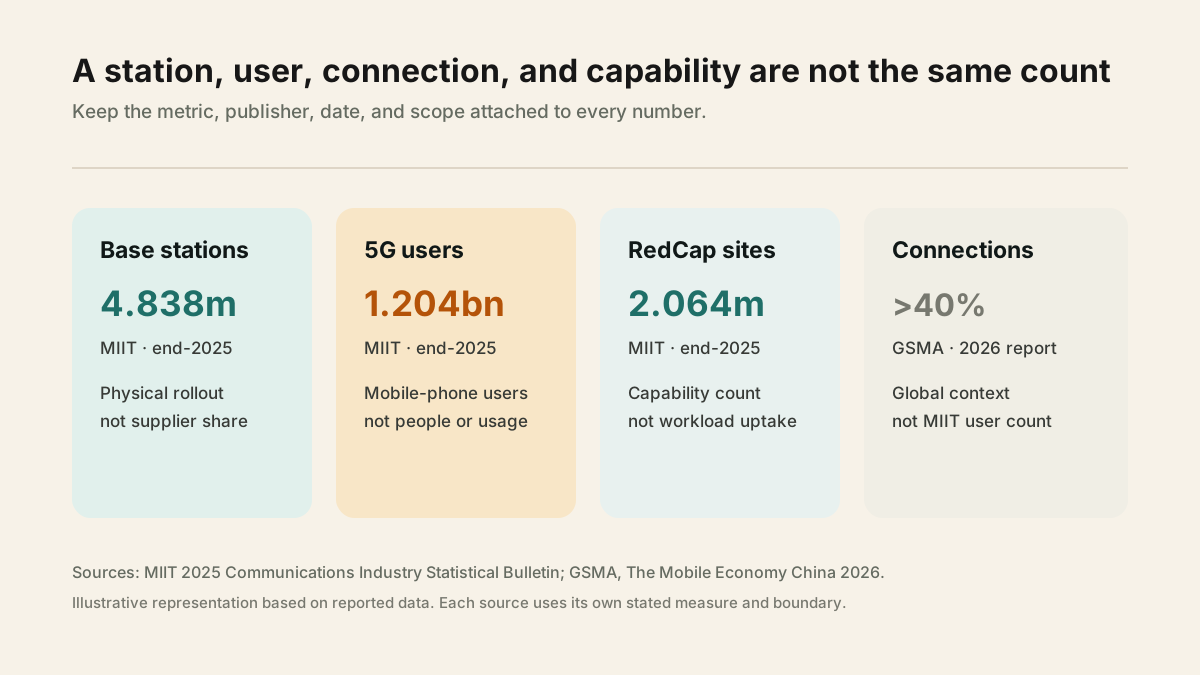
Editorial metric map. Each count answers a different question and should retain its original publisher, date, and scope.
An industrial 5G claim needs a workload file after the network file
The next category error appears in industrial use. A reader sees “5G factory,” “smart mine,” “port automation,” or “private network” and assumes the network label establishes an outcome. It does not. A connectivity deployment can be necessary for a workload and still be insufficient to prove productivity, reliability, safety, financial return, user adoption, or operational fit.
MIIT’s 2025 5G Factory Directory is helpful because it is an official record with an explicit boundary. The ministry says local recommendation, expert review, and public notice determined the directory, and it links the programme to the fully connected 5G factory guide. The directory notice is dated September 2025. Its appendix identifies named projects and includes fields such as project name, construction entity, cooperating operator, and location; the official directory appendix contains examples across industries, including mining and energy-related entries.
That lets the reader make a precise statement: the public record lists named projects after the stated selection process. It does not let the reader make a larger statement without more proof: every listed factory earned a particular return; the programme is representative of all Chinese industry; a project’s connectivity was the cause of a business result; or a buyer will obtain the same result by buying similar equipment.
The distinction matters because the term “5G factory” can hide a great deal of system design. One project may use connectivity for mobile inspection video. Another may connect a small number of devices across a controlled site. Another may integrate machines, edge software, identity systems, a control room, and a customer’s production metrics. The common 5G label does not tell a reader how much of the outcome is attributable to radio connectivity, how much comes from software and process redesign, or what conditions were necessary at the site.
Ask for the workload before asking whether 5G “worked”
An enterprise-workload file begins with a job, not a network generation. What must move, be seen, controlled, authenticated, recorded, or decided? How often? Under what latency, availability, privacy, environmental, and safety conditions? Which existing system receives the output? Who owns the exception when the connection, device, software, or process fails? A useful outcome measure emerges from those answers.
For example, a visual-inspection workload could need a mobile camera, an inspection route, a data path, a review queue, an asset-management system, storage rules, and a decision process for flagged images. The network is one contributor. A productive result might be measured through accepted inspection coverage, rework, false-positive handling, completion time, or avoided downtime—but only if the project defines the baseline and the measurement method. Listing the project in a directory is not the same thing as publishing those results.
Similarly, a mining or energy project may have site-specific physical constraints, safety procedures, control interfaces, equipment vendors, and operating conditions that are invisible in a directory row. A named carrier partner shows that an operator is associated with the entry. It does not name every integrator, explain the network design, or prove a particular operational outcome. The right next request is a project file: the workload, architecture, interfaces, operating owner, acceptance criteria, baseline, period of observation, and exceptions.
This is not an argument against using the directory. It is a way to use it honestly. The directory is an efficient discovery tool. It can tell a reader that a named project exists in an official list and whom the record names as construction entity or cooperating operator. It can suggest a category worth investigating. It should trigger diligence rather than complete it.
The same discipline is valuable across smart manufacturing. A buyer’s smart-manufacturing evidence guide makes the broader point: traceability, quality closure, change control, scheduling, data access, and factory-floor proof are separate questions. 5G may sit inside that system, but it does not erase the need for evidence about the rest of it.
The minimum industrial hand-off
Before treating an industrial 5G story as transferable, request at least the following:
- the named workload and the decision it is meant to improve;
- the site boundary, devices, radio and compute components, and integration points;
- the responsible operator and the responsible business owner;
- the pre-deployment baseline and the measurement period;
- the acceptance criteria, including what counted as a failed or incomplete outcome;
- the data, cyber, maintenance, and change-management responsibilities; and
- the condition under which the project would be expanded, paused, or unwound.
These questions do not require a reader to mistrust China’s industrial applications. They are the same questions that distinguish a demonstration from an operating system anywhere. They are especially important when an application is cited as evidence for a national technology story, because the national story can make a site-level outcome seem obvious before it has been measured.
Huawei policy is a jurisdictional file, not a global 5G conclusion
Huawei is central to much global telecom discussion, but the relevant evidence has to keep its jurisdiction. A national China 5G statistic cannot decide a foreign policy question. A foreign policy decision cannot decide China’s entire network configuration. Neither can replace an engineering or security assessment of a named deployment.
The United Kingdom’s public record is a clear example of what a supplier-policy file looks like. In October 2022, the UK government said it had issued legal directions to 35 operators requiring removal of Huawei equipment from UK 5G public networks by the end of 2027. The UK legal-notices statement also records immediate restrictions on new Huawei installations and other timetable elements. The useful statement is exact: this was a UK framework, aimed at named UK operators, with stated network scope and dates.
That record can support a discussion of UK policy, regulatory timing, transition planning, and the supplier question as it applied to those operators. It cannot establish a rule for a buyer in another country. It cannot, on its own, provide a universal technical conclusion about all Huawei equipment, every network layer, or every deployment. A reader considering a different jurisdiction needs that jurisdiction’s current law, regulator position, operator conditions, contractual requirements, and threat or risk assessment.
The UK’s later policy material also complicates the easy version of a restriction story. Its 2025 response on telecom supply-chain diversification says concentration exists across the radio access network (RAN), mobile core, and subcomponents, and notes that removal of high-risk vendors has exacerbated short-term concentration risk. The government’s response is not a global policy template. It is a useful reminder that restricting a named supplier does not make questions about architecture, substitutability, component concentration, timing, skills, and migration disappear.
A restriction is a decision with layers
The policy file should identify at least six things. First, the jurisdiction and legal instrument. Second, the affected organisation or class of operators. Third, the network layer or equipment scope. Fourth, the effective date, interim controls, and final deadline. Fifth, the operational transition problem: replacement, support, integration, testing, and continuity. Sixth, the remaining concentration or dependency question after the decision.
The UK case shows why this granularity matters. “Banned” can obscure whether a rule affects new installation, core equipment, a public network, a defined date, or a named class of operators. It can also obscure the cost and sequencing of change. A decision may reduce one risk while exposing a new sourcing or concentration constraint. Those are not arguments for or against a particular policy; they are the questions needed to understand the policy that actually exists.
For a buyer, the correct supplier-policy hand-off may involve legal counsel, a compliance team, a security function, an operator, and an engineering owner. The record should name the product or component, where it will be used, who operates it, what data and management access are involved, which standards or rules apply, and what lifecycle commitments exist. A one-sentence claim about China 5G, Huawei, or a national restriction cannot provide that information.
This is also where time matters most. MIIT’s annual statistics, an operator’s annual report, a project directory, and a policy response change on different schedules. A 2025 national record may remain good context after a newer operator configuration has changed. A 2022 legal direction may remain operative while the implementation details and commercial effects evolve. A responsible reader records the source date and asks what must be refreshed before acting.
Open the exact file for the question you actually have
The four-file method is deliberately simple. Its value comes from stopping false hand-offs before they happen. Start by writing the decision in one sentence. Then choose the record that can actually answer it.
| If the real question is… | Start with this file | Ask for these fields | Do not substitute |
|---|---|---|---|
| How large is China’s 5G rollout? | National record | Publisher, metric, period, geography, scope note | A vendor claim or an individual test |
| What does a carrier operate or disclose? | Named operator-system record | Operator, network layer, geography, customer/service scope, date, attribution | A national base-station total |
| Did an industrial 5G deployment create a result? | Named enterprise-workload record | Workload, architecture, baseline, acceptance criteria, outcome period, owner | A factory-directory listing |
| What does a Huawei or supplier restriction require? | Jurisdictional supplier-policy record | Law or direction, operator class, network scope, dates, transition obligations | Another country’s policy or a national China statistic |
| Can a product be used in a particular network? | Product-and-operator compatibility record | Exact device, bands, certification, provisioning, support, configuration, contract terms | A generic “China 5G” narrative |
The method also improves ordinary writing and research. Instead of saying “China dominates 5G,” a writer can state which metric, period, and publisher they mean. Instead of saying “Huawei is banned,” they can name the country, legal direction, affected scope, and deadline. Instead of saying “5G factories prove industrial leadership,” they can identify a directory record and explain what outcome evidence would still be needed. Precision does not weaken the story. It gives the story a claim that a reader can check.
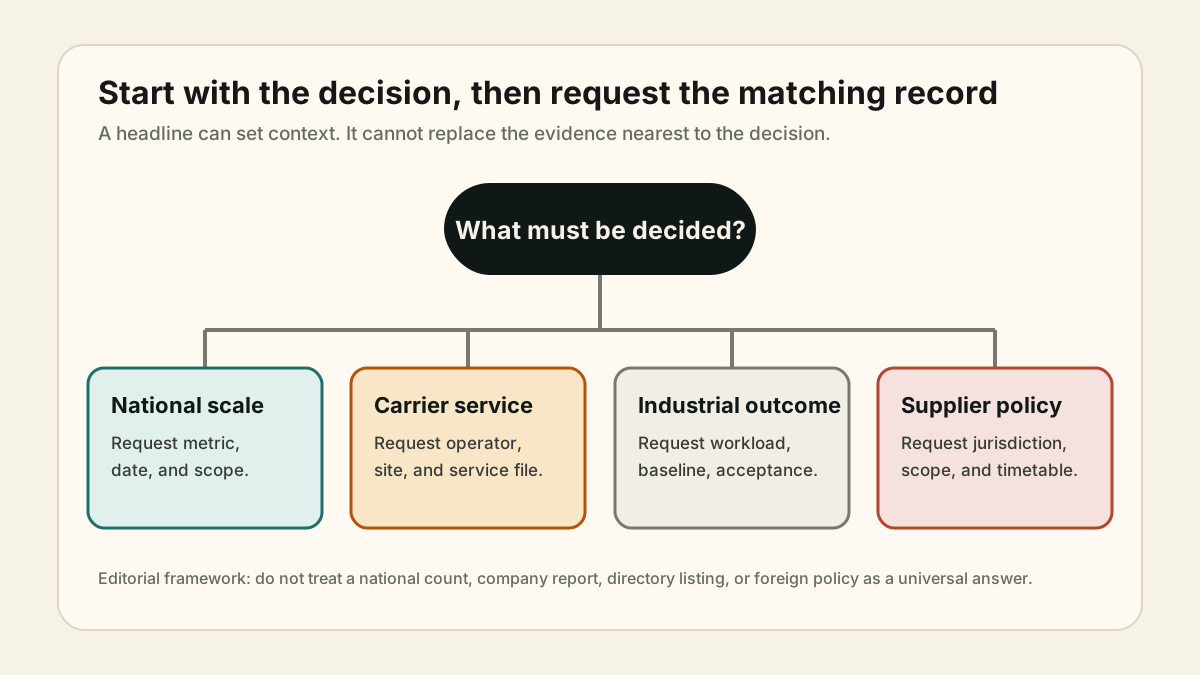
Editorial decision map. It selects an evidence file; it does not decide technical compatibility, legal compliance, or supplier suitability.
What should be refreshed next?
Review the national record when MIIT publishes the next annual bulletin or revises the preliminary series. Review carrier evidence when the relevant operator issues a new annual report, changes the named product or service, or discloses a material network development. Review an industrial story when the workload, site, operator, integration, or acceptance criteria change. Review supplier policy when the applicable regulator, law, deadline, guidance, contract, or operator requirement changes.
Those triggers are more useful than a generic “latest China 5G” search. They help a reader refresh the record that actually bears on the decision, rather than refreshing a headline that may only be background.
Frequently asked questions
How many 5G base stations does China have?
MIIT’s preliminary end-2025 bulletin records 4.838 million 5G base stations, excluding Hong Kong, Macao, and Taiwan from its stated statistical scope. That is a national rollout measure, not a count of users, connections, devices, or supplier equipment shares. For a current decision, check whether a newer MIIT bulletin or a relevant operator record has superseded the context.
Does China’s 5G scale prove Huawei’s market position or network quality?
No. A national base-station count does not identify the supplier or configuration in a particular network, and it does not measure local performance, cybersecurity posture, or procurement suitability. A supplier or quality question needs a named operator, network layer, location, equipment and configuration, plus the appropriate technical, commercial, and policy evidence.
Are 5G factory directories proof that 5G improves productivity?
No. MIIT’s directory is useful evidence that named projects were listed after the stated selection process and that the appendix names project entities, cooperating operators, and locations. It is not a comparable productivity, ROI, safety, or quality dataset. Ask for the workload, baseline, integration design, acceptance criteria, and outcome period before transferring an industrial claim.
What did the UK require regarding Huawei in 5G networks?
The UK’s 2022 legal-notices statement says 35 operators were directed to remove Huawei equipment from UK 5G public networks by the end of 2027, under a UK-specific framework. It should be read as a UK policy record with named scope and dates, not as an automatic statement of another country’s law or of every technical risk in every deployment.
Method and limitations
This is a desk-research reading guide. It uses MIIT’s 2025 communications bulletin and 5G Factory Directory, China Mobile and China Telecom annual reports, GSMA’s 2026 China report, and UK government policy records. The team did not operate, measure, audit, secure, procure, design, certify, or manage any 5G network, spectrum licence, carrier core, radio installation, or industrial private-network deployment.
The article deliberately does not estimate vendor market share, rank equipment, test speeds, assess cybersecurity, judge a factory’s financial return, or give legal or procurement advice. National statistics, company reports, directories, and foreign policy records are used only for the claims they directly support. A real deployment or supplier decision needs current, jurisdiction-specific technical, commercial, legal, and operational evidence.