
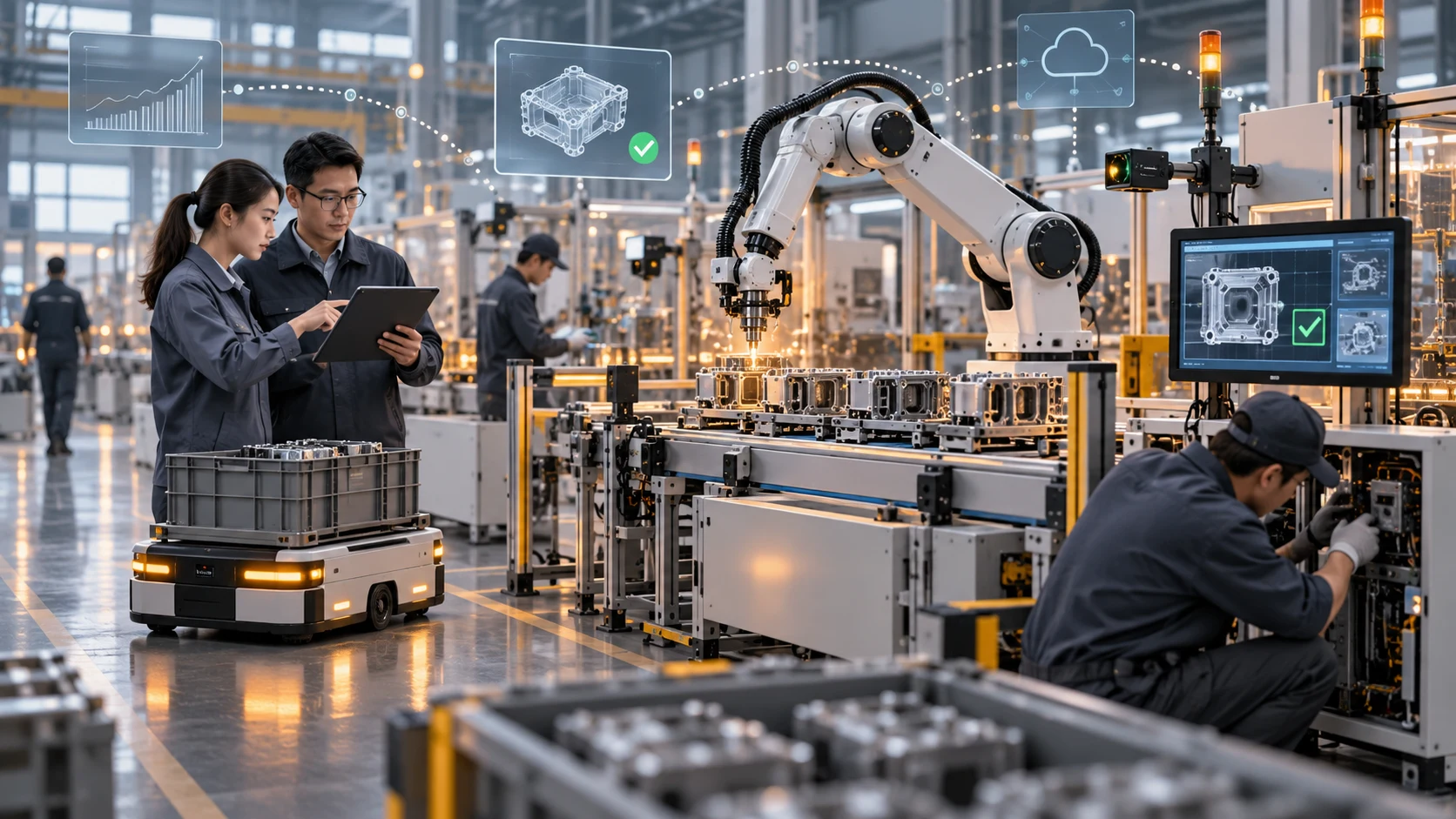
China's factory-automation story is often reduced to one number: how many industrial robots the country produces or installs. That number is useful as a signal of equipment demand, but it does not tell a factory whether automation has improved quality, lowered cost, protected workers, increased flexibility or created a new cybersecurity risk.
The National Bureau of Statistics says that industrial-robot output rose from 218,000 sets in 2020 to 773,000 sets in 2025. It also says applications expanded from welding, painting and handling into precision assembly, polishing and quality inspection. The direction matters: automation is moving from obvious repetitive motion into tasks that depend on measurement, control and process data.
At the policy level, the Ministry of Industry and Information Technology reports 421 national smart-manufacturing demonstration factories, more than 10,000 provincial smart factories and 72 Chinese lighthouse factories in its cited 2025 summary. These are program counts with different definitions. They show an organized transformation effort, not equal digital maturity across every plant.
The useful question is therefore not whether China is replacing workers with robots. It is how factories redesign work. A successful upgrade combines machines, process engineering, sensors, industrial software, maintenance, quality systems, worker training, supply-chain data and management discipline. A robot may be the most visible part of the investment and still be the least important part of the operating change.
The broader How China Manufactures: Inside the World's Factory (2026) provides the industrial context. This article follows automation from the task level to the national program level and asks what evidence would show that a factory is genuinely more capable.
From robot count to factory capability
Automation becomes meaningful only when a factory can connect a task to a measured outcome. The path runs from the work cell to the line, from the line to data and control, and from plant-level evidence to the policy and supplier systems that can repeat it. The sections in this block define the measures before discussing the technologies.
Automation starts with a task
A factory does not automate “production” in the abstract. It automates a task: moving a part, applying a weld, checking a dimension, loading a machine, mixing materials, inspecting a surface or packing a product. Each task has a cycle time, variation, safety risk, information requirement and economic value.
A robot is attractive when the task is repetitive, structured and measurable. It may also be attractive when the task is dangerous, hot, dirty or physically difficult. A vision system is useful when a defect can be defined and measured. An automated guided vehicle is useful when material movement is regular enough to plan and the factory floor supports safe navigation.
Automation is harder when the part varies, the process depends on touch or judgment, the product changes frequently or the work environment is poorly organized. A company may need to redesign the part, build a fixture, standardize materials or improve upstream quality before a robot can create value.
The first question for any automation claim is therefore: Which task changed, and what measured outcome improved? Without that question, “smart factory” can mean anything from one automated station to a fully integrated production system.
Robot output is not robot productivity
The 773,000-set production figure from the NBS report is an important industrial statistic. It shows that China has a large robot manufacturing base and growing demand for equipment. It does not say how many robots are operating, how often they run, what tasks they perform or whether the factory's output per worker improved.
A robot can be installed and left underused because demand is weak, the line is not ready, parts are inconsistent or staff have not been trained. A robot can run at a high speed and create a bottleneck downstream. A robot can reduce manual handling while adding maintenance and programming costs. The economic result depends on the complete line.
Productivity needs a denominator. It may be accepted units per hour, output per labor hour, value added per shift, energy per unit, rework per thousand units or cost per completed order. The chosen measure should match the factory's objective.
Quality also matters. If a robot raises gross output but increases rework, scrap or warranty claims, the apparent productivity gain may be illusory. The same machine can deliver different results in factories with different fixtures, materials, software and maintenance.
Robot production is an input indicator. Factory performance is an operating result.
Smart factories add data to automation
Traditional automation can operate a machine without knowing much about the rest of the factory. Smart manufacturing connects equipment, process data, production orders, quality records, maintenance and supply-chain information. The purpose is to make the factory more visible and more controllable.
The national smart-manufacturing plan describes a system involving processes, equipment, data, factories, supply chains, industrial software, standards and cybersecurity. That definition is useful because it prevents a factory from being judged by equipment alone.
The same national smart-manufacturing plan set 2025 targets for 70% of above-scale manufacturers to basically achieve digital and networked transformation and for more than 500 demonstration factories to be built. Those were policy targets, not completed outcomes established by this article.
A machine can report its status. A manufacturing execution system can connect an order to a work instruction. A quality system can connect a measurement to a part and a finished product. A maintenance system can detect a failure pattern. A supply-chain platform can provide a warning when a material is late or a batch changes.
The value appears when the information changes a decision. A supervisor stops a line before a defect spreads. A maintenance team replaces a component before a failure. A planner changes the sequence to use scarce equipment better. An engineer identifies a process variable that affects yield.
Data without action creates a more expensive dashboard. Smart manufacturing requires organizational authority to respond to what the data shows.
The factory is a hierarchy of control
Automation works at several levels. A sensor and controller manage a process. A machine cell coordinates a group of tools. A production line manages flow and buffers. A workshop schedules orders and people. A factory integrates quality, logistics, maintenance and energy. A supply chain coordinates suppliers and customers.
The levels need clear interfaces. If a line can detect a defect but the quality system cannot stop the affected order, the data is trapped. If a factory planner cannot see a machine's actual availability, the schedule becomes optimistic. If a supplier changes a material without updating the product record, the production data becomes unreliable.
Integration does not mean every system must be replaced with one software package. It means the identity, timing and meaning of data are consistent enough to move between systems. A part should be traceable from supplier to process station to finished product. A machine state should be understood by maintenance and planning teams.
This architecture is difficult because factories accumulate equipment from different generations and vendors. Old machines may lack interfaces. New software may need to work with local controllers. Cybersecurity rules may restrict connections. The upgrade often begins with gateways, sensors and data models before it reaches advanced analytics.
The factory that connects old and new equipment can gain more value than a new factory with isolated high-end machines.
Why the policy counts matter
China's smart-manufacturing programs create demonstration sites, standards, funding channels, supplier demand and a language for measuring transformation. The MIIT summary says 421 national demonstration factories had been cultivated and more than 10,000 provincial smart factories built, while also setting a broader agenda for digital transformation, industrial internet, AI and high-standard parks.
These programs can reduce the risk for a factory considering automation. A demonstration plant provides a reference design. A supplier can adapt its equipment to a known scenario. A city can support networks, training and financing. An industry can develop common methods.
Programme labels still need careful reading. National demonstration, provincial smart factory and lighthouse factory are different categories. A designation may recognize a successful project, a specific line or a broader factory system. It does not mean every process is automated or that the site is profitable.
The program count is most useful as evidence of institutional scale. It shows that transformation is being organized across industries and regions. Plant-level analysis must still ask which tasks changed, what data is connected and whether output or quality improved.
Acceptance criteria are more useful than publicity
The five-department smart-factory acceptance notice lists outcomes such as production efficiency, resource use, equipment use, labor productivity, product-development cycle, operating cost, defect rate, energy consumption, labor optimization and network security.
This is a better assessment frame than robot count because it asks what the factory achieved. A factory can use few robots and still have strong process data, quality control and flexible work design. Another factory can have many robots and weak results because the system is poorly maintained or badly integrated.
Quality indicators should include first-pass yield, rework, scrap, defect escape, warranty returns and process capability. Availability indicators should include downtime, mean time between failures, mean time to repair and planned maintenance. Labor indicators should include training, safe work, decision authority and output per labor hour.
Energy and resource indicators matter as well. A machine that raises output but increases energy per unit may not fit the factory's objectives. A water-intensive process may need recycling or monitoring. A smart factory should measure environmental performance with the same discipline as production performance.
Cybersecurity belongs in the acceptance criteria because an interconnected factory can be disrupted through software, credentials, networks or suppliers. A factory that cannot restore control after a cyber incident is not fully resilient.
From automated cells to a production operating system
The next question is whether the capability survives ordinary factory conditions: product changes, small production runs, equipment failure, supplier variation, staff turnover and cyber incidents. Machines, software, workers and suppliers have to be treated as one operating system. Each subsection below adds a constraint that determines whether automation keeps delivering after installation.
The first wave automated the obvious work
Welding, painting, handling and palletizing are natural starting points. The task is repetitive, the position can be defined and a machine can operate in a controlled space. These applications remain valuable because they improve safety and consistency.
The NBS report describes expansion into precision assembly, polishing and quality inspection. These tasks are harder because the machine needs finer control, better sensing and more reliable data about the part. The factory may need a robot with force feedback, a vision system, a calibrated fixture or an AI model trained on a large set of acceptable and defective examples.
Inspection is particularly important. A camera can inspect every part faster than a human in some conditions, but it needs stable lighting, a defined defect taxonomy and a response when the result is uncertain. An AI system that rejects too many good parts increases cost. One that misses rare defects creates risk.
Advanced automation should therefore be assessed as a measurement system. What does it observe? What tolerance does it use? How are false positives and false negatives handled? Who reviews ambiguous cases? How is the model updated when the product changes?
The shift from motion to judgment is where factory data becomes an engineering asset.
Automation redesigns work
Automation changes jobs unevenly. It can remove repetitive lifting or dangerous exposure. It can reduce the number of operators at one station while increasing demand for technicians, programmers, quality engineers, maintenance workers, logistics planners and data specialists.
The work may become more cognitive and more dependent on systems. An operator may supervise several machines, respond to alarms and verify exceptions. A maintenance worker may read diagnostic data, replace sensors and update software. A quality worker may analyze process distributions instead of inspecting every part visually.
The transition can fail if the factory installs equipment without building skills. Staff need training in safe operation, troubleshooting, high-voltage systems, networks and software changes. Managers need to know which decisions remain human and which can be delegated to an automated system.
Worker redesign should be measured through training hours, new job categories, incident rates, decision time, maintenance capability and the ability to run the process on a night shift without a small group of experts. A factory dependent on one programmer is not robust.
Automation can also improve the quality of jobs. Removing strenuous tasks and giving workers better tools may reduce injury and fatigue. The benefit is strongest when workers participate in process design and can stop a line when safety or quality is at risk.
The social effect is not captured by a simple headcount comparison.
Small factories face a different calculation
Large factories can spread the cost of robots, sensors, software and engineering teams across high output. Small and medium manufacturers may have lower volumes, more product variety and less capital. Their automation route often begins with a specific bottleneck rather than a complete smart-factory transformation.
A small factory may automate material handling, inspection, welding, packaging or machine loading. It may rent equipment, use a systems integrator or join an industrial park platform. The business case depends on changeover time, operator availability, quality requirements and customer standards.
The city pilot for manufacturing technology upgrades includes network upgrades, 5G, industrial internet, AI, robots, smart inspection and logistics. A city approach can lower the barrier to adoption by providing shared services, financing, training and qualified suppliers.
The risk is that a small company buys a system it cannot maintain. A robot may need programming changes when a customer changes a part. A vision system may need retraining. A networked machine may need security updates. The factory needs a supplier relationship and internal owner for the system.
The right small-factory strategy is often modular. Start with a task that has a clear return, design the data interface, train the team and expand only after the process is stable. Automation should solve a production problem rather than create a technology showcase.
Flexible production makes automation harder
Automation is easiest when a factory builds one product in high volume. Chinese factories often face a different market: many models, short product cycles, export variants and frequent engineering changes. A rigid automated line can become a constraint.
Flexibility requires programmable tools, quick-change fixtures, modular software, accurate material identity and a production schedule that can handle variants. The factory must know which tool, part, firmware and inspection rule applies to each order.
A human operator can sometimes adapt quickly to a change. A robot may need a new program, fixture or safety validation. Automation economics should therefore include changeover and engineering time, not only cycle time.
The best solution may be hybrid. Machines handle repeatable force and precision. Humans handle exceptions, configuration and judgment. Software manages identity and records the result. The mix can change as volumes stabilize.
Flexible automation is a manufacturing capability rather than a percentage. It is the ability to change the product without losing safety, quality or cost control.
Maintenance is the hidden constraint
Every automated asset adds a maintenance requirement. Sensors become dirty. Grippers wear. Motors need service. Networks fail. Software versions drift. Batteries, compressed air and cooling systems affect machine availability.
Predictive maintenance can help when the factory has enough data and knows which signal predicts failure. A vibration pattern, temperature trend or cycle-time change may reveal a problem. But an alert is only useful if the team can respond before the line stops.
Maintenance planning should include spare parts, technician coverage, vendor response, safe isolation and a way to restore a known software configuration. A line with high automation and low maintenance readiness can be less reliable than a simpler line.
Availability also affects the labor case. If a robot fails and requires an external specialist for every repair, the factory may need more downtime than expected. A local maintenance team with diagnostic skills can turn the same asset into a stronger operation.
Factory automation should be judged by effective output across a shift or a month, including planned and unplanned downtime. A demonstration cycle is not an availability record.
Supply chains need digital coordination
Automation inside a plant does not protect a factory from an unprepared supplier. A line can stop because a sensor, connector, casting, packaging material or software license is late. A smart factory needs visibility beyond its own gates.
Supplier data can include forecasts, capacity, quality, lot identity, delivery status and engineering changes. A supplier portal can connect a part to a production order and a customer shipment. A digital twin can test a change, but only if the input data is accurate.
The more connected the supply chain, the more important access control and data ownership become. A supplier should see the information needed to fulfill the order, while sensitive product and customer data remain protected. Cybersecurity is a joint responsibility.
National and local smart-manufacturing programs emphasize supply-chain collaboration because a factory cannot optimize a line while upstream variation remains invisible. The real benefit appears when a late material or quality trend triggers a decision before the line stops.
The future factory is therefore a node in a network, not an isolated building full of robots.
AI changes the automation stack
AI can support visual inspection, demand forecasting, maintenance prediction, scheduling, process optimization and worker assistance. It can find patterns that are difficult to encode in fixed rules. It can also produce confident but wrong outputs.
An AI inspection model needs labeled data, a stable camera environment, a way to handle new defects and a human process for uncertain results. A maintenance model needs enough historical failures and a cost-effective action when an alert appears. A scheduling model needs constraints that reflect real materials, people and equipment.
AI should be introduced where the decision is measurable and reversible. A factory can test it on a non-safety-critical inspection task, compare it with a human baseline and monitor false results. It should keep a record of the model version and the data used.
The AI layer does not replace process engineering. If a fixture is loose or a material is inconsistent, a model may detect the symptom but not fix the cause. The factory gains more when AI supports engineers rather than disguises weak process control.
As automation becomes more intelligent, validation and governance become part of production quality.
MES is the factory's operating memory
A manufacturing execution system, or MES, records what should happen, what did happen and what happened to the product afterward. It can assign work, identify material, record process parameters, manage instructions and create a history for quality and service.
Without that memory, automation can make a factory faster while making mistakes harder to trace. A machine may complete a cycle, but the system may not know which part was installed, which software version was loaded or whether a tool was properly calibrated. When a customer reports a failure, engineers have to reconstruct events from paper records or separate databases.
MES projects often fail because the factory starts with software screens instead of process definitions. The team needs to agree on part identity, work status, quality gates, exceptions and ownership. It must also decide which data is required in real time and which can be summarized later.
An MES does not need to control every machine to create value. It can begin with a critical line or a product with strict traceability. The factory can then add maintenance, energy, supplier and customer records as the team learns what decisions need better information.
The operating memory becomes especially valuable when products are customized or exported. Each configuration must be linked to the correct regulations, components, software and test results. Traceability is a competitive capability when customers care about reliability and rapid service.
Data islands are an economic problem
Factories often buy equipment from different vendors at different times. Each machine may have its own controller, data format and maintenance software. The result is a set of data islands: the machine can be automated, but the factory cannot easily compare or coordinate it.
Data integration costs money. The factory may need gateways, sensors, historians, middleware, cybersecurity controls and staff who understand both production and software. It may have to replace obsolete controllers or build a digital layer around them. The return depends on whether the connected data improves a decision.
The first high-value connections are usually near bottlenecks. If an expensive machine causes downtime, connect its status to maintenance and planning. If defects appear late, connect process settings to quality results. If material shortages stop the line, connect supplier status to the schedule.
An all-at-once transformation can overwhelm a factory. A staged project gives the team a chance to prove a data model, train users and refine the interface. The goal is not to collect every signal. It is to make the important signals trustworthy.
Data islands also create organizational boundaries. Production may own machine data, quality may own inspection data, maintenance may own failure data and IT may own the network. A smart factory needs common definitions and an authority that can resolve conflicts.
The most advanced system is often the one that makes a few important decisions more reliable, not the one with the largest data lake.
From operating system to durable factory value
Automation creates a durable advantage only when the operating system can be financed, maintained, secured and transferred. Factory type and region change the business case; energy and cybersecurity add constraints; a roadmap and explicit proof standards determine whether one successful line can become a repeatable method.
Investment returns vary by factory type
A high-volume automotive line can justify expensive automation because the same task repeats many times. A low-volume equipment manufacturer may need flexibility more than speed. A food factory may prioritize hygiene, inspection and traceability. A chemical plant may value process control and safety. A warehouse may value travel reduction and inventory accuracy.
The payback calculation must include more than labor saved. It should include equipment, integration, tooling, software, training, maintenance, energy, floor space, downtime, financing and expected life. It should also count quality improvement, reduced injury, faster changeovers, better delivery and avoided recalls.
A machine can have a long payback and still be strategically necessary if customers require traceability or if a hazardous task is becoming difficult to staff. Conversely, a fast payback estimate can be wrong if it assumes perfect uptime or ignores the cost of engineering changes.
The factory should compare alternatives. A low-cost fixture may solve the problem. A process redesign may remove the task. A worker-assist tool may reduce injury without full automation. A robot may be best when volumes are stable and quality variation is expensive.
Return on automation is therefore a management decision tied to the product roadmap. The right investment changes when the factory moves from one model to five, from domestic orders to exports or from stable volume to demand uncertainty.
Regional factories will automate differently
China's manufacturing regions have different industry mixes, labor markets, supplier bases and energy costs. A coastal electronics plant may have dense automation suppliers and high product variety. An inland heavy-industry plant may focus on equipment reliability, logistics and hazardous work. A small county factory may need shared services and affordable integrators.
The same national policy can produce different factory results. A city with a strong university and robotics cluster can support custom engineering. An industrial park with many small suppliers can support shared testing and maintenance. A remote plant may need simpler systems that local technicians can repair.
Regional differences also affect the worker transition. A city with more technical jobs can help workers move into maintenance and programming. A region with fewer alternatives may need training, wage support and supplier development to avoid a sharp employment shock.
Automation can encourage factory relocation when a site no longer needs a large pool of labor. It can also attract suppliers and create technical employment near the plant. The local outcome depends on what happens after the equipment arrives.
Factory comparisons should therefore state the industry, location, product, scale and starting condition. “China's factories” are not one operating environment.
Green manufacturing gives automation another return
Automation can reduce waste and improve energy control, but it can also add electricity demand, compressed air, cooling and equipment embodied energy. The environmental result depends on the process and the product.
A smart factory can measure energy by line, machine, order or unit. It can detect compressed-air leaks, schedule high-load equipment, reduce idle time and coordinate storage or onsite power generation. It can connect production planning to energy prices and carbon reporting.
Quality improvements can have a large environmental effect. A part that fails late in production has consumed more energy and material than a part rejected at the first process. Better inspection and traceability can reduce scrap, rework and unnecessary transport.
Green claims should identify the boundary. Is the factory measuring direct emissions, purchased electricity, water, material yield or the full product life? A robot does not automatically make a product low-carbon. It can, however, provide the control and data needed to improve resource use.
Energy and resource data also support finance and customer requirements. Export buyers may request product footprints. Local governments may set energy or emissions goals. An automated line with reliable measurement can respond more quickly than a factory that estimates from a monthly meter.
The environmental payoff is strongest when process engineers and energy managers work from the same production data.
Cybersecurity is part of machine safety
Connected machines create a new failure surface. A weak password, unpatched controller, exposed remote-access tool or compromised supplier account can interrupt production or alter a process. The effect may be lost output, a defect reaching the customer, equipment damage or a safety incident.
The acceptance framework for smart factories explicitly includes network security. That is a reminder that digital transformation cannot be separated from operational risk. The factory needs asset inventories, identity management, network segmentation, backups, monitoring, incident response and a safe way to restore machines.
Security measures must fit production reality. A controller cannot always be patched like an office computer. A line may operate continuously. A vendor may need remote access for maintenance. The factory needs a controlled process for exceptions, testing and emergency recovery.
Cybersecurity also reaches suppliers and cloud platforms. A factory should know who can access its data, which systems depend on an external service and how production continues if the connection is lost. It should test recovery rather than assume that a backup exists.
A secure factory is not a factory with no connections. It is a factory that knows its connections, limits access, detects abnormal behavior and can continue safely when a system is unavailable.
A practical automation roadmap has stages
The first stage is process clarity. Map the task, material, quality requirement, cycle time, safety risk and exception. Remove unnecessary movement or variation before buying equipment.
The second stage is measurement. Add sensors, traceability and a baseline for output, quality, downtime, energy and labor. If the factory cannot measure the starting point, it cannot prove the improvement.
The third stage is focused automation. Choose a bottleneck or hazardous task with a clear business case. Build the fixture, train the team, establish maintenance and run the new process through normal demand variation.
The fourth stage is integration. Connect the machine to production, quality, maintenance and material systems. Define data ownership and access. Use the information to change a decision rather than only to display a metric.
The fifth stage is optimization. Apply analytics or AI where the data is reliable and the action is clear. Test false alarms, new products, software updates and recovery from failures.
The sixth stage is replication. Document the process, cost, assumptions, training and performance. Transfer it to another line or supplier only after confirming that the new setting is comparable.
This sequence is slower than buying a collection of machines for a showcase, but it creates a more durable capability. The factory learns what it needs before it scales.
It also gives workers, suppliers and customers a clearer view of what the upgrade is supposed to improve.
What would prove that automation created value?
The first proof is a clear task-level improvement: lower cycle time, safer work, better first-pass yield, less scrap, faster inspection or fewer unplanned stops. The factory should show the baseline, the intervention and the period over which the result persisted.
The second proof is system integration. Production orders, machine data, quality records, maintenance and supplier information should connect well enough to support real decisions. A dashboard is useful only when a team can act on it.
The third proof is worker capability. The factory should be able to train operators, maintain equipment, troubleshoot software and redesign work as the product changes. Automation that depends on one expert is a fragile asset.
The fourth proof is economics. Capital cost, service contracts, energy, software, training and downtime should be included. A robot that saves labor but adds unplanned downtime may not reduce total cost. A system that improves quality may be valuable even if the direct labor saving is small.
The fifth proof is resilience. The factory should recover from a network outage, equipment failure, supplier delay or cyber incident without losing product identity and quality control.
The sixth proof is transferability. A successful process should be reproducible in another line, plant or supplier, with the assumptions stated. A single showcase factory is less important than a method that spreads.
What the current record means
China's automation upgrade is real, but its meaning is broader than replacing a worker with a machine. Robot output, smart-factory designations and city programs show equipment demand and organized transformation. They do not by themselves show equal digital maturity, plant-level productivity or profitability across the manufacturing base.
The durable advantage will come from factories that turn automation into repeatable capability: better output, stable quality, lower risk, faster changeovers, stronger supply-chain coordination and a workforce that can keep the system running. The next stage will be harder because factories must connect old and new equipment, protect data, maintain machines, train workers and prove value in smaller plants while deciding where human judgment remains necessary.
The practical test is whether a factory can deliver through normal demand, product change, equipment failure, staff turnover and supplier disruption. When it can, the robot is one component of the upgrade and the factory operating model is the competitive asset.