
By China Made & Tech Team.
Editorial illustration. It shows the project context, not a photograph or a certification of the DongSu site.
The reported connection of DongSu's 1 GW/4 GWh battery energy storage system in Inner Mongolia is a meaningful engineering and system-integration milestone. It tells a buyer that a four-hour, LFP-based, grid-forming storage project has moved beyond a product brochure and into the grid-connected project phase.
It does not, by itself, prove that the system can deliver every grid-forming service under the relevant grid code, pass a site-level performance test, sustain contracted availability, preserve usable energy through degradation, or provide a dependable warranty and service remedy.
That distinction is the buyer's real takeaway. The ESS News account and pv magazine's report describe the project as connected on August 3, 2026. The useful procurement question is what evidence should sit behind the next word after “connected”: accepted, commercially operating, financeable, and renewable for the full contract term.
For a buyer, DongSu should therefore be classified as a commissioning and system-integration signal. It is a reason to ask better questions about controls, grid-code compliance, energy guarantees, cybersecurity, augmentation, and service. It is not a reason to skip those questions.
The short answer: connection is the start of the buyer file
The connection changes three things.
First, it makes the project a concrete reference point for a technology category that is often discussed in capability language. A gigawatt-scale system is no longer only a PCS data sheet or a conference claim. A reported connection indicates that battery blocks, power-conversion systems, medium-voltage equipment, protection, controls, communications, civil works, and grid interfaces were brought together far enough to energize the project.
Second, it makes the system boundary more important. A buyer is not purchasing the phrase “grid-forming BESS.” The buyer is purchasing a chain that may include the owner, EPC contractor, battery and container supplier, PCS provider, BMS, EMS, plant controller, protection and automation supplier, network integrator, cybersecurity operator, and long-term service provider. If the responsibility matrix is unclear, a successful energization can still leave the buyer without a clear counterparty for a failed ride-through test or a declining usable-energy guarantee.
Third, the milestone makes the missing operating file visible. The public material reviewed for this article does not establish a long-term availability series, a degradation curve, an augmentation schedule, a DongSu-specific black-start test report, a site-level fault ride-through result, a cybersecurity assessment, or the final commercial remedies. That is not evidence that these records do not exist privately. It is evidence that a buyer should request them rather than infer them from the headline.
The wider context belongs beside the project story. Readers who need the manufacturing and deployment background can follow China Battery Storage Boom: Grid-Scale BESS Explained. The project-level decision still has to be made from the actual site, interconnection, contract, controls, and service file.
What happened on August 3?
The public story is specific enough to be useful and qualified enough to require careful wording. Independent storage reporting says a 1 GW/4 GWh project near Mandulatu in Sonid Left Banner, Inner Mongolia, connected to the grid on August 3, 2026. It is described as a four-hour LFP system using grid-forming inverter technology. ESS News reports the first-attempt energization framing and presents investment, land, and expected annual-discharge figures as project context rather than as a buyer acceptance certificate.
The phrase “1 GW/4 GWh” is itself a helpful check. The power figure describes the nominal discharge or conversion scale; the energy figure describes the nominal stored-energy capacity. Four hours is the simple ratio between the two. A buyer should not let that ratio silently become a guarantee of four hours at a particular temperature, state of health, reserve requirement, reactive-power duty, cycling schedule, or point of measurement.
The same care applies to “connected.” In project language, connection may refer to first energization, synchronization, successful energization of a substation, a staged connection of parts of the system, or a broader project milestone. It is not automatically the same as completion of all performance tests, commercial operation, or acceptance of the long-term warranty baseline.
That is why the article uses “reported connection” throughout. The date is an anchor for the file, not a shortcut to a technical verdict.
A layered public record, not one single document
The official record adds an important second layer. A Sunite Left Banner government notice describes a planned centralized grid-forming LFP storage subproject near Mandulatu at 500 MW/2,000 MWh, with its own step-up station and related facilities. This is valuable project-boundary evidence. It is not a final whole-project operating report.
That 500 MW/2 GWh record should not be casually substituted for the reported 1 GW/4 GWh whole-project figure, nor should the two figures be treated as contradictory without checking the project structure. A large storage build can be organized as multiple subprojects, procurement packages, grid interfaces, and ownership or delivery scopes. The buyer's job is to reconcile those layers in a single schedule showing:
- the legal project and asset owner;
- the subproject, lot, and point of interconnection;
- the battery container, PCS, transformer, switchgear, protection, EMS, and plant-controller boundary;
- the guaranteed power and energy at each measurement point;
- the date and definition of energization, provisional acceptance, final acceptance, and commercial operation; and
- the party responsible for each test, dataset, warranty, and remedy.
The Xilingol Energy Bureau's January 2026 implementation list supplies regional planning context and includes multiple storage projects in the DongSu area. It helps explain why the location matters: the project sits inside a broader buildout of storage and renewable-grid infrastructure. It does not turn a regional implementation list into proof of DongSu's final operating performance.
What the scale claims do and do not mean
Trade coverage relaying a Star Charge statement attributes approximately RMB 3 billion of investment, around 420 mu of land, 800 self-developed 5 MWh cabinets, and expected annual discharge near 1 TWh to the project. ESS News also reports project-scale figures from local or industry sources. These are material numbers because they help a buyer understand the physical and commercial ambition of the project.
They are still attributed claims. Expected annual discharge is not measured annual discharge. The number of cabinets is not proof that every cabinet has the same usable-energy baseline or that the BMS, PCS, and EMS controls are interchangeable. Land area is not a reliability metric. Investment is not a warranty reserve.
The safe use of these figures is to frame diligence. Ask how the 4 GWh is measured, how much energy is reserved for grid-forming support, how the 1 TWh expectation translates into annual equivalent cycles, what the warranty allows under that duty, and which party funds augmentation when usable energy falls below the guarantee. Do not use the figures to infer project ROI, availability, or technology superiority.
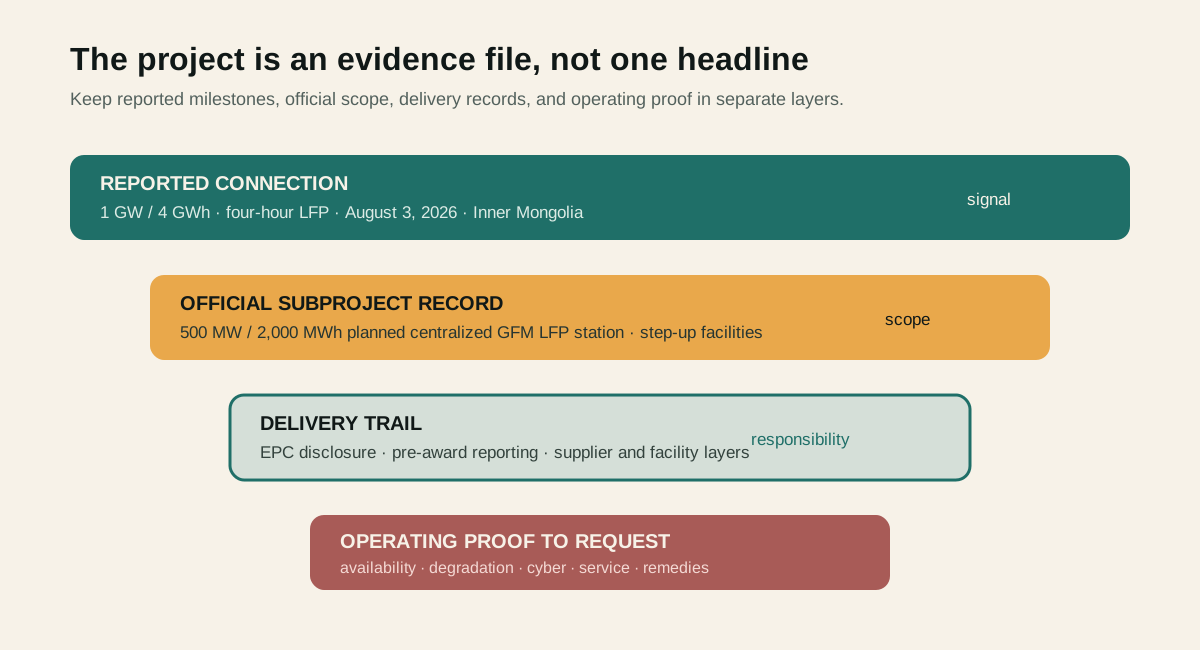
The public record is layered: a reported connection, official project scope, procurement and supplier records, and a separate set of operating proofs still to be requested.
Grid-forming is a control function until the buyer tests it
Grid-following inverters generally synchronize to an existing voltage and frequency reference. Grid-forming controls can establish or support a voltage and frequency reference and can respond to disturbances in ways that are valuable in a renewable-heavy grid. In a BESS, this behavior is created by software, control logic, current-limiting behavior, protection coordination, the PCS hardware, the battery's ability to provide the requested power, and the plant-level controls that coordinate many units.
That last sentence is the procurement boundary. “Grid-forming” can mean at least four different things in a sales conversation:
- The PCS has a control mode with a grid-forming label.
- The PCS has passed a defined factory or laboratory test at its AC terminals.
- The complete plant has been integrated with protection, transformers, network controls, and the point of interconnection.
- The owner has a contractually accepted service with defined disturbance envelopes, response times, data, availability, and remedies.
These are progressively stronger statements. The first is a feature. The second is a component or subsystem qualification. The third is site integration. The fourth is a bankable operating commitment.
The NVIDIA BESS qualification guide is useful here as an evidence-design reference. It places a qualification boundary at the AC terminals and identifies dynamic real and reactive response, current limiting, ride-through, islanded stability, black start, telemetry, and control transparency as separate areas of evidence. It also warns that passing a qualification boundary does not by itself imply site-level stability. That guide is not a DongSu acceptance report and is not a universal Chinese grid code; its value is that it shows how quickly the word “qualified” becomes too vague for a contract.
The Federal Energy Regulatory Commission's IBR reliability explanation supplies general context for why ride-through matters: inverter-based resources must be considered during voltage and frequency disturbances so they do not disconnect in ways that threaten bulk-system reliability. That US context should not be copied into a Chinese contract as if it were the local grid code. It should prompt the buyer to identify the actual local requirements, test envelopes, settings, and approval authority.
The GFM evidence packet a buyer should request
The acceptance packet should include the control philosophy and the exact version of every relevant firmware and parameter set. It should state whether the function is grid-forming, grid-following, or a controlled transition between modes; how the system handles current limits; what happens when battery state of charge, temperature, or cell protection limits are reached; and how the plant controller coordinates individual PCS units.
For dynamic response, request measured real-power and reactive-power traces at the agreed point of measurement. Define the disturbance, the pre-event operating point, the response time, the settling band, the overshoot, the recovery path, and the data sample rate. A single screenshot of a successful event is not enough. The buyer needs raw data, test scripts, timestamps, instrument calibration, and a repeatable method.
For ride-through, define voltage and frequency disturbance envelopes, current limits, protection interactions, and the conditions under which the system is allowed to block, trip, or transition modes. Ask whether the test is at the PCS terminals or at the plant point of interconnection. Those are not interchangeable locations.
For islanded operation and black start, define the starting condition. Does the battery start a dead bus? Can the plant energize the relevant transformer and auxiliary loads? Can it establish a stable reference without an external grid? Can it coordinate with protection and another inverter? What load steps, fault conditions, and duration are included? A company statement that the system supports islanded operation is a reason to request the test protocol, not a substitute for it.
For telemetry and control transparency, require a point list, event logs, time synchronization, command audit trails, remote-access logs, alarm definitions, and ownership of the raw data. If the buyer cannot independently reconstruct a disturbance from the exported record, the technical capability is harder to govern after handover.
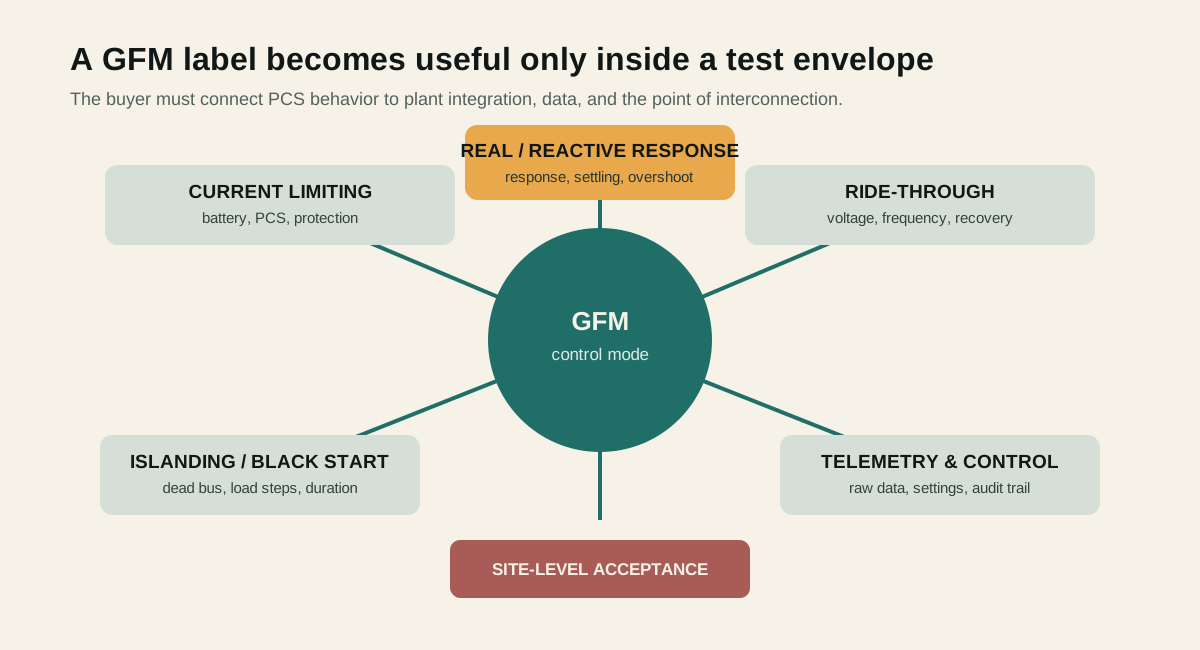
A GFM claim becomes useful only when its control envelope, measurement point, test script, data rights, and site integration are explicit.
Connection does not equal bankability
Bankability is not a single technical test. It is the buyer's confidence that the asset can deliver the contracted service over time, that failures can be diagnosed, that the responsible counterparty can be reached, and that the contract provides money, replacement, data, and schedule remedies when performance falls short.
For a four-hour LFP project, the energy warranty is especially important. The buyer must distinguish nominal energy, usable energy, delivered energy, and available energy. The contract should state the measurement point, auxiliary-load treatment, state-of-charge window, temperature range, response reserve, round-trip-efficiency assumptions, cycling duty, and test conditions. Otherwise, a system can appear to meet a 4 GWh nameplate while delivering less usable energy under the actual dispatch profile.
Degradation must be written as a trajectory, not a single number. The buyer should ask for the guaranteed capacity at commissioning, at each contract anniversary, and at the end of the warranty period. The schedule should state the allowed equivalent full cycles, depth of discharge, calendar-aging assumptions, temperature exposure, rest periods, and the treatment of curtailed or grid-forming support operation.
Augmentation is the next question. If the system needs new cells, containers, PCS modules, or control equipment to maintain the guarantee, who owns the decision, who pays, who supplies the replacement, and how is compatibility proven? A vague promise to “maintain capacity” is not an augmentation plan. The plan needs trigger thresholds, lead times, approved replacement models, isolation and commissioning procedures, fire and protection updates, software compatibility rules, and a new acceptance test after the work.
Cybersecurity is not a commissioning footnote. It crosses the EMS, plant controller, PCS, BMS, network switches, remote support tools, cloud interfaces, vendor VPNs, patch process, and incident-response chain. The NVIDIA guide separates cybersecurity and safety from its PCS qualification scope and points readers toward frameworks such as IEC 62443 and NIST CSF. For a buyer, the practical questions are simpler: what assets exist, who can reach them, how is access approved, how are credentials rotated, how are patches tested, how are logs preserved, what happens when a vulnerability is disclosed, and who owns the operational data?
Service is equally concrete. The buyer needs a named service counterparty, response-time bands, spare-parts commitments, remote-diagnostics rules, on-site escalation, language and time-zone coverage, training, end-of-life support, and remedies for repeated faults. If the EPC, PCS supplier, battery supplier, EMS provider, and O&M contractor are different entities, the contract must explain how the buyer avoids being sent from one party to another.
The public record reviewed here does not establish DongSu's long-term availability, degradation curve, augmentation plan, cybersecurity posture, service response, or contractual remedies after the reported connection. That bounded absence is the correct diligence finding. It is not a negative claim about the private project.
Commissioning versus bankability
The following distinction is the core of the buyer file:
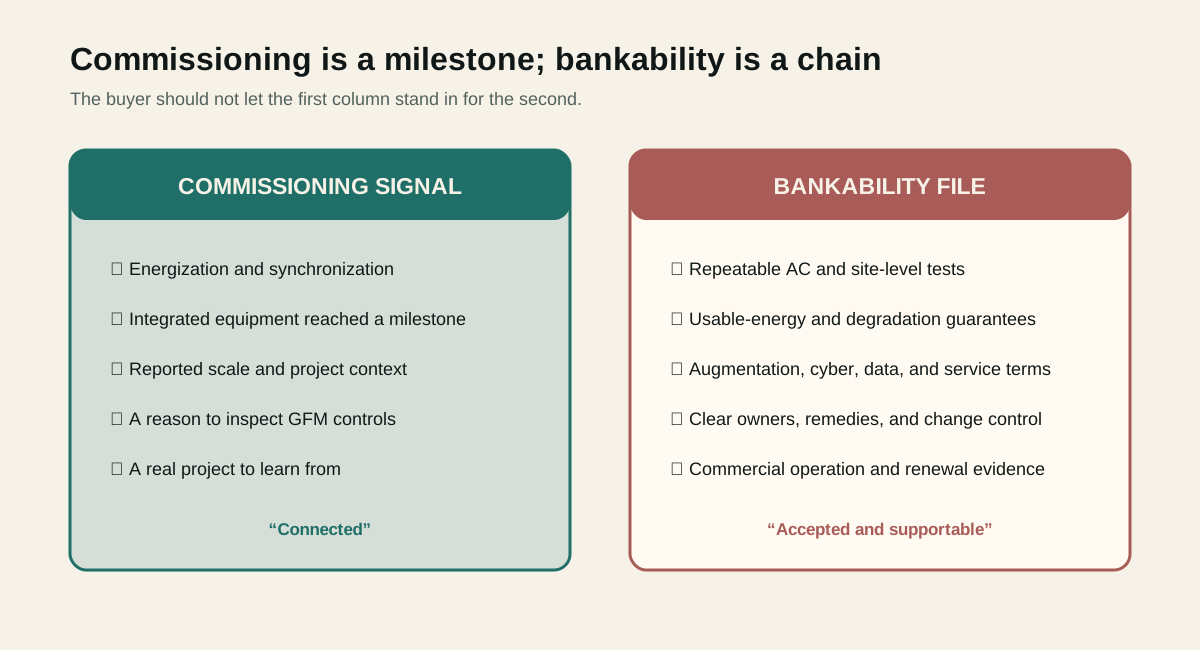
The connection is evidence of progress. Bankability requires a testable, measurable, and enforceable operating chain.
| Evidence layer | What a reported connection or commissioning milestone can show | What a bankability file still needs |
|---|---|---|
| System connection | The project or a defined project stage reached energization and synchronization with the grid | A signed definition of the connected asset, point of measurement, completion boundary, and commercial-operation date |
| Grid-forming label | The project is presented as using GFM inverter controls | Mode definitions, firmware and settings, AC-terminal tests, plant-level tests, and local grid-code acceptance |
| Dynamic response | The equipment may have responded during a commissioning event | Repeatable real/reactive traces, disturbance envelopes, current-limit behavior, calibrated instruments, raw data, and acceptance thresholds |
| Ride-through | The system may have remained connected during a defined event | Local requirements, voltage/frequency envelopes, protection coordination, trip logic, recovery data, and remedies for failure |
| Islanding or black start | A supplier or project report may describe the capability | A witnessed protocol covering dead-bus energization, auxiliary loads, transformer behavior, load steps, protection, duration, and restart |
| Energy capacity | The project has a reported 4 GWh nameplate and four-hour duration | Usable-energy definition, measurement point, auxiliary treatment, SOC window, temperature range, efficiency, and capacity warranty |
| Degradation | The system is new or recently connected | Annual capacity guarantees, cycle assumptions, state-of-health method, augmentation triggers, replacement lead times, and post-augmentation acceptance |
| Cybersecurity | The plant has communications and remote-control capability | Asset inventory, segmentation, identity and access controls, patching, logging, incident response, data ownership, and supplier remote-access terms |
| Service | EPC or system suppliers are publicly associated with the project | A single responsibility matrix, response times, spares, escalation, liquidated damages, warranty counterparty, and end-of-life support |
| Commercial operation | The project may be expected to enter full operation after connection | A declared COD, dispatch-ready test, performance guarantee, availability baseline, invoicing rules, and termination or cure rights |
The buyer acceptance file: five gates
The cleanest way to use the DongSu milestone is to organize diligence in stages. The stages below are not a legal template or an engineering sign-off. They are a procurement structure for asking the right counterparty for the right proof at the right time.
Gate 1: award and responsibility
Before award, freeze the project dictionary. Define “system,” “plant,” “usable energy,” “available power,” “GFM service,” “commercial operation,” “availability,” “forced outage,” “planned outage,” “augmentation,” and “replacement.” Put the definitions in the technical specification and the contract, not only in a vendor presentation.
Then build the responsibility matrix. The PowerChina listed-company disclosure provides a public example of an EPC contract trail for a DongSu-related 1,000 MW/4,000 MWh storage subproject, with a reported contract amount of RMB 1.579 billion. A pre-award report identifies Wanbang Xingchong and Yaoxing in a 500 MW/2 GWh grid-forming storage procurement context. These records help identify layers, but they do not prove final responsibility for every battery, PCS, EMS, control, warranty, or service obligation.
The buyer should demand a signed matrix naming the owner, EPC, battery supplier, container integrator, PCS supplier, BMS provider, EMS and plant-controller provider, protection and automation party, network and cybersecurity operator, O&M contractor, warranty guarantor, and augmentation provider. Every row needs an interface, acceptance test, data owner, response time, and remedy.
Stop the award if the bidder cannot say who owns the plant controller, who can change GFM settings, who approves firmware, who supplies raw test data, or which entity remains liable when a multi-vendor fault crosses the interface.
Gate 2: factory acceptance and configuration control
Factory acceptance should establish what is being delivered before it is placed in the field. The buyer should witness representative battery containers, PCS units, control cabinets, communications interfaces, protection logic, and safety systems according to a risk-based sampling plan. The goal is not to test every future event in a factory. It is to verify that the delivered configuration is the configuration that the design, model, and contract describe.
The configuration file should include battery cell and module data, container ratings, PCS model and firmware, BMS and EMS versions, control modes, protection settings, network diagrams, alarm lists, cybersecurity baselines, and calibration certificates. The buyer should retain a sealed copy and define how changes are approved after FAT.
For GFM, FAT should establish the PCS-level behavior that the site tests will build on. It should not be presented as proof that a large plant will remain stable at its point of interconnection. The contract should say which FAT results are prerequisites for shipping, which failures require retest, and which changes trigger a new FAT or a design review.
Gate 3: energization and site acceptance
At site, the acceptance file must show that the physical and electrical boundaries match the approved design. Check transformer ratio and protection, grounding, switchgear, auxiliary loads, fire systems, communications, time synchronization, plant controller, point-of-interconnection measurements, and the operating modes available to the grid operator.
The SAT record should distinguish first energization from staged energization and final site acceptance. It should record the exact asset population, the state of charge, ambient conditions, firmware, parameter set, test instrument, test operator, grid condition, and event timestamps. “It worked once” is not a repeatable acceptance criterion.
At this gate, test the system's response to defined commands and disturbances. Measure active and reactive power at the agreed boundary. Confirm current limiting, protection coordination, mode transition, recovery, alarm behavior, and communication loss behavior. If black start or islanded operation is part of the value proposition, specify the bus, transformer, auxiliary load, protection, and duration conditions rather than leaving the phrase undefined.
The site file should also include punch-list ownership. A plant can be connected while open items remain. Each open item needs a risk classification, temporary operating restriction, due date, responsible party, and consequence for provisional or final acceptance.
Gate 4: performance acceptance and commercial operation
Performance acceptance is where the buyer separates a connected asset from a contracted service. Write the test plan before the test date. It should cover power, usable energy, response, efficiency where relevant, GFM functions, ride-through, availability baseline, telemetry, and dispatch behavior under the actual operating envelope.
The test must define pass and fail, not only the equipment under observation. If the site misses a response threshold because of plant-controller logic, a network delay, a transformer limit, or a battery state-of-charge restriction, the buyer needs a contractual route to assign responsibility and cure the issue.
Commercial operation should have its own definition. It may require completion of grid-operator approval, all critical punch-list items, agreed dispatch readiness, accepted data links, approved operating procedures, a valid safety file, and a performance guarantee. The COD should not be backdated simply because the first unit synchronized.
Liquidated damages and service credits should be tied to the buyer's actual risk. A delay remedy can address missed COD. A performance remedy can address power or energy shortfall. An availability remedy can address repeated outage. A data remedy can address missing telemetry. A cyber remedy can address failure to maintain controls or notify an incident. The contract should also address repeated failure: when does a cure become a replacement, a step-in right, or a termination event?
Gate 5: operation, augmentation, and renewal
The fifth gate is where bankability is earned. The buyer should receive a monthly operating file that reconciles dispatch, availability, outages, state of health, capacity tests, alarms, firmware changes, cyber events, remote-access sessions, maintenance, spare-parts use, and unresolved defects.
Availability must be defined. Is a unit unavailable when it cannot provide full power, when it cannot provide reactive power, when one container is offline, when the plant is limited by the grid, or when a control mode is unavailable? The denominator matters. A high percentage calculated against only the operating hours selected by the supplier may not describe the buyer's actual service exposure.
Degradation reviews should use the same measurement and state-of-charge definitions as the original guarantee. If the buyer's cycling duty differs from the base case, the parties should have a documented change-control process rather than a later argument about warranty exclusions.
Augmentation should be treated as a project inside the project. It needs engineering review, compatibility evidence, fire and protection review, commissioning, isolation plans, new baseline testing, and clear ownership of the added equipment. Renewal diligence should ask whether the original supplier, firmware, battery model, spare parts, and service organization will still exist for the next contract period.
Cybersecurity review should be continuous. The buyer should ask for current asset and software inventories, patch status, vulnerability notices, privileged-access records, backup and recovery tests, incident history, and a current list of third parties with remote access. If data must leave the site or be processed in a vendor cloud, the contract should define data ownership, retention, export format, and access after termination.
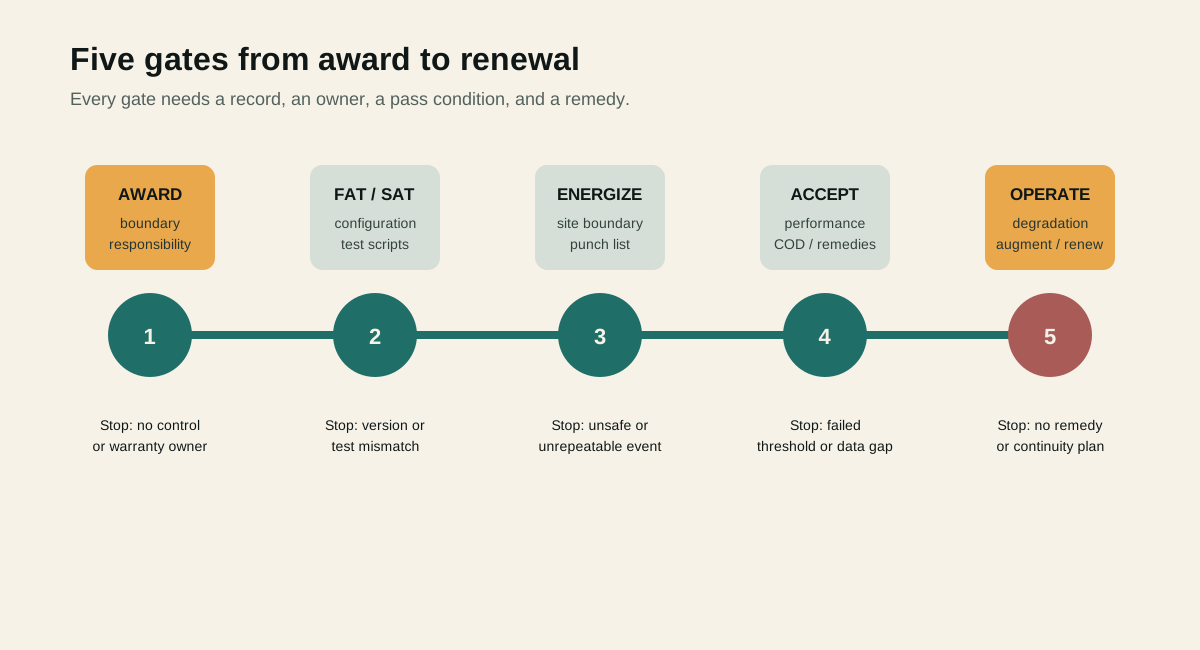
Each gate should end with a defined record, owner, pass condition, and remedy—not merely a meeting or a press release.
What the DongSu file says about supplier diligence
The public delivery trail is useful precisely because it is incomplete. Listed-company disclosures can show EPC scope and contract timing. Procurement reporting can show pre-award allocations. Company-linked project updates can show how a supplier describes its equipment and role. Government records can show planned facilities, land, step-up equipment, and project-company context.
None of these alone gives a buyer the full owner-EPC-PCS-BMS-EMS-O&M matrix. A public supplier name does not establish that the same entity owns the plant-level controls, the final warranty, the cybersecurity operation, or the replacement obligation. A pre-award candidate is not automatically the final supplier. A company statement about a capability is not a witnessed acceptance test.
This is why the acceptance file should have a “source and responsibility” column. For every material statement, record whether it comes from an official public record, a listed-company disclosure, independent reporting, a supplier statement, a witnessed test, an owner approval, or a contract. Record the date, version, and scope. When the same fact appears in two sources, ask whether they are genuinely independent or repeating the same project announcement.
The method is simple but powerful: the farther a claim moves from the public record toward a buyer's decision, the more the buyer must ask for direct evidence. A report can anchor the connection date. A government notice can anchor planned scope. A contract can anchor delivery responsibility. Only a defined test and enforceable contract can anchor a service guarantee.
Four practical buyer postures
The article's conclusion is not that DongSu should be accepted or rejected. The right posture depends on which evidence gates are open.
Proceed with a bounded pilot
Choose a bounded pilot when the system architecture is credible and the buyer can limit exposure, but site-level GFM behavior, data rights, or service arrangements remain incomplete. The pilot should have a defined duration, a limited dispatch duty, an independent measurement plan, a clear stop condition, and no assumption that pilot success automatically permits fleet-wide scale.
The pilot contract should preserve the buyer's right to inspect raw data, witness tests, audit configuration changes, and exit if the integration evidence does not close. It should not allow a supplier to redefine a missed test as “expected commissioning behavior” without a cure plan and deadline.
Proceed to conditional scale
Conditional scale can make sense when the buyer has an accepted plant-level test, a clear responsibility matrix, a workable warranty, cyber controls, and a service organization capable of supporting the exact geography and model. Conditional scale should still be tied to operating milestones: availability, usable energy, disturbance response, data continuity, and defect closure.
The buyer should keep later lots or payment releases conditional on evidence. A first successful project can reduce uncertainty, but it does not eliminate configuration, site, grid-code, or service differences in the next project.
Scale only after the bankability file closes
Full scale is appropriate only when the buyer can explain how the system will be tested, measured, repaired, augmented, secured, and supported over the contract term. That means the technical evidence, commercial definitions, raw-data rights, cyber boundaries, replacement path, and remedies are not separate promises scattered across suppliers. They are one integrated contract and operating file.
The buyer should be able to answer, in one page, what happens if the battery loses capacity faster than expected, the PCS supplier changes firmware, the EMS vendor loses support, a remote-access incident occurs, a GFM test fails after an augmentation, or the original service company exits the market. If the answer is “the parties will discuss it,” the file is not closed.
Hold when basic evidence is missing
Hold the award or scale decision when the buyer cannot verify the legal counterparty, point of measurement, control owner, test boundary, warranty guarantor, data path, or service remedy. A large connection milestone cannot compensate for an unclear liability chain.
Holding is not a technology verdict. It is a decision to wait for the evidence that turns a project signal into a controlled asset. The buyer can return to the decision when the missing records are produced and independently checked.
What to recheck before relying on the headline
This article is a dated public-record snapshot as of August 21, 2026. The latest reviewed company-linked reporting said full operation was expected by late August, which means operating status should be checked again before the article is used for a live procurement or investment decision.
Recheck the project status, the final asset population, the local implementation and grid-connection records, the applicable grid-code requirements, the firmware and parameter versions, the warranty and augmentation terms, cybersecurity obligations, and the current O&M counterparty. Recheck the measurement point for every number. Recheck whether “connected,” “commissioned,” “accepted,” and “commercially operating” are being used as separate defined stages.
The freshness rule matters because a project can move quickly after first energization. A late-August operating announcement may add useful evidence, but it should not erase the distinction between a press statement and a witnessed, repeatable, contractually accepted test.
Method and limitations
This article is desk research by the China Made & Tech Team. It uses public government records, a listed-company disclosure, trade reporting, a company-linked industry update, and technical qualification guidance reviewed on August 21, 2026. No site visit, factory audit, firsthand commissioning observation, independent telemetry series, owner contract, warranty schedule, cybersecurity assessment, or engineering sign-off was available.
Project facts are attributed to the source that reports them. Official notices are used for their stated planned or recorded scope. Company-linked statements are not treated as independent operating data. The technical qualification guidance is used to design buyer questions, not to certify DongSu or establish Chinese grid-code compliance. The acceptance sequence is editorial procurement synthesis and must be adapted to the specific project, grid operator, jurisdiction, contract, and qualified engineering and legal advisers.
The article therefore makes a deliberately narrow claim: DongSu's reported 1 GW/4 GWh connection is important enough to study as a grid-forming storage integration milestone, but the public record reviewed here does not prove the long-term evidence a buyer needs for bankability.