

By China Made & Tech Team. This is desk-researched procurement analysis, not a grid study, engineering review, finance opinion, cyber assessment, service audit, or supplier endorsement.
Sungrow has made two Europe-facing claims that are useful to buyers precisely because they are not enough on their own. First, the company said in May 2026 that its large-scale grid-forming validation covered 14 scenarios over 138 hours and was independently observed and verified by TÜV Rheinland. Second, it announced a planned manufacturing facility in Wałbrzych, Poland, with stated annual capacity of up to 20 GW of inverters and 12.5 GWh of energy-storage systems.
The easy conclusion is that the supplier has solved the European buyer's technical and localization concerns. The evidence does not support that conclusion. The better conclusion is narrower: these disclosures create specific diligence questions that should be answered before a grid-forming feature, local-service narrative, or future factory plan influences shortlist, contract, grid study, financing, or release.
This article is a buyer file for those questions. It separates a supplier disclosure, third-party observation scope, operator/project requirement, and order-linked evidence. That distinction matters because grid-forming capability is increasingly discussed at a European system level while the actual decision remains specific to an offered inverter/ESS configuration, firmware, network operator requirement, service contract, and project acceptance path.
Quick Answer: A Grid Test Is Not Project Acceptance
| Public signal | What it can reasonably support | What it cannot establish |
|---|---|---|
| Sungrow's 14-scenario, 138-hour validation disclosure | a supplier reports a broad validation program with TÜV Rheinland observation/verification | that the offered system, firmware, or project passes the applicable grid study or operator requirement |
| a large simulation platform claim | a supplier reports testing at stated scale and scenarios | system-level interoperability, site model performance, or national acceptance |
| Poland factory announcement | a supplier plans regional manufacturing/localization capacity | present operation, origin of a buyer's unit, spare availability, service response, or warranty outcome |
| regional offices/warehouses/service statements | a public description of footprint | contractual SLA, named escalation, local stock allocation, or remote-access governance |
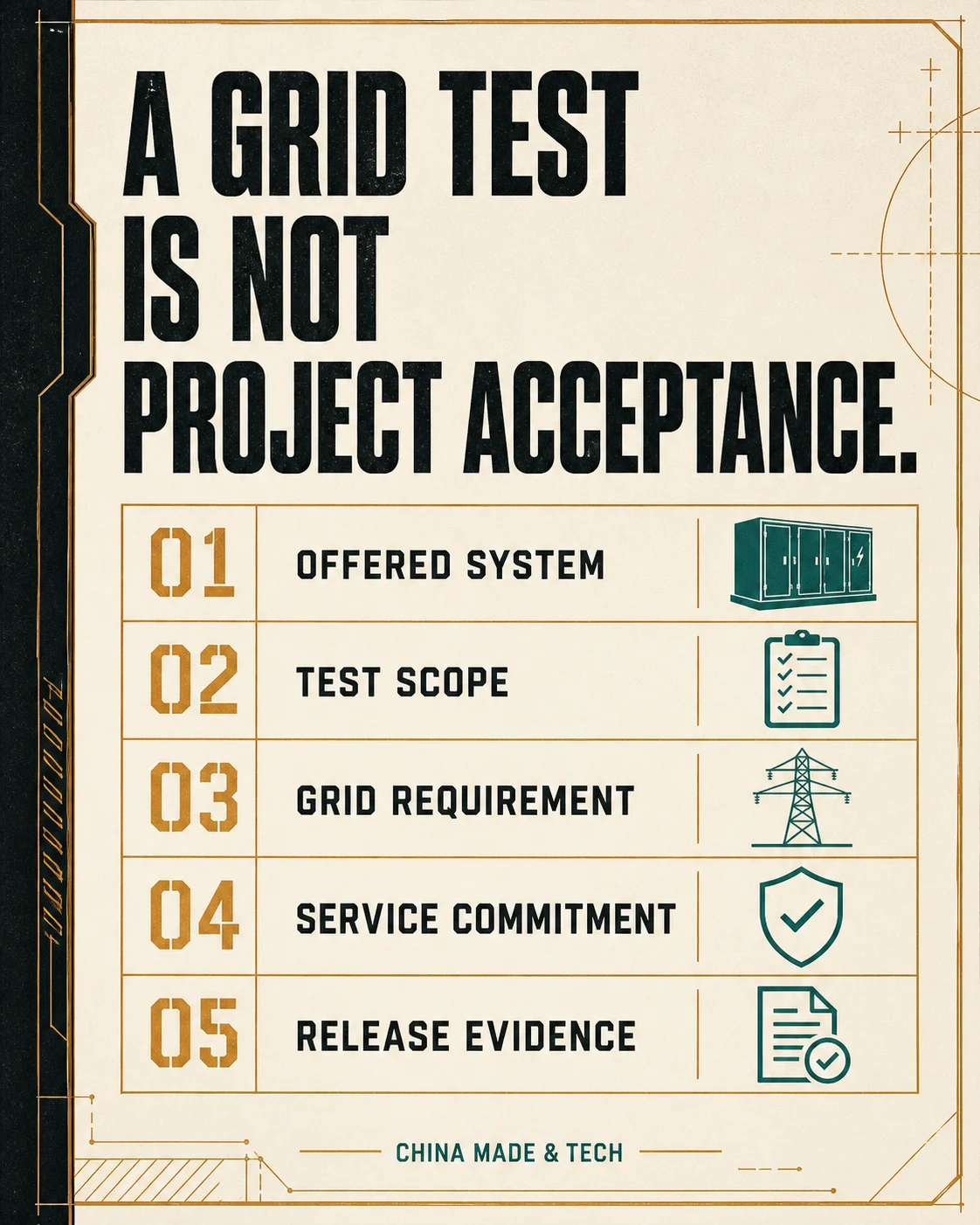 Field Note: vendor validation and project acceptance are separate evidence layers.
What Sungrow Publicly Disclosed
Sungrow's May 2026 announcement says its grid-forming program covered 14 scenarios in 138 hours, with independent observation and verification by TÜV Rheinland. Related company releases describe a 30 MW large-scale simulation platform and scenarios involving grid stress and restoration functions. Those are supplier disclosures. They are useful because they name a program, a claimed third-party role, and an evidence category a buyer can ask to inspect.
The buyer should not silently convert them into a statement about the product on its quotation. The offered inverter/PCS/ESS architecture, hardware revision, firmware, control configuration, plant model, network conditions, protection settings, and interface with other equipment may differ. A summary announcement is not the same thing as the test protocol, applicable product configuration, observed scope, results/limitations, or the local network operator's acceptance.
The Poland announcement also needs a date and boundary. Sungrow said on 5 February 2026 that it planned a 65,400 m² facility in the Wałbrzych Special Economic Zone, a EUR 230 million investment, operation within the following 12 months, and expected capacity up to 20 GW of inverters and 12.5 GWh of ESS. It is a plan, not evidence that a particular order is locally produced or that a named local technician and spare are contractually available.
Why the Buyer File Has Become More Technical
ENTSO-E's Phase II technical-report announcement describes non-binding technical guidance under draft NC RfG 2.0 for grid-forming requirements. In July 2026, ENTSO-E said its later stability guidance would help inform future implementation material once NC RfG 2.0 enters into force. This is public operator context, not a product certificate or a national rule that directly approves an inverter.
It does, however, explain why a product brochure is no longer enough for certain projects. Inverter-based generation and storage may be asked to evidence behaviours relevant to the project's actual requirements. The buyer needs to map each requested behaviour to the offered system and project process, rather than assuming that a company-level test or the word “grid-forming” travels automatically.
| Buyer question | Evidence to request | Do not substitute |
|---|---|---|
| What exact system is offered? | hardware, firmware, PCS/EMS/control architecture, configuration, version/change control | a corporate product-family statement |
| What was actually tested? | protocol, scenario, configuration, result/limitation, third-party observation scope | a press-release headline |
| What does the project require? | applicable TSO/DNO, grid study, EPC/owner, customer, and contractual requirement map | generic European guidance |
| What does the system do at site? | project model, commissioning/acceptance plan, settings governance, evidence owner | a lab/simulation inference |
| Who supports it after handover? | named local service, spares, response, warranty, firmware and escalation commitments | an office/factory announcement |
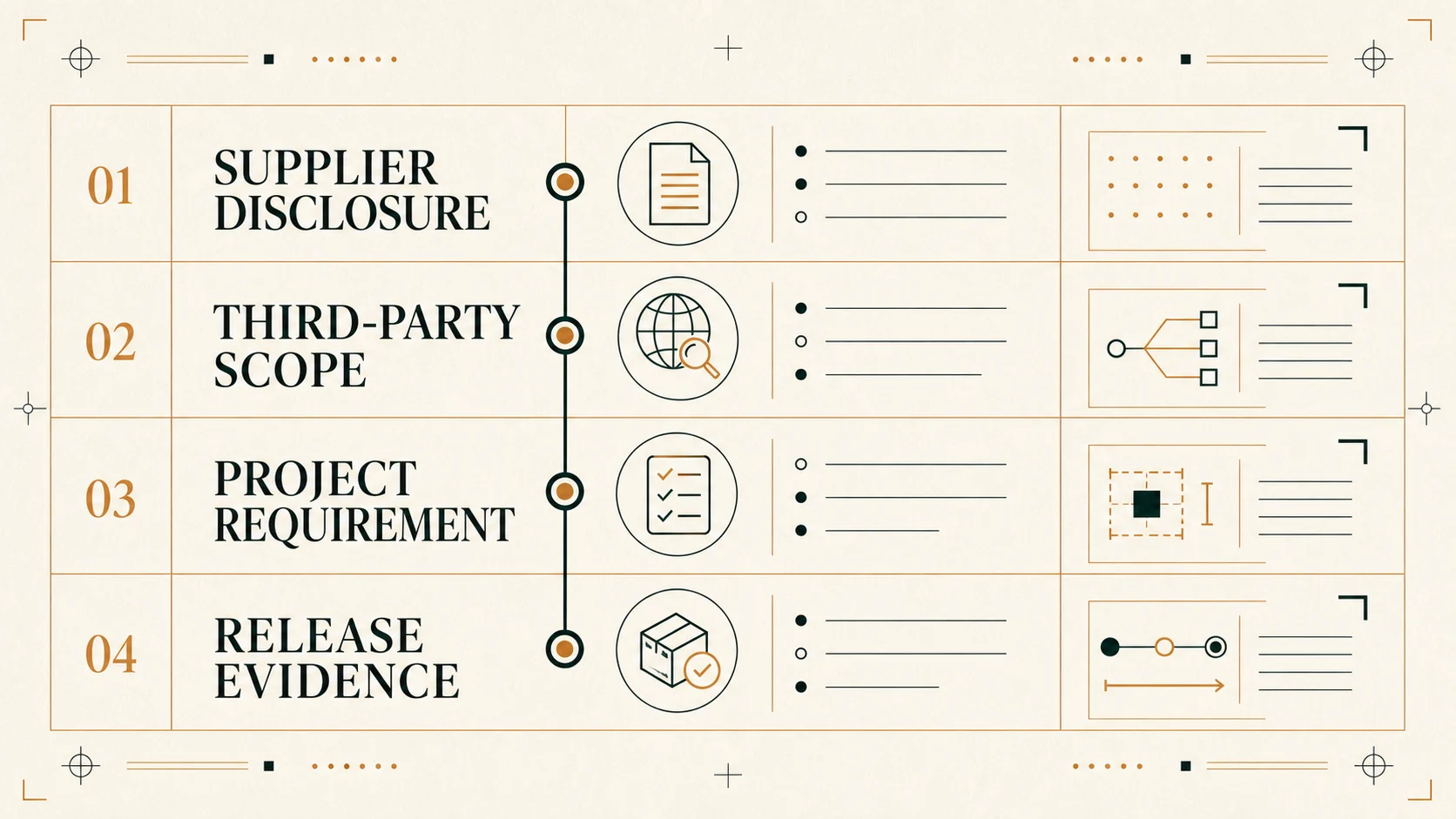 The matrix turns a public claim into a project-evidence request without dismissing or over-reading it.
Ask for the Test Boundary, Not a Stronger Adjective
When a supplier cites a grid-forming test, ask for the material that lets a technical reviewer compare it with the project:
- the precise offered product/system architecture, hardware, firmware, and setting range;
- the test protocol and which scenario corresponds to a project requirement;
- the simulator, network condition, power level, interfaces, and assumptions;
- the result, limitation, exception, and interpretation authority;
- the exact TÜV or other third-party role: observation, verification, witnessing, assessment, or certification; and
- a process for project model, commissioning, acceptance, configuration change, and evidence retention.
The point is not to demand a proprietary dossier that cannot be shared. A supplier may offer a controlled review, redacted report, model documentation, statement of scope, or project-specific demonstration. The buyer's decision should then state what was received, who compared it to the project requirement, and what remains conditional. If a necessary link cannot be established before equipment selection, the commercial choice may be to hold, use a staged qualification, or accept the unresolved engineering/approval risk deliberately.
Run a Claim Review Before the Technical Bid Becomes a Commitment
The practical failure mode is not that a buyer sees an announcement. It is that a marketing statement enters a bid comparison as a silent green tick and later has no owner. Run a short claim review before technical scoring is frozen. Procurement should bring the exact supplier statement and the proposed commercial weight. Engineering should bring the project architecture, grid-study assumptions, interfaces, and operating cases. The asset or O&M team should bring the desired support model after handover. The project lead should identify the next irreversible decision: shortlist, preferred bidder, notice to proceed, factory acceptance, shipment, or energization.
For each cited claim, create one row with five fields: the source and its date; the offered configuration it is supposed to inform; the project requirement it maps to; the evidence that would close the gap; and a named decision owner. The row should also state whether the claim is merely context, a qualification condition, or a release condition. This is deliberately less glamorous than a supplier scorecard, but it prevents a company-level statement from acquiring project-level authority through repetition.
| Claim-review outcome | Meaning | Buyer action |
|---|---|---|
| Context only | public information is relevant but not comparable to the offered scope | retain it as background; give it no technical-release weight |
| Reviewable | the supplier can provide a bounded protocol, scope statement, model material, or service record | assign a reviewer and a due date before technical evaluation closes |
| Qualification condition | the answer changes whether the proposed system can remain shortlisted | hold the score or create a written exception approved by the risk owner |
| Release condition | the answer is needed before order, shipment, commissioning, or handover | put it in the contract, inspection/test plan, or acceptance schedule with an evidence owner |
Sequence the Project Evidence Instead of Asking for Everything at Once
Not every document is needed at the first meeting, and forcing a full final dossier too early can produce boilerplate that nobody compares with the project. A staged evidence path is more useful. At prequalification, verify the offered family and ask whether the supplier can support the relevant behaviour, model, test record, local service, and configuration controls. At bid clarification, pin those answers to the proposed hardware, firmware, interfaces, and project assumptions. Before contract signature, convert material answers into deliverables, review points, time limits, and remedies. Before shipment and commissioning, check the final version and acceptance evidence rather than relying on the bid version.
| Stage | Purpose | Evidence that is proportionate at that stage | Hold point |
|---|---|---|---|
| prequalification | avoid a false shortlist | product family, disclosed test category, support footprint, high-level model/service availability | do not treat a public claim as an approval |
| bid clarification | compare actual offers | offered configuration, controlled technical scope, project requirement map, exceptions, proposed support parties | technical reviewer records the unresolved gaps |
| contract | assign commercial responsibility | named deliverables, version control, review rights, service/SLA, spares, change and remedy routes | no material claim remains only in a slide deck |
| design and study | connect system to site | approved model inputs, parameters, interfaces, scenario assumptions, study comments and change log | project reviewer accepts or escalates the mapping |
| commissioning and handover | preserve operational evidence | final settings/version record, test/acceptance outputs, contact/escalation list, spare and warranty record | asset owner receives a usable, traceable file |
Localization Is a Service Chain, Not a Pin on a Map
The Poland announcement can matter even before the plant is operating. It may signal a strategy to add regional production, quality assurance, and supply-chain presence. But a buyer's service risk is resolved only when the order file answers operational questions.
| Service question | Order-linked evidence |
|---|---|
| What unit and configuration will arrive? | purchase schedule, serial/lot, country/plant/production fact where required, approved configuration |
| What local support exists for this asset? | named service entity, territory, contact, capability, response hours, escalation path |
| What spare path is committed? | parts list, location/allocation statement, lead time, warranty/RMA/return process |
| Who can alter or support controls? | firmware/version policy, remote-access/monitoring responsibility, change authorization and event log |
| What happens after a site incident? | incident route, diagnostic evidence, decision authority, replacement/repair and documentation route |
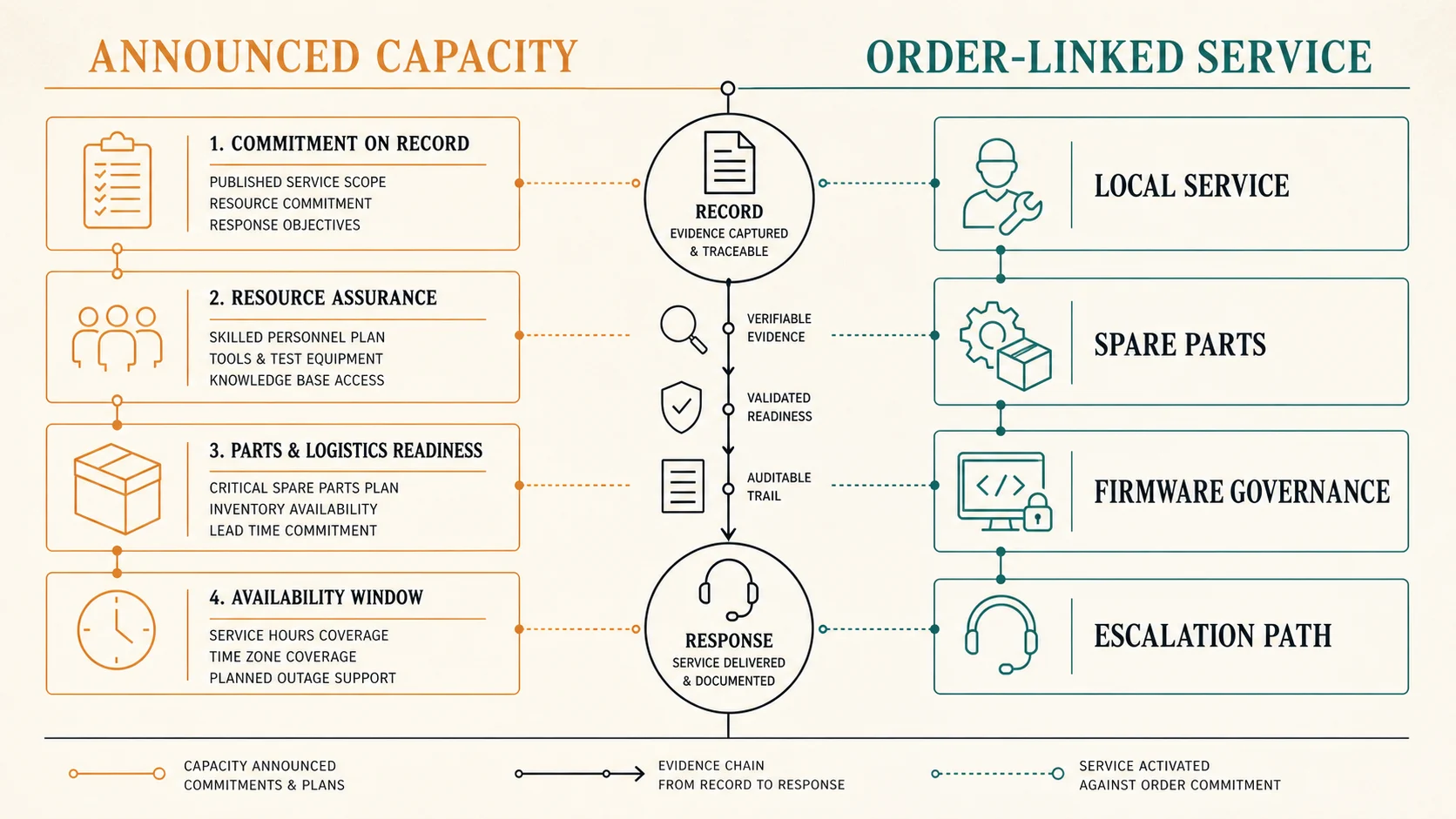 Announced capacity and a workable project service chain are related but different claims.
An office, warehouse, or planned factory is useful context. It cannot prove that a project has spare allocation, a signed response time, a locally competent service party, or a workable remote-access boundary. Conversely, a Chinese supplier can offer a credible local service plan even if the buyer's unit is not made in Europe. The buyer should judge the documented service chain, not make origin or localization a proxy for every control-layer risk.
Put the Service Chain Into the Order File
The most important localization questions are operational and contractual. Who is the legal support counterparty for this asset? Which hours and territories does it cover? What is the escalation route when a control issue crosses local service, remote engineering, the EPC, and the owner? Which spares are committed, where are they held, and what is the replacement or repair route? Who authorizes a firmware change, who records the previous and new version, and what project testing is required after a change? A brochure or factory announcement can invite these questions; it cannot answer them for a particular order.
For material items, specify a document and a consequence. A support plan without a named entity is a proposal, not a service commitment. A parts list without an allocation, lead-time basis, or RMA route may not support availability planning. A promised software update without approval, rollback, notification, and evidence rules can become a control and warranty dispute. The wording does not have to make the supplier guarantee every outcome. It should make the accountable party, process, evidence, and escalation decision visible before handover.
| Contract topic | Evidence or clause to seek | Question the buyer still owns |
|---|---|---|
| service counterparty | named legal entity, territory, hours, competency boundary, contacts and escalation ladder | can that entity meet the asset's actual operational need? |
| response and remedy | severity definitions, acknowledgement/response targets, diagnostic process, repair/replacement route | are the targets aligned with the owner's outage and revenue exposure? |
| spare parts | critical-parts list, allocation/location basis, lead time, RMA and warranty route | which parts must the owner stock or reserve independently? |
| software and remote access | version/change approval, access roles, logs, notification, rollback and incident route | do project cyber and operating rules permit this support model? |
| evidence at handover | final configuration, test/acceptance record, warranty start, service and asset-document index | can the asset team use this file without the bid team? |
Escalate an Unclosed Link Explicitly
Some gaps cannot be closed before a decision. A supplier may be unwilling to disclose a full test report; a network requirement may still be changing; a factory may not yet be operating; or the project model may require later iteration. The disciplined response is neither automatic rejection nor an optimistic assumption. Record the gap, the decision it affects, the temporary control, the accountable owner, the deadline, and the consequence if it remains unclosed.
For example, a bidder can remain conditionally shortlisted while engineering completes a project-specific review, provided procurement does not represent the validation announcement as proof of acceptance. A planned facility can remain useful strategic context while the order requires a separate service and origin evidence package. Where a gap affects safety, grid permission, operation, finance, or a binding contract condition, the relevant qualified reviewer should determine whether it is acceptable to proceed. The article cannot make that determination.
An exception register is especially valuable during handover. It distinguishes a known, consciously owned uncertainty from a missing record that is discovered only after a commissioning delay or service incident. In that sense, the right output of diligence is not a stronger narrative about a supplier. It is a clearer allocation of what is known, what is promised, who verifies it, and what remains conditional.
Build a Shortlist That Survives Handover
For projects where grid behaviour and long-term service matter, score every shortlisted supplier against the same evidence categories:
| Category | Decision owner | Minimum release condition |
|---|---|---|
| system definition | engineering | offered hardware/firmware/architecture and approved change boundary are clear |
| technical claim | grid/engineering | test scope and project mapping are reviewed with stated limits |
| project acceptance | owner/EPC/operator interface | study, commissioning, and evidence path are agreed for the actual project |
| local service | asset/O&M | named entity, SLA/escalation, spare/RMA route, and documentation owner are defined |
| control governance | owner/security/operations | access, configuration, update, incident, and record responsibilities are assigned |
| commercial recovery | procurement/legal | warranty, remedy, replacement, and transition conditions are written into the deal |
Method and Limits
This article separates Sungrow supplier disclosures from ENTSO-E's non-binding technical guidance. It does not verify a Sungrow product, test, TÜV scope, factory operation, regional service, unit origin, grid study, cybersecurity control, financing decision, or project acceptance. It is not engineering, operator, legal, finance, cyber, or procurement advice. The actual offered system, local requirement, agreement, and qualified project reviewers control the decision.