
Europe's inverter fight is not a normal solar tariff story.
The practical risk for buyers is narrower and more immediate: a Chinese inverter or battery PCS choice may still be technically available, but it could become harder to finance, tender, insure, or defend if the project relies on EU-linked public money.
On 2026-04-24, the European Solar Manufacturing Council said the European Commission had decided that EU funding instruments, including the EIB and EIF, would no longer support energy projects using inverters from high-risk countries such as China, Russia, Iran, and North Korea. On 2026-05-04, ESS News reported that battery energy storage PCS is explicitly included in the same guidance.
Then, on 2026-05-29, ESMC and 22 other European industry associations called for faster EU trade-defense action against state-driven overcapacity and unfair trade practices. That broader trade push matters. But for solar and storage buyers, the more urgent lesson is simple: inverters and PCS have moved from equipment selection into project-finance diligence.
Source File
| Source | What it supports | Why it matters |
|---|---|---|
| ESMC April 24 inverter funding statement | ESMC's claim that EU funding should exclude inverters from high-risk countries | Primary industry statement behind the funding-risk story |
| ESS News on BESS PCS inclusion | Reporting that energy-storage PCS is included in the guidance | Key source for why this affects storage, not only solar PV |
| Euronews explanation | Funding-condition framing rather than a blanket import ban | Prevents overstating the policy as customs law |
| European Commission CEF Energy call | Timing and scale of EU-linked energy funding | Shows why buyers must resolve inverter/PCS evidence before funding applications |
| ESMC May 29 trade-defense coalition statement | Broader European trade-defense pressure around state-backed overcapacity | Context for why inverter finance screening is part of a larger industrial-policy shift |
| Chinese official response | China's objection to the high-risk designation | Counter-signal for buyers tracking retaliation and policy uncertainty |
Quick Answer
| Buyer question | Practical answer |
|---|---|
| Is the EU banning all Chinese solar inverters? | No. The immediate issue is EU-linked funding eligibility and project-level risk screening, not a blanket import ban. |
| Does this affect private projects? | Not automatically, but lenders, insurers, public buyers, utilities, and offtakers may copy or reference the same risk logic. |
| Does this affect battery storage? | Yes, according to ESS News documents seen by the outlet, energy storage PCS is explicitly included. |
| What should buyers check first? | Funding source, ultimate vendor ownership, PCS scope, firmware governance, remote-access controls, lender acceptance, and a non-high-risk alternate package. |
What Actually Changed
The clearest public industry statement came from ESMC. Its 2026-04-24 statement says EU funding should no longer flow to energy projects containing inverters from China, Russia, Iran, or North Korea. It also says the measure applies to companies owned or controlled by entities or persons from those countries, and to neighboring regions such as North Africa and the Western Balkans if they are connected to the European electricity grid.
That should be read carefully. It is not customs law. It is not a universal market ban. It is a funding and bankability filter.
Euronews has described the mechanism as a condition attached to EU-funded energy projects rather than a new piece of customs legislation. ESS News says the guidance had already been communicated to financial institutions from 2026-05-01, while the industry was still waiting for a fully public version.
That opacity is part of the buyer problem. Because the most decisive Commission guidance is not fully public, buyers should not present every boundary as settled law. They should treat it as a live funding-screening signal inside the EU's wider economic-security approach, not as a customs ban. Banks, public agencies, and lender technical advisers often act on risk signals before procurement teams see a neat final checklist.
Why Inverters And PCS Are Different From Panels
Panels produce electricity. Inverters and PCS control how electricity is converted, connected, monitored, curtailed, and sometimes remotely managed.
That makes them politically different from modules.
The EU's broader economic-security doctrine has already treated solar inverters as a critical-infrastructure risk category. The concern is not only price dumping. It is the possibility of manipulating generation parameters, interrupting generation, accessing operational data, or using supply-chain access to compromise infrastructure.
Modern inverters and PCS can include:
- firmware update channels
- cloud monitoring
- remote maintenance access
- grid-code settings
- curtailment and shutdown functions
- plant-controller integration
- data collection across distributed assets
That is why a cheap inverter is not just a cheaper box. It is a long-lived control device attached to a grid asset.
BESS PCS Is Not A Footnote
The storage angle is the most important under-covered part of this story.
ESS News reported that "Energy storage systems / Power Conversion Systems (PCS)" are explicitly included in the Commission documents it reviewed. That means solar-plus-storage and standalone storage developers should not treat this as a solar-only issue.
The reason is practical. Many BESS packages, especially all-in-one systems, combine cells, battery modules, PCS, EMS, thermal systems, fire-safety systems, and cloud software into a bundled offering. A buyer may think it has already reviewed battery cell origin, while the funder is more concerned about PCS control, remote access, firmware governance, or ownership.
For storage buyers, the question should be:
- Who owns or controls the PCS vendor?
- Where is PCS firmware developed?
- Who can push updates?
- What cloud or EMS layer controls the asset?
- Can the PCS be substituted without redesigning the battery integration?
- Will the lender accept the package?
That is a different diligence file from normal battery bankability.
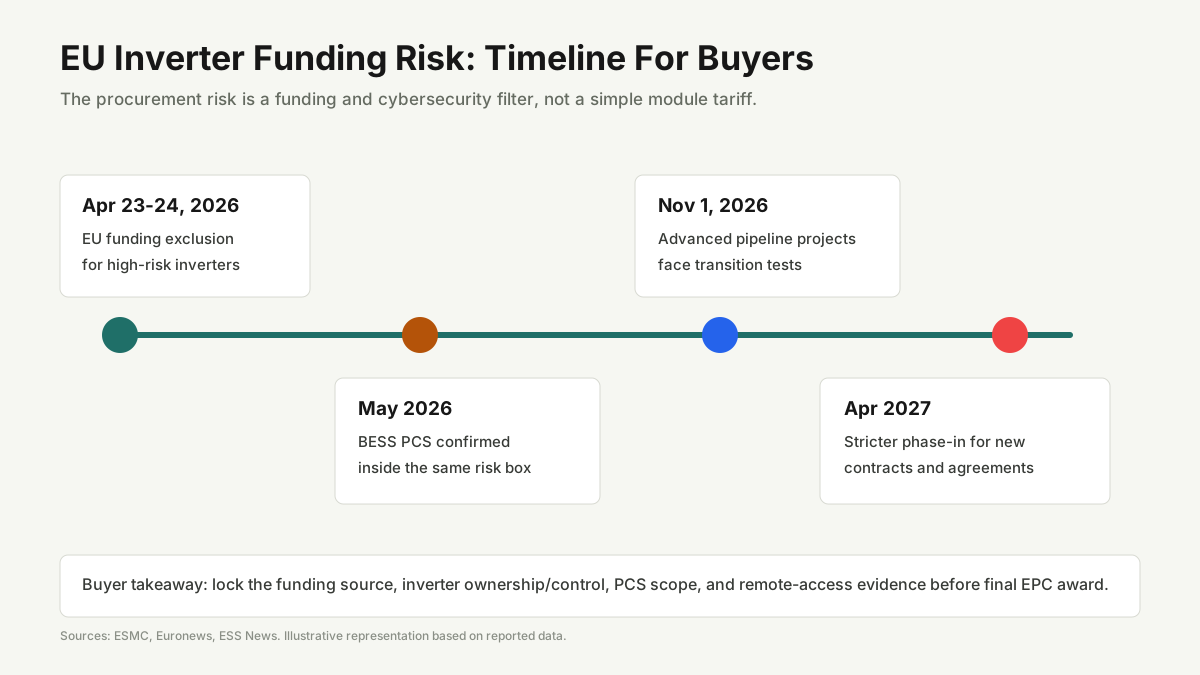 Sources: ESMC, Euronews, ESS News, and European Commission funding notices.
Which Projects Are Most Exposed
Not every project has the same exposure.
| Project type | Main risk | Buyer action |
|---|---|---|
| Fully private rooftop solar | Customer, insurer, or corporate policy may still matter | Keep vendor-origin and firmware evidence in the file |
| Municipal rooftop or public-sector solar | Public procurement and grant eligibility | Pre-clear inverter origin before tender award |
| Utility-scale solar | Lender, offtaker, grid operator, and funding source review | Require an accepted alternate inverter package |
| Solar-plus-storage | PCS, EMS, cloud, and inverter-origin overlap | Review inverter and PCS as one control layer |
| Cross-border or neighboring-region grid projects | EU grid-connected funding exposure | Confirm whether EU-linked conditions follow the grid connection |
| CEF Energy or other EU infrastructure projects | Grant covenant and project eligibility | Check origin and control before application, not after award |
What Bankability Diligence Should Ask
The buyer file should answer seven questions before the inverter or PCS package is frozen.
| Diligence item | What to document |
|---|---|
| Funding source | EIB, EIF, CEF, EU-managed fund, national development bank, public-sector tender, private-only capital |
| Ownership and control | Legal manufacturer, ultimate beneficial owner, controlling entity, parent-company jurisdiction |
| Manufacturing and firmware | Country of manufacture, firmware development location, firmware signing/update process |
| Remote access | Who can monitor, update, curtail, shut down, or change parameters remotely |
| Data governance | Telemetry location, cloud host, data retention, customer access rights |
| Alternate package | Non-high-risk inverter/PCS option with price, schedule, warranty, and service comparison |
| Acceptance evidence | Written confirmation from lender, insurer, offtaker, EPC, and funding program where relevant |
Control-Layer Risk Is Not The Same As Component-Origin Risk
One subtle point matters. European rules and reporting are focused on high-risk inverter and PCS suppliers, especially ownership, control, and grid-connected function. That is not the same as proving every subcomponent is non-Chinese.
An inverter assembled in Europe may still contain Chinese IGBTs, MOSFETs, passive components, or other electronics. That may matter for supply-chain resilience, but it is not the same policy question as who controls firmware, remote monitoring, update authority, or grid-interactive functions.
Buyers should therefore keep two files:
- a control-layer file for inverter, PCS, EMS, firmware, cloud, and remote access
- a component-origin file for semiconductors, power electronics, passive components, enclosures, and replacement parts
The first file is more urgent for funding eligibility. The second file matters for long-term resilience.
The Capacity Counterargument
ESMC argues that Europe and aligned Western producers can meet the demand. In its April statement, ESMC said European inverter production capacity exceeds 100 GW per year, with 45 GW of additional expansion planned by 2027. It also cited Wood Mackenzie analysis suggesting that switching to Western inverters adds 1.7%-4.3% to total investment for residential and small commercial projects, and below 2% for large utility-scale projects in Germany, Spain, and Eastern Europe.
Buyers should use those numbers carefully.
They are useful as an industry-side claim that alternatives exist. They are not enough to approve a project. A buyer does not procure aggregate GW. It procures a specific inverter or PCS that must match grid code, delivery window, warranty, communications architecture, spare-parts availability, lender requirements, and service footprint.
Those capacity and cost figures should be checked against vendor availability, grid-code certification, and lender-approved vendor lists for the specific project.
The better question is not "Does Europe have 100 GW of inverter capacity?" It is:
- Is the right SKU certified for this grid code?
- Can it arrive before construction and interconnection milestones?
- Does the EPC already support it?
- Does the battery integrator accept the PCS change?
- Does the lender accept the vendor?
- What happens to O&M and replacement inventory?
This is where the cheapest hardware quote can become the most expensive project decision.
A Simple Funding Decision Tree
Solar and storage buyers can start with a basic screen before going deeper.
| Step | Question | If yes |
|---|---|---|
| 1 | Is the project using EIB, EIF, CEF, EBRD, EU-managed funds, or a public-sector buyer? | Treat inverter and PCS origin as a funding eligibility issue |
| 2 | Is the project connected or planned to connect to the European grid, including neighboring regions? | Ask whether EU-linked conditions follow the grid connection |
| 3 | Is the vendor owned or controlled by an entity from a high-risk country? | Require legal and beneficial ownership review |
| 4 | Does the package include storage PCS, EMS, or plant controller functions? | Review it as one control-layer package |
| 5 | Can the project switch vendors without redesign or financial-close delay? | Keep the alternate package live until lender approval |
The decision tree also clarifies why private projects are not automatically safe from the issue. A project can start with private capital and later seek public refinancing, infrastructure-bank participation, municipal offtake, or public-sector guarantees. Equipment-origin evidence is easier to gather before the procurement award than after a lender asks for it.
The China Counter-Signal
China rejects the high-risk label. A 2026-05-07 Chinese official response said the EU had designated China a high-risk country without factual evidence, called the treatment discriminatory, and said China would assess the impact and take necessary measures to protect Chinese companies' rights.
Buyers should not ignore that signal.
It does not change the immediate funding diligence problem. If a lender or public funder screens out a vendor, the project has to manage that reality. But it does mean the policy environment can move in both directions: EU funding restrictions on one side, Chinese countermeasures or commercial retaliation on the other.
That is why this is not only a cybersecurity story and not only a trade story. It is a project-risk story.
Suggested RFP Language
Buyers can make the risk manageable by writing it into tenders.
Useful RFP language should require bidders to provide:
- inverter and PCS ultimate ownership disclosure
- manufacturing country and firmware-development country
- remote-access, cloud-monitoring, and data-hosting architecture
- firmware update approval process and release-note history
- SBOM or equivalent software-component disclosure where available
- lender and funding-program acceptability statement
- alternate non-high-risk inverter or PCS package
- price, schedule, warranty, O&M, and spare-parts delta for the alternate package
This does not force every buyer to select a European inverter. It forces every bidder to prove whether the low-cost package is still bankable under the buyer's actual financing and public-procurement constraints.
Red Flags In Supplier Responses
Watch for these answers:
- "EU compliant" without naming the relevant funding program or lender requirement
- local sales-entity ownership disclosure without ultimate parent control
- remote monitoring described as standard cloud service with no access-control detail
- firmware updates described as automatic without approval rights
- PCS excluded from origin review because "the battery system is already approved"
- alternate inverter package priced but not confirmed by the EPC or lender
- warranty and spare-parts commitments that change under the alternate package
None of these automatically disqualifies a vendor. They mean the buyer does not yet have enough evidence.
How This Fits China's Solar Overcapacity
The May 29 trade-defense statement puts the inverter issue inside a larger European industrial argument. ESMC and 22 other associations want faster EU trade-defense action, more DG Trade staffing, more preventive use of existing instruments, and a more strategic approach to the Foreign Subsidies Regulation.
Solar is a visible case because the module market already shows the overcapacity dynamic covered in China Solar Overcapacity: Export Surge Buyer File. But the inverter and PCS issue is more subtle. It is not only about cheap hardware from China. It is about whether a grid-connected control layer should be eligible for public money when ownership, software, remote access, or national-security concerns are disputed.
That is also why this connects to China Solar Equipment Curbs: What U.S. Buyers Risk (2026). Trade risk increasingly moves upstream and sideways: from modules to manufacturing equipment, from tariffs to financing, from hardware cost to bankability.
What To Watch Next
Five dates and signals matter:
- whether the Commission publishes clearer guidance for high-risk inverter and PCS treatment
- whether financial institutions apply the 2026-11-01 maturity test for advanced pipeline projects as reported
- whether non-EU, non-grid-connected projects face the 2027-04-15 phase-out described by ESS News
- whether the 2026-09-30 CEF Energy application window forces applicants to document inverter or PCS origin earlier
- whether Chinese countermeasures move from objection to specific commercial action
If those signals appear, procurement behavior can change without a formal import ban. Financing filters alone are enough to move the market.
Methodology
This article was reviewed on 2026-07-07 and relies on ESMC's 2026-04-24 inverter funding statement, ESS News reporting on BESS PCS inclusion, ESMC's 2026-05-29 trade-defense coalition statement, European Commission energy funding notices, EIB clean-energy financing announcements, and Chinese official responses. ESMC is an industry advocacy organization, so its capacity and cost claims are treated as claims buyers should verify, not neutral market facts. The article separates public Commission funding materials from industry claims and media reports about non-public guidance.
Claim Confidence File
| Claim | Confidence | Evidence boundary |
|---|---|---|
| The current public signal is a funding and bankability restriction, not a customs import ban | High | Supported by ESMC/Euronews framing and lack of a cited customs prohibition |
| ESMC says EU-linked funding should exclude high-risk-country inverters | High | Supported by ESMC's own statement; ESMC is an industry advocacy source |
| BESS PCS is included in the same guidance | Medium-high | Supported by ESS News reporting on documents it reviewed; buyers should confirm with the relevant funder or lender |
| Every private project in Europe is automatically prohibited from using Chinese inverters | Low | Private projects may still face lender, insurer, customer, or utility friction, but not an automatic blanket ban from the cited sources |
| European/Western inverter capacity and cost impacts are settled neutral market facts | Medium-low | Capacity/cost figures are partly industry-advocacy claims and need SKU-, market-, and lender-specific verification |
| Buyers should document ownership, firmware, remote access, cloud, PCS, and alternate-package evidence before financial close | High | Directly follows from the funding, cybersecurity, and control-layer risk profile |
FAQ
Is the EU banning Chinese solar inverters?
Not as a simple import ban. The immediate issue is EU-linked funding, public-finance eligibility, and project-level security screening for inverters and PCS from high-risk countries or controlled entities.
Is this a funding restriction, market ban, or import ban?
The current public signal is best treated as a funding and bankability restriction. It can shape tenders and lender approvals without being the same thing as a customs import ban.
Does the rule apply to BESS PCS?
According to ESS News documents seen by the outlet, yes. Energy storage PCS is explicitly included, which means storage developers should review PCS, EMS, cloud monitoring, and firmware governance alongside battery bankability.
Can private buyers still use Chinese inverters?
Often yes, depending on the project. But private capital does not eliminate lender, insurer, utility, offtaker, or customer-origin requirements. A private project can still face bankability friction.
What should EPCs change in bids?
They should provide at least two equipment paths where possible: the lowest-cost package and a non-high-risk alternate package, with clear differences in price, lead time, warranty, service, firmware, and funding acceptability.