
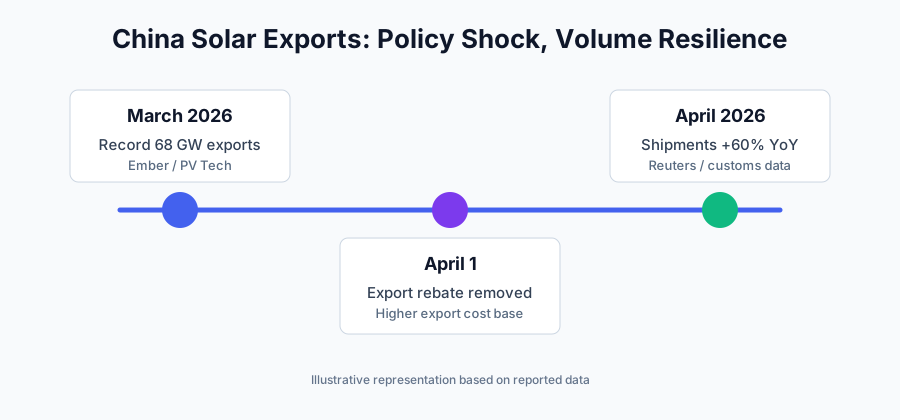
China's solar exports were supposed to slow after April 1. China's Ministry of Finance and State Taxation Administration had announced that export VAT rebates for photovoltaic products would be cancelled from that date, raising the effective cost of shipping panels, cells, wafers, and related products abroad. Instead, Reuters' headline republished by TradingView said Chinese solar exports jumped 60% year over year in April.
That headline sounds bullish. For buyers, it is more useful as a stress signal.
The better reading is that China's solar industry has become so oversupplied that even a policy shock did not stop export volume. March was already extreme: PV Tech, citing Ember's analysis, reported a record 68 GW of Chinese solar exports in a single month. April then showed that the export machine did not simply shut off after the rebate deadline.
The practical implication is this: Chinese solar panels are still available in enormous volume, but the price floor is no longer as simple as "China keeps getting cheaper." Rebate cuts, bankrupt manufacturers, tariff walls, traceability rules, and forced capacity discipline are all pushing against the old assumption that every quarter will bring lower module prices. The buyer task is no longer finding the lowest FOB quote. It is identifying which supplier, route, warranty, and origin file can survive the price war.
Source File
This article was reviewed on 2026-07-03 against three evidence layers. First, the tax-policy baseline comes from the State Taxation Administration's official notice, Announcement No. 2 of 2026, which cancels export VAT rebates for photovoltaic products from 2026-04-01. Second, the April export-growth signal comes from a Reuters headline republished by TradingView; the public page exposes the headline but not the full Reuters article without sign-up, so this article does not treat the page as a full customs dataset. Third, the March volume baseline comes from PV Tech's coverage of Ember's record 68 GW March export estimate, cross-checked with Electrek's summary of the same March 2026 solar export spike. The article treats export-volume jumps as evidence of overcapacity and shipment pressure, not as proof of healthy factory margins or stable buyer demand. Internal links connect the short-term export signal to China Solar Dominance: Supply Chain Power, Profit Crisis, US & EU Tariffs on Chinese Solar Panels 2026, and Chinese Solar Brands: LONGi vs Jinko vs Trina (2026).
Claim Confidence File
| Claim | Confidence | Evidence boundary |
|---|---|---|
| China solar export volume remained strong despite the 2026 PV export-rebate change | Medium-high | Based on the official rebate notice plus Reuters/Ember/PV Tech reporting; the article treats public export data as a pressure signal. |
| High export volume proves healthy margins and stable supplier bankability | Low | The article rejects that leap and frames export strength as compatible with overcapacity stress. |
| Overcapacity changes buyer risk around warranty, origin, supplier survival, and landed cost | High | This is the article's buyer-file conclusion from volume, policy, and sector margin context. |
| Every Chinese solar supplier is unsafe | Low | The article calls for supplier-specific bankability and origin review, not blanket rejection. |
Quick Read
| Signal | What happened | What it means for buyers |
|---|---|---|
| March export surge | China shipped a record 68 GW of solar products | Some demand was pulled forward before rebate changes |
| April rebate removal | official VAT export refunds for PV products were removed | Base export costs moved higher |
| April resilience | Reuters headline says solar exports still rose 60% year over year | Overseas demand and oversupply pressure likely remained strong |
| Domestic overcapacity | Too many producers chase too little profit | Low prices can persist, but supplier risk rises |
| Tariff divergence | US landed costs remain far above EU/Australia | The same Chinese panel has very different economics by market |
Why April Was The Test
April mattered because it was the first month after China's export rebate change took effect. The old rebate regime helped manufacturers recover part of the VAT burden on exported PV goods. Removing that cushion effectively raises the cost of exporting from China for affected products, even before overseas tariffs are applied.
In a normal industry, that should reduce exports at the margin. Marginal buyers wait. Marginal sellers lose pricing room. Marginal projects are delayed.
Solar did not behave normally, at least according to the Reuters headline signal. April shipments still rose sharply from a year earlier. That tells us two things, with the caveat that the publicly visible Reuters page does not expose the full product-level dataset.
First, global demand for cheap solar remains deep. Energy-importing countries still want panels, especially when fossil-fuel prices and supply security are uncertain.
Second, Chinese producers still have to move product. A factory with fixed costs, debt service, and perishable working capital does not stop shipping just because margins compress. It cuts price, extends payment terms, or shifts volume to markets that still clear.
That is the overcapacity mechanism in one sentence: the factory's need to run becomes the buyer's leverage.
The 68 GW Month Was Not A Normal Demand Signal
March's 68 GW export figure was extraordinary. Electrek's summary of Ember's data noted that March exports doubled February's level and beat the previous record by 49%.
But records around policy deadlines are tricky. When buyers know costs may rise on April 1, they pull orders forward into March. When producers know a rebate is disappearing, they accelerate shipments before the policy changes. That does not mean every March shipment represents steady-state demand.
The useful question is what happened next. April did not appear to collapse. That matters more than the March record. It suggests the export surge was not purely a one-month accounting artifact. The system absorbed the policy change and kept pushing product out.
For procurement teams, that means there is no immediate shortage story. If a supplier is using the rebate cut to justify an aggressive price increase, buyers should ask for a detailed landed-cost breakdown. The rebate change matters, but it does not erase oversupply.
The Price Floor Is Rising, But The Ceiling Is Weak
The best way to think about Chinese solar pricing in mid-2026 is a squeezed corridor.
The floor is rising because:
- Export VAT rebates for PV products are gone from 2026-04-01.
- Polysilicon and wafer makers are under pressure to stop selling below cost.
- Weak manufacturers are being pushed out.
- Tariff and compliance costs are becoming harder to route around.
The ceiling is weak because:
- China still has too much module and cell capacity.
- Inventory needs to move.
- Buyers can compare many Tier 1 and Tier 2 suppliers.
- Southeast Asian assembly routes remain active even as trade rules tighten.
That corridor is why prices can stop falling without truly recovering. A module price that rises from distressed levels may still leave manufacturers with poor margins.
This is the same tension discussed in China Solar Dominance: Supply Chain Power, Profit Crisis. China built the world's most complete solar manufacturing system. That system now has enough capacity to reshape global power markets, but it also created a market where the strongest firms survive by letting weaker firms bleed.
What Buyers Should Do Now
The buying strategy should change from "find the cheapest Chinese panel" to "identify the supplier that can survive the price war."
Here is the practical checklist.
| Buyer question | Why it matters |
|---|---|
| Is the manufacturer profitable or cash-flow positive? | A bankrupt supplier cannot honor a 25-year warranty |
| Is the quote post-April rebate? | Old quotes may not include the new export cost structure |
| Which entity issues the warranty? | Trading-company warranties are weaker than manufacturer warranties |
| Which country is the shipment assembled in? | Tariff exposure can change sharply by origin |
| Is the module from a current product line? | Distressed inventory may be cheap but harder to support |
| Can the supplier document bankability? | Project finance depends on more than wattage and price |
The Supplier Survival Scorecard
When overcapacity is severe, buyers should evaluate whether the supplier will still be around to support the project.
| Survival signal | Stronger answer |
|---|---|
| Financial health | positive operating cash flow, manageable debt, and credible access to working capital |
| Warranty counterparty | warranty issued by the manufacturer or bankable parent, not only a trading company |
| Product continuity | current product line with replacement modules and compatible specs likely to remain available |
| Bankability | recognized by lenders, insurers, and EPCs in the buyer's target market |
| After-sales footprint | local or regional service path, claims process, and replacement inventory |
| Compliance history | ability to document origin, UFLPA / forced-labor traceability, and tariff status |
The US Is Still A Separate Market
For US buyers, April's export resilience does not mean Chinese panels are suddenly cheap again. The US tariff stack is still the wall.
As explained in US & EU Tariffs on Chinese Solar Panels 2026, a Chinese TOPCon module that leaves the factory at a low FOB price can become uneconomic after Section 301 tariffs, anti-dumping duties, countervailing duties, and compliance costs. The US market is designed to stop direct Chinese solar imports from winning purely on factory cost.
That creates a strange split. Australia and parts of Europe can still benefit from Chinese oversupply. The United States mostly sees the overcapacity indirectly, through Southeast Asian routes, global price pressure, or non-Chinese suppliers forced to match Chinese economics.
So the buyer question is not "Are Chinese panels cheap?" It is "Are Chinese panels cheap in my jurisdiction after trade policy?"
Market-By-Market Reading
The same Chinese module can create very different buyer economics depending on the destination market.
| Destination | What overcapacity changes | What still controls landed cost |
|---|---|---|
| United States | global price pressure may lower non-China alternatives indirectly | Section 301, AD/CVD, UFLPA documentation, origin route, customs risk |
| European Union | cheap Chinese supply remains more visible in market pricing | VAT, product compliance, project bankability, local inventory |
| Australia | buyers may see direct benefit from Chinese oversupply | warranty support, installer confidence, product continuity |
| India | Chinese price pressure affects benchmark pricing | domestic protection rules and approved supplier requirements |
| Southeast Asia | assembly routes remain important but scrutinized | producer-specific duties, country-of-origin evidence, supply-chain traceability |
Why Beijing Has A Problem Too
Overcapacity is not only a foreign buyer issue. It is also a Chinese industrial policy problem.
Solar is strategically important, but endless margin compression destroys the companies Beijing wants to keep strong. If too many manufacturers fail, supply chains become unstable. If prices rise too much, China loses part of the global adoption story that made its solar industry geopolitically powerful. The policy objective is not maximum output at any price. It is controlled dominance.
That is why the rebate cut matters. It is a signal that Beijing is willing to let export prices rise at the margin and force some discipline into the sector. But April's export growth shows how hard that is. When capacity is this large, policy nudges do not immediately overcome factory economics.
Contract Protection For Buyers
Overcapacity gives buyers leverage, but the leverage should be written into the contract.
Useful protections include:
- warranty issuer and guarantor clearly named
- origin and assembly country fixed or disclosure-triggered
- substitution limits if the supplier swaps modules or cells
- price-adjustment terms tied to rebate, freight, and tariff changes
- spare-module availability commitment
- documentation package for customs, traceability, and project finance
- remedy if the quoted product line is discontinued before delivery
These protections matter because a collapsing price environment encourages substitution. A supplier may try to ship a different batch, route, or model if the original quote becomes uneconomic. Buyers should preserve flexibility on price without losing control over product identity and compliance evidence.
Source Hierarchy For A Solar Quote
When a quote looks attractive because of overcapacity, rank the evidence in this order:
| Evidence | Stronger than | Why |
|---|---|---|
| Manufacturer warranty terms from the legal issuer | sales brochure | identifies who carries long-term liability |
| Audited financial statements or lender bankability file | shipment-volume claims | shows whether the supplier can survive the cycle |
| Customs/origin documentation | salesperson origin statement | controls tariff and compliance exposure |
| Current product datasheet with production date | old catalog PDF | reduces discontinued-model risk |
| Factory inspection and quality records | brand reputation alone | catches margin-driven QC slippage |
| Written substitution limits | verbal "same spec" promise | prevents batch or model changes after deposit |
What Buyers Should Not Misread
Do not read record exports as proof that demand is unlimited. A surge can reflect pull-forward buying, distressed inventory, aggressive payment terms, or suppliers pushing volume to keep factories running.
Do not read overcapacity as a permanent free lunch. Low prices can destroy weak suppliers, reduce warranty quality, and encourage product substitution. The buyer advantage is real, but it must be paired with stronger due diligence.
And do not assume every market receives the same benefit. The same Chinese module that looks cheap in an open market can become expensive in a tariff-heavy jurisdiction. Overcapacity creates global price pressure, but local trade rules decide landed economics.
What To Watch Next
The next useful indicators are not press-release shipment targets. Watch these instead:
- Monthly customs data for cells, wafers, and modules separately.
- Module price quotes after freight and rebate adjustments.
- Earnings and cash-flow reports from the large listed manufacturers.
- Bankruptcy, merger, or capacity-shutdown announcements among smaller producers.
- Tariff changes in the US, India, EU, and Australia.
- Warranty changes or shortened support terms from weaker suppliers.
If exports stay high and prices stabilize, China may be moving from chaotic overcapacity to managed consolidation. If exports stay high and margins keep collapsing, buyers get cheap panels today but inherit warranty and supplier-continuity risk tomorrow.
Methodology
This analysis combines the official Chinese rebate notice, the Reuters April headline signal, Ember/PV Tech export-volume analysis, and the site's prior landed-cost work in US & EU Tariffs on Chinese Solar Panels 2026. The main limitations are that the public Reuters mirror verifies the April headline but not the full article body, and customs export value can understate the energy capacity shipped because module efficiency keeps improving.
FAQ
Did China's solar exports really rise after the rebate cut?
Yes, with a source caveat. Reuters' publicly visible headline said April solar exports rose 60% year over year even after China removed the export tax refund. The important caveat is that March likely included pull-forward demand before the April 1 policy change, and the open TradingView page does not expose the full Reuters dataset.
Does this mean Chinese solar overcapacity is over?
No. Strong exports can coexist with overcapacity. In fact, high exports may be the release valve for excess Chinese production.
Are Chinese solar panels still cheap in 2026?
They are still cheap at the factory gate, but landed costs vary heavily by market. Australia and parts of Europe remain much more open than the United States, where tariffs can erase the factory-price advantage.
What should buyers check before ordering?
Check supplier financial health, warranty issuer, country of assembly, post-April pricing, tariff exposure, and whether the modules are current-generation products rather than distressed inventory.
Is a record export month good news or bad news for buyers?
It is buyer leverage, not automatically good news. High exports mean supply is available and suppliers may negotiate, but they also signal margin pressure, substitution risk, and weaker producers trying to keep factories running.
By China Made & Tech Team. Independent English field guide to China's niche hardware brands, hidden champions, founders, factory towns, and supplier clusters.