

AI-generated editorial illustration by China Made & Tech. It depicts no real fab, product, vendor, process result, export licence, or equipment qualification.
By China Made & Tech Team. Independent English field guide to China’s niche hardware brands, hidden champions, founders, factory towns, and supplier clusters.
“Can China build its own semiconductor tools?” sounds like a direct question. It is not. It packages several different technical categories, several process steps, multiple software and service dependencies, a changing compliance context, and a fab’s own qualification decision into one national yes-or-no label.
That label is too coarse for a useful sourcing decision. Semiconductor manufacturing equipment is not a single product. A U.S. International Trade Commission briefing defines the category broadly enough to include lithography systems, deposition and etching equipment, and metrology tools. The briefing itself has a narrow import-data scope, but its definition is a helpful first correction: the word equipment covers distinct classes with distinct roles, suppliers, interfaces, consumables, service needs, and proof burdens. Read the USITC briefing as category context, not as a measure of Chinese capability.
Export-control material makes the same distinction visible from another direction. In its December 2024 announcement, the U.S. Bureau of Industry and Security (BIS) listed certain etch, deposition, lithography, ion-implantation, annealing, metrology, inspection, and cleaning tools among equipment controls connected to advanced-node integrated circuits. That list is evidence that categories matter. It is not a licence decision for a buyer’s transaction, a measure of any tool’s quality, or a verdict on whether a fab can source a working line. The relevant wording is in the BIS public notice.
The practical question is therefore narrower: which named tool, for which process step, in which configuration, with which service and compliance boundary, has evidence that the intended fab can accept? The answer can differ radically between two tools mentioned in the same headline. A company can manufacture one type of process equipment, develop another, integrate a third, and still not be the right source for the particular layer, material, process window, automation interface, maintenance model, or acceptance requirement a buyer has in mind.
This guide does not rank Chinese equipment suppliers, certify a process, decide a licence application, compare node capability, or advise a reader to buy or avoid a named tool. Its job is more useful: turn a broad “China chip tools” question into five files that a buyer, fab team, supplier, or analyst can inspect.
| The question sounds like… | The file that is actually needed | What it can establish | What it cannot establish alone |
|---|---|---|---|
| “Can China make the tools?” | Category file | Which tool class and process boundary are being discussed | Whether a particular tool fits a particular fab |
| “Are these tools controlled?” | Control file | A public authority’s stated regulatory scope and date | A licence outcome, legal advice, or a transaction decision |
| “Does this company have the product?” | Named-company file | What the company itself says about a named product area | Independent performance, qualification, or comparability |
| “Can this fab run it?” | Configuration and support file | The actual tool, revision, dependencies, service model, and integration boundary | A sustained process result without acceptance evidence |
| “Is it qualified?” | Acceptance file | What a named process and fab accepted under stated conditions | A general national or vendor conclusion |
A tool is not a national capability
The first error in an equipment discussion is to let the country name become the product name. “Chinese semiconductor equipment” may be a useful discovery query. It is not a procurement specification.
Start with the object. Is the reader discussing lithography, deposition, etching, ion implantation, annealing, cleaning, inspection, metrology, material handling, a subsystem, a control package, or a tool service? Is the relevant task patterning, adding a film, removing material, measuring a feature, moving wafers, cleaning a chamber, or controlling the system? What material, wafer format, process generation, throughput requirement, facility interface, and inspection method are in scope? Until those questions are written down, two people can agree that they are discussing “the same tool” while actually describing unrelated risks.
The USITC briefing is helpful precisely because it does not treat semiconductor manufacturing equipment as one homogeneous box. Its overview names lithography, deposition, etching, and metrology as examples of the broad class. It then studies direct, sea-based imports for four U.S. firms during a defined 2019–2023 period. That dataset cannot say whether a Chinese supplier can serve a particular fab. It does show why a buyer should resist a single-country answer: the broad class is populated by distinct equipment types and a supply chain can have multiple sources even within a single project. The briefing’s own limitations—including the exclusion of air and ground shipments and of equipment bought by a domestic third party—are part of the record, not inconvenient footnotes.
This category problem is often hidden by shorthand such as “tool independence,” “localisation,” or “domestic substitution.” These phrases may describe a strategic direction. They do not identify the exact object that is being substituted. A lithography system and an etch tool do not become comparable because both stand in a fab. A tool that can operate in one process position does not automatically replace a tool at another. A public product announcement does not disclose the recipes, integration work, maintenance terms, site utility requirements, or inspection method that a customer needs.
The right starting sentence is modest and specific: “We are evaluating a named equipment category for a named process position.” That sentence has room for the next questions. It does not pre-judge the answer.
Category first, country second
Use a one-page category file before opening a vendor comparison. It should contain at least the following:
- Tool class and process job. Say what the tool is meant to do, rather than only repeating a product family name.
- Process boundary. Identify the wafer, material, layer, critical interface, and whether the tool is a primary process step, a measurement step, or a supporting system.
- Current configuration. Record the tool version, chamber or module configuration, automation and software dependencies, utilities, consumables, and attached metrology where relevant.
- Success measure. State what the fab would measure to decide whether the tool is useful: not a general claim of quality, but a stated process or operational requirement.
- Comparison boundary. Name the current baseline and explain which conditions make a comparison fair. A different workload, material, test period, or maintenance arrangement can make a headline comparison meaningless.
This file is not bureaucracy for its own sake. It protects the buyer from a common bait-and-switch: a discussion begins with a broad capability narrative and ends with a tool that has never been connected to the buyer’s actual process requirement. If the seller cannot help create a category file, the buyer has learned something important before a long evaluation begins.
It also protects a supplier that has a real but bounded capability. A company should be able to say, “This is the tool category we address, this is the configuration we can document, these are the dependencies, and this is the next evidence gate.” That is much more credible than a national self-sufficiency slogan. It gives the buyer a path to an actual technical conversation.
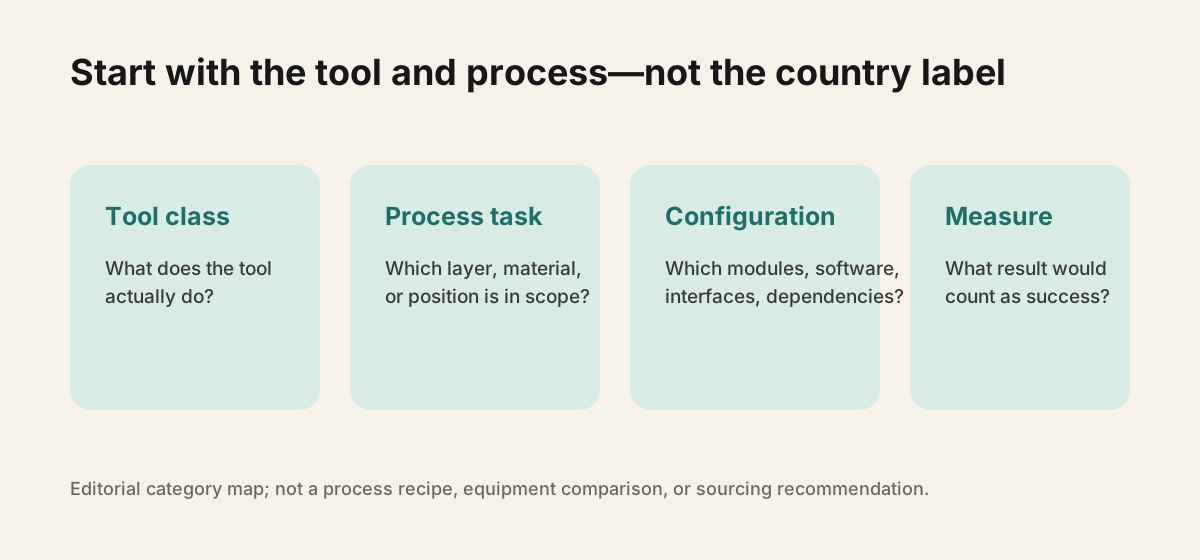
Editorial category map. It is not a process recipe, equipment comparison, or sourcing recommendation.
Do not use a headline category as a hidden equivalence claim
Headlines often contain a category noun plus a performance implication: “new lithography alternative,” “domestic etch replacement,” or “China-made fab tool.” The noun may be accurate while the implication is untested. An alternative to what? A replacement in which recipe? Which integration, availability, support, and quality criteria? Who evaluated it, for how long, and under which conditions?
The answer need not be an immediate no. It can be “research-stage,” “demonstrated in a stated environment,” “available for a defined process,” or “requires a site evaluation.” The important point is that each label has a different commercial and technical meaning. A buyer should not be expected to infer that meaning from country of origin, a product photograph, a conference appearance, or an announcement that a company works in a related category.
The distinction has a useful analogue in smart-manufacturing claims. A factory does not become more productive because an automation technology exists nearby. A named workload, integration, measurement method, and acceptance result are still required. Semiconductor equipment deserves at least that much precision because the object is part of the manufacturing process itself.
The control file is not a sourcing verdict
Export controls are real context for semiconductor equipment. They can affect availability, support, documentation, end-user scrutiny, supply planning, and the timing of an evaluation. But they should be read in the same disciplined way as a product record: identify the authority, date, item category, jurisdictional scope, and limit of the document before treating it as evidence.
BIS’s December 2024 announcement identifies a package that included controls on certain semiconductor manufacturing equipment needed to produce advanced-node integrated circuits. Its public list names certain etch, deposition, lithography, ion implantation, annealing, metrology and inspection, and cleaning tools. The notice also describes controls on some related software and a set of Entity List actions. This can support a bounded statement: these tool categories appear in a specific U.S. control-policy record, as of the cited date. It cannot support “every tool in this class is unavailable,” “this transaction will be denied,” “a competing tool is legally safe,” or “a particular fab can or cannot qualify a product.” Those require transaction-specific legal and commercial analysis.
The gap matters because a control category and a tool category do different jobs. A supplier’s engineering team uses a category to define a product and process. A control authority uses classifications, destinations, end users, end uses, legal jurisdiction, and other conditions to determine regulatory scope. The same noun—etch, deposition, lithography—can appear in both places, but it does not turn a public policy notice into an engineering specification or a buyer’s compliance conclusion.
The control context can also change. In August 2025, BIS said it was closing what it described as a Validated End-User loophole for foreign-owned semiconductor fabs in China. It said former VEU participants would need export licences and stated an intention to grant applications that would allow existing fabs to operate, but not to grant licences for capacity expansion or technology upgrades. That is a current, published agency position at the date of the BIS announcement. It is not advice about a reader’s own contract or licence application, and the page itself should be reviewed whenever a deal depends on it.
What a commercially useful control file contains
The buyer should own a separate control file, even where the vendor has a compliance team. It can be short, but it should identify the precise decision that needs support:
- the named item, version, components, software keys, and documentation;
- the seller, reseller, service provider, end user, consignee, and site;
- the intended end use and whether the description has been checked against current rules;
- the jurisdiction or jurisdictions implicated by the product, components, technology, support, and transaction route;
- the date of the legal review, the reviewer, the assumptions, and the planned refresh point;
- what the commercial plan does if approval, delivery, support, software renewal, spare parts, or an upgrade is delayed or unavailable.
This is not a legal checklist and it does not decide compliance. It is a way to stop an engineering project from treating a generic news story as clearance. A buyer should obtain qualified legal and export-compliance advice for the actual transaction. A supplier should avoid implying that a public control announcement is a substitute for that advice.
The control file also prevents a different mistake: assuming that every domestic source removes lifecycle risk. A tool can be domestically assembled yet depend on specialist components, software, calibration, service labour, consumables, customer interfaces, or a support relationship whose terms matter to the fab. The correct conclusion is not that a particular source is risky. It is that the buyer needs to ask which dependencies remain and how they will be supported across the expected life of the tool.
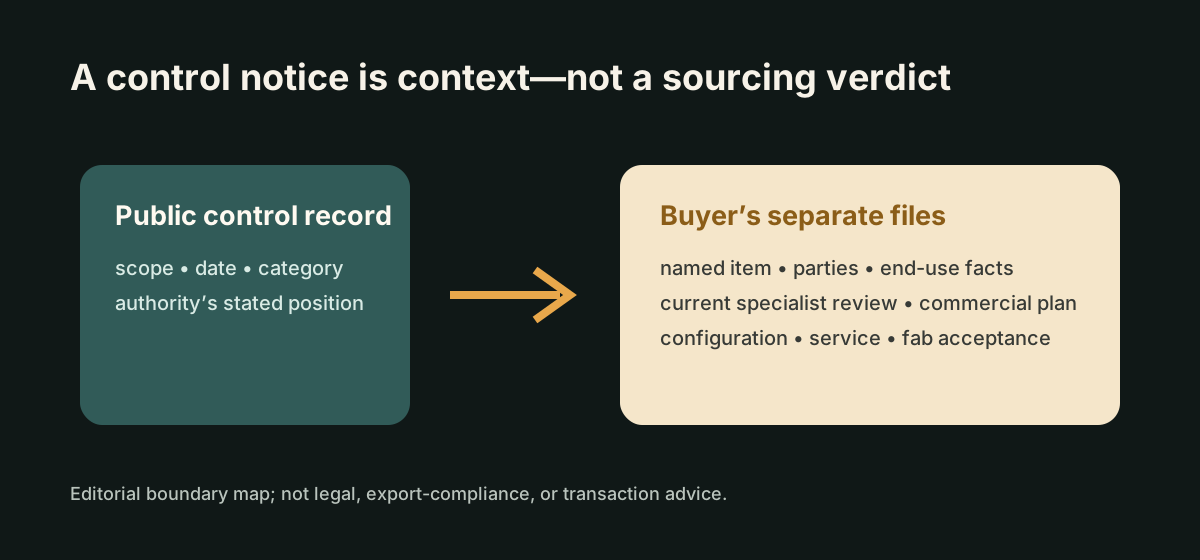
Editorial boundary map. It is not legal, export-compliance, or transaction advice.
A company claim is a starting file, not a qualification result
Named-company material matters. It is where a buyer can learn what a supplier says it develops, sells, researches, and prioritises. But the source must keep its own label.
Advanced Micro-Fabrication Equipment Inc. China (AMEC), for example, says in its 2025 chairman’s statement that it develops plasma-etching equipment and conductor-deposition products. The same statement says that its research projects cover six categories and involve more than 20 types of new equipment. Those are AMEC’s own disclosures. They can be used to identify a company’s stated product areas and research activity. They are not an independent performance test, a named fab’s acceptance record, a comparable market-share study, or evidence that a particular buyer’s process will work.
This is not a criticism of company material. A supplier is the right party to describe its product, configuration, manuals, support model, development roadmap, and intended application. The problem begins when the reader silently upgrades “the company says it develops this category” into “the tool is qualified for every comparable process.” That upgrade discards all of the information a fab needs.
Read a company claim as an invitation to open the next files. Ask which exact model or configuration the statement refers to. Ask whether the product is generally available, available only to a defined customer set, in a limited demonstration, or still in development. Ask which process conditions are in scope, which software, modules, consumables, and interfaces are needed, and which outcomes have been measured. Ask what information can be shared under the relevant confidentiality framework. Ask who will install, train, maintain, calibrate, update, and escalate a fault.
Those questions can feel demanding when a buyer is trying to understand a fast-changing market. In fact, they make a serious pilot easier to organise. They distinguish a research conversation from a production commitment. They let a supplier propose a bounded demonstration rather than overpromising a universal substitution. And they give a fab team a way to stop an evaluation if the relevant technical, commercial, support, or compliance evidence does not arrive.
Keep the company record and the independent record separate
The phrase “independent validation” is often used loosely. A customer name in a presentation may not disclose the configuration or result. A product launch may not disclose the method. A market study may apply a category definition that is not the buyer’s category. A reported installation may not prove sustained production performance. A third-party article may be based on the company announcement it is supposed to verify.
The solution is not to refuse all company information. It is to label it accurately and request a second record that matches the decision. For a technical question, that might be a defined test protocol, an acceptance report, a metrology result, or a quality record appropriate to the process. For a service question, it might be a support agreement, parts plan, escalation path, and response record. For a commercial question, it might be a complete quotation, delivery condition, warranty, change-control process, and exit or replacement plan. For a regulatory question, it might be a current review by the appropriate specialists.
An independent source can add useful context without being a substitute for that buyer-side work. The USITC briefing, for example, shows a defined analysis of equipment imports and makes its data limitations visible. It is useful because it demonstrates the breadth and multi-source character of the equipment category. It does not independently validate AMEC or any other supplier for a fab process. Keeping these roles separate makes the resulting report stronger, not weaker.
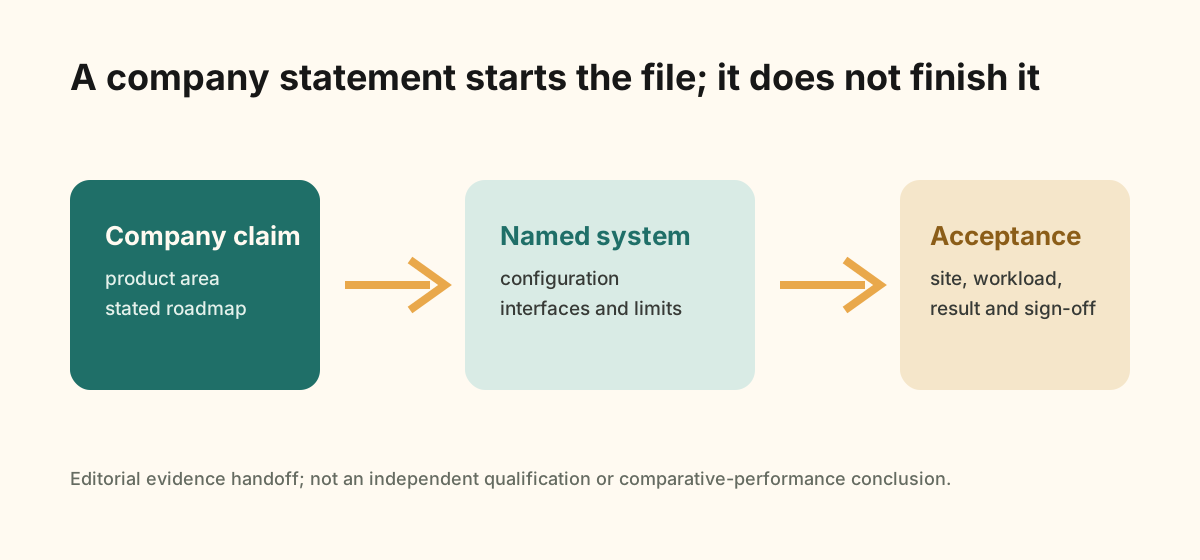
Editorial evidence handoff. It is not an independent qualification or comparative-performance conclusion.
The five files before qualification
The following sourcing handoff is deliberately practical. It does not decide whether a Chinese supplier is the right choice. It makes clear what “right choice” would need to mean in a named evaluation.
File 1: category and process
This file identifies the tool class, process task, material and operating boundary. It should answer: what exactly is being acquired or evaluated, and what job must it perform in the process flow? It should include the existing baseline where there is one, the reason for evaluating an alternative, the relevant interface points, and the measure that determines success.
Do not use a country, company, or product family as a substitute for this file. The category file is where a buyer discovers whether the question is even comparable. It may reveal that the real decision is about a chamber configuration, a software module, a measurement step, a consumable, a cleaning cycle, or a servicing arrangement rather than “a tool” in the abstract.
File 2: named configuration
This file identifies the exact offered system. Record the model, revision, modules, chamber count where relevant, automation, control and data interfaces, software version, optional parts, required facilities, consumables, spares, manuals, and stated limits. Identify whether a material change requires requalification and who controls the change.
The named configuration file is where a supplier’s general product statement becomes a proposal a buyer can test. It should not be assembled from marketing names alone. If a seller cannot identify the supplied configuration, the buyer cannot tell whether a positive statement about a different version applies to the one that may arrive at the fab.
File 3: support and lifecycle
This file asks a less glamorous but often decisive question: who keeps the tool operating? It should cover installation, commissioning, training, preventive maintenance, parts availability, calibration, remote access, software updates, service response, escalation, warranty, responsibilities across the seller, integrator, and fab, and a plan if a critical dependency changes.
No public company statement can create this file for a specific customer. A product can be technically interesting and still fail a buyer’s lifecycle requirement. Conversely, a bounded support plan can make a carefully scoped pilot viable even if the supplier does not claim a universal replacement. The buyer should treat lifecycle evidence as a core qualification input, not an after-sales afterthought.
File 4: control and commercial boundary
This file captures the current compliance context and the commercial terms that turn it into a plan. It should be refreshed when the relevant regulatory, ownership, product, destination, end-use, or service facts change. It should also identify delivery assumptions, payment, warranty, support commitments, allowable substitutions, cancellation or delay outcomes, and which party owns each review.
The aim is not to turn buyers into lawyers. The aim is to make clear that “not discussed in a public notice” is not the same as “cleared,” and “listed in a public notice” is not the same as “unavailable.” A transaction is an object with specific facts. The file keeps those facts from being replaced by a general geopolitical narrative.
File 5: acceptance
The final file records how the fab will decide whether the named configuration is acceptable for the stated process. It needs a defined site, material, recipe or process context, test period, measurement method, success criteria, deviations, failures, corrective actions, sign-off authority, and disposition. It should make clear whether the activity is a lab demonstration, a process-development exercise, a limited pilot, or sustained production use.
An acceptance file does not need to be public. In many cases it cannot be. But it needs to exist for the decision-maker. Without it, the words “qualified,” “replacement,” and “works” are usually claims without a shared denominator.
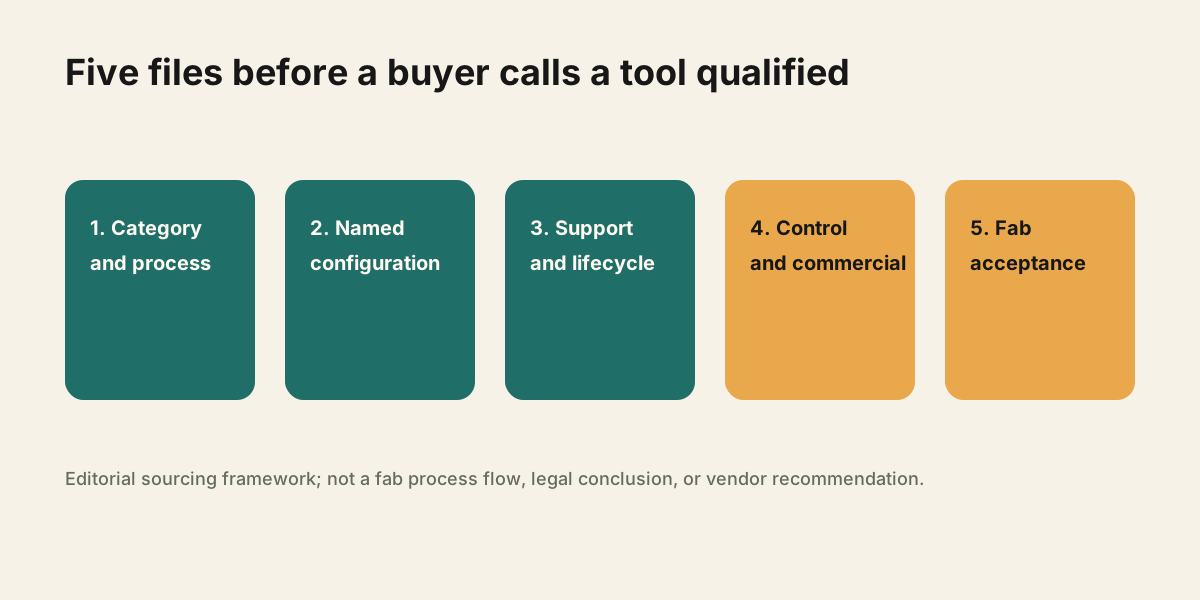
Editorial sourcing framework. The files are evidence layers, not an engineering process flow, legal opinion, or supplier recommendation.
How to run a bounded evaluation without pretending certainty
A buyer does not need to wait for a perfect global narrative before exploring a candidate tool. It can run a bounded evaluation. The discipline is to write down which uncertainty the evaluation is intended to reduce.
Begin with the decision. Is the organisation trying to learn whether a supplier can support a specific tool category? Is it comparing a current baseline with a candidate configuration? Is it reducing a dependency risk? Is it testing a process hypothesis? Is it preparing a contingency? Each purpose implies a different scope, budget, confidentiality boundary, and success measure.
Then define the smallest evidence-bearing step. A research meeting can test whether the supplier understands the process boundary. A documentation review can test whether the named configuration and lifecycle dependencies are clear. A non-production demonstration can test a limited technical question. A controlled site evaluation can test a defined process question. A production acceptance can test an agreed operating result. These are not interchangeable stages, and a positive result in one should not be marketed as a result in the next.
Finally, decide in advance what would stop the project. Examples might include the absence of a necessary service commitment, an unresolved compliance issue, a configuration change the fab cannot accept, a test that does not meet the agreed measure, or an inability to document a critical dependency. A stop condition is not failure. It is evidence that the organisation has protected its process and capital from an unsupported leap.
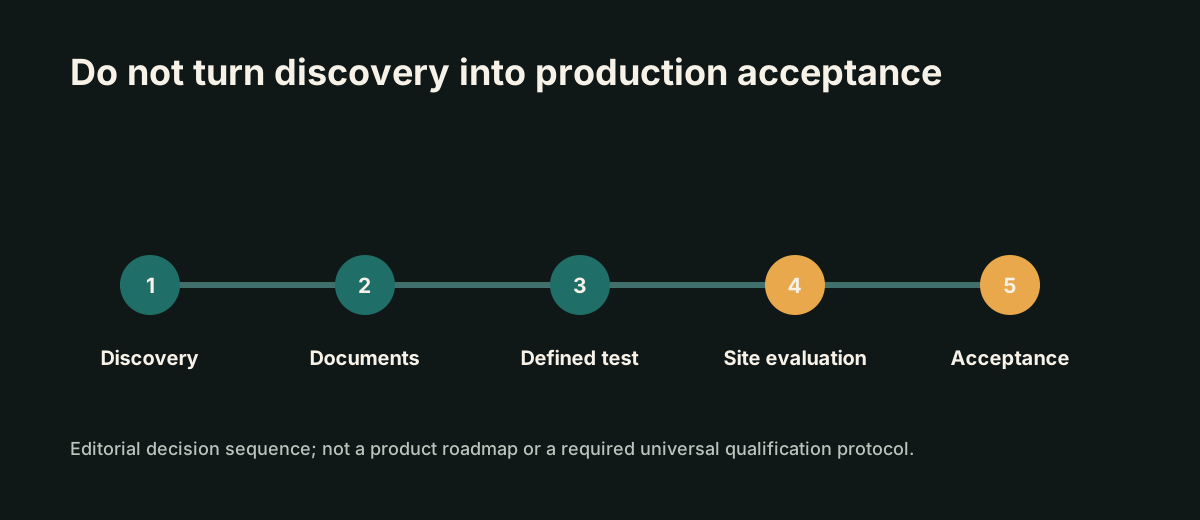
Editorial decision sequence. It is not a product roadmap or a universal qualification protocol.
Questions a supplier should be able to answer
Before a buyer calls an opportunity serious, the supplier should be able to answer these questions in a form that can be recorded:
- What exact tool class and process task does this offer address?
- Which model, modules, revision, software, dependencies, and support boundaries are included?
- What has been demonstrated, for which conditions, and what has not been demonstrated?
- Which parts of the result are company statements, customer-provided information, or independently observed records?
- What will change during delivery, installation, maintenance, upgrade, or substitution, and who authorises it?
- Who supplies training, parts, calibration, repairs, and escalation at the buyer’s site?
- Which regulatory and commercial assumptions must be checked for the actual transaction?
- What acceptance test and sign-off path does the supplier propose?
The best answer to an unverified question may be “we do not yet have that record.” That is more useful than a vague affirmative. It lets the buyer decide whether the missing file can be created through a bounded evaluation or whether the claimed scope should be reduced.
What this article does—and does not—say about China’s equipment sector
The article does say that China’s semiconductor-equipment question contains distinct tool categories and a real policy context. It says a named company may make useful statements about its own product areas. It says that current public sources do not let a reader collapse those facts into a universal equipment-capability conclusion.
It does not say that a Chinese tool source is automatically ready or automatically unsuitable. It does not say that a non-Chinese source has no dependencies. It does not say that an export-control notice resolves a contract. It does not say that a research project produces a production-qualified process. Each of those propositions would require a different evidence base.
This is a more demanding story than a headline about self-sufficiency. It is also more useful for the people who have to sign a purchase order, operate a fab, support a chamber, manage a qualification, or explain a sourcing risk to a board. Their decision is not about a national slogan. It is about whether a defined tool can do a defined job with defined evidence.
Turn the five files into a decision memo
The value of the five-file approach appears when an evaluation has to move between people with different responsibilities. A process engineer may understand the performance question but not the commercial terms. A sourcing lead may understand lead time and supplier relationships but not know which chamber configuration changes the comparison. A service team may see a spare-parts dependency that is absent from the technical presentation. A compliance team may need a clear item and end-use description before it can begin its own work. A plant leader may need to know whether an apparently attractive opportunity is a research project, a pilot, or a production commitment.
A short decision memo gives those people one common object. It should open with a sentence that is deliberately unglamorous: “The proposed decision is to evaluate [named configuration] for [named process task] at [named site] within [stated boundary].” If the team cannot complete that sentence, it is not ready to make a sourcing conclusion. It has a market-research question, and that is fine, but it should not be described as a qualification.
The next paragraph should state the current evidence by file. For the category file, list the process question and the current baseline. For the named configuration file, state exactly what has been offered and what remains to be specified. For the support file, name every party that will install, train, maintain, calibrate, supply parts, update software, and own escalation. For the control and commercial file, list the assumptions requiring current specialist review rather than declaring a result. For the acceptance file, specify what result the team would need before the scope can expand.
Then add an explicit uncertainty register. It is tempting to hide uncertainty under a generic phrase such as “supply-chain risk.” That does not help a decision-maker. Write the uncertainty in an observable form: “software key renewal path not documented,” “site utility interface not confirmed,” “candidate configuration differs from available reference material,” “service response model not yet agreed,” “regulatory review has not begun,” or “acceptance metric has not been set.” Each statement points to an owner and next action. It is much more useful than an overall confidence score.
The memo should also distinguish three decisions that are often merged. The first is whether to continue discovery. This can be a low-cost decision based on a category file and a credible company conversation. The second is whether to fund or schedule a bounded evaluation. That requires the named configuration, site boundary, support expectations, commercial assumptions, and a test plan. The third is whether to adopt the tool for production use. That requires the acceptance result and lifecycle commitments appropriate to the fab’s risk. A positive answer to the first is not evidence for the third.
This separation makes it easier to deal honestly with a company that is still developing a product. The supplier can propose a research or pilot relationship without advertising a production equivalence that is not supported. The buyer can learn whether the company understands the process problem without giving up control over acceptance criteria. Both sides can decide whether the next evidence gate is worth the cost. If it is not, they can stop with a clear record rather than arguing over a national narrative.
A useful red-flag list
The following signs do not prove that an opportunity will fail. They show that the team should pause and return to the missing file:
- The product is described only as “an alternative” or “domestic” without a named process task.
- A company presentation is used as though it were an independent fab qualification.
- The offered model, revision, or module set is not written down.
- The claimed result has no material, site, period, test method, or acceptance owner.
- Service, calibration, consumables, parts, software keys, or upgrades are described as future discussion items while the team is being asked for a production commitment.
- A public export-control announcement is offered as a transaction decision instead of a reason to obtain current specialist review.
- The comparison uses a different process, configuration, baseline, or workload from the buyer’s intended use.
- A request for a bounded pilot is answered with a country-level claim rather than an evaluation plan.
Each red flag can be resolved. The appropriate response is not a quick yes or no. It is a clearer question: what document, named configuration, test, agreement, or review would resolve this point? If no such next step can be identified, the proposed scope is probably too broad.
The strongest conclusion is often conditional
A serious sourcing conclusion may read: “The candidate is worth a controlled evaluation for this tool category and stated process task, subject to completion of the configuration, support, compliance, and acceptance files.” That sentence may seem less exciting than “China has solved semiconductor equipment.” It is the sentence that a cross-functional team can actually use.
It preserves optionality. It allows a buyer to investigate a Chinese supplier, a non-Chinese supplier, or a multi-source strategy without assuming equivalence or rejecting it in advance. It gives the supplier a fair description of the evidence it must provide. And it respects the fact that semiconductor manufacturing is a system: a tool is not useful merely because it exists, but because it can perform a defined job within a process, facility, support model, and decision boundary.
Method and limitations
This is desk research based on BIS public notices, a defined USITC executive briefing, and an AMEC company statement. BIS records are used only for the public control scope and stated agency position. AMEC’s material is used only as an attributed company disclosure. The USITC briefing is used only for its category definition and stated import-data context.
The article does not claim first-hand fab, process-integration, installation, maintenance, calibration, qualification, legal, export-compliance, or procurement experience. It does not assess a named supplier’s performance, availability, market share, technical equivalence, support quality, legal status, or suitability for a buyer. Readers making a technical, legal, compliance, safety, or sourcing decision should obtain records and specialist advice appropriate to the actual tool, process, site, and transaction.
Frequently asked questions
Can China build all of its own semiconductor tools?
This guide does not make a country-wide self-sufficiency claim. Semiconductor manufacturing equipment is a broad category that includes distinct tool classes, and a useful answer must identify the tool, process task, configuration, support model, and qualification record. The public sources used here do not justify a universal yes or no.
Does a Chinese company’s product statement prove a tool is qualified?
No. A company disclosure can identify what the company says it develops or offers. It does not substitute for a named configuration, fab-specific process record, service plan, or acceptance result. AMEC’s 2025 statement, for example, is useful as an attributed company source; it is not an independent qualification report.
Are etch, deposition, lithography, and metrology interchangeable evidence categories?
No. They are distinct categories within semiconductor manufacturing equipment. A buyer should identify the process job and the exact evidence needed for the relevant tool rather than treating a statement about one category as a conclusion about another. The USITC briefing is useful category context but does not make a product comparison.
Do U.S. export-control announcements decide whether I can buy or service a tool?
No. Public announcements describe policy scope and agency positions. Whether a particular item, transaction, support action, end user, or end use is subject to a rule depends on specific facts and current law. Seek qualified legal and export-compliance advice for the actual transaction. See the relevant December 2024 BIS notice and later VEU announcement.
What is the minimum evidence before a fab starts an evaluation?
At minimum, the fab should have a clear category and process description, a named proposed configuration, lifecycle and support responsibilities, a current review of commercial and compliance assumptions, and a written acceptance plan. The exact depth depends on the risk and stage of the project, but a general country or company narrative should not replace these files.
Why is the acceptance file so important?
It defines what “works” means for a named tool in a named process and site. Without a stated test method, conditions, success criteria, deviations, and sign-off authority, a buyer cannot tell whether a claimed result applies to its own decision. An acceptance result may be confidential, but the decision record still needs to exist.