

AI-generated editorial illustration by China Made & Tech. It depicts no real vehicle, brand, country, road, charger, dealer, network, price, or ownership outcome.
By China Made & Tech Team. Independent English field guide to China’s niche hardware brands, hidden champions, founders, factory towns, and supplier clusters.
“Which Chinese EV brands are available here?” looks like a shopping question. It is usually a request for a brand list, a familiar badge, a few model names, and a judgement about whether the buyer should be reassured. That is understandable. It is also the wrong unit of analysis for a costly, long-lived purchase.
An overseas EV buyer does not own a brand’s market announcement. They own one exact vehicle in one legal and operating environment. They may need to import it, register it, insure it, activate its connected features, charge it, receive software updates, repair it, finance it, transfer it, and obtain a remedy if the seller or support path fails. Every one of those questions can have a different answer for a different version of what appears to be the same car.
This guide therefore does not rank Chinese brands, recommend a vehicle, calculate tax, promise charging access, or attempt a country-by-country availability table. Those answers age quickly and are often based on an imprecise version of the question. Instead, it gives a buyer a more durable method: build five files for the exact vehicle before treating a brand’s presence as a purchase result.
The five files are:
- The vehicle-identity file.
- The market-entry file.
- The software and data file.
- The charging file.
- The ownership-remedy file.
The European Union and United Kingdom records used below are bounded examples, not a global rulebook. They show why trade measures, approval routes, software governance, and chargepoint lists cannot be collapsed into one reassuring answer. If the buyer is elsewhere, the same discipline still applies: find the authority, operator, seller, insurer, lender, and service record that actually governs the exact decision.
Are Chinese EV brands “available” abroad?
Brand availability is only a lead. It may mean that a manufacturer has announced a market, a distributor has opened a showroom, a marketplace can ship a car, an importer has one vehicle in stock, or a country has approved a related version. None of those facts alone proves that a buyer can register, charge, update, service, finance, insure, resell, or obtain a remedy for the exact vehicle they plan to acquire.
Does an EU duty rate tell me what a Chinese EV will cost or whether I can buy it?
No. The European Commission’s trade record concerns a defined countervailing-duty measure on battery electric vehicles from China. Its stated definitive duty range is 7.8% to 35.3%. That is useful evidence of a trade boundary; it is not a retail price, a landed-cost calculation, a recommendation, or evidence that a particular vehicle is suitable for a particular buyer. The Commission’s guidance describes that limited scope.
Does a Certificate of Conformity guarantee that an imported EV will be easy to own?
No. GOV.UK says a manufacturer-issued Certificate of Conformity can help with importing and registering a new vehicle. It is an important vehicle record in its stated context, but it does not establish charging access, software support, insurance, financing, warranty handling, parts supply, or resale. The GOV.UK guidance defines the certificate’s role; it does not provide a complete ownership verdict.
Are software updates merely a feature-list question?
No. Software and cyber-security are part of the ownership path. The UK Vehicle Certification Agency describes UN Regulation No. 155 as covering cybersecurity management systems and UN Regulation No. 156 as covering vehicle software-update management systems. Those are governance categories, not a rating of any individual car’s user experience. But they show why a buyer needs an update and support record alongside a vehicle specification. VCA’s guidance is a useful boundary.
A brand’s presence is not an ownership path
The phrase “Chinese EV brand” bundles together too many facts. It may refer to the place where a parent company is headquartered, where a vehicle was assembled, the market that a particular version was designed for, the dealer that advertised it, or the importer that offered it to ship. These descriptions can all be true without describing the car that will arrive at the buyer’s address.
Start with a simple distinction: visibility is not availability, and availability is not ownership readiness. A bill-board, media launch, social post, marketplace listing, or showroom opening establishes visibility. A local order page, a contract from an authorised seller, or a vehicle physically held in a market may establish some form of availability. Ownership readiness is harder: it is the evidence that links an exact physical car to the buyer’s destination, legal route, operating needs, and recovery path.
This distinction is not an argument against Chinese vehicles. It is an argument against treating origin or brand familiarity as a substitute for records. The same method is sensible for any imported, newly introduced, grey-market, or digitally connected EV. A buyer should be especially careful when the product is expensive to return, its approval route is unfamiliar, or its software and support environment depend on accounts outside the buyer’s normal market.
The result is often more nuanced than “yes” or “no.” A car can be orderable but not registered on the buyer’s intended timetable. It can be registrable in a stated route but supported by a seller whose warranty wording does not cover the buyer’s cross-border use. It can use a familiar connector but leave the buyer without a written confirmation about the network, tariff, access method, or home installation they need. It can have a sophisticated software stack but leave unclear whether the buyer’s account, mobile service, language, maps, or update pathway will work as expected in the destination.
The practical goal is to expose these distinctions before money becomes non-refundable. A buyer does not need proof of every hypothetical future event. They need enough current, written evidence to decide whether the unresolved dependencies are acceptable for the intended use. A second household car, a collector purchase, a project vehicle, and a family’s only long-distance car call for very different standards of proof.
Replace the brand question with an exact-vehicle question
Before looking for reassurance, write a one-sentence purchase case that names the thing being evaluated. For example: “Can this exact, new, right-hand-drive vehicle in this colour and stated software configuration be acquired through this seller, registered in this destination, operated with this charging plan, and supported under these written terms?” The sentence may feel pedantic. It prevents the buyer from accepting evidence about a similar, earlier, left-hand-drive, domestic-market, demo, reconditioned, or differently equipped version.
The vehicle-identity file should preserve the model designation, trim or configuration, vehicle identification number when it is lawfully available at the right stage, country or region specification, build date or delivery window, seller identity, and the documents that describe the vehicle’s stated condition. Include a dated copy of the listing or quotation, the purchase terms, and the precise features the buyer considers essential. If a reseller uses a broad product name, ask which documents connect that name to the actual vehicle.
An exact identity makes other questions answerable. A registration authority, insurer, lender, workshop, carrier, chargepoint operator, and manufacturer support team can all ask for different identifiers or configuration details. If the buyer begins only with a badge and a marketing brochure, they will repeatedly receive generic answers. If they begin with an exact vehicle file, they can ask narrow questions and record narrow answers.
Do not confuse an identifier with a universal guarantee. A VIN, chassis number, certificate, or serial number is useful because a relevant party can connect it to a decision. It is not proof that every party will make the same decision. Likewise, a seller’s claim that a vehicle is a “global version,” “export version,” or “EU specification” should be treated as a question to be documented, not as proof that the buyer’s whole ownership path is complete.
The seller’s role is part of the identity question
The same physical model may reach a buyer through a manufacturer subsidiary, a franchised dealer, an independent importer, a broker, a marketplace seller, a fleet-liquidation channel, or a private individual. These routes are not morally better or worse by label. They create different contractual, documentation, handover, return, and service relationships.
Ask the seller to state who will be the contractual counterparty, which entity receives payment, where the vehicle is located before handover, who arranges transport, which entity supplies the warranty, and who handles a rejected delivery or missing document. A broad statement that the “brand has a presence” does not answer these questions. The buyer needs the entity that has obligations to them.
If the seller cannot identify the exact route clearly, the uncertainty is itself material. A buyer may decide that a lower price compensates for it; another may not. What matters is that the buyer does not mistake a promotional relationship or a branded website for a legal and practical ownership pathway. Preserve statements in writing, because a sales call is difficult to use later when an order, registration, or repair issue becomes contested.
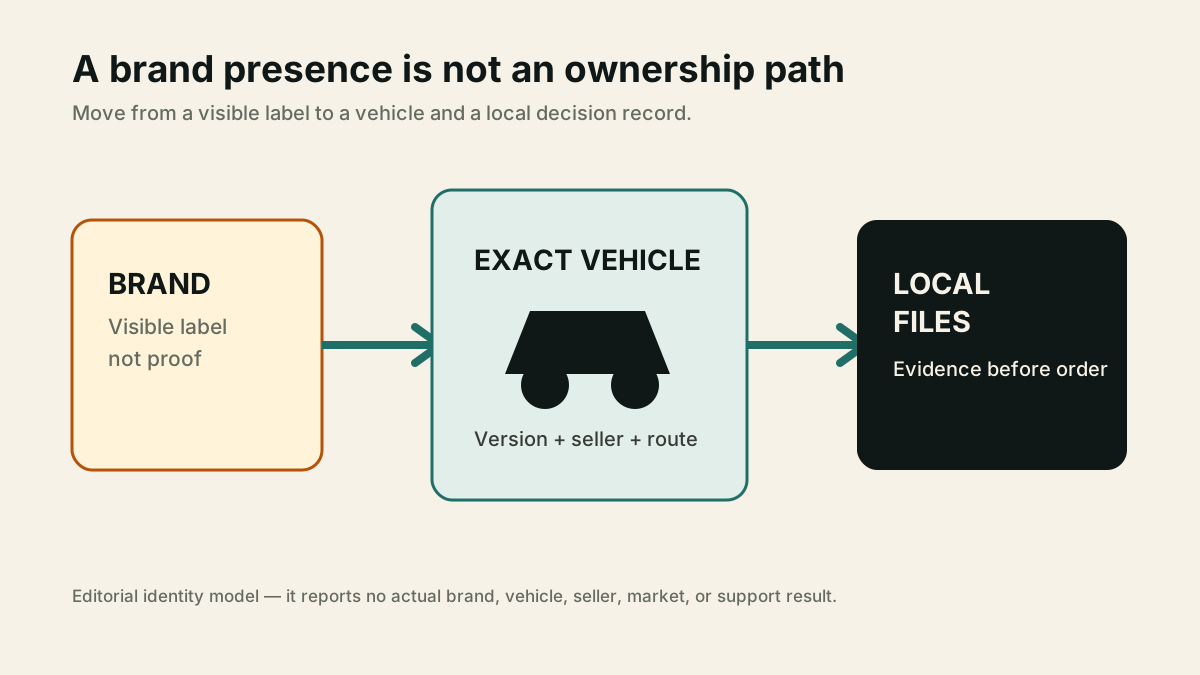
Editorial identity model. It does not state that a named brand, vehicle, seller, or market has any particular availability or support result.
Trade scope is not ownership readiness
Trade headlines often make an EV decision feel settled because they attach a precise number to a familiar category. Numbers can be useful, but only if the buyer keeps their scope attached. The European Commission’s January 2026 guidance says definitive countervailing duties on battery electric vehicles from China range from 7.8% to 35.3%. The page concerns a specific EU trade measure and its stated product and exporter scope. Read the Commission record for the measure itself.
That record can support a narrow sentence: a defined EU trade measure has a stated duty range for the covered China-origin battery-electric-vehicle context. It cannot support several tempting but different sentences. It does not say what a particular consumer will pay. It does not tell a buyer which contractual terms apply, which vehicle is in stock, how a dealer prices a car, whether a vehicle is eligible for a programme, whether an importer has correctly classified it, or whether that particular car can be registered, financed, insured, charged, repaired, or resold.
This is not a technicality. The moment a buyer turns a trade measure into an individual price or availability conclusion, they introduce facts that the trade record does not contain. Freight, insurance, taxes, fees, dealer margin, currency, delivery timing, contract terms, local incentives, and the exact vehicle’s origin and route may all matter. The buyer should get those inputs from the party that will stand behind the transaction or from the authority that governs the relevant calculation, not from a generic duty headline.
Keep the noun attached to the evidence
A useful research habit is to write down the noun that the source actually governs. The Commission record governs a trade measure. A registration authority governs a registration route. A vehicle approval body governs its approval framework. A chargepoint programme list governs its own eligible-vehicle programme. A manufacturer or seller warranty document governs the terms it states. A buyer gets into trouble when they treat each of these as if it governed “the car” in every sense.
In practice, this means storing the source beside a short scope note. For the duty record, write: “Trade measure; China-origin battery electric vehicle scope; not retail cost.” Then place it in the market-entry file, not in a spreadsheet column titled “final price.” If the buyer wants a landed-cost answer, open a separate calculation file with the exact destination, transactional party, vehicle classification, delivery condition, and source for each input. If those records are unavailable, the honest answer is that the cost is not yet verified.
The same approach improves conversations with sellers. Instead of asking “Will tariffs affect this car?” ask, “Which written price and delivery terms apply to this exact vehicle, and which party accepts responsibility if the stated import treatment differs?” Instead of asking “Is it available in Europe?” ask, “Where is this vehicle now, which local market specification does it have, and which entity will provide the documents needed for my stated registration route?” These questions are harder to answer with marketing language and easier to preserve as evidence.
Scope protects the buyer from false reassurance and false alarm
Trade records can be misused in both directions. A buyer may see a duty range and decide the vehicle must be impossible to buy. Another may see a brand’s launch and decide a duty measure cannot matter. Neither conclusion follows from the record alone. The right response is to identify the question the record settles, then find the next record for the next question.
The method also prevents a buyer from importing somebody else’s conclusion. An article may correctly describe a policy at a certain date, but it may concern a different powertrain, origin, legal entity, destination, or delivery structure. A social-media post may accurately recount one person’s invoice and still tell the buyer nothing reliable about their own transaction. Use third-party material to generate questions. Use the relevant primary or contractual record to answer the question that changes your commitment.
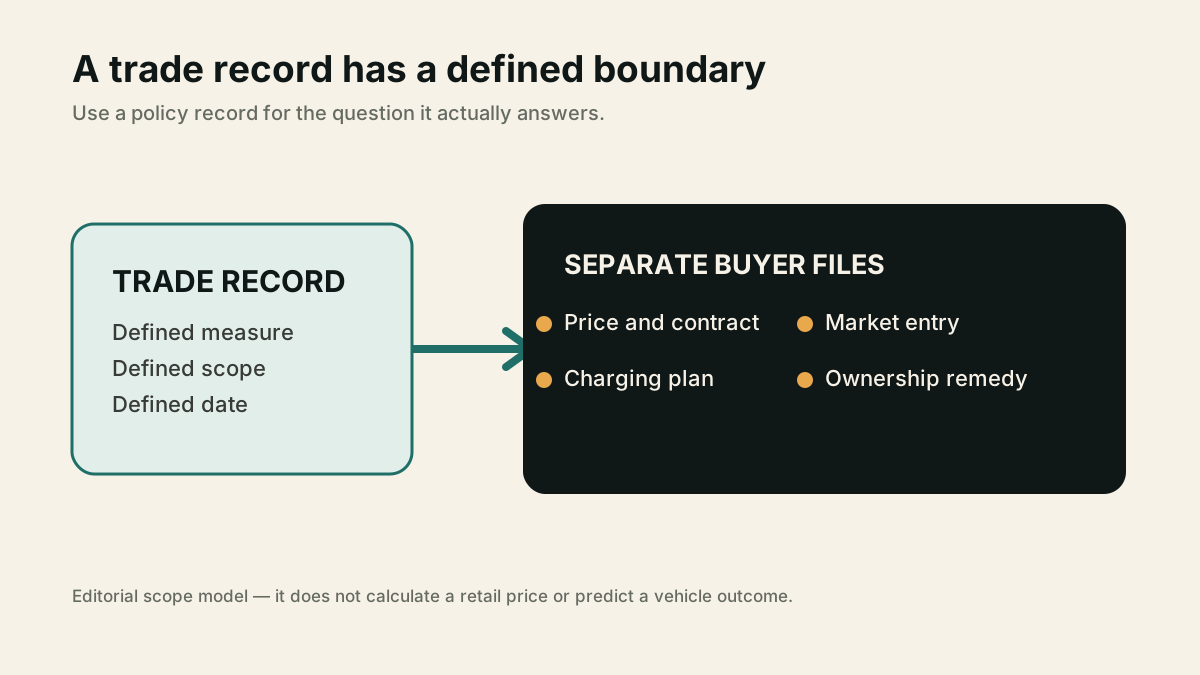
Editorial scope diagram. The duty example is a bounded trade record; the diagram does not calculate a consumer price or predict any vehicle’s availability.
Market entry is a vehicle file
The market-entry file is where a buyer tests whether a particular vehicle can follow the local legal and administrative path they need. It is not the same as a sales or trade file. In the UK example, GOV.UK says that an imported vehicle may require approval to show it meets environmental and safety regulations, and that proof is needed for registration and tax in the stated cases. It directs users to different routes depending on the vehicle and its prior registration context. The import-approval guidance describes the UK process; it is not a worldwide rule.
The practical lesson is simple: a brand announcement does not replace a vehicle approval route. Nor does a seller’s statement that “documents are included” identify which document is relevant to the buyer’s specific vehicle and registration context. The buyer must work backwards from the local authority’s stated route and ask which record the exact vehicle will need.
This is one reason a model list is not a guide to ownership. One model name can cover vehicles built for different markets and sold through different channels. Some may have the documentation or configuration the buyer needs; others may require a different process. A local dealer’s version may not be interchangeable with a parallel-import version. The buyer should never assume that an approval or registration result reported for another car applies to theirs without matching the identity and route.
Certificate of Conformity: useful, limited, vehicle-specific
GOV.UK’s Certificate of Conformity guidance provides a clean example of what a document can and cannot do. It says that the certificate is issued by the manufacturer and can help when importing and registering a new vehicle. That makes it a potentially important part of a vehicle’s market-entry file. The GOV.UK page is clear about the document’s intended role.
It is not, however, a universal “approved to own” certificate. The page does not say that the certificate guarantees a local dealer relationship, a particular warranty, home-charge installation, public-network access, financing, insurance, resale, software availability, spare parts, or a successful remedy. A careful buyer uses the certificate to answer the question it is meant to answer and keeps the other questions open until a relevant party answers them.
Ask for a copy or verifiable details early enough to investigate the stated route. Check that the document connects to the exact vehicle and its stated new-vehicle status, rather than a generic model name or a similar unit. Ask the seller how the document will be delivered, whether it is original or a replacement, and what happens if the registration authority rejects it or asks for something else. If the seller says a certificate will be obtained later, record who will obtain it, by when, and what happens if that cannot be done.
The buyer should avoid pretending to be an approval expert when they are not. The right outcome may be to speak with the competent local authority, a qualified importer, or a professional adviser for a high-value transaction. This guide does not give legal advice. It gives a way to recognise that a general brand claim is not proof of a vehicle-level market-entry result.
Build a market-entry packet before a deposit becomes irreversible
A practical packet need not be enormous. It should contain the exact vehicle identity; the seller’s location and contractual role; the destination and intended registration route; the record or document that the relevant authority says is needed; the source and date for that requirement; the seller’s written answer about who provides it; and the remedy if the process does not work. Keep the original source link and a dated copy of the seller’s answer. Policy pages can be updated; quotations can be edited; staff can change.
Separate known facts from open questions. “The authority’s page says proof is needed in the stated cases” is a known, sourced fact. “This exact vehicle will be registered without further steps” is an outcome that needs evidence specific to the vehicle and buyer. If the buyer cannot get that evidence before paying, they should decide consciously whether the contract and return rights leave enough room for the uncertainty. Do not hide an unknown in the word “available.”
Locality is not a minor detail
The market-entry example is intentionally UK-specific. It illustrates a broader rule: country, region, and even registration history can change the record that matters. A vehicle that is straightforward in one jurisdiction may take a different path in another. A buyer who lives near a border, moves often, buys through a company, needs a particular tax or registration treatment, or intends to export later has further dependencies.
Do not borrow a forum answer from another market simply because the car looks identical. Do not infer the route from steering position, a plug type, language setting, or a delivery photograph. Use the authority for the intended destination and state the vehicle’s actual history. When the local rules are difficult to interpret, the most responsible decision may be to pause rather than convert a partial document into a confident conclusion.
Software is an ownership file
An EV is not only a collection of mechanical parts and a battery. Its ownership path can include software, connected services, account access, maps, mobile applications, diagnostics, security updates, feature changes, data permissions, and the local support organisation that handles a malfunction. A buyer who checks only a screen’s appearance or a feature list is missing the operational question: what evidence shows how this vehicle will be supported where I intend to use it?
The UK Vehicle Certification Agency’s explanation of UN Regulations No. 155 and No. 156 helps define the boundary. VCA says the former covers cybersecurity management systems and the latter covers vehicle software-update management systems. It also describes an approval and manufacturer-management context. VCA’s material should not be read as evidence that a particular vehicle will deliver a good user experience, receive an update on a particular day, or keep every feature in every country. It does show that software updating is governed as a serious vehicle-management subject rather than a decorative option.
For a buyer, that means software deserves its own file. It should describe the exact vehicle’s stated software region and version at handover; the account that will own or administer it; the phone, mobile number, or identity dependencies; the update channel; the language and map assumptions; the data and connectivity terms; the support contact; and the written remedy if a core function does not work in the buyer’s location.
Ask about the operating path, not just feature presence
An advert may say that a vehicle has navigation, app control, driver-assistance functions, over-the-air updates, voice functions, or remote climate control. Each phrase can hide a different operating path. Does the function depend on a local data service? Does it require an account created in a particular market? Does the buyer receive control of that account at handover? Can a used or imported vehicle be transferred to a new owner? Does a software-region change affect feature availability? Who supports the vehicle if a connected service cannot be activated?
These questions are not accusations. They are ordinary ownership questions for a connected product. The seller or manufacturer may have clear answers. The buyer should request them in writing before making the feature part of their purchase case. If a feature is merely a pleasant extra, uncertainty may be tolerable. If it controls charging, access, safety-adjacent alerts, route planning, business travel, fleet management, or the buyer’s mobility routine, the evidence standard should rise.
Be cautious with a promise that a vehicle can simply be “flashed,” “converted,” “unlocked,” or “set to global.” Such claims mix technical possibility with legal, warranty, security, compatibility, and support questions. This guide does not endorse modification. A buyer should ask who performs the change, which software source they use, how it affects the documented support path, whether it alters the vehicle’s stated configuration, and what written remedy survives if the result fails. A workaround can solve one feature while destroying the evidence needed for another.
Governance is not a quality rating
The VCA record is valuable precisely because it is limited. It speaks to regulated cybersecurity and software-update management categories; it does not rank brand software, compare regional experiences, or guarantee that a user will like an interface. A buyer should preserve that distinction. “This manufacturer falls within a management-system framework” is not the same claim as “this car will receive timely updates in my country.” “This vehicle has a connected app” is not the same claim as “my account will activate, transfer, and remain supported.”
Use this limitation constructively. Ask each party only for the promise it can make. Ask the manufacturer or authorised support channel about current account, update, and support availability for the exact vehicle and destination. Ask the seller about handover, account transfer, documentation, and contractual remedy. Ask a charging or mobile-service provider about its own access requirements. Keep each response in the file it belongs to rather than merging them into a single, fragile sentence such as “the car is supported.”
Plan for an ordinary failure, not only a perfect handover
The buyer should also imagine mundane events: a phone is replaced, a password is lost, a vehicle is sold, an update is interrupted, a connected service account is wrongly associated with a previous owner, a mobile connection is unavailable, or a workshop needs to diagnose a warning. The goal is not to predict disaster. It is to see whether the buyer can identify a responsible path before the first problem arrives.
Write down the contact that will handle each event and the evidence that the buyer is entitled to use that path. If the answer is “a local dealer,” identify the dealer and verify whether the car’s route and version are within that dealer’s stated responsibility. If the answer is “the app,” identify who can recover account access. If the answer is “the importer,” make sure the importer is a named contractual entity with an address and a written support undertaking. A vehicle’s software can be excellent and still be a poor fit for a buyer who cannot establish these basics.
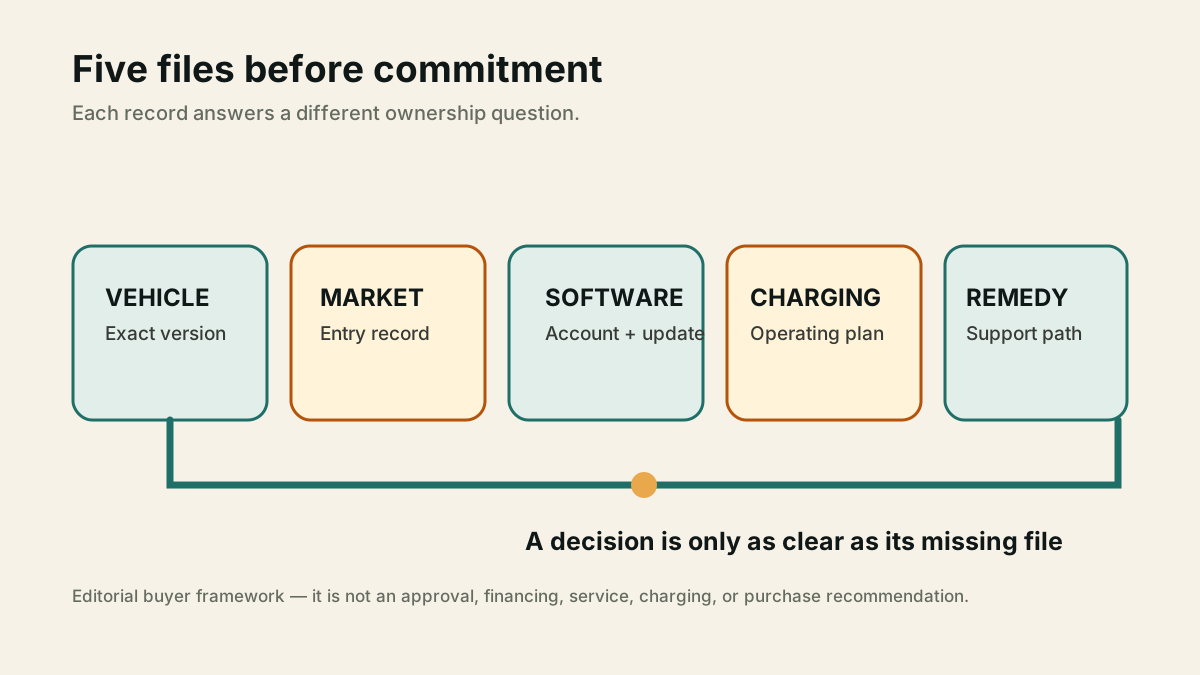
Editorial ownership framework. It does not depict an actual software system, account result, update schedule, or service commitment.
Charging is a local operating file
Charging questions are often reduced to a connector photograph or a broad claim that a country has many public chargers. Neither is a complete operating answer. A buyer needs to know how the exact vehicle, their home or parking situation, their destination’s local electricity and access arrangements, and the networks they intend to use will meet in daily life.
GOV.UK’s page for residential chargepoints provides a useful example of a bounded charging record. It maintains a list of vehicles eligible for the Office for Zero Emission Vehicles residential-chargepoint grant. The official list can be relevant to the stated programme and is updated as that programme changes. It does not certify universal public-charging compatibility, determine the quality of a vehicle’s charging experience, prove that an installer will accept the site, or establish a buyer’s ownership outcome.
That distinction helps a buyer avoid two opposite errors. One is treating list inclusion as proof that every charging question is solved. The other is treating absence from a particular programme list as proof that the car can never be charged. Both infer more than the record says. The buyer should use the list only for the relevant programme question, then build the other parts of the charging file separately.
The charging file has at least four layers
First, identify the exact vehicle’s stated charging hardware and configuration from the vehicle documentation, not an image from another market. Second, identify the buyer’s home, workplace, building, landlord, parking, electrical-installation, and installer constraints. Third, identify the actual public networks or roaming arrangements the buyer expects to use, along with their current account, payment, access, and equipment requirements. Fourth, identify the fallback when the primary plan is unavailable: a nearby alternative, a travel route, a work location, or simply a decision that the ownership pattern is unsuitable.
This is deliberately not a charging-network recommendation. Networks, tariffs, access terms, supported equipment, and physical sites change. A buyer should ask the network or installer that matters to them, and should not rely on a claim made for another country, another plug standard, another software version, or another owner’s account. Record the answer with date, vehicle identity, and any stated assumptions.
For home charging, the vehicle is only one part of the question. A buyer may need permission from a landlord, building manager, employer, or homeowners’ association; an electrical assessment; an installer quotation; a smart-meter or tariff decision; and a plan for access when they move. A vehicle may technically support a charging approach that the buyer cannot practically install. That is not a defect in the brand. It is a mismatch between the buyer’s operating environment and an unresolved dependency.
Do not call a connector an outcome
A connector, maximum charging claim, or eligibility-list entry can be a helpful technical or programme record. It cannot tell the buyer whether a particular charge session will start, how payment will work, whether the account recognises the car, what an installer will approve, whether a car park will be available, or what a long-distance journey will require. The buyer should reserve words like “works,” “compatible,” and “supported” for a specified interaction between a specified vehicle and a specified provider at a specified time.
If the buyer needs reliable public charging, test the decision with their normal routes and routines before committing. Ask what happens when a preferred station is occupied, offline, inaccessible, or changed. If a particular charging feature is essential, ask the actual operator for the evidence it can provide about the exact vehicle and account path. A sales brochure can describe a capability; it cannot guarantee an operating ecosystem.
Programme evidence belongs in a programme folder
The GOV.UK eligibility list is especially useful as a research habit. Put it in a folder labelled with the programme it governs. Add the access date and note that it does not decide general charging. This seemingly modest organisational rule prevents the buyer from reusing the record later as proof of something it never claimed.
Apply the rule beyond charging. A local incentive record goes in an incentive folder. A manufacturer warranty goes in a remedy folder. A network’s access terms go in a network folder. A registration route goes in a market-entry folder. When the buyer sees a blank folder, they can decide whether the missing evidence is tolerable or whether the purchase should pause. Organisation becomes a form of risk control.
Editorial charging workflow. It does not assert that any named vehicle is eligible for a grant, accepted by a network, or suitable for a particular home installation.
The five files before you place an order
The five-file method is an editorial framework, not a regulation or a legal checklist. Its value is that it makes unverified handoffs visible. A buyer can adapt it to a new-car order, a parallel import, a used vehicle, a fleet acquisition, or a research stage before contacting a seller.
File one: vehicle identity
Put the exact model, version, stated market specification, build or delivery information, key identifiers, seller quotation, condition statement, and list of essential features here. The objective is to eliminate the ambiguity between a broad model name and the individual vehicle whose documents, software, charging hardware, and support path will be evaluated. If a claim does not name the exact version, treat it as a lead rather than proof.
File two: market entry
Put the intended destination, the applicable authority source, the stated approval or registration route, the certificate or evidence the authority says is relevant, the seller’s written commitment to provide it, and the remedy if the route fails. The UK import-approval and Certificate of Conformity pages cited above are examples of the kind of primary record a buyer should seek for the destination in question. They do not answer the same question everywhere.
File three: software and data
Put the software region and handover state, account ownership and transfer path, connectivity assumptions, update process, support contact, privacy or data terms that matter to the buyer, and a record of what happens if a core service cannot be activated. Keep statements about features separate from statements about operational support. VCA’s R155/R156 material makes the case for taking the category seriously; it does not certify your particular user experience.
File four: charging
Put the vehicle’s documented charging configuration, the buyer’s home or workplace plan, installer or building permissions, likely public-network path, account and payment requirements, programme evidence where relevant, and the fallback plan. Put the GOV.UK eligible-vehicle list here only if the buyer is assessing that stated residential-chargepoint programme. Do not use it as a catch-all compatibility certificate.
File five: ownership remedy
Put the contractual seller, payment route, cancellation and return terms, delivery inspection process, warranty provider, workshop or support path, parts route, insurance and financing questions relevant to the buyer, complaints procedure, and resale or transfer constraints that affect the intended ownership period. This is the file that converts a technically attractive vehicle into a practical purchase decision. It is also the file buyers most often assume is covered by a brand name.
The files should be linked but not blended. A positive answer in one file is not a positive answer in another. A Certificate of Conformity cannot answer a remote-account transfer question. A chargepoint-list entry cannot answer a warranty question. A seller’s statement about a dealer cannot answer an approval question. The framework works because it prevents a strong-looking document from doing work it was never designed to do.
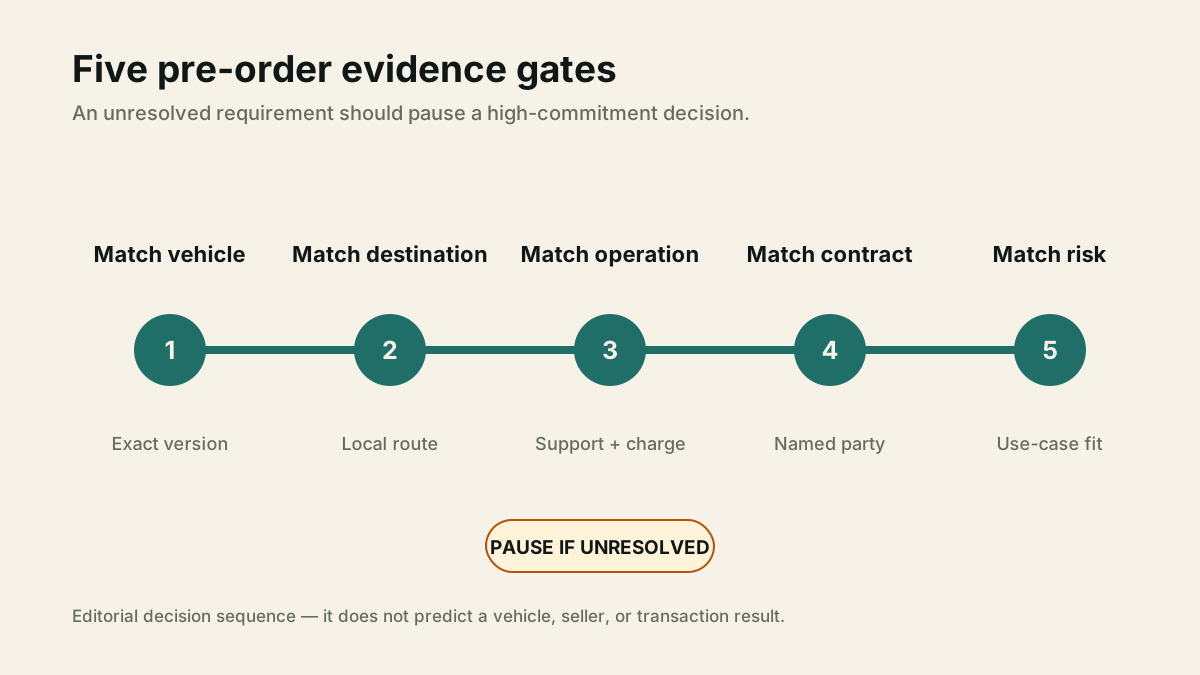
A five-step pre-order gate
Before any non-refundable payment, stop at five gates:
- Match the vehicle. Can every document and answer be tied to the exact vehicle, version, and delivery route?
- Match the destination. Does the relevant local authority or process describe the market-entry record you will need?
- Match the operating path. Do you have a written, current answer for the software, account, charging, and support dependencies that are essential to you?
- Match the contractual party. Is there a named entity that will receive payment and stand behind delivery, documentation, warranty, and remedy?
- Match the uncertainty to the use case. If one file remains unresolved, is that risk acceptable for this purchase, or should you wait, change route, or choose a locally supported alternative?
This gate is not designed to produce a universal “buy” or “do not buy.” It is designed to stop the buyer from making a high-commitment decision while calling an unknown “availability.” Some buyers will uncover a well-supported path and proceed. Others will find that the evidence is too thin. Both are better outcomes than discovering the missing file after delivery.
Common shortcuts that fail
“The brand is sold in my country, so this model is fine.”
Maybe, but the statement collapses exact vehicle identity, seller route, market entry, service, and software into one word: sold. Ask whether the local presence covers the actual version and transaction route. If it does, obtain the written evidence. If it does not, treat the brand’s presence as useful context, not as a substitute.
“The vehicle is listed online, so it is available.”
An online listing can establish that somebody is advertising something. It does not necessarily establish stock location, delivery status, contractual counterparty, included documentation, stated condition, or post-sale responsibility. Save the listing, then ask the seller the questions that the listing cannot answer.
“The duty rate tells me the final price.”
The Commission’s 7.8% to 35.3% range is evidence about a defined trade measure, not a complete consumer transaction. Treat a price as unverified until the party responsible for the deal provides the exact written terms and the buyer understands the inputs that the terms leave open.
“A certificate proves every ownership question.”
A Certificate of Conformity can matter for importing and registering a new vehicle in the stated GOV.UK context. It is neither a general warranty nor a global operating certificate. Use it in the market-entry file and keep the other files open.
“The car has an app, so it will be supported.”
An app is an interface, not a support promise. Ask about account creation, transfer, local connectivity, update path, support contact, and remedy. Do not make essential daily use depend on an unverified account, region, or subscription relationship.
“It has the right connector, so charging is solved.”
The connector is one input. The home installation, parking access, network account, payment method, programme rules, vehicle version, and fallback route are separate inputs. Build the charging file with the providers and locations that will actually matter to you.
“Someone else drove one for months without problems.”
An owner’s experience can generate useful questions, but it is not a reproducible answer to a different buyer’s market-entry, software, charging, warranty, or remedy question. Another person may have a different version, seller, city, account, timing, charging routine, and tolerance for risk. Keep anecdotes in a discovery folder, not in the decision file.
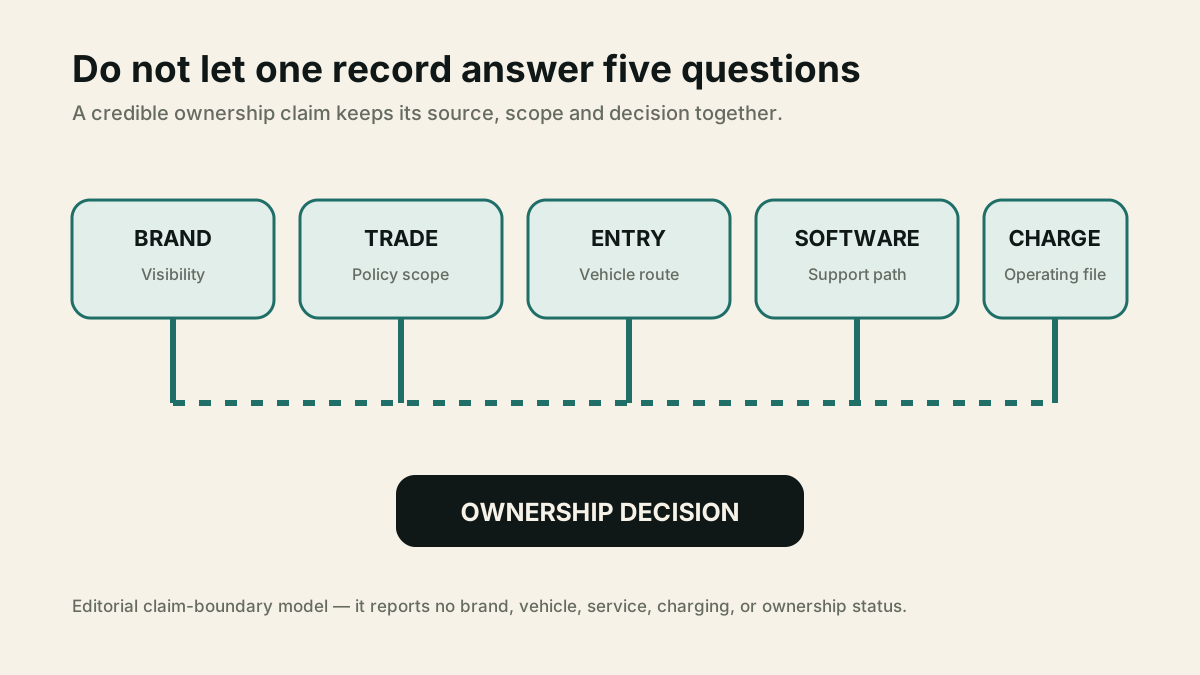
Editorial claim-boundary model. It makes no claim about any actual brand’s service, vehicle availability, charging access, or ownership outcome.
How to use this guide in a real conversation
Bring the five-file framework to every relevant party, but ask each one only about the part they can answer. A seller can identify the car, contract, delivery, and its stated documents. An authority can describe its current route. A manufacturer or authorised support channel can describe its present support scope for an exact vehicle and market. A chargepoint operator can describe its own access conditions. An installer can describe the site. A lender or insurer can describe its own criteria. No single answer needs to be perfect; the buyer needs the answers to join without contradiction.
Use written, dated answers whenever an issue affects the decision. A buyer should not demand promises nobody can responsibly make. Instead, ask for boundaries. “Does your warranty apply to this exact vehicle in my country?” is clearer than “Will everything be fine?” “Which document will I receive for the stated registration route?” is clearer than “Is it road legal?” “Can this existing vehicle account be transferred to me in this market?” is clearer than “Does the app work?” Precise questions produce records that can later be reviewed.
Treat a refusal to give a precise answer as information, not as a debate to win. The seller may not be the right party. The relevant rule may be unsettled. The vehicle may not be appropriate for the buyer’s use case. A good decision can be to wait for a local route, select a different transaction path, reduce the payment commitment, or choose a vehicle whose support obligations are simpler to verify.
The framework also supports comparison. Do not compare two brands only by range, screen size, or a launch price. Compare the completeness of their files for your intended route. Which seller names a local contractual entity? Which vehicle has a clear market-entry packet? Which one offers a documented account transfer path? Which one fits the charging routine you can actually use? Which one offers a repair and remedy route that you understand? That comparison is often more decision-relevant than a global brand ranking.
Method and limitations
This is desk research, not a driving test, registration exercise, import service, charging trial, dealer audit, software evaluation, legal opinion, insurance assessment, financing recommendation, or brand ranking. The article uses current official EU and UK records as examples of limited evidence domains: the European Commission’s defined China-BEV duty measure; GOV.UK’s import-approval and Certificate of Conformity guidance; VCA’s explanation of cybersecurity and software-update management; and GOV.UK’s residential-chargepoint eligible-vehicle list.
Those records are credible for their own stated rules and programmes, but they do not establish an individual buyer’s result. Rules, lists, accounts, service arrangements, sellers, contracts, charging networks, software versions, and vehicle specifications can change. Recheck the original record before you commit, especially if the vehicle, destination, transaction route, or purchase date differs from the one you originally investigated.
The absence of a model list is intentional. A live brand-and-model inventory would imply current information about exact stock, regional specifications, contractual routes, and support arrangements that this evidence set does not establish. The five-file method is more useful because it tells the buyer how to test a specific offer without pretending that a static list can make a complete ownership promise.
Frequently asked questions
What is the first document I should request for an imported Chinese EV?
Start with the exact vehicle identity and the seller’s written quotation. Without a precise model, stated market specification, condition, seller role, and delivery route, the buyer cannot reliably ask an authority, insurer, network, or support channel about the right vehicle. Then identify the local market-entry record required for your destination.
Can I use an EU trade-policy page to negotiate the seller’s price?
You can use it to understand that a defined trade measure exists and has a stated scope. Do not use it as a calculation or an allegation about an individual deal. Ask the seller for the written price, delivery terms, included taxes and fees, and the party responsible if the import treatment differs from what was represented.
Is a UK Certificate of Conformity enough to register every imported EV?
No. GOV.UK says it can help with importing and registering a new vehicle, but the applicable route depends on the stated context. Use the current authority guidance for the exact vehicle and destination. A certificate is one market-entry file, not an assurance about every ownership requirement.
What should I ask about software before taking delivery?
Ask for the stated software region and version; how the vehicle account is created and transferred; whether the buyer can use the features they consider essential in the destination; the update and support path; and who is responsible if account access or a core function fails. Keep the answer in writing and avoid treating a feature list as an operating guarantee.
Does a government chargepoint eligibility list prove public charging compatibility?
No. The GOV.UK list cited here is for a specific residential-chargepoint grant programme. It is not an all-network compatibility certificate. Verify your actual home, workplace, public-network, payment, and fallback arrangements separately.