
A Deye hybrid inverter can be a technically capable piece of Chinese solar hardware and still be the wrong inverter for a buyer. That is the uncomfortable lesson from the 2024 reports of Deye-branded units showing region-warning messages and ceasing normal operation in unsupported markets. The procurement risk was not only whether the electronics worked. It was whether the brand, region, warranty owner, cloud authorization, electrical listing, and installer support path all pointed to the same accountable party.
That is why "Deye inverter problems" is the wrong search if it means "is every Deye product bad?" The more useful search is: which Deye, sold by whom, for which country, under whose warranty, with which firmware/cloud account, and approved under which local electrical rules?
The answer matters because Deye sits in the same larger Chinese solar manufacturing system explained in China Solar Dominance: Supply Chain Power, Profit Crisis, where low-cost, fast-iterating hardware often reaches buyers through complicated export channels. In modules, the buyer file is often about origin, tariffs, and bankability. In hybrid inverters and storage-linked systems, the buyer file adds a control layer: firmware, monitoring, remote access, grid-code settings, and service rights. That puts Deye closer to the procurement questions in China Battery Storage Boom: Grid-Scale BESS Explained than to a normal consumer electronics review.
Source File
This article was reviewed on 2026-06-30 against Deye's official company page and download center, Deye's General Warranty Agreement, Sol-Ark's TUV Rheinland certificate naming Ningbo Deye as manufacturing plant, Sol-Ark warranty documents, Heise reporting on deactivated Deye and Sol-Ark inverters, Solarboi's incident chronology, DOE solar cybersecurity basics, CISA's EG4 inverter advisory, and UL 1741 compliance context. Forum posts are treated as buyer-signal evidence, not as proof of contracts or device behavior.
Quick Answer
| Buyer question | Practical answer |
|---|---|
| Is Deye a real inverter manufacturer? | Yes. Deye describes Ningbo Deye Technology Co., Ltd. as a Shanghai-listed company, stock code 605117.SH, with PV inverter, ESS, and environmental appliance businesses. |
| Are Deye and Sol-Ark the same thing? | Too simple. Some Sol-Ark certification files list Ningbo Deye Inverter Technology as the manufacturing plant, but Sol-Ark-branded products have their own warranty, listings, distribution, and support path. |
| Were Deye inverters remotely disabled? | Reports in late 2024 described Deye-branded units in the U.S. and Puerto Rico showing warning messages and ceasing normal operation. Deye told Heise it was an automatic authorization mechanism, not malicious remote control. |
| Is a grey-market Deye a counterfeit? | Not necessarily. A real Deye unit sold into an unsupported territory is grey-market, not automatically fake. A counterfeit would be a non-Deye product pretending to be Deye. |
| What should installers verify first? | Authorized seller, exact model/SKU, serial number, warranty territory, certification file, firmware/cloud account, and RMA route before money changes hands. |
Who Deye Is
Deye is not an anonymous white-label workshop. The company page for Ningbo Deye Technology Co., Ltd. says the group was founded in 2000 and listed on the Shanghai Stock Exchange in April 2021 under stock code 605117.SH. It identifies three core sectors: PV inverters, energy storage systems, and environmental appliances such as dehumidifiers and HVAC products.
The inverter business is broad. Deye says its product line includes 1 kW to 136 kW string inverters, 3 kW to 80 kW energy storage inverters, and 300 W to 2.2 kW microinverters. Its download center is structured around hybrid inverters, split-phase hybrid inverters, three-phase high-voltage and low-voltage hybrid inverters, string inverters, off-grid inverters, microinverters, micro hybrid ESS, modular C&I ESS, certificates, manuals, and dealer authentication.
That breadth is why the Deye question keeps appearing in installer forums. Deye is visible in residential hybrid systems, off-grid and backup installations, emerging-market solar storage, and rebranded or region-adapted channels. It also operates in a market where the same underlying hardware platform can appear under different commercial arrangements, different firmware, different labels, and different warranty regimes.
The Chinese entity names matter in procurement files. Public English materials use Ningbo Deye Technology Co., Ltd. for the listed group and Ningbo Deye Inverter Technology Co., Ltd. for the inverter manufacturing business. Chinese materials use 德业股份 for the listed group and 宁波德业逆变器技术有限公司 for the inverter unit. Buyers should preserve these names in due-diligence notes because vendor quotes, certificates, customs documents, warranty files, and bank paperwork may not use the same English phrasing.
The buyer implication is not "avoid Deye." It is more precise: do not treat Deye as a generic cheap inverter brand with a single global support policy. Deye is a Chinese manufacturing group with regional channels, OEM/customer arrangements, certification boundaries, and warranty exclusions. If your project sits inside the clean lane, the risk profile can be manageable. If it sits in a grey lane, the low quote can become the most expensive part of the system.
The Deye / Sol-Ark Question
The Deye and Sol-Ark relationship is the part most likely to be overstated online.
Here is what can be said from accessible documents. A Sol-Ark TUV Rheinland certificate for a grid-support utility-interactive hybrid inverter lists Portable Solar LLC dba Sol-Ark as license holder and NingBo Deye Inverter Technology Co., Ltd. as the manufacturing plant. That is strong evidence that Deye manufacturing is part of at least some Sol-Ark certified product files.
But it does not prove that every Deye unit is a Sol-Ark unit, that every Sol-Ark model is identical to every Deye model, or that a Deye-branded inverter bought through an overseas seller inherits Sol-Ark support. Sol-Ark's public materials present Sol-Ark as a U.S.-based energy storage company with its own product line, app platform, distribution network, warranty, and support structure. Its 15K limited warranty document page and other warranty PDFs are written around Sol-Ark products, Sol-Ark authorized channels, Sol-Ark registration, and Sol-Ark RMA procedures.
That distinction matters. In hardware, "same factory" is not the same as "same product." The same manufacturing plant may build different SKUs with different labels, firmware, compliance packages, service entitlements, battery compatibility lists, manuals, and warranty rights. A buyer who says "Sol-Ark is just Deye" may be identifying a real manufacturing connection, but that phrase erases the legal and support reality that determines whether an installer can obtain service after failure.
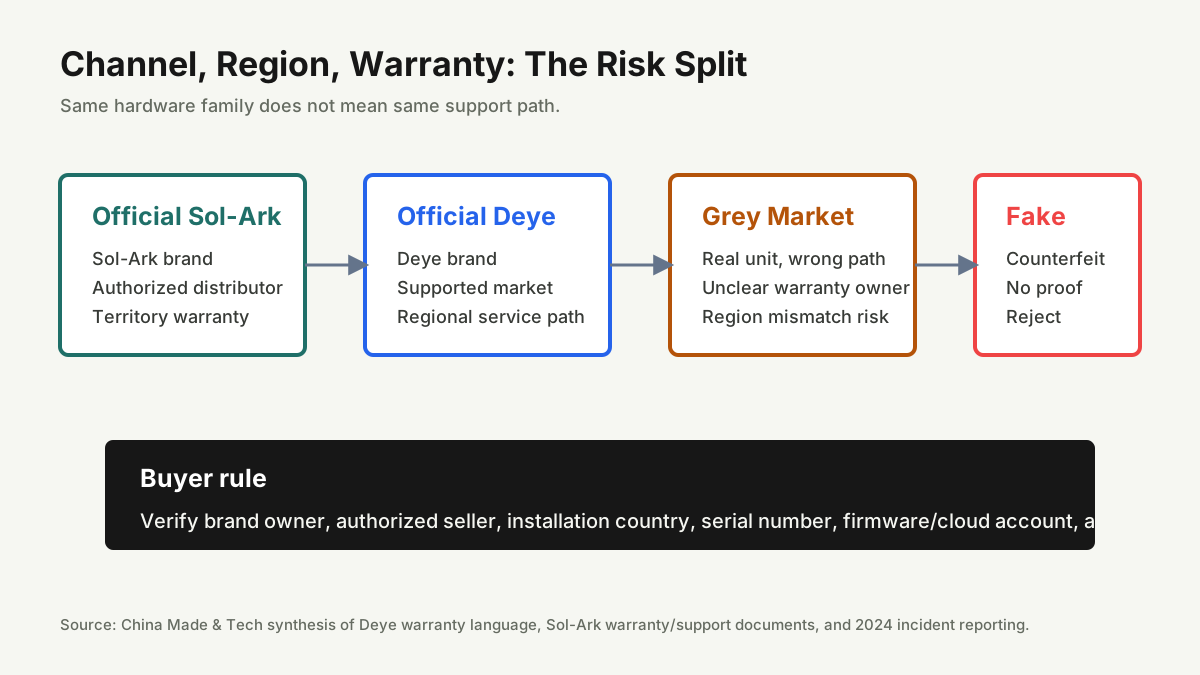
The reverse mistake is also common. Calling every Deye-branded unit a counterfeit is inaccurate unless the unit itself is fake. A real Deye inverter sold outside its intended channel is a grey-market or unauthorized-region problem. It may be genuine hardware but unsupported in the buyer's country. That is very different from a counterfeit inverter made by another party and falsely labeled as Deye or Sol-Ark.
This vocabulary is not pedantry. It changes the buyer remedy:
| Term | What it means | Buyer remedy |
|---|---|---|
| Official Sol-Ark | Sol-Ark-branded product sold by Sol-Ark or authorized channels in supported territory | Sol-Ark warranty/RMA path, subject to terms |
| Official Deye | Deye-branded product sold by an authorized Deye regional channel in a supported market | Deye or regional distributor warranty path, subject to local terms |
| Grey-market Deye | Genuine Deye unit sold into a territory or channel not supported by Deye's warranty | Seller-dependent remedy; high support risk |
| Counterfeit | Non-genuine unit pretending to be Deye or Sol-Ark | Reject, document, pursue seller/payment protection |
| Unsupported install | Product used outside listing, grid-code, voltage, firmware, or territory rules | Warranty and code-compliance exposure |
What Happened in the 2024 Shutdown Reports
In November 2024, English solar forums lit up with reports that Deye-branded inverters in the U.S., Puerto Rico, and possibly other markets displayed messages indicating the inverter was not allowed for use in certain countries and required a passcode or supplier contact. The best citable summary I found is Heise's report, which includes responses from both Deye and Sol-Ark.
Heise reported that cases had become known in the U.S. in which PV inverters stopped working and displayed an error message. Deye told Heise that only "a few inverters" had displayed a pop-up message, that they were all located in the U.S., and that other regions were not affected. Deye denied that it had remotely controlled or maliciously affected the devices via cloud services. Its explanation was that the devices had an authorization mechanism that automatically checks status and displays a warning when authorization fails.
Sol-Ark, according to the same Heise report, said the affected units were Deye-branded inverters sold without authorization in Puerto Rico and the U.S., not Sol-Ark-branded products. Sol-Ark said it had no control over Deye's actions and could not warranty or support Deye-branded inverters not branded and sold by Sol-Ark or through authorized Sol-Ark distributors or resellers.
Solarboi's earlier incident recap captured the user-facing alarm around the case and published Sol-Ark's response to affected households. It described Deye-branded inverters reportedly showing a region warning and said Sol-Ark offered, for a limited period, a discounted replacement option for consumer households affected by Deye-branded units whose functions had been disabled. Treat Solarboi as useful incident reporting, not as the final legal record.
Forum threads are useful for buyer sentiment and vocabulary. A Mike Holt Forum discussion includes electrical professionals debating whether the affected units should be called counterfeit, grey-market, or black-market. The most useful takeaway from that thread is the distinction itself. The thread is not primary evidence for the contracts behind the story.
So what is resolved?
- Deye-branded units in unsupported channels were reported to have displayed disabling or authorization-warning behavior in late 2024.
- Deye acknowledged pop-up messages but disputed the idea of malicious remote control.
- Sol-Ark publicly separated its own branded/supportable products from Deye-branded units sold through unauthorized channels.
- The incident exposed that firmware, cloud accounts, and authorization checks are now part of inverter buyer risk.
What is not resolved from public sources?
- The exact number of affected units.
- The full contract history between Deye, Sol-Ark, and other regional distributors.
- Whether every affected user bought through the same type of seller.
- Whether the behavior should be characterized as remote disabling, automatic authorization failure, or a combination of cloud-enabled policy enforcement and device-local firmware logic.
That uncertainty is the point. If the buyer cannot explain which entity can authorize, update, service, or unlock the inverter, the buyer does not yet understand the system they are purchasing.
The Warranty Trap Is Written in the Documents
The strongest buyer-risk evidence is not a forum complaint. It is Deye's own warranty language.
Deye's General Warranty Agreement lists warranty periods and service modes for inverter categories, commonly five years for many inverter lines and two or five years for accessories or monitoring devices. More important than the period is the exclusion language. The document says OEM products are not applicable under the general warranty terms and should follow contract terms. It also says that if Deye hybrid inverters are sold and installed in the United States, Canada, Puerto Rico, and Mexico, Deye will not support the warranty.
That sentence should stop any North American buyer who is looking at a low-priced Deye-branded hybrid inverter from an online seller. The question is not whether the seller says "factory warranty." The question is whether the manufacturer warranty document, regional distributor, serial number, and installation country agree.
Sol-Ark's warranty documents make the mirror-image point. The Sol-Ark L3 HV limited warranty says coverage is valid only if Sol-Ark products are sold to the owner by Sol-Ark or an authorized distributor, reseller, integrator, installer, or similar person designated by Sol-Ark, registered as required, and installed within listed territories. The same document says products not installed in listed jurisdictions are not covered, and the RMA process requires Sol-Ark procedures. The 5K warranty page similarly frames warranty around Sol-Ark LLC products, proof of purchase, serial numbers, and warranty-claim support.
This creates a clean rule:
A Sol-Ark warranty does not rescue an unsupported Deye purchase. A Deye warranty does not necessarily follow a Deye-branded unit into North America. A seller warranty is only as good as the seller's ability and willingness to resolve the claim.
That is where many grey-market quotes become fragile. A buyer may save thousands of dollars up front, but the claim path may depend on a marketplace seller, an overseas distributor, or a local reseller that cannot obtain firmware authorization, replacement boards, customs-cleared parts, or manufacturer RMA approval.
Four Risks Buyers Should Separate
The Deye case is useful because it compresses several different risks into one story. Buyers should separate them.
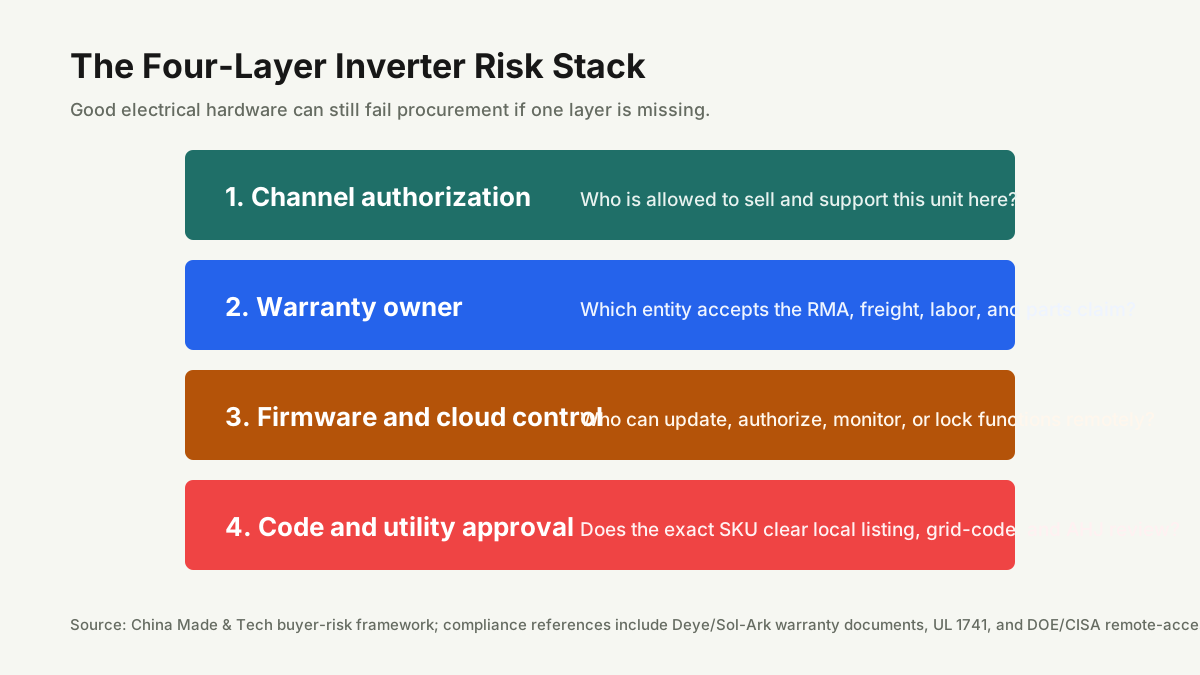
1. Grey-Market Channel Risk
Grey-market risk means a genuine product reaches a buyer through a channel the brand or regional rights holder does not support. It is not automatically illegal, counterfeit, or unsafe. But it can leave the buyer without the warranty owner they assumed they had.
For Deye hybrid inverters, the channel question is especially important in North America because Deye's warranty document explicitly excludes support for hybrid units sold and installed in the U.S., Canada, Puerto Rico, and Mexico. That does not mean every Deye product everywhere is unsupported. It means buyers in those territories cannot rely on a generic Deye warranty claim unless they have a documented support path that overrides or replaces the general exclusion.
2. Warranty Path Risk
Warranty risk is not only the term length. It is the operational path: who issues the RMA, who pays freight, who supplies replacement parts, who decides whether the defect is covered, and who pays for labor. Deye's warranty language says Deye may send spare parts while customers outside mainland China bear some customs and local transport costs. Sol-Ark's warranty terms also limit labor, removal, reinstallation, consequential damages, and other costs.
For homeowners, this is annoying. For installers, it is margin risk. If an inverter fails during the first operating season and the warranty owner is unclear, the installer may become the de facto warranty provider even though the cheap quote came from the end customer's procurement choice.
3. Firmware, Cloud, and Authorization Risk
Modern hybrid inverters are not passive boxes. They communicate with monitoring platforms, receive firmware updates, store grid-code settings, coordinate battery charge/discharge schedules, and sometimes support remote diagnostics or parameter changes.
The U.S. Department of Energy's solar cybersecurity guidance notes that internet-connected PV inverters and control devices carry higher cybersecurity risk than standalone operational-technology devices because cyber-physical changes can alter voltage or current behavior. CISA's advisory on EG4 inverter vulnerabilities is not about Deye, but it illustrates the broader class of risk: attackers or unauthorized users can potentially manipulate inverter data, commands, or settings if remote access is poorly secured.
For Deye specifically, the 2024 incident made buyers ask a sharper question: does the inverter need cloud connectivity for commissioning, warranty, updates, monitoring, or authorization checks? A cloud app can be a service advantage when everything is supported. It becomes a procurement risk when the device is outside its approved channel or the account owner is not the final system owner.
4. Electrical Listing and Utility Approval Risk
Electrical compliance is not optional paperwork. In the U.S., grid-interactive equipment commonly turns on exact model listing, UL 1741, IEEE 1547 interconnection behavior, utility approval, and local authority having jurisdiction requirements. The UL 1741 standard summary covers inverters, converters, controllers, and interconnection system equipment for distributed energy resources and ties interactive equipment to IEEE 1547 and IEEE 1547.1.
The Sol-Ark certificate mentioned earlier is valuable precisely because it is not a vague marketing claim. It names the license holder, product class, test standard, and manufacturing plant. A buyer should ask for the exact certificate matching the exact SKU and firmware family being installed. A "similar Deye" document is not enough for an AHJ, utility interconnection review, insurance file, or lender.
This is the same discipline behind our tariff and origin work in US & EU Tariffs on Chinese Solar Panels 2026. A product can look identical and still fail the paperwork test if the named entity, origin, SKU, or certificate does not match the project file.
Buyer Due-Diligence Table
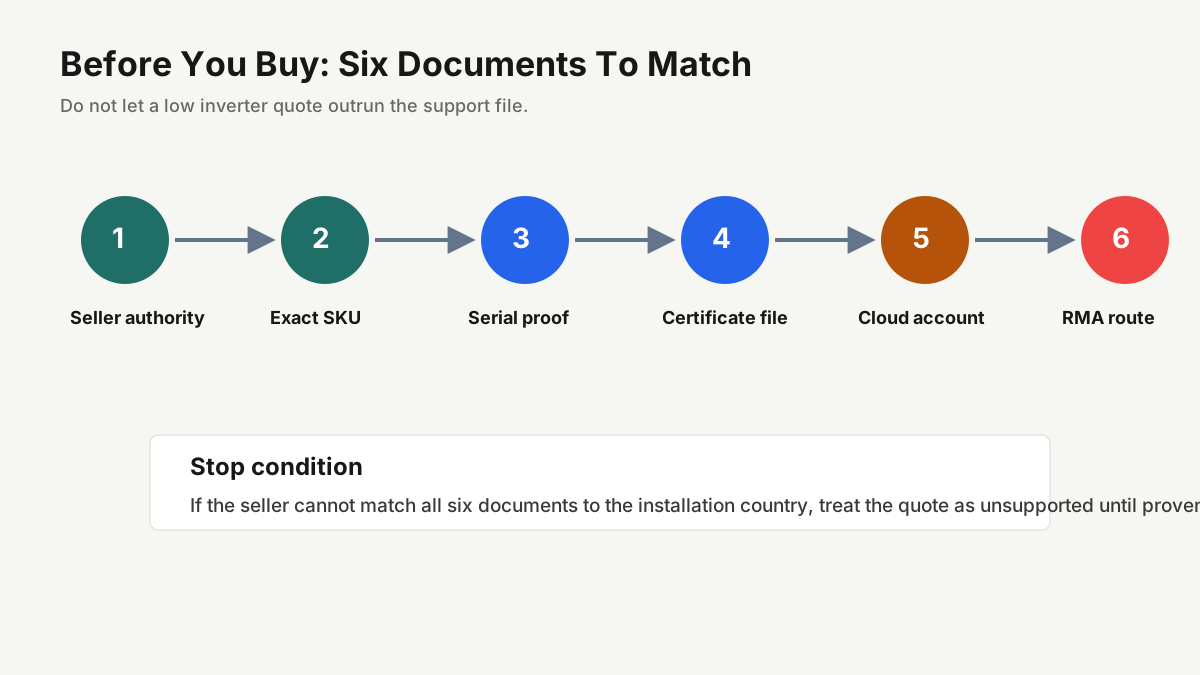
Use this table before accepting a Deye, Sol-Ark, Sunsynk, Inverex, or Deye-derived hybrid inverter quote. The point is not to punish Chinese hardware. The point is to make the seller prove the support chain.
| Question to ask | Document to request | Red flag | Safer alternative |
|---|---|---|---|
| Who is the brand owner for this exact unit? | Invoice with brand, seller legal name, model, serial number | Seller says "same as Sol-Ark" but invoice says generic Deye or another importer | Buy under the brand that will warranty the unit in your country |
| Is the seller authorized? | Deye certificate number or Sol-Ark distributor/reseller proof | No certificate, expired certificate, or seller refuses to identify upstream distributor | Use Deye's dealer authentication page or Sol-Ark's official distributor path |
| Is the model supported in the installation country? | Warranty terms naming territory and model family | Seller offers "global warranty" that conflicts with Deye's country exclusion | Require written warranty confirmation before deposit |
| Does the certificate match the exact SKU? | UL/CSA/CE/grid-code certificate and test report summary | Certificate names a different brand, model, firmware, or license holder | Ask AHJ/utility before purchase or choose certified local SKU |
| Who controls the cloud account? | Commissioning procedure, app ownership transfer, remote-access settings | Installer, seller, or overseas account retains admin access after handover | Require owner admin rights and remote-access governance |
| What happens after firmware update failure? | Firmware policy, rollback process, service contact, RMA path | "Just update through the app" with no rollback or support ticket path | Commission only after support ticket process is documented |
| Who pays labor and removal? | Warranty exclusions and installer contract | Warranty covers parts only, customer assumes labor and freight | Price a service reserve into the quote |
| What is the offline operating mode? | Manual pages for local control, monitoring, and fail-safe settings | System depends on cloud for essential operation or authorization | Prefer local controls for critical backup loads |
Who Is Actually Exposed?
The highest-risk buyer is not the person who buys a Sol-Ark product through an authorized Sol-Ark channel and registers it correctly. That buyer still has ordinary warranty exclusions, but at least the support path is legible.
The most exposed buyer is the North American homeowner or installer buying a Deye-branded hybrid inverter from an online seller because the price is lower than a Sol-Ark quote. Deye's own warranty language says Deye will not support hybrid inverters sold and installed in the U.S., Canada, Puerto Rico, and Mexico. Sol-Ark's public position is that it cannot warranty Deye-branded inverters not sold as Sol-Ark products through authorized channels. That leaves the buyer with the seller.
Off-grid and DIY users are exposed in a different way. Some are not seeking utility interconnection and may care less about standard grid-tie listing. But they often depend more heavily on the inverter for backup power, battery charging, generator integration, and remote monitoring. If a unit enters an authorization state, loses firmware compatibility, or cannot obtain parts, the damage is operational rather than just paperwork.
Installers are exposed because they inherit customer anger. If a homeowner buys grey-market equipment and asks a local installer to wire it, commission it, or troubleshoot it, the installer may become the only reachable professional when the unit fails. The installer should write the equipment support boundary into the contract: who supplied the inverter, who owns warranty claims, what the installer does and does not guarantee, and whether the installer will touch unsupported firmware or cloud accounts.
Distributors are exposed because grey-market inventory can look profitable until one batch becomes a support event. If a distributor cannot prove authorization, territory, RMA path, and certification match, it is not simply selling cheaper hardware. It is selling an obligation it may not be able to fulfill.
Analysts and journalists are exposed to a different error: turning a commercial channel dispute into a simplistic "China kill switch" story. The remote-access and authorization risk is real enough to take seriously. But the publicly available record does not support turning every Deye or every Chinese inverter into the same allegation. Reuters reported in 2025 that U.S. experts had found undocumented communication devices in some Chinese solar inverters and batteries, but the report did not publicly name Deye. Use that as regulatory context, not as brand-specific proof.
How Deye Compares With Other Chinese Inverter Buyer Patterns
Deye is not the only Chinese inverter or PCS supplier forcing buyers to think beyond datasheets.
Sungrow is moving in the other direction: from price competition toward grid-forming proof, local service, and bankability evidence. In our storage coverage, the important point was that Chinese inverter-linked BESS suppliers are increasingly judged on control-layer behavior, not only on box cost. Deye's case is the residential and small-commercial version of the same shift. Buyers want to know not just "does it invert power?" but "who controls the software and who stands behind the system?"
Huawei presents another pattern: scale, advanced electronics, and geopolitical scrutiny. The procurement issue is often public-sector eligibility, cyber governance, and utility policy rather than homeowner warranty. Growatt, GoodWe, Solis, SRNE, FoxESS, Hoymiles, and other Chinese-origin or China-linked brands each have different product strengths and support issues, but the same file structure applies: exact entity, exact model, exact certificate, exact warranty territory, exact service channel.
The broader lesson is that Chinese inverter buying has matured from a price/spec comparison into a governance exercise. In the module era, buyers learned to ask about cell technology, degradation, bill of materials, factory location, and tariff exposure. In the inverter and BESS era, they must also ask about firmware rights, monitoring platforms, remote access, data hosting, service geography, and grid-code behavior.
This is not anti-China. It is pro-documentation. The best Chinese suppliers can pass a hard buyer file. The weakest sellers rely on the buyer not asking.
Practical Buying Rules
For a U.S. homeowner, the conservative rule is simple: if you want the Sol-Ark support path, buy Sol-Ark through an authorized Sol-Ark channel. Do not buy a Deye-branded hybrid inverter and assume Sol-Ark will support it because the hardware appears related.
For a buyer outside North America, the answer is more country-specific. Deye may have authorized distributors, local warranty channels, and supported SKUs in your market. Ask for dealer authentication, warranty language naming your territory, and certificate files matching your grid rules. A Deye unit that is unsupported in the U.S. may be perfectly normal in South Africa, Brazil, parts of Europe, Pakistan, or another market, provided the local channel is legitimate and the exact model is approved.
For installers, the procurement file should include:
- Seller authorization proof.
- Full legal names of seller, distributor, brand owner, and warranty owner.
- Exact model number, serial number, and firmware family.
- Certificate file matching the model, country, grid code, and installation type.
- Written warranty terms for the installation territory.
- Cloud account ownership and remote-access settings.
- RMA, spare-parts, labor, and freight responsibility.
- Customer contract language if the customer supplies unsupported equipment.
For distributors, the minimum standard is tougher. Do not rely on verbal "factory direct" claims. Use Deye's dealer authentication process where applicable, preserve authorization certificates, and make the warranty boundary explicit in quotes. If a product is not supported in the destination country, say so in writing.
For off-grid users, the most important question is whether your system can keep operating safely without a vendor cloud service. Remote monitoring is useful, but critical backup power should not depend on an account you do not control. At minimum, document local settings, owner credentials, firmware version, and the procedure for operating or isolating the inverter if cloud connectivity is lost.
Methodology and Evidence Limits
This analysis uses Deye's official company pages, Deye's warranty and dealer-authentication documents, Sol-Ark warranty and certification files, Heise's incident reporting with company responses, Solarboi's chronology, professional forum discussions, DOE/CISA cybersecurity guidance, and UL 1741 compliance context. Forums are treated as market signals, not proof of contract terms or device behavior.
The biggest unresolved point is the exact mechanism behind the 2024 warning behavior. Deye denies malicious remote control and frames the event as an automatic authorization check. Users and installers experienced the result as a disabled inverter. A buyer does not need to adjudicate the whole dispute to draw the procurement conclusion: if the device can enter a region-authorization failure state and the buyer has no recognized support path, the buyer owns the downtime.
Claim Confidence File
| Claim | Confidence | Evidence boundary |
|---|---|---|
| Deye is a real inverter manufacturer with broad product lines, not an anonymous label | High | Supported by Deye company and download-center materials cited in the Source File. |
| Grey-market Deye, official Deye, Sol-Ark-branded product, and counterfeit are distinct buyer categories | High | Supported by warranty/certificate documents and the article's classification logic. |
| Reported shutdown/authorization incidents prove every Deye unit is unsafe | Low | The article narrows the claim to reported unsupported-channel incidents and separates technical capability from channel risk. |
| North American buyers can rely on generic seller warranty claims for Deye hybrids | Low | Deye warranty language and Sol-Ark channel distinctions make this a high-risk assumption. |
FAQ
Are Deye inverters bad?
No blanket answer is useful. Deye is a real Chinese inverter and ESS manufacturer with broad product lines. The buyer risk is not simply product quality; it is whether the exact unit is authorized, supported, certified, and warrantied in the market where it is installed.
Is a Deye inverter the same as a Sol-Ark inverter?
Some Sol-Ark certification files list Ningbo Deye Inverter Technology as the manufacturing plant, so there is a documented manufacturing connection for at least some products. That does not mean every Deye-branded inverter is a Sol-Ark product or eligible for Sol-Ark warranty. Brand, firmware, certificate, territory, and support path still matter.
Why were some Deye inverters reportedly bricked?
Reports in late 2024 described Deye-branded units in unsupported channels showing region-warning messages and ceasing normal operation. Deye told Heise the issue was an automatic authorization mechanism and denied malicious remote control. Sol-Ark said the affected units were unauthorized Deye-branded products, not Sol-Ark-branded products sold through its channels.
Can I safely buy a Deye hybrid inverter in the U.S.?
Be very cautious. Deye's own general warranty agreement says Deye will not support warranty for hybrid inverters sold and installed in the United States, Canada, Puerto Rico, and Mexico. If a seller claims otherwise, require written warranty confirmation from the support entity that will actually accept the RMA.
What is the safest alternative to a grey-market Deye?
Buy the product under the brand and channel that will support it in your country. In North America, that may mean buying Sol-Ark through authorized channels if the Sol-Ark product fits the project. In other markets, it may mean buying Deye through an authorized local Deye distributor with documented warranty and certification support.
Bottom Line
Deye is a useful case study because it shows how Chinese solar hardware risk has changed. The problem is not that Chinese inverters are automatically poor quality. The problem is that fast global hardware circulation can outrun the legal, warranty, firmware, and certification structures that make a power system supportable.
If the quote is cheap because the product is genuinely more efficient to manufacture, that is the China solar story at its best. If the quote is cheap because the buyer is stepping outside the supported channel, the discount is not savings. It is a transfer of warranty, downtime, and compliance risk from the seller to the owner.