

An EU buyer asks a China furniture maker, plywood trader, timber-component factory or rubber-product supplier for an “EUDR certificate.” The supplier sends a forest-certification logo, a screenshot of a map, or a one-page declaration that its material is responsibly sourced. The response may contain useful evidence. It does not settle the question the buyer has actually asked.
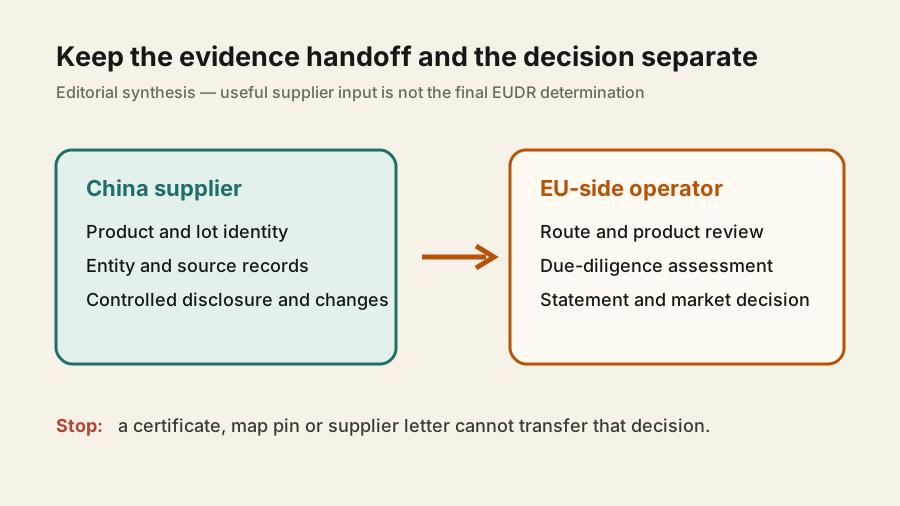
The EU Deforestation Regulation is not a logo programme. It is a product, provenance and due-diligence system. Its relevant information links an exact product to upstream production plots, production timing, suppliers and recipients, plus evidence concerning legality and deforestation-free status. The relevant EU operator must make the due-diligence decision for its own market route. A China supplier can contribute critical upstream records. It cannot turn a broad certificate, a coordinate or a supplier letter into the operator's final conclusion.
That boundary matters for two common China-linked routes. The first begins with wood: logs, veneers, plywood, flooring, furniture parts, pulp or paper inputs pass through harvesters, processors, mills, traders, factories and brands before an EU-bound finished product appears. The second begins with natural rubber: smallholder or plantation output moves through collection, processing, compounding, component manufacture and assembly into tyres, industrial parts, footwear or other products. In both routes, a buyer can lose the link between the goods on an order and the place, time and entity behind the upstream material long before an EU market decision is required.
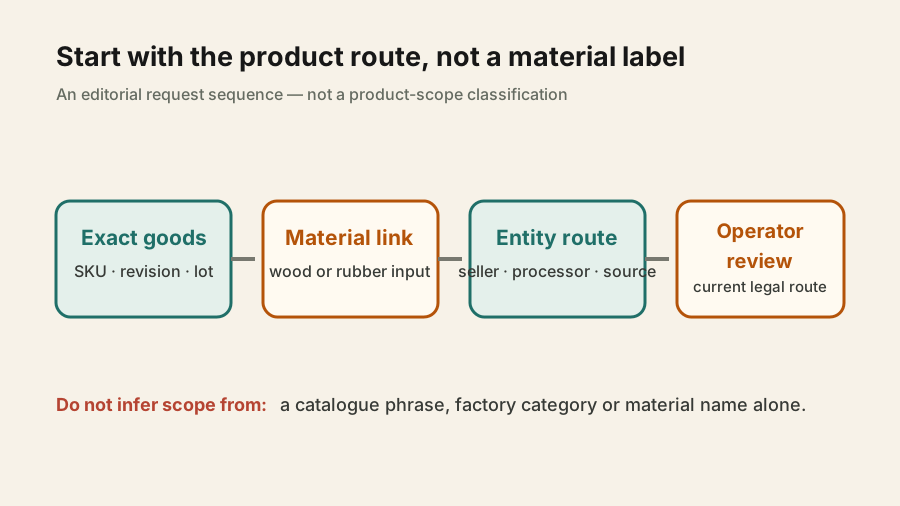
Wood and rubber are among the commodities covered by EUDR, but that does not mean every product described as wood-based or rubber-containing has the same route. The current EUDR Regulation and its Annex I control the product boundary. The European Commission's implementation page identifies the commodity set and current application dates. A sourcing team should start with the exact goods, importer route and records it can obtain—not with a material label in a catalogue.
This article is a desk-research field guide for sourcing, procurement, quality, legal and sustainability teams working with China-linked wood or natural-rubber supply chains. It does not determine whether a named item is in scope, inspect a land plot, validate coordinates, assess deforestation, review a due diligence statement or give forestry, customs or legal advice. It offers a seven-file supplier handoff that makes uncertainty visible before it becomes an unsupported “EUDR-ready” claim.
Quick answer: the EU operator owns the decision; the supplier owns critical evidence
The simplest way to organise the work is to separate the roles that a generic supplier request normally blends together.
| Question | Party that must lead it | Useful China-supplier contribution | Unsafe shortcut |
|---|---|---|---|
| Is the exact product in scope? | EU-side operator and its product/import process | Product composition, item identity and route facts | “It contains wood, so it is automatically covered.” |
| Who makes the EUDR due-diligence decision? | Relevant operator responsible for the EU market route | Upstream data access and named evidence owners | “The factory is EUDR compliant.” |
| Where and when was the relevant commodity produced? | Operator's due-diligence process using source records | Plot and production information connected to the goods | “Here is our factory address or a forest photo.” |
| What can a certificate support? | Operator's risk assessment | Scheme scope, original documents and limitations | “The certificate replaces due diligence.” |
| How do references and changes travel downstream? | Buyer, operator and supplier together | Controlled disclosure, reference handoff and change notices | “We emailed the same PDF to every customer.” |
For a buyer, this creates a better vocabulary. Do not ask whether a factory is “EUDR-ready.” Ask what it can demonstrate:
- “The supplier can connect this customer SKU to its material and entity chain.”
- “The supplier has identified the upstream plot/production record owner and a controlled disclosure path.”
- “The buyer has not yet completed Annex I scope and EUDR due diligence for this market route.”
Those answers are narrower than a badge. They are also useful. A relationship where the parties can state what is known, what is supplier-controlled and what still belongs to the EU operator is easier to repair than one built on a vague certificate promise.
Start with the product route, not the material name
“Wood” and “rubber” are useful search terms. They are not product conclusions. A Chinese factory may make wood furniture, toy components, doors, flooring, paper packaging, plywood panels, natural-rubber components, footwear soles, industrial seals or tyres. The products, their upstream materials, their commercial route and the legal list may not align with the factory's own category label. A product catalogue can describe “solid wood,” “rubberwood,” “wood composite” or “natural rubber” in ways that are meaningful for sales but insufficient for an EU product-scope decision.
The first file should therefore be a product and route identity file. It is not a customs classification opinion. It is a shared, controlled description that lets the buyer carry out its own review. It should connect:
- Supplier item number, customer SKU, product family and current revision.
- Commercial description, material description, unit and quantity convention.
- The portion of the product that is said to contain or be made with relevant wood or rubber material.
- Purchase order, invoice line, factory batch or production reference where available.
- Seller, buyer, intended EU operator/import route if known, and relevant customer destination.
- A date and owner for every record, plus an explicit list of unknowns.
The important word is connect. A buyer may have a commercial product name that no upstream supplier recognises. A mill may know a veneer batch but not a finished furniture SKU. A China trading company may hold the invoice while the factory holds the material records. The identity file does not force one party to know everything. It tells the parties where a record ceases to match the object being bought.
Consider a wood table sold under one customer SKU with two possible top materials, changing hardware and several carton versions. A forest certificate attached to a general factory file does not tell the buyer which top material was used for the batch on its order. Or consider a natural-rubber component that is made to the same drawing but sourced through different compounders in different periods. The part number may not change while the upstream path does. The product and route file is the place to make those changes visible.
Commodity membership does not replace Annex I and route review
The Commission's current overview lists wood and rubber among the seven commodities associated with EUDR. Its July 2026 update also makes a useful freshness point: the commodity list itself is distinct from changes and clarifications concerning derived-product scope. The Commission said that the delegated act would be sent to Parliament and Council for scrutiny. That is a monitoring trigger, not a licence to declare a finished good included or excluded without checking current legal text.
For sourcing teams, the correct question is not “does the factory use wood?” It is: What exact product, material input, market route and current legal product reference are we analysing? If that question cannot be answered, do not demand a plot map yet. First clean the identity. A carefully collected coordinate linked to the wrong product is not better evidence than no coordinate at all.
The provenance file is a chain, not a map pin
Article 9 of the EUDR Regulation describes a broad information boundary. It includes product description and quantity, country of production, geolocation of the relevant production plots, production date or time range, supplier and recipient information, and adequately conclusive and verifiable information relevant to deforestation-free and legality requirements. The practical lesson is not that every supplier should indiscriminately email every document it has ever collected. It is that the evidence needs a chain of custody.
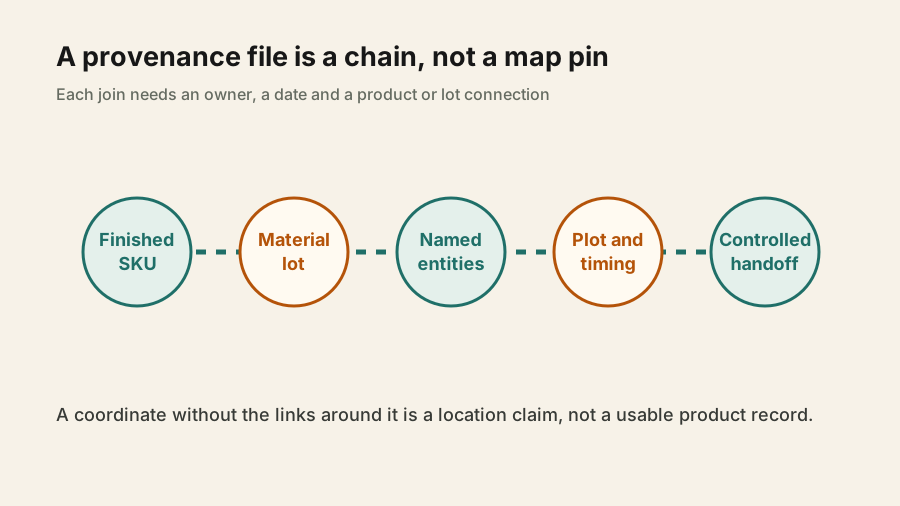
A chain answers two different questions:
- Can the record be traced upstream? The exact finished product or component connects to an upstream material, the entity that supplied it, the relevant plot/production information, and the documents behind assertions about it.
- Can the record be used downstream? The supplier can identify the person or entity allowed to release information, the recipient, any confidentiality condition, the reference or declaration-handling path, and the version or change status.
A generic map point answers neither question alone. It may show a place without proving that the place is the relevant production plot. It may identify a region, warehouse or factory instead of the land where the commodity was produced. It may have been generated in a later period, attached to a different supplier, or disconnected from the finished product through a trader. Conversely, a supplier can possess legitimate source documents but lack a way to match them to a buyer's specific order. The result is not necessarily bad faith. It is a documentation gap that should be recognised before a readiness claim travels further.
The EUDR Information System's operator FAQ describes a downstream collect-and-keep obligation around supplier information, references or declaration identifiers and buyer information for at least five years. The operational interpretation is simple: reference handling and entity identity are not a one-time attachment. They are part of a record that may need to be retrieved long after the shipment left the factory.
For a China-linked supply chain, the chain can include a forest owner or smallholder, collector, sawmill or crumb-rubber processor, agent, upstream trader, board mill or compounder, component maker, assembler, exporter and EU-side operator. The buyer should not assume that the nearest factory owns the earliest information. Ask each link a narrower question: What did you receive? From whom? What product or batch does it refer to? Who can explain its original scope? What change would require an update?
A coordinate is evidence only when it belongs to the right plot and product
Geolocation feels precise because it looks numerical. That appearance creates a particular risk: a supplier can send latitude and longitude values, a satellite image or a location pin, and the recipient may assume that forest provenance is settled. The EUDR definition is more exacting. It concerns the geographical location of a plot of land described by coordinates. For relevant non-cattle commodities, plots over four hectares require polygons with sufficient points to describe the perimeter. These are legal information boundaries, not a test that this article performs.
The useful supplier question is therefore not “do you have coordinates?” It is:
> Which product and production period does this plot record support, which supplier entity provided it, what document establishes that relationship, who checked the file for completeness, and who must be told if the upstream source changes?
That question turns a map into an evidence object. A wood supplier may have a coordinate file connected to a log purchase, a harvest period, a sawmill intake record and a veneer batch. A natural-rubber route may have plot or collection-area records, a production period, processor intake record and lot reference. The details vary. The principle does not: the coordinate must travel with enough identity to prevent its reuse as a decorative location marker.
Do not ask a factory to draw a polygon in a sales call. The buyer should first establish whether the item and upstream entity chain are sufficiently stable to make a targeted request. Then the appropriate party can supply or organise the data through a controlled process. A thoughtful request will also distinguish between information that can be shared directly, information that needs an NDA or data room, and information that needs an authorised contact or a system reference.
The supplier should be allowed to say, “We do not own that record; our upstream mill or processor does.” The next question is then operational: can the supplier identify the record owner, the material/batch link, the disclosure condition and a realistic response path? That answer is more valuable than a coordinate copied from an unknown source.
Build the seven-file wood or rubber provenance handoff
The following seven-file model is an editorial framework. It is not an EUDR due-diligence statement, a prescribed Information System schema or a declaration that a product is deforestation-free. It gives a buyer and supplier a way to organise the records that must remain linked.
1. Product and route identity file
Match the exact goods, customer SKU, revision, materials description, quantity, unit, purchase order, invoice, production/batch reference, seller, buyer and intended route. Record what has not been confirmed. This prevents an upstream material document from being attached to a product it did not actually enter.
2. Supplier and entity-chain file
Name the legal entity that supplied each material or intermediate product, the trading party if different, the manufacturer or processor, the contact who owns source evidence and the party authorised to disclose it. A supplier network is not a straight line; a good file acknowledges when a trader has commercial control but a mill, compounder or processor has the records.
3. Plot and production record
Maintain the plot/geolocation material, production date or range, batch/lot connection and source owner. Do not label it “verified” merely because it exists. The key test is whether a qualified user can connect the information to the appropriate upstream material and finished product path.
4. Legality record
This file indexes the documents the supplier believes are relevant to production under the applicable country-of-production legal framework: entity records, rights to use land where relevant, harvesting or purchase records, transport or processing documents and other source material. Its purpose is not to declare country-law compliance from a desk. It makes the document owner, date, scope and gap visible to the party that must assess it.
5. Deforestation-risk evidence file
Keep any relevant evidence used to support the source history or risk discussion, together with date, product/plot scope, method, owner and limitation. This could include controlled upstream information, a scheme record, a documented assessment input or a reason the information is not yet available. Never treat a generic forest photograph, dashboard screenshot or certificate logo as a substitute for the linked file.
6. Statement and reference handoff file
The EU-side route may involve due-diligence-statement references or other controlled information transfer. The supplier should not submit or invent the operator's result. It should keep a log of what was handed to whom, under what reference, on what date, for what product route, with which access condition and with which unresolved items. A buyer that receives a file can then tell whether it holds a final reference, a supplier input or an outdated attachment.
7. Change, exception and correction log
Record material changes: product revision, wood species or rubber-source change, supplier substitution, plot/production-period correction, processor change, document expiry, entity change, access restriction or new information. For each, name the date, previous and new state, evidence owner, reason, approval and notification recipient. This is how a supplier stops last season's source packet from following a new order without scrutiny.
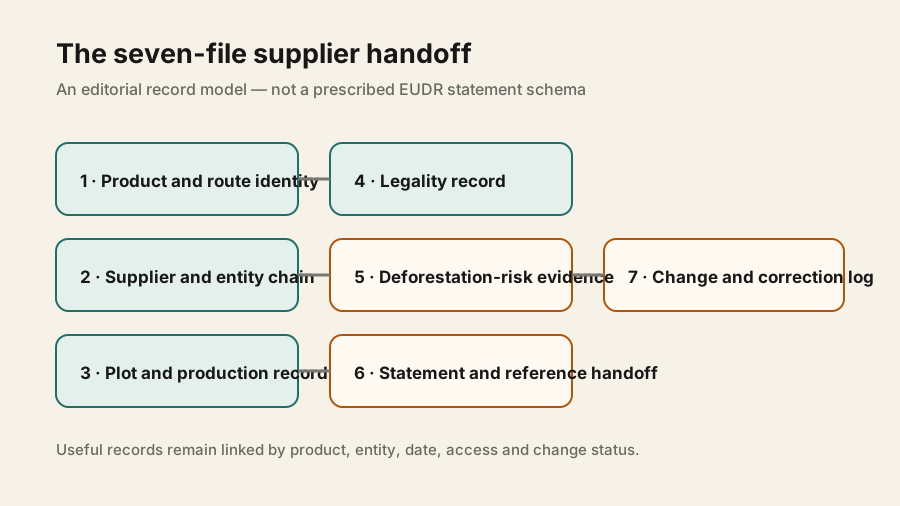
The file model works across supply-chain complexity because it does not force every upstream actor to reveal the same data to every downstream actor. It forces the parties to identify ownership, linkage and access. That is particularly important where sensitive sources, pricing or supplier relationships are involved. A buyer cannot make a robust downstream assessment if a supplier hides every upstream link. A supplier should not expose confidential records to an uncontrolled distribution list. The handoff exists to give both sides a disciplined path.
Make disclosure controlled, traceable and reversible
The seven files should not become an invitation to circulate raw upstream material by email. Some records will identify commercial counterparties, land-related information or confidential sourcing arrangements. A practical handoff begins with a request register: the buyer names the product and route, the purpose of the request, the receiving entity and the required date; the supplier names the record owner, the permitted disclosure method and any condition that prevents direct transfer. The register gives the parties a way to distinguish “we do not have this information” from “the information exists but must move through an authorised channel.”
For a routine request, a supplier can first provide an evidence index rather than the underlying sensitive file. The index should say what the document is, which product or lot it relates to, its date, the producing entity, the source owner, its current version and the route for controlled review. The buyer can then identify the few records that need follow-up. This approach reduces both needless disclosure and the more dangerous practice of attaching a persuasive document to a product it does not cover.
Version control matters just as much as access control. Each release should carry a packet identifier, release date, product/lot scope, sender, approved recipient and a note of the open gaps. If an upstream mill, processor, material lot or product revision changes, the supplier should issue a new version or an explicit exception notice instead of silently overwriting the original. A buyer should retain the old version with its status rather than treating the newest folder as a proof of what was available at an earlier decision point.
This procedure does not decide whether the information is sufficient for an EUDR due-diligence process. It does make a different and essential fact visible: whether a given person can explain the provenance packet, reproduce the item-to-record link and tell the customer when the link changed. That is the operational threshold a China supplier can responsibly own.
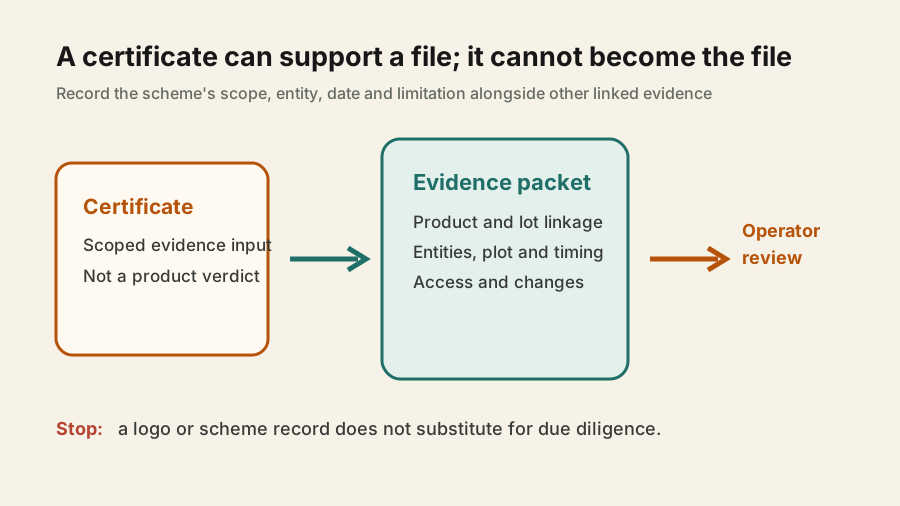
Certificates can support a file; they cannot become the file
Certification, verification and traceability schemes can be useful. They may indicate that a supplier has already built some document controls, chain-of-custody habits or third-party review processes. They can help a buyer ask better questions. What they cannot do is remove the need to understand their own scope, product, plot, date, entity and limitations.
The European Commission's EUDR guidance puts the distinction clearly: certification and other third-party verified schemes may provide useful information for risk assessment, but they do not substitute the operator's responsibility for due diligence. This is a helpful rule for commercial conversations. Do not ask, “Do you have a certificate?” Ask, “Which product, entity, site or plot does this scheme record cover; what is the issue date; who issued it; what evidence underlies it; what does it exclude; and how does it connect to this order?”
There are four ways a certificate can be misused in a China-linked chain.
The scope mismatch. A supplier presents a valid certificate for one material, mill, legal entity or production period, while the customer assumes it covers a different material or finished product. The gap is often created by a commercial label that is broader than the actual certificate scope.
The entity mismatch. A trading company sends a certificate held by an upstream mill but does not establish the relationship between the mill's output, its own lot and the finished item. The document may be legitimate but unconnected to the buyer's object.
The time mismatch. A historical certificate or audit record is reused after a source, site, product revision or processor changed. A date in the header is not a change-control system.
The conclusion mismatch. The certificate proves, at most, what the scheme and evidence support. It does not create the EU operator's due-diligence conclusion. A supplier that calls it “EUDR compliant” may unintentionally encourage the buyer to stop checking the very links that matter.
The safe use is to index the scheme evidence in the seven-file packet. Add its issuer, record number where appropriate, issue date, product/entity/plot scope, availability of underlying records, known limitations and the person who can explain it. Treat the certificate as a referenced evidence object—not as the handoff itself.
Use the timetable to sequence a file, not to declare a supplier compliant
The EUDR dates make the work urgent, but a supplier should not turn them into a generic promise. The Commission's current implementation page says the Regulation applies from 30 December 2026 for large and medium operators, from 30 June 2027 for micro and small operators, and from 30 December 2026 for micro and small operators already covered by the EU Timber Regulation. These are operator-category and legal-implementation boundaries. They are not a finding that every China supplier must produce the same file on the same date.
The stronger planning move is to work backward from the buyer's first material EUDR route. Ask which evidence will be hardest to reconstruct after the product has shipped. It is usually not the final PDF. It is the connection between a finished SKU and an upstream material lot; the identity of the seller, processor and source owner; the production date or period; the location information and its source; and the change that quietly replaced one material or entity with another.
The Commission's July 2026 product-scope update is another reason to create a reusable evidence capability instead of a one-off spreadsheet. It said that scope adjustments concerned derived products and would be sent for scrutiny. New products described there were expected to have a later application path under the stated process. A sourcing team should monitor the legal status of the product it buys. It should not distribute a dated news release as a permanent scope answer.
Use three horizons.
Horizon one: evidence hygiene that is useful regardless of the final product route. Make supplier legal entities, product revisions, material batches, document owners, source dates, disclosure permissions and change logs visible. A factory that cannot distinguish two veneer sources or two rubber lots today will not gain that ability from an EUDR portal.
Horizon two: controlled upstream mapping. Identify where the plot/production information resides, who holds it, how it relates to the product and which gaps require an upstream request. This work may take time because the data owner may be a mill, collector, plantation, processor or intermediary rather than the final factory.
Horizon three: operator-specific route and statement work. The EU operator decides scope, risk and the final system route. It may need a particular information format, translation, reference, confidentiality arrangement or evidence refresh. A China supplier can support those decisions. It should not sell a generic dashboard as the conclusion.
The dividing line helps preserve commercial calm. A buyer can ask the factory to build horizon-one and horizon-two capabilities today without demanding that it certify a future EU conclusion. The factory can state the evidence it has and the records it must obtain without losing the order to an impossible slogan.
Run a product-to-plot drill before you make a readiness claim
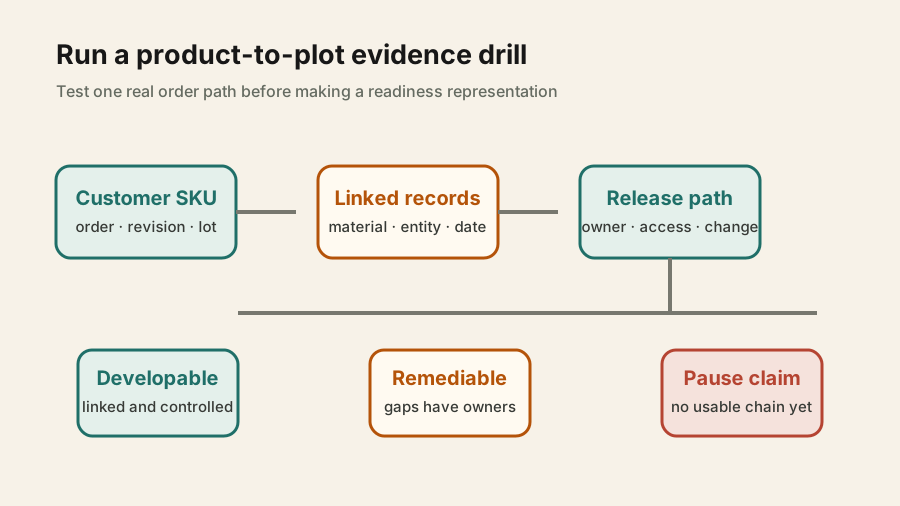
The test of a provenance file is not whether it looks complete in a shared drive. It is whether two teams can follow it when a buyer asks a narrow question about an actual line item. Use one recent order or a representative product route. The aim is not to make a compliance decision in a ninety-minute meeting. The aim is to see whether the handoff survives normal operational pressure.
Start with: “Show us the current source evidence for this exact customer SKU and explain what would change if its wood or natural-rubber input changed next month.” Then work through this sequence:
- Match the buyer's order line, customer SKU and supplier item/revision.
- Identify the legal seller, factory, processor, trader and upstream source owner for the relevant material.
- Show the material or lot connection between the item and the upstream record.
- State whether plot/geolocation and production-period information exists, who owns it and what it is connected to.
- Identify the records that support legality and source history, together with their date and limitation.
- Show any scheme or certificate as a scoped evidence input, not as a final conclusion.
- Name the person allowed to release information to the buyer or its authorised assessment route.
- Identify one material change since the prior version and the notice path it would trigger.
Three outcomes are possible.
Developable: the supplier can match product, entity and upstream evidence; it can state data gaps without obscuring them; and it has a feasible controlled disclosure and change process. That creates a basis for the EU operator's later work. It is not a legal result.
Remediable: records exist but live in disconnected departments, use inconsistent identifiers, have no clear ownership or cannot be released under a defined process. A buyer can continue only by naming the gap, assigning a remediation owner and avoiding a generic EUDR-ready representation.
Pause the representation: the supplier cannot show what material went into the product, which entity owns upstream records, whether plot/production data connects to the material, or how a source change will be notified. The right response is not to label the supplier non-compliant. It is to acknowledge that the buyer has no product-to-plot evidence chain for that statement yet.
This drill also changes the buyer's internal habits. Procurement may discover that purchase orders need a more stable material code. Quality may discover that the certificate register has no product linkage. Legal may discover that a supplier NDA does not permit the intended disclosure. Operations may discover that an upstream trader has no change-notice obligation. Those are useful discoveries. A system cannot repair gaps nobody has named.
Contract questions to settle before information becomes urgent
The first EUDR-related supplier amendment does not have to be an elaborate legal template. It does need to prevent silence at the points where a record changes hands.
| Contract question | Why it matters | A useful initial outcome |
|---|---|---|
| Which product and route does the request cover? | A provenance record needs a defined object. | Item/SKU/revision, quantity convention and buyer route reference. |
| Which entities own each upstream record? | The commercial seller may not hold the plot or process evidence. | Entity-chain list with source-data contact and authority. |
| How is plot/production information linked to product? | A coordinate must not become a detached map pin. | Documented lot, period and source relationship. |
| What may be disclosed to whom? | Confidentiality and usable due diligence must coexist. | Named recipients, NDA/data-room path and response process. |
| How is a certificate described? | A scheme can be oversold after it leaves the source owner. | Scope, date, limitation and no-substitution statement. |
| What triggers a refresh? | Material, supplier and product changes can invalidate old assumptions. | Change log, notice owner and review trigger. |
| Who owns final scope and due diligence? | The supplier must not be asked to guarantee another party's legal outcome. | Named EU-side decision owner and escalation contact. |
A pause rule for “EUDR-ready” claims
The most useful internal sentence is this:
> Do not describe a product, order or supplier as EUDR-ready until the team can identify the exact product and route, the EU-side decision owner, the upstream entity chain, the connected plot/production record, the source owner, the certificate limitation and the change-notice path.
This is not a demand for certainty before a buyer can speak to a factory. It is a demand not to call a broad sustainability file a product-level conclusion. A China supplier can credibly say, “We can organise a controlled provenance packet for this material route,” or “We have identified the upstream record owner and need to confirm the product and disclosure linkage.” Those are meaningful statements. They do not appropriate the EU operator's responsibility.
The rule is also fair to suppliers. A buyer should not send an email asking for “all EUDR documents” with no named product, order, recipient, scope question or confidentiality route. That request makes it difficult for an upstream actor to know what to provide and encourages indiscriminate document sharing. A better request explains the object, asks for a sequence of linked records and states which conclusion remains with the EU operator.
For a broader view of supplier identity, document continuity and handoff risk in China-linked routes, see China Supply Chain: A Buyer’s Dependency Map. EUDR does not replace ordinary sourcing diligence. It changes the importance of keeping provenance, entity and product records connected.
Method and limitations
This is desk research completed on 28 August 2026. It uses the consolidated EUDR Regulation, the Commission's implementation overview, its July 2026 product-scope update, the published guidance notice and the official Information System FAQ. The editorial team did not visit a plot, inspect coordinates, audit a forest or rubber chain, review a certificate, submit a due diligence statement or make a product-scope decision.
EUDR law and implementation may change. The scope and route of a particular product depend on the current Annex I, the product itself, its market route, entity roles, origin and source evidence. This article is not legal, forestry, customs or compliance advice. The seven-file packet is an editorial organisation tool, not a due-diligence statement, a certification result or proof that goods are deforestation-free.
Frequently asked questions
Does an EUDR request mean a China supplier must issue an EUDR certificate?
No. The relevant EU operator retains the due-diligence decision and statement route. A China supplier can contribute source, entity, plot and product-linkage evidence through a controlled handoff. Ask what it can show for a defined product route rather than asking it to guarantee the buyer's legal conclusion.
Is a factory address enough for EUDR geolocation?
No. A factory address identifies where a product was manufactured, not necessarily the plot where relevant wood or natural rubber was produced. A useful geolocation record needs to be connected to the relevant product, source material, production period and entity chain. This article does not validate any coordinates.
Can a wood or rubber certificate prove EUDR compliance?
No. The Commission guidance says certification or third-party schemes can provide useful information for risk assessment but do not replace the operator's due-diligence responsibility. Record the scheme's product, entity, date and limitations as one evidence object in a larger handoff.
Are all wood or rubber products automatically in scope?
No. Wood and rubber are EUDR commodities, but a particular product needs current Annex I and route review. Do not use a marketing material description as a scope conclusion.
What is the best first request to a supplier?
Choose one real product and ask the supplier to connect it to the relevant material, entity chain, plot/production record owner, source-document status, disclosure route and change log. The result will show whether the next need is identity cleanup, upstream mapping, contract work, controlled access or a pause.
By China Made & Tech Team. Independent English field guide to China's niche hardware brands, hidden champions, founders, factory towns, and supplier clusters.
Related entries
- China Supply Chain: A Buyer’s Dependency Map — China-linked supplier identity, continuity and evidence risk.
- How China Manufactures: Inside the World's Factory (2026) — foundational diligence for supplier, factory and document verification.
- Chenghai Toy Cluster: A Buyer’s Sourcing File — why a trader, factory and record owner need to be distinguished.