
Chenghai can make toy discovery faster. It cannot make the supplier decision for you.
By China Made & Tech Team — an independent, desk-research field guide to Chinese manufacturing and technology.
A toy buyer arriving in Chenghai can find a dangerous number of plausible answers very quickly. A building set, a remote-control vehicle, an infant product, a plastic playset, an electronic toy, or a licensed-looking character can appear in a catalogue, a showroom, a trade conversation, and an online listing before the buyer has identified who actually controls the design, the production version, the documents, or the promise that survives after shipment.
That speed is Chenghai’s real value—and its real trap. The cluster can help a sourcing team find product families, compare construction ideas, identify contacts, and learn which questions distinguish one offer from another. It cannot tell the team whether a named party owns the product rights, makes the final version, holds the relevant evidence, controls changes, or will accept responsibility when a carton, component, label, instruction, claim, or customer problem comes back.
The useful rule is therefore simple: use Chenghai for discovery and comparison; use a controlled toy order file for the award decision. A lead tells you where to look next. An order file has to connect one exact toy to named parties, design and rights authority, product version, destination, evidence scope, packaging, change control, commercial terms, and a remedy path.
The public record is strong enough to make Chenghai worth a buyer’s search plan, but not strong enough to make the award. Shantou’s industry bureau reported CNY 14.091 billion in 2024 Chenghai toy creative-industry above-scale industrial output, while a second bureau record reported CNY 10.24 billion in 2024 toy exports including new forms. Both figures describe aggregate context; neither identifies an accountable supplier or order. Read the output record. Read the trade record.
Quick answer: what Chenghai can do, and what it cannot do
Chenghai is a useful toy-sourcing environment when the buyer is still learning a category, building a shortlist, testing whether a concept can be made, or comparing different routes from design to export. The faster the market produces plausible alternatives, the more valuable it becomes to have a clear product brief and an explicit way to map roles.
It is not a qualification label. A dense cluster is not one large factory. A showroom is not a controlled bill of materials. A fair contact is not automatically the legal seller. A photo is not a product specification. A sample is not proof that production will use the same materials and components. A test report, declaration, certificate reference, or shipping history is not meaningful until the buyer can connect it to the exact version, responsible party, destination, date, and order being discussed.
| Chenghai can speed up | Chenghai cannot establish for a buyer |
|---|---|
| Finding product families, styles, category conversations, and possible supply routes | That a particular company owns the design, rights, brand authority, or final production route |
| Comparing how candidates answer a controlled product brief | That similar-looking samples contain the same components, materials, age assumptions, or packaging |
| Seeing a concentrated export-facing toy ecosystem | That an exporter is the maker, that a maker is the legal seller, or that either will carry every post-shipment obligation |
| Identifying questions to ask about tooling, components, packaging, and product changes | That any document, test reference, or certificate applies to the exact product version and destination |
| Building a better shortlist before commercial commitment | That a candidate will meet a buyer’s price, capacity, delivery, warranty, safety, IP, or service expectations |
That question is deliberately less glamorous than a showroom visit or a fast quotation. It is also the question that keeps a discovery advantage from becoming an avoidable dispute later.
Why Chenghai belongs in a toy discovery plan
Chenghai is not interesting because a buyer should assume that every toy there is equivalent. It is interesting because public records describe a concentrated, export-facing toy environment in which category discovery can happen quickly.
The Shantou Municipal Bureau of Industry and Information Technology said in February 2025 that Chenghai’s toy creative industry recorded CNY 14.091 billion in above-scale industrial output in 2024, up 5.2% year on year. The same record describes a stated 2030 goal; that is a policy target, not a result already achieved. It also characterizes Chenghai as producing nearly half of China’s plastic toys across categories including preschool, baby, building-block, electronic/game, and remote-control products. Those facts are useful as attributed, dated cluster context—not as an independent market-share audit or a scorecard for individual suppliers. Read the Shantou industry record.
A separate March 2025 Shantou industry record says Chenghai was one of ten industrial belts selected for Guangdong’s first “cross-border e-commerce plus industrial belt” pilot. It reports 2024 district imports and exports of CNY 14.448 billion, exports of CNY 14.200 billion, and toy exports including new forms of CNY 10.24 billion, or 72.13% of district exports. Those are signals that the cluster has meaningful reported trade activity in a defined period. They do not show which company made a particular toy, which party can authorize a change, or whether a product is suitable for a buyer’s order. The cross-border pilot record retains that scope.
Chenghai’s district government also issued a 2023–2030 toy creative-industry development plan in November 2023, after the plan had been reviewed in October. That dates the local policy direction; it does not prove implementation, a factory’s performance, or a buyer outcome. See the plan notice.
The point of putting those public records together is not to make Chenghai sound inevitable. It is to explain why an importer, retailer, private-label team, product manager, or licensing team may encounter many toy options there. A concentrated market lets the buyer learn faster because it offers more comparisons: finished-product sellers, design-oriented teams, assemblers, component routes, packaging approaches, trading firms, exporters, and product concepts that may look close while being commercially or technically different.
That comparison value is real only when the buyer keeps the offer stable enough to compare. If every contact receives a different verbal description, every quotation may be a quotation for a different toy. The apparent price gap may actually be a difference in plastics, electronics, fastening, decoration, battery arrangement, age-grade assumption, labels, instructions, carton construction, tooling, service expectations, or the party that bears a particular risk.
Read the numbers as discovery context, not as a supplier rank
Cluster numbers describe an aggregate. Your purchase order is not an aggregate. It is a defined object with a version, a buyer, a seller, a manufacturer or manufacturing route, a destination, a delivery pattern, and a continuing set of responsibilities.
This is not a reason to ignore public scale. It is a reason to use it for its proper job. A large, category-rich environment can make search and learning more efficient. It can give a buyer more chances to compare product architecture, discover where a request is under-specified, and see whether a candidate’s questions show that it understands the product’s real variables. But it does not give the buyer a denominator for quality, delivery, IP authority, product safety, or customer experience.
The same principle applies across China’s factory towns. Our guides to China’s industrial clusters, the Guzhen lighting cluster, and the Cixi small-appliance cluster make the same distinction in different product systems: density accelerates discovery; product-specific proof and named responsibility decide the award.
A lead is not an order
The most common sourcing mistake is to let a useful lead answer a question it was never built to answer.
A trade show, showroom, supplier catalogue, marketplace page, referral, public programme, or social-media contact can establish something real. It can establish that someone is presenting an offer. It may reveal an initial product family, a contact person, a visual direction, a rough price position, a claimed category focus, or a route to further conversation. That is valuable. It is not nothing.
But it leaves important questions open:
- Which legal entity will sell to the buyer?
- Which entity makes the sample, and which entity makes the production version?
- Who can prove authority to use a design, mark, character, package artwork, or licensed element?
- Which exact product configuration is being quoted?
- What materials, components, functions, age assumptions, and accessories are included?
- What evidence belongs to that version, for which destination, and as of which date?
- Who can approve a component, artwork, packaging, or factory change?
- Who accepts responsibility for a defect, claim, return, rework, replacement, recall process, or customer complaint?
No cluster statistic answers those questions. Neither does a quick conversation in a showroom. The buyer must turn a lead into a series of explicit joins: party to party, party to product, product to version, version to evidence, evidence to destination, and commercial promise to remedy.
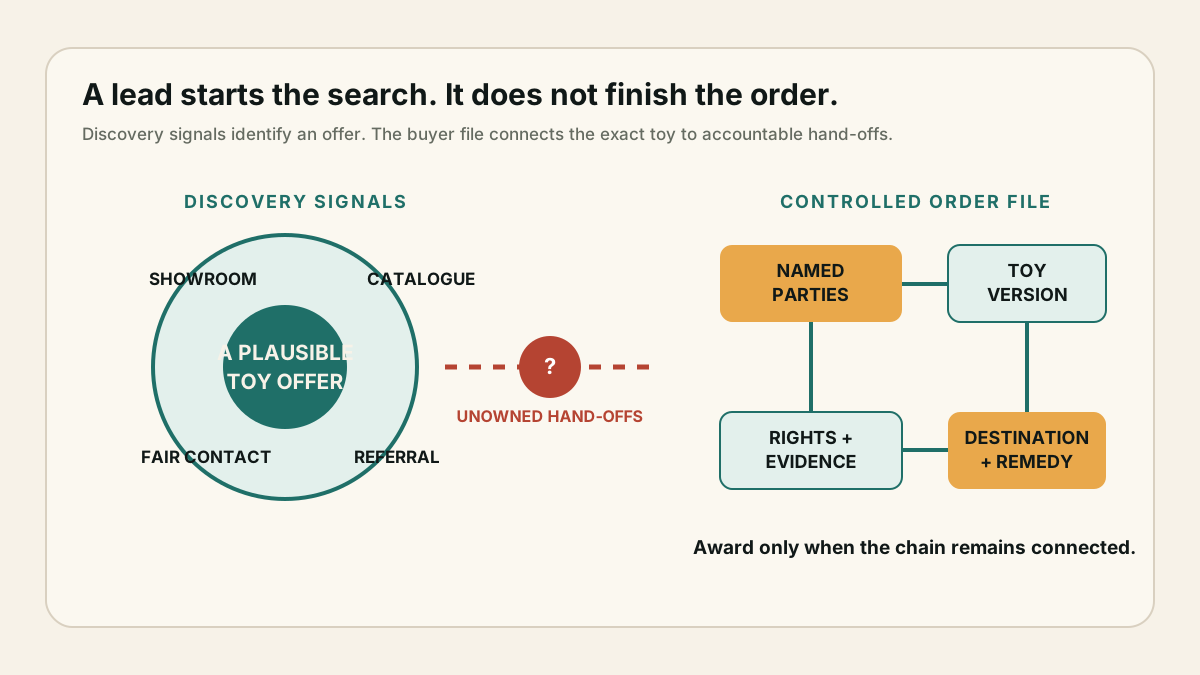 Editorial sourcing framework: a discovery signal can start a conversation; an accountable order needs a separately controlled chain.
Use the first conversation to reveal the delivery system
The first serious request should ask for more than a unit price. It should invite a candidate to identify the legal seller, the proposed manufacturing entity or entities, the product-development contact, the quality contact, the export contact if relevant, and the person who can authorize a change. It should ask whether the sample route and production route are the same. It should ask which work is done directly, which is managed through named partners, and which is only sourced from outside.
This is not a demand that every candidate use the same business model. A multi-party route can be workable. A trading company can be a useful commercial coordinator. A product-development partner may add genuine value. A factory may use specialist component suppliers. The risk is not the existence of multiple parties. The risk is invisible seams: places where the buyer assumes a party controls a decision or obligation that the party cannot actually own.
An answer such as “we handle everything” can be true, partly true, or simply a sales shorthand. Treat it as the beginning of a map, not the end of due diligence. Ask what “everything” means for this specific toy: design authority, tooling, materials, production, packaging, labels, instructions, documents, export, warranty, changes, and customer claims. The candidate that can name the route clearly may be more useful than one that makes the broadest promise first.
Keep discovery material in a discovery folder
There is no need to discard catalogues, screenshots, photographs, product links, business cards, quotation emails, or fair notes. They are useful evidence of what you saw and what was proposed at a given time. The discipline is to label them accurately.
Keep a discovery folder for leads and a separate order file for evidence that has been connected to a specific transaction. A catalogue belongs in the first folder. A controlled specification, version identifier, named legal parties, approved artwork, applicable documents, production sample record, change log, commercial agreement, and remedy contacts belong in the second. The first helps you choose what to investigate. The second helps you decide what to buy and who must answer when something changes.
The toy—not the company brochure—is the unit of control
Toy sourcing becomes vague when the buyer treats a company name as the object being qualified. A company is not a single product. One business can offer many categories, designs, materials, factories, subcontractors, price points, and destination routes. One product family can contain several versions that differ in a way that matters to a customer, a retailer, a test programme, a label, an instruction, a package, or a commercial claim.
Start instead with an identity sheet for the exact toy under discussion. It does not need to settle every technical decision before the first supplier call. It needs to make the current decisions, permitted options, and unknowns visible enough that two candidates can respond to the same question.
| Product identity area | What the buyer should make explicit | What a generic brochure cannot settle |
|---|---|---|
| Intended user and use | Who will use the toy, where, how, and under which age assumptions | Whether a familiar product image reflects the same user, feature set, or use conditions |
| Version and configuration | Model name or working identifier, dimensions, colours, accessories, functions, and included items | Whether two offers refer to the same construction or bundle |
| Materials and components | What is fixed, what is proposed, and what may change only with written approval | Whether plastics, electronics, fasteners, paints, magnets, fabrics, batteries, or packaging are equivalent |
| Design and artwork | Buyer-supplied files, original design responsibilities, marks, characters, packaging art, and approval owner | Who can authorize use, alteration, reuse, or distribution |
| Destination and channel | Markets, retailer requirements, online or physical channel, language, labelling, and instruction expectations | Whether a document from another market or version is relevant |
| Package and presentation | Unit pack, master carton, inserts, warnings, instructions, display needs, and drop or transit assumptions | Whether a showroom sample will arrive, present, or survive in the same way |
| Commercial pattern | Trial, launch, repeat programme, seasonal order, service needs, spare parts, timing, and exit path | Whether the quoted price represents the same future obligation |
Separate what is fixed from what is still being explored
Early product briefs often mix fixed requirements, acceptable alternatives, and genuinely open questions. That makes supplier responses look more comparable than they are.
Fixed requirements are choices already made by the buyer: a product family, a required feature, a commercial timing, a visual direction, a package format, a target retail position, or a buyer-owned design input. A candidate can say whether it meets those requirements.
Bounded options are choices the buyer is willing to evaluate within a stated range. Perhaps a finish, accessory, packing approach, or component configuration can vary if the candidate names the difference and the buyer approves it. Bounded options create useful competition because they make the trade-off visible.
Open questions are not failures. They are questions the buyer has not decided yet: perhaps a control layout, an assembly route, a package structure, a service expectation, or a component strategy. They become risky only when a candidate answers them silently and that answer later becomes part of a quoted toy as if it had been approved.
Ask every candidate to respond in three columns: meets the defined requirement, proposes an identified alternative, or needs clarification. The exercise is simple. It turns a sales exchange into a comparison record and makes it much harder for a familiar product image to hide a different assumption.
Rights are an order-file question, not a geographic judgment
Toy categories create an extra source of confusion because a product’s commercial identity can include more than its physical components. It may involve original design work, characters, brands, logos, artwork, packaging graphics, licensed content, software, sound, instructions, or claims about compatibility. The buyer needs to know which party can authorize each of those elements for the product and territory in question.
The right question is not “Is Chenghai safe for IP?” Nor is it “Does this supplier say it has a licence?” The right question is: for this design and this commercial use, who can demonstrate the authority to make, alter, package, sell, and distribute it, and who bears the consequence if that authority is wrong or incomplete?
There is a reason to keep this question explicit without making a location-based verdict. The U.S. Trade Representative’s 2022 Notorious Markets report recorded right-holder allegations concerning counterfeit goods in Chenghai, including toys, while also stating that the list does not make findings of legal violations. It is a historical, allegation-based and non-adjudicative record. It cannot tell a buyer anything conclusive about a current company, current toy, or current order. It can, however, justify treating design, marks, licences, documentation, and remedy terms as an order-specific gate rather than a box to tick because a product appeared in a showroom. Read the report and its stated limitations.
That framing protects against two bad habits. The first is complacency: assuming a cluster’s scale, reputation, export history, or public programme means that rights authority is already resolved. The second is stigma: treating a historical allegation about a place as a finding against every current business in it. Both habits prevent the buyer from doing the work that matters—checking the rights-and-responsibility chain for the exact commercial object.
Build a rights map alongside the product map
For every design-sensitive toy, name the elements that require authority and the party that provides it. The map may include the buyer’s own design files, a licensor, a brand owner, an artwork creator, a product-development partner, a factory, a seller, and a packaging supplier. It should state what is approved, what can be altered, what must not be reused, and who must be notified if a change is proposed.
This is not a request for a generic assurance. It is a way of asking a candidate to attach its representation to a defined object. If a design is buyer-owned, the record should identify what the buyer supplied and what the candidate is permitted to do with it. If a mark or character is involved, the record should identify which party represents that it has authorization for the relevant product and territory. If the candidate proposes a “similar” product, the buyer should treat that similarity as a new question, not a shortcut around authority.
A document is useful only when it remains connected to the toy
A document can be meaningful. It can also become a prop when it has been detached from the product it is supposed to describe.
The U.S. Consumer Product Safety Commission’s current toy-safety guidance makes the product-specific point clearly within its own stated scope. It says the domestic manufacturer or importer is responsible for identifying the sections of the toy standard that apply to its products, and that different sections apply to different toys. The agency says every toy must be reviewed individually. That is not a global checklist and it is not a conclusion about your product. It is a useful public reminder that one generic file cannot be assumed to answer every version or function question. See the CPSC’s toy-safety guidance.
Destination rules also have a time dimension. The European Commission says its new Toy Safety Regulation entered into force on 1 January 2026 and will apply from 1 August 2030. It says the new rules will require a digital product passport containing safety and compliance information for toys placed on the EU market once they apply. Those are transition facts, not legal advice for a particular product, seller, placement date, or contract. Their sourcing implication is narrower: the buyer’s destination file cannot be treated as a permanent generic attachment. It has to be controlled, dated, and tied to the toy version and the market being discussed. Read the Commission’s transition notice.
The buyer should therefore ask of every document: what exact toy does this describe? Which configuration, material set, factory, legal party, destination, period, and stated scope does it cover? What changed before or after it was issued? Which person is responsible for explaining a mismatch? A document that cannot answer those questions may still be a useful lead. It should not decide the award.
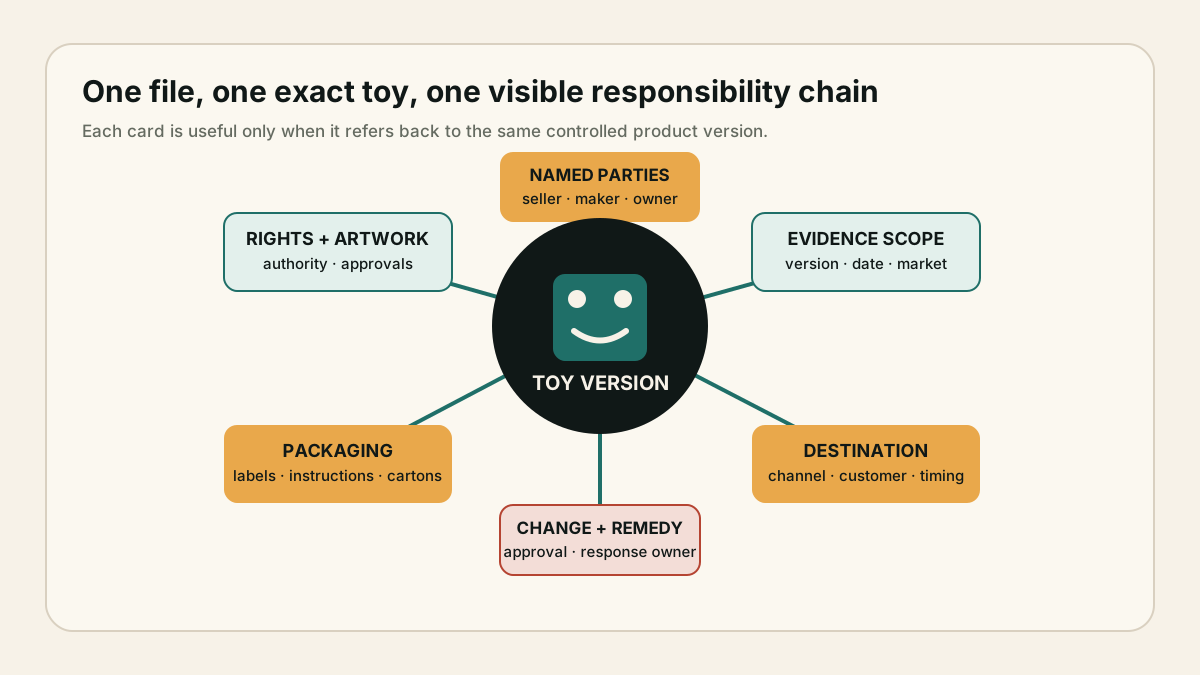 Editorial order-file architecture: each card is useful only when it joins back to the same product version and named responsibility chain.
Build one Chenghai toy order file before award
The objective is not to create a stack of paperwork. It is to create one connected record that makes a commercial promise inspectable. A good order file lets a new member of the buyer’s team ask: what is the toy, who owns each decision, what evidence applies, what can change, and where does responsibility go if something fails?
The following file is an editorial sourcing framework. It does not certify a supplier, validate a document, or replace legal, technical, testing, safety, customs, licensing, or retailer advice for a specific order. Its value is that it makes unowned hand-offs visible before they become expensive.
1. Parties and role map
Start with names, legal entities, and responsibilities. Record the buyer entity, legal seller, proposed manufacturer or manufacturers, product-development contact, quality contact, export or logistics coordinator if relevant, design or artwork owner, licence or brand authority where relevant, and primary commercial contact.
For each party, write what it owns and what it does not own. Who can release a production change? Who can approve a substitute component? Who may speak for the factory? Who carries the contract obligation? Who receives a claim? Who can authorize the use of buyer-supplied files? The purpose is not to force a single-party structure. It is to keep a multi-party structure intelligible.
2. Exact toy identity and version control
Give the product a stable working identifier before the quotation process becomes busy. Link the identifier to the images, drawings, feature list, accessories, colours, dimensions, material and component assumptions, intended user, packaging, instructions, and known variations. If the toy has multiple versions, give each one its own identifier rather than allowing a family name to carry the whole conversation.
Keep a visible version history. A revised picture, new control, changed wheel, substituted battery, adjusted fabric, alternate magnet, revised sticker, or added accessory may look minor. It may also change the product, its evidence, its packaging, or its commercial risk. Version control is how the buyer knows whether the sample, file, and order still refer to the same object.
3. Design, brand, artwork, and licence authority
Record the source of every protected or buyer-sensitive element. Note what the buyer provided, what the candidate created, what is licensed, what is a generic proposal, and what requires approval before production. Link the approval to the exact artwork or design revision, not a verbal reference such as “the superhero version” or “the blue packaging.”
Where a candidate makes a representation about rights, marks, artwork, or licensed content, preserve the representation in the order file with the product context. Make the commercial consequence of a problem explicit in the agreement that governs the transaction. This article does not tell a reader what terms to use. It does tell the reader not to leave ownership and responsibility as a visual assumption derived from a showroom display.
4. Product specification and critical-component map
Separate the visible product description from the components that can change its identity. For a basic plastic toy, critical questions may involve material, colourant, fastening, decoration, movable part, packaging, warnings, and age assumptions. For an electronic toy, the map may also include power source, battery or charging arrangement, sound, light, controller, cable, motor, switch, wireless feature, firmware or app connection, and the person who controls a revision. For plush or composite products, fabrics, stuffing, trims, eyes, threads, seams, and small attachments may each need their own version discipline.
The buyer does not need to pretend to be the manufacturer. The buyer does need to know which elements are fixed, which are proposed, and which cannot change without a recorded review. A price comparison becomes meaningful only after the candidates are responding to the same product identity.
5. Evidence and destination map
Create a table or register that links each relevant document, declaration, test reference, label, instruction, or product statement to its exact scope. Record the document owner, date, product/version identifier, factory or responsible entity if named, destination, stated purpose, and any relationship to the product’s materials, features, packaging, or intended user.
Do not treat the register as a pass/fail verdict. Its job is to expose the questions that need an owner. If a document refers to a different model, a different product image, a different factory, a different market, an old configuration, or an unexplained component set, record the mismatch. The appropriate next action may be clarification, updated evidence, a new product definition, an expert review, or a decision not to proceed. What matters is that the mismatch does not disappear into a shared folder.
6. Sample-to-production equivalence
A sample is a moment in a product’s history. The buyer needs to know what it represents.
Record where it was made, which version it represents, what was provisional, what components it contains, what packaging accompanied it, and what is expected to remain the same in production. If the sample was made by one entity and production will be made by another, write that down. If a component is pending, a mould is being revised, or artwork is unfinished, make it visible. A sample can be useful even when it is incomplete—as long as the buyer knows what is incomplete and does not award production on an imagined equivalence.
7. Packaging, instructions, and market presentation
The customer buys more than the item inside the carton. The commercial product includes the unit pack, master carton, labels, warnings, instructions, languages, online listing inputs, display needs, and the route from factory to customer. These elements can change the product’s claim set, damage exposure, return experience, and responsibility map.
Treat every packaging or instruction revision as a product-file event. Record who supplies the text and artwork, who approves the final version, which product version it accompanies, and what happens when a version changes. A packaging image that looks correct in a presentation is not necessarily the same as a controlled production package.
8. Change control and commercial remedy
Every order file needs a rule for the moment when the original plan cannot be followed. A supplier may propose an alternative material, component, factory, artwork process, carton, assembly route, lead time, or shipment arrangement. The buyer’s file should make the proposed change legible: what is changing, why, what product version it affects, what evidence or approval may need review, who approves it, and how the commercial effects are handled.
This is where responsibility becomes practical. Record the contacts and process for defects, short shipments, claims, returns, rework, replacement parts, warranty responsibilities, and escalation. The right arrangement depends on the order and the parties. The minimum discipline is to avoid a gap where the seller blames the factory, the factory blames a component source, and the buyer has no party clearly responsible for a response.
Use three gates: proceed, pause, or decline
The order file should not make a buyer feel that more documents always equal more certainty. It should make the next decision easier.
Proceed when the product identity is stable enough for the stage of work, responsible parties are named, material hand-offs have owners, key assumptions are recorded, and the evidence and commercial route refer to the same toy and destination. Proceeding does not mean the product is universally approved. It means the buyer has a coherent basis to move to the next controlled stage.
Pause when an important connection is missing but can plausibly be resolved. Examples include an unnamed manufacturing entity, a sample that may not reflect the intended production route, an artwork or licence question without a clear owner, a document that does not match the current version, or a proposed change whose impact has not been described. A pause is not an accusation. It is a request to restore a missing link before the order advances.
Decline when a critical party will not name its role, will not support an important representation, cannot keep the toy version stable enough to compare, will not document a material hand-off, or refuses to own a meaningful post-shipment responsibility. A buyer should not be persuaded out of this decision by the fact that the product looked attractive, the quotation was fast, or the cluster is well known.
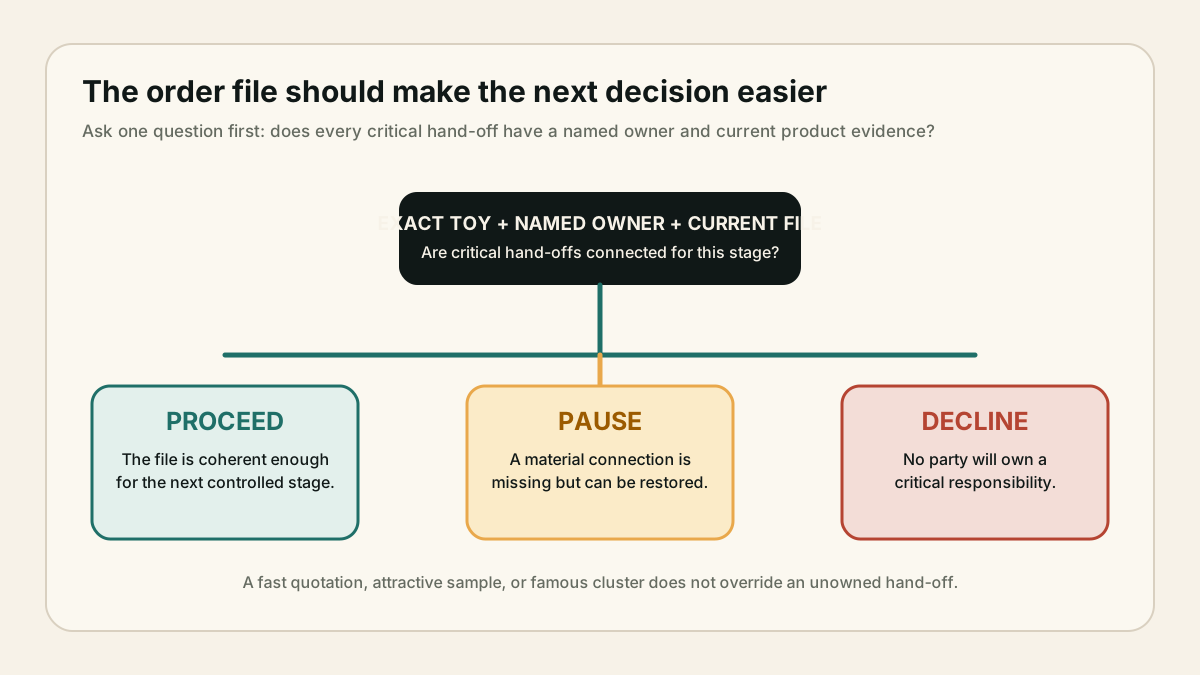 Editorial decision gate: the buyer proceeds only when the exact toy and critical hand-offs have a current, named owner.
What to recheck before each commitment
The exact point of rechecking is not only final purchase order release. Recheck when you request a quote, approve a sample, appoint a manufacturer or exporter, sign a commercial agreement, approve artwork, authorize a change, schedule production, arrange shipment, or plan customer support.
At each point, revisit the legal seller and factory roles; product and version identifier; design, IP, brand, and artwork authority; materials and critical components; age and use assumptions; package, labels, and instructions; destination requirements; evidence dates and scope; sample-to-production equivalence; approved changes; commercial terms; insurance or shipping responsibilities where relevant; warranty and claims route; recall responsibilities; and subcontractor roles.
This is a deliberately broad recheck list because the buyer’s risk does not sit in one document. It sits in the gaps between documents, people, product versions, and commercial promises. The list becomes useful only when it is reduced to the questions that matter for the particular toy. A simple non-electronic plastic item and a connected electronic product should not be run through the same generic file with the same assumptions.
For the wider operating context, see our guide to how China manufactures, and for a food-contact product example of product-specific sourcing proof, see how to source lunch boxes from China. The common lesson is not that all categories behave the same. It is that a fast supplier search needs a decision unit more precise than “supplier.”
Frequently asked questions
Is Chenghai a good place to source toys?
It can be a productive place to discover and compare toy categories because public records describe a large, export-facing toy cluster. That does not make Chenghai a supplier ranking or a product-quality verdict. Use it to find and test candidates, then make the award decision with evidence connected to the exact toy and named responsibilities.
Can I trust a Chenghai supplier because it has a showroom or appears at a fair?
A showroom or fair appearance can be a useful discovery signal: it can show an offer and provide a contact. It does not itself establish who owns the design, makes the final production version, controls components, carries the commercial obligation, or accepts post-shipment responsibility. Treat it as the start of a file, not the completed file.
Does a test report or certificate prove that a toy order is ready?
Not by itself. The buyer needs to connect any document to the exact toy version, materials and components, responsible party, factory or production route where relevant, destination, date, and stated scope. This article does not validate documents or give certification advice; it explains why a generic document should not be detached from the product it is meant to describe.
How should I handle licensed characters, brands, or artwork?
Treat rights authority as a specific order-file question. Identify who supplies or owns the design and artwork, who can authorize the proposed commercial use, what changes are allowed, and which party owns the consequences if an authorization is wrong or incomplete. Do not infer this from a product image, a cluster location, or a supplier’s broad assurance.
What is the most important Chenghai sourcing rule?
Do not let a fast lead become a fast award. The lead is for discovery. The award depends on whether the same exact toy, with named parties and current evidence, remains connected from product definition through production, packaging, shipment, and remedy.
Method and limitations
This is a desk-research field guide based on dated public records from Shantou and Chenghai, U.S. CPSC toy-safety guidance, a European Commission transition notice, and a historical USTR record. The team did not visit a factory, examine a toy, inspect a laboratory, evaluate a supplier, validate a document, manage a transaction, or observe a shipment. The article does not offer legal, IP, safety, certification, testing, customs, engineering, retailer, or supplier-approval advice for a specific product or destination.
Its purpose is narrower: help a buyer use Chenghai’s discovery density without confusing a cluster, showroom, catalogue, trade record, sample, or document reference with proof of an accountable order. Before a real commitment, verify the current product, parties, rights, evidence, destination, commercial terms, and remedy route with the appropriate people and advisers.
Related entries
- China’s industrial clusters guide — the wider map for using manufacturing density without outsourcing your judgment.
- How China manufactures — the operating system behind the sourcing workflow.
- Guzhen lighting cluster — a companion buyer file for another showroom-rich cluster.
- Cixi small-appliance cluster — how product-specific proof changes the value of a fast supplier search.
- How to source food-contact lunch boxes from China — a category-specific example of keeping product evidence connected.
- Hidden Chinese hardware champions — the broader context for finding the companies and systems behind global hardware categories.