

Guzhen can make a lighting search dramatically faster. It cannot make the supplier decision for you.
By China Made & Tech Team — an independent, desk-research field guide to Chinese manufacturing and technology.
Guzhen’s public scale is large enough to change how a lighting buyer searches, but not large enough to answer who should receive an order. The town’s current official records make the first point; the supplier’s product and evidence file must make the second. Read Guzhen’s 2026 cluster publication.
Quick answer
Zhongshan’s Guzhen lighting cluster is valuable because it puts an unusually dense mix of products, showrooms, trading channels, manufacturers, component businesses, design activity, and export-facing services within a small sourcing field. Guzhen’s own May 2026 publication says the town has more than 27,000 industrial enterprises, states that local lighting products account for more than 70% of China’s market and more than 50% of the global market, and says products reach more than 140 countries and regions. A separate town overview reports 45,699 businesses with “lighting” in their registered scope as of 2025 Q2 and describes a wider eleven-town cluster with annual output above 100 billion yuan. These are powerful discovery signals. They are not a list of factories that have already earned your order. Guzhen’s 2026 cluster publication and its 2026 town overview
The right way to use Guzhen is therefore two-stage:
- Use the cluster to discover categories, compare construction and design language, find candidates, and understand which parts of a lighting product are locally available.
- Use a supplier-specific evidence file to decide who owns the design, controls the bill of materials, can make the exact sample, can document applicable requirements, can control substitutions, and will remain accountable after shipment.
| Guzhen can help you do quickly | Guzhen cannot prove for you |
|---|---|
| Find many candidate product families and price positions | That a particular supplier makes the product rather than trades it |
| Compare fixtures, components, finishes, packaging, and visual design | That the same bill of materials will be used after the sample |
| Meet factories, trading companies, design studios, and exporters | That one party owns the design, quality decision, and after-sales duty |
| See a dense trade and fair environment | That a product meets the requirements of your destination market |
| Identify local capability routes | That the route will deliver your order on time and to the agreed specification |
Start with the real promise of Guzhen: discovery density
Guzhen is often introduced with a superlative: China’s Lighting Capital, a global lighting hub, or a city where every shop is a lamp supplier. Those phrases point to something real, but they are too blunt for a buyer.
The more useful picture is of a market that has accumulated many kinds of lighting activity. A buyer can see finished decorative fixtures, commercial and outdoor products, components, electrical parts, packaging, retail displays, design variations, project-oriented products, and trading services in the same broad area. The advantage is not simply choice. It is the chance to move quickly from a vague brief—“we need a mid-market pendant family for hospitality,” for example—to a more informed set of product and supplier questions.
The public figures are substantial, but they have different meanings. Guzhen’s May 2026 town-government publication speaks of more than 27,000 industrial enterprises in a 47.8-square-kilometre town, stated lighting-product shares above 70% of China’s market and 50% of the global market, and sales into more than 140 countries and regions. The January 2026 town overview uses another measure: 45,699 registered entities whose business scope includes lighting as of the second quarter of 2025. It also describes a wider three-city, eleven-town cluster with annual output above 100 billion yuan. The May publication and the town overview are not contradictory once their scope is kept visible. One is talking about industrial enterprises, another about business registrations with a lighting-related scope, and another about the wider regional cluster rather than the town alone.
That distinction is not pedantic. It gives the buyer a first lesson in Guzhen sourcing: a large number is useful only after you know what it counts. A registered lighting business is not automatically a manufacturer. A factory may specialize in one narrow component. A trading company may be highly capable at export coordination without owning production. A showroom can help you find a category but cannot tell you who controls the production line. A wide regional output total says something about ecosystem depth, not about the exact entity that will receive a purchase order.
What density changes in a buyer’s favour
Used well, density creates four advantages.
First, it compresses category learning. A buyer looking at lighting from a distance can mistake visual style for product similarity. In a dense market, you can compare fixtures that look alike but are built differently: metal thickness, joining method, diffuser material, optical component, finish, driver arrangement, wire routing, assembly sequence, packing approach, and spare-part logic. You may not be able to inspect every claim immediately, but you can learn which questions separate a decorative shell from a durable product family.
Second, density makes supplier roles visible. On a single trip or in a concentrated set of video calls, a buyer can encounter a designer, a fixture assembler, a component specialist, a mold or metalwork provider, a packaging supplier, a project trader, and an exporter. That matters because the right partner depends on the job. A private-label retailer may need a product-development and repeat-order partner. A hotel project may need configuration control, documentation, replacement parts, and site coordination. A distributor may need stable stock, local-market packaging, warranty handling, and clear commercial ownership. A buyer who assumes one company performs every role equally well loses the benefit of the cluster.
Third, density improves comparison. An RFQ sent to one supplier produces a conversation. A controlled RFQ sent to carefully chosen candidates produces a market view. The goal is not to collect twenty prices. It is to see which candidates ask the questions that a serious product requires: intended application, electrical environment, target market, installation method, finish tolerance, photometric or performance requirement where relevant, packaging test, labeling, service expectation, and change approval.
Fourth, density can shorten recovery. If a component is unavailable or a design needs a different fabrication route, a mature cluster may provide alternative conversations more quickly than a dispersed supply base. That is a potential advantage, not a promise. The buyer still needs to establish whether a substitution is acceptable, who approves it, and what evidence changes with it.
What density does not change
It does not erase the basic problems of sourcing. A beautiful showroom does not prove manufacturing ownership. A factory tour does not prove that the production process will remain stable after a sales sample. A long export history does not show that a product fits your destination’s requirements. A low price does not say what has been omitted from the bill of materials. A supplier who says “we can do everything” may be the right partner; the statement is not the evidence.
Guzhen’s own 2026 government work report provides a useful corrective to a uniform-quality story. It identifies uneven product quality and insufficient digital enablement across parts of manufacturing, warehousing, logistics, and marketing services as local challenges. The report also discusses further upgrading and foreign-business support. Guzhen’s 2026 work report should not be read as a verdict on any company. It should be read as a reminder that a cluster is an ecosystem with variation. The buyer’s job is to find the right variation for the exact project.
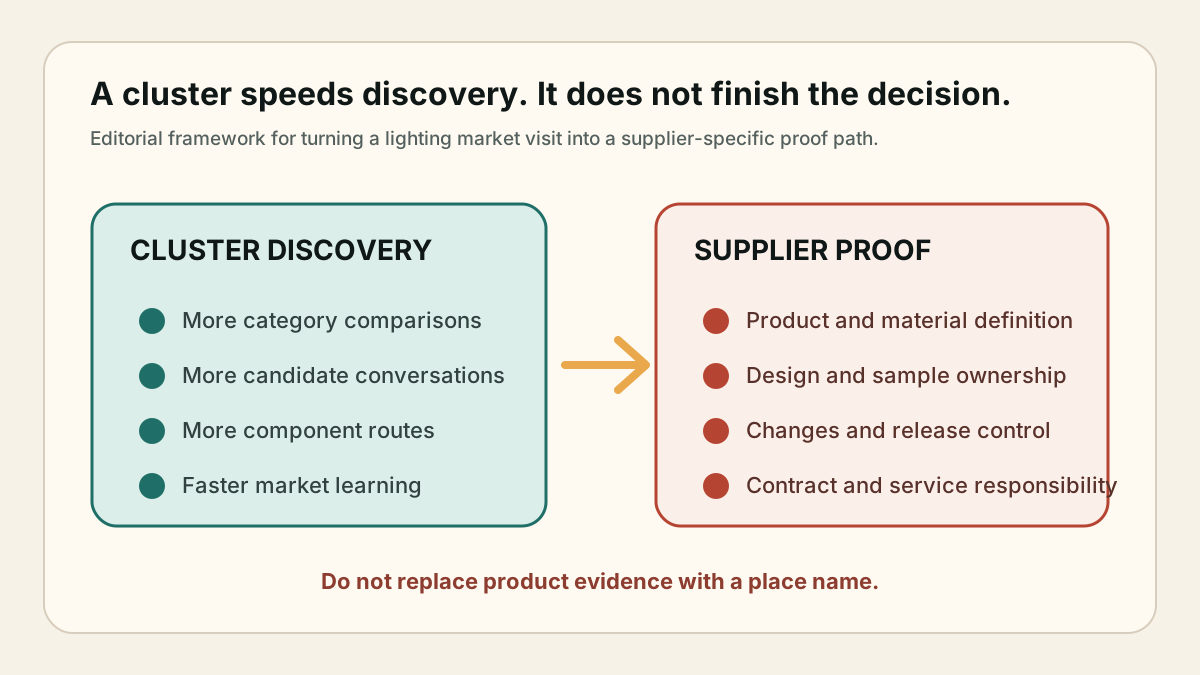 Editorial sourcing framework: a cluster can improve discovery while supplier-specific proof remains a separate task.
Prepare a category brief before you enter the market
The most expensive Guzhen trip is the one that begins with “show me what you have.” You will see a great deal. You will learn very little that can be compared later.
Arrive with a category brief. It does not need to be a final engineering specification. It needs to be specific enough that every candidate is responding to the same problem.
For lighting, the brief should separate the visual idea from the product definition. “Modern black pendant” is visual language. A usable product definition describes the intended application, size range, installation approach, electrical configuration, materials and finish expectations, light source or driver arrangement where relevant, expected user environment, packaging constraints, target market, service expectation, and planned volume or phased-volume hypothesis.
The first page: define the item, not the mood board
A practical first page might contain:
- the product family and the use case: residential decorative, hospitality, retail display, office, outdoor, industrial, or another defined application;
- target regions and sales channels;
- dimensions, mounting constraints, weight limits, and installation assumptions;
- target materials and allowable alternatives;
- finish standard, including reference samples or visual tolerances;
- lighting or electrical requirements that need verification for the target product and market;
- packaging, labelling, instruction, spare-parts, and service expectations;
- intended order pattern: project, launch quantity, repeat retail program, or trial run; and
- the decision owner for visual changes, material substitutions, cost reductions, and release approval.
This page helps you identify a category fit. It does not yet choose a supplier. Its real value is that it exposes ambiguity early. If you cannot explain whether a proposed product will be installed in a hotel room, used above a dining table, shipped as a flat pack, sold in a retail carton, or delivered into a commercial project, then suppliers will fill those gaps differently. The quotations will look comparable but will not be comparable.
Build a candidate map, not a pile of business cards
After the category brief, assign every candidate a preliminary role. Use simple labels:
| Candidate role | What it may be good for | The question that must follow |
|---|---|---|
| Product developer / manufacturer | Turning a defined family into samples and repeat production | Which functions are in-house, and which are supplied or subcontracted? |
| Component specialist | Improving one part of the product system | How does this component map into the fixture and its final evidence file? |
| Trading or project company | Coordinating a portfolio, export process, or project package | Who owns specification, quality release, change approval, and after-sales responsibility? |
| Design-led supplier | Developing a distinctive visual or product direction | Who owns the design, molds, drawings, and production rights after payment? |
| Stock-oriented wholesaler | Testing an existing product or serving a low-complexity need | Is the item controlled well enough for repeat orders and local service? |
The candidate map also makes a trip more efficient. Rather than asking each showroom for a generic company introduction, ask each candidate to show the product path for one comparable item. Where does the design originate? Where is the metal formed? Who makes the electrical subassembly? Who performs final assembly? Who selects packaging? Who releases the production sample? Who keeps the order record? What is the route if an issue is found after shipment? A clear answer is more useful than a long catalogue.
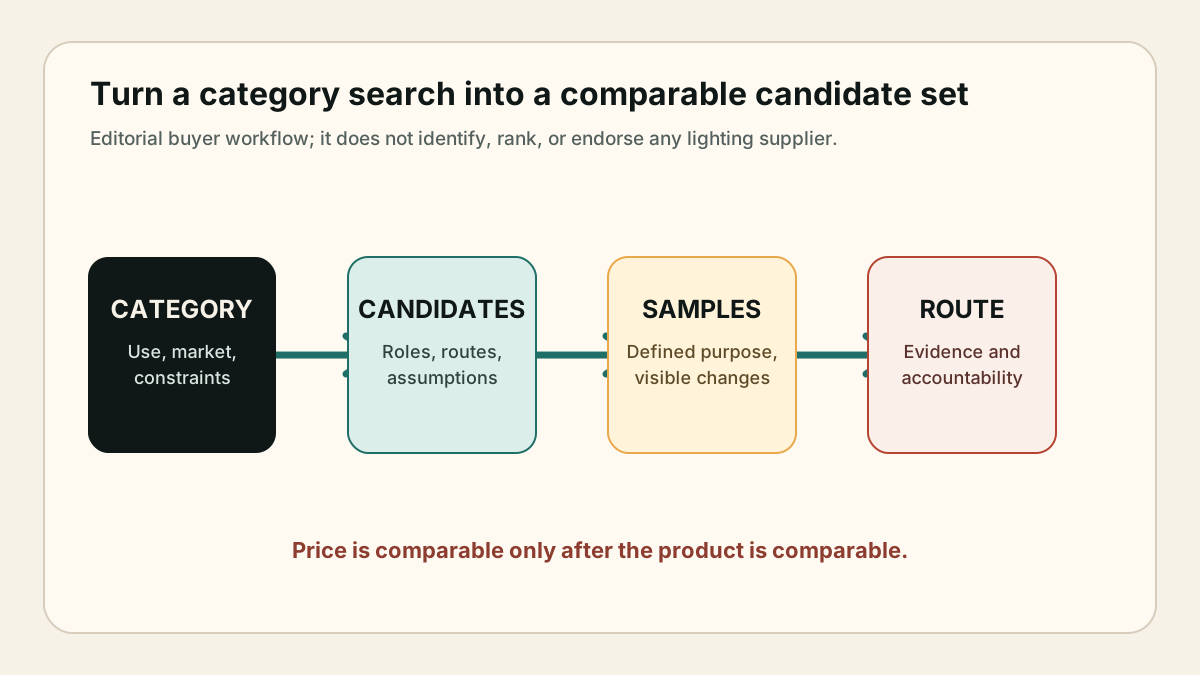 Editorial candidate map: move from a defined category to comparable roles, sample purposes, and an accountable route.
Use trade activity as a discovery signal, not a performance score
Guzhen’s public trade record explains why buyers go there. The 2025 town government work report says that 2024 exports reached 106.9 billion yuan, up 25%, and that the 30th and 31st lighting fairs drew 450,000 visits. It says overseas visitors at the 31st fair’s main venue rose 35.39% year on year. The 2025 work report gives those figures a clear date and source.
The May 2026 cluster publication describes more than 3 million square metres of trade complexes, 34 lighting fairs, and stated growth in 2025 cross-border e-commerce export value and B2B trading value. Guzhen’s overview also describes national market-procurement pilot status; a Zhongshan municipal bulletin records the Guangdong “cross-border e-commerce plus industry belt” pilot context for lighting. Guzhen’s cluster publication, the town overview, and the Zhongshan government bulletin
For a buyer, these facts support a narrow conclusion: there is a serious discovery and trade environment. They do not establish that a particular exhibitor has a controlled export process, understands your destination’s product requirements, can issue the documents you need, or will support a dispute. A fair may be the best place to begin a search. It is a poor place to finish one.
What to do at a fair or showroom
Use the fair to reduce uncertainty, not to create commitment.
Ask the same ten questions of each serious candidate. Bring a one-page version of your brief and capture the answer, not only the product photograph.
- What exact item or product family are we discussing?
- Is the displayed item made by this company, sourced by this company, or developed with another party?
- What is the current bill of materials, and which elements are customer-selectable?
- What are the existing sample, product, or process records for the displayed configuration?
- Which parts of the product are stable, and which are likely to change with volume, cost, finish, or market?
- Who owns drawings, tooling, design files, and customer-specific modifications?
- What destination markets has the company served with this kind of product, and what documents can it actually provide for the relevant item?
- Who is responsible for pre-production approval, production inspection, packing approval, and release?
- How are changes proposed, authorized, recorded, and communicated?
- Who remains responsible when a retailer, installer, project manager, or end customer reports a problem?
The first meeting is not an interrogation. It is an information-design exercise. A capable candidate may answer some questions after a follow-up because the product is not yet fully defined. That is fine. Record what is known, what is promised, who owns the next response, and what evidence will close the gap. The warning sign is not uncertainty. It is uncertainty that has no owner.
The trade-fair trap: mistaking visual abundance for product equivalence
Lighting is visually deceptive. A cluster can show dozens of fixtures that appear nearly identical. The internal construction, heat management, driver choice, wiring, optical result, finish durability, packing, installation instructions, and replacement-parts logic may still differ. The value of comparison is not finding the lowest-looking price. It is discovering which variables move when the price moves.
Ask every candidate to annotate the comparable item. What is the material? What is the wall thickness or construction approach where relevant? Which component changes if the price target changes? Which finish is standard and which is special? Which parts are sourced? What is included in the quote? What is excluded? What is the sample lead time? What is the production lead time after a signed reference sample? Which assumptions must be approved before production can begin?
You are not trying to force suppliers into one answer. You are making their answers comparable. In a dense market, comparability is more valuable than volume of options.
A lighting product is a system of ownership, not a single fixture
The buyer who chooses a lamp based only on a catalogue image is not buying a product system. They are buying a future argument about what the image meant.
Make ownership visible across five layers.
1. Design ownership
Ask who created the design, who owns existing drawings, who can authorize changes, and what the buyer receives after paying for development, tooling, or customization. A design conversation can become confused quickly when a buyer asks for “something like this,” a supplier adapts an existing item, a third party owns a mold, and the finished product appears in multiple channels.
The correct answer varies by deal. You may license an existing design, buy an exclusive market configuration, commission a new design, or accept a non-exclusive catalogue item. Each can be commercially sensible. The decision should be explicit. Define the design source, the rights granted, territorial or channel limits if any, tooling ownership, file access, replacement obligations, and the procedure if a similar product appears elsewhere.
Do not rely on a verbal assurance that something is “our own design.” Ask what that statement means operationally.
2. Product definition and bill of materials
A bill of materials is not just a cost sheet. It is the bridge between a sample and a repeat order. The buyer should be able to identify the material, finish, key components, packaging, labels, instructions, and included accessories that define the approved product.
The level of detail should match the risk. A simple decorative item needs less than a commercial product with a complex electrical, installation, or service requirement. But every program needs a controlled reference point. If a part can be changed because it is “equivalent,” define who decides equivalence. If the finish can vary, define the reference. If the packaging can be substituted, define the protection level and approval method. If the product has optional configurations, define the exact configuration being quoted.
The hidden advantage of doing this in Guzhen is that the component conversation can happen near the product conversation. The hidden risk is that substitutions can also happen easily unless your approval path is clear.
3. Sample ownership and release
Treat a sample as an argument to be resolved, not a souvenir to be photographed. Label it. Record the date, version, materials, finish, components, modifications, open questions, and approval status. State whether it is a visual sample, functional sample, pre-production sample, packing sample, or another agreed stage.
Then decide what the sample proves. A visual sample may prove proportion and finish direction. It may not prove production assembly or packing. A functional sample may show the intended use. It may not prove repeatability. A pre-production sample should link to the materials and process intended for the first production run. It may still need a formal release record before shipment.
The buyer’s mistake is approving one kind of sample while assuming it proves another. The supplier’s mistake is treating an informal approval as permission to change a product without a record. Both disappear when the sample’s job is written down.
4. Factory and process ownership
You do not need to demand that every candidate own every step. You do need to know who performs the steps that matter. Ask which operations are in-house, which are supplied, how incoming materials are controlled, how process changes are decided, and how the company identifies the unit or lot shipped to you.
For a first order, the buyer can be pragmatic. Confirm the production location, the relevant production route, the controls applied to the exact item, the contact who owns quality release, and the rule for material or process changes. If the supplier subcontracts a step, ask whether that step can change without notice. If a component is bought from a named partner, ask whether an alternative can be used and who approves it.
This is not a claim that every supplier needs one uniform audit model. It is a way to decide whether the product being quoted has a stable identity when production begins.
5. Commercial and after-sales ownership
The order remains unfinished after the container leaves. Define who owns documentation, packing list accuracy, shipment coordination, warranty communication, spare parts, claims, rework decisions, and the commercial remedy if the delivered product differs from the approved reference.
This is especially important when a buyer meets one party at a fair but the product route contains several parties. A manufacturer may make the item while a trader signs the contract. A project company may coordinate delivery while another party owns the design. An exporter may prepare documents while a distributor handles service. None of these structures is inherently wrong. The buyer should know which one is in front of them.
The mistake: assuming a cluster is one quality system
The phrase “Guzhen quality” can be useful as a search term. It is not a quality system.
Quality exists at several levels: a design decision, a material choice, a process control, an inspection decision, a packing decision, a change-control rule, and an after-sales response. A cluster can make all of those capabilities available. It cannot ensure that the same level of control is present at every candidate.
The local government’s acknowledgement of uneven product quality and uneven digital enablement should make this intuitive. The 2026 work report does not name poor products or good factories. It does demonstrate why a buyer should never use a cluster label as the final quality claim.
Replace “Are you a good factory?” with proof questions
“Are you a good factory?” invites a polished answer. Ask questions that produce artifacts instead.
| Decision area | Ask for | What you are trying to learn |
|---|---|---|
| Product identity | Controlled drawing, product sheet, and configuration list | Whether everyone is quoting the same item |
| Materials | Bill of materials or defined component list | Which inputs create the approved product |
| Finish | Reference sample, finish code, or visual approval record | How visual expectations will be repeated |
| Function and safety requirements | Applicable product records for the exact item and market | Whether evidence is relevant rather than generic |
| Production | Pre-production sample, process explanation, and release owner | How the approved version reaches production |
| Change control | Written notice and approval process | Whether a substitution can occur silently |
| Packing | Approved packout, carton markings, and handling assumptions | Whether the product can arrive in its intended condition |
| Service | Warranty route, spare-part plan, and claims contact | Who owns the customer problem after sale |
Do not confuse a document with the decision it supports
A document can be real and still be irrelevant. A test report for a different configuration, a declaration for a different market, a photograph of an earlier project, a catalogue list, or a certification mark on a product family can all create false confidence if they are not tied to the exact item and destination.
For every record, ask five questions: What exact product does it name? What configuration does it cover? What does it actually establish? Which destination or use does it relate to? What changed since it was issued? If the supplier cannot answer those questions, do not turn the record into a claim in your own sales or project file.
The Guzhen buyer file: from category search to award
The following is an editorial sourcing framework. It is not legal, customs, electrical-safety, or certification advice. Its purpose is to keep the buyer’s decision reversible until the critical evidence is visible.
Gate 1: define the commercial object
Before you seek quotations, decide what business you are actually doing. Are you buying a catalogue item, adapting an existing product, commissioning a private-label family, sourcing a project package, or building a repeat retail program? Each route creates different ownership and change-control needs.
Write down the product family, target customer, channels, market, demand hypothesis, acceptable alternatives, target launch date, and decision owner. Make clear whether price is a ceiling, a target, or merely an input to be compared. A supplier cannot responsibly solve a tradeoff that you have not described.
Gate 2: turn the category into a controlled RFQ
Send the same core brief to a small set of candidates. Allow each candidate to explain alternatives, but make deviations visible. Ask them to quote a base configuration and list every assumption. Require a response on product route, design ownership, sample stage, minimum order, lead time, relevant records, change-control process, export or delivery role, and after-sales responsibility.
The RFQ should make it easy to compare more than price. A candidate who cannot identify assumptions may be less useful than a candidate whose quotation is higher but whose constraints are explicit. The goal at this point is not award. It is a shortlist with a credible path to samples and proof.
Gate 3: approve the sample’s purpose
For each shortlisted candidate, name the sample type and the decision it will support. Record the configuration and any deviations from the RFQ. If the sample does not match the intended production materials or process, state that clearly. Decide what must be proven before the next stage: visual acceptance, installation, functionality, packing, product record, production repeatability, or a defined set of commercial terms.
The sample decision should end with a written result: accepted, accepted with changes, rejected, or awaiting evidence. A photograph in a chat thread is not a release system.
Gate 4: make changes expensive in information, not in money
Changes will happen. Material availability shifts. A finish is difficult. A packing method fails. A customer requests another variant. The practical question is not whether change is allowed. It is whether change becomes visible before it reaches production or the customer.
Agree on a change notice that identifies the old version, new version, reason, cost or timing effect, evidence effect, sample need, and required approver. Use it for changes that affect the product identity, claimed performance, finish, packaging, installation, records, or service. For low-risk cosmetic adjustments, the process can be lighter. The principle remains: the person paying for the product should not discover the change from the shipment.
Gate 5: award the accountable route
At award, identify the contracting party, production party or parties, shipper or exporter, service contact, and decision rights. Match the commercial documents to the approved product reference. Define payment milestones around evidence and release points rather than only calendar dates where that is commercially practical. Confirm the route for nonconformity, delay, damage, missing documentation, spare parts, and warranty claims.
Then keep the first run intentionally learnable. A staged launch, limited project tranche, or controlled first production can produce information that a broad order cannot. The purpose is not to delay forever. It is to avoid making the first problem impossible to trace.
The stop rule
Do not award a lighting order because the market feels convincing. Award when the exact product, commercial route, evidence still required, approved sample stage, change process, and accountable parties are visible enough for the risk of the program.
If a candidate cannot tell you what it is making, who controls it, what records apply, and who will resolve a problem, the right next step is not a lower price. It is a pause.
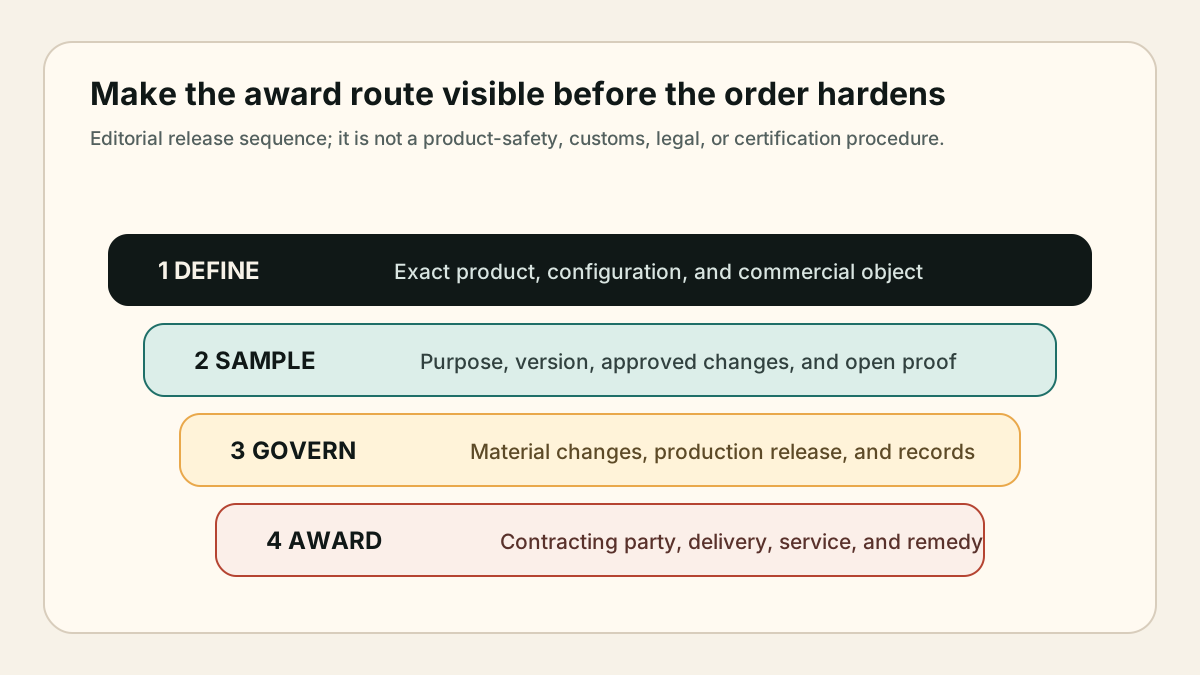 Editorial award sequence: define the product, define the sample, govern change, then award the accountable route.
Why this matters beyond lighting
Guzhen is a concentrated version of a wider China-manufacturing pattern. A strong industrial cluster can give a buyer faster learning, richer comparison, and more alternative production routes. It can also create a dangerous illusion that proximity equals proof.
The same discipline applies in other factory towns. Read China’s industrial clusters guide for the broad map, China’s county industrial clusters for the factory-town logic, and the Yongkang hardware cluster for another example of density turning into a buyer decision only when product and supplier evidence are separated. How China manufactures adds the operating context behind those cluster advantages.
Guzhen’s particular lesson is visual abundance. Lighting is easy to admire and hard to compare casually. The buyer who turns a beautiful market into a controlled evidence path gets the real benefit of the cluster: more options, better questions, and fewer invisible assumptions.
Method and limitations
This is desk research, not a factory visit, audit, product test, electrical-safety assessment, certification review, legal opinion, customs opinion, negotiation record, contract review, shipment review, or supplier recommendation. It was reviewed on August 24, 2026 against Guzhen’s May 2026 cluster publication, January 2026 town overview, 2025 government work report, 2026 government work report, and a Zhongshan municipal government bulletin. China Daily’s April 2026 reporting on foreign-buyer engagement is treated only as attributed context, not as a supplier-performance result. China Daily
The official figures in these records use different dates and scopes. Some refer to Guzhen town, some to registered entities, some to trade activity, and some to a wider three-city, eleven-town cluster. The article preserves those distinctions instead of combining them into one market-size or supplier-quality claim. No named factory, product, sample, quality system, export file, contract, destination-market requirement, or shipment was inspected.
Before acting, verify the current identity and role of each candidate, the exact product and bill of materials, current sample and product records, applicable destination requirements, manufacturing and change-control route, export and delivery terms, payment terms, ownership provisions, warranty, spare parts, and local service responsibilities. Bring qualified technical, regulatory, customs, and legal reviewers into a transaction when their expertise is required.
Frequently asked questions
Is Guzhen the best place to source lighting in China?
Guzhen is a powerful place to start a lighting search because official records describe exceptional product, enterprise, and trade density. “Best” depends on your product category, design needs, destination market, volume, documentation requirements, and service model. Treat the cluster as a discovery advantage, then compare supplier-specific evidence. Guzhen’s cluster publication
Does a Guzhen showroom prove that a company owns the factory?
No. A showroom can be useful for product discovery and comparison. It does not establish whether the company manufactures the item, controls the design, owns tooling, manages quality release, or will be the contractual and after-sales counterparty. Ask those questions in writing for the exact product.
What do the large enterprise and market-share figures mean for a buyer?
They show the official scale and reach that make Guzhen a dense sourcing environment. They do not provide a denominator for supplier quality, capacity, price, or export readiness. Keep the source, date, and geographic scope visible; do not convert a town or wider-cluster total into a factory rating. Guzhen’s 2026 cluster publication and town overview
How should I compare Guzhen supplier quotations?
Compare a controlled product definition, not a product image. Ask every supplier to state configuration, materials, finish, included components, packaging, assumptions, sample stage, evidence available, lead-time conditions, change process, commercial owner, and after-sales responsibility. Price becomes useful only after those variables are visible.
Can a trade-fair visit replace a factory qualification process?
No. Fair activity and trade-platform status show discovery infrastructure. They do not prove the product route or supplier performance for your order. Use a fair to create a shortlist, then move through controlled samples, evidence, change control, and an accountable contract route. Guzhen’s 2025 work report
Does this guide tell me whether a product is compliant or safe in my market?
No. Product requirements vary by item, application, destination, and use. This article does not assess a named product, test record, certificate, or jurisdiction. Obtain qualified advice and product-specific evidence for the transaction you are considering.
Related entries
- China’s industrial clusters guide — the national map behind factory-town advantage.
- China’s county industrial clusters — why smaller places can own global product niches.
- Yongkang hardware cluster — a companion buyer guide to another dense production ecosystem.
- How China manufactures — the broader operating system behind the cluster.