
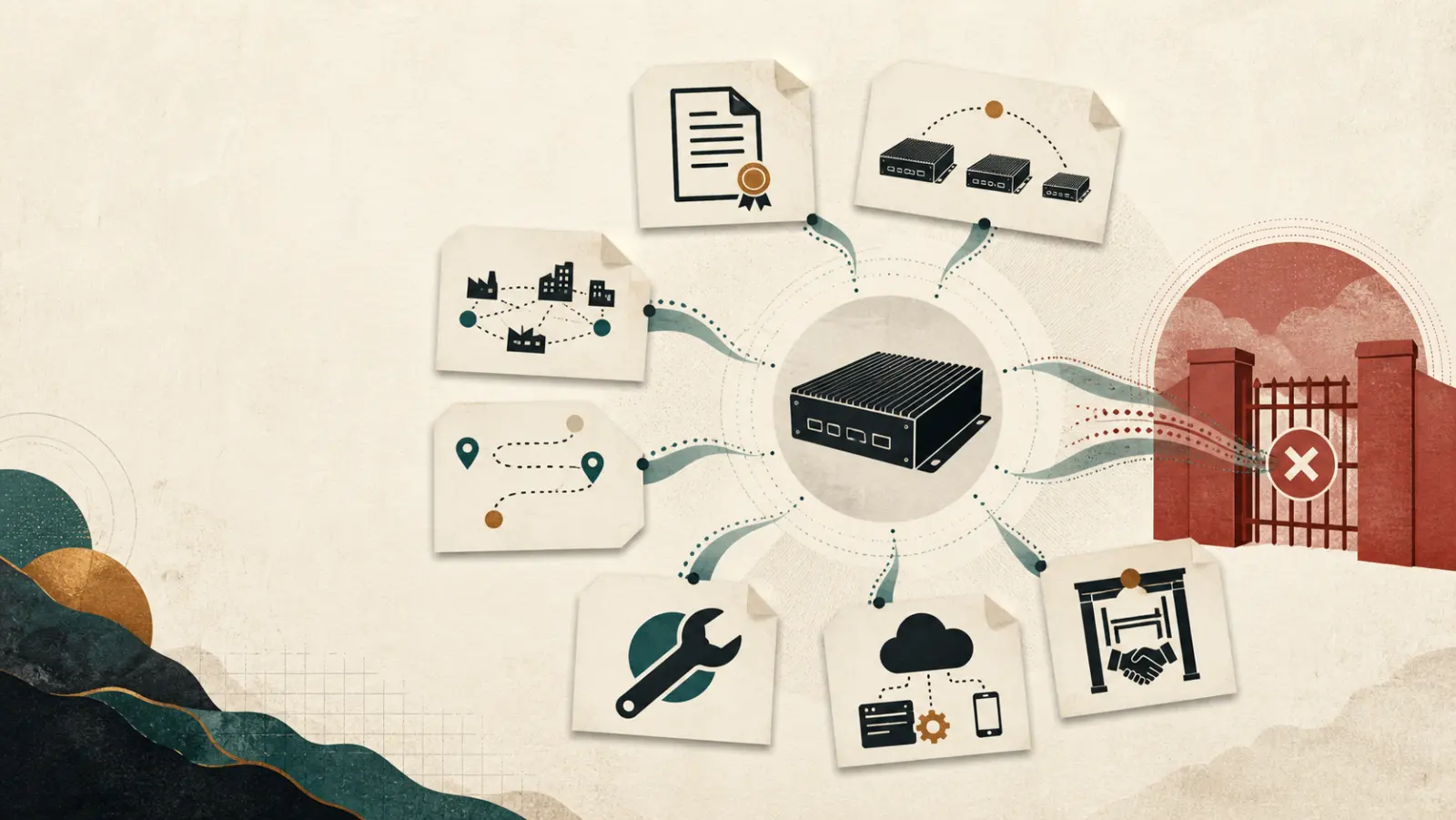
By China Made & Tech Team · August 22, 2026
The useful question is not, “Which Chinese hardware brands are the best?” It is, “What exactly sits behind this name on the product?”
A brand can be a real product company with a clear model family, a recognizable founder story, controlled manufacturing, distributors, a support portal, app accounts, spare parts, and regional warranty terms. It can also be a label used by a trading company, an export channel, an OEM customer, a platform seller, or several different legal entities. Sometimes the answer is mixed: a brand owner designs the product, while a different company makes it, another company sells it in your market, and a local partner handles service.
None of those arrangements is automatically good or bad. The problem starts when the buyer treats the logo as the conclusion.
This is what China Made & Tech means by a hidden Chinese hardware champion: not a nationalist superlative, a shopping recommendation, or a claim that an obscure brand is better than a famous one. It is a company or product system whose useful evidence is usually scattered across names, product families, factory context, channel terms, support documents, software or control layers, and local manufacturing ecosystems. The job is to collect those layers and see what they actually establish.
That approach also keeps manufacturing context in its place. China's official SME-cluster framework concerns county-level industrial systems and formal review. It does not certify a specific brand, product, legal entity, or service outcome. A cluster can explain why a category has depth. It cannot qualify the company that happens to use that place name.
Start with the national industrial-cluster map and the factory-town guide if you need the manufacturing context. Then come back to the brand in front of you.
The short answer: a brand is a system of evidence
When a reader sees a Chinese hardware brand on Amazon, a distributor price sheet, Alibaba, a trade-show stand, a crowdfunding page, a user forum, or a supplier quotation, the instinct is to look for one answer: “legitimate or not?”
That question is too blunt. A better brand investigation has seven cards.
- Identity: What is the exact brand spelling, legal entity, local trading name, subsidiary, importer, and payment beneficiary?
- Product family: Which models, accessories, revisions, firmware versions, or consumables belong together—and which do not?
- Manufacturing context: Is there evidence of a product-family ecosystem or factory-town connection? What does that context not establish about this brand?
- Channel: Is this exact model sold by the brand, an authorized distributor, a marketplace seller, or an unknown intermediary in the relevant market?
- Support: Which warranty, repair, returns, spare-parts, installer, or service terms apply to this product, purchase route, and country?
- Control layer: Does the product use an app, cloud account, cellular plan, firmware, installer portal, battery-management interface, or other service that changes who controls operation after sale?
- Buyer proof: What company, factory, product, test, service, and contractual evidence is still needed before the next irreversible commitment?
The first six cards help the reader understand the brand. The seventh stops understanding from turning into an unsupported recommendation.
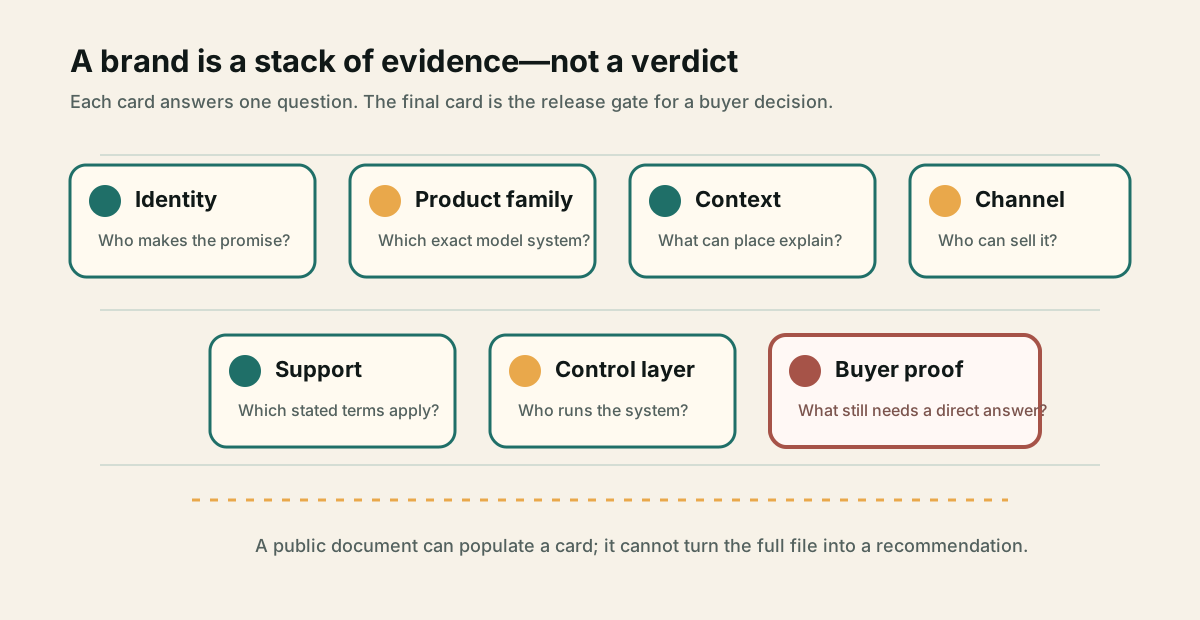
Editorial framework: public materials can fill individual cards, while transaction-specific proof remains a separate release gate.
Why “Chinese brand” is not enough information
“Chinese brand” can describe a country connection, but it says almost nothing about the commercial arrangement a buyer will rely on. It does not identify the legal seller. It does not say who made the model. It does not say where the warranty applies, which software account controls the equipment, whether a marketplace merchant is authorized, or who will provide parts after the first sale.
The same problem exists with labels that sound more precise but are still incomplete:
- “Factory direct” may mean a manufacturer, a sales arm, a trader with a stable production route, or an unverified claim.
- “OEM” can describe a manufacturing relationship but does not tell you who owns the design, tooling, firmware, warranty, or export channel for the offer in front of you.
- “Global brand” can describe visible marketing while leaving the local importer, territorial warranty, repair path, and product revision unclear.
- “Made in Shenzhen” may point to a powerful electronics ecosystem but does not prove that a given company owns the factory or controls the critical process.
- “Sold on Amazon” demonstrates a listing, not the production boundary, authorized channel, or long-term support obligation.
The goal is not to make every reader suspicious. It is to make the missing question visible early enough that a buyer can ask it before a large order, installation, distribution agreement, or service commitment turns it into a problem.
The evidence stack behind a useful hardware brand
Think of the brand as a stack rather than a badge. Each layer answers a different question.
1. The name and the entity
Start with names because they are easy to confuse. Record the brand, the legal seller on the offer, the invoice issuer, the payment beneficiary, the importer or distributor, and the company named in the warranty or privacy policy. Where relevant, capture Chinese and English names exactly as they appear in official documents.
Do not assume that one name should appear everywhere. Multi-entity arrangements are normal in international hardware. What matters is whether the roles form a coherent, disclosed chain. If the order is placed with one company, warranty is offered by another, and the product page points to a third, ask how those entities relate and which one is accountable for the commitment you are about to make.
This is the first distinction between an identity map and a verdict. Public names can create a lead. They cannot prove the counterparty behind a particular bank account, listing, or shipment.
2. The product family, not the hero model
Most hardware brands are easier to understand through a product family than through the product currently receiving attention. A robot mower may include charging equipment, positioning hardware, an app, a cellular option, batteries, cutting components, and service terms. A portable-power brand may cover power stations, expansion batteries, solar inputs, charging accessories, firmware, and home-backup products. An inverter brand may cross into gateway, monitoring, storage, installer, and grid-interface questions.
The product-family map prevents a common mistake: assuming that a positive or negative experience with one model applies to another generation, market configuration, or accessory. Ask which parts, software, accessories, and service policy are associated with the exact model—not merely the brand name.
This is why the existing site dossiers are specific. Mammotion's LUBA dossier is not a verdict on every outdoor robot. the BLUETTI/PowerOak identity map is not a recommendation for every portable-power product. the Hoymiles dossier is not a substitute for checking an exact inverter, storage, installer, and target-market configuration.
3. Manufacturing context
Manufacturing geography can be a useful explanatory layer. A town or city may concentrate a product family, components, tooling, specialist processes, markets, export services, and people who recognize a recurring engineering or packaging problem. That context can help a reader understand why a niche brand can iterate quickly or offer a broad category range.
But do not reverse the reasoning. A cluster record does not prove that a particular brand owns the factory, performs the key process, has current capacity, controls subcontractors, or makes the model being quoted. The MIIT framework is expressly about a county-level system, not a branded company. Use local context to make better questions, then verify the named company's actual route.
For a concrete hardware example, Yongkang's hardware dossier shows how product families and a professional market can form a discovery system. The right next question is still: which part of that system does this candidate actually use for this model?
4. Channel and authorized purchase route
For a buyer, a product is not just what arrives in the box. It is also the chain that lets the buyer register it, obtain parts, make a warranty claim, receive a replacement, access an installer portal, or find someone responsible when the order is wrong.
That is why channel evidence belongs in a brand file. Record the seller, authorized-distributor statement where one exists, purchase receipt requirements, marketplace listing identity, region of sale, importer, shipping route, and post-sale contact. Do not assume a product sold internationally carries the same terms everywhere.
The lesson applies to retail and B2B work. A distributor considering a line needs to know who carries stock, who is authorized to issue the commercial commitment, what service path is promised, and whether the proposed territory is covered. A sourcing buyer needs to know whether the quoted factory, exporter, and warranty holder are the same or different companies. A repair-oriented consumer needs to know whether parts and support attach to the exact purchase route.
5. Support is part of the product
This is where a hardware brand often stops looking like a catalogue item and starts looking like a system.
Mammotion's US after-sales policy is a useful example of the questions a public policy can surface. It sets territorial and official-channel conditions, asks for proof of purchase, directs some buyers to the local dealer first, sets model-specific warranty periods, and describes a service procedure. Those are the company's stated terms. They are not independent evidence that every repair will be fast, every dealer will perform well, or every product is reliable. They are evidence that the exact model, region, purchase channel, and service route matter.
BLUETTI's US warranty policy makes a similar point from another category. It says warranty periods vary by product and country, describes proof-of-purchase information, and outlines repair or replacement conditions. Read that as a policy boundary, not a service-performance score. A buyer of a power product still needs to confirm the exact product, market, seller, return route, service counterparty, and any integration or installation assumptions.
Hoymiles publishes product- and region-specific warranty terms. A 2026 all-in-one document refers to named products and designated European-market conditions. Its existence is useful because it shows why “the brand has a warranty” is an incomplete statement. The reader must match the terms to the product family, the model, the country, the channel, and where relevant the installer or exchange procedure. Publication of terms does not establish product, installer, or service performance.
The general rule is small but consequential: a warranty page is evidence of stated terms, not proof of the result you will receive.
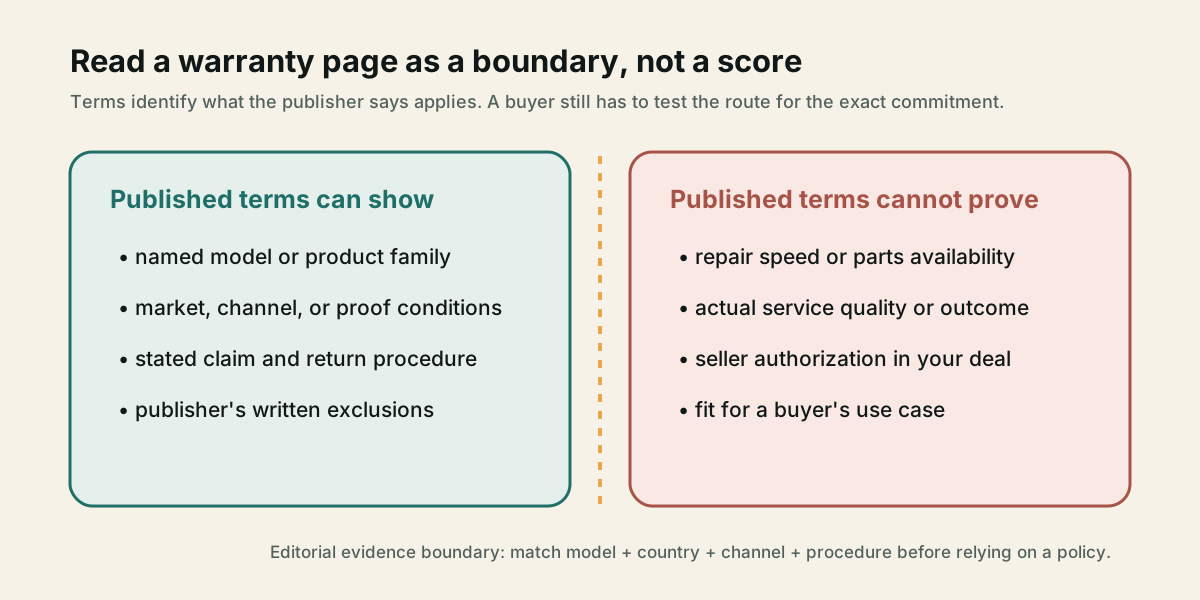
Policy boundary: company documents state conditions and procedures; they do not independently establish a buyer's eventual service outcome.
6. The control layer
The control layer is where a physical product can acquire a second operating boundary. It can include an app account, cloud service, installer portal, firmware update path, cellular plan, device registration, battery-management interface, diagnostic tool, or remote-service workflow.
Not every hardware product has a meaningful control layer. When it does, the buyer should ask who administers it, whether it is optional or required, which region it supports, what happens when ownership changes, whether updates alter functions, how service staff access it, and what information a repair or warranty claim requires.
These are not abstract privacy questions. A control layer can affect whether a robot, inverter, energy-storage system, drone, or connected device is usable, serviceable, transferable, and supportable in the intended market. The public brand page may show that an app exists. It cannot settle the exact account, data, network, feature, or support arrangement for the buyer's purchase.
7. Buyer proof
The final layer is the only one that can support a decision. For a low-cost consumer purchase, the file may be lighter: verify the seller, model, channel, return route, and policy. For distribution, installation, procurement, or an equipment fleet, it needs to be much stronger: legal entity, product revision, factory and critical-process route, approved documentation, model-specific evidence, commercial terms, service and spare-parts plan, software or data boundary, and contractual remedies.
The brand is the beginning of this file, not the end.
A source map: what each kind of evidence can tell you
| Evidence source | Useful for | Cannot establish by itself |
|---|---|---|
| official company product page | stated model family, features, accessories, and published positioning | actual factory route, product performance, or channel authorization for a specific seller |
| company warranty or support policy | stated model, region, channel, proof-of-purchase, and claims conditions | real-world repair quality, speed, availability, or legal outcome |
| legal entity, invoice, and payment details | who is offering and receiving the commercial commitment | that the exact factory and process are controlled without further evidence |
| factory or cluster context | a plausible category ecosystem and discovery route | ownership, capacity, quality, origin, or compliance of the brand's offered model |
| certification or test material | the scope and holder of a named document, when verified for the exact product and market | every product variation, shipment, or obligation outside that scope |
| app, portal, or privacy material | a visible control or support layer | the complete operational, data, and service arrangement for a buyer's account |
| distributor listing | market availability and a possible local route | authorization, warranty coverage, or a binding service commitment unless the terms confirm it |
| user forums and reviews | questions that may deserve investigation | prevalence, causation, or a company-level conclusion |
Read the gaps between the documents
The strongest public brand files do not necessarily contain the most marketing material. They make the important relationships easier to trace. A reader can move from the product page to a model document, from the model document to a warranty or support process, from the support process to a named market or channel, and from the commercial offer to the company that will actually accept responsibility.
That does not require every business to publish its supply chain. It requires the buyer's own file to be coherent enough to identify what needs a direct answer.
A coherent file has connected roles
Imagine a buyer looking at a connected power product. The brand page names one company. The reseller invoice names another. A warranty page uses a regional company. The shipping documents use a third. That arrangement can be legitimate, but the relationship cannot be left to guesswork.
Write each role down: brand owner, legal seller, payment beneficiary, factory or manufacturing manager where disclosed, exporter, importer, local distributor, warranty holder, repair partner, app or cloud operator, and service contact. Then ask the counterparty to reconcile the roles that matter to the decision.
If the answer is clear, the chain becomes easier to manage. If it is unclear, the buyer has learned something material before committing money or reputation. The right response is not to speculate about hidden ownership. It is to ask for the documents and contractual statements that identify who is doing what.
A coherent file has one product boundary
Hardware brands often update models faster than public summaries do. A product can have a similar name but different battery, processor, radio, driver, firmware, power rating, charger, accessory pack, region setting, warranty term, or certification scope. The risk grows when a seller uses a familiar product-family page to support an offer for a different or older variant.
Treat the exact model designation and version as the spine of the file. Attach the quotation, product description, drawings or photos where appropriate, packing, manual, label, market configuration, critical accessories, firmware or app version where relevant, and service terms to that spine. When a substitution is proposed, record it as a change—not as a harmless detail.
This is especially useful for systems with bought-in components. A portable battery product, robot, inverter, drone, or controller may have a visible brand identity while its real operation depends on cells, motors, electronics, radios, software, chargers, or installers. The evidence file should show which components and interfaces are actually part of the offer, and which claims still need confirmation.
A coherent file has a real service handoff
A warranty headline is not a service path. The reader should be able to answer five basic questions: who receives the first request; what proof is needed; where the product goes; who decides whether the claim is covered; and what repair, replacement, refund, or spare-parts outcome is actually promised.
Those answers may differ by country and channel. A local dealer may be the first contact. A manufacturer may require registration or a serial number. A distributor may arrange the return. A service center may be in another country. A connected product may require a software update or remote diagnosis before physical repair begins. None of these arrangements is unusual. The uncertainty comes from assuming the route before it is documented.
A weak file relies on borrowed signals
Be cautious when a seller's evidence consists mainly of borrowed signals: a town name without a factory route; a brand photo without a legal seller; a certificate image without a holder and model; a warranty headline without territory; an app screenshot without account terms; a marketplace badge without channel confirmation; or a factory video that cannot be linked to the offered product.
Borrowed signals are not proof of deception. They are evidence that the file is incomplete. The buyer's next move is to request the missing connection in a proportionate way. A small consumer purchase may justify a simpler check. An installation, distribution agreement, high-value order, or product with safety, energy, or data exposure justifies a much stronger one.
When a brand should become its own dossier
Not every name deserves a long investigation. Create or update a company dossier when the brand repeatedly appears in a high-intent search, a supplier quote, a repair question, a distributor comparison, a safety or support dispute, or a product category where service and control layers materially affect the outcome.
The trigger is not fame. It is reader consequence. A low-cost accessory may only require seller and return checks. A connected robot, inverter, power station, battery controller, drone, or industrial tool may need a fuller record because model identity, service geography, software, spare parts, or installation assumptions can change the economic result.
That is the editorial lane this hub creates: category → brand → product family → manufacturing context → buyer proof. It lets future stories explain a company without making the company sound like a recommendation.
The category map: eight routes into deeper evidence
The point of this hub is not to put unrelated companies into a single “Chinese brands to watch” list. It is to route a reader to the category where the relevant evidence lives.
| Dossier direction | What it helps investigate | The boundary to retain |
|---|---|---|
| Mammotion LUBA | outdoor robotics, identity, app, product system, support | a robot-mower file does not answer every connected-hardware question |
| BLUETTI / PowerOak | portable power, identity, product families, channel and warranty questions | a brand map is not a battery, installation, or service verdict |
| Hoymiles | microinverters, installer and warranty boundaries, energy-hardware company context | exact model, region, grid, installer, and storage configuration still matter |
| Deye inverter buyer risk | channel, product, and grey-market diligence questions | a buyer-risk file does not decide every distributor or installation case |
| JBD, JK, and Daly BMS | battery-control electronics, model-family and support logic | a component-brand comparison does not validate a complete battery system |
| EVE LF280K evidence file | authenticity, channel, and documentation boundaries | a cell label or code alone does not prove grade, route, or performance |
| DJI's drone ecosystem | category dominance, control layers, market and channel context | visibility does not resolve an individual buyer's regulatory or service case |
| Yongkang hardware | factory-town context behind a category system | a place does not qualify a brand or factory |
| County factory towns | a repeatable method for using location as discovery evidence | regional density does not replace supplier proof |
| China's industrial clusters | the broader system behind product-family concentration | national context is not a company rating |
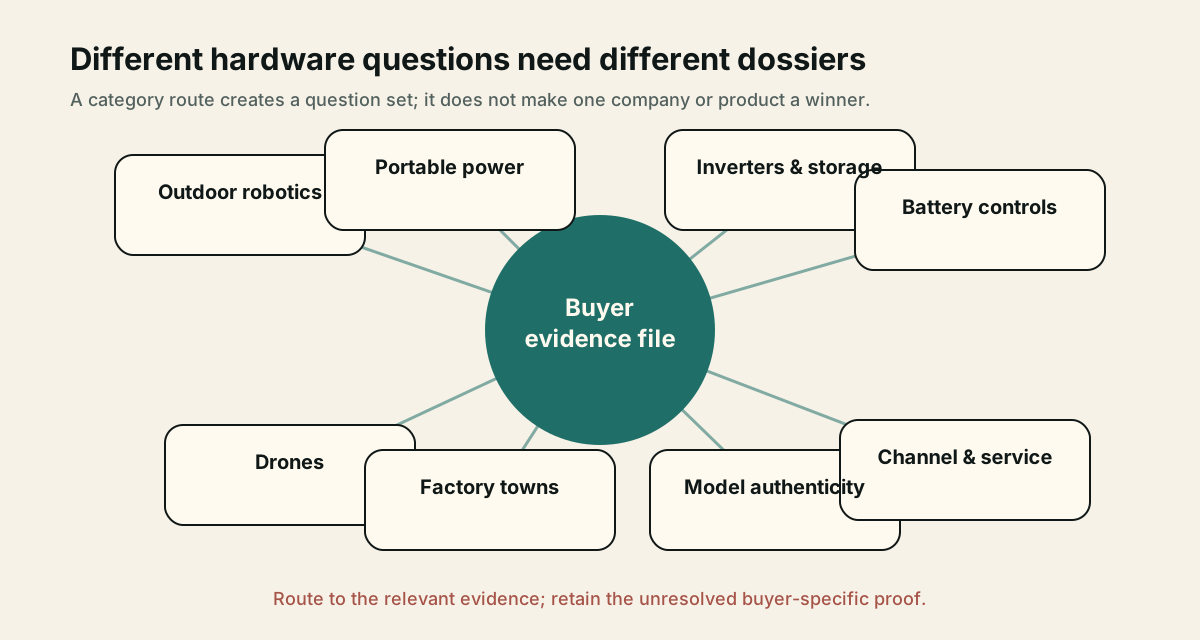
Editorial map: these routes organize different questions; they do not compare or rank the companies, places, or products behind them.
Build the buyer file before the commitment gets expensive
The appropriate depth depends on what is at risk. The following sequence can scale from a consumer purchase to distribution or sourcing work.
Before a first purchase or sample
- Record the exact model, product revision where visible, target market, and the seller's full identity.
- Save the published product, warranty, returns, and support links that apply to the market you are using.
- Ask whether the seller is the brand, an authorized distributor, or another intermediary; record the evidence for the answer.
- Identify any app, registration, firmware, subscription, installer, or account dependency before you assume the product is standalone.
- Confirm the return route, proof-of-purchase requirement, and first support contact.
Before a distribution, installation, or larger order
- Map the legal seller, invoice entity, payee, importer, exporter where relevant, warranty holder, and service counterparty.
- Freeze the model, market configuration, accessory pack, documentation, and any required software or account boundary.
- Request a clear description of the proposed production or supply route for the exact product, including critical components and any subcontracted operations that affect the commitment.
- Separate company policy from contract: identify what is merely published online and what the counterparty will actually agree to provide.
- Confirm the plan for spare parts, repair, replacement, updates, returns, warranty escalation, and end-of-life support.
Before final payment or launch
- Tie product serial, lot, revision, inspection, packaging, instructions, labels, and shipping documents to the agreed order.
- Recheck that the service, warranty, channel, and support terms still apply to the final product and destination.
- Confirm who will receive and resolve an issue after delivery, and what proof or timing the process requires.
- Put changes, exceptions, remedies, and responsibilities into the commercial file rather than relying on a brand page or sales promise.
This is not paperwork for its own sake. It is how a buyer prevents one visible layer—a logo, a product photo, an attractive price, a famous town, or a warranty headline—from standing in for the other layers that determine the outcome.
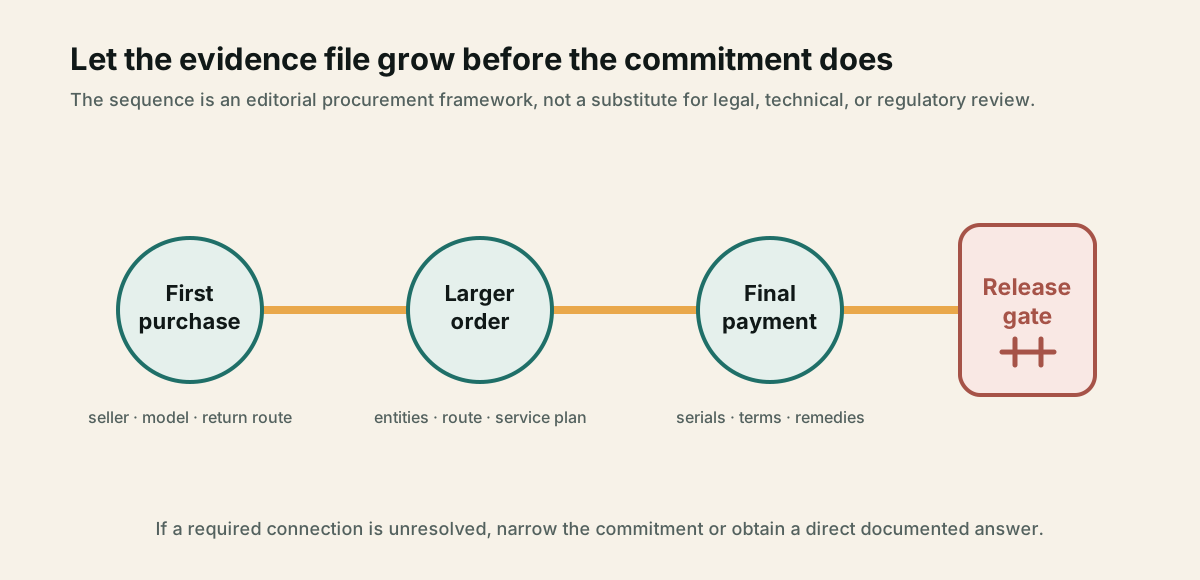
Editorial procurement sequence: increase the evidence before the financial or operational commitment becomes hard to reverse.
What public research will still not tell you
Even a strong brand dossier has limits.
It may not reveal the factory behind the exact seller you contacted. It may not show the actual component substitutions in the model you are offered. It may not tell you whether a distributor is currently authorized, whether a repair center has capacity, whether a firmware feature works in your country, whether a certification applies to a product variant, or whether the seller will honor the promise after payment.
Those are not failures of research. They are signals to narrow the next question. Ask the party seeking your money or signature to connect the claim to the actual entity, product, document, market, and remedy. If that connection cannot be made, treat the uncertainty as unresolved rather than filling it with a brand narrative.
The most useful hidden champions are therefore not necessarily the least known brands. They are the brands whose evidence can be made coherent: who they are, what they sell, where the product system sits, how the reader can buy and service it, what depends on a control layer, and which company will still be accountable when the transaction becomes real.
Method and limitations
This desk-research hub was prepared by China Made & Tech Team from published site dossiers, the MIIT cluster framework, and official company-owned support or warranty materials reviewed through August 22, 2026. No product was purchased or repaired; no factory was visited or audited; no company registry, customs route, certification file, service case, security review, or transaction was independently verified.
Company policy pages establish the terms their publishers state for named products, channels, regions, and procedures. They do not demonstrate actual service performance, product quality, reliability, legal compliance, factory ownership, or suitability for a particular buyer. The linked dossiers are research routes, not recommendations or rankings. Recheck the exact company, model, market, channel, documents, and commercial terms before relying on a purchase, installation, distribution, or sourcing decision.