
BLUETTI is not an anonymous Amazon battery label. The company behind the brand is Shenzhen Delan Minghai New Energy Co., Ltd., Chinese name 深圳市德兰明海新能源股份有限公司, the Shenzhen user-side energy storage company that also appears in English filing trails as SHENZHEN POWEROAK NEWENER CO., LTD.
That is the short answer to "who makes BLUETTI." The more useful answer is that BLUETTI is the global consumer and energy-storage brand built by PowerOak/Delan Minghai around portable power stations, expansion batteries, home backup systems, C&I storage, solar accessories, and overseas service channels. It is a Shenzhen clean-energy hardware story, not just another camping battery review.
The distinction matters because portable power stations now sit between consumer electronics and distributed energy infrastructure. A buyer is not only choosing watt-hours and outlet count. They are trusting a battery pack, inverter, BMS, firmware, warranty promise, service center, sales channel, and sometimes a home backup installation. That is why the right question is not "Is BLUETTI Chinese?" It is: which Chinese company, which product family, which channel, and which support boundary?
Source File
This dossier was reviewed on 2026-06-30 against PowerOak's official Chinese corporate site, the FCC record for FCC ID 2AYT3-AC50B and its service-of-process letter, the 2026 HKEX draft listing document, and BLUETTI's official service / warranty policy. The HKEX document is treated as a draft application proof, not as a final listed-company prospectus. Marketplace listings, reseller pages, and user reviews are treated only as buyer-signal context, not as primary evidence for legal identity, founder history, or manufacturing footprint.
Quick Answer
| Question | Best current answer |
|---|---|
| Who makes BLUETTI? | BLUETTI is a brand of Shenzhen Delan Minghai New Energy Co., Ltd. / 深圳市德兰明海新能源股份有限公司, also connected to the English name SHENZHEN POWEROAK NEWENER CO., LTD in FCC filing records. |
| What is PowerOak? | PowerOak is the English-facing corporate name and official domain identity tied to Delan Minghai. The company's Chinese site at poweroak.net identifies Delan Minghai as the group behind BLUETTI. |
| Is BLUETTI a Chinese company? | Yes. The operating company and core R&D/manufacturing story are Chinese and Shenzhen-centered, though the brand sells globally through subsidiaries, DTC websites, marketplaces, dealers, and service partners. |
| Who founded it? | The 2026 HKEX draft listing document says the company's predecessor was established in 2013 by founder Mr. Yin; the same document identifies Mr. Yin Xiangzhu / 尹相柱 as chairman, executive director, and general manager. |
| Are all BLUETTI products made in one factory? | No public source supports that claim. The draft listing document says production was primarily carried out in China during the track-record period, and selected portable energy storage products were produced through a specialized third-party partner factory in Indonesia from March 2025, mainly for the U.S. market. |
| What should buyers verify? | Exact product line, warranty period by model and channel, battery chemistry, inverter/BMS/EMS responsibility, installer obligations, local service route, replacement policy, and whether the seller is official, authorized, or simply a marketplace reseller. |
The Identity Map: BLUETTI, PowerOak, and Delan Minghai
The cleanest identity chain starts with the Chinese company.
The official PowerOak Chinese site describes 深圳市德兰明海新能源股份有限公司 as the successor to 深圳市德兰明海科技有限公司 and says the company was established in 2013 as a supplier and innovator focused on small and medium-sized user-side energy storage solutions. The same page lists BLUETTI / 铂陆帝 as a brand under the company and lays out a BLUETTI product matrix covering Elite, Apex, Pioneer, Premium, EnergyPro, Ecosystem, and ES series.
That matters because it gives the English searcher the missing Chinese name. In English results, a reader sees BLUETTI, PowerOak, Bluetti Power, BLUETTI POWEROAK INC, POWEROAK GmbH, and marketplace seller names. In Chinese-source company context, the protagonist is Delan Minghai.
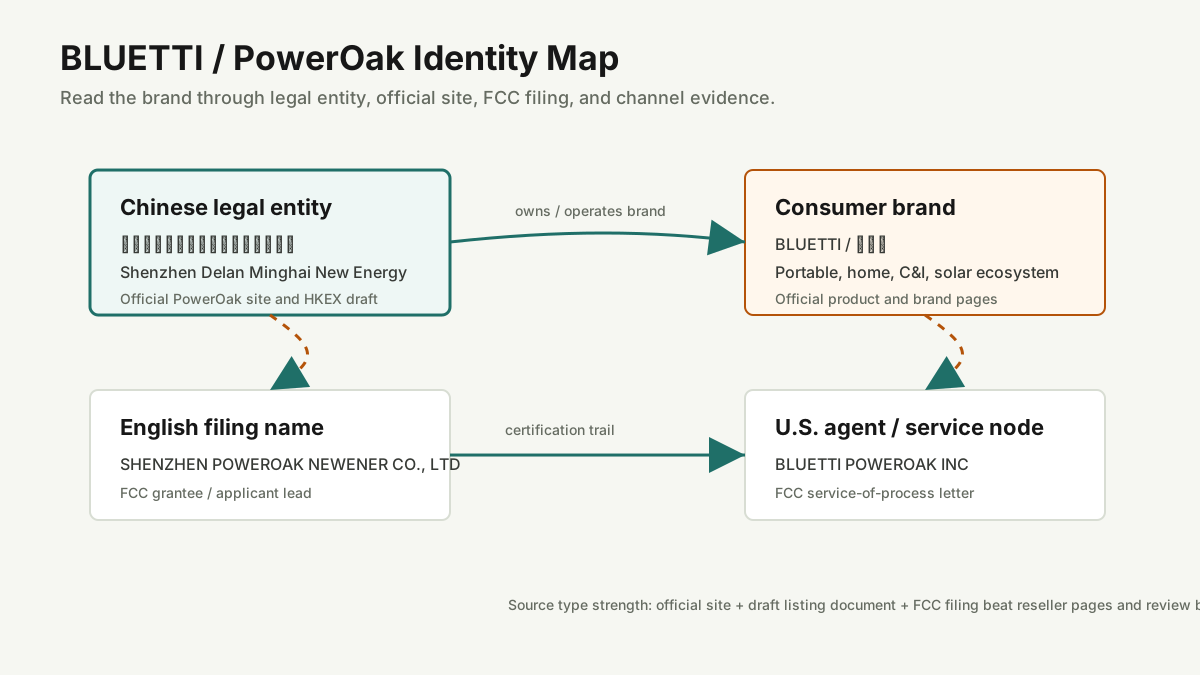 Source map: China Made & Tech synthesis of PowerOak official pages, FCC filing records, and HKEX draft listing materials reviewed on 2026-06-05.
The U.S. certification trail points in the same direction. The FCC record for FCC ID 2AYT3-AC50B lists the equipment as a portable power station and identifies the applicant business as SHENZHEN POWEROAK NEWENER CO., LTD at F19, Building No. 1, Kaidaer, Tongsha Road No. 168, Xili Street, Nanshan, Shenzhen. The service-of-process letter names SHENZHEN POWEROAK NEWENER CO., LTD as the applicant and BLUETTI POWEROAK INC in Las Vegas as the U.S. designated agent.
This is useful evidence because it is not marketing copy. FCC paperwork is not a full corporate history, but it does connect a portable power station product to the PowerOak English filing name and a BLUETTI PowerOak U.S. entity. Combined with the official Chinese site, it supports the identity map: Delan Minghai is the Chinese company, PowerOak is the English corporate identity used in filings and domains, and BLUETTI is the global brand.
The 2026 HKEX draft listing document adds a second layer. It says the company's history can be traced back to 2013 with the establishment of its predecessor company by founder Mr. Yin. In the history section, that predecessor is named SHENZHEN POWEROAK NEWENER CO., LTD with the Chinese name 深圳市德兰明海科技有限公司. In the management section, the document identifies Mr. Yin Xiangzhu / 尹相柱 as chairman, executive director, general manager, and the person responsible for strategic vision.
Because that document is in draft form, it should be treated as a strong but still date-specific source. It is better than a reseller biography, but readers should still check for a final listed-company document if they are doing investment-grade diligence after publication.
Why the Shenzhen Context Matters
BLUETTI's product category looks like camping gear from the outside. From the inside, it is Shenzhen power electronics.
A portable power station combines battery cells, pack design, a BMS, power conversion, thermal control, firmware, AC/DC output, charging inputs, enclosure design, certifications, logistics, and after-sales service. That is exactly the kind of product Shenzhen and the Pearl River Delta are good at: not one invention in isolation, but the coordination of battery, electronics, tooling, testing, software, packaging, and export channels.
This is the same structural advantage described in How China Manufactures: Inside the World's Factory (2026) and Shenzhen Manufacturing: Complete Ecosystem Guide (2026). Shenzhen hardware companies do not win only because labor is cheap. They win because component suppliers, PCB vendors, industrial designers, mold shops, testing labs, export teams, and ecommerce operators sit close enough to compress iteration cycles. For a product that must balance consumer design with electrical safety, that density is more important than the old "world's factory" stereotype.
PowerOak's own technology page frames the company around "3S" technologies: BMS, PCS, and EMS. In plain English, that means the company wants to be understood not merely as a box assembler, but as a system designer. The battery management system protects the pack. The power conversion system turns stored DC power into usable AC/DC output and manages charging. The energy management system coordinates how the device uses solar, grid power, home loads, pricing, backup events, and remote controls.
Those claims should be read as company claims, not independent lab findings. Still, they explain why BLUETTI belongs in the broader China Battery Storage Boom: Grid-Scale BESS Explained story. China's storage edge is moving from cheap cells to integrated systems: batteries plus inverters, thermal design, controls, software, service, and financing evidence. BLUETTI operates on the smaller "user-side" end of that spectrum, but the logic is similar.
The Product Family Is Bigger Than Camping Batteries
English reviews usually focus on one unit: AC180, AC200MAX, AC300, AC500, EB3A, EP500, or another portable station. That is useful for buyers comparing runtime. It misses the company map.
The BLUETTI / PowerOak story is a product family map:
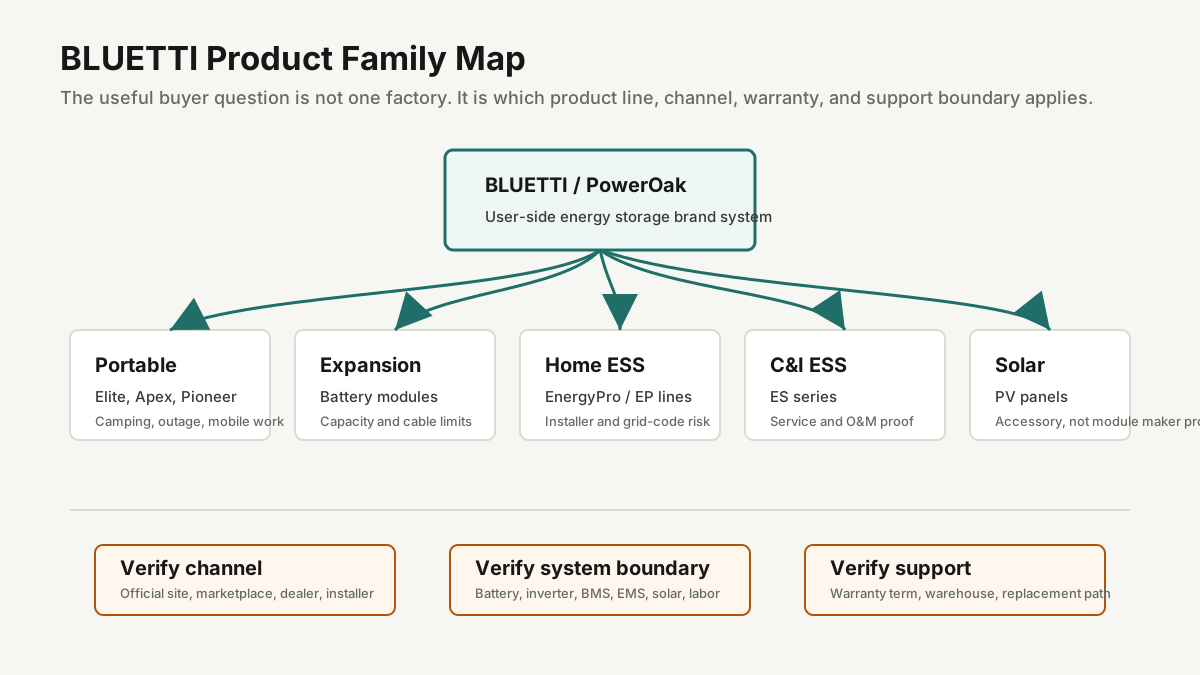 Product map: China Made & Tech synthesis of PowerOak and BLUETTI product-family pages reviewed on 2026-06-05.
| Product family | What it represents | Evidence to check before buying |
|---|---|---|
| Portable power stations | AC/EB/Elite/Apex/Pioneer-style products for camping, mobile work, emergency backup, and appliance runtime | Battery chemistry, AC output, surge rating, recharge input, warranty term, local stock, and return path |
| Expansion batteries | Modular battery packs that extend runtime for compatible stations | Exact compatibility, cable limits, whether the warranty follows the station or the battery, and replacement logistics |
| Home backup / residential ESS | EP/EnergyPro-style systems positioned for household backup and solar storage | Installer requirements, electrical permit obligations, grid-code compatibility, service phone path, and battery/inverter responsibility |
| C&I energy storage | ES-style systems for small commercial or industrial users | O&M coverage, site commissioning, thermal and fire evidence, remote monitoring, and local service commitments |
| Solar panels and peripherals | Folding solar panels, flexible panels, accessories, and ecosystem devices | Whether BLUETTI is the seller, manufacturer, or bundler; MC4 compatibility; warranty by component |
| Software and service layer | App, EMS, remote monitoring, warranty, service centers, and agent entities | Data access, firmware update policy, service-center coverage, and channel-specific exclusions |
The draft listing document says BLUETTI's major categories include portable energy storage products, household energy storage products, and a growing ecosystem of smart peripherals and accessories. It also says the company shipped more than 3.5 million units worldwide since the BLUETTI brand launch as of December 31, 2025, and that BLUETTI had 847 patents. Official pages repeat similar global claims: 120-plus countries and regions, 30 subsidiaries, 22 global service stations, 3.5 million-plus users, and 847 patents.
Those numbers are useful scale signals, but they are not buyer proof by themselves. A buyer still needs model-level evidence: the exact battery chemistry, exact inverter rating, exact service route, exact warranty period, and exact seller identity.
Manufacturer, Brand Owner, or System Integrator?
The most accurate answer is that BLUETTI is all three in different layers.
It is a brand owner because BLUETTI is the customer-facing brand used on official websites, retail channels, crowdfunding campaigns, product packaging, support pages, and overseas subsidiaries. That is the layer most English buyers see.
It is a system integrator because the product value is not the cell alone. A portable station or home backup system combines cells, pack design, BMS, inverter, charging architecture, EMS software, enclosure, thermal design, certifications, app behavior, accessories, and service workflow. PowerOak's own 3S language points directly to this layer.
It is also a manufacturer in the business sense that public company materials describe operational execution, production capability, and a portfolio of energy-storage products rather than a pure trading-company model. But that does not mean every component is made in-house or every model is assembled in one owned factory. The correct buyer reading is "brand owner and energy-system company with manufacturing capability and partner production," not "anonymous reseller" and not "fully vertically integrated cell-to-outlet factory."
That distinction helps avoid a common sourcing mistake. In Chinese hardware, a serious own-brand company can still buy cells, panels, connectors, fans, semiconductors, structural parts, and some assemblies from outside suppliers. What matters is who owns the product specification, who controls the system design, who signs the warranty, and who has the service obligation when something fails.
What the Company Evidence Supports
The evidence supports four strong conclusions.
First, BLUETTI is a brand operated by a real Shenzhen energy-storage company, not a private-label storefront with no visible manufacturer. PowerOak's Chinese official site, FCC applicant records, and HKEX draft listing materials all point to the same Shenzhen company family.
Second, the company sits in user-side energy storage. That term matters. It means small and medium-sized users: households, outdoor users, mobile workers, small commercial operators, and businesses that need backup or distributed power. The draft listing document describes user-side storage as a market driven by volatile energy prices, distributed-storage demand, backup power, and the need to switch off-grid during outages or congestion.
Third, BLUETTI is not only a hardware label. The company's story is brand plus product matrix plus channels. Its own pages emphasize DTC official websites, ecommerce marketplaces, distributors, retail chains, crowdfunding for early product iterations, and service stations. That is a classic Chinese own-brand manufacturing pattern: technical base in China, global consumer brand, overseas subsidiaries, marketplace distribution, and localized service promises.
Fourth, the manufacturing footprint should be stated carefully. The draft listing document says production was primarily carried out in China during the track-record period, and that since March 2025 the company collaborated with a specialized third-party partner factory in Indonesia to produce selected portable energy storage products, primarily for the U.S. market. That makes it wrong to say "all BLUETTI products are made in one Shenzhen factory." The better statement is: BLUETTI is controlled and developed by a Shenzhen-headquartered Chinese company, while model-level production location can vary and must be verified.
That last sentence is the kind of nuance English reviews often miss. The country behind the brand and the factory behind a specific serial number are related questions, but they are not the same question.
What English Reviews Usually Miss
Most BLUETTI reviews are useful on runtime, noise, ports, charging speed, and whether a fridge keeps running. They are weaker on company identity and system risk.
The first missing layer is battery chemistry. Many modern BLUETTI products use LiFePO4, but the buyer should still verify chemistry by exact model and region. LiFePO4 is attractive for portable and stationary storage because it usually trades lower energy density for better cycle life and thermal stability. But chemistry alone does not prove pack quality. Cell supplier, pack design, BMS settings, thermal layout, charge limits, and warranty behavior matter. For the broader trust problem around Chinese LFP cells and QR-code claims, see EVE LF280K Grade A Cells: QR Codes, Genuine Claims, and Buyer Verification.
The second missing layer is the BMS and inverter boundary. A power station is not just a battery. It is a battery pack plus inverter plus charger plus control electronics. If a station fails to charge, trips under load, refuses solar input, misreports state of charge, or needs a firmware change, the failure may sit in the cells, BMS, PCS, EMS, cable, app, or user configuration. The same logic appears in DIY systems comparing JBD, JK, and Daly BMS units: the brand name is less useful than the exact board, firmware, wiring, and support path. That is why JBD vs JK vs Daly BMS: LiFePO4 Buyer Comparison is relevant even though BLUETTI buyers are not building the pack themselves.
The third missing layer is service geography. BLUETTI's about page claims 22 global service stations, and its warranty page says warranty claims may be repaired by BLUETTI service center or swapped for a replacement product with equivalent specifications. The same warranty page notes that a refurbished model of equal value may be provided in a replacement case and that the swap product assumes the remaining original warranty or thirty days from replacement, whichever is greater. That is the language buyers should read before purchase, not after a failure.
The fourth missing layer is channel. BLUETTI sells through official websites, marketplaces, and offline distributors. A unit bought from the official U.S. site, a regional BLUETTI site, Amazon, Home Depot, an installer, a dealer, or a clearance reseller may not have the same return workflow. If the product is heavy, shipping cost and warehouse location matter. If the product is installed, the installer and local electrical rules matter. If the product is sold as part of a bundle, each component may have a different warranty period.
The fifth missing layer is component origin. A BLUETTI station may be made by the PowerOak/Delan Minghai group, but that does not tell you the supplier of every cell, MOSFET, fan, relay, solar panel, connector, or enclosure part. Serious buyers should resist both lazy extremes: "Chinese brand, therefore risky" and "famous brand, therefore every component is verified." The real work is model-level diligence.
Buyer Checklist: Portable Power Station
For a portable BLUETTI buyer, the checklist should be specific enough to expose weak assumptions:
| Check | What to ask | Why it matters |
|---|---|---|
| Model identity | Exact model, region, revision, battery chemistry, capacity, AC output, surge rating, and solar input | Similar names can hide different specs or generations |
| Seller identity | Official site, marketplace sold-by line, authorized dealer, installer, or third-party reseller | Warranty and return path often follow the channel |
| Battery chemistry | LiFePO4 or another chemistry by exact model | Cycle life, weight, safety profile, and storage behavior differ |
| AC output and surge | Continuous watts, peak watts, UPS behavior, and load-start limits | Compressors, pumps, heaters, and power tools behave differently from phone chargers |
| Solar input | Maximum voltage, amperage, connector type, and panel compatibility | Wrong panel voltage can damage equipment or underperform badly |
| Warranty term | Written warranty period, exclusion list, proof-of-purchase requirement, and transferability | Marketing claims are weaker than policy language |
| Service route | Local warehouse, repair center, replacement timing, refurbished replacement policy, and shipping responsibility | Heavy battery products are expensive to move |
| Firmware/app | Whether updates are required, how app data is handled, and what happens if the app is discontinued | Energy hardware now includes software lifecycle risk |
Buyer Checklist: Home Backup and Solar Storage
Home backup is a different category from a portable station plugged into a fridge.
A home system touches household wiring, permits, transfer equipment, solar integration, utility rules, fire spacing, installer competence, and long-term warranty service. That means the buyer should ask a different set of questions:
| Check | What to verify |
|---|---|
| System boundary | Which company is responsible for battery, inverter, gateway, transfer equipment, panel work, solar input, and commissioning? |
| Installer role | Is the installer authorized, trained, insured, and responsible for permit compliance? |
| Grid interaction | Is the system off-grid only, backup-only, grid-tied, or solar-plus-storage? |
| Service ownership | Does BLUETTI service the system directly, through an authorized partner, or through the installer? |
| Warranty by component | Battery, inverter, gateway, accessories, labor, and shipping may carry different terms. |
| Spare parts | Which parts are stocked locally, and which must be shipped from another region? |
| Remote access | Who can access system data, push firmware, and change settings? |
| End-of-life plan | What happens when the battery reaches warranty end, and who handles recycling or replacement? |
This is where the Shenzhen story becomes practical. Chinese companies are excellent at compressing hardware cost and adding features quickly. The global support layer is harder. For a small portable station, a replacement swap may be enough. For a home battery, the buyer needs installation accountability and service continuity.
What We Can Say About the Founder
Founder information is often messy in English searches because regional pages, reseller biographies, and rewritten brand stories mix names without source hierarchy.
The strongest source found for this article is the HKEX draft listing document. It says the company's history traces back to 2013 with the establishment of its predecessor by founder Mr. Yin, and it identifies Mr. Yin Xiangzhu / 尹相柱 as chairman, executive director, and general manager. That is enough to state that Mr. Yin is the founder figure in the public company-history record.
What it does not give is a rich founder biography that should be treated as fully verified for readers. Some English regional pages mention other names in the BLUETTI brand story, but at least one such page also describes itself as an independent comparison and recommendation platform rather than the primary company site. I would not use that as the basis for an authoritative founder paragraph.
The careful version is this: public primary and quasi-primary evidence points to Mr. Yin Xiangzhu as founder of the predecessor company and current chair/general manager. The broader founding team, overseas brand-launch roles, and any California brand-story details need stronger primary confirmation before being presented as settled history.
What Remains Uncertain
The evidence is strong enough to answer the identity question. It is not strong enough to answer every manufacturing question.
The first uncertainty is model-level factory location. We can say BLUETTI is a brand of a Shenzhen-headquartered Chinese company. We can say the draft listing document describes production as primarily in China during the track-record period and selected portable energy storage output through an Indonesian third-party partner factory from March 2025. We should not claim that every AC, EB, EP, Elite, Apex, Pioneer, EnergyPro, or ES product is made in the same plant.
The second uncertainty is model-level cell supplier. BLUETTI may disclose chemistry and product specifications, but public product pages do not always identify the cell maker by model, batch, and region. Buyers who care about cell provenance should ask directly and record the answer in writing.
The third uncertainty is service-center performance. "22 global service stations" is a scale claim. The buyer-relevant question is whether the service station covering your product has parts, authority, turnaround capacity, and a clear replacement policy. Reviews and forum posts can help identify pain points, but they are user-signal evidence, not statistical proof.
The fourth uncertainty is channel-specific warranty enforcement. BLUETTI's official warranty policy is the starting point. Marketplace sellers, regional sites, dealers, installers, and clearance channels may add or remove practical friction. For heavy energy products, the practical warranty is often shaped by shipping, local warehouse stock, and whether the seller still exists when a claim happens.
The fifth uncertainty is software lifecycle. Portable energy products increasingly depend on apps, cloud services, firmware updates, and remote diagnostics. Public pages rarely give the long-term software support horizon that a home-storage buyer would want.
The Real Takeaway
BLUETTI is best understood as a Shenzhen own-brand energy-storage company that escaped the camping-battery niche and moved into a broader user-side storage portfolio.
The protagonist is PowerOak/Delan Minghai: a Chinese company with official Chinese identity, English filing trail, global brand, overseas service entities, and a product matrix that spans portable, home, C&I, and solar-adjacent equipment. That makes BLUETTI part of the same manufacturing evolution that turned many Chinese hardware suppliers into global brands: start with technical execution, build a differentiated product family, push through crowdfunding and ecommerce, add overseas subsidiaries and service, then try to move from product seller to energy-system platform.
For readers, the answer should be neither suspicion nor blind trust. The useful posture is evidence-based buying.
If you are buying a portable station for camping, verify model, chemistry, warranty, return path, and seller identity. If you are buying home backup, verify installer responsibility, grid compatibility, service route, spare parts, and remote access. If you are evaluating BLUETTI as a company, follow the Chinese legal name, PowerOak filing name, FCC entity records, and draft listing materials rather than relying on review-site biographies.
That is the story English search results usually flatten. BLUETTI is not just a product review keyword. It is a window into how Shenzhen clean-energy hardware companies are turning batteries, inverters, BMS, software, ecommerce, and overseas service into global consumer infrastructure.
Claim Confidence File
| Claim | Confidence | Evidence boundary |
|---|---|---|
| BLUETTI is tied to Shenzhen Delan Minghai / PowerOak entities | High | PowerOak's corporate site, FCC records, and the HKEX draft listing document support the identity map. |
| The HKEX document proves a final listed-company prospectus | Low | The article treats it as a draft listing document / application trail, not a completed listing or final prospectus. |
| FCC records connect PowerOak / BLUETTI entities to portable power station equipment | High | FCC records are strong for equipment authorization identity and service-of-process context, not for full manufacturing footprint or product quality. |
| Mr. Yin Xiangzhu is the founder figure supported by primary / quasi-primary materials | Medium-high | The HKEX draft document supports the founder figure. The article avoids unsupported English reseller biographies. |
| BLUETTI manufactures every cell and component in-house | Low | The article does not claim this. It supports an integrated brand / system-company story and tells buyers to verify cell supplier, factory, and model-level BOM where relevant. |
| BLUETTI warranty performance is proven by policy language alone | Low | Warranty policy is the starting document. Actual support depends on region, channel, product, warehouse, service authority, and shipping logistics. |
Frequently Asked Questions
Is BLUETTI Chinese?
Yes. BLUETTI is tied to Shenzhen Delan Minghai New Energy Co., Ltd. / 深圳市德兰明海新能源股份有限公司, a Shenzhen-based Chinese user-side energy storage company. The English filing trail also uses SHENZHEN POWEROAK NEWENER CO., LTD for portable power station certification records.
Is PowerOak the same as BLUETTI?
PowerOak is best understood as the corporate/entity identity behind the BLUETTI brand, while BLUETTI is the global consumer and energy-storage brand. FCC records connect SHENZHEN POWEROAK NEWENER CO., LTD to portable power station equipment and designate BLUETTI POWEROAK INC as a U.S. agent.
Does BLUETTI make its own batteries?
BLUETTI is more than a reseller, but "make its own batteries" needs precision. Public evidence supports that PowerOak/Delan Minghai develops and sells integrated energy-storage systems with in-house R&D around BMS, PCS, and EMS. It does not prove that every cell or component in every model is manufactured in-house, so buyers should verify cell supplier and factory location by exact model if that matters.
Are BLUETTI power stations reliable?
Reliability depends on the exact model, chemistry, use case, firmware, seller channel, and service route. BLUETTI has global scale and official warranty infrastructure, but buyers should still verify warranty terms, replacement logistics, local service coverage, and whether the product is suitable for the intended load.
What should I check before buying a BLUETTI home backup system?
Check the system boundary first: battery, inverter, gateway, solar input, transfer equipment, permits, installer obligations, and service ownership. A home backup system is not the same as a portable unit; the warranty and support path should be clear before installation.
Methodology
This article uses PowerOak's official Chinese site, BLUETTI's official about and warranty pages, FCC records for FCC ID 2AYT3-AC50B, and the 2026 HKEX draft listing document for Shenzhen Delan Minghai / PowerOak. Company claims are treated as company claims unless supported by filing or certification records. Regional reseller and marketplace pages were used only as user-signal leads and not as primary evidence for legal identity or founder history.