
A 16-cell LiFePO4 battery built from EVE, CATL, REPT, or other large-format Chinese cells can easily carry several thousand dollars of stored energy. The BMS that decides when that pack charges, discharges, balances, reports SOC, and talks to an inverter often costs less than one good cell.
That mismatch is why "JBD vs JK vs Daly" is such a persistent DIY battery search. The question is not which Chinese BMS brand has the cleanest brochure. The question is which board, app, communication option, seller path, and support burden fit the pack you are actually building.
Source File
This article was reviewed on 2026-06-30 against official and near-official materials from Jiabaida/JBD, JBD's UP16S019 product listing, JK/Jikong, JK's active-balancer BMS page, Daly's official site, Daly manual pages, and Daly ESS BMS manual material. Installer context was checked against Overkill Solar's JBD support page, SolarAssistant's JK inverter-BMS guide, and Victron's battery compatibility page. Forum signals are used to identify common buyer problems, not to estimate defect rates.
Quick Answer
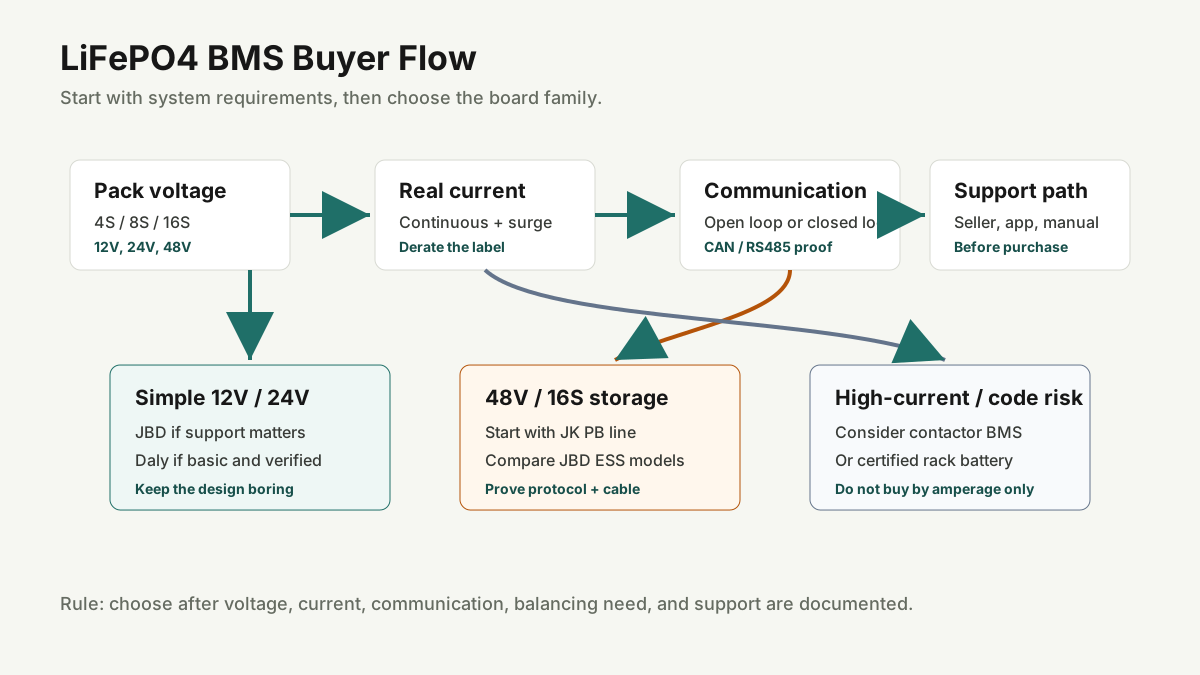
For a simple 12V or 24V LiFePO4 battery, JBD is usually the conservative choice if you buy through a reseller that tests, preconfigures, and supports the board. Daly can be acceptable for basic low-cost protection when the exact model, temperature cutoff, Bluetooth module, and current derating are clear. For a 48V 16S home-storage pack, JK has the strongest current buyer story because its newer inverter-BMS line puts active balancing, CAN/RS485, parallel-pack support, and Pylontech-style inverter protocols into one product family.
That is not the same as saying JK is always "best." A BMS is a system component, not a popularity contest. A well-supported JBD in a 12V van battery may be less risky than an overfeatured JK bought from a random marketplace listing. A Daly board used inside its real current and temperature envelope may do exactly what a basic pack needs. A JK inverter BMS can still become a wiring, firmware, or protocol problem if the buyer assumes "CAN" means certified compatibility with Victron, Growatt, Deye, EG4, or any other inverter.
The buyer map is:
| Use case | Best direction | Why |
|---|---|---|
| 12V drop-in or mobile battery | JBD through a support-heavy reseller, or Daly if budget and simplicity matter most | Lower voltage, fewer communication needs, support quality matters more than active balancing current |
| 24V workshop, marine, RV, or small off-grid pack | JBD for conservative smart-BMS builds; JK if the pack has badly matched cells or needs active balancing | Both can work; the decision turns on balancing needs and app/support tolerance |
| 48V / 16S DIY home-storage pack | JK PB inverter BMS or a verified JBD ESS/inverter model | 16S packs expose communication, balancing, and parallel-pack issues faster |
| High-current 200A-300A pack | JK, JBD relay/contactor models, or a higher-grade BMS beyond all three | Do not treat MOSFET board current ratings as "run this forever at the label" |
| Inverter-integrated pack | JK PB line first; JBD or Daly only after protocol proof | CAN/RS485 listings are not enough; verify the exact inverter protocol and cable pinout |
What The BMS Actually Decides
A LiFePO4 BMS is not only an electronic fuse. It is the pack's boundary manager.
At minimum, it watches individual cell voltages, pack current, temperature probes, charge and discharge limits, and protection states. If a cell goes too high, too low, too cold for charging, too hot, or if current exceeds the programmed limit, the BMS opens the power path or tells the rest of the system to stop. Current Connected's plain-language BMS explainer frames it in three blocks: monitoring and computing, current carrying or disconnect hardware, and cell balancing. That is the right mental model for buyers because most BMS problems live in one of those three blocks, not in the brand name alone.
For LiFePO4, balancing and SOC reporting deserve special attention. LFP voltage stays flat across much of its state-of-charge curve. A pack can look calm at 3.25V per cell and still hide meaningful SOC uncertainty. That is why a shunt, good full-charge synchronization, and conservative charge settings can matter as much as the BMS app. Current Connected's SOC drift note explains the practical issue: a BMS can use a full absorption event as a reference point, but systems that rarely reach full charge can drift.
The power-block design matters too. Many DIY boards from JBD, JK, and Daly use MOSFET switching. MOSFET BMS units can be compact and affordable, but heat and current derating are real. Relay or contactor-based BMS designs separate sensing/control from heavy current switching and can be better for large packs, but they cost more and add wiring complexity. If you are building a 12V 100Ah camping battery, MOSFET simplicity is usually fine. If you are building a 16S 280Ah or 314Ah home-storage battery that may see 150A to 250A peaks, you should think harder about current path, thermal mounting, precharge, fusing, and whether the BMS is the right place to carry all current.
This is also where the broader China battery story connects. Articles such as China Battery Storage Boom: Grid-Scale BESS Explained and China graphite export compliance file focus on cells, storage systems, validation, and procurement. The DIY BMS layer is smaller, but it follows the same pattern: Chinese suppliers give buyers an extraordinary range of low-cost hardware, while the real risk shifts to documentation, configuration, warranty, firmware, and support boundaries.
 Source: China Made & Tech buyer framework based on official product documentation and installer support notes.
The Three Brands Behind The Search
The English market usually talks about "JBD," "JK," and "Daly" as if they are fixed product qualities. They are really shorthand for several product generations, seller channels, model families, apps, and firmware versions.
JBD / Jiabaida
JBD is the export shorthand for Jiabaida. Current English materials point to Jiabaida as a Chinese BMS maker focused on smart lithium battery management. The current English Jiabaida site describes the company as a full-scenario new-energy BMS solution provider with BLE+BMS, WiFi+BMS, 4G+BMS, energy-storage, and power-battery management products. The same site says Dongguan Jiabaida Electronic Technology Co., Ltd. was established in 2015. Older manuals and reseller documents may reference Shenzhen Jiabaida Electronic Technology Co., Ltd. or a Shenzhen R&D center. For a retail buyer, the safest wording is "JBD / Jiabaida," and the practical due-diligence step is to verify the legal entity on the invoice or distributor paperwork before treating the company name as settled.
JBD's reputation in the DIY market came partly through resellers, not just through the factory. Overkill Solar, for example, built a strong English-language support ecosystem around JBD boards such as the JBD-SP04S020 for 4S, JBD-SP10S009 for 8S/6S, and JBD-SP25S003 for 16S. Its support page now says the older JBD units it supported are officially supported only for those listed models, while the company is moving to its own Pathfinder BMS. That matters: many positive JBD experiences in English forums are really "JBD hardware plus Overkill-style documentation and support" experiences.
Current JBD/Jiabaida product listings show the brand has not stood still. One current JBD ESS inverter listing covers 8S-16S smart BMS versions at 50A, 100A, 150A, and 200A for 36V/48V/60V systems, with RS485/CANBUS, Bluetooth/WiFi, app/PC control, discharge switch, and 20mA-80mA balancing. Another JBD AP21S002-style listing covers 7S-21S, 200A/300A options, and UART+Bluetooth or UART+Bluetooth+RS485+CAN variants. These are useful examples, but they also show why buyers must read the exact SKU. A "JBD 16S 200A" can mean different hardware and communication options depending on the seller.
The practical JBD profile: good for simple-to-moderate DIY packs when bought through a reliable channel, historically strong in English support through resellers, generally passive balancing unless a specific active-balance model is specified, and less of a default choice than JK for a new 48V inverter-integrated battery wall.
JK / Jikong
JK BMS is tied to Jikong. The Jikong factory site describes Jikong Technology Co., Ltd. as a company focused on power battery management systems, with factory information in Chengdu's Shuangliu district. JK's own about page emphasizes active balancing and BMS products for Li-ion, LiFePO4, NMC, LTO, and other chemistries, and says its solutions support Bluetooth, RS485, RS232, and CANBus.
JK's current English-facing advantage is active balancing plus a clearer home-storage product line. The official JK active-balancer BMS page lists Bluetooth active balancing BMS products with optional RS485/CANBus, active balancing current from 0.6A to 5A, and maximum continuous discharge up to 350A across relevant model families. The JK PB inverter-BMS range is especially important for this article. A current JK-PB2A16S20P listing describes an 8S-16S Li-ion/LiFePO4/LTO BMS for 24V/48V battery walls, 200A continuous discharge, 2A active balancing, built-in CAN and RS485, Bluetooth, PC monitoring, and parallel support up to 16 packs. JK-PB1A16S10P is a lower-current 100A / 1A active-balance example in the same 8S-16S home-storage direction.
That is why many 2025-2026 forum discussions lean JK for new 16S 48V DIY batteries. The product family is closer to what home-storage builders now ask for: active balancing, 16S LFP, parallel packs, inverter protocol menus, and enough current headroom for a 5kW to 12kW inverter system if the design is otherwise sound.
The risk is overconfidence. "JK supports CAN" is not the same claim as "this exact JK board, firmware, cable, and protocol setting has been validated with my exact Victron, Deye, Growatt, GoodWe, EG4, SMA, Sol-Ark, or Solar Assistant setup." SolarAssistant's JK inverter-BMS guide, for example, distinguishes the newer JK PB range from the original JK BMS line and gives specific RS485 connection and protocol-selection guidance. That is a good reminder that JK's feature list is strong, but integration is still a system job.
The practical JK profile: best current default for 48V 16S DIY home storage when active balancing and inverter communication matter, but buyers must verify model generation, protocol, firmware, cable pinout, and support path.
Daly
Daly is the easiest brand to find and the hardest to summarize fairly. Daly's official mobile site says Dongguan Daly Electronics Co., Ltd. was established in 2015 and integrates R&D, production, and sales of lithium battery protective boards for LiFePO4, NMC, and LTO use cases including energy storage, electric vehicles, tools, wheelchairs, AGVs, and forklifts. It states Daly BMS specifications span 3S-32S, 12V-120V, and 5A-500A, with Smart BMS, Bluetooth, UART, RS485, CAN, LCD, and GPS options.
That breadth explains both Daly's visibility and the confusion around it. Daly sells many categories: hardware BMS, smart BMS, active-balancer modules, pack-parallel accessories, ESS BMS, cloud tools, and product manuals. A buyer searching "Daly BMS review" may be reading comments about a small hardware board, a 16S 100A smart board, a 300A 48V board, a separate active balancer, or an ESS model. Those are not interchangeable.
Daly also draws more negative English forum sentiment than JBD or JK in the DIY solar crowd. DIY Solar Forum and Reddit threads include complaints about app behavior, Bluetooth modules, SOC reporting, BMS not passing current after cutoff, protocol frustration, and users switching from Daly to JK. Those reports are useful as a warning map. They are not a defect-rate study. The English forum population is self-selected, many builds involve unknown sellers, and a large share of BMS failures across all brands begin with balance-lead wiring, wrong cell-count setup, wrong chemistry profile, cold-charge settings, unsupported app versions, or cable/protocol mismatch.
The practical Daly profile: broadest low-cost availability, acceptable for many basic protection jobs if the exact board and seller are known, but a weaker default for new 48V inverter-integrated DIY packs unless the buyer can verify the precise model, app, protocol, current derating, and support.
Feature Comparison: What Actually Changes The Build
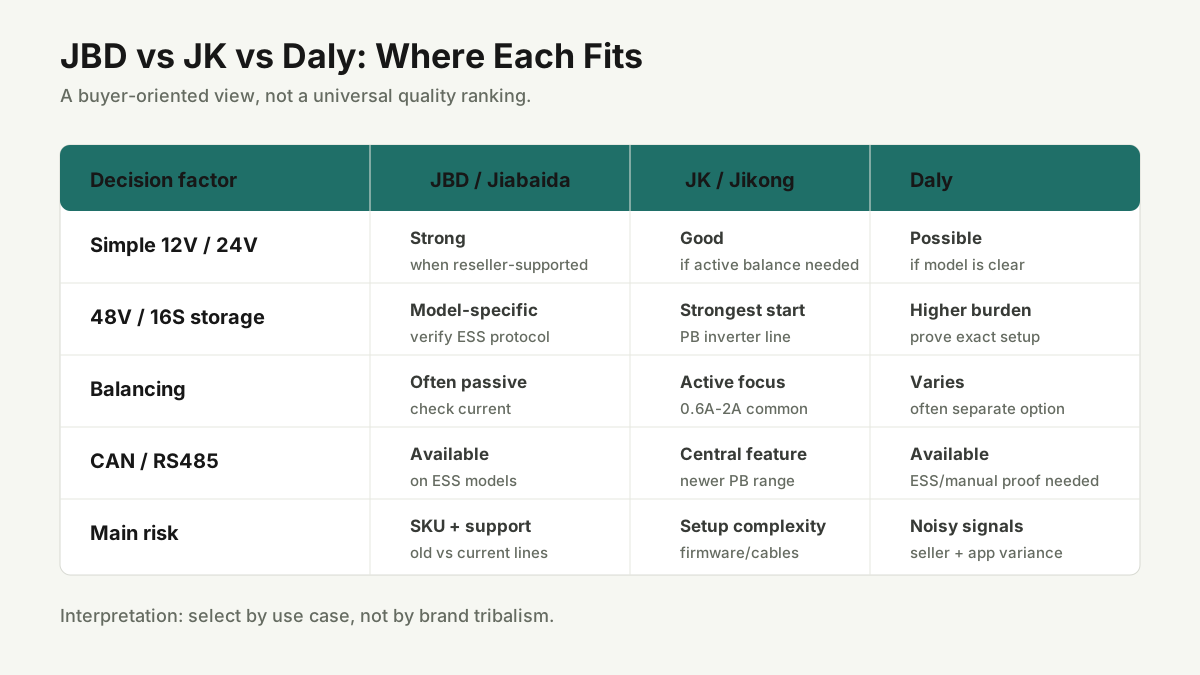
The difference between these brands is not "good" versus "bad." It is which problem each product family is trying to solve.
| Feature | JBD / Jiabaida | JK / Jikong | Daly |
|---|---|---|---|
| Strongest buyer fit | Simple-to-moderate smart LiFePO4 builds; reseller-supported packs | 48V / 16S DIY home storage; active balancing; inverter-BMS builds | Budget/basic protection; broad model availability; simple packs |
| Typical model examples to verify | JBD-SP04S020, JBD-SP10S009, JBD-SP25S003, JBD-UP16S019, JBD-AP21S002 | JK-PB1A16S10P, JK-PB2A16S20P, JK-B2A20S20P, JK-BD6A20S variants | Daly 4S/8S/16S smart BMS, Daly ESS BMS, Daly smart active-balance BMS, separate Daly active balancer modules |
| Cell-count coverage | Many 4S, 8S, 16S, 7S-21S, and ESS variants depending on seller | Many 3S-24S/25S variants; PB range targets 8S-16S battery walls | Officially broad: 3S-32S, 12V-120V depending on line |
| Current range | Common DIY boards around 50A-200A; relay/contactor variants higher | Common inverter examples at 100A/150A/200A; some lines advertise higher | Very broad official range from 5A to 500A, but derating and board type matter |
| Balancing | Often passive in classic DIY models; verify exact balance current | Active balancing is the brand's main selling point, commonly 0.6A-2A in DIY-relevant models and higher in some lines | Passive in many boards; active-balancer options exist but may be separate or specific product lines |
| App ecosystem | JBD Li-ion / Xiaoxiang / reseller apps such as Overkill for supported models | JK BMS app and PC tools; more settings, more complexity | Daly app, PC tools, Daly Cloud for some lines; user reports are mixed |
| Inverter communication | Available on specific ESS/inverter models; do not assume every JBD supports it | Strongest current story in PB inverter-BMS line with CAN/RS485 and protocol options | Available on smart/ESS models; Daly ESS manual lists RS485/CAN protocol options |
| Buyer risk | Model confusion, old reseller stock, app compatibility, exact entity/seller support | Protocol/cable/firmware complexity, overbuying features, current-path thermal assumptions | Marketplace clones/confusion, app/support complaints, treating broad current labels as continuous real-world capacity |
 Source: China Made & Tech synthesis of official JBD, JK, Daly, reseller, and support documentation reviewed on 2026-06-05.
Active Balancing
Active balancing is the feature that most clearly separates JK from classic JBD and Daly boards in the DIY market.
Passive balancing bleeds a small amount of energy from high cells as heat. It is simple and often enough for a well-matched pack that is top-balanced before assembly. Many classic JBD and Daly boards use low-current passive balancing. JBD's current UP16S019 listing, for example, gives a 20mA-80mA balance-current range for that ESS smart-BMS product. That is not a defect; it is a design choice. If the cells are well matched and the pack reaches a proper top-balance window periodically, passive balancing can be adequate.
Active balancing transfers energy between cells. JK's official active-balancer page says its active balancing current covers 0.6A to 5A across the listed line, while the JK-PB2A16S20P seller listing gives 2A active balancing and the JK-PB1A16S10P gives 1A. In a 16S DIY pack built from used, grade-B, or mismatched 280Ah/304Ah/314Ah cells, that higher balancing current can be useful. It can also conceal a bad build if the buyer treats balancing as a substitute for cell matching, compression discipline, correct torque, and good busbar connections.
The buyer rule: active balancing is valuable when pack size and mismatch justify it. It is not a license to skip cell verification. For cell sourcing and QR-code trust issues, the separate stub EVE LF280K Grade A Cells: QR Codes, Genuine Claims, and Buyer Verification is the natural next article because the BMS cannot turn questionable cells into a known-good pack.
Bluetooth And Apps
Bluetooth is convenient, but it is not a safety architecture.
JBD, JK, and Daly all have Bluetooth-capable models. Overkill Solar sells a spare Bluetooth module for many JBD/Xiaoxiang BMSs and notes that its older app support applies only to specific JBD models it sold. Current Connected's JBD quick-start guide says its JBD units are pre-programmed, tested, and calibrated before shipping, with LiFePO4 parameters set so the user can start without extra programming. That statement is about Current Connected's selling process, not a universal truth about every JBD listing.
JK's app gives access to more active-balance and protocol settings, which is powerful but easier to misconfigure. Daly's app ecosystem is broad, and forum complaints often involve app connection, Bluetooth dongle, or data-reporting frustrations. Across all three brands, several "bad BMS" stories begin as app permission problems, old Android APKs, iOS Bluetooth restrictions, wrong model selection, sleep-mode behavior, or a cable plugged into the wrong port.
The buyer rule: before ordering, download the manual and app notes for the exact model. Check whether the Bluetooth module is built in or external, whether a USB/UART cable is included, whether PC software exists, and whether settings can be changed without opening the battery case.
CAN, RS485, UART, And Inverter Protocols
Communication protocols matter only when another device needs to obey the battery.
UART and Bluetooth are often enough for local monitoring and configuration. RS485 is common for PC tools, SolarAssistant, and some inverter or parallel-pack communication. CAN becomes important when the BMS needs to communicate charge voltage, charge current, discharge current, SOC, alarm states, and allow-to-charge/allow-to-discharge limits to a GX device, inverter, charger, or energy-management system.
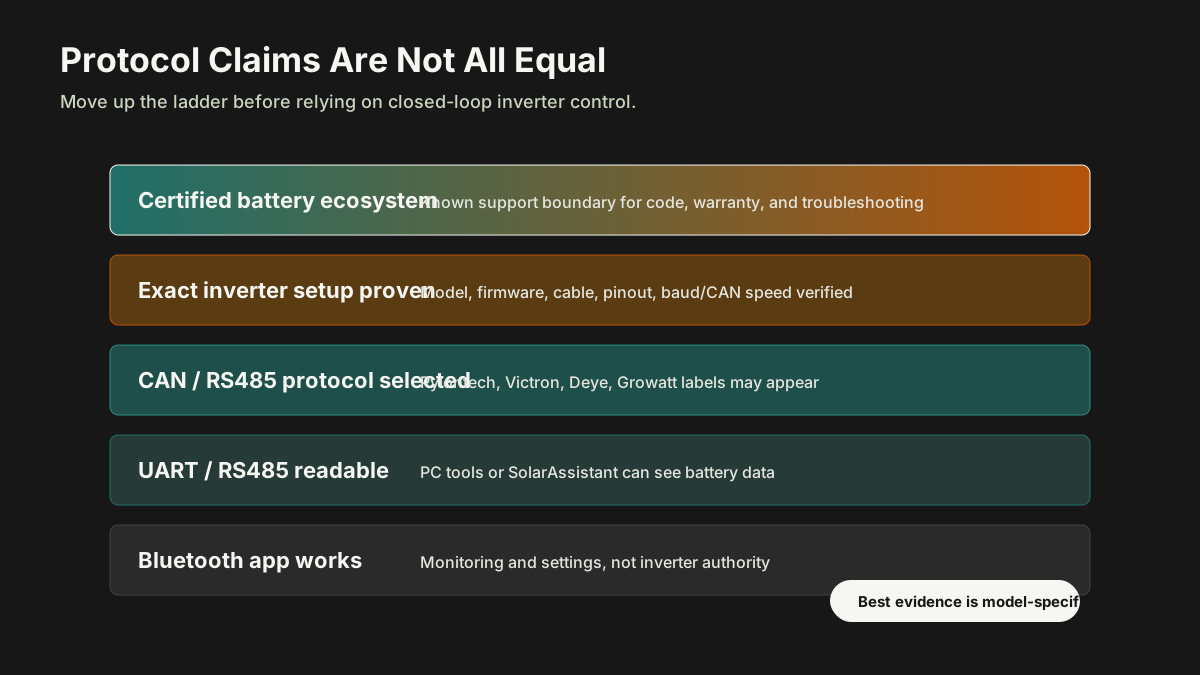
The trap is assuming protocol words are certification words. A seller page may say "supports Victron, Deye, Growatt, GoodWe, SMA, Pylontech, Voltronic." That may mean the firmware can emulate a known CAN/RS485 message set. It does not mean Victron or the inverter maker has certified the exact DIY battery. Victron's battery compatibility page is explicit that it offers very limited support for systems running custom BMS batteries and warns that custom BMS behavior can create troubleshooting time for apparent inverter faults. That is the right caution to carry into every DIY communication claim.
Daly's ESS manual lists RS485 and CAN protocol choices including Voltronic, Growatt, SRNE, and Victron protocol labels. JK's PB seller pages list Pylontech, Victron, Deye, and other protocol directions. JBD's UP16S019 listing names RS485 and CANBUS inverter compatibility families including Pylon, Growatt, Deye, Victron, SMA, Sofar, and others. Treat those as a shortlist for verification, not as final proof.
 Source: China Made & Tech protocol-risk framework based on JBD, JK, Daly, SolarAssistant, and Victron support materials.
The buyer rule: if the inverter integration matters, ask for the exact protocol list, firmware version, pinout, cable type, and a screenshot or document showing your inverter model. Then search for the exact board plus the exact inverter. "CAN" alone is not enough.
Use-Case Recommendations
12V LiFePO4: Keep It Boring
For a 4S 12.8V pack in an RV, van, boat, trolling motor, small solar box, or portable power project, the BMS should be boring. You need high/low voltage protection, low-temperature charge cutoff, sensible current rating, temperature probes, a clear app, and a seller who can help when the board sleeps or refuses to wake.
JBD is often the cleanest route here if bought from a support-heavy reseller. A JBD-SP04S020-style 4S model, an Overkill-supported legacy model, or a Current Connected-tested JBD board gives the buyer documentation and English-language setup help. Daly can also work in this class when the pack is simple and the buyer verifies low-temperature charging protection. A Daly 4S 100A smart BMS in a modest RV battery is a different risk from a Daly 16S 300A board asked to feed a large inverter.
JK is sometimes overkill for 12V unless the buyer specifically wants active balancing, higher current, or detailed monitoring. For a 12V pack, spending the saved money on a proper fuse, busbars, compression fixture, temperature sensor placement, and a shunt can improve the system more than choosing a feature-rich BMS.
24V LiFePO4: Decide Whether Balancing Matters
An 8S 24V pack sits between simple drop-in batteries and full home-storage walls. It may run an inverter, but the communication burden is usually lighter than a 48V rack system. Here the JBD versus JK choice often turns on balancing and current.
If the pack uses matched new cells and the design is conservative, a JBD 8S smart BMS through a known reseller is a sensible choice. If the pack uses reclaimed cells, mixed cells, or large-capacity cells that drift, a JK model with active balancing becomes more attractive. Daly remains a budget option, but the buyer should be honest about support tolerance. If a winter cabin battery will be left unattended, "cheap and probably fine" is not enough; low-temperature charge cutoff and reliable recovery behavior matter.
For 24V, also check charge-source behavior. Some alternator chargers, MPPTs, and inverter chargers can produce transient conditions that expose weak settings. The BMS should not be the only protection layer.
48V / 16S Home Storage: Start With Communication And Parallel Plans
A 16S LiFePO4 pack is the center of this search intent. It is where JBD, JK, and Daly stop being small-board shopping choices and become system design choices.
A typical DIY 16S pack might use 16 EVE LF280K cells for roughly 14.3kWh nominal energy, or newer 304Ah/314Ah cells for around 15.6kWh to 16.1kWh. Current Connected's current 16kWh wall-battery examples show the direction of commercial products: 51.2V nominal, around 314Ah, CAN/RS485 communication, 157A-200A current limits, outdoor ratings, and UL-listed system claims in some integrated products. A DIY pack using loose cells and a standalone BMS is not equivalent to that commercial battery, but the specification comparison shows what buyers are trying to approximate.
For a new 48V DIY pack in 2026, JK's PB inverter-BMS line is usually the first product family to evaluate. The JK-PB2A16S20P is a concrete example: 8S-16S, 200A continuous discharge, 2A active balance, Bluetooth, PC monitoring, CAN/RS485, and parallel support up to 16 packs according to the seller listing. The JK-PB1A16S10P gives a lower 100A / 1A active-balance option. Those features line up with what a 16S home-storage builder actually asks for.
JBD can still be a good choice if the exact JBD ESS/inverter model supports the required communication and the buyer has a reliable seller. The JBD UP16S019 listing is relevant because it targets 8S-16S ESS use and lists RS485/CANBUS. The buyer must verify whether the model's lower balance current is acceptable and whether the communication protocol is proven with the inverter.
Daly should not be dismissed automatically, but it should carry a higher verification burden for this use case. Daly has ESS manuals and RS485/CAN protocol options. The question is whether the exact Daly board, firmware, cable, and seller support match your inverter and current plan. The English DIY signal is noisy enough that a first-time 48V builder should not choose Daly solely because the amperage label is high or the price is lower.
High-Current Packs: Current Rating Is A Thermal Claim
The number "200A" or "300A" on a BMS listing is not the end of current design. It is the beginning.
For an inverter system, translate power into current. A 5kW 48V inverter may pull around 100A before losses. A 12kW inverter can exceed 250A at low battery voltage. Surge loads can be higher. If multiple packs are paralleled, each BMS may see less current, but current sharing is never perfectly equal. Cable length, busbar layout, internal resistance, and fuse choices matter.
This is where a BMS with a large MOSFET board can be a poor substitute for a contactor-based design, a high-quality rack battery, or a professionally engineered pack. JBD has relay/contactor-style offerings in some lines. JK and Daly both advertise high current models. The buyer should still ask:
- Is the rating continuous at the expected ambient temperature?
- What heat sinking or mounting does the manufacturer require?
- Is the BMS carrying both charge and discharge current through MOSFETs?
- Does the design need precharge for inverter capacitors?
- What fuse and breaker strategy protects the pack if the BMS fails closed?
The cheapest BMS is expensive if it becomes the weakest thermal part in a multi-kWh battery.
What Forum Complaints Actually Tell You
Forum threads are useful because they reveal failure modes that official pages understate. They are not useful if read as brand-wide statistics.
The DIY Solar Forum thread "JK-BMS or Daly BMS?" compares a Daly 16S 48V 300A BMS with a JK 200A 2A model in the context of an EVE 16S2P 48V build. Another DIY Solar Forum thread from mid-2025 asks what users would buy for a 16S 48V BMS, with JBD, JK, Daly, terminals, seller paths, and new model preferences all mixed together. Reddit SolarDIY and batteries threads from 2025-2026 include sharp comments against Daly, positive reports for JK, and some long-running positive JBD experiences. Those signals matter because they show what real buyers are wrestling with: Bluetooth, terminals, balance current, app quality, SOC accuracy, inverter talk, and return support.
But those threads cannot prove that Daly has a specific defect rate, that JK has no failures, or that JBD is universally reliable. The denominator is missing. We do not know seller source, clone risk, assembly quality, cable pinout, firmware version, cell condition, torque, environmental exposure, or whether the buyer followed the manual. Current Connected's JBD guide says poor balance-harness connections lead to around 90% of BMS faults during initial setup in its support experience. That is a support statistic from one reseller, not a universal law, but it is directionally important: many "BMS failures" begin as build failures.
The practical way to read forums is to classify complaints:
| Complaint type | What it may mean | Buyer response |
|---|---|---|
| BMS will not turn on | Sleep mode, balance-lead order, charger wake-up, blown board, wrong cell count | Read startup procedure before declaring hardware dead |
| Bluetooth not visible | App permission, wrong app, external module, sleep state, bad module | Confirm exact app and module before sealing the case |
| SOC wrong | Coulomb-count drift, wrong capacity setting, no full-charge sync, current calibration | Use a shunt for system decisions if SOC accuracy matters |
| Cells out of balance | Poor top balance, bad cell, loose busbar, low passive balance current | Fix pack construction before relying on active balancing |
| Inverter does not communicate | Wrong protocol, cable pinout, baud rate, CAN speed, unsupported firmware | Verify exact protocol and cable, not just brand name |
| Overcurrent shutdown | Inverter surge, undersized BMS, heat derating, parallel imbalance | Recalculate current and consider multiple packs or contactor BMS |
Buyer Selection Matrix
Use this matrix before you click "buy." It turns the brand debate into a design file.
| Buyer condition | Choose JBD when... | Choose JK when... | Choose Daly when... | Red flag |
|---|---|---|---|---|
| First DIY 12V pack | You want a preconfigured smart BMS and English setup support | You specifically need active balancing or high current | You want a simple low-cost board and can verify low-temp cutoff | Listing does not show chemistry, cell count, temp probes, or app |
| First 16S 48V battery | Seller can document a current ESS/inverter JBD model with your protocol | You want active balance plus CAN/RS485 in one current product family | You have exact proof of inverter protocol and strong seller support | Seller says "works with all inverters" without protocol details |
| Used or mismatched cells | Cells are only mildly mismatched and you can top-balance well | Active balancing is a core requirement | Separate active balancer is documented and supported | Buyer expects BMS to fix bad cells |
| Victron system | You are not relying on closed-loop comms, or exact protocol is proven | Exact JK PB protocol, cable, and user reports match your setup | Daly ESS protocol has been proven in the same setup | "Victron protocol" is listed but no model, firmware, or cable proof |
| Growatt/Deye/Voltronic-type inverter | JBD inverter model lists and documents the protocol | JK PB line has model-specific setup reports | Daly ESS manual/protocol matches and seller can support | No way to change protocol or confirm baud/CAN settings |
| Remote/off-grid cabin | You can test recovery and support before installation | You need active balancing and monitoring, with local spares | Budget is primary and loads are conservative | No spare BMS or bypass plan |
| High-current inverter | Relay/contactor or derated current path is well understood | JK current rating and thermal layout are documented | Daly rating is derated and tested, not just label-read | BMS rating equals expected continuous current with no margin |
| Compliance-sensitive project | You are using a certified commercial battery instead | You are using DIY only for non-code experimental systems | You are using DIY only where allowed | DIY battery presented as UL-listed or code-compliant when it is not |
What To Verify Before Ordering
The ordering checklist should be more specific than "buy from a good seller."
Ask for the exact model number. Not just "JK 200A" or "JBD 16S" or "Daly smart BMS." You want JK-PB2A16S20P, JBD-UP16S019, JBD-SP25S003, Daly 16S smart BMS with the exact suffix, or whatever the real SKU is.
Ask for the chemistry profile. LiFePO4, Li-ion/NMC, and LTO settings are not interchangeable. A 16S LiFePO4 pack is a nominal 51.2V battery. A 16S NMC pack is a different voltage class. Marketplace listings often stuff every chemistry term into the title.
Ask for current rating conditions. If the board says 200A, ask whether that is continuous charge and discharge, what ambient temperature, what heat sinking, what wire or busbar configuration, and whether the board has separate charge/discharge paths.
Ask for low-temperature charging behavior. LiFePO4 should not be charged below freezing unless the pack has a controlled heating strategy and the cell maker allows it under specific conditions. The BMS should have temperature probes and a configurable low-temp charge cutoff.
Ask for communication evidence. For an inverter build, demand the protocol list, manual, cable pinout, CAN speed or RS485 pinout, and a seller answer on your exact inverter. Save screenshots. If you use SolarAssistant, check whether the board is the newer JK inverter BMS or older original JK BMS style because the setup differs.
Ask for software before hardware. Download the mobile app or PC tool, read the manual, and check whether you can change settings you care about. If the seller cannot provide the manual until after purchase, assume support will be weak.
Ask for return and warranty boundaries. A BMS damaged by wrong balance-lead wiring may not be covered. A BMS bought from AliExpress may have different support than the same board bought from a domestic reseller who tests and calibrates it. That support difference is often worth more than the hardware price difference for a first build.
Ask whether the BMS is the certification boundary. For a code-sensitive residential ESS, a DIY cell pack plus standalone BMS is not the same as a UL 1973 / UL 9540 listed battery system. Do not let a seller's "CE" or "CAN" language substitute for project-specific code review.
The Inverter Question: Victron, Growatt, EG4, Deye, And Others
For many buyers, the real question is not JBD vs JK vs Daly. It is "which one talks to my inverter?"
The answer depends on whether you need closed-loop communication. In an open-loop setup, the inverter or charger uses voltage-based charge settings, and the BMS acts as the last line of defense. That can work, especially in small systems, but it requires conservative voltage settings and a good shunt if SOC matters. In a closed-loop setup, the BMS sends current, voltage, SOC, alarms, and charge/discharge limits to the inverter or control device. That can improve behavior, but only when the protocol is stable and correctly configured.
Victron is the cautionary case. Victron supports many third-party batteries and publishes battery compatibility materials, but its general compatibility page warns that support is very limited for custom BMS batteries. That is not anti-DIY language; it is systems engineering reality. A custom BMS can make an inverter report confusing errors even if the inverter hardware is fine.
Growatt, Deye, Voltronic/Axpert, EG4, GoodWe, SMA, Sofar, and Sol-Ark setups have their own protocol expectations. Some DIY builders use Pylontech emulation because many inverters understand Pylontech-style low-voltage battery communication. That can be useful, but it creates another verification step: is the BMS really emulating the expected frames, at the expected baud/CAN speed, over the expected pins, with sane limits?
JK's PB inverter BMS line is the first place many 16S DIY buyers now look because it was built around this problem. JBD ESS/inverter models are also relevant. Daly ESS products may work in specific setups. The brand does not remove the integration work.
For a critical home-storage system, the most robust answer may be to buy a certified rack battery or wall battery with a known BMS/inverter support path. DIY is attractive because Chinese cells and BMS boards have made high-capacity packs accessible. That accessibility does not remove responsibility for electrical design.
Final Recommendation
If you are building a simple 12V or 24V LiFePO4 pack, start with JBD from a support-heavy seller unless price is the overriding constraint. Daly can be fine for basic protection if the model is clear and the current/temperature margins are conservative. JK becomes attractive when active balancing is worth the added setup complexity.
If you are building a 48V / 16S home-storage battery in 2026, start your comparison with JK's PB inverter-BMS line, then compare a current JBD ESS/inverter model, then consider Daly only if the exact model and inverter protocol are proven. For a first 16S pack, the best value is rarely the cheapest board. It is the board with the clearest manual, known app, verified communication path, realistic current rating, and seller who will still answer after the listing disappears.
The Chinese BMS market gives DIY builders choices that did not exist a decade ago. That is the good news. The hard part is that those choices arrive through fast-changing model families, reseller channels, firmware versions, and forum lore. Treat the BMS as a procurement file, not an accessory. The battery will be safer for it.
Claim Confidence File
| Claim | Confidence | Evidence boundary |
|---|---|---|
| JBD, JK / Jikong, and Daly are real Chinese BMS suppliers with current official or near-official product materials | High | The article cites brand sites, manuals, and product pages. Entity naming and reseller-operated pages can still vary, so exact SKU verification matters. |
| JK's inverter-oriented PB line is often the stronger starting point for 16S / 48V DIY inverter communication | Medium-high | This is based on product positioning, protocol-focused documentation, and user-signal evidence. It is not a universal compatibility guarantee. |
| Daly should be treated more cautiously in English DIY searches | Medium | The caution is based on noisier user-signal evidence and model/documentation ambiguity, not a proven defect-rate dataset. |
| Forum complaints prove statistical reliability rankings | Low | Forums are used to identify failure modes and buyer vocabulary. They do not provide denominator-controlled failure rates. |
| A BMS brand choice can make a DIY battery code-compliant | Low | A standalone BMS does not make a battery UL 1973 / UL 9540 certified or acceptable to an AHJ, insurer, lender, or installer. |
| This comparison replaces electrical design | Low | It is a procurement and integration map. Pack sizing, fusing, contactor strategy, thermal design, enclosure, and code review remain project-specific. |
Methodology And Source Limits
This analysis reviewed official and semi-official product pages and manuals from Jiabaida/JBD, JBD's UP16S019 product listing, JBD AP21S002-style listing, JK/Jikong, JK's active-balancer BMS page, JK-PB2A16S20P seller documentation, Daly's official site, Daly manual pages, and Daly ESS BMS manual material. It also used support and installer materials from Overkill Solar's JBD support/download page, SolarAssistant's JK inverter-BMS guide, and Victron's battery compatibility page.
Forum evidence from DIY Solar Forum and Reddit was used only as user-signal evidence: it helped identify common failure modes and buyer concerns, but it was not used to claim statistically valid defect rates. Company and entity names were verified against currently accessible official or near-official pages where possible; JBD/Jiabaida entity naming remains a caveat because current and older English materials reference different Jiabaida entities.
FAQ
Is JK BMS better than JBD?
For 48V / 16S DIY home-storage packs, JK's newer inverter-BMS line is usually the stronger starting point because active balancing, CAN/RS485, and parallel-pack features are central to the product family. For simpler 12V and 24V packs, a well-supported JBD can be the lower-risk choice.
Is Daly BMS bad?
No single brand-wide answer is fair. Daly makes a broad range of BMS products, and many basic applications can work. The reason Daly gets a weaker recommendation here is that English DIY user-signal evidence is noisier, and buyers must verify exact model, app, current derating, temperature protection, and protocol support more carefully.
Do I need CAN or RS485 for a LiFePO4 BMS?
Not always. A small open-loop system can run with voltage-based charger settings and BMS protection. CAN or RS485 matters when the battery must communicate charge/discharge limits, SOC, and alarms to an inverter, charger, GX device, or monitoring system.
Is active balancing required for LiFePO4?
No. A well-matched and properly top-balanced LiFePO4 pack can work with passive balancing. Active balancing becomes more useful in large 16S packs, used-cell builds, mismatched cell sets, or systems that rarely reach a full top-balance window.
Can a DIY JBD, JK, or Daly battery replace a certified rack battery?
Electrically, a well-built DIY pack can deliver similar voltage and capacity. For code, insurance, warranty, and lender-sensitive projects, it is not the same. A standalone DIY BMS does not make a battery UL 1973 or UL 9540 certified.