
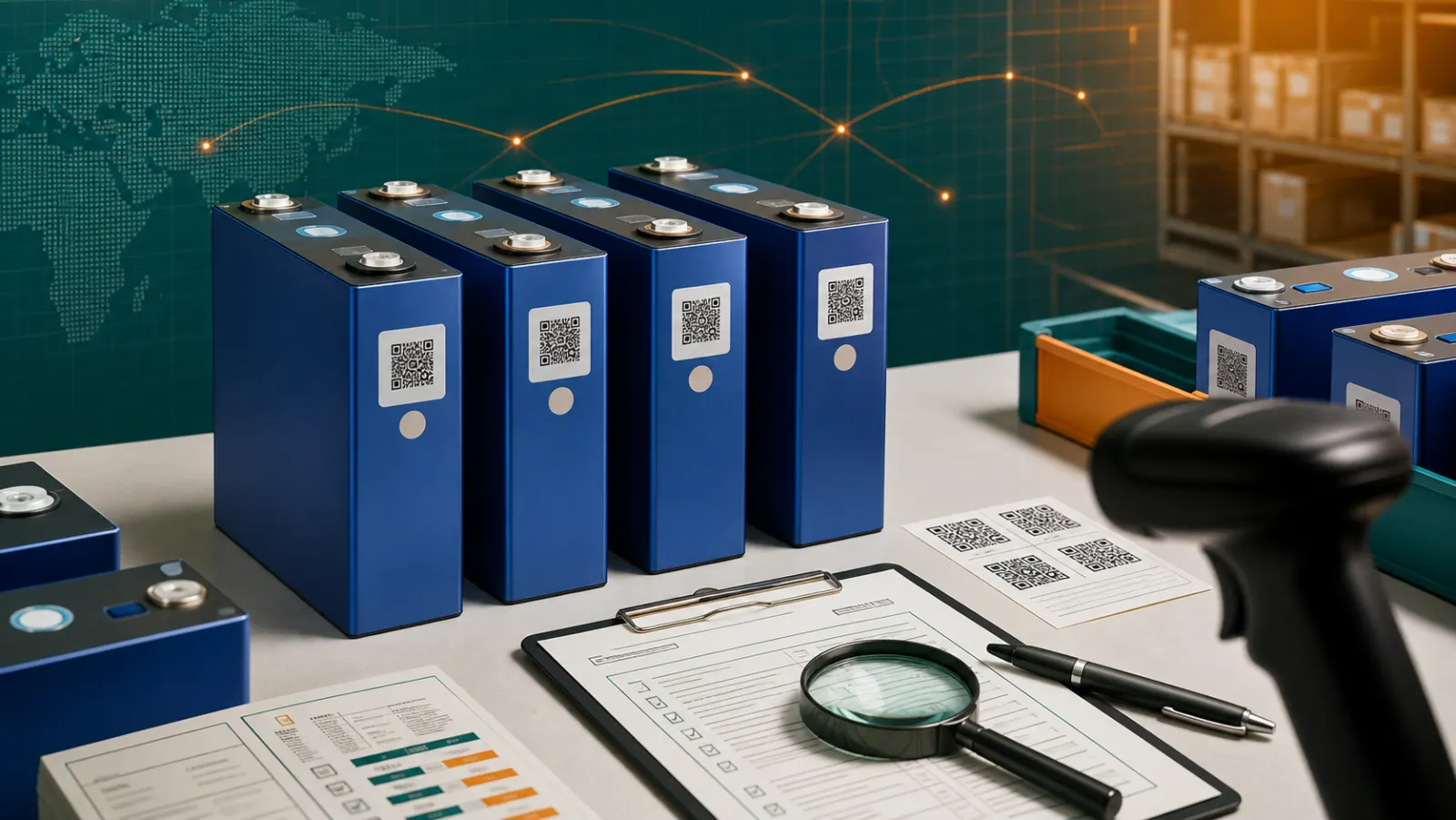
An EVE LF280K cell can look right, scan right, and still leave the buyer with the same uncomfortable question: what, exactly, has been proven?
That is the trust problem behind the English searches for `EVE LF280K grade A`, `EVE LF280K QR code`, and `EVE LiFePO4 cells genuine`. The buyer is rarely asking whether EVE Energy exists. It does. EVE Energy's official site points to power batteries, prismatic LFP cells, energy storage, BMS, and system-development businesses, and the same site links to EVEMALL as a buy channel. The harder question is whether a particular 3.2V 280Ah prismatic LiFePO4 cell in a reseller listing is new, genuine, properly matched, covered by a meaningful warranty, and appropriate for a DIY or small commercial storage pack.
The short answer is this: a QR code is useful evidence, but it is not a magic authenticity certificate. A seller's "Grade A" label is useful only if the seller can show who defined the grade, how the cell entered the channel, what test report belongs to the batch, and what warranty path exists if the cells drift, arrive damaged, or fail under normal use.
Source File
This article was reviewed on 2026-06-30 against EVE Energy's official company and product-category pages, EVE's prismatic LFP cell category, EVE's LF280K UL9540A news release, EVEMALL's current LF280K-V3 product page and LF280K-V1 explainer, the China Standards Online Service page for GB/T 34014-2017, and CATARC training material on battery coding. Reseller listings and forum posts are used only to illustrate buyer-facing claims, not to authenticate any batch.
Quick Answer
| Question | Practical answer |
|---|---|
| Is LF280K a real EVE cell family? | Yes. EVE's own site lists prismatic LFP cells as a product category, and EVEMALL, linked from EVE's official site, lists LF280K-V3 as a 3.2V 280Ah prismatic lithium iron phosphate cell for ESS uses. |
| Does "Grade A" have one universal public meaning? | No. In DIY reseller language it usually means new, high-capacity, low internal-resistance, QR-intact, and matched, but the term is not enough unless tied to factory or authorized-channel documentation. |
| Can the QR code prove the cell is genuine? | It can help identify traceability information and expose obvious mismatch, but by itself it does not prove legal channel, grade, age, warranty rights, or pack-level matching. |
| What evidence should buyers ask for? | Exact model/version, real photos of the same batch, QR/laser code images, factory or supplier test reports, invoice or shipping trail, warranty terms, and pre-shipment voltage/IR/capacity data. |
| What should buyers test after arrival? | Visual condition, terminal condition, resting voltage spread, internal resistance spread, capacity under controlled current, self-discharge, and early balance drift under the intended BMS. |
What EVE Is, and Why LF280K Became a DIY Storage Cell
EVE Energy is not an anonymous cell label. On its official English site, EVE describes power batteries, prismatic LFP cells, modules, BMS, and battery system development as part of its product portfolio. Its company profile shows a large Chinese battery manufacturer with production sites in Huizhou, Jingmen, Ningbo, Qidong, Qinghai and other locations, with headquarters in Huizhou, Guangdong.
The LF280K sits in the category that matters most to DIY storage builders: large prismatic lithium iron phosphate cells. LFP is not the highest-energy chemistry, but for stationary storage it gives buyers the combination they usually want: lower fire risk than high-nickel chemistries, long cycle life when used conservatively, good cost per kWh, and a form factor that can be assembled into 12V, 24V, and 48V packs.
EVEMALL's current LF280K-V3 page describes the cell as a 3.2V 280Ah prismatic lithium iron phosphate battery for utility ESS, telecom ESS, commercial and industrial ESS, residential ESS, and marine power. The same page lists 280Ah nominal capacity and 3.20V nominal voltage, with 8,000 nominal cycles and a 0.5P/0.5P charge/discharge multiplier. EVEMALL also keeps an LF280K-V1 explainer, but buyers should rely on the active product page and seller documents for any current purchase.
Those numbers explain the appeal. Sixteen 280Ah cells in series produce a nominal 51.2V pack with about 14.3 kWh of gross energy before reserve settings, inverter limits, and usable depth-of-discharge policy. For an off-grid cabin, RV, workshop, telecom backup cabinet, or home solar battery, the math is simple enough to attract competent DIY builders and risky enough to punish sloppy sourcing.
The model context also matters because English listings often blur LF280K, LF280K-V1, LF280K-V3, LF304, MB30, MB31, and "280Ah/304Ah/314Ah" language into one shopping basket. EVEMALL's LF280K-V1 page itself lists nearby options including LF304 and LF280K-V3. That does not mean the cells are interchangeable in a pack. It means buyers should treat model name, version, capacity, terminal style, dimensions, charge/discharge rating, and test report as part of one identity file.
EVE's own 2021 news release also shows why LF280K entered energy-storage credibility discussions early. EVE Power said it received UL9540A certification for LF280K and signed an MOU with UL to promote energy-storage safety development. That certification news is not a retail authenticity tool for your specific cells, but it does confirm LF280K as a real EVE energy-storage product family rather than an invented reseller name.
Why "Grade A" Is a Buyer Trap
"Grade A" sounds official. It feels like a factory stamp. In many English listings, it is used that way.
But buyers need to separate three different meanings:
- Factory grading: how a manufacturer classifies output internally or for contracted customers.
- Channel grading: how a distributor or reseller describes cells it acquired from a particular source.
- Buyer grading: how a DIY builder judges whether the cells are acceptable for a specific pack.
Those are not the same thing.
A reseller page may describe cells as "Grade A", "EV grade", "ESS grade", "brand new", "matched", "QR intact", or "factory test report included." For example, Docan Power's LF280K listing uses "Grade A" in the title and has a grade-comparison table that distinguishes EV/ES Grade A, ESS Grade B, and used or recycled cells. Another LF280K-V3 reseller page says the cell is "brand-new, Grade A" and comes with a QR code for verification and traceability.
Those listings are useful because they show the language buyers encounter. They are not, by themselves, proof that EVE has certified a particular retail batch as "Grade A" for the end buyer. The claim has to be supported by documents, photos, tests, and a credible route back to the manufacturer or authorized channel.
In practice, "Grade A" in DIY storage usually means a cluster of promises:
- New and unused cells, not recovered from a pack.
- No sanded, re-lasered, covered, or visibly tampered QR/laser code.
- Capacity at or above nominal under an agreed test method.
- Internal resistance within a tight range.
- Similar resting voltage and production batch.
- No swelling, dents, terminal damage, or electrolyte leakage.
- A test report or batch report that matches the cells received.
- Some form of seller warranty.
The problem is that each item needs its own verification. A cell can be new but not matched. It can be genuine EVE but not from a channel that gives you warranty rights. It can test above 280Ah once and still be older stock, poorly stored, or mismatched for a tightly balanced 16S pack. It can have a readable QR code and still arrive with scratched terminals or a questionable shipping history.
That is why "Grade A" should be treated as a claim to investigate, not a conclusion to repeat.
What a QR Code Can and Cannot Prove
Chinese traction-battery traceability is not folklore. GB/T 34014-2017, the Chinese standard for automotive traction-battery coding, sets rules for battery code objects, code structure, representation methods, and data carriers. The China Standards Online Service page describes the standard as applying to automotive traction batteries, supercapacitors, and other rechargeable energy-storage devices. A CATARC standards training PDF explains the purpose more plainly: battery coding supports lifecycle traceability and management, with objects including packs, modules, and individual cells.
That matters because the QR or data-matrix style codes on Chinese lithium cells are not random decoration. They can carry manufacturing and traceability information. In the public English discussions around LiFePO4 cells, buyers often decode or compare parts of those codes to infer manufacturer, date, line, or batch.
But three limits are essential.
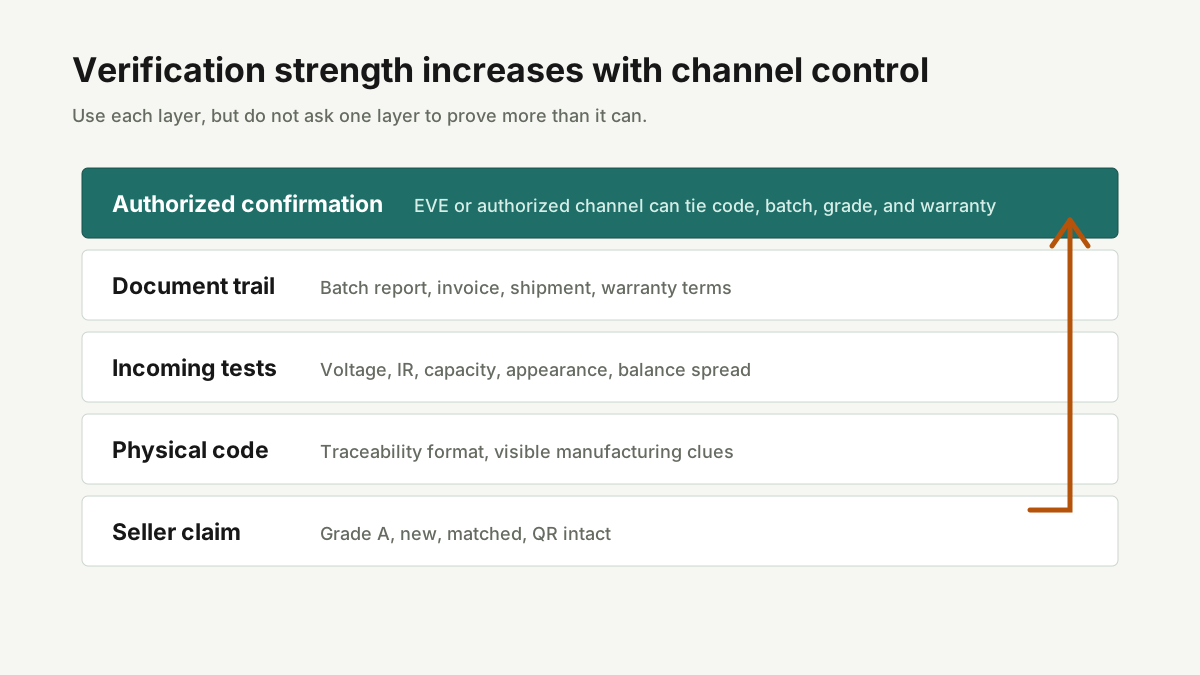
First, a code is not the same as an online verification response from EVE. Unless EVE or an authorized database confirms that a specific code belongs to a specific cell sold through a specific channel, the code is only one layer of evidence. It may show that a cell carries a plausible code format. It may not show that the cell is new retail stock with warranty rights.
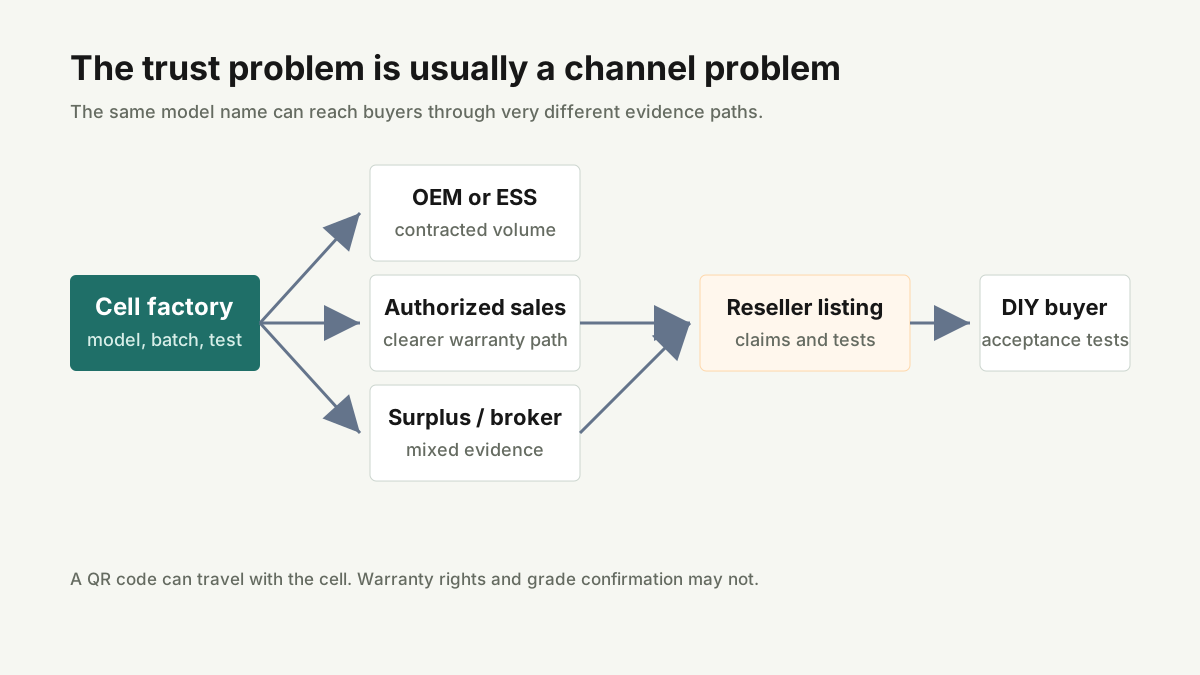
Second, the code travels with the physical cell, not with a buyer's full transaction history. If a genuine cell moves from an OEM allocation to a surplus broker to a reseller to a DIY buyer, the code may remain intact while the warranty path becomes unclear. The code can help identify the cell. It cannot reconstruct commercial rights that were never assigned to the retail buyer.
Third, code integrity is not the same as cell quality. A readable QR code does not tell you whether the cell was stored correctly, compressed incorrectly in transit, mixed with older cells, exposed to moisture, or capacity-tested under your intended operating conditions.
Here is the clean way to use a QR code:
- Use it to check whether the physical identity of the cell is internally consistent.
- Compare all cells in the shipment for batch, date, and sequence coherence.
- Ask the seller to supply pre-shipment images of the actual codes, not generic product photos.
- Check whether the code information matches the test report, invoice, and carton labels.
- Treat covered, sanded, relabeled, missing, or inconsistent codes as a reason to stop and ask for an explanation.
Here is the wrong way to use it:
- Do not assume "QR intact" equals "Grade A."
- Do not assume a decoded manufacturer/date clue equals authorized sales channel.
- Do not assume a code proves capacity, internal resistance, or cycle life.
- Do not assume a seller's QR screenshot came from the cells you will receive.
The QR code is like a passport number. It is valuable. It is also not the whole background check.
Verification Matrix: What Each Evidence Type Proves
The most useful buyer tool is not a single yes/no test. It is a matrix of evidence. Each item should answer a narrow question and leave the rest open.
| Evidence | What it can support | What it cannot prove by itself | Buyer action |
|---|---|---|---|
| EVE official product category and EVEMALL model page | LF280K is a real EVE prismatic LFP / ESS product family; nominal model context exists | That your seller's batch is authorized, new, or Grade A | Save the official model/spec page and compare exact version, dimensions, voltage, capacity, terminal style, and application language |
| QR or laser code | Physical cell identity, possible manufacturer/date/batch clues, obvious mismatch among cells | Grade, warranty, channel, storage history, matched quality, or capacity | Request clear photos before payment; compare all codes after arrival |
| Factory or supplier test report | Claimed capacity, internal resistance, voltage, test date, batch relation | Authenticity unless tied to actual cell codes and credible issuer | Require report-cell-code matching; reject generic PDFs without cell identity |
| Invoice and shipping documents | Seller identity, quantity, declared product, shipping route | Cell grade or performance | Keep for warranty and customs file; compare quantities and model descriptions |
| Seller reputation | Probability of fair handling if something goes wrong | Technical truth of the cell claim | Read recent buyer outcomes; prefer sellers that publish test method and accept evidence-based claims |
| Capacity test | Energy delivered under your test current, temperature, and cutoff settings | Long-term cycle life, origin, age, or all-cell matching unless every cell is tested | Test consistently; document current, temperature, voltage limits, rest time, and equipment |
| Internal resistance test | Relative consistency and obvious outliers | True factory grade, capacity, or future degradation | Use the same meter and temperature; compare spread more than absolute precision |
| Visual inspection | Shipping damage, swelling, terminal abuse, relabeling clues | Electrochemical health | Photograph every cell on arrival before cleaning or assembly |
| BMS logs during first cycles | Balance drift, cell divergence, temperature behavior, alarm events | Original channel or grade | Keep early logs; they become your strongest warranty evidence |
Chinese Cell-Channel Ambiguity
The English DIY market often imagines a simple route: EVE factory, official distributor, end buyer. Some purchases do work that way. Many do not.
Large prismatic cells are industrial components. The best lots are often committed to contracted OEM, energy-storage, telecom, marine, or commercial customers. Retail DIY buyers are usually a small, fragmented, high-support-cost market. That does not mean retail cells are fake. It means retail supply can be a mixture of authorized channels, regional distribution, surplus, cancelled project stock, brokered lots, and sellers who source opportunistically.
The same ambiguity appears across Chinese manufacturing, not just batteries. A product can be made by a real manufacturer and sold through a weak channel. A reseller can be honest about what it has but imprecise with marketing language. A batch can be genuine but not matched for your use. A listing can be accurate when first published and misleading months later after the supplier's incoming stock changes.
For LF280K buyers, the practical channel questions are:
- Did the seller buy directly from EVE, from EVEMALL, from an authorized regional channel, from another distributor, or from a broker?
- Is the quoted stock physically in a named warehouse, or is the listing collecting orders before sourcing?
- Are the photos of the actual cells, actual cartons, and actual QR codes?
- Is the warranty from EVE, from the reseller, or only a promise to negotiate later?
- Are the cells one production batch, one test batch, or merely "matched" by the seller after sorting?
- If a cell tests low, who pays shipping, and what threshold triggers replacement?
This is why price is a signal, not just a bargain. A very low price can be legitimate if a seller has old inventory, regional stock, or a promotional lot. It can also mean incomplete warranty, mixed batches, ESS-grade rather than EV-grade stock, cosmetic defects, or weaker after-sales support. A high price does not guarantee authenticity either, but it should buy stronger evidence.
The buyer should avoid one common mistake: comparing only dollars per Ah. In real pack economics, the expensive failure is not paying a few dollars more per cell. It is building a 16S or 32S pack, wiring the BMS, compressing the stack, connecting the inverter, and then discovering one cell drifts, swells, self-discharges, or cannot be replaced under a practical warranty.
The Four-Stage Buyer Workflow
Verification should happen in stages. The worst workflow is to buy first, assemble quickly, and investigate only after the pack misbehaves.
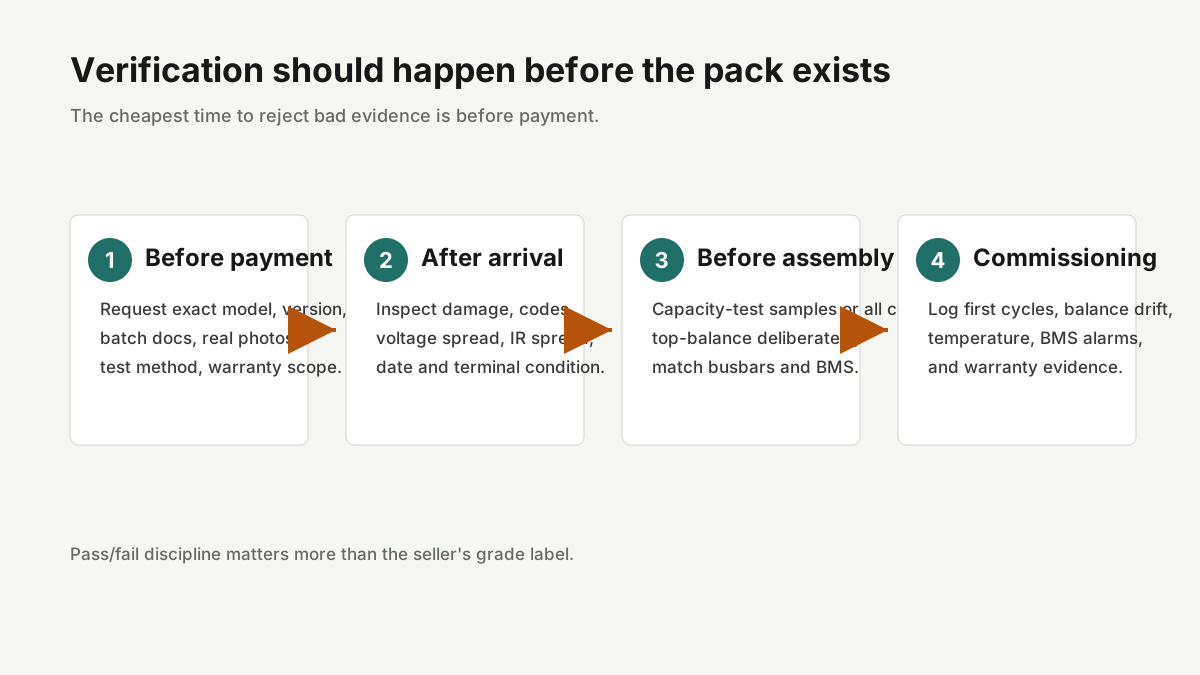
Stage 1: Before Payment
Before payment, the buyer should make the seller commit to specifics in writing.
Ask for the exact model and version: LF280K-V1, LF280K-V3, LF304, MB31, or another model. Do not accept "EVE 280Ah" as enough. Ask for nominal capacity, voltage, dimensions, terminal style, weight, charge/discharge rating, and intended application. Then compare those against EVE or EVEMALL pages where available.
Ask for photos of the actual cells. Product-page photos are not evidence. You want carton labels, top surfaces, terminal areas, QR/laser codes, and any test stickers. If the seller will not send actual photos before payment, decide whether the price discount is worth the information gap.
Ask for a sample test report before shipment. The report should show cell identifiers, capacity, internal resistance, voltage, test date, test conditions, and pass/fail criteria. A report that has no connection to the individual cells is a brochure, not a batch record.
Ask how matching is done. Some sellers match by voltage and internal resistance. Better sellers can provide capacity or batch coherence. For a 16S storage pack, voltage-only matching is weak. Cells can rest at similar voltage and still diverge under charge/discharge.
Ask about warranty logistics. "Five-year warranty" means little if the buyer must ship a 5.4 kg cell internationally at their own expense, prove failure under unspecified conditions, and wait months for replacement. A good warranty answer includes thresholds, test method, photo/video evidence requirements, replacement shipping responsibility, and whether partial refund or local replacement is possible.
Ask whether the seller will accept rejection before shipment if photos, codes, or reports do not match the quote. If the answer is vague, the buyer is financing the seller's sourcing risk.
Stage 2: After Arrival
After arrival, slow down. Do not unwrap, clean, assemble, and compress everything before documenting condition.
Photograph every cell from all sides. Capture cartons, labels, QR codes, terminals, vent area, sidewalls, bottom edges, and any denting or swelling. If the shipping carton is damaged, photograph it before opening. This is not bureaucracy. It is your warranty file.
Measure resting voltage after the cells have been at the same temperature. The absolute voltage is less important than spread. A wide spread does not automatically mean the cells are bad, but it raises questions about state of charge, storage, sorting, and whether the seller shipped a coherent set.
Measure internal resistance with the same device, same fixture pressure, and similar temperature. Low-cost meters are not laboratory instruments, but they are useful for spotting outliers. Treat one cell that is materially different from the group as a reason to investigate before assembly.
Inspect terminals. Reworked, scratched, overheated, cross-threaded, or contaminated terminals can matter as much as capacity. DIY pack failures often begin at connections: loose busbars, uneven torque, oxide layers, insufficient contact area, wrong hardware, or a terminal damaged before the pack was built.
Check the QR/laser codes against the seller's pre-shipment photos and documents. If the seller sent a report for one batch and the cells show another, stop. A mismatch is not proof of fraud, but it does require an explanation before the cells are buried inside a pack.
Stage 3: Before Pack Assembly
Capacity testing is where many buyers gain confidence, but it is also where they overread the result.
A capacity test proves that a cell delivered a certain Ah or Wh under the test conditions used: current, temperature, rest time, charge voltage, cutoff voltage, and equipment accuracy. It does not prove the cell's factory grade, age, cycle history, or future behavior. It also does not prove pack matching unless the same procedure is applied consistently across the set.
For expensive or mission-critical builds, test every cell. For lower-risk builds, test samples at minimum and run a stricter incoming inspection. If one sample fails, expand the test. If multiple cells fail, do not assemble first and argue later. Keep the cells in a claimable state.
Top balancing should be deliberate, not rushed. A 16S LiFePO4 pack has a very flat voltage curve through much of its state of charge. Small differences can hide until the top or bottom of the curve, where one cell hits the BMS limit before the rest. That is why early balance behavior matters more than a single resting-voltage screenshot.
Compression is another area where buyers should not let forum certainty replace model-specific guidance. Large prismatic cells can expand under cycling. A pack needs secure mechanical restraint, electrical insulation, thermal spacing where required, and protection against vibration. But the correct mechanical design depends on the cell, enclosure, application, and manufacturer's guidance. If the seller cannot provide current handling and assembly guidance for the exact model/version, treat that as a missing document.
Busbars and fasteners deserve the same seriousness. A 280Ah cell is not dangerous because it is mysterious; it is dangerous because it can move a lot of current through a bad connection. Verify torque recommendation, washer stack, contact cleanliness, fuse strategy, cable size, and whether the supplied busbars are appropriate for the intended current.
Stage 4: After Commissioning
The verification file does not end when the pack turns on.
During the first cycles, log cell voltage spread under charge, near top-of-charge, under load, and near your lower cutoff. Watch for a cell that repeatedly reaches high-voltage cutoff first or sags earlier under load. That behavior can point to capacity mismatch, internal resistance difference, connection problems, temperature differences, or balancing limits.
Log temperature. A warm cell or connection may reveal a busbar, torque, or contact problem before it becomes a failure. In a home or RV pack, the pack environment changes: cold mornings, hot cabinets, inverter surges, charger transitions, and long float periods all stress the assumptions made during bench tests.
Keep the BMS data. If a seller dispute happens, a clean evidence chain is stronger than frustration. Show arrival photos, code photos, test data, assembly method, BMS logs, and the exact failure condition. A serious seller will respond better to a precise file than to "these cells are bad."
This is also where the LF280K decision connects to the broader system. The cell is only one part of the storage pack. The BMS, inverter protocol, balancing current, enclosure, fusing, busbar design, charger settings, and user discipline determine whether a good cell becomes a reliable battery. That is why the coming JBD vs JK vs Daly BMS: LiFePO4 Buyer Comparison article matters: a weak BMS choice can make good cells look bad, and a good BMS can reveal weak cells early.
Capacity Testing: Useful, but Not Omniscient
The DIY community often treats capacity as the final judge. If an LF280K cell tests at 290Ah, 300Ah, or higher, buyers relax. That is understandable. Under-capacity cells are an obvious problem.
But capacity is only one dimension.
A cell that tests above nominal once may still be poorly matched. It may have higher self-discharge. It may have higher internal resistance than its neighbors. It may be old stock with acceptable present capacity but uncertain warranty. It may have been tested at a gentle current that does not reflect the buyer's inverter surge behavior. It may pass capacity but have terminal damage, swelling, or inconsistent code documentation.
The better test file combines:
- Capacity under a stated current and temperature.
- Initial and final voltage conditions.
- Rest period before and after test.
- Internal resistance measured consistently.
- Self-discharge observation after resting.
- Physical inspection photos.
- Batch/code coherence.
- Early pack-cycle BMS logs.
For a low-current home ESS pack, a cell that is not "EV grade" may still be perfectly serviceable if it is new, coherent, honestly represented, and used conservatively. For a mobile, high-vibration, high-current, or professionally warrantied system, the acceptable evidence bar is higher.
That is the nuance sellers often flatten. The buyer does not need the most prestigious label. The buyer needs the cell grade, channel, test data, and application risk to match the pack being built.
Price, Supplier Reputation, and Warranty Reality
Price differences in LF280K listings often reflect more than margin.
A supplier with local warehouse stock may charge more because it has already absorbed import, duty, inventory, and domestic shipping risk. A direct-from-China seller may quote less but shift shipping delay, customs uncertainty, and damage risk to the buyer. A broker may quote low because the stock is available quickly but not fully documented. A reseller may charge a premium for tested, matched, QR-intact cells, but the buyer still needs to ask how those claims are verified.
Use price as a question generator:
- Why is this quote lower than comparable sellers?
- Is the stock current production, warehouse stock, or surplus?
- Are the cells one batch?
- Is the test report from EVE, from the seller, or from a third party?
- Are QR codes visible, intact, and matched to reports?
- What happens if one cell tests below nominal after arrival?
- Who pays replacement shipping?
Supplier reputation matters, but it is not a substitute for evidence. Forum posts, Reddit threads, YouTube capacity tests, and buyer photos are useful signals because they reveal recurring patterns: slow claims, mismatched batches, good packaging, real replacements, or changing stock quality. A DIY Solar Forum LF280/LF280K thread is useful as an example of how buyers discuss QR scan results and Grade-A claims, but it is not manufacturer evidence. Use community material to decide what to ask, not what to believe as fact.
This distinction is central to how China Made & Tech treats sourcing questions. Chinese manufacturing risk is often not "fake versus real." It is evidence quality, channel clarity, and after-sales enforceability. The same logic appears in broader battery procurement and storage bankability, which is why this article bridges to China graphite export compliance file and China Battery Storage Boom: Grid-Scale BESS Explained.
Red Flags That Should Pause the Purchase
Some issues are not automatic proof of a bad cell, but they are strong enough to pause the purchase or assembly.
| Red flag | Why it matters | Reasonable next step |
|---|---|---|
| Seller cannot name exact model/version | "EVE 280Ah" may hide LF280K, LF304, MB30/MB31, old stock, or mixed lots | Require exact model page match before payment |
| Generic product photos only | You cannot connect listing to actual inventory | Ask for dated photos of cartons and codes |
| QR codes hidden, covered, sanded, or inconsistent | Physical identity is compromised or unexplained | Request replacement stock or walk away |
| Test report has no cell identifiers | The report may describe a different batch | Ask for report tied to QR/serial list |
| Very wide voltage or IR spread on arrival | Possible mixed batch, storage difference, or weaker cells | Do not assemble; expand testing |
| Seller redefines warranty after delivery | Commercial risk is larger than technical risk | Preserve evidence and escalate before using cells |
| Capacity test requires unrealistic conditions | Seller may be using a test method that flatters results | Agree on current, temperature, voltage limits, and equipment before buying |
| Pack kits include thin busbars or vague torque guidance | Connection risk can defeat good cells | Upgrade hardware and request model-specific assembly guidance |
How to Think About LF304 and Other Nearby Cells
The LF280K trust problem is part of a broader naming problem. Buyers see EVE LF280K, LF280K-V3, LF304, MB31, "280Ah", "304Ah", "314Ah", "310Ah tested", "EV grade", and "ESS grade" across listings and forums. Some of these are real product names. Some are seller shorthand. Some are capacity-test marketing.
Do not buy by headline capacity alone.
An LF304-class cell may look like a better deal if the price per Ah is close. But pack design is not just Ah. Different models can have different cycle-life claims, dimensions, recommended charge/discharge profile, terminal hardware, compression guidance, certification context, and channel availability. Mixing models inside one pack is almost always a mistake unless a qualified integrator has a specific reason and a validated design.
For a new build, choose one model/version and build the evidence file around it. For replacement, match the existing pack more conservatively than the listing headline suggests. A single replacement cell in an aged pack should be judged by compatibility with the pack, not by its standalone capacity.
What Only EVE or an Authorized Channel Can Truly Confirm
The final layer of uncertainty should be stated plainly.
Only EVE or an authorized channel can give the strongest confirmation that a specific cell code, batch, grade, channel, and warranty entitlement belong together. A DIY buyer may not have access to that confirmation. That does not make every retail purchase reckless. It means the buyer has to decide whether the remaining uncertainty is acceptable.
For a small off-grid shed, the acceptable risk may be modest if the cells are inexpensive, the system is protected, and failure does not create a critical outage. For a home backup pack near living space, a commercial site, a marine installation, or anything connected to expensive inverter hardware, the evidence bar should be much higher.
That is the disciplined middle ground:
- Do not panic because the cells came through a reseller.
- Do not trust a reseller because the listing says Grade A.
- Do not worship the QR code.
- Do not ignore the QR code.
- Do not use one capacity test to excuse weak channel evidence.
- Do not use official EVE product existence to validate every retail listing.
The right question is not "Are EVE LF280K cells real?" They are. The right question is: "Can this seller prove that these specific cells, in this specific shipment, are what my pack needs them to be?"
Claim Confidence File
| Claim | Confidence | Evidence boundary |
|---|---|---|
| EVE Energy is a real Chinese battery manufacturer and LF280K-family cells are real products | High | EVE's official site, product-category pages, and LF280K-related materials support the identity and product-family claim. |
| QR / laser markings can support traceability | Medium-high | Chinese battery traceability standards and EVE-style markings make codes useful evidence, but a visible code is not by itself proof of grade, freshness, warranty, or authorized channel. |
| Retail "Grade A", "matched", "new", and "factory test report" labels are seller claims | High | Reseller listings can be useful for seeing market language, but they are not manufacturer confirmation unless tied to serial-level proof and a recognized channel. |
| A capacity test proves a cell is safe for any pack | Low | Capacity testing is useful incoming inspection. It does not replace internal resistance spread, physical inspection, temperature behavior, compression, BMS settings, fusing, enclosure design, or code review. |
| EVEMALL or another reseller page automatically validates every marketplace listing | Low | Product-family context is not the same as shipment-level authorization. Buyers still need invoice, seller entity, warranty path, batch data, and post-delivery inspection. |
| This guide is electrical or fire-code advice | Low | The article is a sourcing and evidence file. Critical systems should use qualified pack design, local code review, and appropriate certified equipment. |
Methodology and Source Caveats
This guide uses EVE's official English site for company and product-category context, EVE's LF280K UL9540A news release for product-family validation, EVEMALL's active LF280K-V3 product page and LF280K-V1 explainer for retail specification context, the China Standards Online Service page and CATARC training material for GB/T 34014 traceability context, and selected reseller/forum sources only as examples of buyer-facing claims and community signals.
Reseller pages and forum discussions are not treated as manufacturer proof. "Grade A", "QR intact", "matched", "new", and "factory test report" remain seller claims unless tied to a verifiable channel, batch, and warranty path.
Bottom Line
EVE LF280K cells became popular because they sit in the practical sweet spot for DIY and small-system LiFePO4 storage: large capacity, familiar 3.2V LFP chemistry, strong ESS product context, and a huge ecosystem of pack builders, BMS suppliers, enclosures, busbars, and resellers.
The trust problem exists for the same reason. A cell designed for industrial channels is now being bought through retail channels by people building real energy systems. The English market has learned to ask for QR codes and Grade-A labels, but those are only the start of verification.
If you are buying EVE LF280K cells, build a file before you build a pack. Exact model, actual photos, QR/laser codes, batch report, seller warranty, incoming inspection, capacity data, IR spread, BMS logs, and assembly discipline all matter. A good supplier will help you assemble that file. A weak supplier will ask you to trust the headline.
For a battery pack, trust should not be a headline.
FAQ
Can an EVE LF280K QR code prove a cell is Grade A?
No. A QR code can support traceability and help match markings to a claimed cell family, but it does not prove retail grade, freshness, matching quality, warranty coverage, or whether the cell was diverted from another channel.
Is EVEMALL the same as buying directly from EVE Energy?
EVEMALL is linked from EVE's official site and is useful for product-family and specification context. Buyers should still verify the selling entity, warranty terms, shipping route, invoice details, and after-sales process before treating a transaction as manufacturer-backed.
What should buyers test before assembling LF280K cells into a pack?
Check physical condition, QR/serial consistency, open-circuit voltage, internal resistance, capacity at a documented test rate, and batch matching. Keep photos and test logs before compression, busbar installation, or BMS commissioning.
Are reseller Grade-A claims reliable?
They are claims, not proof. Treat "Grade A", "EV grade", "brand new", and "matched" as prompts for documentation: factory test reports, batch lists, serial-level photos, warranty terms, and a dispute process that survives after delivery.