
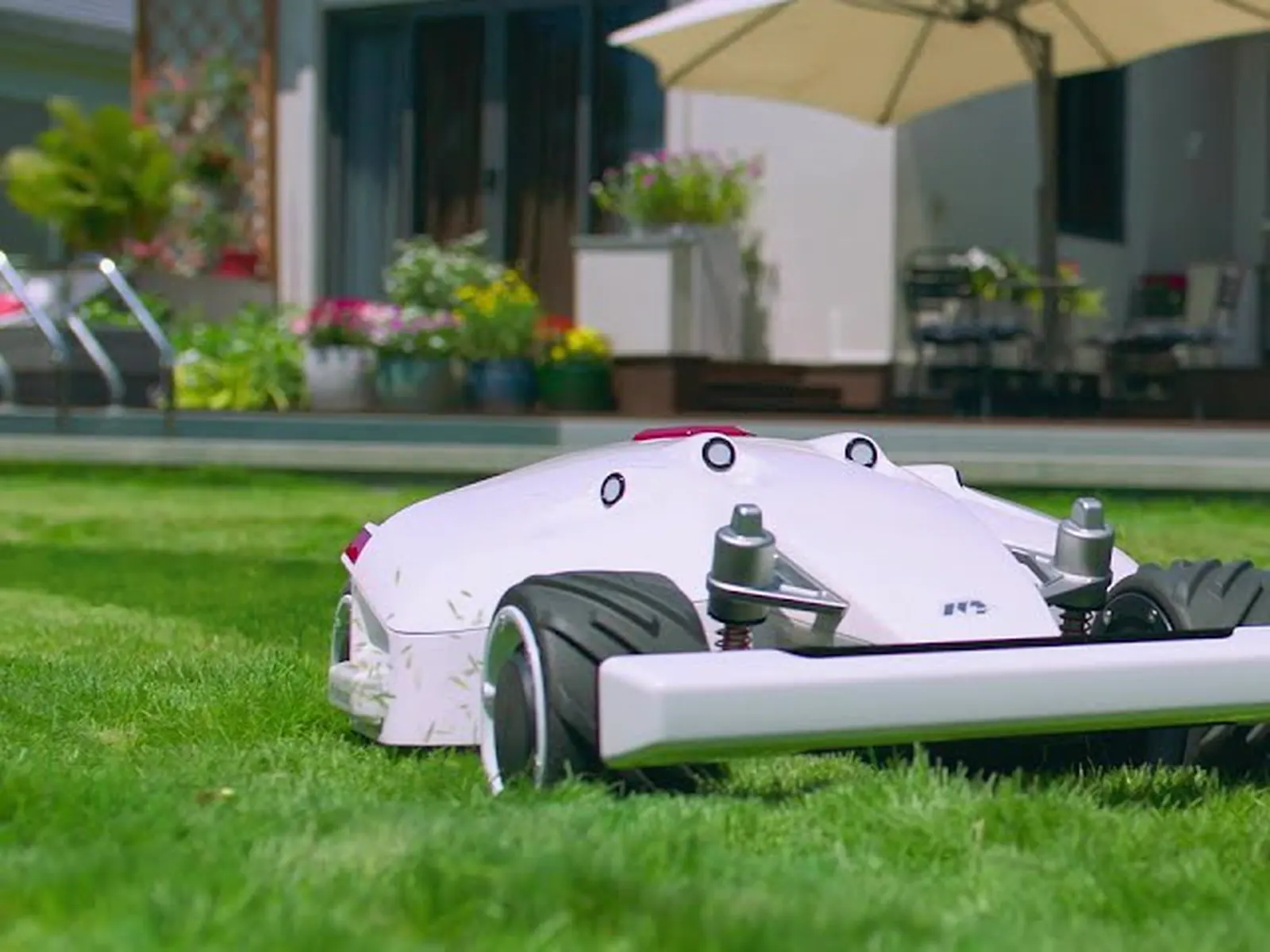
Mammotion is the Shenzhen-linked outdoor robotics company behind LUBA, the wire-free all-wheel-drive robot mower that turned a niche lawn-care problem into a global robotics story. If you found this page by searching "Mammotion Luba company," the useful answer is not just "yes, it is a Chinese company." The better answer is that Mammotion sits at the intersection of Shenzhen hardware, Dongguan robotics chassis know-how, app-controlled consumer devices, and a still-maturing global support network.
That combination explains both sides of the brand. On one side, LUBA arrived early with a strong idea: remove the perimeter wire, use positioning and mapping instead, give the mower serious traction, and make a yard robot feel closer to a drone or mobile robot than to a traditional garden tool. On the other side, owners do not buy only a mower. They buy a robot, an app, firmware updates, positioning infrastructure, batteries, parts, warranty handling, and a repair path. That is why this dossier treats Mammotion as a company file, not a shopping review.
Quick Answer: What Is Mammotion?
Mammotion is a yard-robotics brand focused on wire-free robotic lawn mowers and, more recently, pool-cleaning robots. In the US, its current comparison page lists LUBA 3 AWD, LUBA mini 2 AWD, YUKA mini 2, older LUBA 2 and LUBA mini variants, and YUKA models. Mammotion's own About page describes the company as a smart outdoor robotics brand and claims 400,000+ global families, 30+ countries and regions, 1 million social followers, and 900+ patented technologies. It also calls itself the world's number-one wire-free robot-lawnmower brand based on Frost & Sullivan research measuring sales revenue from July 2024 to June 2025; that remains a company-attributed market claim, not an independently audited reliability result.
The more important origin point is the 2022 LUBA launch. A PRNewswire release from May 17, 2022 announced LUBA as Mammotion's first perimeter-wire-free robot lawn mower, quoted Jidong Wei as founder of Mammotion, and said Mammotion was founded in January 2022. The same release says the team inherited AgileX Robotics' experience in robotics chassis hardware and algorithms.
That sentence matters. It places Mammotion in a specific Chinese hardware lineage: not a generic consumer-goods exporter, but a robotics team trying to convert mobile-robot chassis, positioning, path planning, motor control, and mass manufacturing into a product that Western homeowners understand immediately.
Source File
This article was reviewed on 2026-08-05 against Mammotion's official About page, current US product comparison, 2022 PRNewswire launch release for LUBA, Apple's Mammotion App Store page, UESTC reporting on the joint laboratory with Mammotion, Mammotion's After-Sales Policy, repair-service, and LUBA 3 release notes. Support complaints, app reviews, and owner posts are treated as buyer-risk signals, not as statistically representative defect-rate data.
The Chinese Company Behind Mammotion
The public entity trail is clear enough to identify Mammotion as a Chinese robotics company, but not clean enough to pretend there is only one simple name.
Apple's Mammotion App Store page lists the Mammotion app developer as `深圳库犸动力科技有限公司` and the seller as Mammotion Technology Co., Limited. EqualOcean's company profile also lists Mammotion's HQ location as Shenzhen, China and its legal name as `深圳库犸动力科技有限公司`, describing it as a yard robot company whose core products are boundary-less intelligent robotic lawn mowers and pool-cleaning robots.
Chinese-facing Mammotion material uses closely related public names. Google Play's developer listing identifies `深圳库犸科技有限公司`, while University of Electronic Science and Technology of China coverage of a 2026 joint laboratory identifies `库犸科技创始人兼CEO魏基栋`, describing the company as moving from mobile robot chassis technology toward a global yard-robot business.
The practical reading is this: Mammotion's public English brand connects to Mammotion Technology Co., Limited for global-facing app/store purposes; Chinese sources connect the operating story to `库犸` entities in Shenzhen; and the most directly cross-checked Chinese entity in public app/company databases is `深圳库犸动力科技有限公司`. For a buyer, distributor, or warranty claimant, the due-diligence task is to verify the exact invoice, seller, warranty obligor, and regional service entity for the country where the product is purchased.
| Public-facing name | What it tells us | Source type | How to use it |
|---|---|---|---|
| Mammotion | Global consumer brand | Official site and product pages | Product family, claims, support links |
| Mammotion Technology Co., Limited | App Store seller / global-facing company name | Apple App Store | App and privacy/seller context |
| 深圳库犸动力科技有限公司 | Mammotion app developer and EqualOcean legal name | Apple / EqualOcean | Strong Chinese entity cross-check |
| 深圳库犸科技有限公司 / 库犸科技 | Chinese profile and media-facing company name | Chinese brand/profile sources | Founder and domestic story context |
| AgileX Robotics / 松灵机器人 | Robotics chassis lineage | PRNewswire and AgileX sources | Founder and technical background |
Founder: Jidong Wei, or Wei Jidong, or 魏基栋?
The founder name is another place where English search results can mislead. PRNewswire quotes "Jidong Wei, founder of Mammotion." AgileX English materials use "Wei Jidong" or "JD Wei." Chinese sources identify the founder/CEO of `库犸科技` as `魏基栋`.
The most responsible way to write the name is Jidong Wei (魏基栋), noting that the English order changes by source. AgileX's own company blog says Wei left DJI in 2016 and started AgileX Robotics with a group of young technology professionals. That prior robotics-chassis company matters because LUBA is not just a mower with a different blade deck. It is a low-speed autonomous ground vehicle for an outdoor, uneven, consumer environment.
The DJI connection should not be overstated. Mammotion is not DJI, and LUBA is not a drone. But the career pattern is familiar in the Greater Bay Area: engineers trained around drones, mobile robots, embedded systems, and supply-chain execution leave anchor companies or incubators, form more specialized teams, and build products where hardware, software, and manufacturing have to iterate together. That pattern is central to Shenzhen's hardware ecosystem and the broader China factory robot deployment story.
Why LUBA Broke Through
Before LUBA, many robotic mowers were still defined by the perimeter wire. The wire was both a physical boundary and a mental boundary: installation was awkward, the garden had to be adapted to the machine, and complex yards punished buyers who expected plug-and-play autonomy. Mammotion's 2022 pitch attacked that pain point directly.
The first LUBA release emphasized three things. First, it removed perimeter cables and used RTK positioning, with Mammotion claiming 2 cm positioning accuracy in the launch release. Second, it used all-wheel drive with in-wheel motors, aiming at slopes and rougher lawns that would defeat lighter two-wheel machines. Third, it made mapping, multi-zone scheduling, recharge behavior, and anti-theft monitoring part of the app-controlled system.
Those features sound normal in 2026 because the category has moved. In 2022, they changed the searcher's mental model. A mower could be evaluated less like a garden appliance and more like an autonomous mobile robot: how does it know where it is, how does it map a changing outdoor space, how does it handle traction, how does the app recover from a bad map, how quickly does firmware improve, and how does the manufacturer support a robot that may be sitting on a lawn thousands of miles from Shenzhen?
Mammotion's later product pages show the same direction. LUBA 3 AWD claims Tri-Fusion positioning, combining multiple sensing approaches; all-wheel drive for slopes up to 80% or 38.6 degrees; a 19 kg body; up to 215 minutes of runtime on a 15Ah battery; and app-based control of zones, route behavior, recharge, and safety modes. Whether every buyer needs those capabilities is a separate question. The strategic point is that Mammotion moved the category from "robot mower with a buried wire" toward "yard autonomy stack."
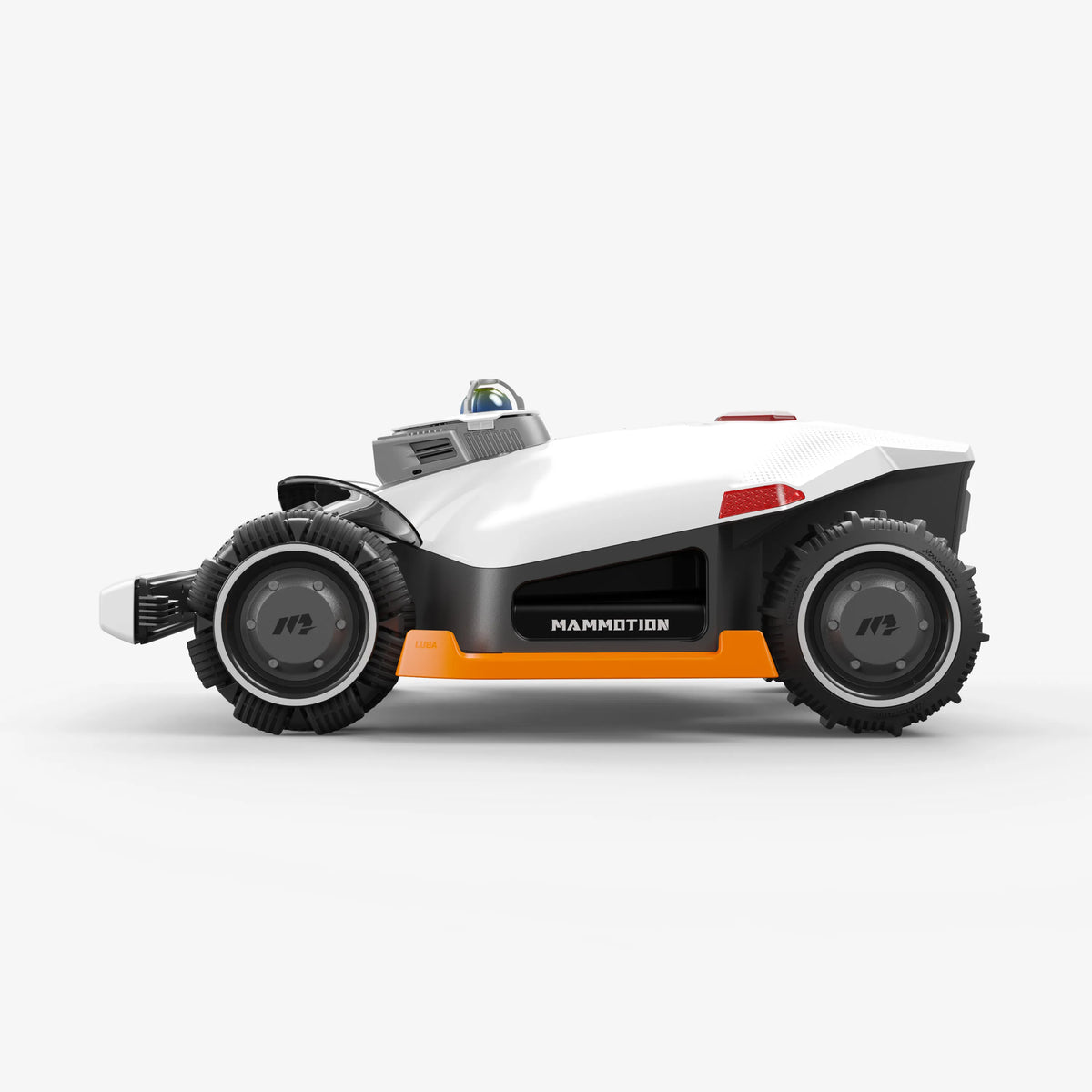 Product image: Mammotion LUBA 3 AWD official product page. Used for product identification; not independent performance evidence.
That is why the brand matters outside China. LUBA was not famous because it was another cheaper Chinese mower. It became visible because it made the product conversation about localization, navigation, traction, mapping, app software, and service. Those are robotics questions.
Shenzhen and Dongguan Context
Mammotion's story fits the Pearl River Delta better than it fits the old "cheap China factory" stereotype. Outdoor robotics needs far more than final assembly. It needs motors, waterproofing, molded housings, battery packs, embedded controllers, camera or LiDAR modules, RTK or GNSS integration, app development, cloud services, quality testing, export packaging, and after-sales logistics.
Shenzhen is unusually good at compressing those layers. A hardware team can find embedded developers, PCB suppliers, sensors, tooling shops, app contractors, industrial designers, logistics providers, and trial-production partners within the same regional network. Dongguan's Songshan Lake robotics cluster adds another layer: mobile-robot chassis companies, machine shops, and robotics engineers who are used to building low-speed autonomous platforms for industrial or research use.
This does not guarantee consumer-product polish. In fact, the transition from robotics chassis to homeowner product can expose weaknesses. A university or industrial customer may tolerate debug logs, firmware iteration, and hands-on setup. A homeowner who paid several thousand dollars for a mower expects the app, repair flow, replacement parts, and support response to work like a mature appliance brand. That gap is where many Chinese hardware companies learn the hard lessons of global own-brand manufacturing.
The pattern is not unique to Mammotion. DJI, Anker, EcoFlow, Roborock, and other Chinese hardware brands all crossed the same bridge from manufacturing competence to branded customer ownership. The difference is that Mammotion chose an outdoor robot category where weather, terrain, yard shape, connectivity, and local repair infrastructure make the customer-experience problem unusually difficult.
Product Family Map
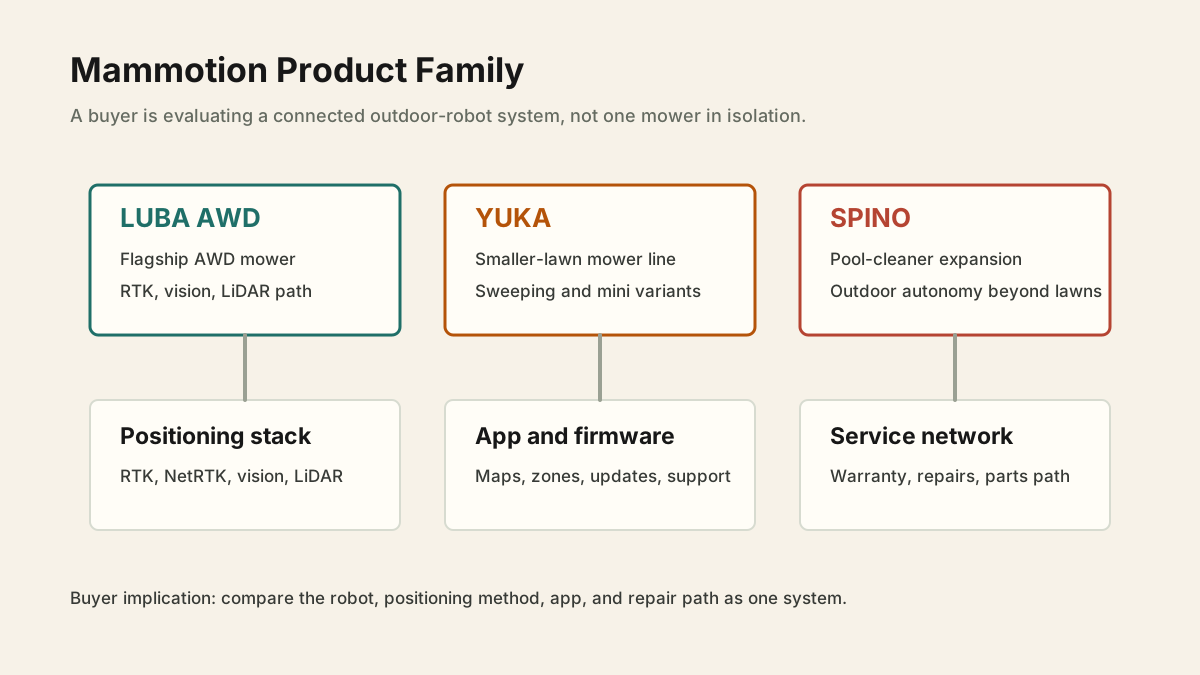
Mammotion is no longer only LUBA. The product family now looks like an expanding outdoor-robotics portfolio, with SPINO E1 support materials showing how the company wants to move from lawns into pool care.
| Line | Positioning | What it signals |
|---|---|---|
| LUBA AWD / LUBA 2 / LUBA 3 | Flagship wire-free AWD mower line for larger or more difficult lawns | Mammotion's core proof point: traction plus positioning |
| LUBA mini | Smaller AWD mower variants, including LiDAR versions | Down-market expansion without abandoning the robotics stack |
| YUKA / YUKA mini | Smaller-lawn and sweeping-oriented mower line | Broader consumer segmentation beyond flagship buyers |
| iNavi / positioning services | NetRTK, vision, LiDAR, and app-positioning features | Mammotion wants the navigation layer to become a platform advantage |
| SPINO E1 / S1 Pro | Pool-cleaning robots | Expansion from lawn autonomy to outdoor-home autonomy |
| Accessories and service products | Blades, RTK mounts, 4G service, extended warranty | Recurring ownership and support layer |
The LUBA 3 underside makes one physical distinction visible: the flagship uses two cutting discs. That image identifies the deck layout only; it does not prove cutting quality, coverage, or performance on a particular lawn.
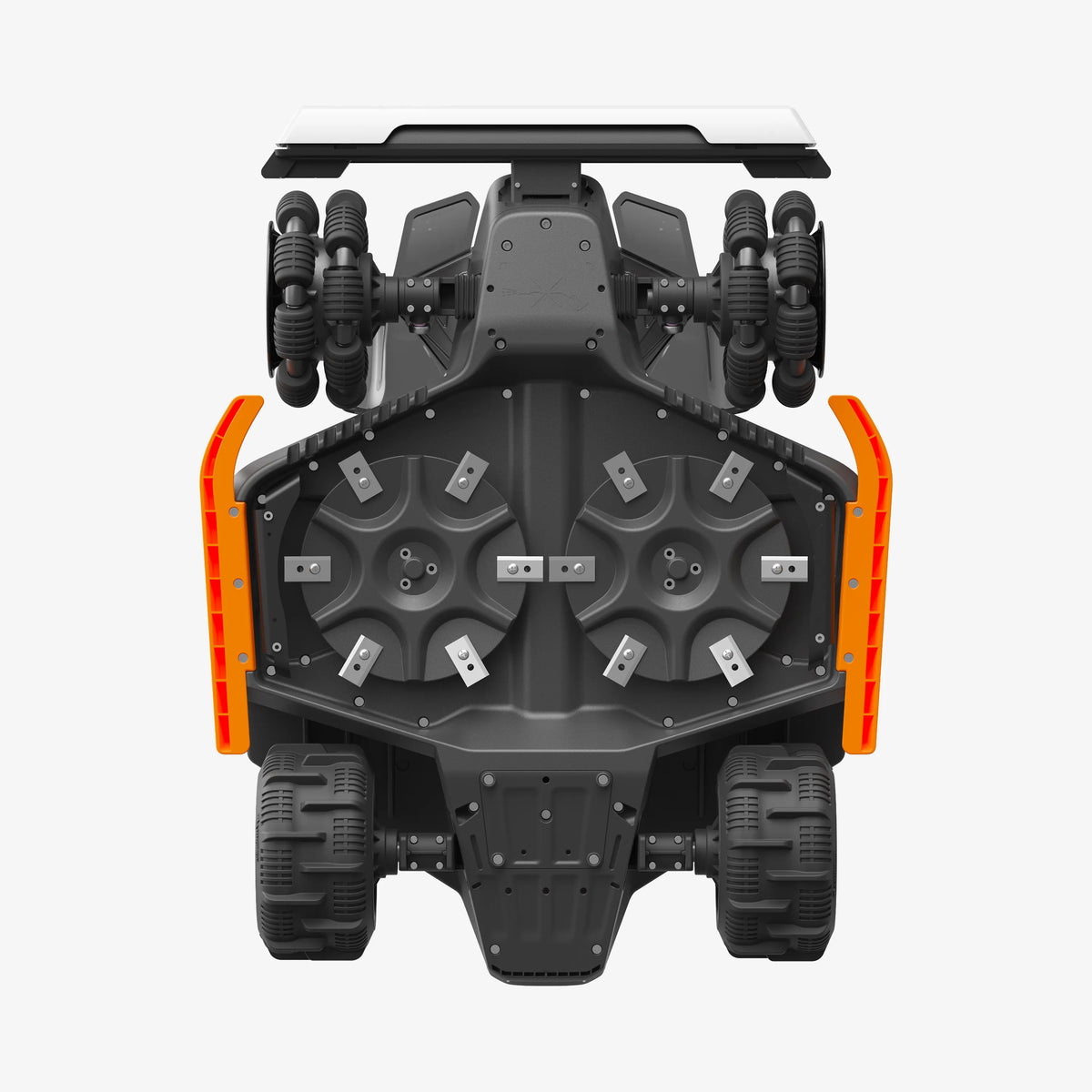 Product detail: Mammotion LUBA 3 AWD official product page. Used to identify the cutting-deck layout; not independent cutting-performance evidence.
That timeline shows a company trying to do three things at once. First, defend the flagship LUBA franchise. Second, cover more lawn sizes and price bands. Third, reuse the autonomy stack beyond mowing. The pool-cleaner move is especially revealing: Mammotion is not only asking, "How many mowers can we sell?" It is asking, "Can we become an outdoor robot company?"
Official Claims vs Buyer-Relevant Evidence
A Mammotion buyer should keep four evidence buckets separate.
The first bucket is official product information. Mammotion can tell you the model names, claimed slope capability, battery configuration, warranty table, supported countries, app functions, and product positioning. These are legitimate sources for what the company promises.
The second bucket is Chinese entity and founder information. Apple, EqualOcean, Mammotion's Chinese pages, UESTC, and AgileX materials help identify the company, founder, and robotics lineage. These sources explain the origin story; they do not prove a given unit will be reliable.
The third bucket is retailer and app-store feedback. App Store reviews, Amazon listings, Home Depot listings, and other channels can show patterns: app complaints, mapping praise, setup friction, shipping problems, or support frustration. They are useful, but they are not controlled samples.
The fourth bucket is complaint forums: BBB, Reddit, Facebook groups, and owner communities. These are important because service failures show up there before they appear in polished marketing material. They are also selection-biased. Happy owners are mowing; angry owners write posts. The right conclusion is not "ignore complaints" or "the company is bad." The right conclusion is: turn recurring complaints into due-diligence questions.
For Mammotion, the recurring user-signal questions are consistent: How responsive is support in your country? Are repair centers local or cross-border? Are parts available for the component most likely to fail in your use case? Does the warranty start from purchase, delivery, or app activation? Can the app and firmware be used reliably with your yard, phone, network, and comfort level with cloud-connected devices?
Warranty and Support: What Can Be Verified
Mammotion's current After-Sales Policy is the more useful starting point for a 2026 buyer. It says warranty service applies in the country where the product was purchased and used, and can be voided outside that recognized market. It also tells buyers who purchased from a local dealer to contact that dealer first, then states that proof of purchase and serial number are part of the claim file.
The model table is not one generic promise. Older LUBA 1 and LUBA 2 lines are listed at two years for the specified components, while the policy lists three years for the named battery, motor, LiDAR/vision, PCBA, GPS, charging-station, and—in specified LUBA 3 models—RTK components of the LUBA 3 AWD series. It also lists three years for the named components on LUBA mini 2 AWD 1000. The warranty clock normally starts with the first purchase from Mammotion or an authorized dealer; for certain direct-sales purchases where that date cannot be verified it starts at activation, while pre-orders start at warehouse shipment. Cutting blades, tires, cutting discs, charging cables, bags, and other wear items are excluded except for the policy's limited early material/workmanship provision.
The policy says Mammotion may repair or replace an in-warranty product or component, and that a repair or replacement does not restart the original warranty period. Its separate Repair Service page says the company has a certified service network in more than 30 countries and regions, will provide replacement service if an in-warranty repair exceeds 30 days, and offers lifetime maintenance. Those are published company terms, not independently verified repair-speed data for every country.
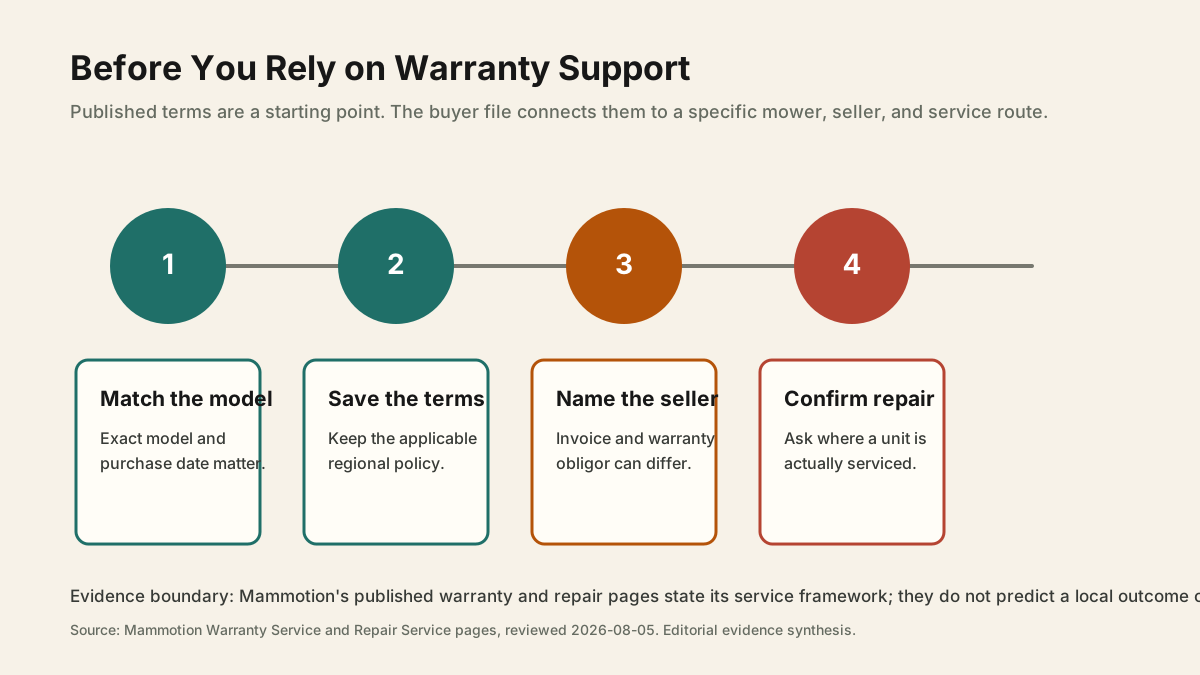
Those terms are concrete enough to turn into a buyer file. Before buying, save the policy for your region, model page, seller entity, order confirmation, serial number, and any extended-warranty terms. If buying through a retailer, ask whether that retailer is the first claim contact and which service station will receive the mower. If buying direct, confirm the repair geography and the written terms that apply to the exact model.
2026 Software and Support Signal
LUBA's current ownership risk is not only mechanical. Mammotion's own LUBA 3 release log shows a rapid software-maintenance cadence. Its July 18, 2026 entry says the company fixed a positioning failure, occasional map disappearance, and an RTK reference-station movement misreport; earlier 2026 releases also list mapping, connection, charging, and operating-behavior changes. That is evidence that the product is still actively maintained. It is not evidence that every unit had those problems, or that the current firmware will behave the same way in every yard.
An independent TechRadar test of the LUBA 3 AWD 3000 reported strong results on the reviewer's large, complex lawn while noting occasional remote-connectivity and interface quirks. Read alongside release notes and owner posts, that is the more useful picture: capability and software maturity can coexist. A buyer should ask which positioning mode is installed, record the firmware version at setup, and confirm the recovery path for map, RTK, connectivity, or app-account problems before relying on automation during peak mowing season.
Support Complaints: What They Do and Do Not Prove
The complaint signal is real, but it must be handled carefully.
The BBB complaints page for Mammotion's Ontario, California profile lists the company as not BBB accredited and shows 18 total complaints in the last three years, with 8 closed in the last 12 months at the time of review. Complaint categories include product issues, service or repair issues, customer service, delivery issues, and sales/advertising issues. The same BBB page warns readers that complaint details may not represent all complaints, that consumers may choose not to publish details, and that BBB does not verify every third-party statement.
That makes BBB a user-signal source, not a verdict. Eighteen complaints may be meaningful for a small business or minor for a high-volume brand; public sources do not provide enough shipment, country, and support-ticket denominator data to calculate a failure rate. The value is in the themes: warranty communication, repair delays, product functionality disputes, missing parts, and delivery resolution.
Reddit tells a similar story. The `r/mammotion` and `r/MammotionTechnology` communities include owners who praise the product, owners who struggle with app behavior, and owners who complain about support response, firmware changes, account/app access, replacement parts, or repair times. Reddit is useful because it reveals the lived experience of a connected outdoor robot. It is unreliable if used to estimate defect rates.
The App Store signal is also mixed. Apple's Mammotion app page lists the developer as `深圳库犸动力科技有限公司`, a 3.1 out of 5 rating at the time of review, and public reviews that range from successful setup and positive LUBA mini experiences to complaints about map editing, Bluetooth/remote connection switching, and app polish. That is exactly the kind of signal a buyer should expect from a rapidly evolving connected hardware product.
My reading: Mammotion has enough official warranty infrastructure to be treated as a real company, not a fly-by-night brand. But the support risk is material because the product is not self-contained. If the app, firmware, RTK station, charging dock, cloud account, or regional repair flow breaks, the mower's value can fall sharply even if the chassis is mechanically sound.
Mammotion vs Legacy Wire Mowers and Other Chinese Brands
The comparison frame should start with architecture, not price.
Legacy perimeter-wire mowers solve the localization problem with infrastructure. The buyer installs a wire, and the robot stays inside it. That is crude but robust. A wire can be annoying to bury and repair, but it is understandable. The system works because the environment has been physically simplified.
Wire-free mowers solve the same problem with sensing, positioning, mapping, and software. That is more elegant when it works and more complex when it fails. RTK can be sensitive to sky visibility and station placement. Vision can struggle with lighting and edge cases. LiDAR adds perception capability but also cost and new failure modes. App-based mapping is powerful, but bad UX can turn a small yard edit into a support ticket.
Mammotion's LUBA line competes by making the wire-free stack feel practical for real lawns, especially sloped or irregular ones. Segway Navimow, Husqvarna EPOS/NERA, Dreame, Sunseeker, Yarbo, Ecovacs-linked players, and other Chinese or global brands are attacking the same problem with different mixes of RTK, vision, LiDAR, local dealers, and service networks.
That means "Mammotion vs X" is not only a spec comparison. It is a system comparison:
- Positioning: RTK base, NetRTK, vision, LiDAR, or hybrid.
- Mobility: AWD traction, slope claims, wheel design, weight, ground impact.
- Software: mapping, zone editing, route planning, firmware update history.
- Service: dealer support, direct support, local repair center, replacement parts.
- Ownership: consumable cost, battery path, app dependency, warranty duration.
Mammotion's advantage is that it made AWD wire-free mowing legible early and has moved quickly across the portfolio. Its weakness is the same weakness many fast Chinese hardware brands face: the global service layer must mature at the same speed as product launches.
Buyer and Owner Checklist
Use this checklist before replacing a traditional mower with a Mammotion robot mower.
1. Match the yard to the positioning method. If your lawn has heavy tree cover, narrow sky view, metal structures, steep transitions, retaining walls, or many disconnected areas, do not rely on the slogan "wire-free." Ask which exact positioning mode the model uses and what installation constraints apply.
2. Verify the regional warranty page. Mammotion's global support pages provide a useful baseline, but regional terms, sellers, and retailer return windows may differ. Save the warranty language that applies on the purchase date.
3. Identify the seller and warranty obligor. Is the seller Mammotion direct, Amazon, Home Depot, Lowe's, a dealer, or another marketplace seller? Which entity appears on the invoice? Which entity handles returns after 30 days?
4. Ask about repair geography. A mower that must be shipped across a country for a docking sensor or wheel-motor issue has a different ownership risk from a mower supported by a local dealer.
5. Price the ownership layer, not only the mower. Include blades, tires, battery path, charging station, RTK station, 4G service if needed, extended warranty, and expected downtime during peak mowing season.
6. Read complaints by theme. Ignore all-caps conclusions and look for repeat patterns: app instability, map corruption, repair delay, replacement parts, warranty documentation, or delivery handling.
7. Test the app assumption. If your tolerance for firmware updates, cloud accounts, app-based mapping, and support-ticket troubleshooting is low, a simpler mower with dealer support may be better even if the specification sheet looks weaker.
8. Keep evidence from day one. Save screenshots of activation date, app warranty status, serial number, invoices, shipping proof, installation photos, support chats, and firmware versions. Connected hardware disputes are much easier to resolve when the record is clean.
This is not anti-Mammotion advice. It is realistic connected-robot advice. The same logic applies to most new-generation robotic mowers.
What Remains Uncertain
Several points remain uncertain from public sources.
First, Mammotion's corporate structure is not fully transparent. The public entity chain is strong enough to identify the brand as Chinese and Shenzhen-linked, with `深圳库犸动力科技有限公司` cross-checked through Apple and EqualOcean, and `魏基栋` cross-checked through Chinese sources. But the relationship among `深圳库犸动力科技有限公司`, `深圳库犸科技有限公司`, Mammotion Technology Co., Limited, and regional sellers is not fully mapped in public English sources.
Second, shipment and support denominators are not public. Mammotion claims 400,000+ families and category leadership, but without audited shipment, country mix, support-ticket volume, repair turnaround, and replacement rates, outside observers cannot calculate reliability or support quality at scale.
Third, product-line speed creates both opportunity and risk. LUBA, LUBA mini, YUKA, YUKA mini, iNavi, Tri-Fusion, and SPINO show fast iteration. Fast iteration can produce real improvements. It can also fragment parts, firmware behavior, documentation, and support training.
Fourth, the user-signal layer is noisy. BBB and Reddit reveal real owner frustration, but they do not provide a representative sample. Treat them as a map of what can go wrong, not proof that every buyer will experience it.
What Mammotion Reveals About Chinese Robotics
Mammotion is a useful case study because it is neither a famous national champion nor a faceless OEM. It is a newer Chinese brand trying to own the full stack: product idea, robot chassis, positioning, software, app, export channel, warranty, and consumer relationship.
That is the direction many Chinese hardware companies are moving. The older model was to make products for someone else's brand. The newer model is to turn manufacturing speed and engineering depth into a branded product family. In robotics, that transition is harder than in chargers or headphones because the product must operate in messy physical environments after the sale.
Mammotion's opportunity is obvious. Mature markets have expensive lawn labor, aging homeowners, large suburban yards, and growing comfort with robot vacuums and app-controlled devices. A wire-free mower that can handle slopes and complex yards has a real problem to solve.
Mammotion's test is also obvious. Can a Shenzhen/Dongguan robotics team build not only the robot, but also the long-term trust layer that homeowners expect from an outdoor appliance? That means spare parts, repair centers, app stability, firmware discipline, warranty clarity, and honest communication when something breaks.
If it succeeds, Mammotion will be one of the more interesting Chinese hidden champions in consumer robotics: a company that took mobile-robot know-how out of labs and industrial parks and put it into ordinary yards. If it struggles, the reason will probably not be that China cannot build the hardware. It will be that global connected-hardware support is a different discipline from rapid product engineering.
Claim Confidence File
| Claim | Confidence | Evidence boundary |
|---|---|---|
| Mammotion is a Shenzhen-linked Chinese outdoor robotics company | High | Supported by official, app-store, EqualOcean, and Chinese-language sources |
| Jidong Wei / Wei Jidong / 魏基栋 is the founder figure tied to Mammotion and AgileX lineage | High | Supported by PRNewswire, AgileX, and Chinese university/company coverage; English name order varies by source |
| Mammotion is the world's number-one wire-free robot lawnmower brand | Medium | Mammotion attributes this to Frost & Sullivan research; underlying methodology and category definition should be checked before using as neutral market fact |
| Official warranty and repair pages prove every country has fast local service | Low | They provide company promises and service framework, not verified repair turnaround by market |
| BBB, Reddit, and app reviews prove the product has a known defect rate | Low | Useful owner-signal sources, but selection-biased and not a statistical denominator |
| Buyers should document seller entity, warranty terms, repair geography, and app/cloud dependence | High | Directly follows from connected-hardware ownership risk |
Frequently Asked Questions
Is Mammotion a Chinese company?
Yes. Public sources identify Mammotion as a Shenzhen-linked Chinese robotics company. Apple's App Store page lists the Mammotion app developer as `深圳库犸动力科技有限公司`, EqualOcean lists the legal name the same way, and Mammotion's Chinese profile materials connect the brand to `库犸科技` and founder `魏基栋`.
Who founded Mammotion?
PRNewswire identifies Jidong Wei as founder of Mammotion. Chinese sources identify the founder/CEO of `库犸科技` as `魏基栋`, and AgileX materials refer to the same robotics founder as Wei Jidong or JD Wei. The most careful rendering is Jidong Wei (魏基栋).
What makes Mammotion LUBA different from older robot mowers?
LUBA's breakthrough was not simply that it cut grass automatically. The original pitch combined perimeter-wire-free setup, RTK positioning, all-wheel drive, app mapping, multi-zone management, recharge behavior, and anti-theft monitoring. That moved the category from a buried-wire appliance toward an autonomous yard-robot system.
What is the Mammotion Luba warranty?
The current After-Sales Policy makes the answer model- and market-specific. It lists two years for specified LUBA 1 and LUBA 2 components, and three years for the named LUBA 3 AWD and LUBA mini 2 AWD components; it also sets territorial limits, purchase/activation/pre-order start rules, dealer-first handling, and exclusions for many consumables. Save the policy and order record that apply where you buy and use the mower.
Are Mammotion Luba problems common?
Public sources do not provide enough data to calculate a defect or complaint rate. BBB and Reddit show recurring user-signal themes around support responsiveness, repairs, app behavior, parts, and warranty documentation, but those sources are anecdotal and selection-biased. They should inform a buyer checklist, not serve as a statistical verdict.
Methodology
This desk-research dossier uses Mammotion official pages for product-family, firmware, and warranty claims; PRNewswire for the 2022 LUBA launch, founder mention, and AgileX lineage; Apple App Store and EqualOcean for Chinese entity verification; UESTC and Mammotion Chinese materials for founder Chinese name checks; and BBB, Reddit, App Store reviews, and one independent review only as bounded user or product-test signals. It is not a hands-on test, warranty-administration record, or defect-rate study. Official company claims are labeled as claims where shipment, leadership, market-share, service, or support-ticket denominators are not independently audited in public sources.
By China Made & Tech Team. Independent English field guide to China's niche hardware brands, hidden champions, founders, factory towns, and supplier clusters.
Related Entries
- China factory robot deployment — broader China robotics and embodied-AI context
- How China Manufactures: Inside the World's Factory (2026) — how Chinese manufacturing systems turn engineering into export products
- Shenzhen Manufacturing: Complete Ecosystem Guide (2026) — Shenzhen hardware ecosystem and product-iteration context