

Cixi can make a small-appliance search much faster. It cannot make the supplier decision for you.
By China Made & Tech Team — an independent, desk-research field guide to Chinese manufacturing and technology.
A dense appliance cluster is exciting precisely because it creates too many plausible answers. A buyer can move from kettles to air-treatment products, kitchen tools, grooming devices, seasonal heaters, fans, and accessories in a short span of conversations. Similar-looking products appear in different material grades, with different motors, heating elements, controllers, moulds, packaging systems, and service assumptions. That abundance can compress a search. It can also conceal the moment when a buyer stops comparing a market and starts appointing a party responsible for an exact delivered product.
Cixi, in Zhejiang, is useful in that first sense. A May 2026 Zhejiang industry record reports that the core area of Cixi’s modern-furniture and intelligent-appliance cluster reached 108.38 billion yuan in 2025 revenue. The same record describes more than 20 provincial intelligent factories and digital workshops cultivated over three years, and more than 10,000 patent applications across 48 small-appliance categories in 2025. Those are meaningful signs of category depth and activity. They do not identify the factory that controls your model, the components inside it, or the obligation that survives after a shipment. Read the Zhejiang cluster record.
The central rule of Cixi sourcing is therefore simple: use the cluster to make discovery and comparison more intelligent; use a product-and-responsibility file to make the award decision. The place can help you find choices. The file has to show which choice is real, repeatable, documented, change-controlled, commercially accountable, and appropriate for the product brief you actually own.
Quick answer: what Cixi can do, and what it cannot do
For a buyer of a defined small-appliance category, Cixi can be a productive discovery market. It can make it easier to find product families, identify component routes, compare suppliers with different roles, test the quality of their questions, and learn how a category is assembled. Its density is most valuable before a shortlist exists: when the buyer is still finding the right product architecture, production partner, and commercial route.
It is not a qualification system. Cluster revenue is not a supplier score. A platform introduction is not a factory audit. An exporter’s category history is not proof that the exporter made your appliance. A sample is not proof that the production bill of materials will be the same. A document is not proof until it is connected to the exact model, configuration, factory, scope, date, and purchase arrangement that matter to the buyer.
| Cixi can speed up | Cixi cannot establish for you |
|---|---|
| Finding product families and viable category conversations | That a particular company owns the product design or operates the final assembly process |
| Comparing components, finishes, packaging ideas, and product positions | That a component, process, or version will remain unchanged after sampling |
| Meeting manufacturers, traders, component firms, and export coordinators | That one party accepts responsibility for quality, delivery, warranty, and service |
| Seeing a busy appliance ecosystem and trade-service channels | That a specific appliance fits a target destination, retail channel, or customer use case |
| Building a shortlist more quickly | That the lowest quotation represents the same product and obligation as the next quotation |
Why Cixi belongs on a small-appliance buyer’s map
The productive way to think about a manufacturing cluster is not as one huge factory. It is a local field of overlapping capabilities. Finished-product assemblers sit beside firms that make or source components, moulds, metal parts, plastic parts, cables, controls, packaging, sales channels, and export services. That does not mean every function is local, or that every candidate has the same depth. It means a buyer can investigate a product family through more than one route.
A January 2026 Zhejiang Council for the Promotion of International Trade record describes Cixi as having more than 2,000 appliance manufacturers and nearly 10,000 upstream and downstream companies. It also describes a local appliance-platform program rather than a single supplier directory. The practical implication is not that a buyer should contact thousands of companies. It is that a clear brief can generate several genuinely different conversations: an OEM conversation, a product-development conversation, a component-control conversation, an export-coordination conversation, and occasionally a conversation with a party that only looks like a manufacturer until roles are tested. The CCPIT’s Cixi platform record is useful context for that density.
That density changes four parts of a buyer’s work.
It compresses category learning
Small appliances are easy to underestimate because their visible form is compact. A blender, kettle, garment steamer, fan, trimmer, coffee tool, heater, diffuser, air-treatment device, or kitchen accessory may look simple in a listing. The production object is a system. It has a use case, an input or power arrangement, a control logic, a material stack, a thermal or mechanical load, a user interface, a cleaning or maintenance story, a packaging journey, and a service life. Two products with similar photography can be quite different systems.
In a dense market, a buyer can compare those systems more quickly. One supplier may start by asking about the intended user, target retail channel, annual volume, destination, replacement-parts expectation, and price architecture. Another may begin with a catalogue image and a quotation. Neither opening is a final verdict, but the contrast reveals where the buyer needs to ask better questions. The purpose of a first round is not to award a product. It is to learn which variables actually define the category.
It makes roles easier to separate
The phrase “supplier” covers too much. A business may design and manufacture a complete appliance. It may assemble a product from controlled and uncontrolled external parts. It may own a mould but buy the electronics. It may trade a finished product from another plant. It may coordinate export documentation while another entity controls production. It may have a good sales team but no authority over the product changes that matter after a sample is approved.
Cixi’s density lets a buyer encounter these roles close together, which is useful if the buyer labels them rather than blending them into one vendor column. A product developer is not automatically the best repeat-production partner. A component expert is not automatically the legal seller. A capable exporter is not automatically the manufacturer. A factory may be the right partner, but the buyer still needs to know which factory, which legal entity, which product line, and which responsible people are connected to the order.
It improves comparison only when the brief is controlled
An uncontrolled request for quotation produces a stack of prices. A controlled request produces information. If every candidate receives a different verbal description, each quotation contains a different appliance, a different set of assumptions, and a different level of commercial exposure. The buyer may believe the gap is cost; the gap may be a heating element, battery cell, motor, controller, material thickness, carton construction, instruction set, test scope, warranty promise, or delivery term.
A cluster gives the buyer enough candidates to make comparison useful. It does not solve the comparison problem. The buyer solves that by deciding what is fixed, what may vary, who can approve a variation, and what evidence must travel with any change.
It can make recovery faster—but not automatic
When a component is unavailable, a finish is inconsistent, a mould needs revision, or a package cannot survive the intended distribution path, a concentrated supply environment may create more alternative conversations. That can be a real advantage. It should never be confused with a right to substitute without approval. A faster alternative is still an alternative: it may affect performance, durability, appearance, documents, cost, lead time, user experience, or the validity of prior test work.
The buyer’s job is to turn recovery speed into controlled recovery. That means knowing which change is proposed, why it is proposed, what it touches, what evidence has to be revisited, who approves it, and whether the original commercial commitments remain intact.
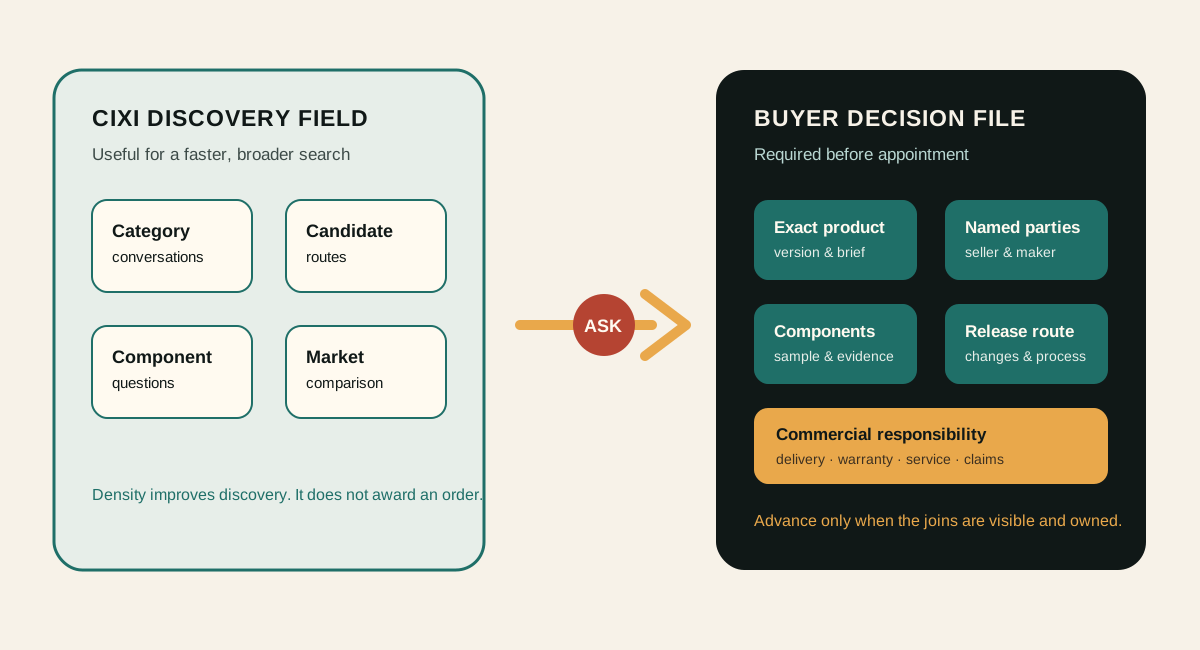 Editorial sourcing framework: a cluster can accelerate discovery, while a product-specific proof file remains a separate decision.
Read public scale and trade activity with the right scope
Public numbers make Cixi relevant. They should not make a buyer careless.
The Zhejiang cluster record cited above describes a 2025 core-area revenue measure, a three-year program count for provincial intelligent factories and digital workshops, and 2025 patent applications across 48 categories. A separate March 2026 provincial report also describes Cixi’s 2025 108.38-billion-yuan core-area result in the context of a newly identified thousand-billion-yuan cluster core area. The numbers are useful because they tell a buyer that this is not an isolated product town. They do not measure the number of suppliers suitable for a particular brief, and they do not establish whether a candidate has the right people, tools, inputs, quality process, or service model for one SKU. See the March 2026 provincial cluster report.
The same discipline applies to platform activity. The January 2026 CCPIT record says that its Cixi appliance-platform program had five overseas venues, relationships with more than 20 e-commerce platforms, and more than 100 matching activities. It also reports transaction facilitation above 1 billion yuan and direct cross-border exports above 50 million yuan. These are program-level descriptions. They can help a buyer understand why there may be more routes to discovery and overseas channels. They do not tell the buyer which participant is the manufacturer, whether an individual shipment met a buyer’s specifications, or whether a candidate will remain responsible when a problem appears. Read the full CCPIT platform description.
Category export reporting needs the same restraint. A February 2026 CCPIT report, attributing figures to customs data, states that Cixi heating-appliance exports reached 3.32 billion yuan in the first 11 months of 2025, including 1.28 billion yuan to the European Union and 8.4% year-on-year EU growth. That tells a buyer something narrow and useful: a defined product category had meaningful reported trade activity in a stated period and destination. It does not establish that any particular heater supplier is suitable for an EU order, has the appropriate product and document set, can meet the buyer’s design, or will deliver consistently. The heating-appliance report retains that category and date context.
This is not excessive caution. It is how a buyer keeps useful market context from mutating into a decision that the public record never made. Treat each source as a description of its own object: a cluster, a program, or a category’s reported trade activity. Then build evidence for your different object: the exact appliance and the parties who will make, sell, ship, support, and stand behind it.
Start with an appliance identity, not a catalogue image
The fastest way to waste a strong cluster is to begin with “something like this.” A photograph is a starting reference. It is not a product definition.
Before contacting candidates, create a one- or two-page appliance identity sheet. It can evolve. It does not need to settle every engineering detail before the first conversation. It does need to make the unknowns visible, because unknowns are where quotations become falsely comparable.
For every product family, decide what the buyer is actually asking for.
| Product identity area | A useful question | Why it matters before price comparison |
|---|---|---|
| Intended use | Who uses it, how often, and in what environment? | Use conditions drive what must be discussed, tested, packaged, and supported. |
| Product configuration | What exact version, size, colour, accessories, controls, and optional items are in scope? | A family name can hide several materially different versions. |
| Target market and channel | Where will it be sold, through what channel, and with what user information? | The commercial product includes the way it is presented, labelled, supported, and delivered. |
| Material and component intent | What is fixed, what is preferred, and what can change only with approval? | This separates a design preference from a controlled bill of materials. |
| Performance intent | What should the user be able to do, and what must remain stable over time? | It turns a product feature into a future sample, test, and acceptance conversation. |
| Packaging and service | How will it travel, be unpacked, used, repaired, returned, or replaced? | A finished appliance reaches the customer through more than final assembly. |
| Commercial pattern | Is this a project, launch, trial, repeat program, or seasonal order? | Volume, timing, spares, warranty, and change control differ across these patterns. |
Separate fixed requirements from conversation starters
Many early briefs mix three things that should be separate.
First are fixed requirements. These are decisions the buyer has already made: a specific product family, target retail position, dimensions, colour language, required accessory, packaging format, commercial timing, or approved reference. A candidate can state whether it can meet them.
Second are bounded options. Perhaps a buyer accepts two materials, a defined range of finishes, two approved packing approaches, or several component configurations subject to evidence. These can create productive comparison, but only if the limits are written down.
Third are open questions. Perhaps the buyer has not decided on a control layout, a component route, a service model, or a carton construction. An open question is not a defect. It becomes dangerous only when one supplier silently answers it and the answer later appears inside a price as though the buyer had approved it.
Ask candidates to respond in the same three columns: meets, proposes an option, or needs clarification. That small discipline turns a sales conversation into a comparison record. It also reveals the candidate that can say “we do not know yet” without hiding the uncertainty behind a familiar product picture.
Design the first request to expose roles
A serious first request should ask for more than a unit price. It should ask the candidate to identify the legal seller, proposed manufacturing entity or entities, principal product-development contact, quality contact, export contact if relevant, and person authorized to approve changes. It should ask where the sample will be made and whether the proposed production route differs from the sample route. It should ask which functions are in-house, controlled through designated partners, or merely purchased.
The point is not to make a candidate complete a bureaucratic questionnaire. It is to see whether the supply route can be named. An answer such as “our factory handles everything” may be correct, incomplete, or a sales shortcut. The next step is not to accuse the candidate; it is to request the product-specific map that makes the statement useful.
Build a candidate map before you build a shortlist
Once the product identity sheet is in circulation, make a candidate map. A shortlist should not be a row of company names with prices beside them. It should be a set of possible delivery systems that can be compared on the same dimensions.
For each candidate, create a record with five layers.
1. Party and role
Record the legal seller, the manufacturing entity, the product-development owner, the quality owner, the export or shipping coordination role, and the service or warranty contact. If several entities are involved, record the handoffs rather than flattening them. A multi-party route may be entirely workable. It becomes risky when no one is clearly responsible for the seams.
Ask who owns the relationship with the buyer, who owns the product file, who can approve a material or component change, and who has authority to release production. If a representative or trader is involved, ask what information it can obtain from the plant and what it cannot control directly. The objective is not to prefer one business model. It is to avoid assuming that a sales contact, a factory floor, and a contractual obligation belong to the same party when they do not.
2. Product-family fit
Ask for examples of the candidate’s relevant process and product family, but do not let a catalogue answer the entire question. A company that makes a similar appliance may still use a different construction, target a different price point, work with a different component set, or lack the intended packaging and service pathway.
Product-family fit is strongest when the candidate can discuss the buyer’s actual variables: version control, critical components, assembly sequence, likely sample path, known trade-offs, packaging approach, and where it needs more information. A generic “yes, we can do OEM” is an invitation to ask the next question, not a completed qualification.
3. Product-file ownership
Identify who can keep the approved specification, drawings, bill of materials, sample approvals, test material, packaging artwork, manuals, and release record together. The best owner is not necessarily the person who speaks the most fluently about the product. It is the person or process with the authority to keep production from drifting away from the agreed version.
If information is scattered across a sales person, a product engineer, a factory manager, a component supplier, a packaging supplier, and a buyer’s own inbox, the risk is not that any one person is unreliable. The risk is that a change can occur without the whole system seeing it.
4. Evidence path
Write down what the candidate can show, what is promised later, and what must be independently reviewed by the buyer’s own appropriate advisers or technical resources. The relevant evidence will vary by product and market. The discipline remains the same: connect a document, sample, test, specification, or process record to the exact version and entity being considered.
“We have documentation” is an incomplete statement. The useful version is “Here is the document, its scope, its date, the model or configuration it covers, the entity it names, the relationship to the proposed production version, and the change that would require us to revisit it.”
5. Commercial accountability
Finally, record who quotes, accepts the purchase order, receives payment, owns the agreed delivery obligation, handles defects, provides replacement parts, responds to a change request, and remains available after a sale. The cheapest offer may still be the right choice. The buyer cannot know until these obligations are attached to an appliance that is the same appliance being priced.
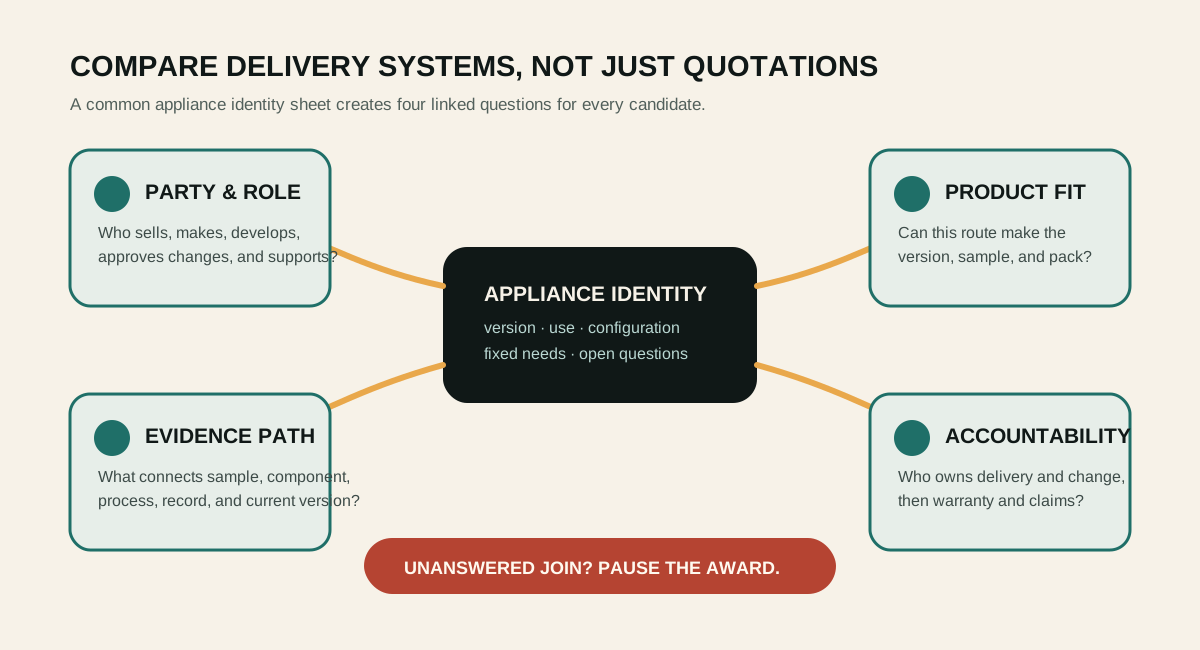 Editorial sourcing framework: compare delivery systems, not just catalogues and quotations.
The Cixi buyer file: turn a product into a controlled delivered system
The buyer file is not a decorative checklist. It is the working connection between what the buyer wants, what the supplier proposes, what has been approved, and who must act if something changes. It should grow in stages. An early candidate will not be able to fill every field. An award candidate should be able to make the important fields reviewable.
The specification and version record
Give the appliance a controlled identity. Record the product name, internal reference, proposed supplier reference, configuration, revision date, and who approved the current version. Attach or reference the drawings, dimensions, colour and finish standards, interfaces, accessories, user-facing features, packaging expectation, and other fixed buyer requirements.
The essential habit is to distinguish the latest picture from the approved version. A supplier may send a new rendering, a revised sample photograph, or a message saying that a feature has been improved. Each may be useful. None should silently replace the object that the buyer evaluated. A changed handle, plug, switch, heating element, motor, display, coating, mould, carton, manual, or accessory can create a new product decision even if the product name stays unchanged.
Keep a simple change register: what changed, why, who proposed it, what it affects, what evidence must be revisited, who approved it, and when it became effective. This is not a demand for elaborate software. A disciplined document and a clear owner are often enough for an early program. The important thing is that the supplier and buyer can answer the same question: “Which version are we discussing now?”
The bill of materials and critical-component view
Not every component needs identical scrutiny. Start by identifying what is critical to the product’s intended function, user experience, appearance, durability, serviceability, cost, and documentation path. Depending on the appliance, that may include a motor, heating element, power arrangement, control board, sensor, cable, connector, battery or charger, pump, blade, gasket, filter, coating, plastic resin, metal treatment, display, fastener, moulded housing, or carton structure.
The buyer need not pretend to be the product engineer. The buyer does need to know which parts would materially change the promised product if they changed. Ask the candidate to distinguish approved components from proposed alternatives, and in-house parts from externally supplied parts. Ask what triggers a substitution request. Ask whether the component name, supplier, specification, revision, or sample linkage can be kept visible.
This is where a Cixi comparison becomes more valuable than a catalogue search. If three candidates quote a similar item, the buyer can learn whether they are actually proposing the same architecture. The right result may be a common baseline, three consciously different options, or a pause because the buyer has not yet specified the critical variable. The wrong result is to treat hidden difference as competitive efficiency.
Samples are decision points, not souvenirs
A sample is the first physical version of the buyer’s product story. It should carry enough information to be evaluated as a version: who made it, where it was made, what components and configuration were used, what differs from the buyer’s brief, and what would be expected to remain the same in production.
Before approving a sample, record the criteria used to evaluate it. Those might include fit, function, appearance, assembly feel, packaging, instructions, accessories, usability, or other relevant aspects of the buyer’s product brief. Where specialist testing or destination-specific interpretation is necessary, scope and obtain it through the appropriate qualified channels; do not convert an informal inspection into a conclusion it cannot support.
When a sample is approved with changes, name the changes. “Approved with comments” becomes dangerous when the comments live only in a call or a chat history. Turn the decision into a versioned action: approved subject to these listed changes; new sample or evidence required for these changes; no change to these fixed characteristics without written buyer approval.
Tests and evaluation scope
The word “tested” is often too broad to be useful. A buyer needs to ask: tested for what, on which version, by whom, under what conditions, using what scope, and with what result? The answer will differ by appliance, market, and buyer policy. The editorial principle is universal: a result has meaning only when its object and boundary are clear.
Do not let a generic report become a magic amulet. If a candidate presents a document, connect it to the proposed model or configuration, the relevant entity, date, stated scope, and current component arrangement. If the product changes, ask whether the change affects the document’s connection to the product. If the product is intended for a particular market or channel, make that a separate decision with the appropriate product, commercial, and professional review rather than assuming that a prior export story resolves it.
Documents must follow the product, not lead it
China’s State Administration for Market Regulation describes the China Compulsory Certification system as a market-access system with stated public-interest purposes. That is a system-level statement. It is not a conclusion about a particular appliance, manufacturer, model, market, or buyer’s transaction. SAMR’s English-language CCC release explains the framework’s stated role.
For a buyer, the practical lesson is to avoid both extremes. Do not dismiss documents as irrelevant, and do not treat a generic document, logo, or certificate reference as the product itself. Ask what the document relates to and preserve the answer alongside the product version. The needed documents, their use, and their significance vary by product and destination. This article does not determine them. It does insist that a buyer make the connection explicit before it becomes a sales or release assumption.
Production process and lot traceability
When the sample moves toward production, the file should name the intended factory process. Which entity makes the product? Which operations are performed there? Which components arrive from designated sources? Who receives and checks them? How is the approved version communicated to the line? Who can halt or escalate a deviation? What identifies a production lot? How are approved changes reflected in production instructions, packaging, manuals, and outgoing documents?
The goal is not to demand that every supplier use the buyer’s preferred terminology. It is to make the route reviewable. A smaller manufacturer may have a practical process that is well understood by a named team. A larger manufacturer may have more formal controls. In either case, a buyer needs a way to learn whether the approved sample, released production instruction, incoming component choice, final packed unit, and shipment documentation refer to the same product definition.
Packaging, instructions, service, and the delivered experience
An appliance is not complete when it leaves final assembly. It must travel, be unpacked, understood, used, stored, maintained, and sometimes repaired or returned. Packaging can protect a product or create a claim problem. Instructions can clarify use or leave the customer with a mismatch between product and expectation. A spare part can save a relationship or reveal that no one planned for service.
Put these parts into the buyer file early enough to influence the product. Record the carton configuration, inserts, labels, accessory pack, manual version, language or market needs as defined by the buyer, spare-parts plan, warranty terms, service contact, claim pathway, and responsibility for each. Treat any of them as a versioned item when the product changes. A revised cord, accessory, control layout, packaging dimension, or material can create a user-experience and support implication even when it has no visible effect in a supplier’s product photograph.
Commercial terms are where the supplier map becomes real
A buyer can have a strong product file and still have an unclear deal. The commercial layer should attach responsibilities to the product version rather than sit beside it as a generic sales agreement.
At a minimum, the buyer should make the following questions answerable before award:
- Who is the contracting seller, and who is responsible for performance under the order?
- Which entity makes the product, and which parties are involved in material components, assembly, export coordination, or service?
- What exactly is the quoted configuration, and what is excluded or subject to confirmation?
- What is the agreed release point for samples, production, packaging, documentation, and shipment?
- What happens when a component, process, or packaging change is proposed?
- What evidence or approval is required before a changed version can proceed?
- How will deliveries, shortages, defects, returns, replacement parts, warranty claims, and after-sales contacts be handled?
- Who pays for which outcome when the delivered product departs from the approved record?
These are commercial and operational questions, not conclusions this article can answer for a particular transaction. Their value lies in forcing responsibility to become visible while the buyer still has options.
There is a useful Cixi-specific reason to do this early. In a dense cluster, the buyer can move quickly between candidates. That is an advantage only while product information remains portable and comparable. If a buyer allows every candidate to own a different interpretation of the brief, switching later becomes difficult. If the buyer owns the appliance identity, change record, sample observations, and release criteria, the buyer can change candidate with less loss of learning.
Use staged gates, not one irreversible award moment
The safest small-appliance decision is usually not a single leap from catalogue to order. It is a series of increasingly specific commitments. Each stage should answer a different question and leave the next decision reversible where possible.
Gate 1: product definition
Before a broad supplier search, confirm that the buyer can describe the intended product, user, channel, target market, fixed requirements, bounded options, and open questions. If the product is still only a mood board, use the first conversations to learn. Do not demand false precision, and do not compare prices as though the product were already settled.
Gate 2: candidate roles
Before samples, identify who is proposing to make, sell, coordinate, and support the product. Confirm the candidate’s product-family fit and where it needs clarification. A candidate that cannot name its proposed route is not necessarily dishonest; it is simply not ready to receive an award.
Gate 3: sample and evidence connection
Before a sample becomes a production reference, record what it is. Link it to a product version, proposed components, known deviations, evaluation criteria, and next actions. If it relies on a prototype-only component, alternate factory, substitute material, or provisional packaging, make that explicit.
Gate 4: production and document release
Before production, connect the approved specification, bill of materials or critical-component record, packaging, instructions, relevant documents, and change-control route to the intended production entity. The aim is not to prove everything with one document. It is to ensure that each important decision has an owner and a connection to the exact product.
Gate 5: commercial and service accountability
Before an order, connect the product file to the commercial arrangement. Confirm the seller, performance responsibility, delivery terms, payment path, warranty and service route, replacement-parts plan, claims path, and change authority. A supplier may provide excellent products and still be the wrong commercial structure for the buyer’s program. Better to learn that before the first order than after a launch.
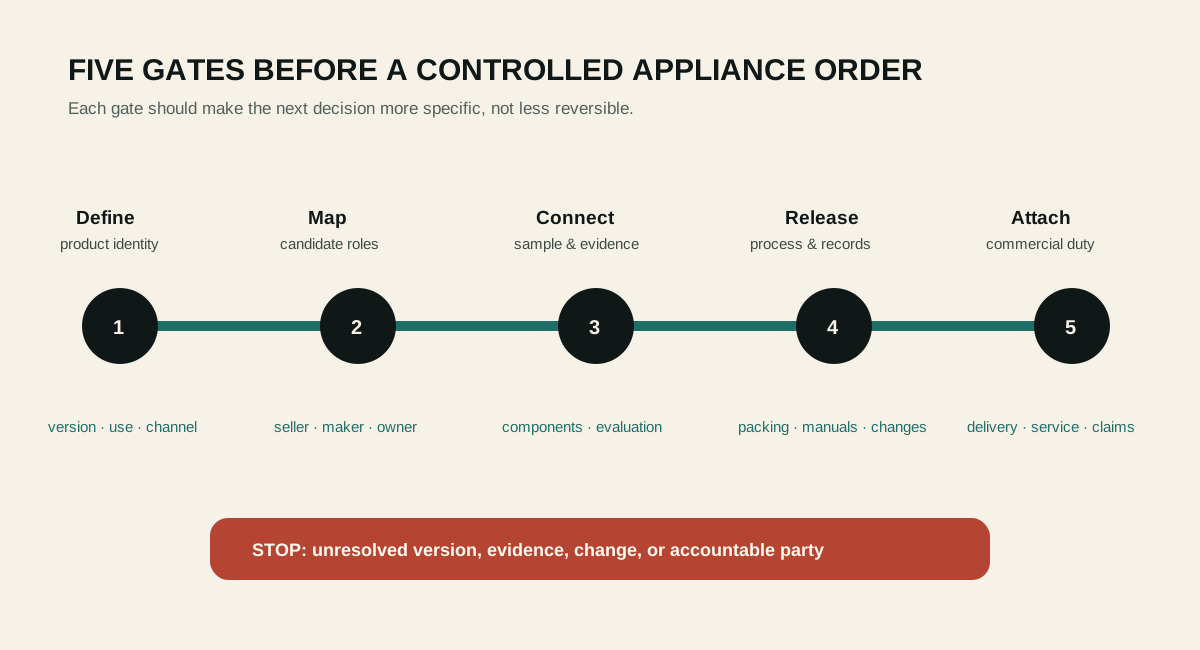 Editorial sourcing framework: advance only when the exact product, evidence, and accountable parties remain connected.
The stop rule
Pause the award when one of these questions has no clear answer: Which exact version is being offered? Who is making it? What are the material or component assumptions? Which sample represents the release direction? What changed since that sample? Which records and documents relate to the current product? Who can approve the next change? Who is contractually responsible for delivery and service?
The stop rule does not reject a candidate. It protects the buyer’s ability to choose. In a fast cluster, urgency often arrives as a message that a component is available only now, a price is valid only this week, or a production window is closing. Some opportunities are real. A buyer still needs a product and responsibility record strong enough to know what it is accelerating toward.
A 30-day Cixi discovery sequence
The following sequence is an editorial operating pattern, not a prescribed schedule for every product. It is useful because it avoids putting a price negotiation ahead of product definition.
Days 1–5: frame the product. Create the appliance identity sheet. Separate fixed requirements, bounded options, and open questions. Identify the buyer’s decision owners: product, quality or technical review, packaging, commercial terms, service, and final release.
Days 6–12: build the first candidate map. Contact a small, deliberately varied group of candidates. Ask each to name its role, proposed manufacturing route, product-family fit, sample route, known clarifications, and commercial contact. Do not narrow solely by catalogue breadth or opening price.
Days 13–20: compare product routes. Turn replies into a common comparison table. Note which candidates can connect their statements to a proposed product version and which are offering attractive but undefined alternatives. Select sample candidates based on fit and clarity, not only quotation.
Days 21–30: make samples and gaps visible. Request samples or further product material with version identifiers and a clear list of deviations. Record evaluation observations, unanswered questions, proposed changes, missing documentation or scope questions, and the commercial responsibilities that still need agreement. Decide whether to advance, request more evidence, revise the brief, or stop.
The benefit of this sequence is not speed for its own sake. It creates a learning loop. The buyer leaves the first month with a better product definition, a sharper view of candidate roles, and a list of decisions that must be made before any order deserves to be called controlled.
Common Cixi sourcing mistakes
Mistake: treating category breadth as uniform capability
An ecosystem can be broad while individual factories are narrow. That is often a strength: specialization can produce deep product knowledge. The mistake is to assume that a supplier who makes one appliance family can automatically control another because both are sold under the broad label “small appliances.” Ask about the exact product route instead.
Mistake: comparing prices before comparing product versions
Price is a useful signal only when the buyer knows what is included. A lower figure can reflect a better sourcing route, a different component set, a shorter service expectation, a different packaging assumption, or an omitted obligation. Ask candidates to state their assumptions before judging the price gap.
Mistake: accepting a sample without capturing its identity
A sample can be persuasive because it is physical. It still needs a version, a component context, a list of deviations, and an approval action. Otherwise, the buyer may approve an object that cannot be reliably recreated or whose production version later changes without a shared record.
Mistake: using a certificate reference as a shortcut to product truth
Documents matter when their connection to the exact product is clear. A generic reference, old file, unrelated model, unverified scope, or missing entity linkage is not the same as a current product decision. Keep the document in the product file, ask what it covers, and obtain appropriate product- and market-specific review where needed.
Mistake: leaving after-sales outside the sourcing decision
For a small appliance, the customer experiences the product long after the factory receives payment. Spare parts, user information, replacements, warranty handling, returns, and claim escalation should not be treated as a later administrative job. They shape the supplier and product choice from the beginning.
Frequently asked questions
Is Cixi a good place to find small-appliance suppliers?
It can be a very useful place to discover and compare candidates because current public records describe a large, category-rich intelligent-appliance environment. Whether it is the right place for your order depends on the exact product, proposed supplier route, components, evidence, commercial terms, and service requirements. Treat the cluster as a search advantage, not a recommendation of a supplier.
Should I work directly with a factory or through a trading company?
Neither label answers the whole question. A direct factory relationship can offer a clear production connection; a trading company can add coordination, communication, category knowledge, or export support. The buyer should identify who controls the product, who makes it, who accepts the order, who can authorize changes, and who owns the service obligation. Choose the delivery system that can make those links clear for the product program.
What should I ask for before accepting a small-appliance sample?
Ask what exact version the sample represents, who made it, what components and configuration it uses, how it differs from the requested product, what is expected to remain the same in production, and what evaluation or documentation questions remain open. Then record the buyer’s observations and any required changes in a versioned decision rather than leaving them in scattered messages.
Does export activity prove that a supplier can serve my destination market?
No. Reported category export activity is useful context, but it does not establish a particular supplier’s product, document set, capacity, delivery performance, or suitability for your market. Treat destination requirements and product evidence as a specific review for the actual model, entity, transaction, and channel.
What is the single most important file to own?
Own the evolving product-and-responsibility file: the approved product identity, version history, critical components, sample decisions, evaluation scope, packaging and manuals, proposed production route, relevant documents and their scope, change approvals, commercial terms, and service commitments. It lets the buyer compare candidates without losing the learning created by each conversation.
Method and limitations
This is an independent desk-research guide, not a factory visit, supplier audit, appliance or component test, certification assessment, legal opinion, customs opinion, or supplier recommendation. It uses 2025–2026 Zhejiang public records for Cixi’s cluster, platform, and category-trade context. Those records describe aggregate activity and programs, not a named supplier’s product safety, quality, capacity, price, delivery, warranty, or destination-market suitability. Before sampling, appointment, order, or change, recheck the exact supplier roles, product version, component set, evidence, documents, packaging, commercial terms, and service responsibilities for the transaction at hand.
Related entries
- China’s industrial clusters guide — the broader map for using factory-town density well.
- Guzhen lighting cluster — a companion buyer file for another dense product ecosystem.
- Yongkang hardware cluster — how product proof changes the value of a manufacturing town.
- How China manufactures — the operating context behind the sourcing workflow.