
The most useful thing HiTHIUM did this spring was not add another bigger box.
It tried to prove that a bigger box can fail in a more controlled way.
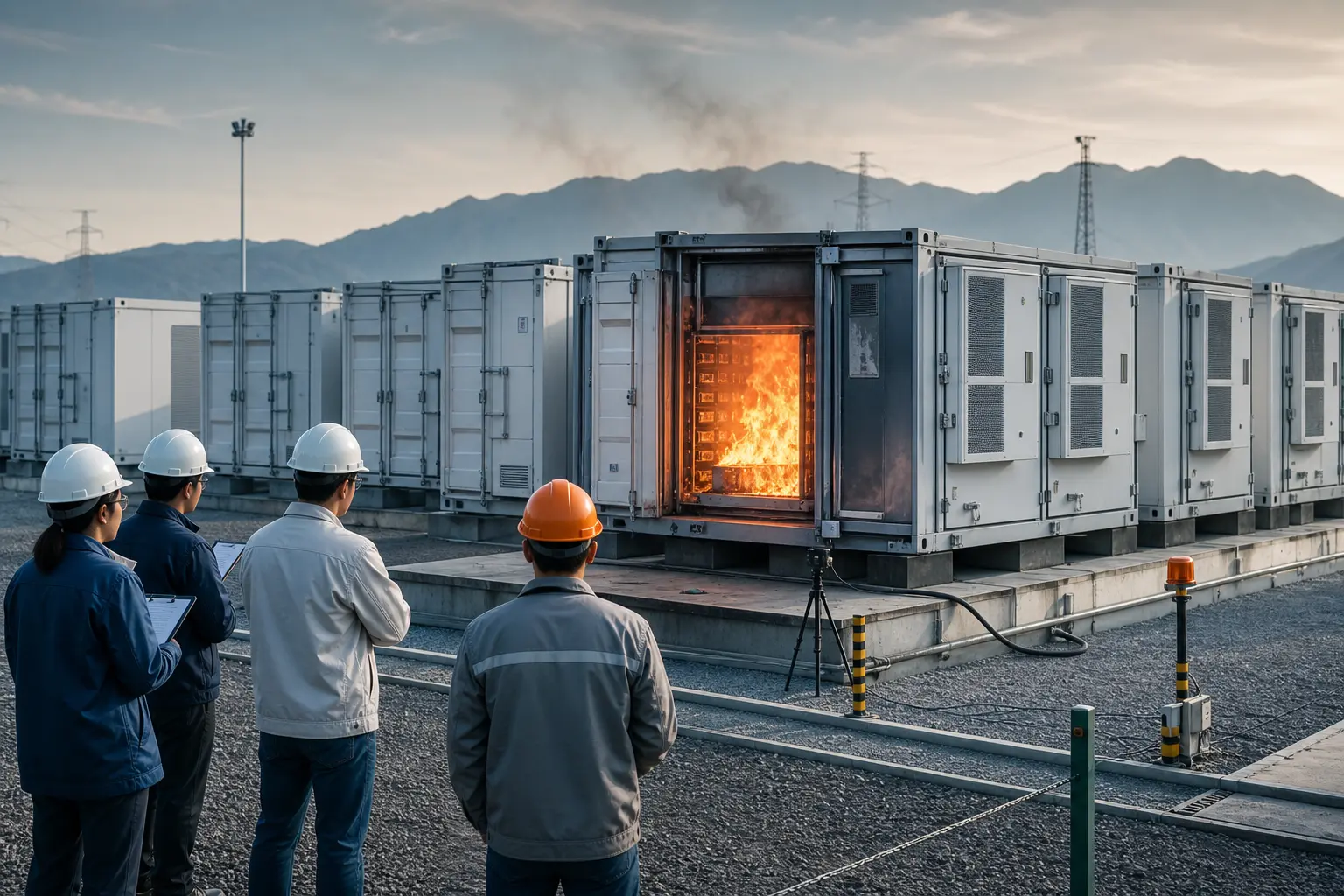
On May 26, 2026, HiTHIUM published a detailed account of an open-door large-scale fire test for its `∞Power 6.25MWh 4h` long-duration energy storage system. The company said the test used `1175Ah` cells, followed `UL 9540A 2025` and `NFPA 855-2026`, ran at `100% state of charge`, disabled active suppression, and placed adjacent containers back-to-back and side-by-side at only `15 cm` spacing. HiTHIUM said the result was no explosion, no propagation to adjacent containers, and no structural failure.
By itself, that could still be dismissed as supplier theatre. The reason it matters now is that HiTHIUM is also pushing long-duration commercialisation, including a May 19, 2026 debut in Australia of a `6.9MWh 8-hour` system. Once Chinese suppliers ask buyers to consider bigger cells and longer discharge durations, safety validation becomes a sales gate, not an appendix.
Source File
This article was reviewed on 2026-07-07 against HiTHIUM's 2026-05-26 open-door fire-test post, HiTHIUM's 2026-02-09 6.25MWh fire-test release, and HiTHIUM's 2026-05-19 Australia LDES launch. HiTHIUM's references to UL 9540A, NFPA 855, supervision, no propagation, no explosion, and adjacency behavior are treated as supplier test claims unless a buyer obtains the underlying test report, insurer / AHJ review, EPC design assumptions, site layout, and project-specific approval documents. Internal links connect the analysis to China Battery Storage Boom: Grid-Scale BESS Explained and CATL's Xiamen Storage Testbed Is a Bankability Signal.
Quick Answer
| Buyer question | Practical answer |
|---|---|
| Why does HiTHIUM's fire test matter? | It shifts the buyer conversation from container MWh toward system-level safety proof for higher-capacity LDES hardware. |
| What is new in the test? | Open-door combustion, `15 cm` spacing, `100% SOC`, disabled active suppression, and a `6.25MWh` platform using `1175Ah` cells. |
| Does this mean the product is automatically bankable? | No. It is a stronger supplier safety signal, not a substitute for local AHJ, insurer, EPC, and project-specific validation. |
| What should buyers verify first? | Test method, spacing assumptions, venting logic, fire-propagation limits, local code fit, and how the tested configuration maps to the quoted project. |
| Evergreen bridge | This belongs inside China Battery Storage Boom: Grid-Scale BESS Explained, near CATL's Xiamen Storage Testbed Is a Bankability Signal and China battery storage boom. |
Why This Is A Bigger Signal Than Another 6-MWh Launch
Chinese storage vendors have spent the past year racing on:
- container capacity,
- cell size,
- density,
- and longer-duration positioning.
The problem is that higher energy density and larger cells change the safety argument. The buyer cannot simply scale yesterday's 5MWh diligence checklist into tomorrow's 6-7MWh container and assume the risks behave linearly.
That is why HiTHIUM's disclosure matters more than a standard product launch:
| Standard launch story | Better buyer story |
|---|---|
| bigger MWh per container | what happens when the higher-energy system fails under severe conditions |
| lower BOS cost | whether insurer and AHJ friction rises faster than BOS savings |
| larger cell means fewer components | larger cell also means larger energy-release event to manage |
What HiTHIUM Actually Tested
The company's published conditions are severe enough to matter:
| Test condition | Why buyers should notice it |
|---|---|
| `6.25MWh 4h` LDES system | this is a high-energy utility-scale object, not a lab cabinet |
| `1175Ah` cells | kAh-class cells increase release-management pressure |
| `100% SOC` | worst-case stored-energy condition is more relevant than a partial-charge test |
| `15 cm` spacing between adjacent containers | pushes the propagation question into a realistic site-layout problem |
| active suppression disabled | forces the intrinsic design to do more of the work |
| UL 9540A 2025 and NFPA 855-2026 framing | helps the result travel into Western buyer language |
- release without explosion,
- combustion without propagation,
- resistance without structural failure.
Those are exactly the categories buyers, fire engineers, and insurers care about.
Why Open-Door Testing Matters
Open-door testing is valuable because it is harder to hide behind a sealed-container narrative.
HiTHIUM said the container doors remained fully open throughout the test to maximise oxygen supply and flame impact. That matters for one reason: a serious buyer wants to know whether the supplier is testing for a comfortable pass condition or for a brutal one.
The article also explained the supplier's control logic:
- three-dimensional airflow channel,
- directional venting,
- dual pressure-relief valve design,
- fire-resistant module covers,
- reinforced steel enclosures,
- insulated multi-layer container structures.
Those details do not prove every real project will behave the same way. They do reveal the safety philosophy. In 2026, that philosophy increasingly belongs in the commercial comparison.
The Real Buyer Question Is Not "Did It Burn?"
Battery systems can burn. Buyers already know that.
The better question is: what happened to everything around the fire event?
| Safety question | Why it is commercially important |
|---|---|
| Was pressure released without explosion? | explosion risk changes site approval and separation assumptions |
| Did heat propagate to adjacent containers? | propagation risk drives layout, land use, and insurance conditions |
| Did the structure stay intact? | structural failure changes emergency response and collateral-damage scenarios |
| Was the test configuration close to a marketable product? | otherwise the result becomes marketing theatre |
Why The Australia 8-Hour Launch Makes This More Important
If the fire test were standing alone, buyers could still treat it as an engineering-publicity piece. The context changes when HiTHIUM also pushes long-duration market expansion.
On May 19, 2026, the company said it debuted a `6.9MWh 8-hour` energy storage system in Australia. That connects the safety file to an actual LDES commercial story:
| Commercial push | Why the safety file matters more |
|---|---|
| 8-hour storage positioning | longer-duration systems often face different permitting and use-case scrutiny |
| larger cell formats | higher energy concentration raises consequence of poor failure management |
| transport-constrained and site-constrained markets | buyers want higher density but do not want hidden safety trade-offs |
A Better LDES Buyer Checklist
For any Chinese long-duration storage quote in 2026, the minimum diligence file should now include:
| Check | Minimum evidence |
|---|---|
| Test standard | exact method, witnessing parties, and which standard edition was used |
| Tested configuration | cell size, module architecture, SOC, spacing, suppression status, and venting configuration |
| Marketed configuration match | confirmation that the quoted product is materially the same as the tested product |
| Propagation boundary | what happened to adjacent containers, and at what measured thresholds |
| Structural survivability | whether doors, frame, partitions, and enclosure remained intact |
| AHJ translation | local fire-code and permitting interpretation, not only supplier language |
| Insurer acceptance | whether the evidence meaningfully reduces premium or approval friction |
Why This Matters For Land Use And BOS
Higher-energy systems are often sold on land and BOS efficiency. That is rational. It is also incomplete.
If a buyer chooses a denser system but then has to:
- increase spacing,
- add external mitigation,
- negotiate longer AHJ review,
- or accept tougher insurer conditions,
some of the claimed economic gain can disappear.
That is why the `15 cm` spacing detail is not trivial. It points directly at a project-level question: can higher-density Chinese LDES hardware keep its siting advantage after safety review?
This is where HiTHIUM's test creates a useful procurement edge. It does not end the debate. It gives buyers a better starting file for it.
The Competitive Implication For Chinese Storage Suppliers
The deeper story is not only about HiTHIUM.
Chinese storage competition has already moved beyond cell cost. CATL's Xiamen Storage Testbed Is a Bankability Signal showed CATL turning system validation into a trust argument. China battery storage boom showed chemistry diversification moving into portfolio planning. HiTHIUM's signal adds another dimension: safety validation at higher energy levels.
That means the strongest Chinese storage suppliers in 2026 are increasingly competing on:
- validation,
- safety architecture,
- control-layer credibility,
- and site-approval friendliness,
not only on how much energy fits in one container.
What Buyers Should Not Assume
Three assumptions should be rejected.
First, do not assume one dramatic test equals universal approval. Project codes, AHJs, insurer standards, and local utility requirements still vary.
Second, do not assume all `6+ MWh` Chinese storage products now carry the same safety profile. Test details matter.
Third, do not assume bigger cells automatically improve project economics. They can also shift emergency-response and approval complexity in ways the quote does not show.
Buyer Takeaway
HiTHIUM's fire-test disclosure matters because it turns long-duration Chinese storage into a more legible risk object.
The market has spent enough time talking about larger containers and longer durations. The harder and more valuable work is to ask how those systems behave when they fail, how far the event spreads, and whether the evidence can survive AHJ and insurer scrutiny. In 2026, Chinese LDES competition is becoming a safety-document contest as much as an energy-density contest. Buyers should welcome that shift and demand far more of it.
Methodology
This article was reviewed on 2026-07-07 and is based on HiTHIUM's May 26, 2026 fire-test post, HiTHIUM's February 9, 2026 official release on the 6.25MWh fire test, and HiTHIUM's May 19, 2026 Australia LDES launch. It is connected to prior site analysis in China Battery Storage Boom: Grid-Scale BESS Explained and CATL's Xiamen Storage Testbed Is a Bankability Signal. Company claims are treated as supplier claims unless buyers can validate them with independent fire-safety, insurer, EPC, and authority review.
Claim Confidence File
| Claim | Confidence | Evidence boundary |
|---|---|---|
| HiTHIUM disclosed a 6.25MWh / 1175Ah open-door fire-test scenario | High | Supported by HiTHIUM's own fire-test disclosures |
| The test automatically proves bankability for every project | Low | Bankability still depends on AHJ, insurer, EPC, site layout, certification, and project-specific approval |
| No propagation / no explosion / no structural failure are independently verified public facts | Medium | They are useful supplier claims; buyers need the underlying report and witness details |
| The 15 cm adjacent-container detail is commercially relevant | High | Spacing affects land use, permitting, insurer review, and emergency-response assumptions |
| Larger LDES containers make safety validation more important | High | Higher energy concentration can change consequence management and approval scrutiny |
Frequently Asked Questions
Does an open-door fire test prove a storage system is bankable?
No. It is one useful safety signal, not a complete bankability file. Buyers still need cell data, enclosure design, thermal-runaway test evidence, certification, warranty, service, insurance, and project-specific fire-code review.
Why does the test matter more for long-duration storage?
Long-duration systems can pack large amounts of energy into fewer project sites. A safety event can therefore affect land use, permitting, insurance, and public acceptance. Fire behavior is not only a technical issue; it is a project-approval issue.
What should buyers ask after seeing a fire-test claim?
Ask for the test standard, test lab, configuration tested, door / venting condition, propagation result, gas and heat behavior, extinguishing assumptions, and whether the tested configuration matches the quoted product.