
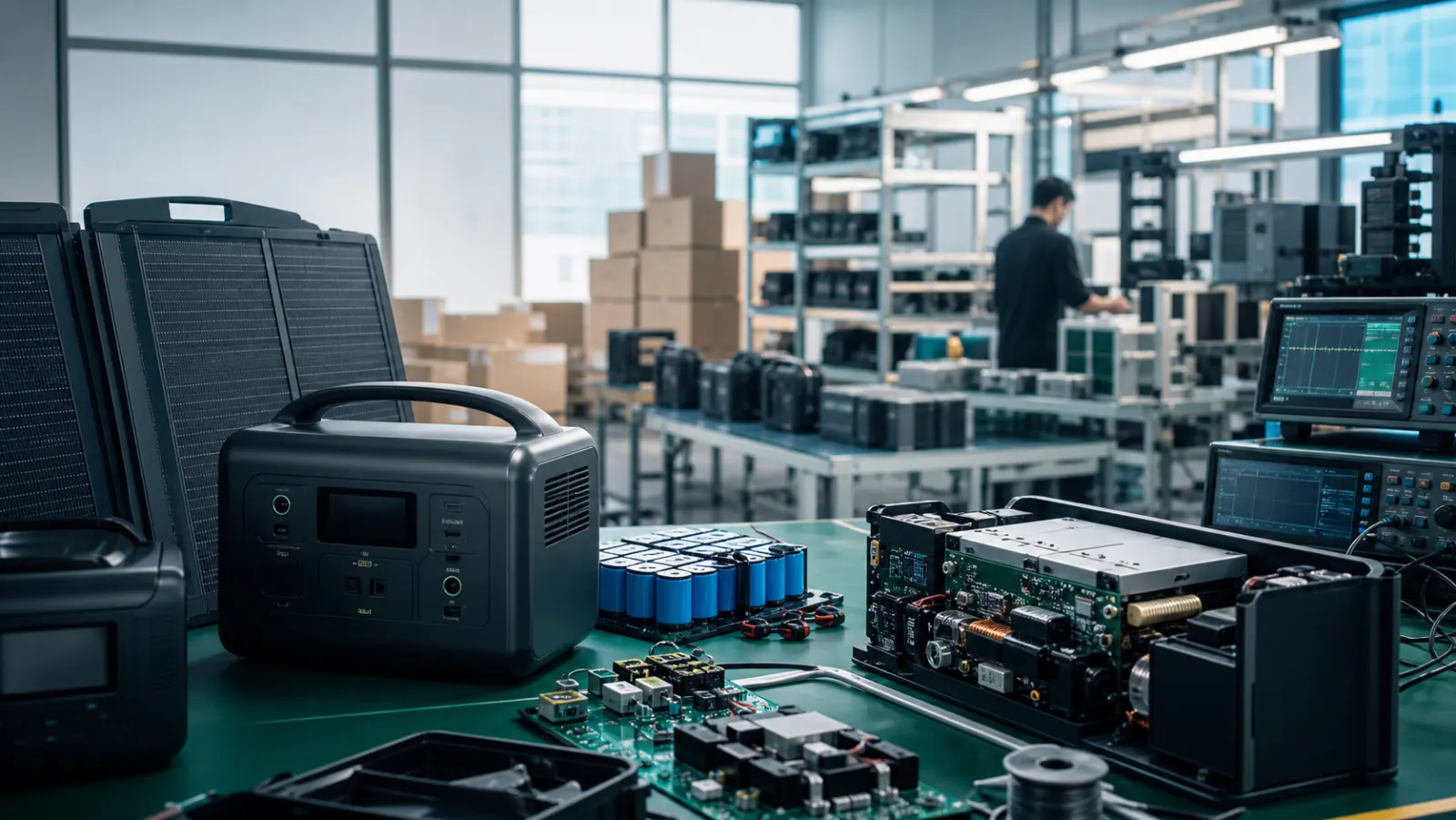
The most useful thing about Hoymiles' new home battery is not that it is another China-made storage box for Europe.
It is that Hoymiles is trying to turn a microinverter brand into a controllable retrofit stack.
In its June 1 launch, Hoymiles said the new HiBattery 4020 series includes two distinct buying paths: the `HiBattery 4020 X`, a hybrid model directly connected to PV modules, and the `HiBattery 4020 AC`, an AC-coupled model designed to pair with an existing home solar system. The official numbers matter. Each unit starts at `4 kWh`, scales to `16 kWh`, includes a built-in `2500 W` inverter, claims up to `96.5%` DC/AC efficiency, and in the `4020 X` version offers `4 MPPT` inputs with up to `4 kW` PV input. Hoymiles also says the system uses an AI energy-management model with `30 million` parameters, recalculates strategy every `3 hours`, and supports operation from `-20C` to `55C` with `IP66` protection, `48-layer` BMS protection, aerosol fire suppression, and LiFePO4 cells.
That is not just a battery launch. It is a control-layer pitch aimed at Europe's retrofit and plug-in storage market.
Source File
This buyer file was reviewed on 2026-07-07 and is based first on Hoymiles' official HiBattery 4020 launch release. The AC-coupled retrofit discussion is checked against Hoymiles' HB-4020-AC datasheet. The wider European storage frame is checked against SolarPower Europe's European Battery Market Outlook 2026-2030, the European Commission's digitalisation and AI in energy roadmap, and IEC's explanation of IEC 62619 battery safety requirements. The retrofit-storage frame is also connected to prior site work in Hoymiles Microinverters: Company and Warranty Map, China Battery Storage Boom: Grid-Scale BESS Explained, and Deye Inverter Buyer Risk: Warranty and Sol-Ark. Vendor claims about AI-EMS, efficiency, IP rating, safety systems, and availability are treated as product disclosures that buyers should verify against country-specific installer, warranty, and certification documents.
Quick Answer
| Buyer question | Practical answer |
|---|---|
| What changed? | Hoymiles moved from being mainly a microinverter and gateway company to selling a more complete home-storage control stack. |
| Why is that useful? | Buyers can now choose between direct-PV hybrid storage and AC-coupled retrofit storage inside one vendor ecosystem. |
| What are the strongest numbers? | `4 kWh` to `16 kWh`, built-in `2500 W` inverter, `96.5%` DC/AC efficiency, `4 MPPT`, `30 million` parameter AI-EMS, `3-hour` recalculation cycle, `IP66`, and `-20C` to `55C`. |
| What is the buyer risk? | The real risk sits in retrofit fit, warranty path, account ownership, and whether "AI-EMS" meaningfully improves savings versus adding another opaque control layer. |
| Evergreen bridge | Read this with China Solar Dominance: Supply Chain Power, Profit Crisis, Hoymiles Microinverters: Company and Warranty Map, China Battery Storage Boom: Grid-Scale BESS Explained, and Deye Inverter Buyer Risk: Warranty and Sol-Ark. |
Why The AC-Coupled Version Is The Real Buyer Trigger
The launch copy gives both models attention, but the stronger market signal is the `HiBattery 4020 AC`.
That is because AC-coupled retrofit storage maps directly onto a real European buyer problem: many households already have solar, but not storage. Those homes do not necessarily want a full inverter-and-rooftop redesign. They want a controllable way to add battery capacity without rebuilding the system around a new primary inverter vendor.
| Product path | What it means for buyers |
|---|---|
| `HiBattery 4020 X` | best for buyers starting from or rebuilding the PV side |
| `HiBattery 4020 AC` | best for retrofit buyers who already have solar and want to bolt on storage |
| one shared vendor ecosystem | Hoymiles gets a chance to expand beyond module electronics into home-energy control |
The Independent Context Is Europe's Storage And Control-Layer Push
The product launch makes more sense when it is read against Europe's storage and digital-energy policy direction. SolarPower Europe's 2026-2030 battery outlook treats battery storage as a core flexibility resource, not a niche accessory to rooftop solar. The European Commission's June 2026 roadmap for digitalisation and AI in energy puts smart meters, demand-side flexibility, energy data, AI, and cyber resilience into the same policy conversation.
That is why the buyer file should not stop at the product datasheet. A retrofit battery with AI-EMS sits at the intersection of three checks:
| External context | Buyer implication |
|---|---|
| European storage growth | buyers should test whether the system fits the target market's tariff, installer, and grid-connection rules |
| digital-energy roadmap | data ownership, automation, remote access, and cyber resilience become part of product diligence |
| IEC 62619 safety baseline | battery safety claims should be mapped to certifiable cell and system evidence, not only marketing language |
The Numbers Show A Push Toward "Good Enough" Home-Stack Integration
Hoymiles is not presenting HiBattery 4020 as a laboratory breakthrough. It is presenting it as a practical home stack with enough performance and enough control features to win real installations.
| Hoymiles claim | Why buyers should care |
|---|---|
| `4 kWh` standard capacity, expandable to `16 kWh` | sized for staged adoption rather than one-shot high-ticket purchase |
| built-in `2500 W` inverter | reduces system complexity in small residential and balcony-style use cases |
| `96.5%` maximum DC/AC efficiency | energy economics are being sold as a practical savings file, not just a marketing number |
| `4 MPPT` and up to `4 kW` PV input on the X version | signals direct-PV flexibility for buyers not limited to pure retrofit |
| LiFePO4 chemistry | aligns with the market's safety and cycle-life expectations |
| `IP66` and `-20C` to `55C` | tells installers the product is meant for real outdoor and mixed-climate deployment |
AI-EMS Is The Marketing Layer Buyers Need To Audit Hardest
The launch's strongest selling language is not about the cells. It is about control.
Hoymiles says its AI-EMS is built on a self-developed model with more than `30 million` parameters and recalculates energy strategy every `3 hours` based on electricity price, weather, and home-consumption patterns. It also pitches AI time-of-use optimization and an Energy Ledger dashboard for visualizing usage and savings.
That sounds attractive, but buyers should translate it into a diligence file:
| AI-EMS claim | Buyer question |
|---|---|
| `30 million` parameter model | does model size translate into measurable savings, or is it just branding? |
| `3-hour` rolling recalculation | how often do control decisions change, and can installers or homeowners override them? |
| price and weather optimization | which tariffs and forecast integrations are supported in the actual country of installation? |
| Energy Ledger dashboard | who owns the account, the history, and the support path when the installer changes? |
Safety Is Being Sold As An Everyday-Living Argument
Hoymiles also understands the trust problem in residential storage. The launch puts unusual emphasis on safety signals:
- automotive-grade LiFePO4 cells,
- `48-layer` BMS protection,
- intelligent balancing,
- built-in aerosol fire suppression,
- pressure relief and PV input overheat protection,
- and intelligent self-heating.
That list matters because residential storage buyers, installers, and insurers do not want abstract "advanced technology" language. They want to know whether the system can survive ordinary deployment mistakes, weather shifts, and long idle periods.
| Safety signal | Why it matters |
|---|---|
| LiFePO4 | market-familiar chemistry with a safer reputation than higher-voltage nickel-rich alternatives |
| `48-layer` BMS | Hoymiles is trying to make system management a visible trust object |
| aerosol suppression | strong retail-installation reassurance signal |
| self-heating for `-20C` to `55C` | climate resilience becomes a buying argument, not just a specification note |
| `IP66` | buyers can think beyond purely indoor placement |
Why This Is Strategically Bigger Than A Homeowner Product
Hoymiles says the series will be available across Europe starting in June 2026. That timing matters because Europe remains one of the strongest regions for:
- balcony-solar adoption,
- retrofit storage demand,
- electricity-price sensitivity,
- and Chinese power-hardware brands that can win outside the U.S. market structure.
This is why the article belongs beside China Solar Dominance: Supply Chain Power, Profit Crisis. China's advantage in energy hardware is no longer just cheap module output. It is category breadth. A company that started as a specialized module-level electronics supplier can now sell an energy stack that includes inverter logic, monitoring, AI control, warranty tooling, and battery hardware.
A Better Buyer Checklist For HiBattery 4020
If an installer or homeowner is evaluating the system, the right checklist is:
| Check | Minimum evidence |
|---|---|
| Retrofit fit | whether the home already has solar, and whether AC-coupled or hybrid architecture makes more sense |
| Tariff fit | proof that local time-of-use logic and savings assumptions actually map to the destination market |
| Account fit | who controls monitoring, Energy Ledger access, and future installer handoff |
| Warranty fit | local country warranty documents, distributor authorization, and installer RMA path |
| Placement fit | indoor/outdoor installation rules, local code requirements, and climate assumptions |
| Expansion fit | how `4 kWh` to `16 kWh` scaling works with mixed old and new modules in practice |
What Buyers Should Not Assume
Three assumptions are weak.
First, do not assume AC-coupled retrofit automatically means painless integration. Existing inverter brand, installer competence, and local code rules still matter.
Second, do not assume the `30 million` parameter AI model guarantees lower bills. Control quality depends on local tariff design and clean data inputs.
Third, do not assume home-storage safety is solved by chemistry alone. Warranty, installer quality, and documentation discipline still decide how much real protection the buyer has.
Buyer Takeaway
Hoymiles' HiBattery 4020 matters because it moves the company from a component-level microinverter story toward a fuller household energy-control story.
The most important thing in the launch is not one battery metric. It is the split between direct-PV hybrid storage and AC-coupled retrofit storage, wrapped in Hoymiles' own AI-EMS, warranty-query, and support ecosystem. In 2026, the meaningful buyer question is whether HiBattery 4020 gives homeowners and installers a genuinely simpler retrofit path, or whether it adds one more opaque control layer to a system they still need to support for years.
Methodology
This article was reviewed on 2026-07-07 and is based on Hoymiles' official HiBattery 4020 launch release, Hoymiles' HB-4020-AC datasheet, SolarPower Europe's European Battery Market Outlook 2026-2030, the European Commission's digitalisation and AI in energy roadmap, and IEC's overview of IEC 62619 battery safety requirements. It is connected to prior site work in China Solar Dominance: Supply Chain Power, Profit Crisis, Hoymiles Microinverters: Company and Warranty Map, China Battery Storage Boom: Grid-Scale BESS Explained, and Deye Inverter Buyer Risk: Warranty and Sol-Ark. Product capabilities, AI-EMS claims, and availability timing are treated as vendor disclosures that buyers should verify against country-specific installer, warranty, and certification files before purchase.
Claim Confidence File
| Claim | Confidence | Evidence boundary |
|---|---|---|
| Hoymiles launched HiBattery 4020 X and AC paths with 4 kWh to 16 kWh positioning | High | Supported by Hoymiles' launch release and datasheet |
| AI-EMS with 30 million parameters guarantees lower household energy bills | Low | It is a vendor control claim; savings depend on tariff, load, data quality, installer setup, and user behavior |
| AC-coupled storage can be attractive for retrofit homes | Medium-high | Strong product-market logic, but site fit depends on existing inverter, code, installer, and country rules |
| Safety claims are fully proven by launch copy alone | Low | Buyers need country-specific certification, installation guidance, warranty exclusions, and emergency-response documents |
| Hoymiles is expanding from microinverter component supplier toward home energy-control stack | High | Supported by the battery, monitoring, AI-EMS, and service-tooling direction |
Frequently Asked Questions
Is AI-EMS enough to choose a home battery system?
No. AI-EMS can improve scheduling and self-consumption, but buyers still need to check usable capacity, inverter compatibility, backup behavior, safety certification, warranty, installer support, and app reliability.
Who is the HiBattery 4020 most relevant for?
It is most relevant for homeowners or installers who want a residential storage product tied to PV optimization and energy-management software. Commercial and utility buyers should evaluate different storage architectures and service models.
What safety evidence should buyers request?
Ask for cell chemistry, enclosure rating, thermal management, certification, warranty exclusions, installation requirements, and emergency-response guidance. Safety claims should be matched to the exact product configuration being quoted.