
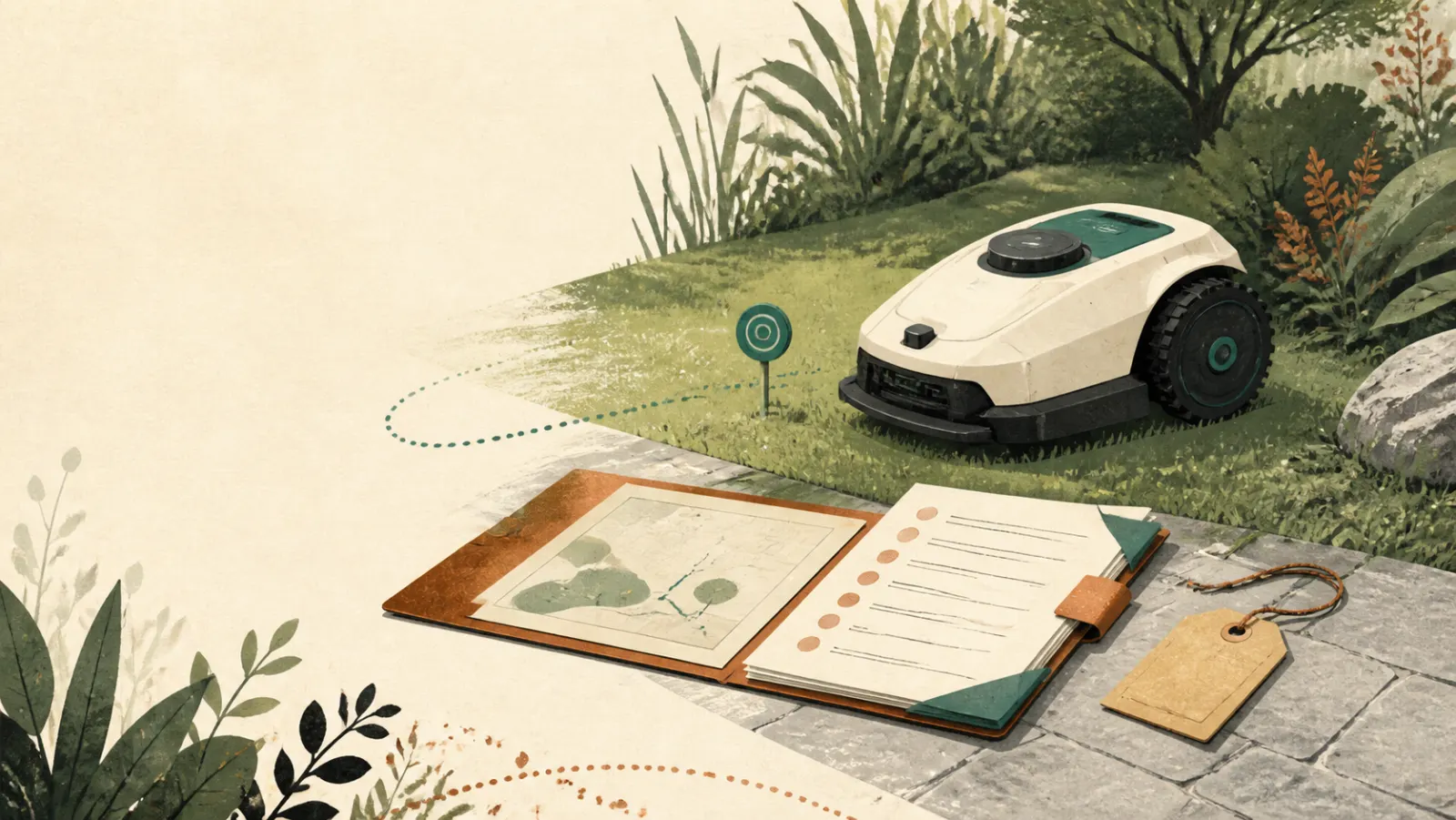
On 8 August 2026, Apple’s App Store listed Mammotion Technology Co., Limited as the Mammotion app seller, while the Google Play listing header displayed 3.1 stars from 2.78K reviews. The first is a bounded identity record; the second is a mutable, self-selected Android snapshot. Neither establishes product reliability, typical support, sales, ownership, or a result for a particular lawn.
A Mammotion LUBA buyer is not simply choosing a robotic mower from a specification sheet. They are choosing a mower, an app, a positioning setup, a firmware path, an invoice seller, and a repair relationship. Those two early records make the real task visible: assess the connected ownership system without turning a seller listing or platform snapshot into a brand verdict.
This dossier builds a dated evidence chain from those records outward. It separates public identity traces, Mammotion’s own product and support statements, two named independent reviews, an app-platform snapshot, and paired owner testimony. The records support treating Mammotion as an identifiable connected-hardware brand that merits a model-specific investigation; they do not establish its complete group ownership, current factory footprint, sales scale, fleet reliability, typical repair time, local service quality, or a particular warranty result. Verify the exact model, seller, firmware state, property conditions, warranty geography, and repair route before money changes hands.
The short answer
Mammotion has a traceable public and product-facing footprint. The evidence does not justify either a blanket endorsement or a blanket warning. Its value lies in converting a vague brand question into a documentable offer file: who is selling this unit, which model and bundle is it, which policy applies, where does it go for service, and what happens when a map, app, or update becomes part of normal ownership?
That framing fits the larger question behind a Chinese hardware brand. As How China Manufactures: Inside the World's Factory (2026) explains, the useful buyer story is often not the chassis alone but the commercial and support system around it. LUBA makes that especially visible because its operation depends on mapping, connectivity, software releases, and a regional after-sales path alongside the physical mower.
What the public record establishes
The first distinction is between a traceable operating footprint and a complete corporate map. Apple lists the App Store seller, Mammotion Technology Co., Limited for the Mammotion app. This is a bounded identity fact: the listing connects a named seller to a live software-facing product relationship. It does not establish who owns every related entity, who makes every model, or how every country’s sales and service arrangements are structured.
The Australian Business Register provides a separate public trace. Its record says the named entity was active from 1 March 2023 and GST registered from 1 March 2023. That is useful because it dates one named registration in one market. It is not a measure of global sales, manufacturing capacity, customer count, or an assurance about a particular dealer.
There is also a historical, product-specific technical record. An SGS report dated 9 January 2024 identifies Mammotion Technology Co., Limited as applicant and manufacturer for the listed LUBA 2 AWD configuration, with Huizhou BYD Electronic Co., Ltd. named in the report’s factory field. Its scope is deliberately narrow: it is evidence about one LUBA 2 configuration and that report, not a current LUBA 3 supply-chain map or proof that every Mammotion unit is made at the same site.
The Consumer Technology Association’s CES 2026 exhibitor directory supplies another dated third-party trace. It lists Mammotion Technology Co., Limited for CES 2026 in categories including AI, robotics, and smart home. An exhibitor entry is not an endorsement, sales result, or product-quality test. Together, however, the app listing, business identifier, technical report, and event directory make an anonymous-marketplace reading hard to sustain while still leaving the corporate map unresolved.
 AI-generated editorial evidence diagram. It classifies source roles and is not a reliability score.
Reading key: archive and calendar = public record; policy sheet = company statement; notebook and tape = independent test; dialogue = owner testimony; copper boundary = no valid reliability score.
For a buyer, the practical consequence is simple: ask which legal name will appear on the invoice, warranty correspondence, return instructions, and repair case. Public records make those questions more concrete; they do not answer them automatically.
Founder attribution and the Chinese operating context
The founder trail is useful context, provided it is not inflated into a corporate genealogy. A 28 April 2026 University of Electronic Science and Technology of China report identifies Wei Jidong as founder and CEO of Kuma Technology. Mammotion’s own 2022 LUBA launch release calls Jidong Wei its founder.
The two sources therefore support only a cross-source founder-name attribution: Mammotion’s release uses the English name “Jidong Wei,” while the UESTC account names “Wei Jidong (魏基栋)” in the Kuma context. They are not a direct public record establishing a legal or operating relationship between the companies. They also do not support claims about ownership, board control, a current factory network, or which entity stands behind a buyer’s specific transaction.
This limit sharpens the China context. Mammotion belongs in a Shenzhen-linked outdoor-robotics story because a specific brand, product family, and founder attribution can be traced across Chinese and global-facing records. It should not become a generic claim that a city or manufacturing ecosystem guarantees ownership transparency, product fit, or after-sales capacity. For background on the place behind many hardware brands, see Shenzhen Manufacturing: Complete Ecosystem Guide (2026); the buyer’s actual counterparty remains the seller on the offer, not a regional narrative.
The product map is an official claim
Mammotion’s current US comparison page describes LUBA 3 AWD as the flagship line and places it beside LUBA mini 2 AWD, YUKA mini 2, older LUBA 2 variants, and other products. That is helpful for decoding the product family and making an initial shortlist. It is also a company statement, so it cannot independently tell a buyer whether the local SKU, bundle, terrain, positioning hardware, service route, or warranty matches their own offer.
The distinction matters because property fit is a system question. Tree cover, narrow passages, slopes, boundaries, charging location, Wi-Fi or cellular conditions, and a buyer’s tolerance for setup work may all change the result. A flagship label has no authority over those variables. It is the start of the file, not the conclusion.
Two independent reviews help qualify the product page without replacing it. PCWorld describes a model-specific LUBA 3 AWD 3000 experience on an awkward yard; TechRadar frames its reviewed machine as more suited to large, complex lawns than to small or medium urban lawns. Those observations can identify a comparison question, but their different reviewers, properties, dates, firmware, and judgments cannot generate a universal recommendation.
The numbers that should change a buyer’s questions
Numbers deserve to stay attached to their source, model, period, market, and denominator. A review price is not a current quote. A stated runtime is not a promise for another lawn. An app rating is not a hardware-reliability score. The table does not rank Mammotion; it shows the factual inputs that should change the next verification question.
| Recorded signal | What the source actually says | How to use it without overreaching |
|---|---|---|
| Review-time price and capacity | PCWorld's June 2026 review listed $2,799 and described the reviewed 3000 model as designed for 0.75 acres. | Treat both as a dated, one-model reference. Recheck country, tax, seller, bundle, terrain, and current offer. |
| Handling and one observed cycle | PCWorld called the reviewed unit a little over 40 pounds; in one run it recorded about 55 minutes as displayed battery fell from 100% to 66%. | Use this to ask about recovery, storage, expected cycle length, and physical access. It is not an average-runtime test. |
| A second review’s price and size specification | TechRadar's March 2026 review listed $2,399 and a maximum lawn size of 3000㎡ for its reviewed model. | The different review price underlines why current seller verification matters. The area figure is a specification, not a property-fit result. |
| Physical and terrain filters | The same review lists a 40cm cutting deck, 80% (38.6°) maximum climbing ability, and 30 zones. | Measure gates, paths, separated lawns, grade, ground condition, turns, and wet areas; do not turn a published threshold into a site safety conclusion. |
| Stated energy and connectivity terms | TechRadar records 175 mins of mow time, 120 mins of charging time, and 3 years free data in the reviewed specification. | Contrast stated specifications with real property conditions; confirm regional data terms, network availability, charging location, and current documentation. |
| Android platform snapshot | The Google Play listing header displayed 3.1 stars from 2.78K reviews and 100K+ downloads when rechecked on 8 August 2026. | Test the app workflow, account access, mapping, and connectivity before purchase. This is a mutable, self-selected Android snapshot; the header and lower ratings area can render different rounded snapshots, and neither is sales, owners, or a service score. |
| Company-stated series range | Mammotion’s US page lists 0.37-1.25 acres for the LUBA 3 AWD series. | Confirm the exact model and regional SKU. This is Mammotion’s product-positioning range, not independent proof for a particular lawn. |
| Named policy term | Mammotion’s US policy gives three-year component terms for named LUBA 3 components under listed conditions. | Read the covered component, proof, seller, country, exclusions, and policy version. A term is not whole-product coverage or a claim-approval forecast. |
| Visible software-maintenance activity | The LUBA 3 log contains 15 release-log entries from 10 January through 18 July 2026. | Keep firmware state and escalation path in the buyer file. Entry count says nothing about affected units, severity, or successful resolution. |
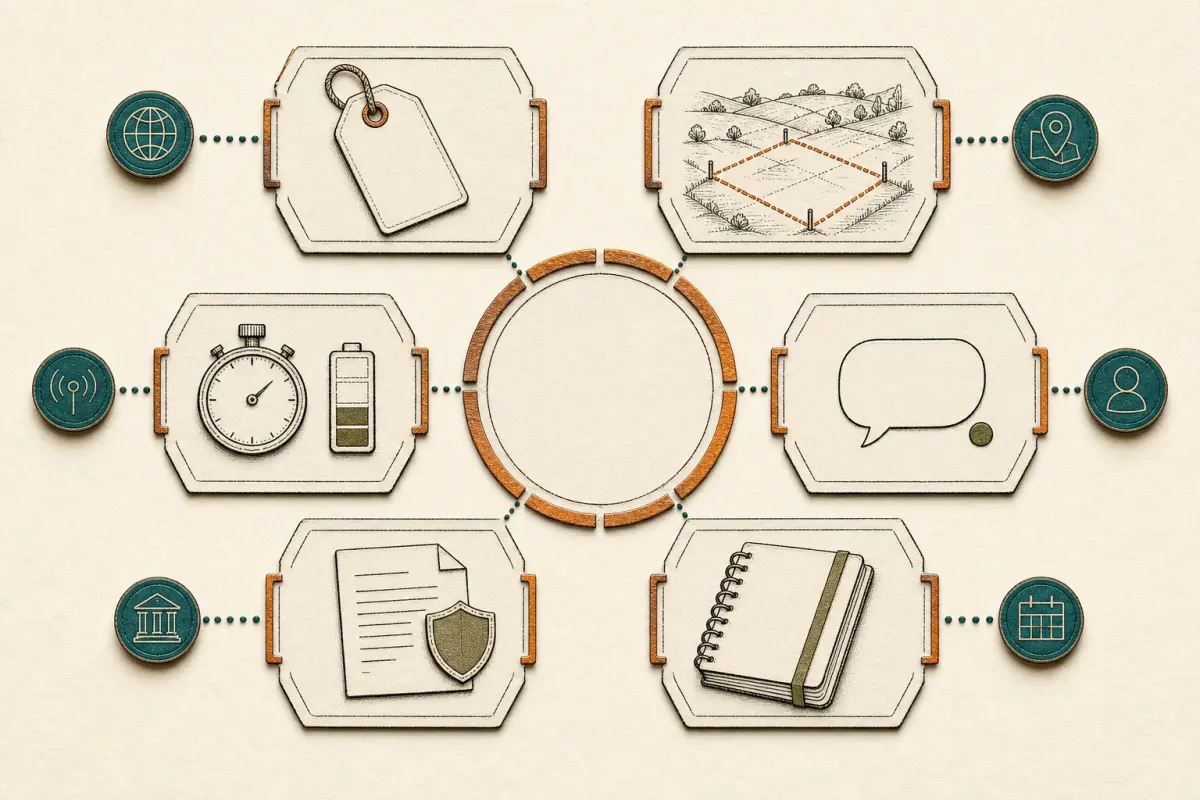 AI-generated editorial metric-scope diagram. It separates source-bounded figures and does not depict a reliability, service, or performance statistic.
Reading key: tag = price; map = stated property scope; stopwatch and battery = a time-bound run; dialogue = platform feedback; shield = policy terms; notebook = release activity. Each stays source-bound.
The ownership system: software, warranty, and repair
LUBA is not only a mower chassis. Mammotion’s LUBA 3 release notes dated 18 July 2026 describe changes around positioning failure, map disappearance, RTK reference-station movement reporting, memory, and mowing stability. This does not show how often any condition occurred, how many devices were affected, or whether a particular update will solve a particular buyer’s issue. It does show why software version, mapping state, and support escalation belong in an ownership file.
The published policy is a second layer, not a service-performance dataset. Mammotion’s US Warranty Service terms describe listed component scope and exclusions, and say the applicable policy is tied to the country where the product was purchased and used. Its repair instructions call for valid proof of purchase, a receipt or order number, serial number, and location-specific support contact. Those are company-defined eligibility and process requirements; they do not promise a local repair centre, replacement, turnaround, or claim outcome.
Independent review evidence makes the system boundary tangible. PCWorld reported app lag and intermittent Wi-Fi and Bluetooth drops in its own test context. TechRadar also names app glitches among its caveats. These are useful diagnostic signals: buyers should test the app, connection, map recovery, and update workflow before committing. They remain observations from named reviewers, not prevalence statistics.
What independent evidence can and cannot prove
The two reviews show why a source-bounded dossier is more useful than either marketing copy or complaint counting. In PCWorld’s June 2026 review, the reviewer found the LUBA 3 AWD 3000 capable on a rough, awkward property while still identifying price, weight, app friction, and intermittent connections as material trade-offs. In TechRadar’s March 2026 review, the reviewer found a large-complex-lawn use case but also flagged price, app glitches, tyre scuffing, and the possibility that the model is excessive for smaller lawns.
The reviews agree on an important narrow point: a model can show useful capability in a challenging setting while creating setup, cost, or ownership constraints that matter before purchase. They do not test the same lawn, firmware, regional SKU, or service channel. Neither establishes how every LUBA will perform, whether another property will work, or what warranty result an owner will receive.
That is the right decision boundary for a prospective owner, reseller, or analyst. Use independent tests to compare the precise setting, physical constraints, and workflow described with the proposed site. Do not use a reviewer’s success to erase policy limitations—or a reviewer’s friction to infer fleet-wide failure.
Why a support verdict is not available
Community material is valuable only when its limitations remain visible. In one current Reddit account, an owner described unwanted behaviour after a firmware update and dissatisfaction with support triage while also saying the mower kept the lawn neat. In a separate thread, a self-described dealer said firmware issues are largely overblown, while a recent purchaser reported no problems so far.
These are contradictory anecdotes, not data points that can be averaged. They have no shared sample frame, regional service route, verified device history, denominator, or common definition of success. The positive source may have a commercial interest; the negative source is anonymous and self-reported. Neither can establish reliability, typical turnaround, or a regional support-quality result.
Their legitimate use is narrower: turn a disputed outcome into seller questions. Who receives a failed unit? Is support handled by the retailer, a dealer, or Mammotion? Who pays shipping? What documents open the case? Does map, positioning, app, and hardware triage use the same route? Obtain the answer in writing before a fault turns it into an urgent dispute.
A buyer file that matches the evidence
The dossier’s recommended output is not a score. It is a six-part file for one offer:
- Identity and counterparty. Save the seller’s legal name, address, authorised-market status, and the name that will appear on the invoice.
- Exact product. Record full model, generation, included positioning hardware, bundle contents, firmware version, app region, and serial-number process.
- Property conditions. Note lawn size, obstacles, tree cover, narrow passages, slopes, charging position, and actual Wi-Fi or cellular conditions where the machine will operate.
- Written coverage. Keep the current regional policy, purchase-date rule, component terms, exclusions, and named claim counterparty with the order record.
- Repair route. Confirm proof, serial, shipping, contact, and escalation steps before a fault occurs; do not rely on a retailer summary.
- Software route. Ask what happens if mapping, RTK positioning, app access, connectivity, or firmware updating fails, and whether the same regional contact owns the answer.
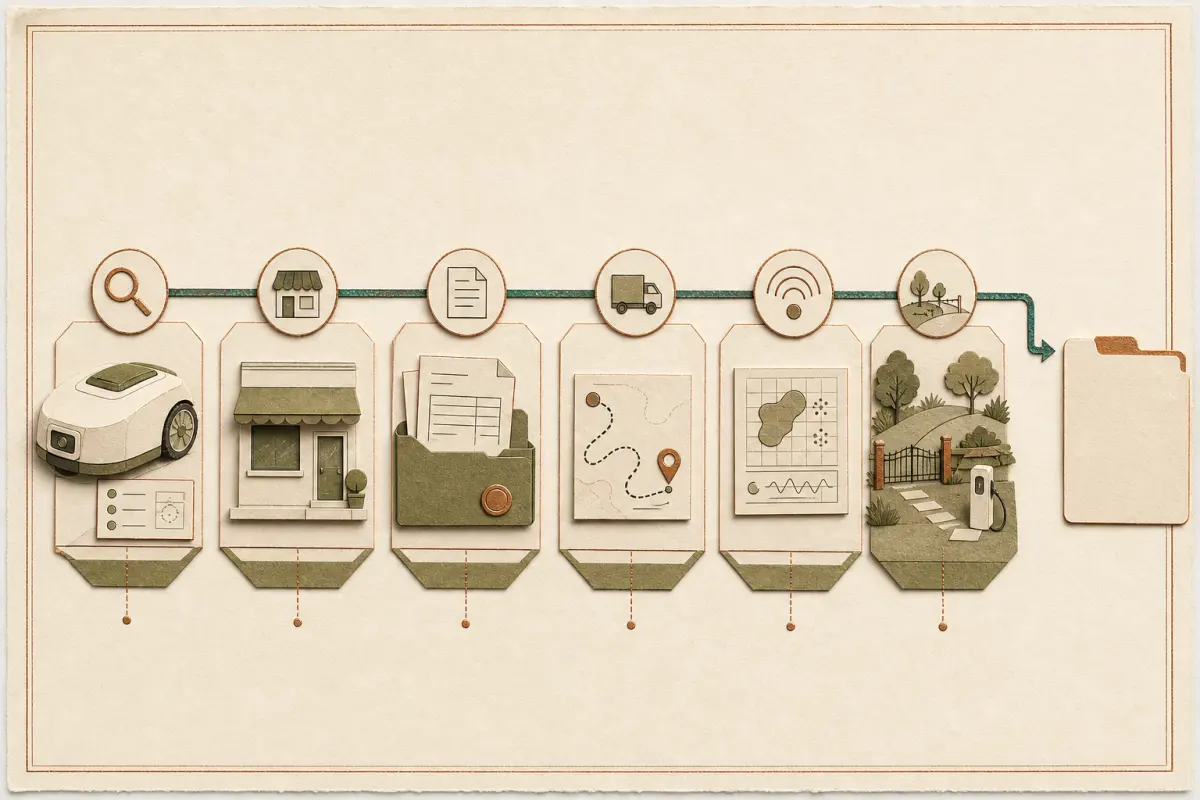 AI-generated editorial buyer-file diagram based on the article's cited support and release records; it does not promise a repair, warranty, or mowing result.
Reading key: mower card = exact model; storefront = seller; document folder = invoice and policy; route = repair path; signal panel = firmware and connectivity; gate and lawn = property conditions. The blank end folder is a verification file, not an approval.
This is a product-as-system check, not generic caution. It follows from the sources themselves: current policy terms depend on country, components, documents, and conditions; repair instructions depend on evidence and location; a connected mower’s operation changes through releases; and independent results are property-specific. The exercise also mirrors the site’s China Humanoid Robots In Factories: Deployment, Not Demos analysis: for connected Chinese robotics, the visible machine is only part of the operator’s decision.
Read the offer in three passes
The first pass is identity and transaction. A buyer should reconcile the brand name with the legal name on the quotation, invoice, payment destination, warranty notice, and repair contact. The public records make Mammotion traceable enough for that exercise, but they do not substitute for it. If a retailer cannot state which entity is responsible for the sale and which regional policy attaches to it, the evidence chain breaks before product performance even enters the discussion.
The second pass is property and product. Compare the exact model, included positioning equipment, app region, and firmware version with the actual lawn—not a generic area figure. Map tree cover, obstructions, narrow passages, grade, charging location, and connectivity dead spots. A review can help construct those questions because it describes a real setting. It cannot certify a different setting, especially where software, map maintenance, or satellite positioning changes the ownership experience.
The third pass is recoverability. Ask what the buyer can do when a setup, software, connectivity, or hardware problem cannot be resolved remotely. Save the policy version, required documents, serial-number steps, shipping responsibility, contact route, and escalation path while the purchase is still optional. This is the most important transition in the dossier: a product can be technically plausible and commercially traceable while its outcome still depends on a local support relationship that public records do not measure.
What this dossier does not prove
The reviewed material does not establish Mammotion’s current revenue, market share, customer count, global ownership chart, current factory network, defect rate, repair-time average, service-centre capacity, or representative satisfaction result. No reviewed source provides a transparent period and denominator for those outcome questions.
It also does not make a safety, privacy, certification, legal-compliance, or site-specific purchase recommendation. The SGS document remains a LUBA 2 configuration record. Current product, warranty, repair, and release material remains Mammotion’s own statement. The two reviews remain model- and setting-specific. The app snapshot and owner accounts remain platform- or testimony-bound. The most defensible conclusion is therefore not “good” or “bad,” but “identifiable, connected, and still in need of offer-level verification.”
Frequently asked questions
Is Mammotion LUBA a legitimate company?
The public record supports an identifiable commercial footprint through an app seller, Australian business identifier, historical LUBA 2 technical report, CES listing, and bounded founder context. Those records do not prove a complete group ownership chart, product quality, or the service conditions of a particular seller.
Does Mammotion’s warranty prove that a repair will be covered?
No. The published US policy is evidence of Mammotion’s stated terms for named products and components under stated conditions. Eligibility still depends on the specific product, country, seller, proof of purchase, exclusions, and facts of the claim; the article cannot predict an outcome.
Do app ratings and forum posts show that LUBA is unreliable?
No. The Google Play figures are a self-selected Android snapshot, and the paired threads are anonymous, non-representative testimony. They justify testing the app and asking detailed support questions, but they cannot yield a defect rate, typical repair time, or service-quality conclusion.
Methodology
This is a desk-research dossier reviewed on 2026-08-07. It uses public and institutional records, a dated technical report, current Mammotion product and support pages, two named independent reviews, an Android listing snapshot, and paired community accounts. Company materials are used only for what Mammotion says it sells, covers, requests, or changes. Independent reviews remain tied to their reviewer, model, property, date, and setup. Platform and community material remains self-selected or anecdotal.
China Made & Tech did not purchase, test, install, repair, inspect, interview, or obtain warranty administration for a Mammotion product. The research supports a bounded buyer file, not a reliability estimate, service-time prediction, legal assessment, safety approval, or individual warranty conclusion. Recheck the current model, seller, policy, repair route, app terms, and firmware information before acting on an offer; the fast-moving materials in this dossier should be reviewed at least every 90 days and after a material policy or firmware change.
By China Made & Tech Team. Editorial research desk covering Chinese manufacturing systems, hardware companies, and the evidence behind global product decisions.