
By China Made & Tech Team · Updated 31 August 2026
A solar-module pre-shipment inspection (PSI) is most useful when it releases or holds a defined production lot against rules the parties agreed before testing. It is not a generic factory visit, a gallery of electroluminescence images, or a certificate stapled to a packing list. Kiwa PVEL describes its PSI service as sample-based shipment-release inspection using pre-agreed criteria and defect thresholds, typically combining visual inspection, flash/IV testing, EL imaging and calibration verification.Kiwa PVEL’s pre-shipment inspection description
That is the right starting point, but it leaves the buyer with real design work. What exactly is the lot? Which pallets and serials are eligible for selection? Who selects and retains custody of the sample? What version of the bill of materials is being checked? Under what conditions was the flash result taken? What defect rule applies to the EL image? Who can release, hold, rework, retest, or reject the lot? If the order cannot answer those questions, a positive inspection report may still be difficult to connect to the cargo that arrives. A separate Kiwa PVEL description also distinguishes batch testing for manufacturing consistency from one-pallet BOM/design qualification; sampled PSI should therefore be read as bounded lot evidence, not every-module proof.Kiwa PVEL’s batch-testing description
This buyer file explains how to build that connection. It is desk research, not an inspection of a factory, report, module, test instrument, or shipment. It does not prescribe sample sizes, AQL values, output tolerances, engineering acceptance limits, or a substitute for a project engineer, laboratory, insurer, lender, or contract adviser. Those decisions belong in the applicable contract, technical specification, project requirements and local rules.
Quick answer: release a declared lot, not a reassuring document
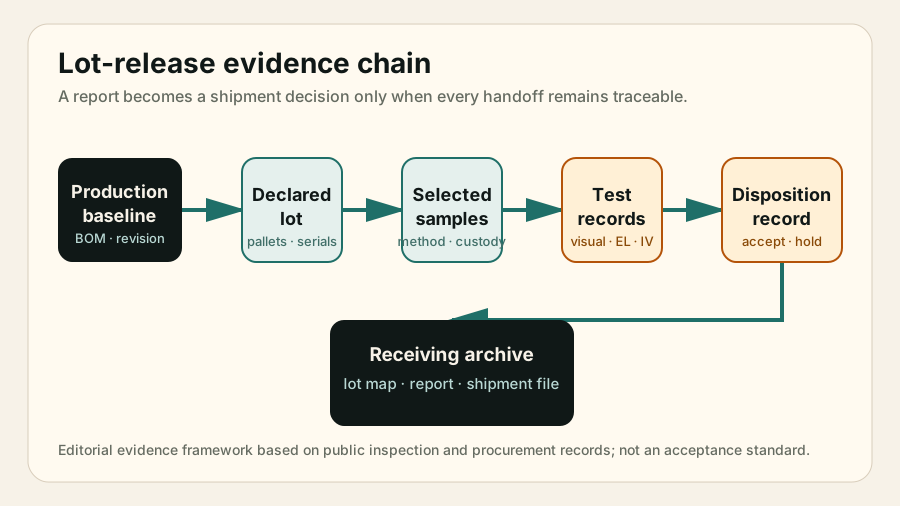
The practical object of pre-shipment inspection is not “the supplier,” “the factory,” or even “this module model.” It is the defined collection of modules offered for shipment under one order and one controlled production baseline. A good file lets a buyer trace the following sentence without guessing:
> These identified pallets and serial numbers came from this declared lot, were sampled and tested under these recorded conditions, against these agreed criteria, and were released by this named decision process.
That sentence has five joins. If one is missing, the inspection may still have value, but the value is narrower than a shipment-release claim.
| Join | Question to settle before dispatch | Useful record | What the record does not settle by itself |
|---|---|---|---|
| Lot identity | What modules is the decision about? | PO line, model and revision, factory/line, lot and pallet identifiers, serial-number range | Whether a sample is representative or the lot passes |
| Production baseline | What was the lot supposed to be? | Frozen bill of materials (BOM), construction or configuration record, approved change log | Whether a test result applies to every future production change |
| Sampling and custody | How was the sample tied to the lot? | Sampling rule, selection record, sample/pallet/serial map, chain-of-custody note | Whether the chosen quantity is sufficient for every project risk |
| Test record | What did visual, EL, or flash/IV actually measure? | Method, instrument and calibration details, images/data, operator and date | Whether a different test question has also been answered |
| Disposition | What happens after the result? | Acceptance criteria, exception log, release/hold/rework/retest/reject authority | Long-term field performance or warranty recovery |
This distinction also improves supplier communication. It replaces an open-ended request to “guarantee quality” with a finite request for identifiers, conditions, evidence, decision rights and remedies that both sides can check before the goods leave the factory.
This article complements How to Verify a Chinese Solar Panel Supplier Before Paying a Deposit, which establishes the legal seller, exact model and commercial chain before money moves, and Solar Module Contract Changes: Control a Supplier Substitution Before It Becomes a Shipment, which keeps substitutions from silently rewriting an approved order. PSI starts only after those earlier joins are usable. It cannot repair an order whose product, factory, payee, warranty route, or permitted substitution is still unknown.
1. Define the inspectable lot before selecting one module
“Today’s production” is not a lot definition. “The next container” is not a lot definition. Nor is a photo of finished pallets. The inspection request needs an identifier that lets the buyer, supplier, inspector, and receiving team refer to the same population of goods.
At minimum, create a lot declaration before sampling that states:
- purchase order, line item, purchaser and contracting seller;
- manufacturer, plant and, where relevant, production line;
- full module model, power-bin convention, construction revision and label version;
- declared BOM or configuration document and its revision;
- production start and completion window;
- lot ID, total quantity, pallet count, pallet IDs and serial-number range or mapping method;
- packing configuration and the point at which the lot is frozen for selection; and
- every known exception, rework event, substitution proposal, or incomplete record.
The aim is not bureaucratic perfection. The aim is to prevent the sample from floating free of the cargo. If the inspector tests modules set aside by the factory but the packing list later describes a different pallet group, the report may prove something about the set-aside modules only. If the supplier combines several production runs into one booking, the file should say whether they form one declared lot, separate lots, or a mixed lot with separate sampling and release rules.
A public procurement example shows why these links belong in the order rather than in the inspector’s memory. In Annexure B of one Solar Energy Corporation of India (SECI) tender, the pre-dispatch protocol calls for checking the bill of materials against the construction data form, sampling the stated lot, and using visual, flash and EL checks with specified acceptance/rejection handling.SECI tender technical document, General Annexure B
That tender is useful because it makes the transaction structure visible. It is not a global PV inspection standard or a ready-made acceptance annex for another buyer. Its sampling level, AQL figures, test conditions, defect treatment and disposition were negotiated or specified for that procurement. Copying the figures without the project context would turn an example of careful contracting into false precision.
Treat the BOM as part of the lot’s identity
Solar modules can look alike while differing in cell, encapsulant, glass, frame, junction box, connector, backsheet, cable, construction, labelling or other assessed design details. The buyer does not need to assert that every variation is unacceptable. The buyer does need a process that distinguishes an approved configuration from a proposed change.
IEC TS 62915:2023 describes a retesting approach for type approval, design and safety qualification when terrestrial PV modules undergo modification.IEC TS 62915:2023 scope The public scope does not decide whether any particular supplier change is material, which test is required, or whether a named module may ship. It does establish the important boundary: a previously assessed design is not a blank cheque for an unspecified modified design.
For a PSI call, therefore, ask the supplier to provide a controlled “as-built/as-offered” record. It should identify the approved BOM or construction document, version, issuer, date and any permitted alternatives. If the factory cannot disclose every proprietary detail, the parties can still agree the identifiers, change categories, notification process, independent-access arrangement and hold point that make the control real. A vague assurance that “all components are equivalent” is not a change record.
Map the lot to the packing hierarchy
The receiving team must be able to inherit the pre-shipment evidence. Capture the relationship between lot, production batch, pallet, carton and serial number while it is still available at the factory. A practical mapping might say:
| Packing layer | Identifier to retain | Why it matters at PSI | Why it matters after arrival |
|---|---|---|---|
| Production lot | Supplier’s declared lot ID and dates | Defines the inspection population | Connects a later issue to the release decision |
| Pallet | Pallet ID, count and location | Lets the inspector record where a sample came from | Lets receiving isolate a damaged or disputed pallet |
| Carton | Carton ID or contained serial range | Preserves a smaller traceable unit | Helps reconcile shortages and exception reports |
| Module | Serial number and label photo protocol | Connects individual test images/results to a physical unit | Supports receiving, warranty and claim records |
2. Design the sampling and custody rule before anyone sees the result
Sampling is where a PSI earns its name. An inspection of a few convenient modules may reveal a problem, but it cannot transparently support a claim about a defined shipment unless the buyer knows how the modules were chosen and what quantity they were intended to represent.
The required question is not “What sample size is normal?” No sample size is normal outside a context. The right quantity and method depend on lot size, module construction, project schedule, buyer’s loss tolerance, product history, installation design, finance or insurer requirements, shipment structure, supplier agreement, and the consequence of a missed defect. A contractor’s tender specification may be deliberately more or less demanding than a distributor’s small replenishment order.
Instead, place these choices in a short sampling schedule:
| Field | Decision to write down | Avoid this weak substitute |
|---|---|---|
| Population | Exact lot/packing population eligible for selection | “Random modules from production” |
| Timing | When the lot is frozen and when selection occurs | “Inspection before shipping” |
| Selection method | Random, stratified, pallet-based or other agreed method; selector and witnesses | “Factory will choose samples” |
| Quantity | Number of samples and the contract basis for it | “Industry-standard sample size” |
| Substitution | When a damaged, inaccessible or non-testable sample can be replaced | “Inspector may pick another one” |
| Custody | Who handles, labels, transports, retests and photographs each sample | “Third party present” |
| Records | Serial/pallet ID, date, location, photos, test sequence and exception log | “Inspection report to follow” |
The same SECI annex uses an identified inspection level and AQL treatment for random sampling.SECI tender technical document, Annexure B That proves that sampling and defect treatment can be made contractual. It does not prove that the annex’s settings fit another country, module, purchase size or tolerance for rework. In this article, it is an example of a written rule—not a recommendation to use its figures.
Keep the exception sample inside the record
Without a custody rule, the cleanest sample may be the only one that receives full documentation. Require the report to identify every module removed from ordinary flow, whether it was reinserted into the lot, and whether it sustained a handling or test-related exception. If an EL image is retaken, record the original image, the reason for retest, the operator, the settings or quality check that changed, and which image controls the decision.
This is not an allegation that a supplier or inspector will manipulate a test. It is basic traceability. The same discipline protects both sides if a customer later compares a shipped serial number to a report image or claims that a sample was not representative.
3. Use each inspection method for the question it can actually answer
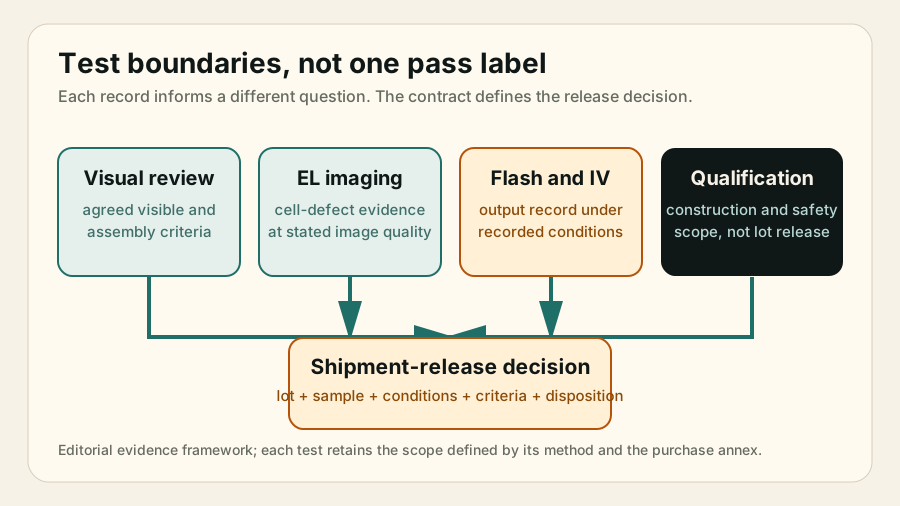
The phrase “full inspection” creates a trap. Visual review, EL imaging, flash/IV testing, calibration verification and document review have different purposes. A strong result in one does not automatically settle the others.
Visual inspection: compare the physical unit with an agreed appearance and assembly rule
Visual inspection may identify visible damage, workmanship conditions, labelling, packing condition, obvious mismatch or other criteria the parties define. It is often where an inspector can compare the label and physical construction with the declared product baseline. But “no visible defect” is not a power measurement, cell-defect classification, safety qualification, or proof that the whole lot matches every document.
Write the visual rule in advance. Include the inspection lighting and handling conditions if relevant, categories for major/minor/cosmetic defects, the applicable reference samples or photo standards, what evidence the report must retain, and whether each finding is an observation, repairable condition, retest trigger, hold, or rejection. The SECI protocol explicitly combines visual inspection with other tests and sets its own acceptance framework.SECI tender technical document, Annexure B That is another reason not to let an unsigned inspector’s generic checklist become the acceptance rule after production is complete.
EL imaging: useful for cell-defect inspection, not a complete release verdict
SEMI PV94 is specifically a guide for identifying and classifying cell defects in crystalline-silicon PV modules by electroluminescence imaging. Its public abstract also says image quality is critical to proper use of the method.SEMI PV94 abstract
That is a useful boundary for buyers. An EL image is not merely a photograph of a panel. It is evidence produced by a method, at a stated image quality, for a defined class of cell-defect questions. It can support an agreed defect assessment for the sampled module. It does not, by itself, establish nameplate power, IV-curve conditions, every handling event, sample representativeness, local-code acceptance, the absence of all latent issues, or shipment release.
Ask the inspection scope to state:
- module serial number and, where possible, pallet/lot mapping;
- capture date, operator or laboratory, equipment and relevant configuration;
- image format, resolution or quality-control requirement, and retained original file;
- defect classification rubric and the person authorised to make it;
- how borderline findings, retakes and disagreements are handled; and
- what EL result triggers a hold, broader sample, engineering review, rework, retest or rejection.
The aim is not to turn a buyer into an EL analyst. It is to stop an unlabeled image from carrying more decision weight than its method and contract allow.
Flash/IV: a measured result needs its measurement conditions
A flash or IV result can be commercially important, but a number without conditions is not fully auditable evidence. The SECI tender illustrates the level of detail a contract can request: its electrical-inspection section specifies temperature stabilisation at 25 ± 2°C, a Class AAA simulator under IEC 60904-9, current calibration evidence, a reference module traceable to an approved laboratory, and a tender-specific Pmax retest variation.SECI tender technical document, Electrical Inspection – Flash Test
Those figures are reported here only as attributes of that named tender. They are not a recommended tolerance, a universal Pmax rule, or evidence about a particular factory’s equipment. The durable lesson is that a buyer should be able to reconstruct the conditions behind the number it relies on.
For each flash/IV record, retain the module identity, claimed rating basis, test date/time, instrument or simulator identification, test settings/conditions specified by the order, calibration status and reference basis, raw or exportable result where available, operator, result versus the agreed criterion, and retest/disposition history. If the factory’s own output is used, specify whether an independent party observes, repeats, samples, audits calibration, or accepts the factory record under stated controls.
Calibration is not an appendix
Kiwa PVEL includes calibration verification among the described PSI activities.Kiwa PVEL’s pre-shipment inspection description The SECI example identifies calibration evidence and a traceable reference module as part of its flash-test protocol.SECI tender technical document Neither source tells a buyer which calibration interval or laboratory chain is sufficient for every transaction. They do show why calibration cannot be treated as an afterthought once a numerical result drives payment or release.
Ask the test provider to state what record was checked, its status on the test date, what reference basis was used, any stated limitation, and whether the named instrument was the instrument used for the sample. The buyer need not publish confidential calibration certificates. It does need enough provenance to distinguish a controlled measurement from a number copied into a report.
4. Do not confuse safety qualification, a certificate and a lot-release decision
Certification documents are important, but they do a bounded job. IEC 61730-1:2023 sets out construction requirements for safe electrical and mechanical operation of photovoltaic modules. Its public scope notes that it does not encompass all national or regional code requirements and points changes to construction toward IEC TS 62915.IEC 61730-1:2023 scope IEC 61730-2:2023 describes safety-qualification testing to be used with Part 1 and likewise refers to additional application and local-code considerations.IEC 61730-2:2023 scope
Those public scope descriptions support three careful conclusions:
- a safety-qualification standard is not a serial-numbered shipment release;
- a public certificate page is not a complete decision about local code, project fit, import, insurance, lender requirements or long-term performance; and
- a module change still needs its own change-control and, where applicable, technical review route.
The opposite error is to discard certificates because they do not answer everything. Do not do that. Use each document for its stated scope. A certificate may support a particular qualification, construction, issuer or product-record question. The lot-release file then asks the separate question: can the parties connect that approved configuration and supporting record to the modules on these pallets now?
This separation is especially valuable when sales materials combine words such as “certified,” “factory tested,” “bankable,” “inspected” and “warranted” in one sentence. Each may be meaningful. Each must be tied to a named document, scope, date, issuer, configuration and decision. A commercial label should never silently become a release rule.
5. Put the acceptance rule and remedy path in the purchase file before failure
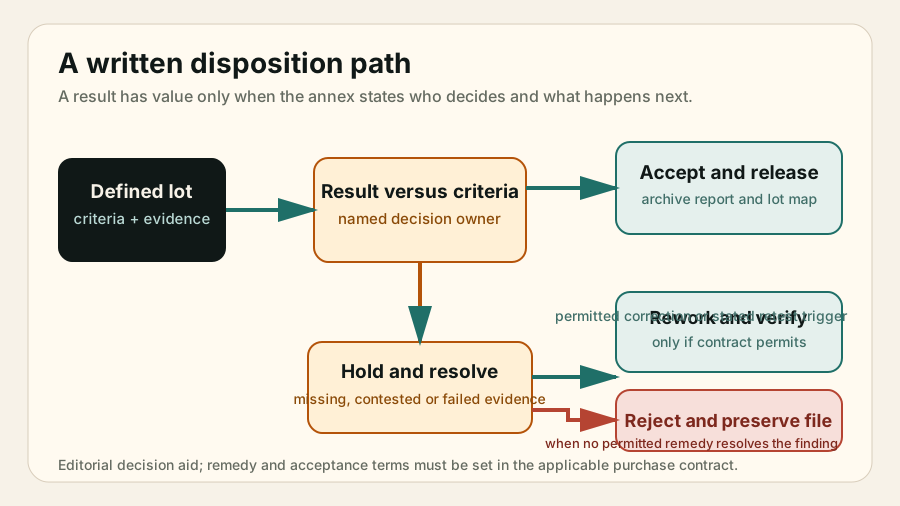
An inspection finding changes nothing unless the contract says what happens next. “Pass inspection” is incomplete without the condition that creates a pass, the decision authority, and the treatment of a failed or ambiguous result.
The SECI annex is useful again because its procedure includes acceptance/rejection treatment and says inspection does not relieve the supplier of responsibility for meeting the specifications.SECI tender technical document, Annexure B The exact remedy structure must be agreed for each order. Still, the principle is broadly sensible: an inspection report should not accidentally replace the supplier’s contractual obligations or the buyer’s remedies.
Build a disposition ladder that names five possible results:
| Result | Meaning | Required next record |
|---|---|---|
| Accept | Sample and documents meet the agreed rule | Signed release, report reference, lot/pallet map, shipment permission |
| Hold | Evidence or result is incomplete, contested or outside the defined rule | Hold notice, affected lot, missing evidence, decision owner and deadline |
| Rework | A defined, permitted correction is proposed | Rework description, affected serial/pallet map, approved method and verification plan |
| Retest | A stated trigger permits another measurement or sample action | Original result, reason, revised custody record, retest method and controlling-result rule |
| Reject | Lot or portion does not meet the agreed rule, or a required remedy fails | Rejection notice, segregation/return/disposal direction, commercial remedy and evidence archive |
For payment control, tie the release to a clear commercial instruction. Examples include permission to load, permission to issue a final invoice, release of a balance payment, or retention pending close-out. The article cannot decide which is fair for a particular purchase. It can prevent a situation in which a finance team releases funds because “the inspection was okay” without knowing which lot, which test, which exceptions, and which contractual rule that phrase refers to.
6. Use a ten-field inspection annex, not a loose email request
The following annex structure turns the ideas above into an order-specific document. It deliberately has no universal numerical limits. Populate each field with the project’s actual decisions and attach the supporting schedules.
| Field | What to specify | Why the field exists |
|---|---|---|
| 1. Scope | PO lines, module model/revision, quantity, manufacturer/plant and declared lot definition | Stops scope creep and untraceable sampling |
| 2. Production baseline | BOM/construction record, permitted alternatives, change-control notice and approval rule | Makes a substituted configuration visible |
| 3. Packing/serial map | Lot, pallet, carton and serial identifiers; required export format and timing | Connects a report to received cargo |
| 4. Sampling | Population, method, quantity, selector, witnesses, substitutions and custody | Makes sampled evidence interpretable |
| 5. Visual inspection | Conditions, categories, reference standard, photos and defect treatment | Separates visible criteria from other tests |
| 6. EL imaging | Module identity, image quality, capture/retention, classification and escalation | Makes image evidence more than a gallery |
| 7. Flash/IV and calibration | Measurement conditions, equipment, calibration/reference record, raw result and comparison rule | Preserves the provenance behind a number |
| 8. Documents | Certificates, data sheets, labels, warranty, BOM and revision-control records to compare | Keeps each document’s scope explicit |
| 9. Acceptance/disposition | Criteria, hold/rework/retest/reject triggers, authority, supplier responsibility and payment/shipment hold points | Turns observations into an enforceable decision |
| 10. Reporting/archive | Report deadline, photo/data file names, exceptions, signatures, release note and post-arrival archive owner | Makes the file usable after the shipment moves |
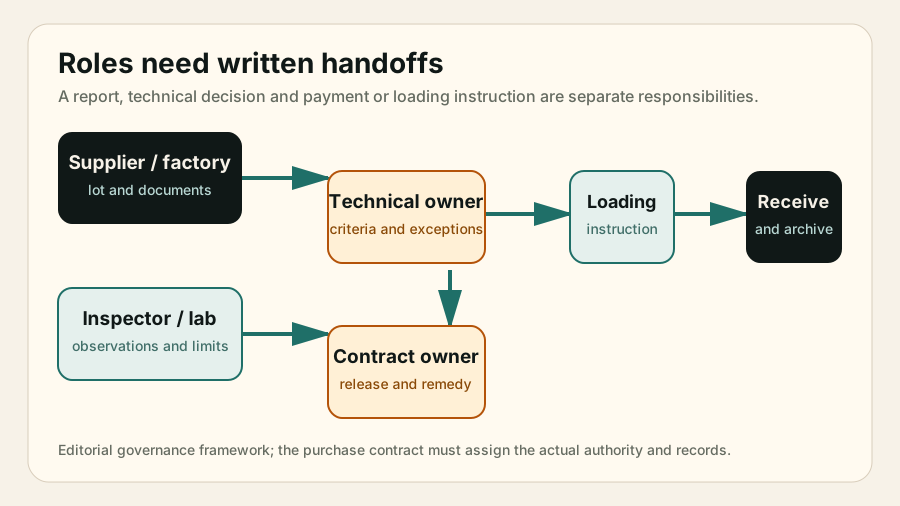
Agree the roles without pretending they are independent by title
“Third-party inspection” is not a complete governance plan. An inspector may be hired by a buyer, supplier, financier, insurer, EPC contractor or another participant. The report can remain useful in any of those arrangements if the buyer knows the scope, access, payment relationship, instructions, reporting recipient and limitation.
Record at least these roles:
- supplier/manufacturer: declares the lot, gives access, supplies the documents, handles nonconformance and remains accountable under the contract;
- buyer or buyer’s technical owner: defines the technical and commercial acceptance rule and owns the release decision unless delegated;
- inspector/laboratory: follows the contracted method, records observations and limitations, and identifies what it did not inspect;
- logistics/warehouse owner: preserves the packing/serial relationship through loading, carriage and receipt; and
- finance or contract owner: enforces the payment and remedy consequence of a hold or release.
These roles can overlap on a small purchase. They should not disappear. A supplier-quality employee may accurately record a factory test, yet not have authority to release a buyer’s balance payment. A third-party inspector may describe a finding but not interpret a contract clause. A buyer’s engineer may approve a technical exception while finance still needs a signed instruction about payment. Write the handoffs before the shipment becomes urgent.
7. Preserve the evidence after loading: PSI does not finish the quality file
A sample-based pre-shipment inspection gives bounded evidence about the sampled, declared lot at a point in time. It does not prove that every module is identical, that every shipment condition will be harmless, that installation will be correct, or that the array will meet long-term project expectations.
Kiwa PVEL makes a related distinction on its batch-testing page: it says a one-pallet BOM/design-qualification approach is not intended to answer manufacturing consistency, while batch testing is focused on that question and can be tailored to project risk and site conditions.Kiwa PVEL’s batch-testing description This is a provider’s description of a service, not evidence about the consistency of any factory, module or shipment. Its value here is the boundary: design qualification, sample PSI, and manufacturing-consistency programmes are separate questions that may need separate evidence.
The buyer’s file should therefore survive past loading. At minimum, retain:
- the signed purchase and inspection annex, all approved technical revisions and change notices;
- lot, pallet, carton and serial-number data in a format the receiving team can use;
- inspector report, original supporting images/data where agreed, calibration/condition notes, exception log and final disposition;
- bill of lading, packing list, container/seal information, loading photographs where appropriate, and damage/shortage records at receipt;
- receiving inspection, storage, handling and installation records relevant to later claims; and
- warranty version, notice route and the person responsible for preserving evidence if a field issue arises.
That archive does not create a warranty claim or prove causation. It keeps the evidence chain from breaking at the moment it is most likely to be needed. A later claim may involve product design, shipment damage, storage, installation, electrical design, maintenance, site conditions, warranty terms, insurer requirements and local law. The release file simply makes it less likely that the parties begin that investigation without knowing which modules were accepted and why.
Questions buyers should ask before booking the inspection
Use these questions to turn a vendor’s “we offer PSI” response into an inspectable commitment:
- What exact PO lines, model revisions, factory and production dates will be in the declared lot?
- Can you provide the controlled BOM/construction or configuration record and disclose any approved alternatives or changes?
- What lot, pallet, carton and serial-number identifiers will be available before sample selection and after dispatch?
- Who chooses the sample, how is the population frozen, and what written sampling/custody record will we receive?
- Which visual criteria, EL classification rule, flash/IV conditions, calibration records and document comparisons apply to this order?
- Which party supplies and pays for the inspector or laboratory, and who receives the unedited report and supporting files?
- What result or document gap causes accept, hold, rework, retest or reject—and who has authority at each step?
- Does a failed sample expand the sample, stop loading, permit a defined rework, or lead to another specified remedy?
- Which records must be transmitted before final payment, shipment permission and receipt?
- How will the buyer preserve the lot-to-serial map and inspection evidence for warranty, insurance, receiving and project review?
If a supplier cannot answer all ten immediately, that is not automatically disqualifying. It tells the buyer which points remain open. Set a deadline and a hold point that match the project’s consequences. The costly mistake is not an unresolved question; it is allowing an unresolved question to become an implied release after the cargo has been loaded.
Frequently asked questions
Is an EL test enough for PV module pre-shipment inspection?
No. SEMI PV94 is focused on identifying and classifying cell defects in crystalline-silicon modules through EL imaging, and it identifies image quality as important to appropriate use.SEMI PV94 abstract An EL image does not, by itself, establish nameplate output, calibration conditions, lot representativeness, certificate scope, packing identity or the contractual release rule. Use it for the question the order assigns to it.
Does a valid IEC certificate prove the shipment can be released?
No. The public scopes for IEC 61730-1 and -2 concern construction and safety qualification/testing; they do not make a certificate a serial-numbered lot release or complete local-code decision.IEC 61730-1:2023 IEC 61730-2:2023 A shipment-release decision still needs the declared lot, agreed configuration, sampling, test record, criteria and disposition.
What sample size should I use for solar-module inspection?
There is no universal answer in this article. The size and method should be written against the lot, project risk, contractual requirements, module construction, shipment structure and the consequence of a missed defect. A public tender can demonstrate that an inspection level and AQL may be specified; it cannot make its numbers suitable for your transaction.SECI tender technical document
Can the factory’s own flash-test results be used?
They can be part of an agreed file if the contract says what factory record is accepted and how it is controlled. Preserve the module identity, measurement conditions, calibration/reference evidence, raw or exportable result where required, comparison rule, and any independent observation or retest right. A number without those links is weaker evidence for payment or release.
Does PSI prove long-term performance or manufacturing consistency?
No. PSI is sample-based and bounded to a defined lot and acceptance process. Kiwa PVEL distinguishes one-pallet BOM/design qualification from batch testing focused on manufacturing consistency.Kiwa PVEL’s batch-testing description Neither a sample PSI nor a public service description proves future field performance for every module. Preserve receiving, installation and warranty evidence after shipment.
Method and limitations
This is a desk-researched buyer framework based on public scope descriptions from the IEC and SEMI, one public SECI procurement annex, and public descriptions of Kiwa PVEL inspection and batch-testing services. We did not inspect a PV module, solar factory, laboratory, instrument, test report, certificate, lot, pallet, shipment, installation or warranty claim. We did not validate an individual supplier’s quality, compliance, output, capacity, calibration, acceptance criteria, service performance, shipment outcome or product suitability.
The cited SECI tender is treated as a contract-specific example of an inspection protocol. Its sample plan, AQL figures, test conditions, defect categories and disposition rules are not universal requirements or recommendations. IEC and SEMI public product pages describe scope, not the full paid standards. Kiwa PVEL pages describe the provider’s services, not results for a specific factory or batch. Have qualified technical, contractual, local-code, finance, insurance, lender, customs and project advisers set the requirements that control your purchase.