
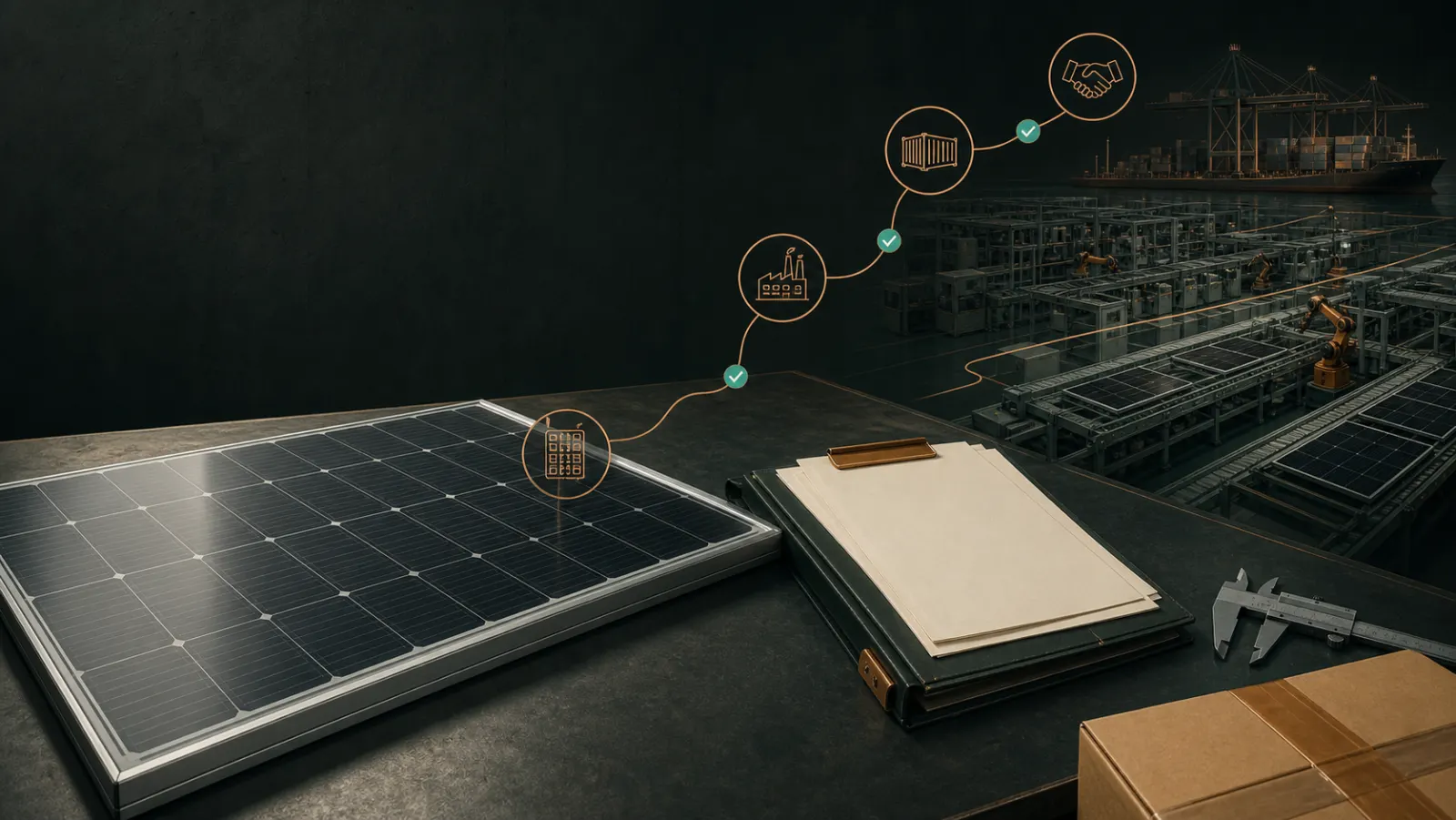
A solar-module quote can contain a familiar Chinese brand, a plausible certificate PDF, and a price that expires on Friday. It can still leave the buyer unable to answer the question that matters when the deposit is due: which entities and records control this exact order?
The company on the quote may be a trading company. The company named in a certificate may be the manufacturer. A third company may receive payment; a fourth may export the cargo; a fifth may be named in a warranty document. That division of roles is not automatically a problem. It becomes a problem when a logo or certificate causes the buyer to assume a connection that no contract, bank instruction, or shipment record later proves.
The practical answer is to build a deposit-release evidence file. It does not certify a supplier. It connects the legal seller, exact module, factory or channel, payment beneficiary, shipment path, and warranty route for one defined purchase. This is a source-backed method for organizing questions, not legal, customs, engineering, inspection, or supplier-approval advice.
Quick Answer: Verify Four Joins, Not One Brand
Before payment, every material claim should fall into one of three states:
- Independently verified: found through an authoritative record or an independent confirmation channel.
- Transaction-linked but conditional: plausible and tied to the order, but still dependent on production, payment, shipping, or change-control evidence.
- Unresolved: a name, model, site, beneficiary, exporter, or warranty route is missing or conflicts with another record.
The four joins below make that classification useful.
| Join | Question | Minimum evidence to retain | What it still does not prove |
|---|---|---|---|
| Legal seller | Who actually owes delivery and receives payment? | Chinese legal name, unified social credit code, contract party, signatory, invoice entity, beneficiary explanation | Factory capacity, authorization, product quality, or shipment outcome |
| Exact model | Which module configuration is being bought? | Full model string, data-sheet revision, label sample, applicable certificate record, warranty revision | That the quoted seller controls allocation or that a later shipment will match |
| Factory or channel | Who makes the module, or why can this seller supply it? | Named factory or permitted factory set, manufacturer/channel confirmation, production window, substitution rule | That every upstream or origin question is resolved |
| Payment and shipment | Who is paid, invoices, exports, packs, and answers a claim? | Pro forma, beneficiary confirmation, final-invoice path, packing/serial or lot method, exporter, warranty notice route | Compliance, origin, safety, or enforceability for a specific project |
A Certificate Is Evidence, Not an Order File
Certificates, manufacturer portals, equipment lists, and factory documents can all be useful. The error is not using them. The error is asking them to answer a question outside their scope.
For example, UL says that Product iQ certification information can include ratings, conditions of acceptability, and other critical information. It also says certification alone does not establish whether a component or product is appropriate for a particular end use. That limitation is explicit in UL's Product iQ material. The same logic applies commercially: even a correct certificate does not identify the legal seller on a quote, the bank beneficiary, or the exporter of the buyer's cargo.
The California Energy Commission's Solar Equipment Lists make the boundary even clearer. They support program, utility, and interconnection work and include PV modules, but the CEC says manufacturer-submitted information is not confirmed and makes no warranty regarding listed equipment's safety, performance, or durability. Read the CEC's scope and disclaimer. A list entry may be relevant to a project's equipment question; it is not a supplier endorsement or a substitute for an order file.
Use certification systems to check the bounded facts they are designed to record: certificate number, product or model fields, applicant, manufacturer or factory where shown, ratings, issue date, and status. The IECEE certificate database is one possible independent route. Then return to the transaction: does the defined module in your schedule match that record, and can the seller show why it controls the route by which that module reaches you?
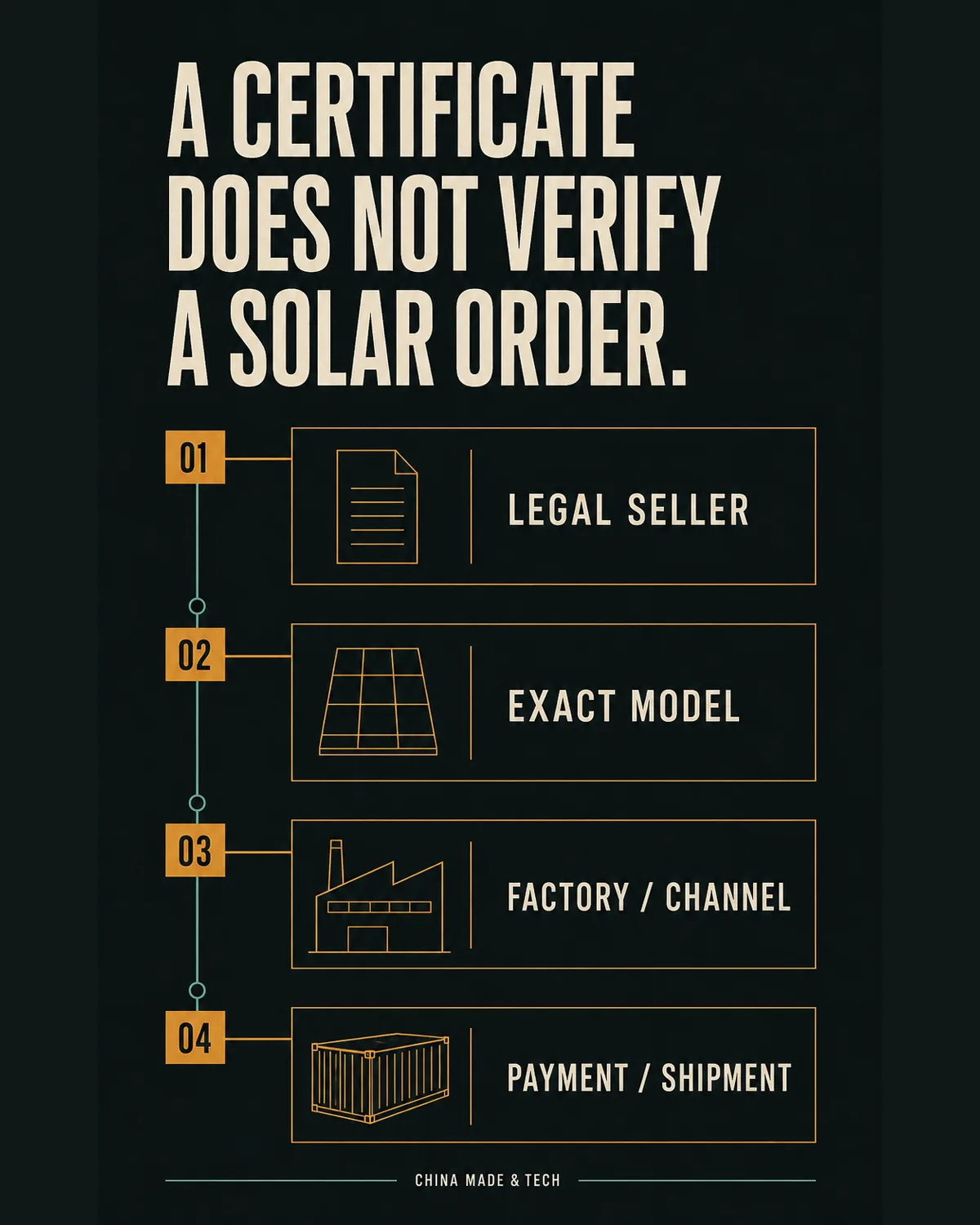 AI-generated editorial Field Note by China Made & Tech. It is an evidence framework, not supplier approval or professional advice.
The graphic contains a deliberately narrow claim. A certificate can support a bounded product or conformity fact. It cannot by itself establish the seller, payment path, factory or channel, shipment, or warranty outcome for an order. That is why a credible supplier may have good documents and still need to supply more transaction-specific evidence before money moves.
Join 1: Make the Quote Point to a Legal Seller
Ask for the exact Chinese legal name and 18-character Unified Social Credit Code of the entity that will contract with you. An English trading name, a sales email domain, and a catalogue logo are not enough to map money and remedies to a legal party.
Use the China National Enterprise Credit Information Publicity System as a starting point for the legal-entity check. Search by Chinese name, unified social credit code, or registration number, capture the result with the date, and compare it against the quote and contract. Public databases may be browser- or query-dependent; the purpose is not to claim that a screen lookup proves the whole business. It is to make identity discrepancies visible early.
Reconcile these fields before a deposit:
- legal name and registered address on the contract;
- Chinese legal name and code shown in the public record and seller documentation;
- signatory's authority and the entity on the pro forma invoice;
- bank beneficiary name, account, and the explanation for any different payee; and
- the role the seller says it performs: manufacturer, subsidiary, distributor, trader, or agent.
Different names do not automatically signal misconduct. A group treasury, authorized distributor, or export intermediary may create a legitimate split. The required response is a signed, order-specific explanation and a reconciliation of the payment path, not a rushed assumption that a familiar brand makes the mismatch harmless.
Join 2: Freeze the Exact Module Before You Review Its Documents
“N-type 620 W bifacial module” is a feature string, not a purchase object. Request the full manufacturer model code, all suffixes, power class, construction, current data-sheet revision, label sample, applicable manual, certificate identifier, and warranty revision. Record the filename or revision date, not only a webpage link that can change after the order is signed.
Then make the evidence do one job at a time:
| Record | Useful bounded question | Question that remains open |
|---|---|---|
| Manufacturer product page | Does the manufacturer publicly present this product family? | Is this seller authorized to supply this exact configuration? |
| Certificate database or report | Does a stated certificate record cover a stated product/manufacturer scope? | Is the shipment's configuration within scope and controlled by the seller? |
| Equipment list | Is a listed item relevant to the program, utility, or interconnection process in question? | Is the project approved, the record current, and the seller accountable? |
| Supplier data sheet and warranty | What does the supplier say will be supplied and supported? | Has the supplier incorporated those versions into this order? |
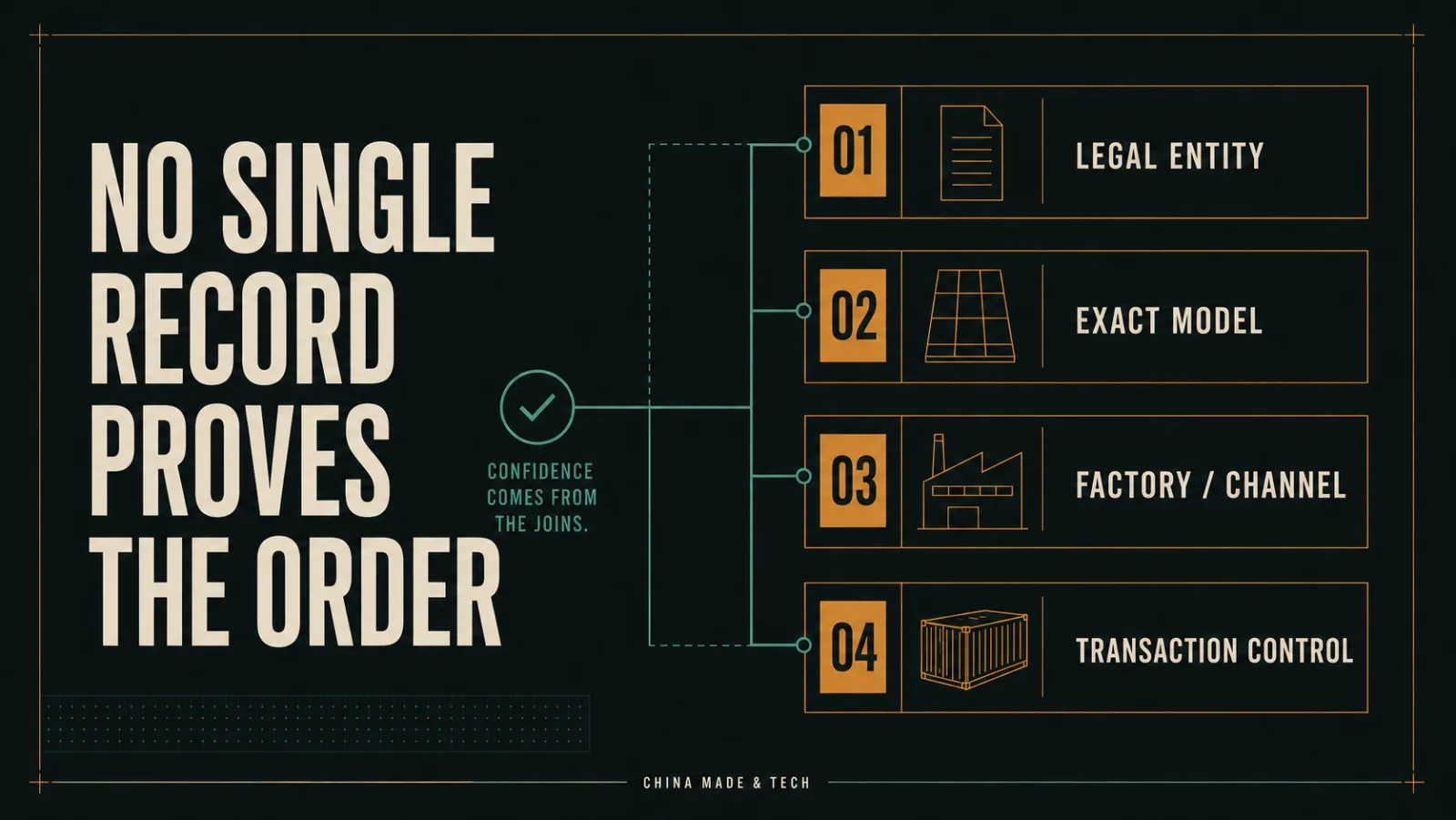 Editorial evidence synthesis based on public registry, certification, and equipment-list entry points. It is not an official certification sequence.
Build a Document Index Before the Documents Become a Pile
The useful unit is not the PDF. It is the claim a PDF is allowed to support. Create a short index as soon as a supplier begins sending documents, and keep it with the purchase schedule rather than in an email thread.
| Index field | Why it matters | Example of a useful entry |
|---|---|---|
| Record and version | Prevents a new attachment from silently replacing the approved file | `Module datasheet, Rev. 2026-07-18` |
| Issuer and role | Distinguishes manufacturer, seller, laboratory, factory, carrier, broker, and bank | `Issued by manufacturer; provided by contracting seller` |
| Fact supported | Stops a factory certificate being reused as payment or export proof | `Supports stated management-system scope only` |
| Order link | Connects the document to the defined line item | `Applies to module code and PO line 03` |
| Date and status | Makes time-sensitive records reviewable at the right moment | `Valid as checked on deposit-review date` |
| Verification route | Lets a second reviewer reproduce the check | `Certificate number searched in issuer database` |
| Open point | Preserves uncertainty instead of concealing it in a note | `Factory allocation not yet confirmed for this PO` |
It also makes a second review possible. A colleague should be able to pick a certificate or factory letter and answer: who issued it, what it actually says, which order fact it supports, when it was checked, and what it does not establish. If the answer is merely “it was in the supplier folder,” the file has not reduced decision risk.
The same discipline applies to public links. Save the page title, URL, access date, query or identifier used, and the specific field relied on. Do not keep a generic browser bookmark as if it were a transaction record. A manufacturer portal may change; a database may require a different search path; an equipment list may be updated. The order file needs the result that was checked, its limitation, and the next event that requires a refresh.
Use a Second Reviewer for the Important Joins
The second reviewer does not need to rerun every search or become a solar engineer. Their job is narrower: follow the index from the signed purchase schedule to the evidence supporting the legal seller, exact module, factory or channel, beneficiary, exporter, and warranty route. If a record does not point back to the correct order fact, it should be marked conditional or unresolved.
This small separation is valuable because the person negotiating the quote naturally knows the supplier's explanations and may fill gaps from context. A reviewer who only sees the controlled file can expose the difference between a reasonable story and a documented connection. For a material payment, the result should be captured as release, hold, or escalation with the unresolved fact named. It should never be an undocumented feeling that the package “looks complete.”
Join 3: Turn “Factory Access” Into a Controlled Claim
Many solar quotes use phrases such as “direct factory,” “Tier 1 source,” or “global manufacturer allocation.” Those phrases may describe a real commercial relationship, but they do not tell the buyer what can actually change without approval.
Ask the seller to state one of two things:
- the named factory expected to manufacture the order; or
- the permitted factory set, the production window, the reason a later allocation may change, and the buyer's approval right if it does.
Then ask for the specific commercial bridge: a manufacturer confirmation, current channel evidence, a signed order acknowledgement, or another document that identifies the seller's role for the defined model and order. A generic letter saying that a company is “a partner” is weaker than an order-linked acknowledgement that names the legal seller, product family, and current scope.
This is also where the buyer must keep a boundary. Factory evidence is not a universal traceability determination. Upstream origin, forced-labor, sanctions, customs classification, safety, and project bankability are separate files with different evidence thresholds. Use UFLPA Solar Panel Import Checklist and Solar Panel Origin Documents: Build the Evidence Chain Before Shipment for their specific questions, and involve qualified advisers where those questions control the decision.
Join 4: Make Payment, Shipment, and Warranty Survive a Change
The commercial chain is often where a plausible quote becomes weak. Before payment, map the seller, beneficiary, invoice issuer, manufacturer or channel, exporter, and warranty counterparty in one simple schedule. It should identify who provides each record and when the buyer receives it.
| Stage | Evidence that should join the order | Hold point |
|---|---|---|
| Before deposit | signed contract, pro forma, legal seller, beneficiary confirmation, model/revision schedule, permitted factory/channel | a material identity, model, or payee mismatch is unexplained |
| Before production release | accepted model documents, factory/channel confirmation, production window, change-control procedure | an unapproved model or factory substitution is proposed |
| Before final payment | final commercial parties, packing/serial or lot method, exporter and shipping-instruction path, warranty schedule | seller cannot connect goods and documents to the approved schedule |
| At arrival and claim | receiving file, damage/shortage evidence, serial or lot mapping, named notice route | no entity has a defined duty to receive and process a warranty claim |
For a U.S. import transaction, responsibilities may also be split among buyer, broker, importer of record, seller, and exporter. The module brand does not resolve that allocation. It is one reason a solar order should carry a role map rather than a loose collection of certificates and chat screenshots.
Treat Changes as New Evidence Events
A model change, factory change, bank-beneficiary change, exporter change, revised warranty, or altered delivery term is not necessarily a reason to cancel the order. It is a reason to reopen the file.
Use a short change notice that records:
- the approved old fact and source record;
- the proposed new fact, affected order line, and effective date;
- the supplier's explanation and commercial impact;
- every data sheet, certificate, factory/channel, shipping, origin, or warranty document that must be refreshed;
- the buyer's technical, commercial, compliance, and warranty reviewer; and
- the decision, deadline, and consequence if approval is not given.
This protects a legitimate distributor as well as the buyer. It lets the seller disclose a normal allocation or logistics issue without pretending that no change occurred. It lets the buyer approve a harmless revision quickly or hold a material one before money and cargo become irreversible. Solar Module Contract Changes: Control a Supplier Substitution Before It Becomes a Shipment develops that signed-baseline approach in more detail.
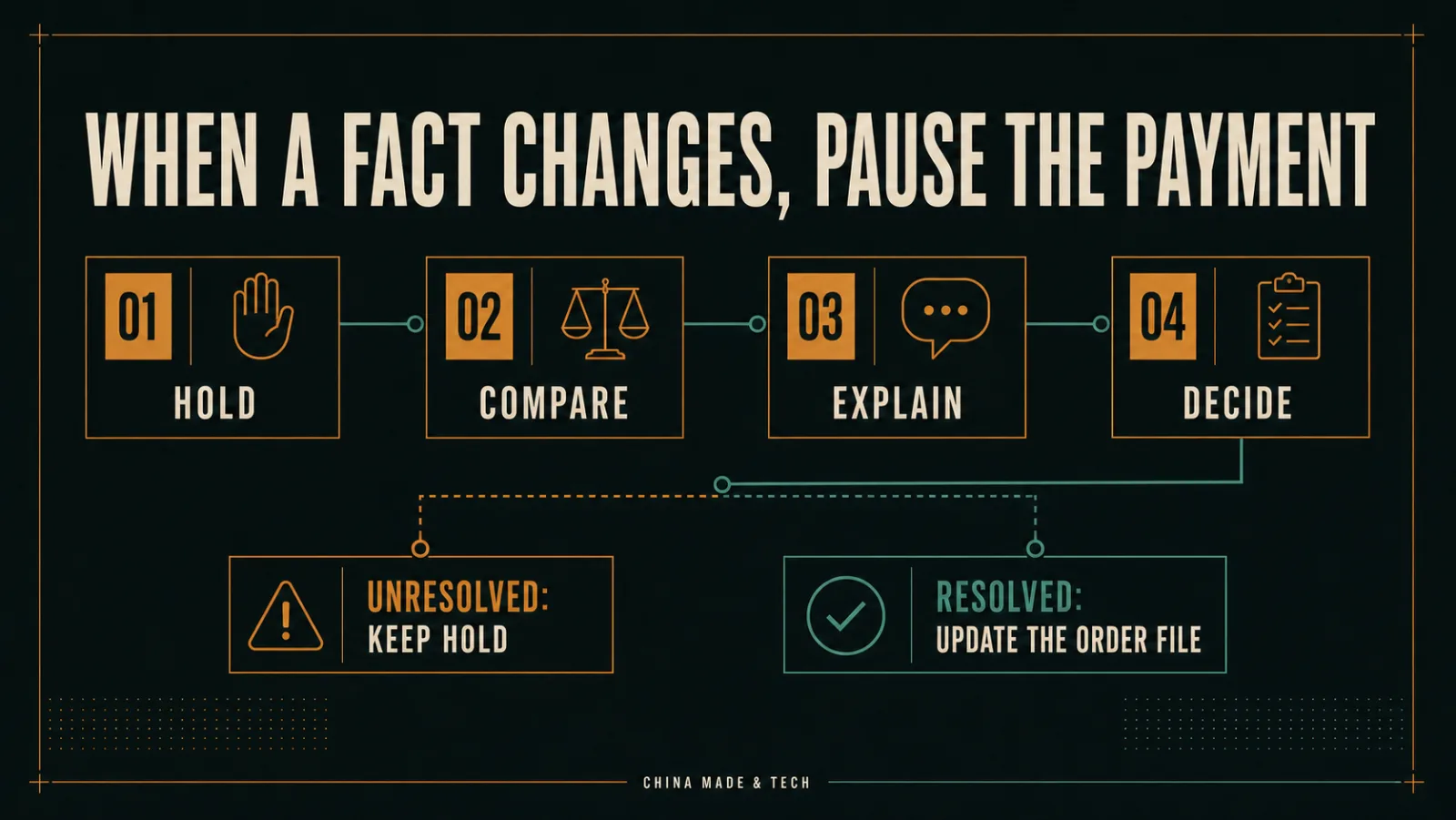 Editorial decision framework. A discrepancy is an evidence problem to document and resolve, not an automatic finding of fraud.
Escalate the Right Question, Not the Whole Supplier
Not every unresolved item deserves the same response. The useful question is: which decision does this gap block? That keeps a buyer from treating every mismatch as a fraud finding while still preventing a material unknown from slipping through because the supplier has a polished presentation.
| Gap | Ordinary next step | When it becomes an escalation issue |
|---|---|---|
| English trading name differs from Chinese legal name | request the legal-name mapping and revise the contract schedule | the contracting party, bank beneficiary, or signatory cannot be reconciled |
| Certificate or datasheet suffix differs | pause model approval and request the matching record or an explanation | engineering, customer, utility, or financing acceptance depends on the disputed configuration |
| Factory is not fixed | define a permitted factory set, evidence refresh, notice period, and approval owner | origin, traceability, customer, or project requirements need a specific site or material path |
| Beneficiary or exporter changes | obtain a signed role explanation and refresh the commercial file | the change affects payment authorization, entry, contractual recourse, or a compliance review |
| Warranty notice route is vague | request the incorporated warranty and a named claims contact | the buyer has no entity with a defined obligation to receive notice or direct a remedy |
The order file should record the escalation as an open point, its owner, the decision deadline, and whether the relevant payment or release is on hold. That is more useful than an internal label such as “high risk.” It identifies the fact that is missing, the person who can decide it, and the consequence if the answer does not arrive in time.
This approach remains fair to legitimate sellers. It gives them a precise request and a defined way to explain a normal commercial structure. It also gives the buyer a disciplined route to decline or delay an order when the evidence never becomes sufficient for the actual project.
The Deposit-Release Test
Before a deposit, give the file to a colleague who was not part of the sales conversation. They should be able to answer these questions without relying on an unrecorded promise:
- Which Chinese legal entity signs the contract, and which entity receives the money?
- What exact module, revision, and product evidence are incorporated into the purchase schedule?
- Which factory or permitted factory set and channel explanation are acceptable for this order?
- Who invoices, exports, packs, and produces the serial or lot, carton, and shipment records?
- Who receives a warranty notice, and what evidence enables a claim?
- What happens if any of those facts changes before production, final payment, or shipment?
If the answer to a material question is “the brand is well known” or “the salesperson said so,” the issue is unresolved. The appropriate next step may be a hold, a smaller test order, more commercial protection, or escalation to a technical, legal, customs, financing, or inspection professional. It is not a basis for calling the seller fraudulent without evidence.
The payoff is a better order, not more paperwork for its own sake. A buyer who can connect seller, product, factory or channel, payment, shipment, and warranty facts has a file that can survive normal changes. A buyer who only has a familiar logo and a certificate pack has public signals, not transaction control.
Method and Limits
This article is editorial desk research by China Made & Tech Team. It uses public enterprise, certification, and equipment-list entry points plus document-control reasoning; it does not report a factory visit, a supplier transaction, a legal opinion, an engineering inspection, or a supplier approval.
Public records and certificates support bounded facts. They do not prove that a particular seller controls a factory, payment path, shipment, customs outcome, product performance, or warranty remedy. Recheck time-sensitive facts for every material order and after any model, factory, beneficiary, exporter, or warranty change. For project-specific technical, legal, customs, financing, or compliance decisions, use qualified advisers and the governing requirements.
Related Entries
- Buying Chinese Solar Panels: Build a File for the Exact Module
- Solar Module Contract Changes: Control a Supplier Substitution Before It Becomes a Shipment
- Solar Panel Origin Documents: Build the Evidence Chain Before Shipment
- UFLPA Solar Panel Import Checklist
- Quality Control in Chinese Factories: Build a Defect-to-Release Evidence Chain
By China Made & Tech Team. Independent editorial research.