
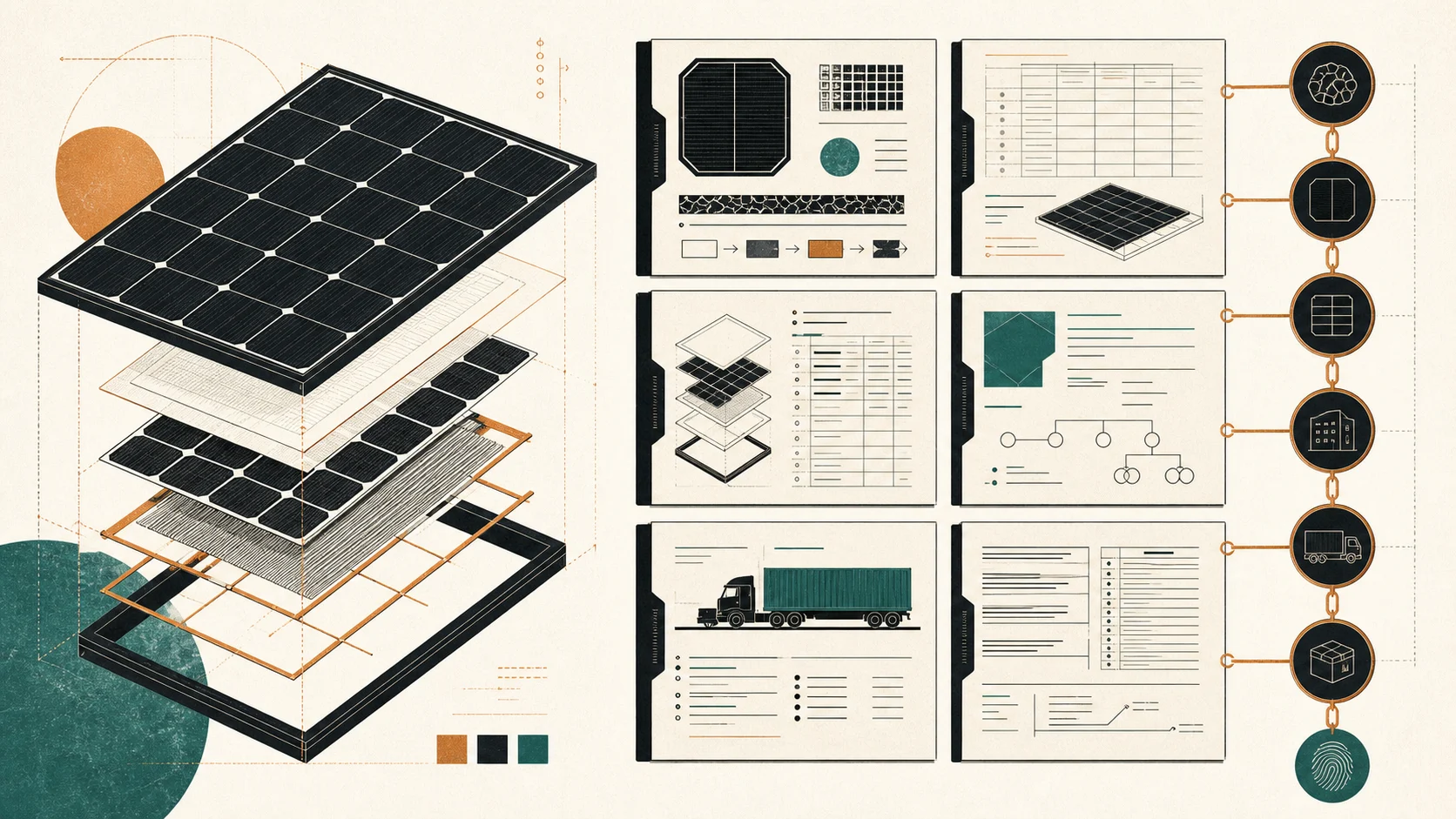
By China Made & Tech Team. This is desk-researched origin-evidence analysis, not customs, broker, legal, trade-remedy, tax-credit, traceability, or supplier advice.
"Where was this solar panel made?" is not usually a label question. It is a question about a defined legal purpose, a physical production sequence and an imported module that must be connected to its commercial and transport records. A factory address or generic certificate may be relevant context. It is not the evidence chain by itself.
CBP's H261693 ruling and N355286 ruling show why. They consider solar modules under stated facts and legal contexts, including the role of solar cells and the processing described. The results cannot be copied from one product, route or question to another. A buyer should treat a ruling as an explanation of fact-specific analysis, not as a universal origin certificate.
This article helps a U.S.-bound buyer build the source file that a customs professional, lender, customer or internal compliance team needs before cargo moves. It does not decide origin, marking, tariff, trade-remedy or procurement eligibility for a particular shipment.
Start With the Question, Not the Certificate
Origin can matter for marking, customs/trade remedies, a customer term, project finance, public procurement or a traceability claim. Those questions may use different rules and evidence. The first task is to write a concise issue statement: imported product/model, importer, route, manufacturer/exporter, intended market, decision needed and the legal/customer program that creates the requirement.
Without that statement, a request for "a certificate of origin" encourages the supplier to provide a broad conclusion while the buyer has not identified what needs to be proved. Ask first for production and transaction facts; qualified advisers apply the relevant legal test to them.
| Question | Evidence that helps | Evidence insufficient on its own |
|---|---|---|
| What exact product is involved? | approved model, invoice line, serial/lot, packing and shipment records | product family name or generic carton description |
| Where were cells made? | facility, batch/process connection and dated production evidence | unlinked cell-supplier name |
| Where was the module assembled? | factory, production window, line/lot and manufacturing record | corporate office or export-port address |
| What legal purpose applies? | written issue statement and adviser direction | a universal assertion of "origin" |
| Can another reviewer reproduce the claim? | indexed documents, sources, record owner and retained links | a broker's memory or sales chat |
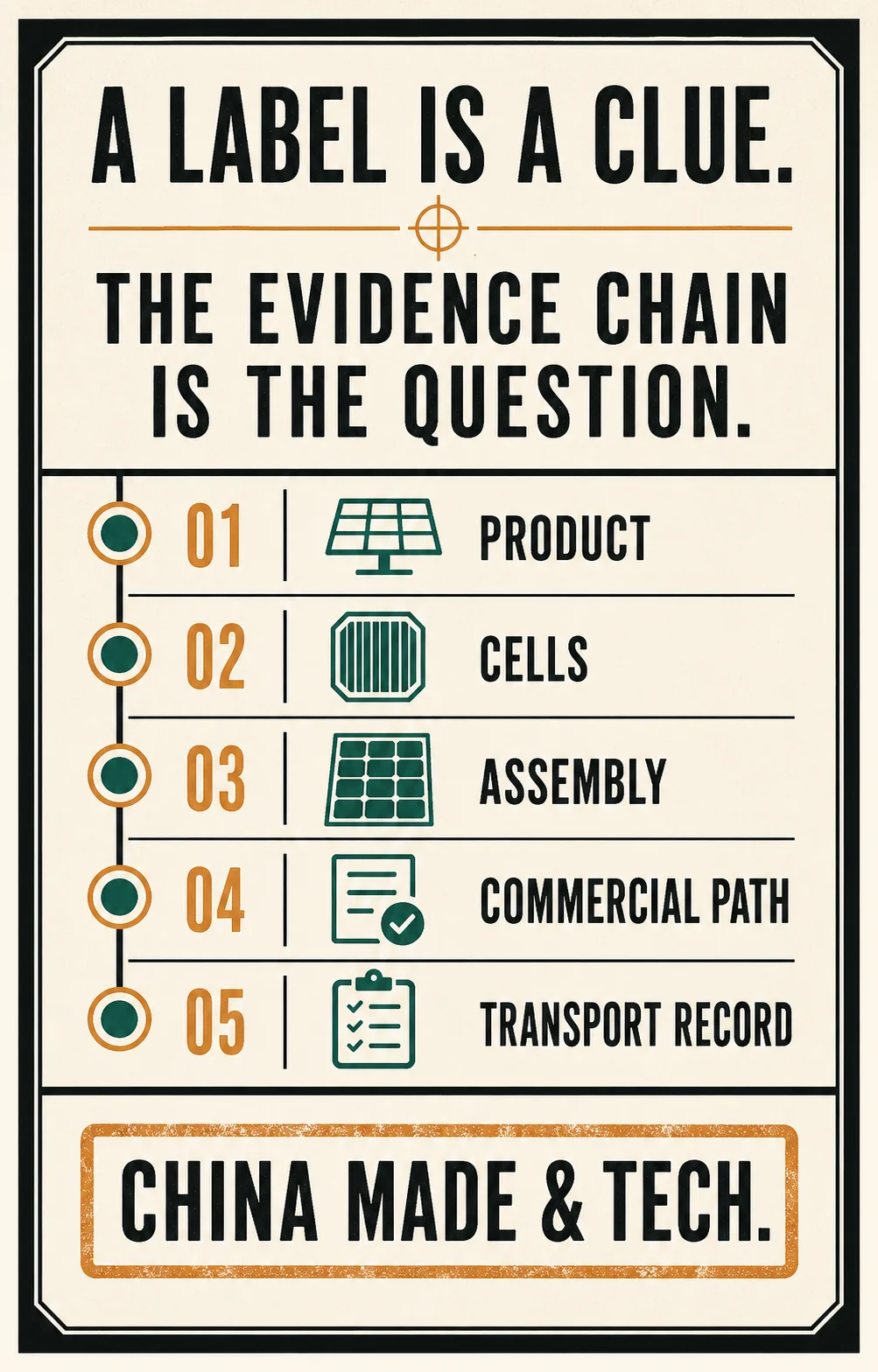 Field Note: evidence needs to be connected to a stated legal or commercial question before it can carry a conclusion.
Read CBP Rulings for Their Facts and Boundaries
H261693 concerned a Trade Agreements Act government-procurement question and describes cells from Malaysia or Korea with later module assembly under stated facts. CBP's analysis turns on the substantial-transformation framework and the evidence supplied. It is a useful source because it shows the level of production detail an origin analysis can require. It is not an answer for a different rule or supply chain.
N355286, issued in November 2025, describes two specified solar-panel models and manufacturing across Taiwan, China and the Philippines. The ruling identifies the cell-manufacturing process in Taiwan, subsequent lamination/related work in China and final assembly in the Philippines, then reaches its conclusion on those facts and for its marking/trade-remedy context. Its value to a buyer is not a country name to reuse. It is the reminder that the production of a functioning solar cell and the later module steps must be described accurately before a legal conclusion is made.
The practical rule is: do not quote a ruling's conclusion until you can compare its product, process and legal purpose with the shipment in front of you. If the cell facility, process, module assembly, product configuration, route or question differs, tell the adviser where it differs. The difference may be decisive or immaterial; it should not be hidden.
Build Backward From the Imported Module
The shipment is the anchor. Begin with the module that will appear on the invoice and bill of lading, then map backward through physical and commercial links:
- approved model, configuration, quantity and invoice line;
- serial range or bounded lot, carton, pallet and container relationship;
- module factory, production window and assembly/release record;
- solar-cell facility and batch/process link to the module production;
- upstream wafer/ingot/polysilicon records when the stated requirement needs them; and
- seller, manufacturer, exporter, importer and other material commercial entities at each handoff.
Each link should state what it proves and where it stops. A bill of lading may identify shipper, consignee, cargo and route; it does not prove cell provenance. A product certificate may support a technical configuration; it does not prove a factory's current production allocation. A supplier declaration may summarize a claim; it becomes stronger when it points to contemporaneous records the buyer can review.
The SEIA 101 traceability standard is useful in this respect. It frames traceability as due diligence, data collection, analysis and a management program, with transaction relationships at different supply-chain stages. The principle is not that every importer must demand every confidential upstream record. It is that the claim's required granularity should determine the documentation request, and any limitation must be explicit.
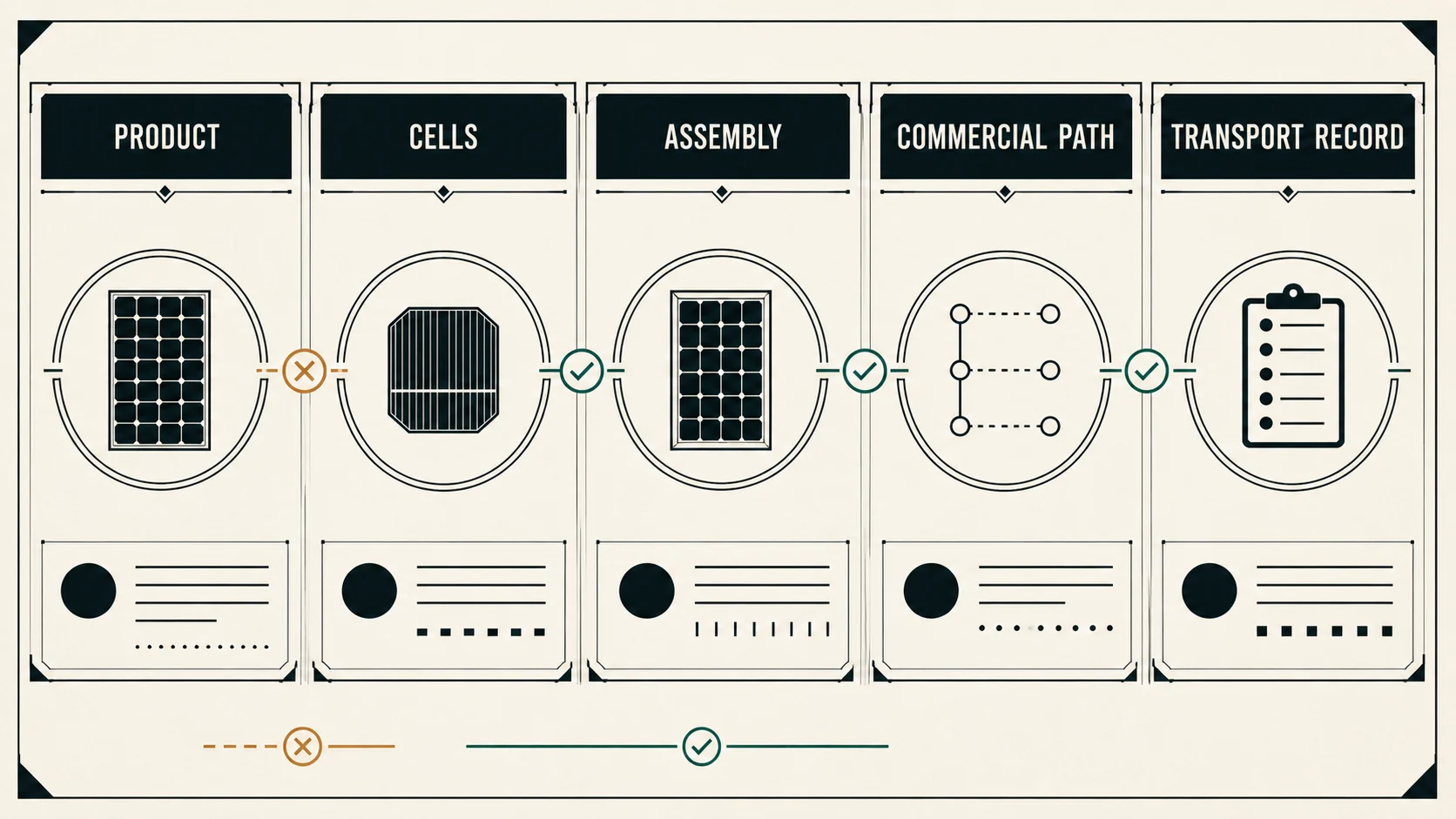 The chain organizes facts; it does not itself decide origin or entry treatment.
Make Commercial and Production Records Agree
The best pre-shipment review is a consistency test. Compare legal names, addresses, model codes, quantities, dates, lot identifiers, factory, exporter and container details across the order, production map, invoice, packing list, serial export and transport documents.
CBP's current commercial-invoice guidance requires an adequate description, quantity, value, HTSUS information and the relevant foreign invoicing party in entry documentation. Its cargo-description guidance emphasizes a plain-language description detailed enough to identify the commodity. For a module file, vague language such as "solar panels" should never be the only product identity preserved. Retain the model and physical/transaction links in the controlled file even if a transport field has a shorter format.
Escalation signals include a cell batch dated after the stated module run, an invoice suffix not covered by the approved data sheet, a module plant absent from the production map, a newly introduced exporter, or a serial list that cannot be tied to the packed cargo. None proves wrongdoing. Each means the buyer should stop calling the file complete until the facts are reconciled.
Use a document index: document, issuer, date, fact supported, model/lot/transaction link, reviewer and open issue. This makes it possible for a broker, owner or later employee to reconstruct the basis for a declaration without converting missing evidence into a confident story.
Keep the Importer as the Long-Term Record Owner
CBP's recordkeeping guidance says entry records must be kept for five years from entry or the activity requiring the record and produced on demand. A broker or forwarder can store copies, but the importer must retain a controlled record system with a named owner.
For an origin-sensitive module purchase, preserve the signed order and approved product schedule; invoices/payment evidence; packing and transport records; serial/lot and factory records; cell/production records required by the issue statement; certificates/declarations; adviser analyses; change notices; and correspondence resolving conflicts. Preserve original versions and date any correction. A clean rewritten spreadsheet may be convenient, but it can destroy the history that explains why a record changed.
This does not mean a buyer must circulate sensitive supplier information freely. An NDA, redaction protocol, secure data room or limited third-party review can protect legitimate confidentiality. The boundary is practical: the review mechanism must still link the claimed fact to the imported product. A blanket refusal to provide product connection leaves the buyer unable to support the representation it intends to make.
Treat Production and Commercial Changes as New Facts
Cells, module plants, exporters and product revisions can change for legitimate capacity, price or logistics reasons. The buyer must decide whether the change affects the origin, marking, trade-remedy, customer, lender or traceability assumption that justified the original order.
Require notice that identifies the old and new fact, affected PO line, effective date, documents needing refresh, unresolved issues and buyer decision required. A change to a factory or cell path is not an administrative update if the original file used it to answer an origin question. Solar Module Contract Changes: Control a Supplier Substitution Before It Becomes a Shipment provides the broader mechanism for preserving an approved order baseline.
Give Advisers Facts, Not a Requested Answer
When the file goes to a customs broker or counsel, send the issue statement, product map and indexed documents together. Do not ask the professional to "confirm this is not China origin" or to select a country from a supplier letter. Ask what rule applies to the stated purpose, which facts are material, which record gaps prevent a conclusion, and whether the proposed entry/marking/customer statement needs a different analysis.
This framing matters because advice is only as reliable as the production story it receives. If the buyer later learns that cells, factory, exporter, product construction or relevant commercial relationship differed from the materials reviewed, the original analysis may need to be revisited. A change log is therefore part of legal/compliance discipline, not just procurement administration.
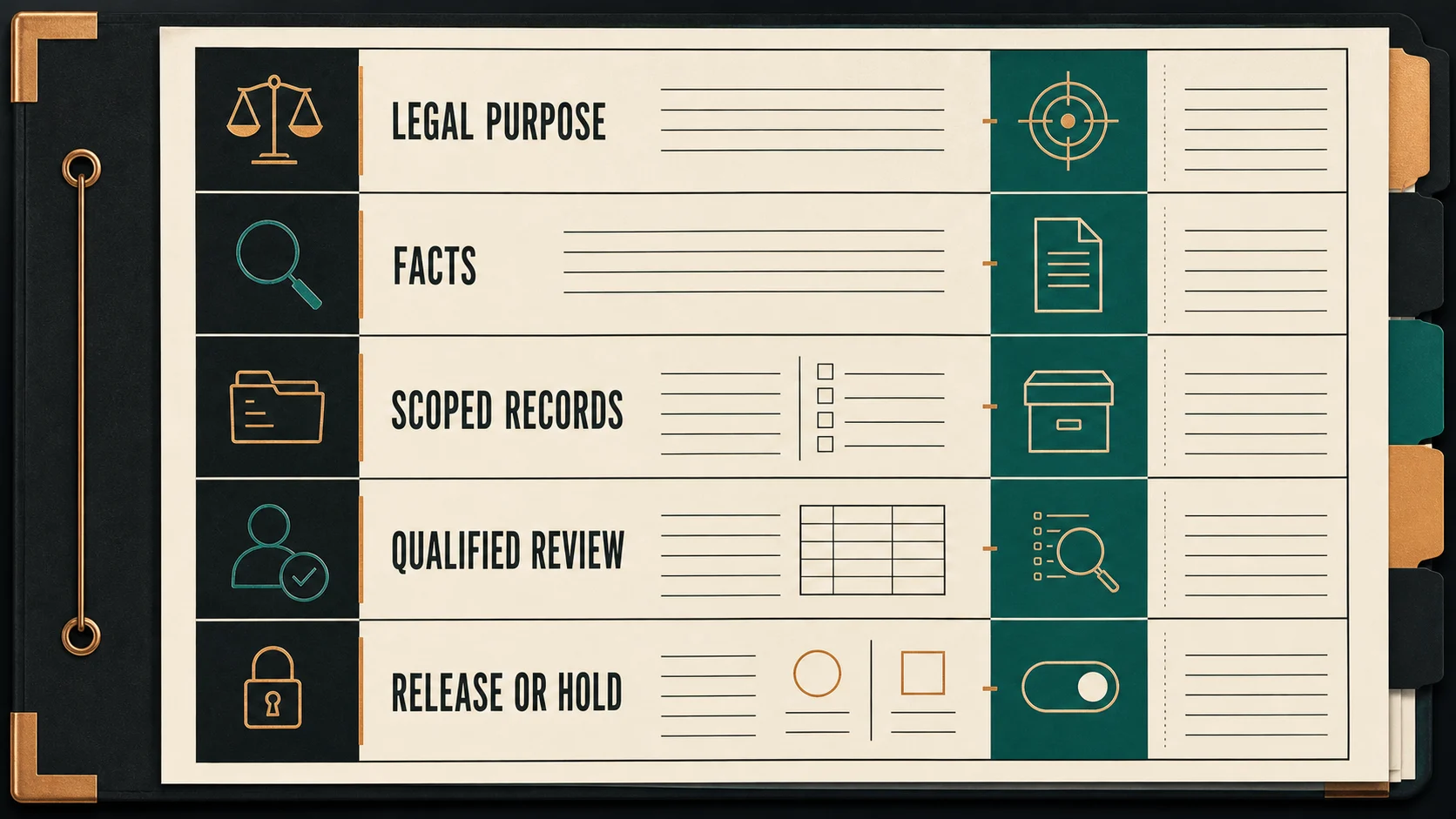 The review file records who must decide what, and on which facts.
A Pre-Entry Evidence Test
Before cargo leaves, give the file to a reviewer who did not negotiate the order and ask:
- What exact model and serial/lot range is being imported?
- Who sold, manufactured, exported and will receive the cargo?
- Which facility made the module and which evidence identifies the relevant cell process?
- Which documents connect those facts to this invoice, packing and container?
- What legal/customer question is the file intended to support, and what does it not answer?
- What changed, who approved it and where are the retained originals?
If the file cannot answer them, it is not ready for a complex origin assertion. Clarify, condition or hold the shipment. A label may still be necessary, but it is the end of the evidence chain, not its beginning.
Method and Limits
This article uses fact-specific CBP ruling examples, SEIA traceability framing and public CBP recordkeeping guidance to explain an evidence-file approach. It does not decide origin, marking, classification, tariff, trade remedy, procurement eligibility, entry treatment, tax-credit treatment, traceability compliance, or supplier suitability. The actual item, production facts, commercial route, legal purpose, current rules and qualified reviewers control the conclusion.
What This Article Does Not Determine
H261693 and N355286 are examples of fact-specific CBP analysis, not determinations for another module or legal purpose. A shipment's origin, marking, classification, duty or procurement treatment requires the applicable rule, complete facts and qualified advice.