

By China Made & Tech Team. We publish desk-researched buyer files about Chinese manufacturing systems; this is not legal, engineering, customs, insurance, or inspection advice.
A supplier says the approved module is no longer available from the expected plant. A different factory can make a near-identical module. Or the module is unchanged, but the exporter, invoice entity, warranty contact, carrier, named delivery point, or product-document revision has moved. Each message can sound routine. Each can also change a fact that engineering, finance, compliance, logistics, or the future asset owner relied on when the order was approved.
The useful question is not whether every change is bad. It is whether the buyer can still explain, from one controlled file, what was approved, what changed, what evidence moved with it, who decided, and what happens next. A supplier substitution becomes risky when it silently rewrites the approved baseline after a payment, production slot, or booking has made reversal expensive.
This article gives that buyer file a name: the five-question change dossier. It is designed for a solar-module order sourced from China, but the method is broader. It does not decide whether an actual change is acceptable. The signed agreement, product requirements, project constraints, and qualified review determine that. It makes the underlying decision visible early enough to be made deliberately.
Quick Answer: Do Not Approve a New File. Approve a Defined Change.
Before deposit, establish an order baseline. For every proposed material deviation, require a short dossier that answers five questions:
| Question | What the buyer needs in the file | Why it matters |
|---|---|---|
| 1. What changed? | approved fact, proposed fact, affected PO line/quantity, effective date | stops a vague “equivalent” claim from replacing a defined product or party |
| 2. What evidence moves? | old/new data sheet, factory, certificate, packing, commercial, delivery, or warranty records | shows whether the proof still fits the actual order |
| 3. Who must approve? | named technical, commercial, logistics, compliance, and asset-owner decision rights | prevents one rushed email from standing in for every required review |
| 4. What does it cost? | price, freight, insurance, testing, schedule, storage, and remedy effect | keeps commercial pressure separate from technical acceptance |
| 5. Can it wait? | hold point, deadline, default if no approval, and instruction to factory/forwarder | prevents silence from becoming an irreversible release |
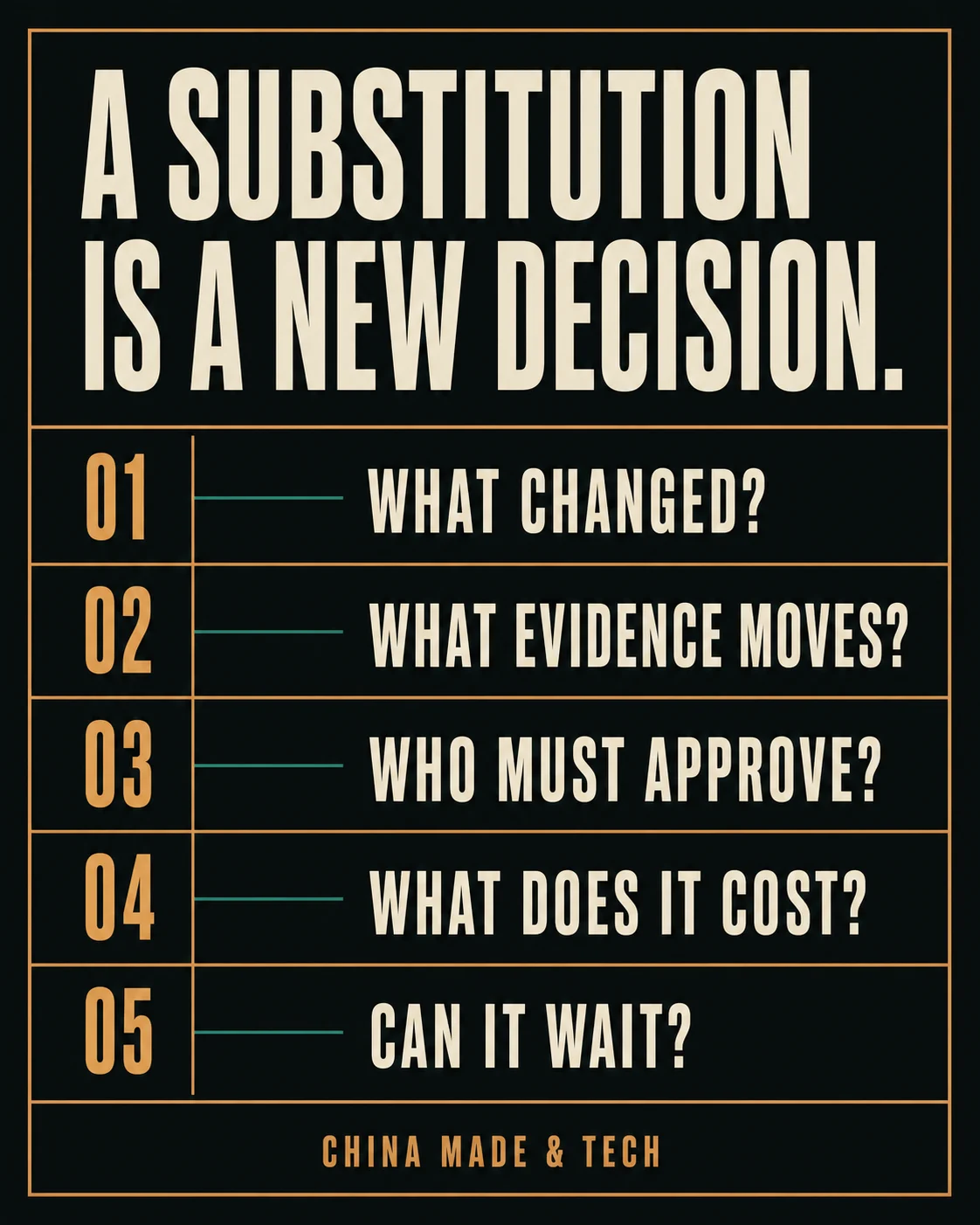 Field Note: an editorial decision framework, not a legal determination or supplier approval.
Start With the Baseline, Not the Supplier's Explanation
The first failure happens before any change notice arrives. The PO describes “Tier 1 modules,” “locally supplied product,” “freight included,” or “equivalent product acceptable,” but never turns those phrases into order facts. Later, the buyer and supplier are both forced to debate what they meant.
Make the baseline a signed schedule or an explicitly incorporated file. It should be concise enough to use and specific enough to compare.
| Baseline layer | Facts to lock before release | Record that carries the fact |
|---|---|---|
| Product | manufacturer, full model suffix, power class, construction, approved data-sheet/manual/certificate/warranty revisions | approved technical schedule |
| Production path | named factory or permitted factory set, production window, permitted substitutions, serial/lot method | order schedule and production-release record |
| Commercial chain | contracting seller, invoice entity, payee, exporter, manufacturer role, warranty notice route | contract, pro forma, role map |
| Delivery exposure | rule, named place or point, rule year, carrier/booking control, insurance expectation, inspection point | delivery schedule and booking instruction |
| Acceptance file | packing hierarchy, serial/lot export, receiving record, damage/exception process, archive owner | release and handover checklist |
The buyer should also mark which baseline facts are hard stops. A product construction change might be technically impossible after design approval. A factory move might be acceptable on one project and require a financing or customer review on another. The hard-stop list is not a universal rulebook; it tells the supplier which changes cannot be treated as administrative.
1. Describe the Difference Before Calling It a Substitution
“Same module,” “same factory group,” and “minor logistics adjustment” are explanations, not comparisons. A change notice should begin with a before-and-after table.
| Field | Approved state | Proposed state | Buyer question |
|---|---|---|---|
| product | exact model, suffix, data-sheet revision | exact replacement and revision | does performance, fit, certificate scope, or warranty scope change? |
| production | permitted plant and window | proposed plant and window | does the evidence/traceability requirement still fit? |
| commercial party | seller, payee, invoice entity, exporter | new role map | who receives money, performs, exports, and handles a claim now? |
| delivery | agreed rule, year, place/point, carrier control | revised term or route | do cost, risk, timing, import, or insurance assumptions move? |
| acceptance | serial/lot and packing hierarchy | revised file or exception | can the receiving team still reconcile the delivered product? |
The buyer's default should be modest: if a fact was used to choose the product, allocate money or risk, meet a customer condition, or plan acceptance, treat the new fact as a proposed change until the responsible owner says otherwise. A typo correction or an added contact may be administrative. The party proposing it should still show why the approved scope did not move.
2. Refresh the Evidence That the Change Disturbs
The strongest change notice does not attach a pile of PDFs. It identifies which proof is no longer sufficient, which replacement record is needed, and which link remains unresolved.
For a product or production-path change, the needed file may include the revised data sheet, applicable certificate or test scope, manual, warranty revision, factory/production identification, and a serial or lot mapping plan. For a commercial-party change, it may include the updated contract role map, invoice, payment instruction, exporter information, and named warranty/service route. For delivery, it may include the precise rule, its year, named place or point, booking responsibility, insurance/claim assumptions, and carrier or container record.
SEIA 101 describes traceability as a management program supported by due diligence, data collection, analysis, and transaction relationships across the supply chain. It does not turn a public standard into proof that a particular order is compliant. It does support a useful operational question: when a factory, component boundary, or product path changes, what order-linked records must be refreshed before the old file can still be relied on?
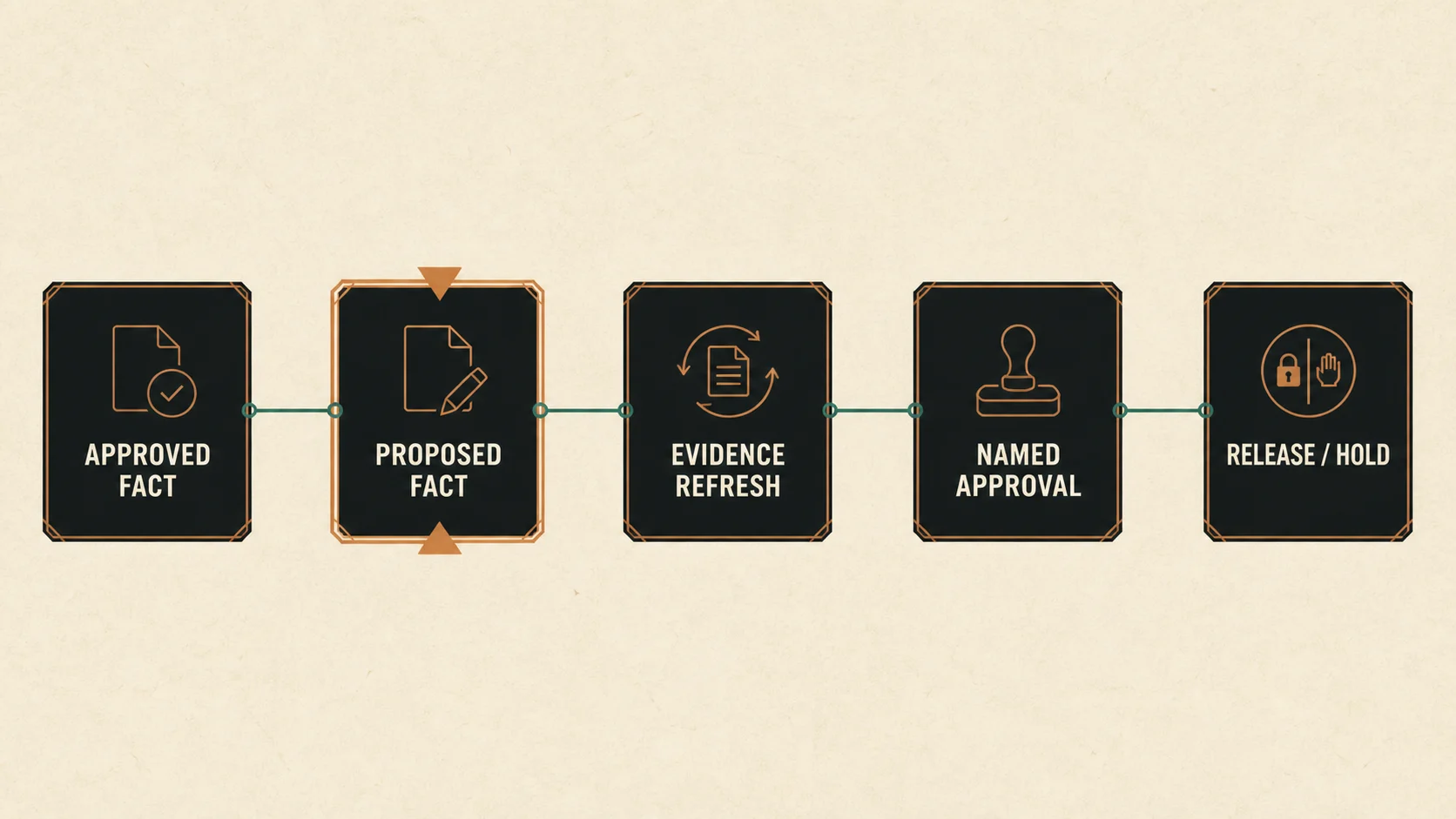 The change dossier links a proposed fact to the evidence and decision it requires. It is an editorial framework, not a contract interpretation.
Use an evidence table that includes the issuer, version/date, fact supported, order or product link, reviewer, and open limitation. A factory letter might support a bounded production claim. It does not by itself prove the right to receive payment. A revised packing list may support a shipment record. It does not substitute for a technical approval of a different module. Keeping each document's claim narrow is what makes the joined file useful.
3. Assign Decision Rights Before the Urgent Phone Call
Change control breaks down in two opposite ways: every routine update is escalated to a committee, or a salesperson's email is treated as technical, commercial, logistics, and warranty approval at once. Use an approval map with limited roles.
| Change | Supplier must provide | Buyer decision owner | Escalate if |
|---|---|---|---|
| document correction | old/new version and unchanged-scope statement | document owner | model, issuer, date, certificate, or warranty scope changes |
| module configuration | comparison and refreshed product evidence | engineering authority | design, mounting, electrical, certification, or performance assumptions move |
| factory/product path | production comparison and required traceability records | procurement plus relevant compliance/customer owner | the project depends on an origin, financing, or customer condition |
| seller/payee/exporter | entity role map and commercial records | commercial, finance, legal owner | payment protection, entry file, or recourse path changes |
| delivery/route | revised term, precise place, booking, insurance, schedule impact | logistics/insurance owner | costs, risk, import timing, or site readiness moves |
| warranty/service | applicable signed revision and notice/remedy route | asset owner/legal owner | claimant, response, or field-cost allocation changes |
The notice must also say what silence means. For a material change, the safest operational default is generally that the affected line is held until the named decision is recorded. That may cost allocation or time. It is still clearer than learning after payment that one owner thought an email was a question while another treated it as a release.
4. Treat a Delivery Change as a Risk-and-Cost Change
“Freight included” is not a complete delivery instruction. The ICC says a contract using Incoterms should state the chosen rule, named place or point, and year. Its Incoterms 2020 Q&A also distinguishes the named destination in C rules from the earlier delivery/risk-transfer point. In other words, a seller may arrange and pay carriage to a named destination without keeping risk until arrival.
That is why a change in route, carrier control, named place, or rule should not disappear into a forwarding update. The buyer should ask:
- What exact rule, year, and named place or point is now proposed?
- Where does the actual delivery/risk-transfer event occur under the agreement?
- Who books carriage, controls instructions, and can approve a carrier or route change?
- Who has the required insurance/claim position, and what evidence will preserve it?
- Does the new exporter, transit, arrival plan, or receiving point change a project-specific import, site, financing, or schedule assumption?
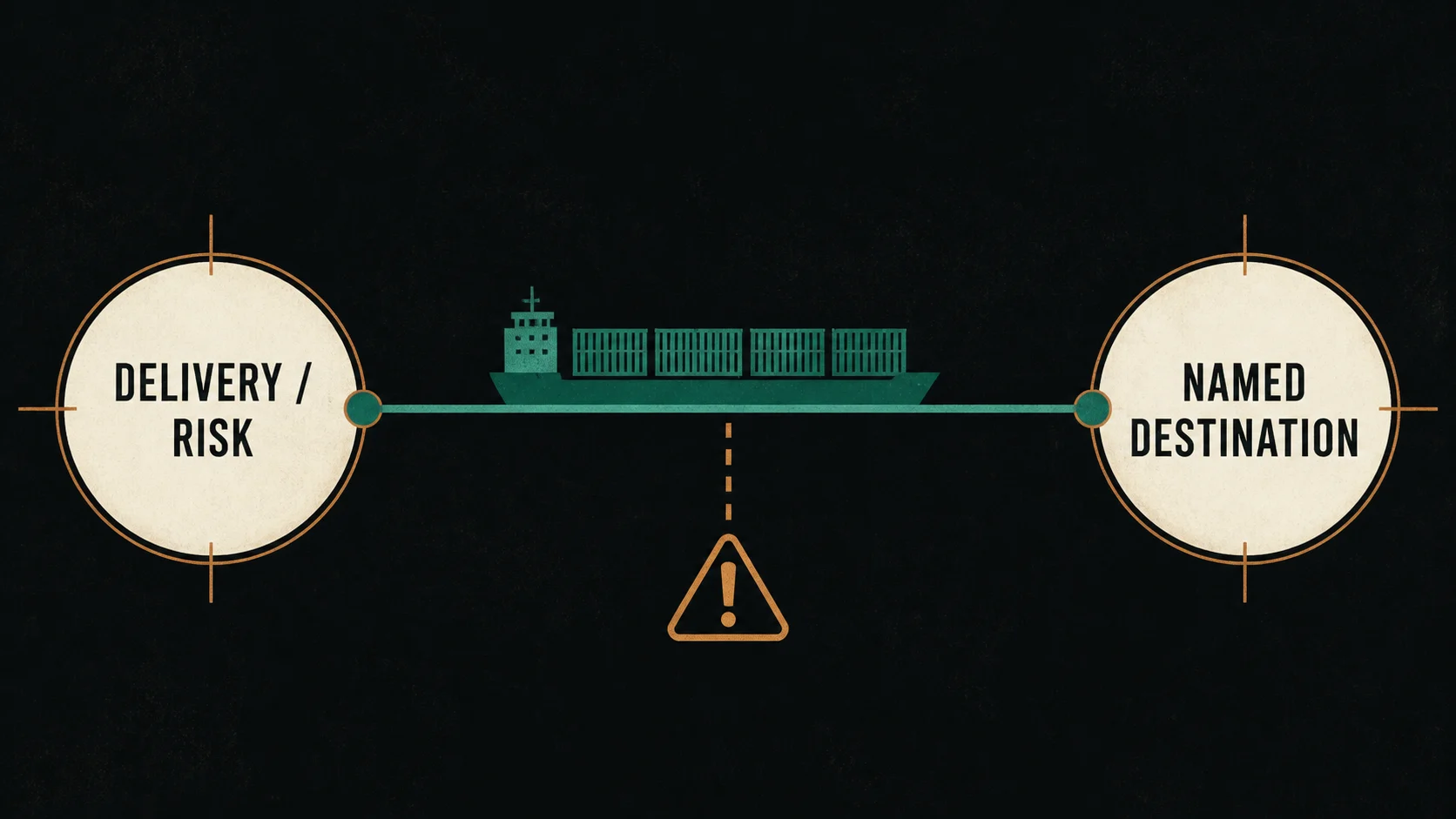 Delivery, destination, cost, and risk are related but not interchangeable. Check the actual signed agreement and applicable rule.
No article can determine the answer for a shipment. The value of the checklist is that it prevents “destination” from becoming a vague substitute for a delivery rule and precise location.
5. Price the Change Separately From Accepting It
An urgent alternative can be technically acceptable and commercially unacceptable, or the reverse. Put its commercial effects in a separate record:
- unit price, currency, deposit, and final-payment effect;
- freight, insurance, inspection, storage, demurrage, inland-delivery, and replacement cost;
- testing, engineering, document-review, customer, or financing work created by the change;
- production, vessel, arrival, installation, commissioning, and remedy dates; and
- cancellation, credit, liquidated-damages, spare-stock, and dispute process where applicable.
DOE warns that inadequate procurement instructions invite change orders and renegotiation in its procurement-phase guidance. The buyer cannot eliminate every renegotiation. A separate impact sheet prevents the more damaging outcome: accepting a new product/factory/delivery fact simply because the price or booking deadline is being discussed in the same message.
The seller should be able to state what remains possible while the review runs. Can it reserve capacity without switching product? Hold a booking without changing the Incoterm? Ship the uncontroversial lines while a substituted line is reviewed? Those are commercial options. They are better than pretending there is no decision.
Run the Dossier at Four Milestones
The buyer should not perform change control only when something feels suspicious. Run a short comparison at four ordinary milestones:
| Milestone | Compare | Stop or escalate when |
|---|---|---|
| before deposit | signed baseline against quote, pro forma, parties, product file | material product, payee, factory, or delivery facts remain undefined |
| production confirmation | baseline against allocation, plant, product revision, and production window | a permitted path has changed or evidence cannot match the new path |
| before final payment | baseline and approved notices against invoice, packing, serial/lot, exporter, warranty, and booking file | any material difference has no dated acceptance |
| release/arrival | final documents against physical shipment, receiving, and handover archive | the product/packing/claim record cannot be reconstructed from the file |
A One-Page Release Test
Before authorizing the proposed change, ask a reviewer who did not negotiate it to answer the following from the dossier alone:
- What was approved, and exactly what is being changed?
- Which order lines, dates, quantity, product, parties, and delivery facts are affected?
- Which documents are still valid, which must be replaced, and what link remains conditional?
- Who has authority to approve each technical, commercial, logistics, warranty, and project-specific effect?
- What occurs if the decision is not made before the stated deadline?
- Do the final release records preserve the approved state and every accepted exception?
If the file cannot answer those questions, the buyer may still choose to proceed. It should call that choice a commercial acceptance of unresolved change risk, not an administrative update. That distinction is the whole point of change control.
Method and Limits
This is an editorial desk-research framework based on public DOE, ICC, and SEIA materials and on document-control reasoning. It does not verify a supplier, factory, product, certificate, commercial party, delivery term, origin, traceability program, customs position, warranty, or shipment. It does not interpret a contract or replace qualified legal, engineering, customs, insurance, finance, or inspection advice. The actual signed agreement and project requirements govern.