
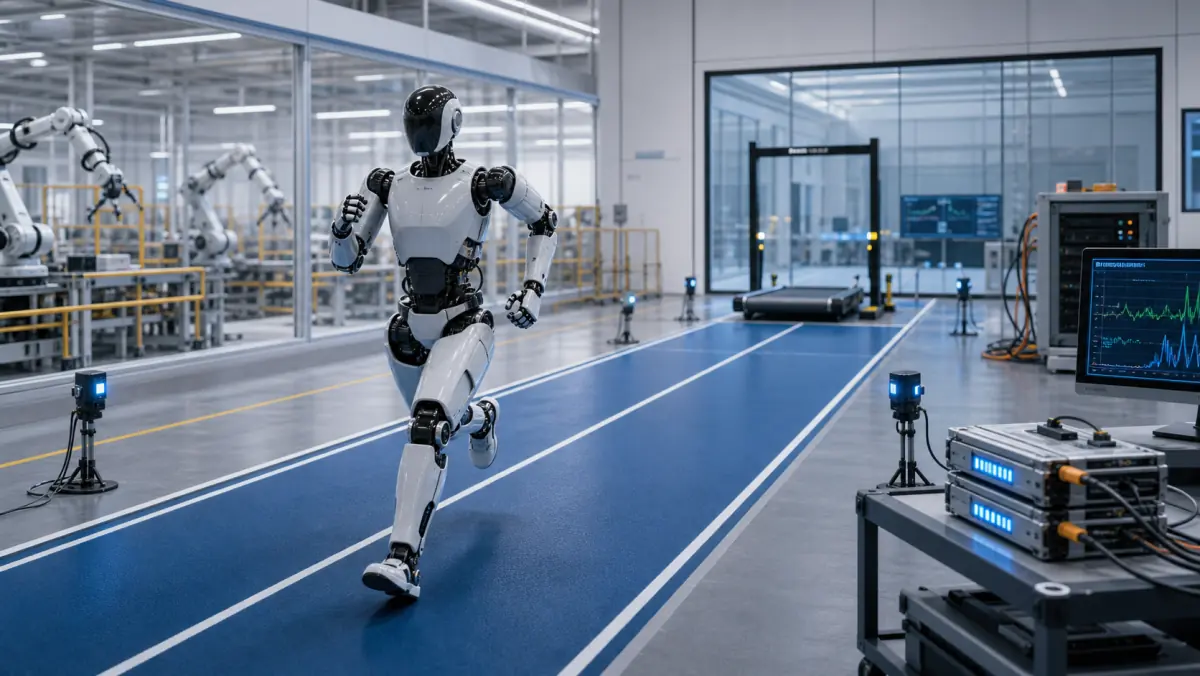
On April 19, 2026, race coverage said a humanoid robot crossed the finish line of the Beijing Yizhuang Half Marathon in 50 minutes and 26 seconds. Some reports compared that time with a human half-marathon benchmark just over 57 minutes. That comparison made the headline irresistible, but it should be read as a robotics-event benchmark, not as an official athletics equivalence between humans and machines.
The headlines wrote themselves. But the real story is not about robots beating humans at running. It is about what completing 21.1 kilometers at sustained speed proves about durability, battery endurance, and real-time control -- and why those capabilities matter far more inside a factory than on a race track.
Source File
This article was reviewed on 2026-07-01 against Xinhua's photo report on the 2026 Beijing E-Town humanoid robot half-marathon, PBS coverage of the 50:26 winning robot time, Al Jazeera's report that Honor's humanoid robot broke the human benchmark, TechCrunch's note on weighted scoring and remote-control status, The Verge's technical summary of Honor Lightning and the 2026 field, World Athletics' men's half-marathon all-time list, and IFR's World Robotics 2025 industrial-robot summary. The article treats the race as an engineering benchmark for endurance, thermal management, power, and control, not as evidence that humanoid robots are broadly factory-ready. Internal links connect the analysis to China factory robot deployment, AgiBot benchmark evidence, and Unitree buyer risk.
Quick Answer
| Question | Short answer |
|---|---|
| What happened? | Reports said the winning humanoid robot finished the Beijing Yizhuang half marathon in 50:26. |
| Is this mainly a sports story? | No. It is more useful as a public engineering stress test for endurance, thermal management, battery power, and control reliability. |
| Does it prove humanoid robots are factory-ready? | No. Factory readiness still requires uptime, safety certification, useful payload, manipulation skill, service cost, and total cost of ownership data. |
| Why should manufacturing readers care? | The same actuator, battery, thermal, and balance systems stressed by running also determine whether humanoid robots can survive longer duty cycles in warehouses and factories. |
| What is the best next signal to watch? | Paid factory pilots with published uptime and maintenance data matter more than another race record. |
What Actually Happened in Beijing
The Beijing Economic-Technological Development Area (better known as E-Town or Yizhuang) has been positioning itself as China's humanoid robotics hub since 2024. In April 2025, it hosted what it billed as the world's first humanoid robot half marathon. That inaugural event was more stunt than sport: the winning robot, Tiangong Ultra from the Beijing Humanoid Robot Innovation Center, finished in roughly 2 hours and 40 minutes. Multiple robots broke down mid-race. Battery swaps were frequent. The spectacle was real; the performance was modest.
One year later, the gap between stunt and substance narrowed dramatically.
The 2026 edition featured a field of roughly two dozen humanoid robots from companies including the Beijing Humanoid Robot Innovation Center, Unitree, Agibot, and several university-affiliated teams. The reported winning robot completed the 21.0975 km course in 50:26, sustaining an average pace of approximately 2 minutes 23 seconds per kilometer. For context, elite human half-marathon records sit in the high-50-minute range. The comparison is useful for speed intuition, but the race rules, control methods, machine assistance, and scoring system are not the same as human athletics.
Several factors likely made the improvement possible: improved actuator efficiency, higher energy-density battery packs, and better gait optimization algorithms. But the most important development was not speed. It was the public demonstration that a leading robot could remain functional across a long endurance event. That is narrower than saying the race proved general reliability.
It is worth noting what battery-swap claims mean in engineering terms. The 2025 race allowed teams to perform hot-swap battery changes at designated pit stops, similar to Formula E racing. Public reports suggested that battery and thermal management improved sharply by 2026. If the winning run required fewer interventions than prior editions, that is a meaningful signal. It still needs to be separated from independent uptime data, factory-duty-cycle testing, and maintenance records.
What The Race Result Does And Does Not Prove
The 50:26 number deserves attention, but the fine print matters. TechCrunch's race coverage noted that an even faster Honor robot time was subject to the event's scoring rules because it used remote control, while the 50:26 winning result was treated as the autonomous winner. Other coverage also noted falls, collisions, scoring distinctions, and incomplete runs across the field.
That is why this article treats the race as a stress test, not as a general-purpose robot certification. The credible signal is narrower: a leading autonomous humanoid could sustain high-speed bipedal locomotion for a full half marathon under public race conditions. That is meaningful. It is not the same as proving useful manipulation, safe human-robot collaboration, or full-shift factory economics.
The Three Things a Half Marathon Actually Tests
A half marathon is a terrible metric for athletic elegance. It is an excellent metric for engineering reliability. Here is what completing one actually demonstrates.
1. Thermal management under sustained load
Running 21 kilometers at pace generates enormous heat in electric motors. Humanoid robots use brushless DC actuators in their hips, knees, and ankles that must operate continuously for nearly an hour under peak torque. In 2025, thermal throttling was reported as one reason robots slowed or stopped during the Yizhuang race. The 2026 result suggests improved heat dissipation, more efficient motor control, better gait planning, or some combination of all three. The public race does not disclose enough engineering detail to identify the exact mechanism.
This matters for manufacturing because factory robots face the same challenge on longer timescales. A welding robot on an automotive line operates at high duty cycles for 16 to 20 hours per day. Thermal management is what separates a robot that needs constant maintenance from one that runs reliably for months. In China's automotive factories -- where companies like BYD operate some of the world's most automated production lines -- thermal failure in a robot arm can halt an entire production cell. The cost is not just the repair; it is the lost throughput on a line producing hundreds of vehicles per day.
2. Battery endurance and power management
The winning robot's battery system sustained locomotion for about 50 minutes at competitive pace. Rough engineering estimates based on reported weight and speed would put sustained power draw in the kilowatt range, but the event reports do not provide a full pack specification, discharge curve, or thermal profile. Treat battery-size calculations as directional, not disclosed fact.
The key innovation is not raw capacity -- it is power management. The ability to dynamically adjust torque output, recover energy during the swing phase of each stride, and maintain stable voltage delivery under varying load conditions is what separates a demonstration from a practical system. These are exactly the power management challenges that industrial robots face when performing repetitive tasks over multi-hour shifts.
The battery endurance improvement from 2025 to 2026 also reflects broader trends in China's battery industry. CATL and BYD have been pushing energy density higher across their product lines -- not just for EVs, but for industrial and robotics applications. Semi-solid state cells, now entering limited production, offer 20-30% higher energy density than conventional lithium-ion at comparable weight. If the marathon robots are using cells from this generation, the endurance gains make engineering sense.
3. Real-time control and vibration resilience
Running on asphalt for 21 kilometers subjects a bipedal robot to millions of impact cycles. Each foot strike sends shock loads through the actuators, sensors, and structural frame. Maintaining balance and consistent gait under those conditions requires control loops operating at kilohertz frequencies with reliable sensor feedback.
The fact that a leading robot could finish the course indicates a level of proprioceptive feedback and real-time adaptation that goes beyond a short lab demonstration. But public reports of collisions and incomplete runs elsewhere in the field also matter. The race is evidence of progress in locomotion control, not proof of robust warehouse navigation or manipulation.
Consider the scale: approximately 20,000 steps over the full distance, each requiring millisecond-level balance adjustments based on IMU data, joint encoders, and force sensors in the feet. A single calibration drift or sensor glitch at high speed would result in a fall. Completing the distance without incident means the entire sensorimotor pipeline -- from perception to planning to actuation -- operated reliably for tens of thousands of consecutive cycles. That is a meaningful engineering milestone regardless of the application.
Why This Matters for Manufacturing, Not Sports
The temptation is to frame this as a "robots replacing athletes" narrative. That misses the point entirely.
China's humanoid robotics industry -- covered in depth in our China factory robot deployment -- is not building robots to run marathons. It is building robots to work in factories, warehouses, and eventually homes. The marathon is a public-facing benchmark that tests exactly the capabilities those applications demand: sustained operation without failure, power efficiency over long durations, and adaptive control in unstructured environments.
Consider what a factory deployment requires from a humanoid robot:
- 8+ hours of continuous operation between charges. The half marathon proved 50 minutes of peak-effort operation. At factory-duty power levels (which are lower than running), that same battery and thermal architecture translates to multi-hour reliability.
- Thousands of repetitive motion cycles without joint degradation. Running 21 km requires approximately 20,000 stride cycles. That is comparable to the number of pick-and-place cycles an assembly robot might perform in a single shift.
- Tolerance for real-world variability. A race course has slopes, surface changes, wind, and temperature variation. A factory floor has obstacles, varying payload weights, and unexpected interruptions. The control systems that handle the former are the same ones needed for the latter.
Companies like Unitree and Agibot -- profiled in our China factory robot deployment overview -- have been explicit about this trajectory. Their robots are designed for industrial deployment first, with public demonstrations like marathons serving as high-visibility validation events.
The Pace of Progress: 2025 vs. 2026
The year-over-year improvement is worth quantifying.
| Metric | 2025 Yizhuang Race | 2026 Yizhuang Race | Improvement |
|---|---|---|---|
| Winner's finish time | ~2:40:00 | 50:26 | ~68% faster |
| Average speed | ~8 km/h | ~25 km/h | ~3x |
| Unplanned stops (winner) | Multiple battery swaps | None | N/A |
| Robots finishing | ~60% of starters | ~80% of starters | +33% |
| Fastest lap pace | ~12 km/h peak | ~25 km/h sustained | ~2x |
But the most significant signal is not the speed. It is the apparent reduction in interruptions among leading teams. If robots can sustain longer runs with fewer interventions, that suggests improvement in battery, thermal, and locomotion efficiency. That is the metric that matters for industrial applications.
What the Skeptics Get Right
Not everything about this milestone is cause for celebration, and honest assessment requires acknowledging the limitations.
Controlled conditions. The Yizhuang course is flat, well-paved, and carefully managed. A factory floor or construction site presents far more complex terrain, obstacles, and interaction challenges. Running in a straight line is not the same as navigating a dynamic environment.
Specialized hardware. Marathon-running robots are optimized for locomotion. They lack the manipulation capabilities (arms, hands, tool interfaces) needed for most manufacturing tasks. The dexterity gap between a robot that can run and a robot that can assemble a smartphone remains enormous.
Energy scalability. Even at the improved efficiency, humanoid robots consume significantly more power per unit of work than purpose-built industrial arms. A Kuka or FANUC welding robot uses a fraction of the energy of a bipedal humanoid performing the same task. The humanoid form factor is inherently less energy-efficient than fixed automation for repetitive tasks.
Cost. The winning robot's hardware likely costs hundreds of thousands of dollars. At current price points, humanoid robots are not cost-competitive with industrial arms for the vast majority of manufacturing applications. The marathon proves capability, not affordability.
Software generalization. A gait controller optimized for flat-surface running is a narrow skill. Manufacturing requires manipulation, spatial reasoning, task sequencing, error recovery, and interaction with objects that behave unpredictably. The gap between a robot that can run and a robot that can perform useful work in a factory is measured not in hardware improvements but in software complexity that may take several more development cycles to bridge.
The Real Trajectory: From Benchmark to Factory Floor
China's China factory robot deployment sector already installs more industrial robots than the rest of the world combined. IFR's World Robotics 2025 summary says China installed about `295,000` industrial robots in 2024, or `54%` of global deployments, and its operating stock exceeded `2 million` units. Those are predominantly fixed-base arms performing repetitive tasks with high precision and reliability.
Humanoid robots represent a different value proposition. They are not meant to replace industrial arms at tasks those arms do well. They are meant to operate in environments designed for humans -- climbing stairs, opening doors, navigating narrow aisles, handling objects of varying shapes and sizes without custom tooling.
The half marathon suggests that the foundational capabilities for those applications - sustained operation, reliable power, adaptive control - are advancing rapidly. The gap between "robot completes a half marathon" and "robot works a full shift in a car plant without supervision" is still measured in years, not months. The pace of progress is real, but factory validation needs paid pilots, uptime records, safety approvals, and maintenance-cost data.
Beijing's strategic investment in this space is deliberate. The Yizhuang half marathon is not just a race -- it is an annual public benchmark that forces companies to improve tangible, measurable performance rather than optimize for demo videos. That discipline is what differentiates China's approach to humanoid robotics from the more hype-driven narratives coming out of Silicon Valley.
There is also a subtler dynamic at work. The marathon format creates a shared benchmark that the entire Chinese humanoid robotics ecosystem can rally around. When 20+ teams compete on the same course under the same conditions, the results are directly comparable. That comparability accelerates learning across the industry -- every team can see what worked and what failed, and adjust accordingly. It is the same dynamic that made ImageNet transformative for computer vision: a shared benchmark focused collective effort and produced faster progress than isolated research groups working in parallel.
What to Watch Next
Three developments will indicate whether the marathon milestone translates into real industrial capability:
- Factory pilot announcements. Watch for companies like Agibot, Unitree, or the Beijing Humanoid Robot Innovation Center announcing paid pilot deployments in actual manufacturing environments -- not labs, not controlled demos, but real production lines with real throughput requirements.
- Operational hours between failures. A robot that runs for 50 minutes in a race is impressive. A robot that operates for 2,000 hours between unplanned maintenance events is industrially useful. The transition from the former to the latter is the key metric.
- Total cost of ownership data. When humanoid robots start appearing on factory balance sheets with published ROI calculations, the technology will have crossed the threshold from R&D curiosity to industrial tool.
A fourth signal worth monitoring is regulatory readiness. When Chinese municipal governments start issuing safety certifications or operational permits specifically for humanoid robots in industrial settings, it will signal that the technology has moved beyond experimental status. Beijing and Shenzhen are the most likely cities to move first on this front, given their existing regulatory frameworks for autonomous vehicles and their economic incentives to accelerate humanoid robot deployment.
Until then, the half marathon stands as what it is: a demanding public test of endurance, reliability, and control. It does not prove that humanoid robots are ready for factory floors. It proves that they are getting closer, faster, than most observers expected.
The robots are not coming for the Olympics. They are coming for the assembly line.
Methodology And Source Notes
This article was reviewed on 2026-07-07 using Xinhua, PBS, Al Jazeera, TechCrunch, The Verge, World Athletics, and IFR references for the Beijing race result, race-rule context, the human half-marathon benchmark, and China's industrial-robot deployment base. The race is interpreted as an engineering stress test rather than as a direct proxy for factory readiness. Claims about industrial usefulness are limited to durability, battery endurance, thermal management, and control-system implications, with factory deployment treated as a separate future validation step.
Claim Confidence File
| Claim | Confidence | Evidence boundary |
|---|---|---|
| The Beijing Yizhuang event produced a reported 50:26 humanoid half-marathon result | High | Supported by multiple race reports; race scoring and control-method distinctions still matter |
| The robot result is directly comparable to human athletics records | Low | Useful for speed intuition, but machine events, scoring, control, and assistance rules differ from human athletics |
| The race proves humanoids are factory-ready | Low | Factory readiness requires uptime, payload, manipulation, safety certification, service cost, and customer acceptance |
| The race is meaningful as a locomotion endurance and thermal stress test | Medium-high | Supported by the duration and public course conditions, though detailed engineering telemetry is not public |
| Battery size and power-draw figures can be treated as exact disclosed specifications | Low | Any pack or power estimate is directional unless provided by the robot maker or race organizer |
| China's industrial-robot base makes humanoid deployment commercially relevant to watch | High | Supported by IFR deployment data and the existing China robotics manufacturing context |
Frequently Asked Questions
Did a humanoid robot really beat the listed human half-marathon record?
According to the race reports reviewed for this article, the winning humanoid robot finished the Beijing Yizhuang half marathon in 50:26, faster than the men's all-time half-marathon mark listed by World Athletics. The article treats that as a robotics benchmark, not as an athletics comparison under human sporting rules.
Does the result mean humanoid robots are ready for factories?
No. A half marathon proves endurance, power management, balance, and thermal control under a public stress test. Factory readiness requires many more metrics, including safety certification, maintenance intervals, useful payload, uptime, and total cost of ownership.
Why is running useful as a robotics benchmark?
Running creates continuous impacts, heat, battery drain, and balance challenges. Those stress the same actuator, sensor, and control systems that matter in warehouses and factories, even if the actual factory tasks are slower and more precise.
What should buyers watch next?
The next meaningful signals are paid factory pilots, published uptime data, service-cost data, and regulatory approvals for humanoid robots working near people. Race performance is useful only if those operational metrics improve too.
Related Entries
- China factory robot deployment -- China's AI and robotics landscape: foundation models, industrial robots, and the convergence story
- AgiBot's Benchmark Win Is Not Deployment Proof for Buyers -- Why benchmark wins are not the same as deployment proof
- NVIDIA Unitree GR00T Robot: Buyer Risk Checklist -- Unitree, GR00T, and buyer risk in humanoid robotics