
NVIDIA's June 1 humanoid announcement gave the robotics market something more useful than another demo video: a stack that buyers can inspect.
The Isaac GR00T Reference Humanoid Robot combines four named layers: a Unitree H2 Plus humanoid body, Sharpa Wave robotic hands, NVIDIA Jetson Thor compute, and Isaac GR00T software workflows. NVIDIA positioned the system for academic research, with systems expected to ship later in 2026 through Taiwan-based GMI Technology. Reuters also reported that NVIDIA plans similar reference-platform work with U.S., European, and South Korean humanoid makers, and described the first platform as roughly $70,000 for academic users.
That makes Unitree harder to ignore. It does not make the Unitree H2 Plus a factory-proven labor substitute.
The right buyer conclusion is narrower and more valuable: NVIDIA has made the humanoid development stack more legible. Procurement teams can now ask better questions about body, hands, compute, model workflow, telemetry, service ownership, and policy exposure.
Source File
This article was reviewed on 2026-06-30 against NVIDIA's 2026-06-01 Isaac GR00T reference humanoid announcement, Reuters-syndicated reporting on NVIDIA's Unitree and non-China reference-platform plans, the American Security Robotics Act announcement, and related site work in AgiBot factory deployment file and China Humanoid Robot Filings: Commercialization Reality Check. The article treats NVIDIA's reference stack as research and pilot evidence, not factory-deployment proof or a blanket procurement approval for Unitree hardware.
Quick Answer
| Buyer question | Practical answer |
|---|---|
| Does NVIDIA's reference robot validate Unitree? | It validates Unitree as a credible research-body choice inside NVIDIA's first reference stack. It does not validate Unitree as a production-ready factory platform. |
| Is this an enterprise procurement green light? | No. It is a research workflow signal. Factory buyers still need uptime, service, safety, intervention, cybersecurity, and ROI evidence. |
| What changed for buyers? | The robot is now easier to diligence by layer: body, hands, compute, software, data, and support. |
| What should buyers avoid? | Avoid treating NVIDIA involvement as a substitute for supplier qualification. |
| What is the policy risk? | U.S. procurement-risk language around foreign robotics systems can affect universities, federal contractors, and regulated buyers before it becomes enacted law. |
What NVIDIA Actually Announced
The announcement matters because it turns a humanoid from a brand into a system.
The stack is not vague:
| Layer | Named component | Why buyers should care |
|---|---|---|
| Body | Unitree H2 Plus | Defines mobility, serviceability, spare parts, mechanical durability, and China-origin supplier exposure. |
| Hands | Sharpa Wave robotic hands | Defines manipulation limits, object compatibility, wear points, and replacement cost. |
| Compute | NVIDIA Jetson Thor | Defines edge inference capability, update path, cybersecurity review, and hardware lifecycle. |
| Software | Isaac GR00T workflows | Defines training, simulation, policy development, model-update behavior, and possible platform lock-in. |
| Channel | GMI Technology | Defines procurement route, delivery timing, and some support logistics. |
This is why the announcement belongs in How China Manufactures: Inside the World's Factory (2026) rather than in a generic robotics hype cycle. China's advantage in humanoids is not only walking robots. It is supplier density, mechanical iteration, nearby pilot environments, and a hardware cost curve that can move quickly. But when a Chinese body becomes part of an NVIDIA reference stack, the buying question becomes more complex, not less.
The buyer should ask: which layer is valuable, which layer is replaceable, and which layer creates risk?
What The Announcement Does Not Prove
The most dangerous reading is simple: "NVIDIA picked Unitree, so Unitree is ready for factories."
That is wrong.
Research validation and factory deployment measure different things.
| Research-platform question | Factory-deployment question |
|---|---|
| Can a lab bring up a common humanoid stack faster? | Can the robot run a defined workflow for weeks with limited human rescue? |
| Can researchers compare policies on a shared body? | Can the buyer prove cycle-time, scrap, throughput, safety, or labor-flexibility improvement? |
| Can the platform support model and manipulation experiments? | Can the system survive real lighting, dust, fixtures, traffic, operator behavior, and maintenance gaps? |
| Can the stack produce comparable academic results? | Can it meet uptime, intervention-rate, warranty, service, and payback thresholds? |
| Can expert users configure it? | Can normal plant staff operate, inspect, reset, and escalate it safely? |
The market needs signals. Buyers need proof.
The Stack Buyers Should Diligence
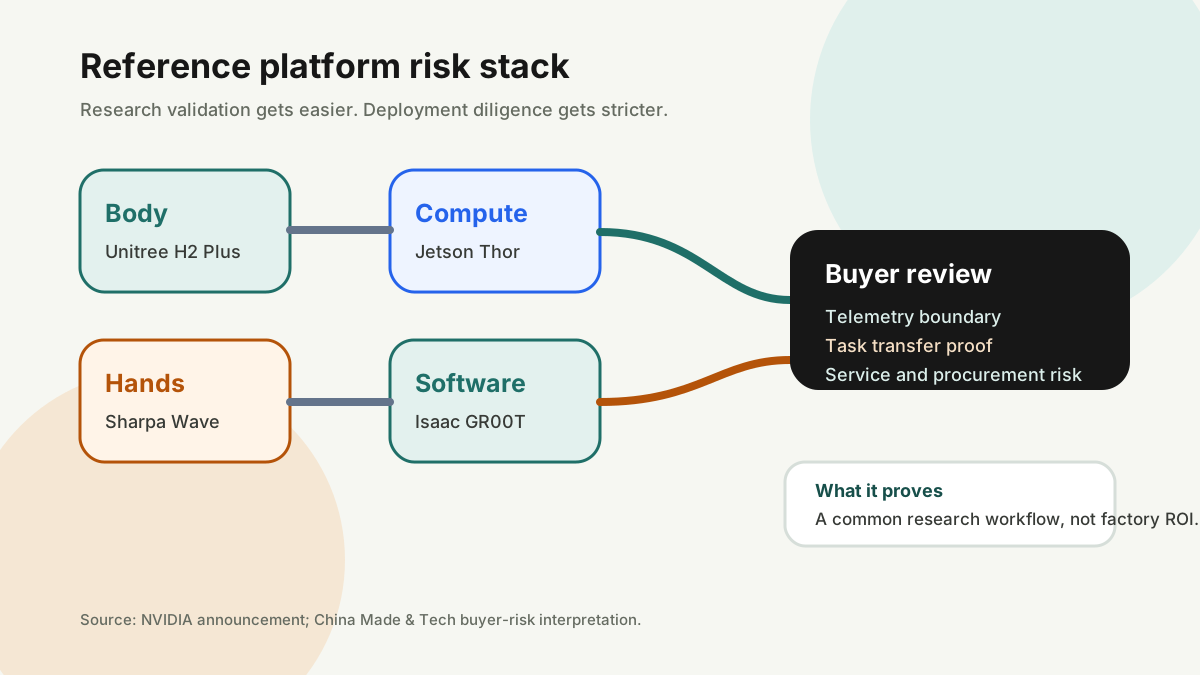
The reference platform helps buyers stop asking one vague question: "Is this robot good?"
That question is too broad. Replace it with a layer-by-layer diligence file.
| Stack layer | Diligence question | Red flag |
|---|---|---|
| Body | What is the field failure record, actuator replacement path, battery policy, and repair lead time? | Vendor can show demos but not spare-parts and service assumptions. |
| Hands | Which object classes, force ranges, and duty cycles are supported? | Hands are optimized for lab manipulation, not the buyer's parts or packaging. |
| Compute | Who controls updates, logs, edge inference, network access, and security review? | Compute stack needs vendor access that the facility cannot approve. |
| Software | Can tasks be reproduced outside NVIDIA's workflow? | The buyer cannot tell whether success comes from body, model, integration, or lab conditions. |
| Data | What video, telemetry, and task data leaves the site? | Remote support or training requires data flows the buyer has not approved. |
| Channel/support | Who owns failures after sale? | NVIDIA, Unitree, GMI, integrator, and buyer responsibilities are not written down. |
Unitree's Signal Is Real, But It Cuts Both Ways
Unitree benefits from the announcement.
A company does not become the body in a high-profile NVIDIA academic reference platform by accident. The H2 Plus now becomes more visible to researchers. Developers may build familiarity with the chassis. Labs may generate more comparable work around Unitree hardware. Over time, that can create a body-level reference effect.
That matters because robot bodies can become ecosystems. If enough researchers, integrators, and toolchains learn one chassis first, that chassis can become easier to support and benchmark than technically similar alternatives.
But the signal also increases scrutiny.
Unitree is already in a transition from viral robotics company to supplier-governance subject. In AgiBot factory deployment file, the important buyer point was not valuation. It was whether Unitree could show capital discipline, service-network investment, production maturity, and disclosure quality.
NVIDIA's reference platform raises the same bar. Buyers will now ask whether Unitree can support not just a research shipment, but a fielded fleet with spares, warranties, repair processes, cybersecurity documentation, and customer-specific restrictions.
That is the right scrutiny. Visibility is not the same as bankability.
The Compliance Risk Is Not A Current Private-Sector Ban
The policy angle needs precision.
On March 27, 2026, lawmakers including Elise Stefanik, Tom Cotton, and Chuck Schumer announced the American Security Robotics Act. The proposal would restrict federal procurement and operation of certain unmanned ground vehicle systems from foreign entities of concern, including humanoid and quadruped robots.
That is proposed legislation, not current law. Private buyers should not treat it as a blanket ban.
But they should treat it as risk language.
Policy language often spreads into procurement before final law changes. Universities with government funding, defense-adjacent manufacturers, critical infrastructure operators, federal contractors, and multinational enterprises may begin asking the same questions:
- Can a foreign-origin mobile robot enter this facility?
- Can cameras, audio, telemetry, or task logs leave the site?
- Can vendor staff remotely access the robot?
- Can model updates be approved by the buyer before deployment?
- Can the buyer disable cloud features without breaking the pilot?
- Can a non-China body be substituted if customer requirements change?
The point is not to panic. The point is to design the pilot so those questions are answerable.
The Pilot Contract Should Name The Stack Owner
The reference-platform announcement makes one contract issue unavoidable: ownership.
In traditional factory automation, the boundary between robot OEM, integrator, PLC, safety system, and plant engineering is usually understood. Humanoids blur that boundary. A body vendor, hand vendor, GPU platform, model workflow, teleoperation system, cloud tool, and local integrator can all affect behavior.
The pilot contract should answer five questions before the robot arrives.
| Ownership question | Why it matters |
|---|---|
| Who approves software and model updates? | A model update can change robot behavior in ways that affect safety and task reliability. |
| Who controls telemetry and video data? | Humanoids often operate with rich camera and sensor data in sensitive facilities. |
| Who is responsible for hardware failure? | A hand, actuator, sensor, or battery issue can stop the pilot even if the model works. |
| Who owns task adaptation? | The buyer needs to know whether fixture changes, data collection, and recovery logic are included. |
| Who can replace a layer? | Dual-sourcing is impossible if body, hands, compute, and software are contractually fused. |
For a humanoid pilot, the buyer should know which layer is strategic, which layer is experimental, and which layer is merely convenient for the first test.
A Factory Pilot Should Have Two Stages
The best buyer response is not a broad humanoid rollout. It is a two-stage pilot.
Stage one is validation. The buyer asks whether the stack can safely operate inside the facility, whether data controls are acceptable, whether the task can be measured, and whether support ownership is clear.
Stage two is economics. Only after validation should the buyer ask whether the robot can improve a KPI enough to justify the cost.
| Stage | Success metric | Stop condition |
|---|---|---|
| Validation pilot | Robot runs one narrow workflow under buyer data, safety, and support rules. | Data boundary, service path, or intervention rate is unacceptable. |
| Economics pilot | Robot improves a named KPI such as cycle time, defect sorting, line flexibility, or safety exposure. | Payback fails after fixture, supervision, service, and training costs are included. |
The hidden cost buckets are predictable:
| Cost bucket | What buyers forget |
|---|---|
| Integration | Fixtures, paths, work instructions, network access, safety review, and local engineering time. |
| Supervision | A robot that needs frequent rescue can consume the labor it was supposed to save. |
| Service | Hands, actuators, batteries, sensors, calibration, and rollback procedures may need more support than expected. |
| Cybersecurity | Camera-rich mobile robots trigger more review than fixed industrial equipment. |
| Change management | Operators need training, escalation rules, and confidence that the robot will not disrupt the line. |
Buyer Checklist
Before buying or piloting a Unitree-based humanoid platform, ask for written answers to these questions:
| Diligence area | Minimum answer |
|---|---|
| Task boundary | One workflow, one object set, one environment, one KPI. |
| Intervention rate | A target for human rescue frequency and a definition of failed autonomy. |
| Uptime | Availability threshold, downtime definition, and maintenance window. |
| Data boundary | Rules for logs, video, telemetry, teleoperation, vendor access, model updates, and deletion. |
| Service path | Named support owner, spare-parts lead time, escalation route, and warranty process. |
| Substitution | Whether body, hands, compute, or software can be replaced independently. |
| Policy exposure | Whether the facility, customer, grant, or contract has restrictions on foreign robotics systems. |
| Exit rule | The condition under which the buyer stops the pilot rather than extending it. |
What A Strong Buyer File Looks Like
A serious buyer file should not end with the vendor's slide deck. It should be a working file that operations, legal, cybersecurity, procurement, and finance can all inspect.
For this specific NVIDIA-Unitree signal, the file should have six sections.
| File section | Minimum contents |
|---|---|
| Technical stack | Body, hands, compute, software, teleoperation, network, sensors, and update path. |
| Task definition | Exact workflow, object range, fixtures, human handoff points, and success metric. |
| Facility controls | Safety zone, network segment, operator rules, incident stop procedure, and access control. |
| Data controls | What is collected, where it is stored, who can access it, how long it is retained, and whether it leaves site. |
| Service economics | Spare-parts list, support response time, warranty exclusions, expected downtime, and replacement process. |
| Policy review | Customer restrictions, federal funding exposure, contractor obligations, export-control review, and substitution plan. |
It also prevents a common failure mode in emerging robotics: each team assumes another team owns the hard question. Operations assumes cybersecurity reviewed remote access. Cybersecurity assumes procurement checked vendor access. Procurement assumes the integrator owns service. Finance assumes the pilot manager priced supervision time. The buyer file forces those assumptions into the open.
How This Changes The China Robotics Narrative
The announcement also changes how global buyers should read China's humanoid sector.
The old narrative was demo-heavy: robots dancing, running, boxing, or appearing on stage. Those demonstrations mattered because they showed mechanical progress, but they were weak procurement signals.
The stronger 2026 narrative is infrastructure: Unitree's governance visibility, AgiBot's task claims, Hangzhou's scenario base, China's robot identity-code system, EngineAI's throughput claims, and now NVIDIA's reference stack. These are not all equal signals, and some are still early. But together they show a market moving from spectacle toward commercialization scaffolding.
That is the point buyers should care about. Chinese humanoid suppliers are not only trying to build better robots. They are trying to build the ecosystem around robots: production, identity, pilot scenarios, service networks, developer stacks, and buyer language.
This does not remove risk. It changes the risk. The question moves from "Can Chinese humanoids do impressive things?" to "Which Chinese humanoid suppliers can support a buyer file that survives operations, cybersecurity, compliance, and finance review?"
That is a much better question.
Buyer Takeaway
NVIDIA's Unitree-based Isaac GR00T reference humanoid is a real signal. It makes Unitree more visible, makes the development stack easier to inspect, and gives researchers a common platform for humanoid work.
It is not a factory deployment shortcut.
The mature buyer response is to diligence the stack layer by layer: Unitree body, Sharpa hands, NVIDIA compute, Isaac GR00T workflows, data controls, service owner, and procurement-risk language. If the platform passes those tests, it may be a useful research or pilot vehicle. If it fails them, NVIDIA's involvement does not solve the problem.
Humanoid robotics in China is moving fast. Buyers should move carefully.
Methodology
This article is based on NVIDIA's 2026-06-01 reference humanoid announcement, a Reuters-syndicated 2026-06-01 report on NVIDIA's broader reference-platform plans, the 2026-03-27 American Security Robotics Act announcement, and internal site context in How China Manufactures: Inside the World's Factory (2026), AgiBot factory deployment file, AgiBot factory deployment file, China Humanoid Robots In Factories: Deployment, Not Demos, and China factory robot deployment.
Claim Confidence File
| Claim | Confidence | Evidence boundary |
|---|---|---|
| NVIDIA GR00T and Unitree references are meaningful signals for embodied-AI attention | Medium-high | Based on cited public announcements/materials; reference status is not the same as production qualification. |
| A reference robot proves a deployable factory automation system | Low | The article separates demo/reference visibility from safety, integration, uptime, maintenance, and workflow fit. |
| Buyers should evaluate SDK/control stack, data rights, parts support, safety certification, and real task evidence | High | This is the article's procurement checklist. |
| The article claims Unitree is the universal best vendor for humanoid buying | Low | It frames Unitree as a buyer-risk case, not a blanket recommendation. |
FAQ
Does NVIDIA's Unitree reference robot mean Unitree is factory-ready?
No. It means Unitree's H2 Plus body is credible enough for NVIDIA's first reference humanoid stack. Factory buyers still need uptime, service, safety, cybersecurity, intervention-rate, and ROI evidence for their own workflow.
Is the American Security Robotics Act already a private-sector ban?
No. The article treats it as proposed procurement-risk language, not current blanket law. It matters because universities, federal contractors, infrastructure operators, and regulated buyers may copy the risk questions before legislation becomes final.
What should buyers ask before piloting a Unitree-based humanoid?
Ask who owns body service, hands, compute updates, Isaac GR00T workflows, telemetry, remote access, safety stops, and data retention. The robot should enter a defined pilot file, not a broad deployment plan.