
AI-generated editorial illustration by China Made & Tech. It depicts no real route, country, factory, product origin, customs result, or supply-chain audit.
By China Made & Tech Team. Independent English field guide to China’s niche hardware brands, hidden champions, founders, factory towns, and supplier clusters.
China Plus One is often described as a choice: keep manufacturing in China or move it somewhere else. For a buyer, it is usually neither. It is a reconfiguration problem. A company may add final assembly in another country while continuing to buy components, tooling, materials, subassemblies, engineering support, or logistics capacity from China. It may reduce one disruption risk while adding another. It may obtain a second factory without gaining a second qualified supplier. It may change a shipping route without changing the product’s most important dependency.
That is why “we have a China+1 strategy” is not yet evidence that a product is diversified. The useful question is: which exposure has changed for this named product, and which exposure remains? The answer requires a bill of materials, supplier map, site record, origin-and-compliance review, continuity plan, and acceptance record—not a country slogan.
The World Bank’s analysis of Vietnam makes the point at a macro level. It says Vietnam gained U.S. export-market share in electronics and machinery where China’s exports contracted, while Vietnam’s imports of components from China increased rapidly. The two facts can coexist: final-goods relocation can occur alongside persistent Chinese input dependence. The World Bank report is not a report about any buyer’s product, legal origin, or supplier qualification. It is a useful warning against treating final-assembly geography as the entire supply chain.
The article’s conclusion is not that diversification is impossible or pointless. It is that diversification has to be named. A second site may be valuable. A second qualified supplier may be valuable. A buffer may be valuable. A tested recovery plan may be valuable. But they solve different problems, and a buyer should not claim the last one when it has only completed the first.
| A company says… | The question to ask | Evidence needed | What it does not prove alone |
|---|---|---|---|
| “We moved assembly out of China.” | Which components, tooling, services and engineering inputs still come from China? | Product and component files | Product origin, supply continuity, or risk elimination |
| “We have a second factory.” | Is it qualified for the same product, material, process, volume and quality requirement? | Supplier and acceptance files | A usable production alternative |
| “We are China+1.” | Which risk is being reduced: capacity, transport, compliance, component concentration, or customer concentration? | Risk and continuity file | A general resilience conclusion |
| “The product is made in country X.” | What is the applicable origin rule, transformation, documentation, and current legal assessment? | Origin-and-compliance file | A customs or tariff answer without specialist review |
| “We have contingency plans.” | Has the plan been tested against named failure modes and recovery times? | Continuity and acceptance files | That recovery will work under a real disruption |
China Plus One is reconfiguration, not a clean break
A clean break would mean that every relevant dependency has been removed or independently replaced. That is an unusually demanding proposition. It would require not only a different assembly address but alternate components, materials, sub-suppliers, tools, process knowledge, inspection capability, logistics capacity, service, financing, customer approvals, and a way to manage changes. Most practical China+1 programmes do not claim to do all of that at once. They should not be judged as failures for that reason. They should be described accurately.
The more realistic pattern is reconfiguration. Final assembly moves or expands. Some suppliers follow. Some components remain sourced from China. New local suppliers cover a subset of the bill of materials. A regional distributor or freight path changes. An engineering team supports more than one site. The product may become more resilient to one type of disruption and more exposed to a different bottleneck. The task for the buyer is to keep each shift visible.
Vietnam is often used as a shorthand for China Plus One. The World Bank report gives a more careful picture. It says recent relocation of several value chains from China offers opportunities for Vietnam, and that Vietnam gained the most U.S. export-market share in electronics and machinery where China’s exports contracted. But the report immediately adds that Vietnamese imports of components from China increased rapidly, creating vulnerabilities associated with concentrated supply dependence. It also describes Vietnam and Mexico as connector countries that have attracted investment from both the United States and China in manufacturing. These are linked regional changes, not a simple handoff from one self-contained national supply chain to another.
That does not mean a buyer should ignore the second location. It means the buyer should open the component file before drawing a conclusion. If the alternative site assembles the final product but receives a critical board, motor, connector, enclosure, chemical, display, die-cast part, packaging material, or spare from the same single source, the product’s exposure has not disappeared. It has moved into a different stage of the chain. The new site may still be strategically useful; its claim should be “we have added assembly capacity,” not “we have fully diversified supply.”
Why final assembly is the most visible and least sufficient proof
Final assembly is visible because it has an address, employees, containers, an export declaration, a customer visit, and sometimes a launch announcement. Components are harder to see. They can travel through distributors, contract manufacturers, sub-tier suppliers, bonded zones, or multiple facilities. Engineering support can be even less visible: a tool adjustment, quality escape investigation, firmware revision, drawing correction, or process change may still depend on a specific person or group in the original ecosystem.
For that reason, the buyer should treat final assembly as a useful but incomplete indicator. It can establish that a facility exists and may establish a specific production action. It does not establish the composition of the product, the availability of upstream inputs, a lawful origin conclusion, customer approval, capacity under stress, supplier financial health, or recovery from disruption.
The same point applies to a contract manufacturer that advertises multiple countries. The buyer should ask whether the advertised facility has the exact production line, trained staff, equipment, quality system, test fixtures, approved materials, and access to the same components for the proposed product. A broad footprint matters only when it connects to the actual production file.
A macro trade pattern is a hypothesis generator
The World Bank material is valuable because it tells a buyer where to look, not because it answers the buyer’s product question. It suggests that a final-goods export increase can coincide with rising component imports from China. That should trigger a product-level investigation: which components are imported, in what quantities, under which supplier relationships, with which transport and inventory assumptions, and what happens if the input is delayed or restricted?
It should not trigger an origin conclusion. Trade data and public reports cannot establish the legal origin of a specific SKU, the reason for each shipment, the accuracy of a customs classification, or whether a company has complied with an applicable rule. They also cannot prove that a connector-country flow is unlawful transshipment. These are factual and legal questions that require records, current rules, and qualified advice appropriate to the transaction.
The discipline may feel restrictive, but it creates a better China+1 strategy. A product team that maps its critical Chinese inputs can choose whether to develop an alternate component, hold a qualified buffer, add a supplier, redesign a dependency, establish a second tool, or negotiate a different support arrangement. A product team that merely selects a new final-assembly country may never discover which of those actions is needed.
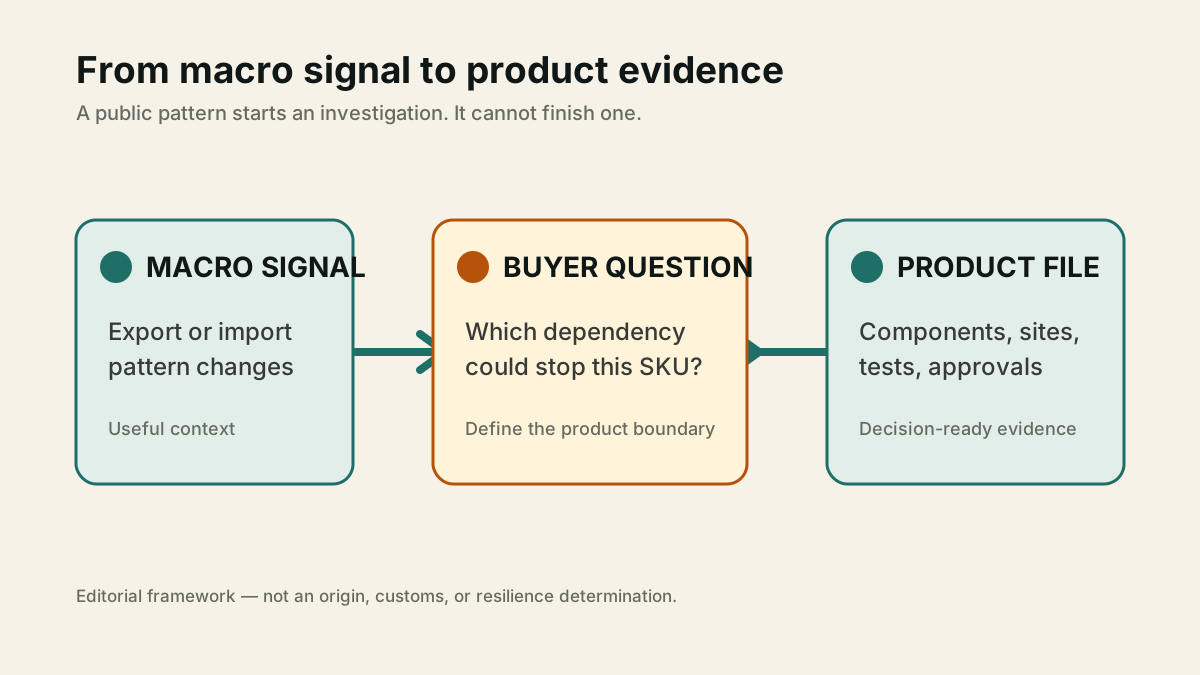
Editorial decision model. A macro pattern identifies a question; it does not resolve a product’s origin, compliance, or continuity status.
A connector country is not a clean-room supplier base
A connector country is a place where regional and global value chains meet. It may host assembly, investment, exports, imports, logistics, suppliers, and customers from multiple economies. This can create genuine capability and opportunity. It also means that a buyer cannot infer independence from the final shipping country.
The World Bank report makes this concrete with a defined Vietnam vulnerability assessment. It identifies 24 vulnerable products out of 5,099 imported products, with a combined market value of US$9.5 billion. The report describes the vulnerability as concentrated rather than universal and explains that the risk is predominantly associated with imports of machinery and electronic goods from China that are integral to Vietnam’s export assembly processes. That is a useful number because it retains its denominator, geography, method, and limitation. It is not a score for every Vietnam-linked product or every buyer.
The record supports a modest but important conclusion: vulnerability can be concentrated in a comparatively small number of strategically important inputs. That is exactly why country-level debates are inefficient. A buyer does not need to solve every cross-border dependency before improving a product’s continuity. It needs to find the components and services whose absence would stop shipment, quality, safety, certification, or customer acceptance.
The IMF’s October 2025 Asia outlook provides a related regional warning. It says a high share of Chinese value added embedded in regional exports leaves many countries exposed to potential transshipment tariffs, and it describes diversification prospects as uncertain in the face of ongoing trade-policy shifts. Read that statement as macro exposure, not a prediction of a tariff outcome for any transaction. The IMF chapter cannot decide a product’s origin, rule-of-origin treatment, or customs liability. It explains why a supply-chain story that stops at final assembly may miss material embedded links.
The clean-room metaphor is a useful test
Ask whether the alternative country could continue to build, test, repair, and ship the product if the original ecosystem were temporarily unavailable. The answer may be “not yet,” “only at reduced volume,” “only after an approved substitution,” or “yes for a stated period.” Each answer is valuable when it is recorded.
The metaphor does not require a company to eliminate China from every supplier relationship. It asks a more useful question: if the dependency remains, is it known, owned, buffered, qualified, and recoverable? A product with a documented single-source component and a tested contingency may be easier to manage than a product with a vague claim of regional diversification.
This is also why a supplier should avoid presenting a product as “non-China” without defining the statement. Does it mean final assembly? Majority value? A component threshold? A legal origin assessment? A sales organisation? A warehousing location? Different audiences may hear different meanings. The supplier should make its scope visible and direct the buyer to the appropriate origin-and-compliance file for any transaction-specific conclusion.
The six files behind a credible China+1 claim
The six-file model creates a common language for sourcing, engineering, quality, legal, finance, operations, and leadership. It does not replace specialist work. It shows where the specialist work belongs.
File 1: product and process
Name the product, revision, customer requirements, critical quality attributes, process steps, tooling, test equipment, and approval state. A product may appear identical while using a different approved material, firmware, test fixture, supplier part, or quality method. The product file is the anchor for every other file because it defines what must continue.
Do not write “we diversified the product” without this file. Write “the named product can be made at the alternate site under the stated revision and approval boundary.” That statement can later be checked against a build, test, and customer record.
File 2: component and sub-tier dependency
Map the bill of materials at the level of decision relevance. Identify single-source and high-consequence components, material dependencies, tooling, sub-tier suppliers, engineering support, repair pathways, and lead-time assumptions. The goal is not to produce a beautiful exhaustive map that nobody maintains. It is to identify what stops the product.
For each critical item, record current source, alternate source, qualification state, inventory position, lead-time assumption, change-control owner, and recovery action. If the item is still sourced from China, say so. A known dependency can be managed; an assumed absence of dependency cannot.
File 3: supplier and site capability
Name the proposed assembly or production site, legal entity, capacity boundary, production line, relevant equipment, labour and training assumption, quality controls, test capability, utilities, local supplier network, and service ownership. Separate a site tour or capacity claim from a production qualification. The first may justify exploration; the second requires evidence tied to the product file.
Ask whether the site has run the product or an actually comparable product. Ask what changed during the transfer. Ask who owns tooling and programming, who approves substitutions, and what happens when a quality escape crosses borders. These are not hostile questions. They are the difference between a location and a usable alternative.
File 4: origin and compliance
This file is deliberately separate because origin is not a marketing adjective. It is a transaction-specific legal question that can depend on the product, transformation, components, documentation, destination, applicable preference or trade measure, and current rules. The correct answer may change when the product changes or a rule changes.
The U.S. Commerce country guide says that companies sourcing or manufacturing in China should consider supplier diversification, inventory buffers, and contingency planning in light of supply-chain risk. It also urges exporters to determine requirements specific to their proposed transaction by classifying items and reviewing destination, end use, end user, and relevant screening information. These are U.S. government guidance statements, not a legal opinion for a reader’s shipment. The file should be reviewed by the appropriate qualified specialists.
File 5: continuity and recovery
This file records the risks the business has actually chosen to manage. List named disruption scenarios: a component delay, port disruption, licence delay, supplier shutdown, engineering unavailability, quality event, weather event, financial failure, cyber incident, or a customer demand shock. For each, identify the trigger, immediate owner, information source, inventory or capacity buffer, alternate supplier or site, decision rights, communication plan, and recovery measure.
The U.S. Commerce guide’s references to supplier diversification, buffering inventories, and contingency planning are useful precisely because they are distinct actions. A buffer buys time; it does not create an alternate source. An alternate source may require qualification; it does not create transport capacity. A contingency plan can assign responsibilities; it does not prove the plan has been tested. The file must say which one the company actually has.
File 6: acceptance and learning
The final file records whether the alternate arrangement works under stated conditions. It should identify the product revision, site, period, volume, materials, supplier inputs, test plan, quality measure, failures, deviations, corrective actions, customer approvals, and sign-off authority. It should say whether the record represents a sample build, a pilot, a ramp, or sustained output.
An acceptance file is often confidential, but it should exist for the decision-maker. Without it, a company cannot distinguish “we have contacted an alternate site” from “the alternate site has delivered an acceptable product under an agreed scope.” The distinction is the entire point of a practical diversification programme.
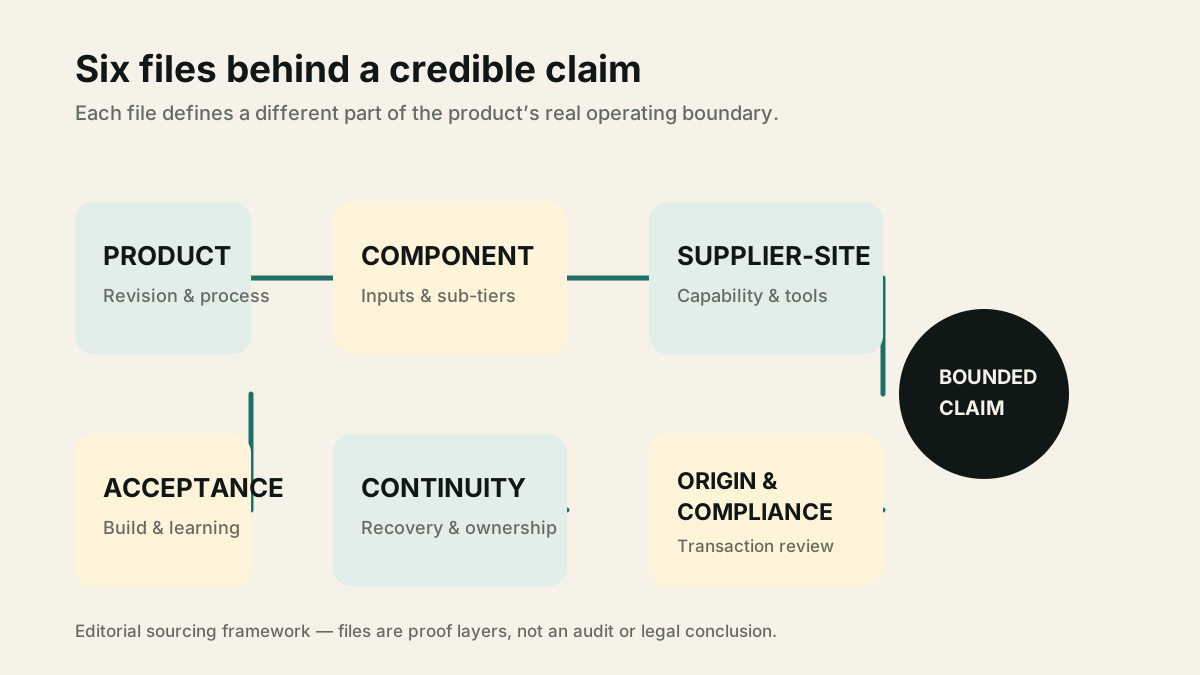
Editorial sourcing framework. These files are proof layers, not a customs determination, factory audit, or country recommendation.
Turn the strategy into a testable continuity plan
The six files can sound extensive, but they do not all need the same depth on day one. Begin with the product that matters most and the disruption that would hurt it most. That may be a customer-critical SKU, a component with an unusually long lead time, a product with a single testing fixture, or a line whose transfer requires an approval that has not been obtained.
Write a small hypothesis. For example: “If the current assembly site is unavailable for four weeks, the named alternate site can ship product revision X at the agreed quality level using the specified components and approved test method.” This is a real statement. It reveals every missing piece: capacity, inputs, tooling, staff, logistics, customer approval, documentation, and time. It is much more useful than “we have China+1.”
Then choose the smallest test that could disprove or support the hypothesis. It might be a document review, component trace, engineering build, quality audit, test transfer, supplier capacity review, or controlled production run. The test should have a written success condition and a stop condition. If it fails, the company has learned which file needs work. If it succeeds, the company has evidence for the next stage, not necessarily for every future claim.
Avoid false redundancy
Two sites can share a hidden single point of failure. They may buy the same component, use the same tool, depend on the same design authority, ship through the same port, use the same software key, rely on the same financial counterparty, or require the same customer approval. A map with two factory icons can look redundant while the underlying product remains concentrated.
The continuity file should therefore identify common-mode dependencies. The best question is not “Do we have two suppliers?” It is “What could stop both suppliers at once?” The answer may be a material, a sub-tier, a calibration house, a technical expert, a logistics route, a regulatory condition, or a customer-controlled specification. This does not make the second supplier useless. It tells the buyer what protection it actually provides.
Separate a strategic option from a production promise
An alternate site can be a valuable strategic option even before it is fully qualified. It may provide local market access, a future hiring base, a supplier-development pathway, or a contingency direction. The organisation should state that it is an option. A production promise needs a different level of evidence.
This language helps everyone. Finance can value the option without booking it as capacity. Sales can avoid promising a customer a delivery path that has not been tested. Sourcing can budget the qualification work. The supplier can earn a defined pilot instead of being asked to prove a universal claim. And leadership can see which investment turns the option into a reliable capability.
Make every diversification claim reversible
A useful operating rule is that a diversification claim should be reversible back to the evidence that supports it. If a buyer says that a product has a second source, another person should be able to open a short record and see the exact product, the source, the qualifying conditions, the owner, the date, and the limit of the statement. That is not bureaucratic excess. It is how a claim survives a staffing change, a supplier dispute, a customer question, or the first day of an actual disruption.
The record does not need to be a giant report. A controlled one-page summary can route the reader to the detailed files. It can state: product revision; primary and alternate source; covered process; critical shared inputs; demonstrated output; outstanding actions; next review date; and decision owner. The detail can live in engineering, procurement, quality, logistics, compliance, and finance systems. The summary is a handoff, not a substitute for those systems.
This approach prevents a common reporting failure. An executive presentation may show a country, a factory, or a supplier name and describe the picture as “diversified.” Six months later, the product revision changes, the supplier changes a sub-tier, the tooling moves, a customer specification tightens, or a key input is reallocated. The slide remains while its evidence expires. A reversible claim gives the organisation a place to record that the prior statement no longer applies, rather than allowing the old description to become institutional memory.
Give the claim an owner and an expiry
Every file needs an owner, but the claim itself needs one too. That owner is not necessarily the person who negotiates price. For a quality-sensitive product, it might be the programme manager with sign-off from engineering and quality. For a regulated product, compliance may own a gating record. For a long-lead component, sourcing may own the supplier and capacity evidence while operations owns the recovery assumption. The important point is that a named person can say what the evidence means and when it must be revisited.
Set an expiry condition rather than relying only on an annual calendar. A diversification conclusion should be reviewed when a bill of materials changes, a critical supplier changes site, an alternate source loses capacity, demand changes materially, a new customer requirement is added, tooling is modified, a route becomes unavailable, or a relevant regulatory condition changes. These are not predictions. They are change events that can invalidate an otherwise accurate record.
Expiry language makes the claim more credible, not less. “Alternate assembly has been demonstrated for revision B under the listed inputs; requalification is required after a tooling or material change” is a stronger statement than “the product is fully diversified.” It tells a customer or internal reviewer exactly what has been demonstrated. It also protects the team from treating a historical pilot as a permanent attribute of the product.
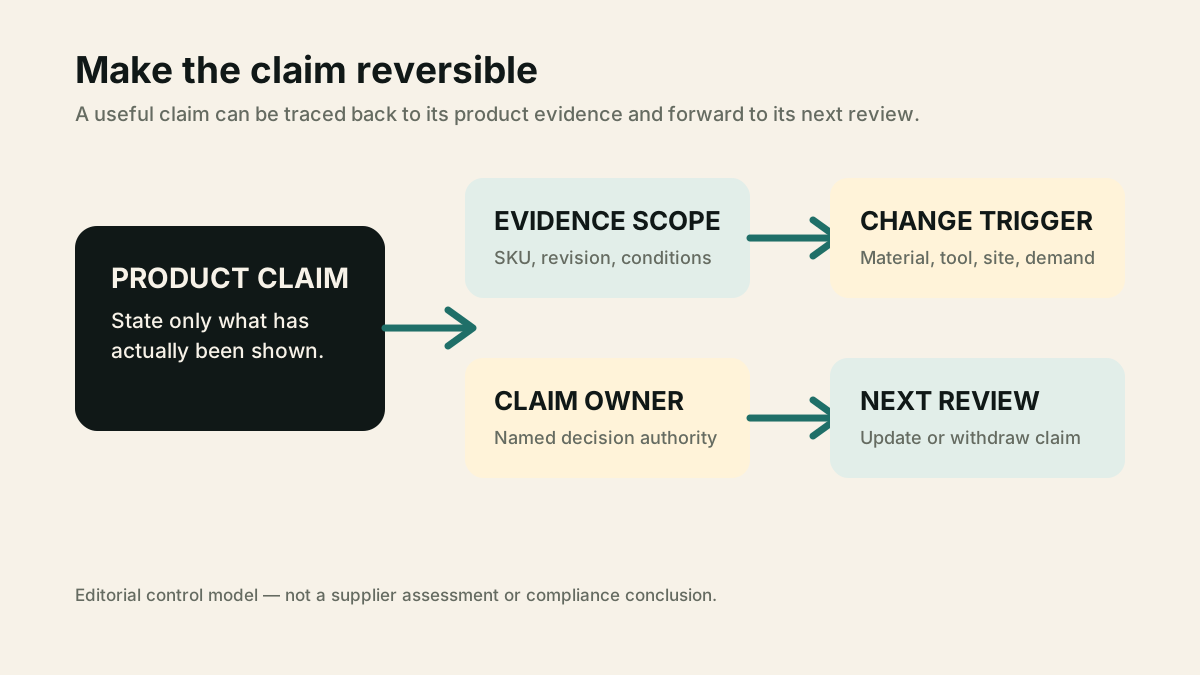
Editorial control model. It describes how to keep a product-level claim traceable; it is not a supplier score, audit result, or legal finding.
Test the chain at the point of failure
Diversification work is most valuable when it starts from a failure that matters. A broad mandate to “reduce China exposure” can trigger many activity lists: visit more factories, add countries to a presentation, request quotations, or duplicate a generic supplier list. Those activities may be useful, but they can consume time without changing the failure that would actually stop the product.
Start with a disruption question. If a named input were unavailable for a defined period, what would stop first? The answer may be final assembly, but it may instead be a specialised material, a chip, a test fixture, a firmware signing process, a calibration step, a packaging format, a logistics handoff, a payment arrangement, or customer approval. The chain should be modelled at the level at which the product can actually fail.
Then distinguish time from capacity. A company can have sufficient nominal capacity at an alternate site and still be unable to ship in time because materials need approval, technicians must be trained, test equipment needs calibration, product data are incomplete, or transport documentation is not ready. Conversely, a small inventory buffer may cover a short interruption without a full site transfer. Neither observation proves resilience on its own. Together they describe a time-bound recovery posture.
Use scenario cards instead of a single resilience score
One resilience score can be tempting because it is easy to compare. It often hides the decision. A product may be strong against one disruption and weak against another. An alternate component may protect against a supplier outage but not against a shared material shortage. A second assembly site may protect against a local event but not against a shared tool or software dependency. A single score can make these differences disappear.
Use short scenario cards instead. Each card names one event, its assumed duration, the affected product, the critical dependency, the evidence available now, the proposed action, the decision owner, and the residual gap. The cards do not need to forecast geopolitical events. They work for ordinary operational events as well: a quality hold, a capacity shortfall, a port delay, a design revision, a supplier insolvency, or a test failure.
For example, a card might say: “If supplier A’s machining line cannot produce part X for three weeks, can supplier B make the approved revision using the specified fixture and material, and can the customer accept it?” The supporting evidence would live in the component, supplier-site, continuity, and acceptance files. If one is missing, the card identifies an action rather than pretending the second supplier is ready. The wording turns an abstract strategy into a concrete decision.
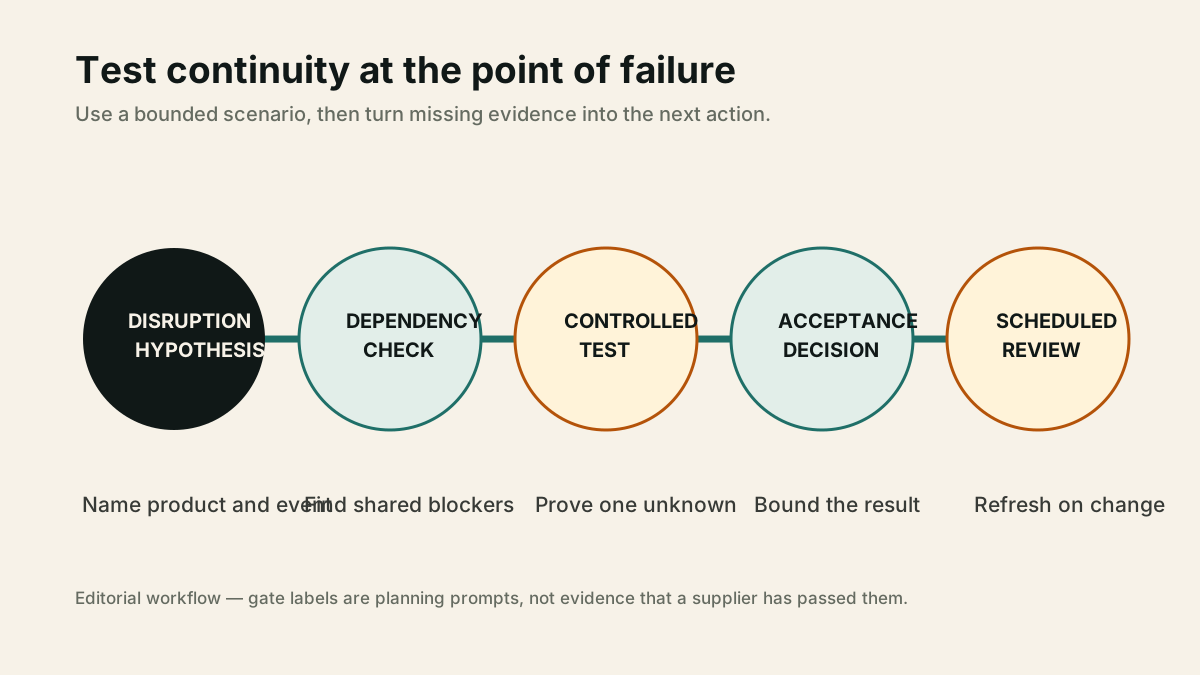
Editorial continuity workflow. Gate labels are planning prompts, not evidence that any supplier or product has passed them.
Keep the first test deliberately narrow
A first test should answer the highest-value unknown, not attempt to certify the entire network. If the main uncertainty is whether the alternate site can use the existing test fixture, a controlled test transfer may be the right first step. If it is whether a component can be sourced independently, a bill-of-materials and sub-tier trace may come first. If it is whether a customer will accept an alternate process, the first step may be a documented approval path.
Narrow tests reduce the temptation to interpret activity as proof. A quotation is evidence that a supplier has quoted, not that it can deliver the required product. A sample is evidence of a sample under stated conditions, not of repeatable output. A capacity letter is an input to review, not a production record. A factory visit can answer what was observed on that visit; it cannot substitute for controlled records across the product lifecycle. The organisation should preserve the distinction in its decision notes.
The test should also specify what happens next. A positive result may allow a pilot, a larger qualification run, a procurement action, or a customer conversation. A negative result may identify a shared dependency, a design change, a sourcing search, or a decision to maintain a buffer. Either result is useful if the programme records it honestly. The problem is not that every alternate will fail. The problem is letting an untested alternate become a promise.
Treat the commercial agreement as part of the continuity file
Operational evidence and commercial terms must agree. A supplier may be technically capable of making a product but lack an agreed reservation, response time, pricing mechanism, tool-access arrangement, intellectual-property permission, service commitment, or change-notification duty. If these points are outside the contract or operational agreement, the buyer may discover them only after the disruption begins.
The question is not whether every contingency should be converted into a rigid contract clause. That depends on the product, relationship, bargaining position, and applicable law. The practical point is to make the assumption visible. If the continuity plan assumes access to a fixture, a defined amount of material, a particular engineering response, or a priority production slot, record where that assumption is supported and who can confirm it.
Commercial records also help separate independent sources from dependent ones. Two legal entities may look separate but share a parent, a purchasing desk, a financial exposure, a tool owner, a technical team, or a single sub-tier. Such links are not automatically disqualifying. They affect the scenario that the alternative can cover. A buyer that understands the connection can choose a suitable buffer, qualification plan, or escalation route. A buyer that ignores it may overstate redundancy.
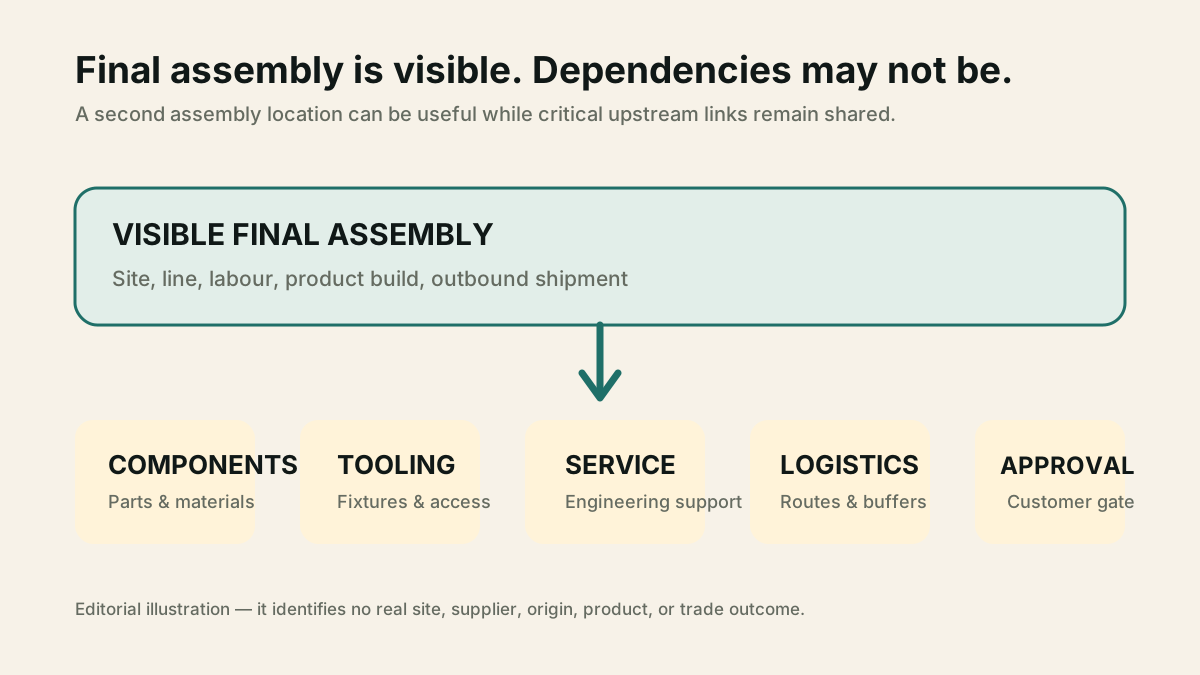
Editorial illustration of the distinction between final assembly and upstream inputs. It identifies no real country, route, supplier, product, or origin outcome.
A practical buyer review before repeating “China+1”
Before allowing a country strategy phrase into a customer presentation, board pack, risk report, or public statement, use this review:
- Name the product. Which SKU, revision, customer and process are covered?
- Name the changed exposure. Is the move about assembly capacity, components, logistics, compliance, customer concentration, or something else?
- Open the component file. Which critical inputs still originate in the original ecosystem, and which have qualified alternatives?
- Open the site file. Has the alternate site produced the actual product with the required tooling, test, quality, and staffing?
- Open the origin-and-compliance file. Do not use a public trade pattern as a legal conclusion; obtain current specialist review for the transaction.
- Open the continuity file. Which failure modes, buffers, alternates, owners, and recovery measures exist today?
- Open the acceptance file. What build, pilot, or sustained record establishes the scope that is being claimed?
- State the residual risk. A good strategy can still have exposure. Say what remains rather than hiding it.
The review does not ask for certainty that global trade cannot provide. It asks for a truthful statement of capability. A company can say, “We have moved final assembly,” “we have qualified an alternate component,” “we carry a defined buffer,” “we have tested a recovery build,” or “we are developing a second site.” Each is a useful business fact when properly bounded. None needs to become a universal claim of independence.
Method and limitations
This is desk research based on a World Bank analysis of Vietnam trade and vulnerability, the IMF’s October 2025 Asia outlook, and a U.S. Commerce country guide. These sources are used for their stated institutional context and guidance only. The article does not infer a product’s legal origin, customs treatment, tariff outcome, transshipment status, or a buyer’s supply-chain resilience from macro trade data.
The article does not claim first-hand factory audit, supplier qualification, customs review, bill-of-materials access, logistics operation, or continuity testing. Readers making a sourcing, customs, legal, compliance, investment, quality, safety, or production decision should obtain product-specific records and qualified advice for the actual transaction and operating environment.
Frequently asked questions
Is China Plus One the same as leaving China?
No. China Plus One commonly describes adding or relocating capacity, not necessarily removing Chinese components, suppliers, engineering support, or other links. The right question is which dependency has changed for a named product and which remains. The World Bank’s Vietnam analysis illustrates that export relocation and Chinese component dependence can coexist.
Does final assembly in a second country prove that a product is diversified?
No. It can prove a defined assembly action if documented, but it does not by itself prove alternate components, tooling, service, origin treatment, customer approval, or continuity. Review the component, supplier-site, continuity, and acceptance files before making a broader claim.
Does a connector-country trade pattern prove transshipment?
No. A macro pattern does not determine the facts or legal treatment of a specific product or transaction. The IMF discusses regional exposure and uncertainty, including Chinese value added embedded in regional exports, but it does not decide an origin or tariff outcome. See the IMF regional outlook.
What should a buyer buffer first?
Start with the component, material, tool, service, or approval whose absence would stop the highest-consequence product. The answer is product-specific. A buffer buys time; it is not a substitute for qualification, supplier development, or a recovery plan. Record the assumption and review it when lead times, demand, or source conditions change.
Is a second factory enough to make a supply chain resilient?
Not necessarily. Two factories can share critical components, sub-tier suppliers, tooling, engineering support, software, logistics routes, or customer approvals. Identify common-mode dependencies and test whether the alternate site can make the specific product under the stated conditions.
Is this article trade or customs advice?
No. Origin, tariff, customs, export-control, and transaction questions depend on specific facts and current rules. This article provides a sourcing evidence framework only. Obtain qualified advice for the actual product, destination, end use, parties, and transaction.