
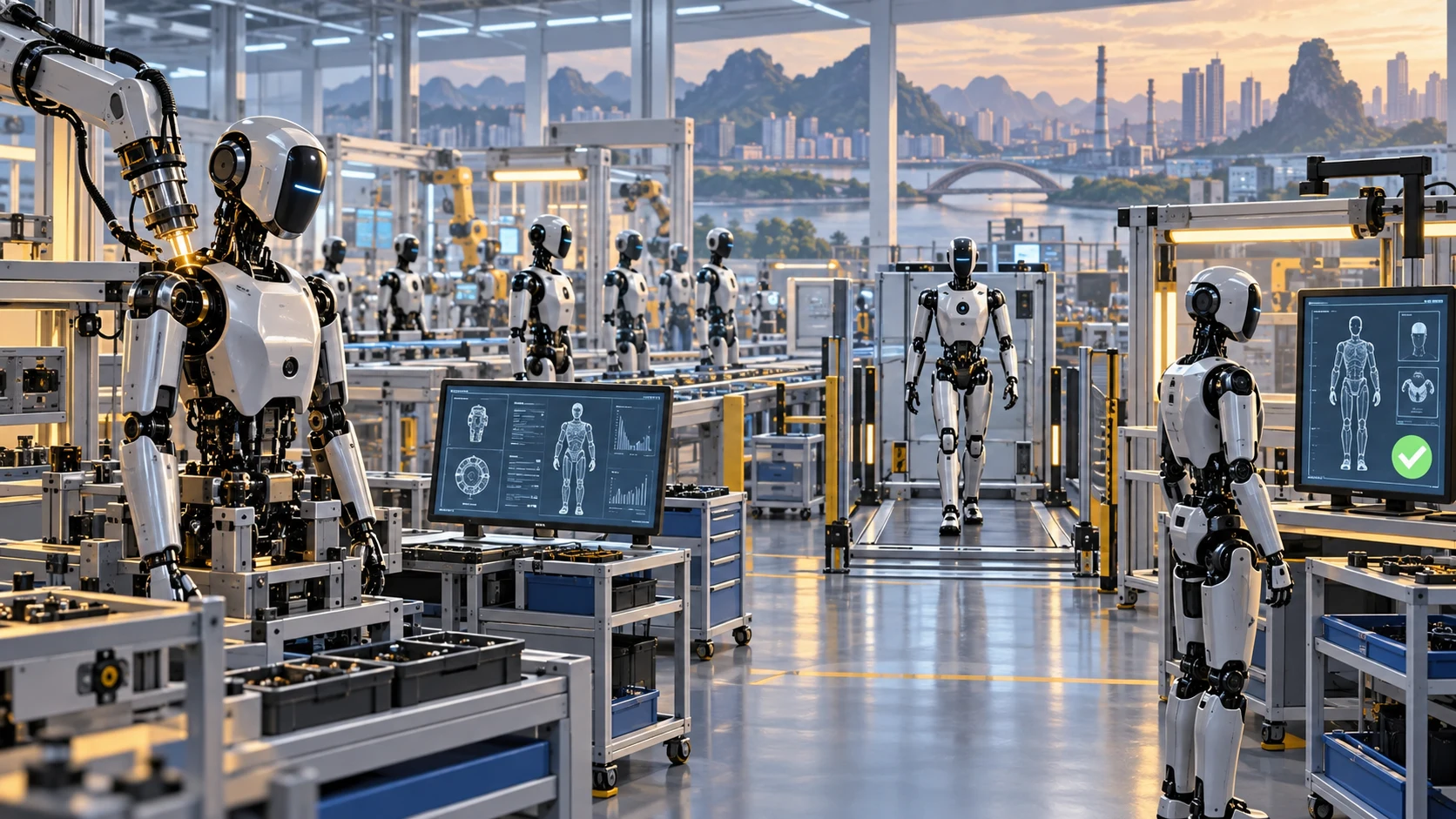
UBTECH's new humanoid-robot factory in Liuzhou, Guangxi, is built around a production figure that is easy to repeat and easy to misunderstand.
The 2026 commissioning report says the factory entered operation on September 12, 2026, according to a report carried by the Guangxi government portal and attributed to Guangxi Daily. The reported facility covers 14,000 square meters, is 13.8 meters tall, is designed for one Walker S or Cruzr-series robot every 10 minutes, and has planned annual capacity above 10,000 units. A separate report by Seoul Economic Daily describes robot-assisted material handling, collaborative final assembly, automated logistics, and more than four hours of full-unit testing for each finished robot. The Guangxi report and the Seoul Economic Daily account provide the most useful public starting points.
The announcement matters because it changes the question around Chinese humanoid robots. The question is no longer only whether a company can build a capable prototype, train a robot in an automotive plant, or ship a small batch. It is whether the company can turn a complicated, fast-changing machine into a repeatable production system with controlled material flow, assembly, software configuration, inspection, traceability, and serviceable output.
That is what the Liuzhou factory can plausibly demonstrate: UBTECH has designed an industrial system for scaling a humanoid-robot product family. It does not, by itself, demonstrate that the line is already sustaining its planned rate, that more than 10,000 robots will be delivered, or that every robot can perform a customer's task safely and economically for a full shift.
The news is about a factory system, not only a larger building
The local report presents the Liuzhou site as a “super-smart factory” for industrial humanoid robots. The language is promotional, but the underlying object is concrete. There is a named site, a named product family, a physical footprint, a production design rate, a planned annual capacity, and a stated digital manufacturing architecture.
The report says the site uses industrial simulation for planning and a digital “smart brain” for scheduling and dispatch. It also says UBTECH is working with Siemens on a digital manufacturing foundation designed for humanoid-robot production (Guangxi report). The problem that foundation is supposed to address is specific: humanoids contain many parts, require frequent material movement, demand accurate assembly, and change quickly as the product evolves.
Simulation is most useful at the interfaces among stations. Before equipment is fixed in place, a model can help planners examine travel paths, material presentation, station loading and how parallel work areas connect. A scheduling layer then has to turn that design into daily dispatch: which unit goes next, where a part should be delivered, and how an exception changes the sequence. That distinction matters in a factory where the robot under assembly is itself large work in progress and different product configurations may follow different routes. Simulation can help expose congestion or poor handoffs before they become expensive layout problems; it is only as useful as its assumptions about cycle times, buffers and variation. The public description names the tools and intended role, but gives no modeled-versus-measured comparison.
That combination is more revealing than the word super-smart. Humanoid robots are difficult products to manufacture because the factory is trying to stabilize a moving target. The body includes many actuated joints, sensors, cabling, structural elements, compute hardware, batteries, hands, covers, and software-dependent calibration. The product is also expected to behave as an integrated system. A loose connector, a calibration error, a mismatched software build, or a changed component can surface as a movement or manipulation problem rather than a simple cosmetic defect.
An ordinary assembly line is never merely a sequence of workers and tools. It is a controlled flow of parts, work-in-progress, instructions, tests, exceptions, and quality decisions. For a humanoid, the control problem is harder because the final product is both mechanically complex and behaviorally dependent on software. A production system therefore has to answer several questions at once:
- Which bill of materials and hardware revision is being built?
- Which software, model, calibration and skill package belongs to that unit?
- Which parts were installed, by which station, under which process conditions?
- What happens when an assembly result falls outside tolerance?
- Which tests must pass before the unit can leave the factory?
- How are changes introduced without making the installed fleet inconsistent?
The public reporting does not answer all of these questions. It does show that UBTECH is building the kind of digital and physical infrastructure that makes them answerable at scale. That is the meaningful manufacturing signal.
What does “one every 10 minutes” mean?
The 2026 commissioning report presents the phrase as a production-design statement. The Guangxi government report says that the facility is designed around one industrial humanoid coming off the line every 10 minutes, and separately describes annual planned capacity above 10,000 units. The report does not disclose the customer-demand calculation or available production time that would let an outside reader independently reconstruct a formal takt-time calculation.
In lean manufacturing, takt time is normally calculated as available production time divided by customer demand. It is not automatically the same as the time one unit spends in the building, the time required for one operator to perform one task, or the average time between products during an early ramp. For this article, designed output interval is the more precise description of the disclosed figure because the opened factory reports establish a planned line cadence, not the inputs to a customer-demand calculation.
The practical distinction is easy to miss. A line may have a 10-minute exit interval while a robot spends much longer in the facility moving through parallel stations, test bays, rework areas and software loading. Multiple units can be in process at the same time. A station may work on one robot for 40 minutes while the line still releases a unit every 10 minutes because four parallel stations share the load. Conversely, a nominal 10-minute cadence may be available only when staffing, parts, tools, software and rework capacity all remain within their designed boundary.
The planned annual number introduces another boundary. More than 10,000 units a year does not tell the reader how many shifts the plant assumes, how many operating days are planned, what mix of Walker S and Cruzr units is expected, or how much capacity is reserved for engineering changes, maintenance, rework and pilot configurations. It also does not show realized utilization after commissioning.
Why humanoid production is a harder manufacturing problem
The difficulty is not simply that a humanoid has two legs and two arms. The difficulty is that the product has to combine many mature and immature subsystems into one repeatable unit.
An industrial arm often operates from a fixed base with a known reach envelope, a controlled end effector and a structured workpiece presentation. A humanoid is intended to move through more variable spaces, use human-oriented work areas, handle objects with different poses, and perform several categories of work. That flexibility increases the number of interfaces the manufacturer has to control.
At the mechanical level, the factory must manage joint modules, reducers or transmissions, motors, encoders, wiring, batteries, structural parts, covers, hands and sensors. At the electrical level, it must manage power distribution, charging, thermal behavior, communication and computing. At the software level, it must load and validate perception, navigation, manipulation, motion control and task policies. At the application level, it must determine what a particular customer expects the robot to do.
These layers can change at different speeds. A mechanical revision may require a new calibration process. A sensor change may affect perception. A software update may alter how the robot moves or recovers from an error. A customer-specific task may require a new hand, fixture, data-collection routine or safety boundary. The production system has to preserve identity and traceability even as the product evolves.
That is why the reported cooperation with Siemens is relevant even without accepting every promotional claim. Digital planning and manufacturing-management software can help connect product definitions, process instructions, material flow, test results and production scheduling. It does not make the robot autonomous in the field. It can make the factory more capable of controlling the process that creates the robot.
The Liuzhou project therefore sits at an important boundary between robotics and manufacturing engineering. It treats the humanoid as a repeatable industrial product rather than as a research artifact that is assembled in small numbers by a highly experienced team.
What the Liuzhou line reportedly does
The most detailed public operational description comes from Seoul Economic Daily. It reports that the site uses Cruzr Y1 and Cruzr S2 robots to unload, stack, load and transport materials. It describes collaborative robots working with human operators in final assembly, alongside remote manipulators, automated guided vehicles and rotating workbenches.
This layout matters because it shows several different forms of automation rather than a simple claim that “humanoids build humanoids.” A factory can use a humanoid where the task benefits from a human-compatible body, a collaborative robot where a repeatable assembly motion is more suitable, an AGV where horizontal movement is the right tool, and a human where judgment, exception handling or dexterity remains more efficient.
The phrase “robots building robots” is therefore best read as a mixed production system. The line is not valuable because every station has to be humanoid. It is valuable if the company can assign each operation to an appropriate machine or person while keeping the whole flow synchronized.
The report says each completed robot undergoes more than four hours of full-unit testing and passes through an automotive-grade tunnel for a 360-degree exterior check.
The report also describes a three-dimensional warehouse designed to hold 112 robots in 65 square meters, with automated vehicles and unmanned forklifts supporting movement. That is a reported design detail; its operational implications depend on how inventory moves through testing, rework and dispatch.
What would show whether the mixed line works
The reported equipment list identifies humanoids, collaborative arms, remote manipulators and automated guided vehicles, but not how those stations perform together. Useful operating records would show each machine's role, supervision needs and result against a baseline. That would let readers assess whether the mix improves cycle time, quality or operator time, rather than infer coordination from an installed-equipment list.
The sequence between stations matters as much as each machine's individual performance. A material-handling robot may arrive on time yet leave an assembler waiting if bins are presented inconsistently; a collaborative arm may move quickly while inspection or software loading sets the pace. Queues can grow even when each machine meets its local target. Line-level records should therefore show whether routine variation is absorbed by the system or pushes coordination work back onto operators.
Moving from a successful trial to routine production adds a change-control test. Engineers may adapt a task, fixture or sequence during a pilot; later shifts must preserve the result as products, operators and parts change. A prepared station can demonstrate capability, while repeatable results across shifts show whether the process can be transferred and maintained. Both are useful evidence, but they answer different questions.
How testing and warehousing shape the production rhythm
The reported four-hour-plus full-unit test creates a downstream-capacity question. A facility designed to release units at short intervals would need multiple test bays, staggered starts, parallel diagnostics or some combination. The public description does not say how many bays operate, how many units are tested simultaneously or how failed tests return to rework. Those details would show how the test stage is staffed and integrated with assembly.
As a conditional illustration, if the reported test lasts more than four hours while the line actually releases a robot every ten minutes at the reported design interval, more than 24 units would need to be in the test stage simultaneously at a steady state. This ratio assumes both numbers describe the same product flow and ignores downtime, retesting and variation; it is not a claim about Liuzhou's actual test-bay count. It shows why capacity and test duration need to be read together before inferring throughput.
That separation can be beneficial. Assembly can continue while earlier units undergo endurance, motion, communication and subsystem checks. It also creates work in progress: robots occupy space and capital while their results are pending. If a test reveals a calibration fault or a software mismatch, the plant needs a route to isolate the unit, diagnose it, make a controlled correction and repeat the relevant checks without confusing its status with a passing unit. A mature production record would connect a serial number to the test plan, software version, measured result, repair history and final release decision. The public account establishes that long tests are reported; it does not disclose that traceability record.
The exterior scan and functional checks address different failure modes. A visible gap or damaged cover points toward handling, fit or finishing; a motion or communication fault may involve assembly, calibration or software. Keeping those categories distinct is more informative than a single pass figure because appearance, subsystem function and integrated behavior do not fail in the same way. The reporting does not disclose defect thresholds or release rules, leaving the relationship between inspection and final acceptance open.
The reported warehouse provides another clue about flow. A buffer can decouple assembly from slower testing, rework or dispatch; it can also hide work that is waiting for a decision. Storage capacity alone does not show how quickly units move through it or why they stop there. The same inventory can support smooth production or signal a bottleneck, depending on its age and movement. Throughput depends on that flow, not the maximum number of robots the warehouse can hold.
Walker S and Cruzr are different signals inside the same factory
The factory is reported to produce the Walker S and Cruzr series. That pairing is useful because it prevents the site from being interpreted as a single robot model with one fixed use case.
Walker S is associated with UBTECH's industrial humanoid line. In its 2025 interim report, UBTECH describes Walker S, Walker S1 and Walker S2 as industrial versions of its embodied-intelligence robots. The filing details Phase 2.0 multi-robot trials involving workbin handling, parts sorting, assembly, process-material handling and quality inspection; its reference to “SPS sorting” is not defined in the passage. It also describes the Walker S2's autonomous battery-changing system and software/data platforms for group collaboration. This filing documents industrial product work and coordinated trials before Liuzhou's commissioning; it does not measure output from the new plant.
Cruzr belongs to a different part of UBTECH's product history and portfolio, with service and interaction applications alongside the newer factory use described in the Liuzhou reporting. The public factory reports name Cruzr Y1 and Cruzr S2 as material-handling machines on the production floor; UBTECH describes Cruzr S2 as a full-sized wheeled humanoid robot. Walker and Cruzr therefore represent different physical and application signals inside the same factory, rather than interchangeable names for one product family.
This distinction has two consequences.
First, the annual capacity number may describe a product-family plan rather than the output of one model. A mixed portfolio raises a scheduling question: which components and stations are common, where do model-specific operations begin, and how often must equipment or software be changed between configurations? Common parts can simplify procurement and assembly, while different hands, batteries, sensors or test routines can create separate routes through the same plant. The public sources do not specify how much of Walker S and Cruzr production shares a route, or whether the reported capacity assumes a particular mix. That matters because a line may sustain its best interval on one configuration while a different mix increases changeovers or occupies specialized test bays.
Second, factory-internal work and customer work create different operating data. A Cruzr moving materials inside UBTECH's plant can generate information about routes, handoffs and line-side delivery; the Walker S1 tasks announced by Dongfeng involve a separate set of inspection, assembly and handling operations. Comparing those uses requires attention to the robot configuration and work process, not a single company-wide deployment count.
Why Liuzhou is a meaningful place for this experiment
Liuzhou is not an arbitrary backdrop. It is a major automotive manufacturing location in Guangxi, and the factory's most concrete local application story is tied to vehicle production.
In May 2025, Dongfeng Liuzhou Motor announced a plan to deploy at least 20 UBTECH Walker S1 robots in its vehicle-production facilities. The announcement listed tasks including seatbelt inspection, door-lock testing, headlight-cover inspection, bodywork checks, tailgate inspection, interior evaluation, fluid refilling, front-axle assembly, material sorting, vehicle-logo application, configuration programming, label printing and parts handling. It also described initial training and coordinated multi-robot work across production zones. Dongfeng Liuzhou Motor's announcement is a partner disclosure that identifies the task scope and the planned local application.
The announced tasks span different kinds of work. Seatbelt and bodywork inspection depend on repeatable sensing and defect criteria; fluid refilling requires controlled handling and a measurable fill result; front-axle assembly combines part positioning with a defined mechanical operation; material sorting and parts handling depend on presentation and delivery reliability. Grouping these into one headline task count would hide their different process conditions. That range shows why an automotive setting can expose several distinct engineering problems within one customer relationship.
The task mix also changes how a fleet is organized. Inspection robots need consistent viewing positions and lighting; a filling operation depends on the container and connector being presented correctly; assembly work must coordinate part arrival with tools and the vehicle's production sequence. When multiple robots operate across production zones, their routes and work assignments must fit the plant's material flow so one station does not create a queue at another. These are integration questions that arise even when each robot can perform its assigned motion. They help explain why an automotive customer is a technically rich environment: it tests not one generic capability, but the fit between a particular robot configuration, a defined work step and the surrounding line.
Automotive plants offer structured processes, repeated parts and defined inspection points, while still requiring equipment to work around people, line-side inventory, vehicle bodies, moving equipment and changing variants. That mix makes the site a demanding place to develop and adapt industrial systems.
Liuzhou also gives UBTECH proximity to a local industrial ecosystem. The Guangxi government report frames the project as part of a development path linking research in larger Chinese cities, integration in Guangxi and future applications in China and Southeast Asia. That is policy language, not a confirmed export or deployment result. The industrial logic is nevertheless clear: a manufacturing city can supply application scenarios, engineering partners, production knowledge and a customer base that is close enough for iteration.
This is one of the stronger features of China's robotics development environment. A robot company can place a system near automotive, logistics, electronics or equipment manufacturers and use those sites as both customers and learning environments. The relationship can accelerate product improvement. It can also blur the line between a paid deployment, a joint validation project, an internal trial and a demonstration.
The earlier field evidence is encouraging and incomplete
The Liuzhou factory did not appear from nowhere. Before the September commissioning, UBTECH had reported industrial trials and small-batch commercial activity.
In May 2026, Hitachi China reported that Hitachi had introduced UBTECH's Walker S2 into selected manufacturing environments and that the partners were conducting operational testing and application-scenario validation. The announcement names secondary development on a Hitachi Elevator manufacturing floor. That identifies a partner, robot family and manufacturing setting while describing work in progress rather than publishing test measurements. For an outside reader, the named site and test status locate the programme, but they do not show how many cycles were completed, what intervention rate was observed or whether a production task met a defined acceptance threshold.
The 2025 annual report filed by UBTECH reports a 2025 sales volume of 1,079 units for its full-size embodied-intelligent humanoid products and services for all scenarios; separately, it says more than 1,000 industrial humanoids were delivered with revenue recognized. These are two differently defined commercial measures, not two batches that can be added together: the filing does not state how much the categories overlap. It also presents the sales figure for the company's full-size humanoid offering, while the delivery figure is scoped to industrial humanoids.
In its April 2025 filing with the Hong Kong Stock Exchange, UBTECH said it had signed a small-batch purchase contract for Walker S1 and Walker C robots for manufacturing and commercial hospitality in automobile factories, and had received an advance payment. The filing does not name the purchaser, so this contract should not be treated as the separate Dongfeng Liuzhou plan for at least 20 Walker S1 robots. The payment is a commercial signal, but it does not establish delivered units, task performance or sustained deployment.
The evidence can be read in six stages, from Hitachi's reported operational testing and Dongfeng's announced plan to reported commercial volume, factory capacity and sustained task performance; the sequence does not assume every step has been completed.
- Product and platform development: UBTECH names industrial Walker models and their system architecture.
- Controlled field trials: multiple robots are trained or tested in production environments.
- Small-batch commercial activity: a buyer or partner places an order or announces planned deployment.
- Reported commercial volume: UBTECH's 2025 annual report records two distinct company-wide sales and industrial-delivery measures.
- Factory scale: UBTECH builds a dedicated plant with a planned output above 10,000 units.
- Sustained task deployment: repeated operating records that connect task performance with intervention, safety, service and economics.
What the factory proves about China's humanoid supply chain
UBTECH vice president Fang Jianxin told Global Times, as quoted by Seoul Economic Daily, that the company's ability to mass-produce complex robots depends on China's accumulated engineering talent, manufacturing capability, research capacity and application scenarios. SED notes that its English article was AI-translated from Korean and translated quotations may not reflect the exact original wording; the sentence here paraphrases Fang's attributed view. That statement is partly a company view, but it points to a real manufacturing mechanism. A humanoid company needs more than a clever control policy. It needs motors, joints, sensors, batteries, structural parts, machine tools, assembly equipment, testing capability, software integration and operators who can diagnose failures.
Those resources become more valuable when they are geographically and commercially connected. A factory in an automotive region can learn from the same types of line balancing, quality control, material presentation and maintenance problems that its customers face. A supplier base can shorten iteration on parts. A digital production system can carry configuration information from engineering into assembly and testing. A customer trial can produce data that feeds back into product changes.
For the manufacturer, that feedback has to work in both directions. Production engineering needs to know which component or process revision was used in a unit; an application team needs to return observations in a form that can be tied to a configuration and task. A fault that repeats across one parts batch may call for supplier or assembly changes, while a failure isolated to one workstation may require a fixture, task or supervision adjustment. When those teams can investigate together, a factory location near industrial users can shorten the path from observation to a controlled decision. The mechanism depends on shared records and change management as much as physical distance.
The plant's strategic significance lies in whether it can turn production and application observations into controlled revisions across hardware, software and task design. China's industrial-robotics base explains the supplier and integrator network from which a humanoid plant can draw; Liuzhou adds the specific challenge of coordinating those partners with a software-rich robot product and nearby automotive users.
What operating data would clarify next
The denominator matters as much as the unit count. A monthly total should be read alongside operating days, shifts, scheduled hours, product mix and time lost to changeovers or rework. Ten Walker S units and ten Cruzr units may use different stations, parts and test procedures, so a combined total can conceal where capacity is actually being used. A short commissioning-period peak would also mean something different from a sustained rate across ordinary shifts. To compare a reported cadence with customer deliveries, the record would need to identify when a unit passed final release and whether reworked or demonstration units are included. These details do not require disclosure of proprietary recipes; they define the scope of the measure. Without them, an annual target, a peak-day count and a shipment total can all be accurate while describing different stages of production.
Six types of operating records would make the plant's production and deployment stages easier to assess. They form a chain: realized output establishes what leaves the line; configuration and delivery records identify what reaches a user; task, safety and service data show what happens afterward. A gap at any step changes how much can be inferred from the headline capacity. For example, a shipment count without model revisions or acceptance status cannot establish how many units entered a customer's workflow, while a successful supervised task says little about uptime or recovery over a full shift. The records below would connect those stages without treating factory output as a proxy for customer value:
On narrow screens, swipe horizontally to review all columns.
| Question | Evidence still needed |
|---|---|
| Realized output | A dated output series, utilization measure, rework rate and explanation of whether the designed interval has been sustained. |
| Delivery and configuration | Shipment or installation records tied to Walker S or Cruzr variants, customer-specific hardware, software revisions and acceptance status. |
| Task performance | Task-level cycle time, success rate, recovery behavior, intervention frequency, quality and uptime under named operating conditions. |
| Safety release | Operating envelope, safeguarding, stop and restart behavior, risk assessment, training and maintenance boundaries for the customer site. |
| Economics | Integration, supervision, downtime, maintenance, spares, software, insurance and the value of the task compared with alternatives. |
| Cross-border service | Delivery timing, local support, regulatory approvals, customs treatment, spare-parts coverage and service ownership outside China. |
What a prospective user should compare
Liuzhou's production system is a supplier-readiness signal: repeatable configurations and controlled revisions could support rollout across multiple sites. It does not determine whether a humanoid is the right automation choice for a particular task. In an automotive or logistics plant, alternatives may include a fixed arm with controlled part presentation, a wheeled mobile robot for material movement, a gantry for a predictable work envelope, or a human-assisted station for exceptions. Each design trades tooling and layout changes against supervision, flexibility and recovery needs.
A buyer can make the comparison concrete by selecting one bounded task and documenting its current process before a robot trial begins. The baseline should include the work cycle, quality checks, exception rate, staffing and the time needed to recover from an interruption. The trial then needs the same measures, plus robot interventions, safety stops, failed attempts and maintenance time. Counting robot motions or completed demonstrations is not enough: a trial may look fast while a worker prepares parts, resets the station or corrects outputs outside the measured cycle. The relevant question is whether the complete task becomes more reliable or economical once preparation and recovery are included.
The task boundary also determines what success means. A robot that transports a bin may be judged on delivery accuracy and line-side availability; one performing an inspection needs a defined defect set, false-accept rate and escalation route. Assembly adds fit, torque or other process criteria, depending on the operation. These measures should be agreed with production and quality teams before the trial, so that a successful motion is not mistaken for an accepted production result. If a human remains responsible for exceptions, training and handover are part of the system being evaluated.
Only after the task is repeatable should a buyer ask whether the result travels to another shift, station or site. The hardware may be consistent while layouts, lighting, parts presentation, safety rules and local support differ. A rollout plan should say which settings are fixed, which require site-specific engineering, how updates are approved, and who owns recovery when the robot stops. Those decisions connect factory repeatability to customer operations: controlled manufacturing helps supply a known configuration, while deployment records show whether that configuration performs in the setting where it is sold.
A humanoid may suit a workstation built around human spaces and tools, or a task whose variation makes dedicated automation costly. Its form may reduce facility changes while shifting complexity into perception, balance, manipulation and fault recovery. The factory matters if it can supply consistent units and controlled revisions; the buyer still needs to test the task under actual operating conditions and compare total integration and support costs with alternatives. After installation, service coverage and parts availability determine how much production capacity becomes usable work. A stopped unit's recovery time can matter as much as its nominal cycle, and a regional support operation only helps if diagnosis is tied to the affected configuration and returns a verified unit to service. Our guide to Chinese humanoid robots distinguishes a platform offer, produced unit, supervised pilot and released work system.
What UBTECH's Liuzhou factory actually proves
Liuzhou shifts the industrial question from whether a humanoid can be assembled to whether product engineering, repeatable manufacturing and customer application can operate as one system. UBTECH's reported production software, automated material flow, collaborative assembly, long-duration testing and multi-model output describe an attempt to connect those parts.
The next evidence should show whether revisions move cleanly into production, test failures improve designs and application learning returns to engineering without disrupting released configurations. Those links will determine whether Liuzhou becomes a durable manufacturing platform; its design capacity alone cannot answer that question.
Method and limitations
This article is desk research conducted on September 23–24, 2026. It uses the Guangxi government portal's report attributed to Guangxi Daily, Seoul Economic Daily, Hitachi China's press release, UBTECH's Hong Kong Stock Exchange filings, Dongfeng Liuzhou Motor's partner announcement, and the UBTECH Cruzr S2 product page. The Liuzhou factory reporting supports stated commissioning, design capacity and factory-configuration claims; company and partner sources are kept attributed. No factory, robot, customer site, production line, safety system or acceptance test was visited or independently audited.