

The short answer: AMEC’s August 20, 2026 Lingang Phase II disclosure is a meaningful supply-side signal. The listed-company announcement identifies a board-approved proposal, a wholly owned project entity, an equipment-family focus, a RMB 3.5 billion total investment, a RMB 1.7 billion fixed-asset component, about 70 mu of land, expected workforce and mature-state targets. That is enough to justify attention from fab planners, integrators, suppliers, and analysts. It is not enough to say that a named etch, inspection, metrology, or deposition tool will be available on a particular date, at a particular capacity, for a particular process, with a particular support commitment.
This difference is more than careful wording. A capital plan and a sourcing commitment live at different points in a manufacturing chain. Between them sit agreements, land and construction, utilities and cleanroom readiness, installation, configuration-specific output, supply-chain qualification, process capability, customer evaluation, acceptance, service, spares, export and trade compliance, and contract-backed allocation. A serious buyer can value the first signal without inventing evidence for the later stages.
The public announcement itself helps establish this boundary. It describes the project as proposed, says the investment and support agreement had not yet been signed, and lists technology, market, competition, policy-support, land, management, and time-to-production risks. Those are not reasons to predict failure. They are reasons to treat the filing as what it is: a controlled starting point for further evidence, not a factory-release certificate.
For readers following China’s fabrication ecosystem, the durable context is SMIC Explained: China's Chipmaking Limits (2026). That guide explains why a fab’s node, tool, yield, and external-control constraints do not collapse into a single “domestic equipment” narrative. This article is narrower: how to read one current AMEC project disclosure without losing either the positive signal or its limits.
What AMEC actually disclosed
The primary record is AMEC’s August 20 investment announcement, available through a public mirror of the listed-company disclosure. The announcement says AMEC’s wholly owned Lingang subsidiary plans to invest in a Phase II production and research-and-development base at Minlian Lingang Industrial Park. The board approved the investment; the stated funding basis is the company’s own or self-raised funds. The plan is described as integrating R&D, production, and sales for etching equipment, measurement and inspection equipment, and thin-film-deposition equipment.
That is a useful set of facts. It ties the project to a corporate decision, a legal entity, a location, a capital envelope, and named equipment families. It also means the report should not be reduced to a generic story that “China is adding chip-tool capacity.” The disclosure is more specific than that. But its specificity does not extend to several facts buyers usually want most: tool configurations, throughput or unit capacity, qualified processes, customer allocation, delivery dates, acceptance status, service coverage, spare-parts availability, commercial terms, or any named customer order.
The table below preserves the labels the public record supports.
| Disclosed item | What the announcement says | Correct buyer reading |
|---|---|---|
| Corporate action | AMEC’s board approved its Lingang subsidiary’s proposed Phase II investment. | A board-approved project proposal, not an operating factory or a committed tool allocation. |
| Total investment | RMB 3.5 billion is stated as the total project investment. | A capital input, not a capacity unit, order book, or delivered revenue. |
| Fixed assets | RMB 1.7 billion is stated as fixed-asset investment. | A disclosed investment component, not a tool count or a measure of qualified output. |
| Site | The announcement describes about 70 mu of land. | Physical-site context, not a cleanroom-capacity or utilization result. |
| Equipment families | Etching, measurement and inspection, and thin-film deposition are named. | A product-family focus, not a list of sellable configurations, customers, or proven process windows. |
| Workforce | Expected staffing is 1,500–2,000, including 600–800 R&D personnel. | A mature-state expectation, not current headcount or production staffing. |
| Expected benefits | The filing references RMB 3 billion of mature-state local sales contribution and 300 patents over seven years. | Targets or expected benefits, not booked sales, granted patents, or shipment capacity. |
| Conditions and risks | The support agreement had not been signed; the filing names execution risks. | A reason to define later evidence gates, not a prediction of delay or failure. |
The board approval is material, but it does not complete the chain
Board approval has real signal value. It shows that the company has publicly put a capital project through its governance process and identified a funding basis. It is stronger than a rumour, an unsigned supplier presentation, or a general policy aspiration. It also gives a buyer a traceable document to archive and revisit.
What it does not do is execute every downstream condition. A board decision does not sign the local investment and support agreement. It does not build the site, fit out the facility, select equipment, establish a qualified supplier chain, hire the announced workforce, obtain operational approvals, put a tool through a customer’s acceptance sequence, or allocate output under a purchase agreement. It does not eliminate component constraints, process-specific requirements, logistics risks, or export-control exposure.
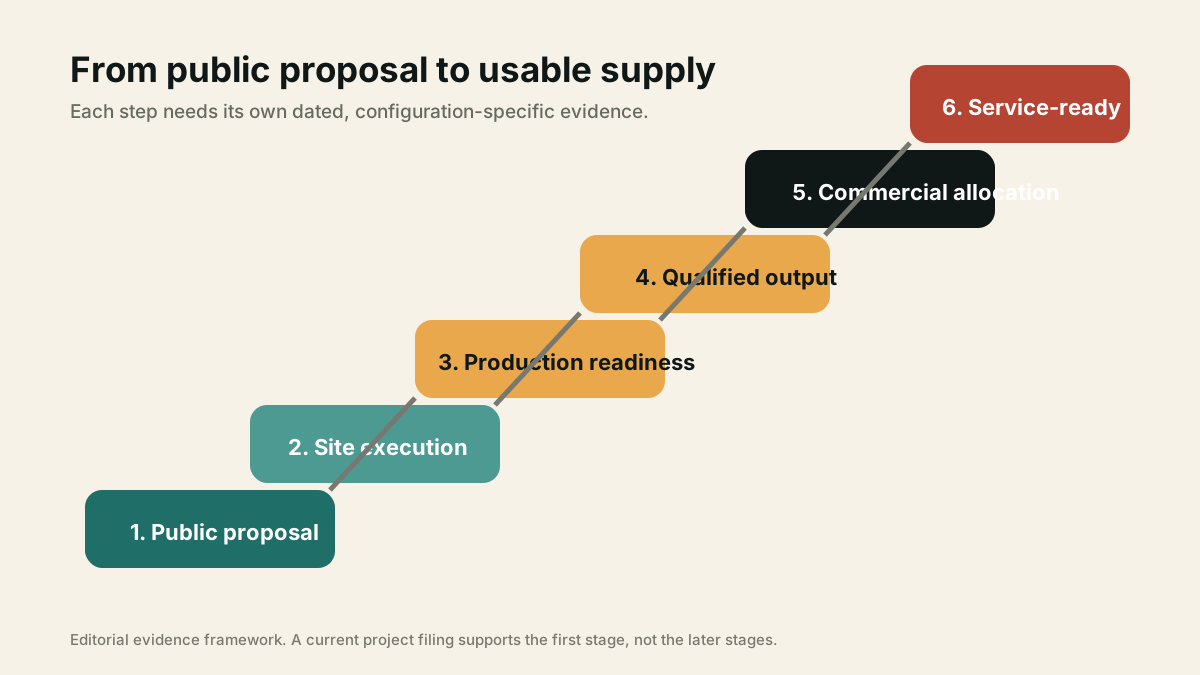
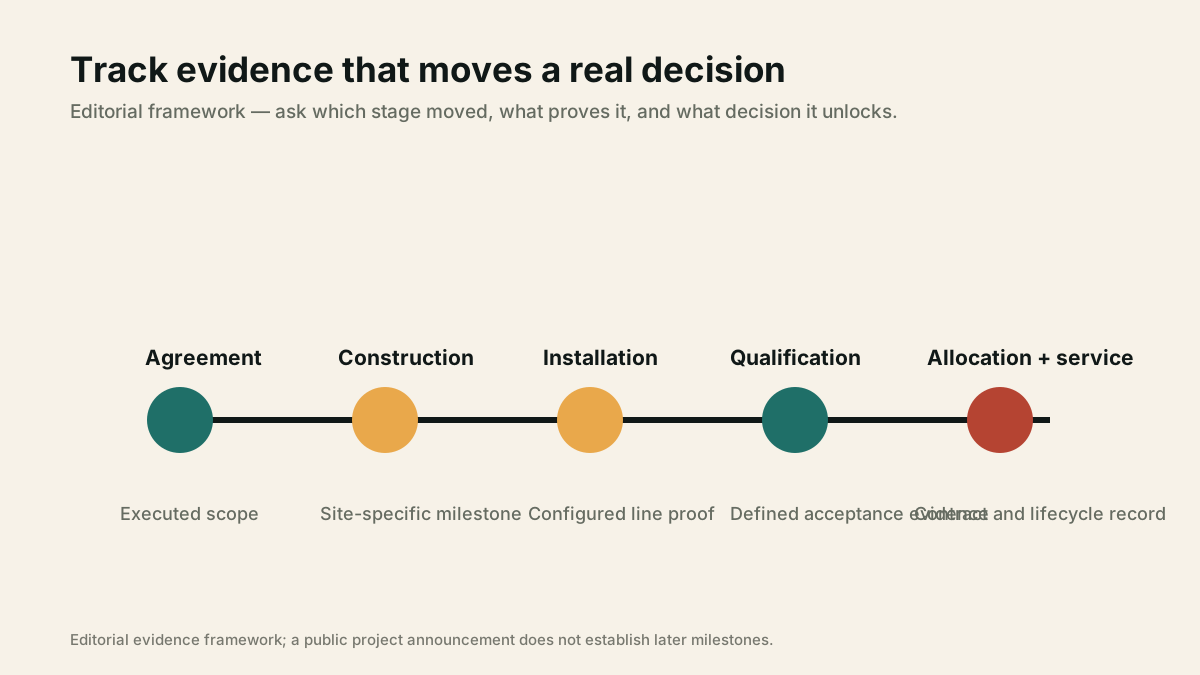
That is why the most useful internal status is not simply “announced” or “not announced.” Use stages: publicly proposed, agreement executed, site and construction verified, installation verified, configuration-specific production verified, customer-qualified, commercially allocated, and service-ready. The Phase II announcement can support the first stage. The later stages require their own records.
The numbers are important because they are not capacity numbers
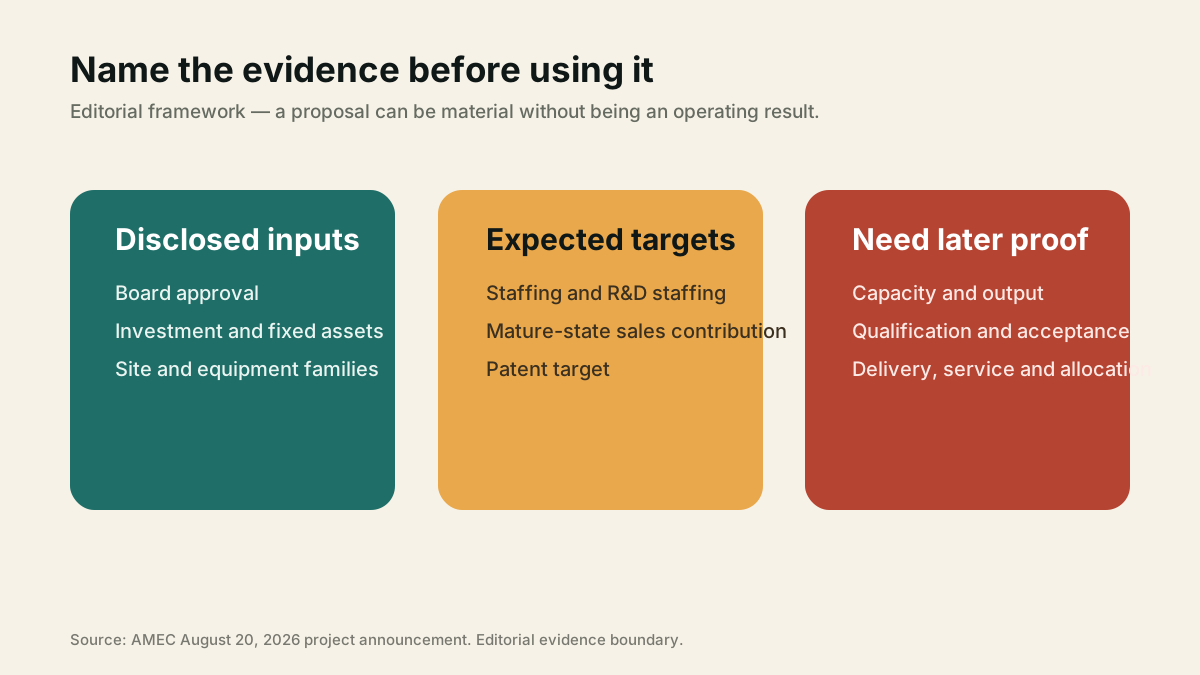
The most tempting error in this story is to convert scale into output. RMB 3.5 billion sounds like a capacity result because it is large and concrete. About 70 mu sounds like a facility measure. A 1,500–2,000-person workforce and 600–800 R&D staff sound like operating readiness. RMB 3 billion of mature-state local sales contribution sounds like future revenue. A 300-patent target sounds like a technology roadmap. All of these facts matter. None, alone or together, tells a buyer how many tools of a given configuration will be built, when, for which customers, with what process qualification, or under what delivery commitment.
The public announcement itself positions the figures as planned investment or expected benefit. The strongest reading is therefore also the most useful one:
- Total and fixed-asset investment indicate intended resource commitment and the scale of the proposed build, not an installed base.
- Land area indicates a potential physical envelope, not usable production space, cleanroom class, yield, or tool capacity.
- Expected personnel indicate a stated staffing ambition, not that the people have been hired, trained, retained, or assigned to a particular product line.
- Expected local sales contribution indicates a mature-state business target, not a current backlog, customer contract, or revenue forecast a buyer can book into its own plan.
- Patent targets indicate a stated innovation aspiration, not issued IP, product readiness, freedom to operate, or customer qualification.
This distinction is normal in industrial projects. Buyers make it valuable by avoiding two opposite errors. The first is cynicism: rejecting any plan because it is not already a finished plant. The second is overreach: turning a plan into a delivery promise because the capital figure is large. A capital announcement sits in the middle. It is evidence of intent and resource direction. It is not a substitute for operational evidence.
A simple “input, target, outcome” ledger
When a sourcing, strategy, or finance team discusses this project, it helps to label each statement before it enters a slide or model.
| Label | Examples from the public record | How to use it |
|---|---|---|
| Input | Board approval, funding basis, RMB 3.5 billion total investment, RMB 1.7 billion fixed assets, about 70 mu. | Monitor commitment, project scope, counterparties, and evidence of execution. Do not convert to output. |
| Target | Expected 1,500–2,000 personnel, 600–800 R&D employees, mature-state local sales contribution, 300 patents over seven years. | Use as a stated management ambition with date and source. Do not present as a result. |
| Context | Existing Lingang footprint and contemporaneous company results. | Assess supplier direction and ability to support investment, while keeping it separate from Phase II output. |
| Outcome | Installed capacity by configuration, qualified units, customer acceptance, delivery, field service, spares, and contract allocation. | Require direct, current, configuration-specific evidence. The project announcement does not supply it. |
If a reader needs a broader view of why manufacturing information must be separated from production capability, Smart Manufacturing in China: What a Buyer Can Verify is useful background. The same principle applies at a different level: an announced facility, digitization program, or investment plan becomes operational value only through observable implementation and performance.
What the named equipment families do—and do not—tell a buyer
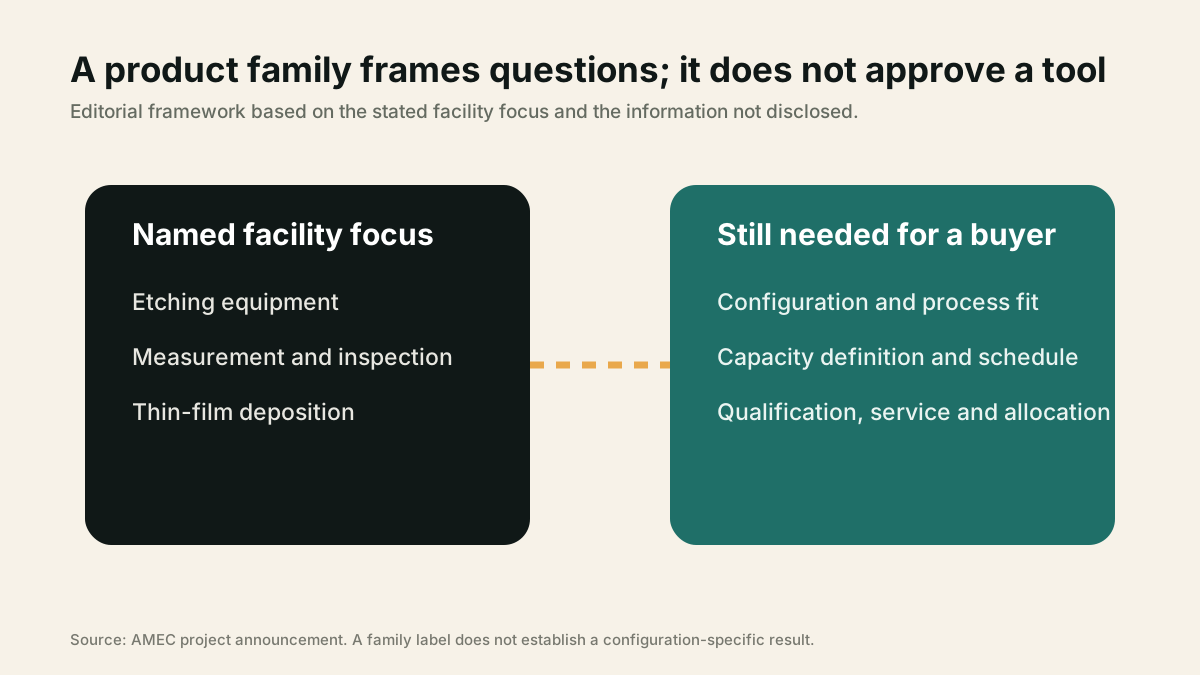
AMEC’s announcement identifies three families: etching, measurement and inspection, and thin-film deposition. That matters because it locates the proposed base within important portions of semiconductor process equipment. It gives a buyer a better starting point than a generic “chip equipment” label. It may also help a supplier-management team identify which internal product specialists should track the project and which existing qualification or service relationships are relevant.
But equipment-family language is not tool evidence. Consider how much remains unspecified:
- The exact tool platform, chamber or module configuration, wafer-size support, process capability, throughput, automation interface, and factory-acceptance conditions.
- The intended end market, customer mix, node and process use, order-book position, and allocation policy.
- The parts and materials supply chain, including whether a specific configuration depends on constrained components, overseas subcomponents, or particular logistics routes.
- The production line’s commissioning date, utilities and cleanroom readiness, equipment-installation sequence, yield ramp, internal quality controls, and capacity by model.
- The customer’s qualification cycle, process integration, reliability testing, field performance, service response, spare-parts stocking, and software or controls support.
- The commercial terms: price, payment, lead time, warranty, liquidated damages, priority allocation, change notification, support geography, export-control clauses, and termination rights.
None of that absence is a negative finding about AMEC. It is a scope boundary. A public capital announcement is not expected to disclose every detail of an individual tool sale. The buyer’s job is to understand which question belongs to which record. A facility filing can establish the facility plan. A product specification can establish a configuration. An acceptance record can establish a particular acceptance event. A service agreement can establish a support obligation. A purchase order or framework agreement can establish allocation only to the extent its own terms show it.
This is especially important when someone tries to use the filing to settle a “can it replace X?” question. Replacement is not a property of an equipment-family label. It is a comparison of a named tool, a process need, a qualification status, customer requirements, integration work, availability, service, commercial risk, and time. The right response is not “yes” or “no” from a headline. It is a targeted evidence request.
For readers tracking the technology and evidence constraints around advanced lithography separately, China EUV Prototype: What It Proves And What It Does Not offers a useful counterweight: one high-profile technology claim does not define the capabilities, bottlenecks, or commercial readiness of an entire semiconductor-equipment system.
Existing Lingang activity is context, not a Phase II release schedule
The new project did not appear in a geographic vacuum. Lingang public material describes AMEC’s earlier industrial base in the area and says Phase I began operation in August 2024. Yicai’s August 20 report also provides context on the existing footprint while covering the Phase II announcement. That history matters. It means the company has an already visible Lingang presence and the district has experience describing its development.
It does not create a completion date for Phase II. Existing operations, earlier construction, and local industrial relationships can make a new project more credible as a corporate direction than a greenfield rumour, but they are not proof that the next phase has been constructed, commissioned, or turned into capacity. The distinction is worth writing down because real organizations often reuse prior-site facts as if they were current-project facts.
The clean formulation is: Phase I history is a context signal; Phase II execution needs its own evidence. Put the records in adjacent folders, not in the same evidence field.
Financial context works the same way
AMEC’s 2026 half-year disclosure provides contemporaneous company-reported operating context. The public materials reviewed here describe RMB 6.7 billion of first-half revenue and more than RMB 2 billion of R&D spending. Yicai also reported the company’s first-half results and noted that a one-time investment gain affected net profit. Those figures can help a reader understand the scale of current corporate activity and research spending around the announcement date.
They do not measure Phase II. Revenue is not factory capacity. R&D spending is not a particular tool’s performance. Profit is not customer acceptance. A company with healthy reported activity may still need to execute a new project under the conditions it has disclosed; a buyer still needs the configuration-, customer-, and contract-specific record.
This does not make financial context useless. It makes it correctly scoped. Use it to ask better questions:
- Is the project being discussed as an isolated ambition or in the context of an active public company with reported R&D and operating activity?
- Which future filings, capex updates, construction reports, hiring disclosures, customer references, or product releases would materially update the picture?
- Does a buyer’s own supplier-risk model clearly distinguish present company financial context from a forward operating-capacity assumption?
The answer to the last question should be yes. If the model cannot show that distinction, its apparent precision is misleading.
The unsigned agreement and listed risks are part of the signal
One of the strongest parts of the announcement is not a number. It is the disclosure that the investment and support agreement had not yet been signed, paired with listed risks involving technology, market volatility and competition, policy support and land, management coordination, and time to production. This is not hidden fine print. It is material context for any buyer trying to decide how much confidence to place in a project timeline.
The correct use of a risk disclosure is narrow. It says do not assume the condition is already resolved. It does not say the project will fail. A high-quality buyer file converts each unresolved category into a verification request:
| Disclosed condition or risk | Buyer evidence request | Why it matters |
|---|---|---|
| Investment and support agreement not yet signed | Executed agreement status, relevant project scope, and confirmation of any material changes. | A board-approved proposal is not the same as an executed local arrangement. |
| Policy support and land | Verified land, permits, construction approvals, utilities, and changes to the project footprint. | A site description does not establish that the operational prerequisites are in place. |
| Technology and market risk | Configuration roadmap, qualification plan, critical component path, demand and allocation evidence for the buyer’s product family. | A general equipment-family statement does not establish a specific tool’s market or technical readiness. |
| Management and coordination risk | Named project owner, milestone governance, escalation route, supplier dependencies, and change notices. | Large projects fail operationally when decisions and dependencies are unowned. |
| Time-to-production risk | Milestone plan from construction through installation, pilot output, quality gates, qualification, and customer acceptance. | “Construction” is not “supply”; a buyer needs the stages in between. |
From factory plan to fab-ready evidence
The most valuable operational response is an evidence ladder. It describes what a buyer would need to see before moving from “we are tracking this announcement” to “we can include this source in a named-tool plan.” The ladder is not an approval template. Different fabs, processes, geographies, and contracts will require different proof. It is a way to stop evidence from skipping stages.
| Stage | What can be said | Evidence that can support it | What cannot yet be said |
|---|---|---|---|
| 1. Public proposal | A company has announced and board-approved a proposed project. | Public announcement, governance record, named entity, investment scope, stated conditions. | That the facility is built, operating, or supplying a tool. |
| 2. Agreement and site execution | Local arrangements and physical prerequisites are advancing. | Executed agreements where relevant, land and permit status, construction milestones, updated company or government disclosures. | That a configured product is available or qualified. |
| 3. Installation and production readiness | A line or equipment set is installed and ready for controlled output. | Configuration-specific line information, factory acceptance, quality-system evidence, utilities and operational records. | That a customer’s process accepts the tool or that capacity is commercially allocated. |
| 4. Qualified output | A named product meets defined internal and/or customer technical gates. | Product configuration, test or qualification scope, acceptance criteria, result provenance, customer-authorized evidence where available. | That every customer or process has approved it, or that a buyer has a delivery commitment. |
| 5. Commercial allocation | A buyer has a defined, enforceable supply path. | Quote, purchase order, framework agreement, allocation terms, lead-time terms, change control, compliance clauses. | That after-sales support and lifecycle obligations are fully covered. |
| 6. Service-ready operation | The buyer can maintain the installed tool through its expected lifecycle. | Service organization, response terms, spare-parts policy, training, software and upgrade plan, field-change governance. | That unrelated tools or other sites have the same support outcome. |
Build the evidence ladder into the sourcing process
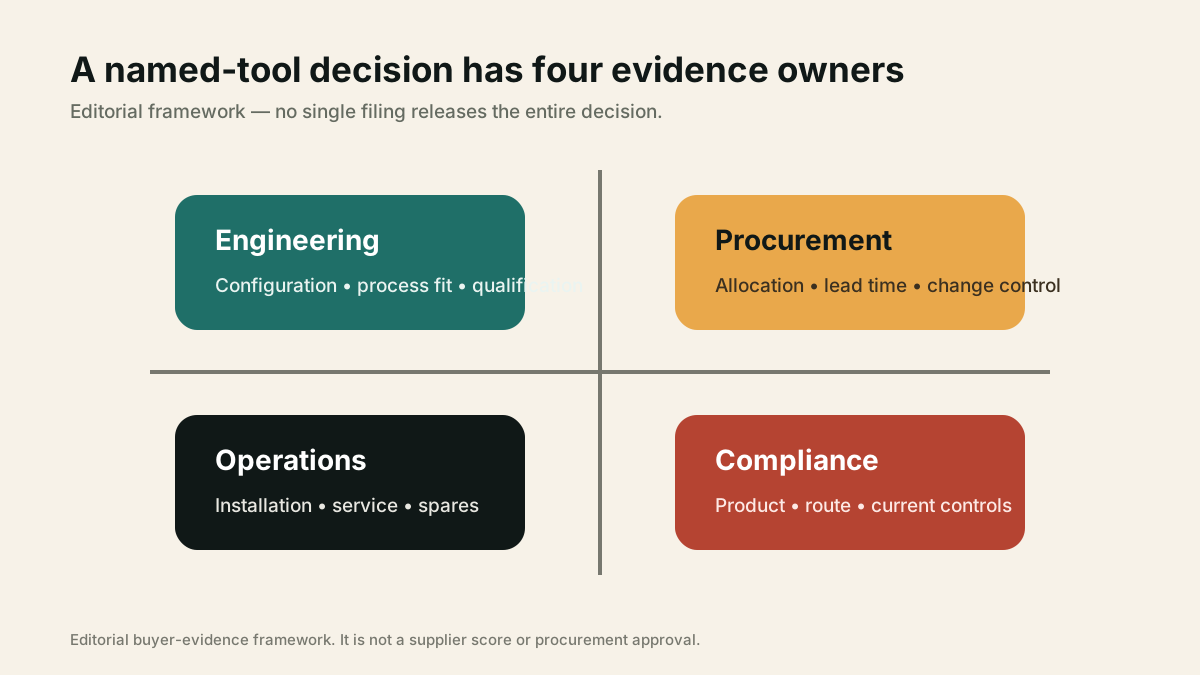
For a buyer, the ladder should have owners. The corporate strategy or market-intelligence team can monitor public filings and local project updates. The engineering team can define the configuration, process, qualification, and acceptance evidence needed for a named tool. Procurement can request commercial allocation, lead-time, change-control, service, and spare-parts commitments. Compliance can evaluate export, import, sanctions, data, cybersecurity, and other applicable control questions. Operations can test installation, service, and lifecycle readiness. Senior management can decide whether remaining uncertainty is acceptable for a given schedule or should be carried as contingency.
The worst arrangement is a single unowned status called “supplier capacity.” That field tends to absorb the capital announcement, a salesperson’s forecast, a report on a different product, and an internal hope. Replace it with separate fields:
- Public project status and source date.
- Agreement and construction status.
- Named configuration and product family.
- Capacity measure and what it counts.
- Qualification owner, method, and result.
- Customer acceptance and scope.
- Contracted allocation and delivery basis.
- Service, spares, and change-control owner.
- Compliance status and recheck date.
- Open conditions, next evidence, and escalation owner.
The key phrase in each field is “and what it counts.” A capacity number without a definition is not very informative. Does it mean theoretical output, equipment hours, annual units, installed line capability, a company aggregate, one tool family, one site, or customer-ready deliveries? Does it include a ramp? Does it assume specific components? Does it correspond to a signed allocation? Without the denominator, even a real number can lead to the wrong operational decision.
A buyer matrix for AMEC’s Lingang signal
The following matrix turns the public disclosure into practical next actions without pretending it approves a supplier.
| Buyer question | What the public record provides | What to request next | Release condition |
|---|---|---|---|
| Is there a credible expansion signal? | Board-approved proposed project, named subsidiary, location, investment inputs, and equipment-family focus. | Current company filing and confirmation that the project scope has not materially changed. | The buyer may track the project as a public supply-side signal. |
| Can the buyer assign a tool configuration to the site? | Product-family language only. | Configuration, module or chamber scope, process application, roadmap, critical parts, and production-line association. | Engineering identifies a specific configuration and evidence basis. |
| Can the buyer include capacity in a schedule? | No capacity units or release date in the announcement. | Defined capacity metric, timeline, line status, ramp assumptions, allocation terms, and the consequences of a delay. | Planning uses an evidenced, scoped capacity commitment with contingency. |
| Can the buyer assume qualification? | No customer or process qualification is disclosed. | Qualification plan, criteria, results, customer-authorized references, and acceptance scope. | Engineering and the customer’s process owner approve the evidence for the intended use. |
| Can the buyer rely on after-sales support? | No service or spare-parts commitment is disclosed. | Service footprint, response terms, training, spare-parts list and stocking, software support, and escalation path. | Contract and operations owners approve lifecycle support. |
| Can the buyer treat the project as compliance-neutral? | The announcement does not settle export, import, data, security, or third-party component issues. | Product- and route-specific compliance review, supplier declarations, and current control analysis. | Qualified compliance review for the actual transaction and deployment. |
For a broader view of how to organize supplier verification and manufacturing evidence, see Quality Control in Chinese Factories: Build a Defect-to-Release Evidence Chain. Incoming quality, process controls, and supplier documentation do not replace equipment qualification or commercial allocation, but they reinforce the same habit: define the requirement, preserve the evidence, and reopen the decision when the product or process changes.
Make evidence requests narrow enough to answer
A vague request for “capacity confirmation” tends to produce a vague answer. It may return a corporate production target, an aggregate facility statement, a presentation on a different platform, or a reassuring but unauditable email. The better request has a subject, a time basis, a definition, and an owner. For example: “For configuration X intended for process Y, what annual or quarterly output measure is relevant to this request; which site and line does it describe; what inputs or ramp assumptions does it rely on; what portion is unallocated; who can approve allocation; and which current document proves the answer?” The same structure works for service, spares, qualification, and delivery.
This is not bureaucracy for its own sake. It is a way to make a supplier answer usable inside the buyer’s decision process. An engineering answer that lacks the commercial configuration may be technically impressive but not awardable. A commercial delivery statement that lacks process qualification may be timely but not deployable. A project-status update that lacks a date or a definition may be encouraging but cannot change a capacity plan. The evidence ladder tells each function what it needs from the next function.
The request should also make change control explicit. A supplier may be able to support a current configuration, then replace a component, alter a module, move a production step, or revise the support model. Those changes are not necessarily bad; semiconductor equipment is an evolving product. But a buyer should agree on which changes require notice, technical review, requalification, price adjustment, schedule reassessment, or compliance recheck. Otherwise, “capacity available” can quietly become capacity for a different product under different assumptions.
Finally, distinguish an evidence request from an accusation. The announcement does not obligate AMEC to disclose non-public customer, order-book, or technology details to every reader. A buyer should request only what it needs for its intended stage, protect confidential information appropriately, and accept that some information may be available only under a qualified commercial relationship. The public filing sets the monitoring baseline. The later supplier and buyer records determine whether that baseline can become a real sourcing decision.
Three decision scenarios
Scenario 1: A fab needs an etch tool within a fixed production window
The project announcement may be strategically relevant, especially if the buyer wants to understand the supplier’s stated direction in etching. But it is insufficient as a schedule input. The fab should ask for the exact tool configuration, technical fit to its process, demonstrated qualification stage, current manufacturing location, capacity definition, delivery window, components at risk, logistics path, installation plan, field-service coverage, spares, and contract allocation. It should carry a contingency supplier or schedule buffer until these facts are documented.
The buyer should not interpret the absence of a public tool commitment as evidence that AMEC cannot supply the tool. It means the public announcement is not the record that proves it. The appropriate next contact is not a request for a generic “capacity assurance.” It is a configuration-specific request that connects the desired tool to an owned production and service plan.
Scenario 2: An integrator is selecting between suppliers for a future program
The expansion can inform a qualitative supplier map: AMEC has publicly signalled continued investment in particular equipment families and a Lingang manufacturing-and-R&D footprint. The integrator can monitor execution milestones and compare them with other suppliers’ public signals. But supplier selection should still be based on fit for the exact process, qualification evidence, commercial terms, service model, integration risk, and change-control discipline.
This is where the input-target-outcome ledger is helpful. A strategy team may assign a positive “investment direction” signal. It should not assign a positive “available capacity” score until direct evidence exists. The dashboard needs both columns. Otherwise, a high score may imply a level of supply certainty that no one can defend.
Scenario 3: An analyst is estimating China semiconductor-equipment capacity
The project belongs in a pipeline of proposed capacity, not in current installed or qualified capacity. An analyst can show the disclosed investment and targets, date them, attribute them to the company announcement, and make the definition clear. The model should not convert RMB into units without a documented engineering or capacity relationship, should not add mature-state sales targets to current revenue, and should not assume that a particular factory serves a particular customer.
This is not merely an accounting preference. Semiconductor equipment is heterogeneous. A facility’s useful economic contribution depends on tool mix, configuration, component availability, customer qualification, price, service, and utilization. A model that reports one large capacity number without those definitions may look more precise while being less informative.
What to watch next
The next meaningful evidence will not be another restatement of the August 20 announcement. It will be a record that moves one part of the ladder:
- Confirmation that the investment and support agreement has been executed, with no material scope change.
- Project, land, permit, construction, and utilities milestones that are specific to Phase II rather than recycled descriptions of earlier Lingang facilities.
- A configuration-specific production or installation milestone, with a defined capacity measure and a source that establishes what it counts.
- A named product, process, and customer qualification record where the source is authorized and the scope is clear.
- A commercial allocation or delivery commitment that identifies the buyer, configuration, time basis, change control, and conditions.
- Service and spares evidence that demonstrates how the tool will be supported after installation.
The review rhythm should match the decision. A long-range strategy map may need quarterly monitoring of public filings and project progress. A live tool tender needs the latest configuration, quotation, capacity, qualification, compliance, and contract evidence before award. A fab schedule should be reforecast whenever a milestone, configuration, supplier dependency, or delivery term changes.
The most useful question in an update meeting is not “is the factory still happening?” It is “which stage of the evidence ladder has moved, what proof supports the change, and what decision can now be made that could not be made before?” That question prevents both premature optimism and unhelpful scepticism.
FAQ
Does AMEC’s Lingang Phase II announcement prove more etch-tool capacity is available now?
No. It proves that AMEC publicly proposed and received board approval for a project with an etching-equipment focus, among other families. The announcement does not disclose current capacity units, configuration-specific output, customer allocation, delivery, or qualification.
What does the RMB 3.5 billion investment figure mean for a buyer?
It is a disclosed total project investment and therefore a meaningful signal of intended resource commitment. It is not a tool count, a lead-time commitment, a measure of accepted output, or a guaranteed revenue result.
Are the 1,500–2,000 expected employees already working at the new site?
The announcement presents that range as an expected staffing level, including an expected R&D range. A buyer should treat it as a mature-state target unless a current source directly establishes actual hiring and operational assignment.
Does the existing Lingang Phase I site prove Phase II will be ready on schedule?
No. Earlier site activity provides useful context for AMEC’s local footprint, but it does not establish the new project’s construction, commissioning, qualification, or customer readiness. Phase II needs its own dated execution evidence.
What should a fab request before placing a tool order tied to the Lingang expansion?
Request a named configuration, process-fit and qualification evidence, defined capacity and delivery basis, allocation terms, service and spare-parts coverage, change control, and the current compliance view. The public project filing can inform the conversation, but it cannot replace these transaction- and product-specific records.
Method and limitations
This is desk research current to August 26, 2026. It uses AMEC’s public investment announcement and half-year disclosure, Lingang public material, and bounded independent Yicai coverage. The analysis separates stated project facts and targets from outcomes the sources do not establish.
It is not a factory visit, equipment test, supplier audit, procurement recommendation, securities analysis, or evidence that an AMEC tool is suitable for a named process. No source reviewed here establishes tool performance, capacity units, lead time, price, delivery, customer allocation, yield, uptime, service coverage, exportability, or fab readiness for Phase II. Before relying on the plan in a live sourcing or capacity decision, obtain current configuration-specific technical, operational, commercial, compliance, and contractual evidence.
Related reading
- SMIC Explained: China's Chipmaking Limits (2026)
- China EUV Prototype: What It Proves And What It Does Not
- Quality Control in Chinese Factories: Build a Defect-to-Release Evidence Chain
- Smart Manufacturing in China: What a Buyer Can Verify
By China Made & Tech Team. We publish evidence-bound buying and manufacturing analysis for teams working with China’s technology supply chains.